Protestant Christianity forms one of the largest branches of the Christian faith, uniting over 833 million believers worldwide. At its core, this tradition emphasizes personal faith, direct access to Scripture, and salvation through grace alone. These principles create a vibrant spiritual landscape where diverse worship styles and theological perspectives thrive.
From historic groups like Lutherans and Baptists to modern evangelical movements, Protestant churches share foundational beliefs while expressing them uniquely. Many congregations prioritize community engagement and approachable worship services, making them welcoming spaces for spiritual exploration. The focus on individual Bible study encourages believers to develop personal relationships with their faith.
Understanding different Protestant denominations helps appreciate how Christian theology adapts across cultures and generations. Groups like Methodists and Presbyterians maintain distinct traditions while upholding shared values like Christ-centered teaching and social outreach. This diversity reflects Protestant Christianity’s ability to grow while honoring its 500-year heritage.
Key Takeaways
- Protestant Christianity serves over 833 million believers through various denominational traditions
- Core principles include salvation through faith and Scripture as ultimate spiritual authority
- Major denominational families range from Baptists to Pentecostals, each with unique practices
- Modern churches balance historical roots with contemporary cultural engagement
- Accessible worship styles make Protestant congregations inviting to diverse communities
- Theological differences often stem from interpretations of baptism and church leadership
Historical Roots and the Reformation
In 1517, a single act of defiance ignited a movement that divided the Christian church. A German monk named Martin Luther nailed his Ninety-Five Theses to All Saints’ Church door in Wittenberg, challenging the sale of indulgences. This bold action questioned whether forgiveness could be bought rather than received through genuine faith.
Martin Luther and the Ninety-Five Theses
Luther’s critique targeted a widespread practice: paying money to reduce punishment for sins. He declared, “When our Lord and Master Jesus Christ said ‘Repent,’ he willed the entire life of believers to be one of repentance.” This stance rejected the church’s role as a spiritual middleman, arguing salvation comes solely through God’s grace.
Early Challenges to Catholic Authority
The Reformation sparked debates reaching far beyond indulgences. Three key disagreements reshaped Christianity:
| Issue | Catholic Position | Reformers’ View |
|---|---|---|
| Scripture Access | Latin-only Bible | Translations for all |
| Religious Authority | Pope and clergy | Priesthood of believers |
| Salvation | Faith + good works | Faith alone |
These ideas spread rapidly thanks to the printing press. By 1520, Luther’s writings reached every major European city. The movement empowered ordinary people to engage directly with Scripture, creating lasting changes in how communities practiced their faith.
Proto-Protestant Origins and Early Movements
Long before Luther’s protest shook Europe, courageous groups laid spiritual foundations for religious reform. These early believers questioned church authority and practiced faith in ways that foreshadowed later Protestant values. Their stories reveal how Christian renewal movements existed centuries before the Reformation.
Pioneers of Faithful Resistance
In 12th-century France, the Waldensians chose poverty over privilege. Led by merchant Peter Waldo, they distributed translated Bible portions and preached in local languages. Personal Scripture study became their compass, challenging the Latin-only traditions of medieval churches.
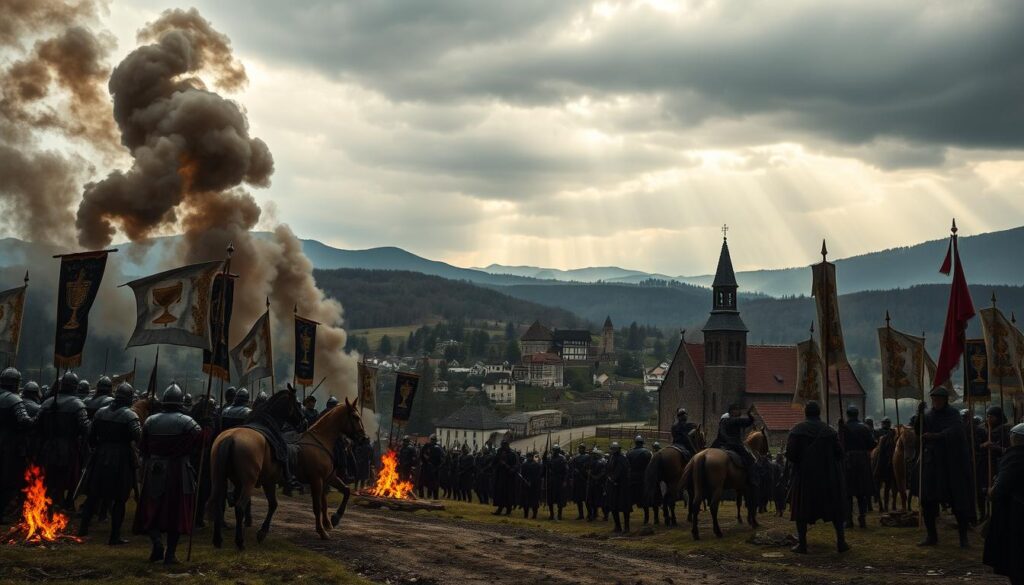
Bohemia’s Hussites sparked change 100 years later. Jan Hus demanded communion for all believers and called corrupt leaders to account. His fiery sermons declared: “Sanctify Christ as Lord in your hearts, always prepared to make a defense to anyone who asks you for a reason for the hope in you.”
Both movements faced harsh opposition. Waldensians retreated to Alpine valleys while Hussite warriors defended their beliefs. Their survival proved alternative Christian communities could thrive outside official church structures.
These groups planted seeds for future reforms through Bible accessibility and lay leadership. Their legacy echoes in Protestant churches today, from Baptist congregational governance to Methodist emphasis on personal holiness.
The Emergence of Lutheran Churches
When Martin Luther sparked the Reformation, he unknowingly planted seeds for one of Christianity’s most enduring traditions. These communities became the first organized Protestant denomination, blending bold theology with practical worship. Their identity crystallized through a landmark document that still guides millions today.
Foundations in the Augsburg Confession
In 1530, Lutheran leaders presented Emperor Charles V with a revolutionary statement: “Our churches teach that people cannot be justified before God by their own strength.” This Augsburg Confession became Lutheranism’s doctrinal backbone. It defined churches as communities where Scripture shapes worship and sacraments reflect Christ’s promises.
The confession helped Lutheranism sweep through Northern Europe. By 1600, it became the official faith in Sweden, Denmark, and Finland. Nordic countries still show strong Lutheran roots – nearly 70% of Norwegians identify with their national church.
| Lutheran Distinctives | Key Teachings | Global Impact |
|---|---|---|
| Worship Style | Liturgical with hymns | 7,500+ U.S. congregations |
| Sacraments | Baptism & Communion | 80 million members worldwide |
| Leadership | Pastors & bishops | 23 member churches in Lutheran World Federation |
North America’s Lutheran landscape reveals fascinating diversity. The Evangelical Lutheran Church in America (ELCA) leads with 2.9 million members, supporting LGBTQ+ inclusion. Meanwhile, the Lutheran Church-Missouri Synod maintains traditional stances, attracting 1.7 million adherents.
Modern Lutheran churches balance ancient confessions with contemporary needs. From food pantries in Minnesota to climate initiatives in Sweden, they prove historical faith can address modern challenges. Their emphasis on grace continues to draw seekers and lifelong believers alike.
Reformed Churches and Calvinist Traditions
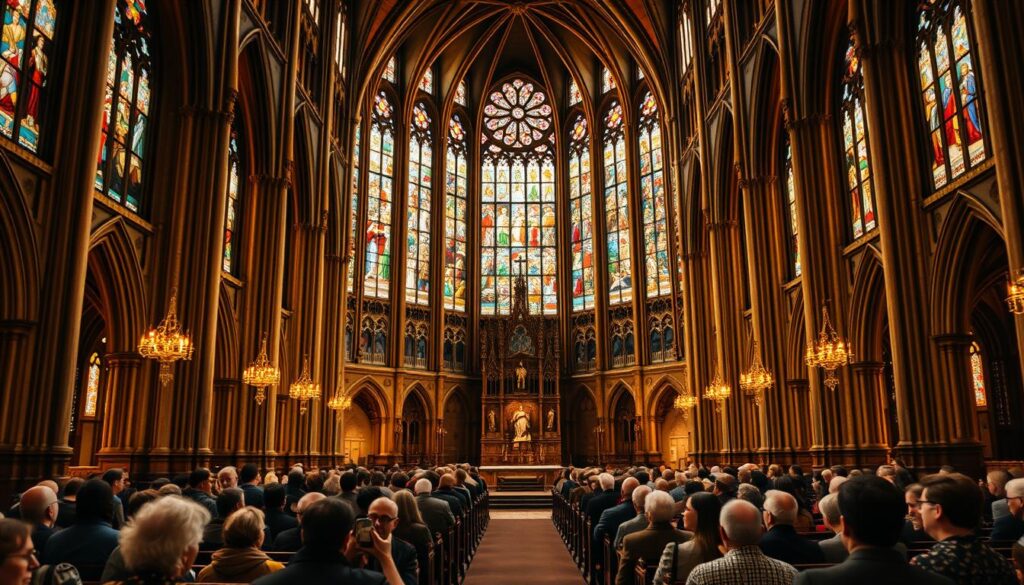
From the cobblestone streets of Geneva to the rolling hills of Scotland, a new theological vision reshaped Christian communities across continents. Reformed churches grew from bold thinkers who reimagined church life through rigorous Bible study and structured governance. Their teachings continue to influence millions through well-organized denominations and timeless confessions.
Foundations of Faithful Governance
John Calvin’s Geneva became a laboratory for church reform. His Institutes of the Christian Religion laid out a system emphasizing God’s complete authority. “True wisdom consists in knowing God and knowing ourselves,” Calvin wrote, capturing his focus on divine sovereignty and human humility.
Swiss reformer Huldrych Zwingli took a different approach in Zurich. He saw communion as symbolic and championed local language worship. These ideas spread through Europe like wildfire:
| Reformer | Key Contribution | Modern Impact |
|---|---|---|
| John Calvin | Systematic theology | Presbyterian governance |
| Huldrych Zwingli | Symbolic sacraments | Congregational autonomy |
| John Knox | Scottish Reformation | Church of Scotland |
Today’s Presbyterian Church (U.S.A.) carries this legacy with 1.1 million members. They follow the Westminster Confession, a 1646 document still guiding worship and doctrine. Local churches elect elders who collaborate regionally – a system balancing community needs with shared standards.
Reformed theology’s emphasis on God’s grace remains central. From Dutch Reformed hymn-singing to Korean Presbyterian missions, these churches prove 500-year-old ideas still inspire fresh faith expressions. Their structured yet adaptable approach helps communities thrive in changing times.
Anglican Heritage and the Book of Common Prayer
The story of Anglican Christianity begins with a royal dispute that reshaped England’s spiritual landscape. When King Henry VIII broke from Rome in 1534, he created a unique church blending Catholic traditions with Reformed theology. This new religious body became a via media – a middle way between old and new expressions of Christian faith.
Thomas Cranmer and the 39 Articles
Archbishop Thomas Cranmer gave the Anglican church its distinctive voice. His 1549 Book of Common Prayer transformed worship by using English instead of Latin. The text became so popular that 80% of Shakespeare’s biblical references come from Cranmer’s translations.
Cranmer’s 39 Articles (1571) clarified Anglican doctrine, affirming Scripture as ultimate spiritual authority. These principles allowed local churches to adapt while maintaining unity. Today, the global Anglican Communion includes 70 million members across 165 countries.
Modern Anglican churches balance ancient rituals with contemporary concerns. From African congregations to American Episcopal churches, communities honor their 16th-century roots while addressing modern issues. This flexibility makes Anglican tradition a living part of global Christian practice.
FAQ
How did Martin Luther spark the Protestant Reformation?
Martin Luther’s Ninety-Five Theses, posted in 1517, criticized Catholic practices like indulgences. This act ignited debates about church authority and scripture, laying the groundwork for new Christian movements.
Who were the Hussites and Waldensians?
The Hussites (inspired by Jan Hus) and Waldensians were pre-Reformation groups that challenged Catholic teachings. They emphasized scripture over tradition, influencing later reformers like Luther and Calvin.
What defines Lutheran churches today?
Lutheran churches follow the Augsburg Confession (1530), which stresses salvation by faith alone and scripture as the ultimate authority. Major bodies include the Lutheran World Federation and the Evangelical Lutheran Church in America.
How did John Calvin shape Reformed Christianity?
Calvin’s teachings on predestination and church governance, along with Huldrych Zwingli’s reforms in Zurich, shaped Reformed traditions. These ideas influenced Presbyterians, Congregationalists, and the Dutch Reformed Church.
What makes Anglican worship unique?
The Book of Common Prayer, crafted by Thomas Cranmer, standardized Anglican liturgy. The Thirty-Nine Articles later outlined doctrines, blending Protestant theology with Catholic traditions like episcopal governance.
How did early reformers challenge the Catholic Church?
Early reformers rejected papal authority, questioned sacraments like confession, and translated the Bible into local languages. These actions shifted focus to personal faith and accessible scripture.
Why is the Augsburg Confession important?
Presented in 1530, it became the core Lutheran doctrinal statement. It defended reforms like justification by faith and clarified differences with Catholicism, uniting Lutheran territories politically and theologically.