How did a small group of believers in ancient Jerusalem grow into the world’s largest Christian institution? The answer lies in a blend of sacred tradition and historical evolution. Many trace the roots of the Catholic Church to Pentecost, when early followers of Jesus Christ gathered after his resurrection. This event marked the birth of a faith community that would shape civilizations.
Traditional teachings emphasize that Jesus himself established the Church, appointing Peter as its first leader. Over centuries, this spiritual foundation merged with cultural shifts and leadership changes. Historians, however, often highlight a gradual development—from scattered congregations to a unified institution centered in Rome.
This guide unpacks these perspectives. We’ll explore how apostles like Peter spread teachings across the Mediterranean. You’ll also discover how later leaders refined practices and doctrines, blending ancient rituals with new challenges. Whether you’re curious about theology or history, understanding these origins offers fresh insights into a 2,000-year legacy.
Key Takeaways
- The Catholic Church traces its spiritual roots to Jesus Christ and Pentecost.
- Saint Peter is traditionally viewed as the first leader appointed by Jesus.
- Historical research suggests organizational growth over centuries.
- Early Christian communities evolved into a centralized institution.
- Sacred tradition and scholarly analysis shape modern understanding.
Understanding the Roman Catholicism Founder
Who actually laid the groundwork for this global faith community? This question divides scholars and believers alike. While sacred tradition points to divine origins, historical analysis often reveals a more complex story.
Historical Perspectives and Interpretations
French biblical expert Alfred Loisy once observed:
“Jesus proclaimed the Kingdom, and it was the Church that arrived.”
This sharp contrast highlights a key debate. Did Jesus aim to build an organized institution, or did his followers reshape his teachings over time?
The Catholic Church maintains that Jesus directly established its structure during his lifetime. Ancient texts describe Peter receiving spiritual authority, forming what many see as early papal leadership. This view ties modern practices to first-century decisions.
Most researchers, however, see a slower transformation. Early Christian groups operated independently for generations. Only after 300 years did unified structures emerge. Archaeological finds show varied rituals across regions before standardization.
Three main viewpoints shape this discussion:
- Theological: Focuses on spiritual continuity from Jesus to today’s Church
- Historical: Traces organizational changes through ancient records
- Cultural: Examines how Roman governance influenced Christian administration
These approaches aren’t mutually exclusive. Many modern scholars blend sacred texts with societal context. By balancing tradition with evidence, we gain richer insights into this 2,000-year journey.
Tracing the Early Roots of the Catholic Church
What transformed a regional spiritual movement into a worldwide religious force? The answer lies in the unique conditions of the first-century Mediterranean world. A combination of advanced infrastructure and cultural connectivity allowed ideas to travel faster than ever before.
From Judea to the Roman Empire
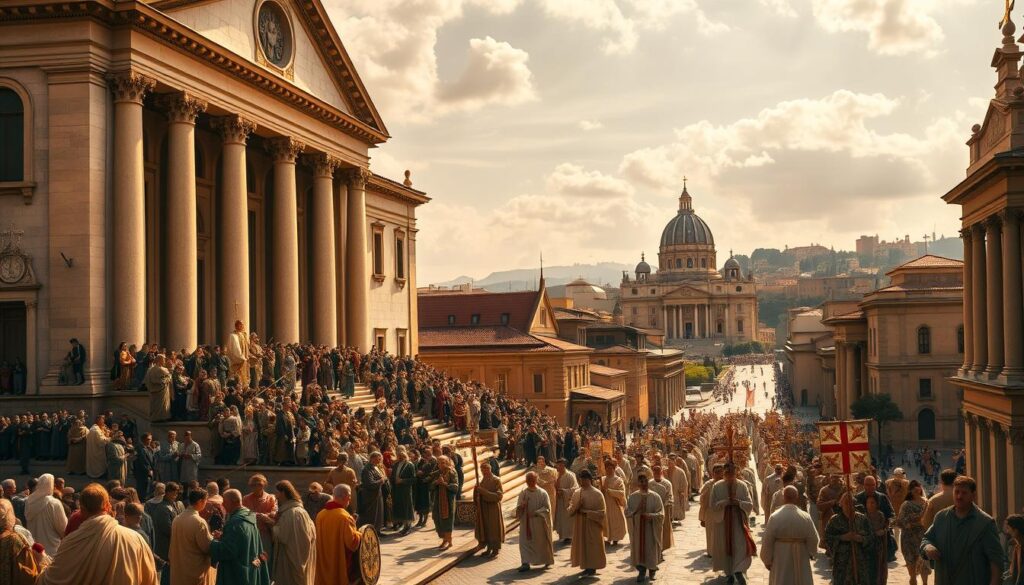
The empire’s network of roads and safe sea routes acted like ancient highways for faith. Soldiers, merchants, and travelers carried new teachings from Jerusalem to bustling cities. Greek became the common tongue, letting diverse groups discuss complex spiritual concepts easily.
Early believers faced a crucial challenge: adapting Jewish traditions to Gentile cultures. Communities in Antioch blended local customs with shared rituals. Alexandria’s scholars added philosophical depth to simple parables. Rome’s legal-minded members shaped organizational frameworks.
Three factors supercharged this growth:
- Urban hubs: Cities provided meeting places and diverse audiences
- Shared governance: Roman administrative models inspired church structure
- Cultural exchange: Local traditions enriched core practices
By the fourth century, what began as house gatherings became an institution mirroring imperial efficiency. Bishops adopted regional oversight roles similar to provincial governors. This blending of spiritual vision and practical organization created lasting foundations.
Jesus Christ and the Birth of a Movement
What ideas sparked a movement that reshaped global spirituality? At its core lies a three-year journey through dusty villages and crowded markets. A carpenter-turned-teacher shared stories that challenged social norms and offered radical hope.
The Life and Teachings of Jesus
The New Testament paints vivid scenes: healing the sick, dining with outcasts, calming storms. Jesus’ life modeled compassion over rules, mercy over judgment. His parables about lost coins and good neighbors revealed God’s love in everyday terms.
Twelve ordinary men became his students. Fishermen learned to lead. Tax collectors transformed into truth-tellers. This diverse group received clear instructions: “Go and make disciples of all nations.” Their training blended practical lessons with spiritual depth.
The Significance of the Resurrection
Empty tombs changed everything. Followers who’d scattered in fear became bold proclaimers. The resurrection validated Jesus’ claims, turning despair into unshakable faith. Without this event, his teachings might have faded like other ancient philosophies.
Early believers gathered secretly, sharing bread and wine as he’d shown them. These rituals grew into the Church‘s heartbeat—visible reminders of sacrifice and renewal. Over time, simple meals became sacred ceremonies connecting millions across continents.
Three lasting impacts emerged:
- Hope: Death lost its finality
- Community: Shared beliefs created global bonds
- Purpose: Followers found meaning in service
This spiritual revolution began with one man’s life and grew through stories told over campfires. Today, two billion people trace their faith to those transformative events in first-century Palestine.
The Role of Peter and Apostolic Leadership
How did one fisherman become central to a global spiritual legacy? The story of Saint Peter bridges ancient traditions with modern practices. While history offers fragmented clues, his symbolic role shaped how communities organized their faith.
Saint Peter’s Influence on Early Rome
Matthew’s Gospel records Jesus telling Peter:
“You are Peter, and on this rock I will build my church.”
This moment became the bedrock for claims about thepope’s spiritualauthority. Early texts suggest Peter visited Rome, but he didn’t start its first Christian group. By the time he arrived, believers already met in homes along the Tiber River.
His martyrdom under Nero, however, cemented Rome’s status. Later leaders linked the city’s importance to Peter’s final resting place. The Bishop of Rome gradually became seen as Peter’s direct successor—a claim that still defines leadership structures today.
The Foundation of Apostolic Succession
Three key ideas transformed Peter’s legacy into an organizational system:
- Continuity: Later bishops argued their power flowed unbroken from Peter
- Unity: A single leader could resolve disputes across regions
- Legitimacy: Connecting to apostles gave decisions divine weight
By the 3rd century, lists tracing the Bishop of Rome back to Peter appeared. This succession concept helped standardize practices from Spain to Syria. Though modern scholars note gaps in early records, the symbolic power of this lineage remains unmatched.
Peter’s story shows how memory and need shape institutions. What began as informal respect for a martyr evolved into a blueprint for centralized spiritual authority.
Formation of the First Christian Community
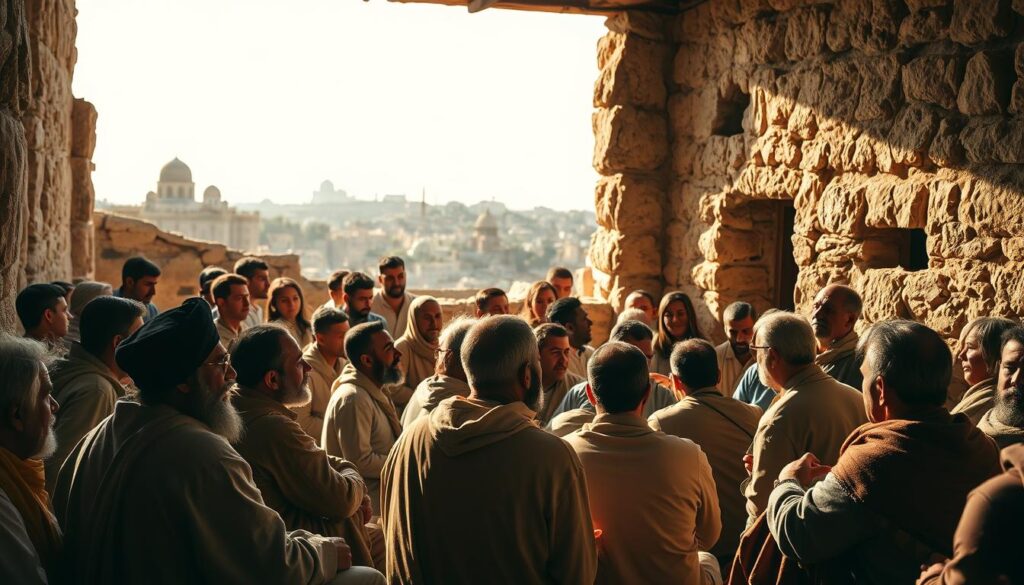
What united a small group of Jewish followers in Jerusalem after their leader’s departure? The first Christian community began as a tight-knit circle of 120 believers, gathering in homes to share meals and prayers. Their faith centered on Jesus’ resurrection and messianic role—ideas that reshaped traditional Jewish beliefs while preserving sacred customs.
Jewish Roots and Early Beliefs
These pioneers saw themselves as fulfilling Hebrew prophecies, not abandoning them. They attended synagogue on Sabbath but met Sundays to honor Jesus’ resurrection. Acts 2:44 describes their radical community: “All who believed were together and had all things in common.”
Three practices defined their identity:
- Shared resources: Members sold property to support needy believers
- Baptism: Initiation ritual symbolizing spiritual rebirth
- Communal meals: Re-enactments of Jesus’ final supper with disciples
Their beliefs blended old and new. They kept kosher laws but taught salvation through Christ. Torah study continued, now paired with stories of Jesus’ miracles. This hybrid approach helped the church grow while staying rooted in familiar traditions.
Within two decades, Sunday worship became standard—a quiet revolution marking their gradual separation from mainstream Judaism. Yet their beginning as a Jewish reform movement left enduring marks on Christian theology and practice.
Early Organization and Community Structure
How did scattered groups transform into an organized spiritual network? The answer lies in practical problem-solving and visionary decisions. Early believers faced growing pains as their numbers swelled across diverse regions.
The Evolution of Church Leadership
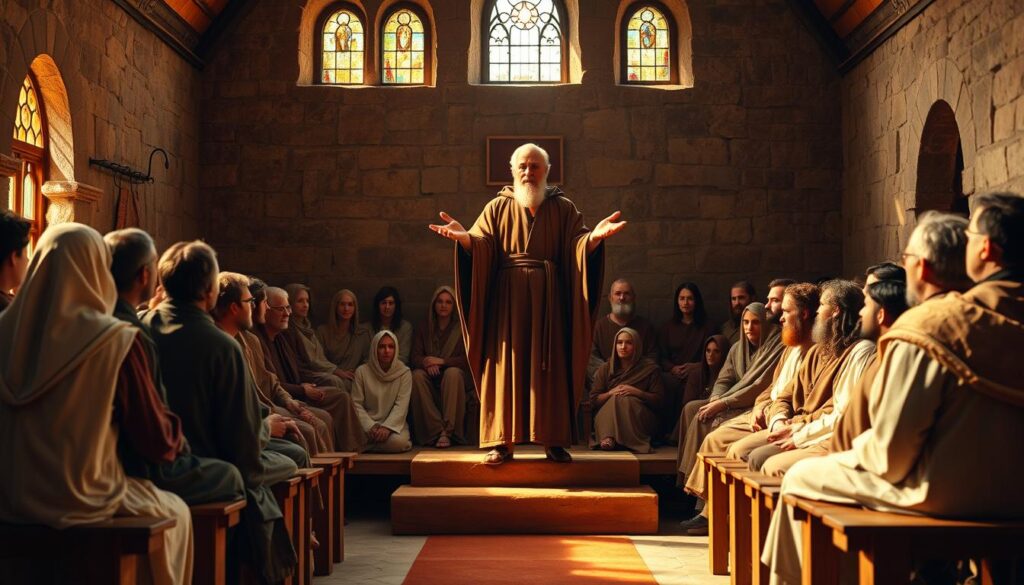
Initially, local groups relied on respected volunteers. These charismatic leaders taught scriptures and settled disputes. But rapid growth created challenges:
- Disagreements over rituals and teachings
- Resource distribution across cities
- Maintaining consistent practices
By 150 CE, a clear pattern emerged. Single bishops began overseeing urban congregations. This authority structure mirrored Roman civic organization, creating recognizable leadership roles.
| Period | Leadership Style | Key Features |
|---|---|---|
| 30-50 CE | Charismatic | Informal teachers & miracle workers |
| 50-150 CE | Collegial | Elders & deacons sharing duties |
| 150+ CE | Episcopal | Single bishop per city |
Insights from the Council of Jerusalem
The first major church meeting in 50 CE solved a critical issue. Could non-Jewish converts skip ancient rituals? After heated debate, leaders agreed:
“We should not make it difficult for Gentiles turning to God.”
This landmark decision did more than welcome new members. It established a model for resolving conflicts through collective authority. Later bishops would use similar councils to address complex theological questions.
By 200 CE, the church had developed standardized roles. Metropolitan bishops supervised regional networks, ensuring unity across growing communities. These changes laid groundwork for the global religious structure we recognize today.
The Spread of Christianity in the Roman Empire
What fueled Christianity’s explosive growth across ancient cities? Within a century, the movement transformed from a marginalized group to a Mediterranean-wide phenomenon. By 100 CE, over 40 vibrant communities stretched from Spain to India, thriving in urban hubs where ideas mixed freely.
Adoption and Expansion in Urban Centers
The religion first resonated with society’s overlooked members. Enslaved individuals and laborers found hope in teachings of equality and eternal dignity. Wealthy women soon followed, using their resources to host gatherings and fund missionary journeys.
Rome’s advanced infrastructure became an unexpected ally. Well-maintained roads allowed messengers to travel safely between cities. Common Greek dialects helped share complex ideas across cultures. As one bishop noted:
“Our letters bind distant communities like threads in a tapestry.”
Persecution backfired spectacularly. Instead of crushing the movement, it created resilient networks. Underground worship strengthened bonds between believers. Stories of martyrs’ courage inspired curiosity, drawing more converts into the fold.
By the third century, the church had mastered cultural adaptation. Syrian congregations incorporated local music into hymns. North African groups blended traditional storytelling with biblical parables. This flexibility ensured the religion‘s survival through shifting political tides.
Pivotal Moments in Institutional Development
What solidified early Christian practices into lasting institutions? The fourth and fifth centuries marked a turning point. Imperial support transformed the church from scattered communities into an organized force. This period saw two key developments that defined religious life for centuries.
Ecumenical Councils That Shaped Doctrine
Emperors and bishops worked together to unify beliefs. The Council of Nicaea (325 CE) tackled debates about Jesus’ divine nature. Over 300 leaders crafted the Nicene Creed—a statement still recited worldwide. These meetings blended spiritual authority with political strategy.
The Rise of Monastic Traditions
Meanwhile, desert hermits pioneered new ways to live their faith. Saint Benedict’s rules for communal prayer and work spread across Europe. Monasteries became centers of learning, preserving ancient texts while shaping medieval doctrine.
Together, councils and monks created frameworks that endure today. They balanced divine inspiration with practical systems—a hallmark of the church’s 2,000-year journey.
FAQ
Who is considered the founder of the Catholic Church?
The faith traces its origins to Jesus Christ, whose teachings and resurrection inspired His followers. Early leadership under figures like Saint Peter helped shape its structure, with later institutional growth rooted in apostolic tradition.
Why is Saint Peter significant in Catholic history?
Regarded as the first bishop of Rome, Peter symbolizes unity and authority. His role as a leader among the apostles laid groundwork for the concept of papal succession, linking modern leadership to early Christian roots.
How did early Christianity transition from a Jewish sect to a global religion?
After Jesus’ death, His followers spread His message across the Roman Empire. Gentile inclusion, debated at events like the Council of Jerusalem, and urban growth transformed it into a distinct faith separate from Judaism.
What role did the Resurrection play in shaping beliefs?
The Resurrection became central to Christian theology, affirming Jesus as divine. This event fueled missionary zeal and solidified hope in eternal life, forming the core of early teachings still upheld today.
How did apostolic succession influence church structure?
Leaders like Peter and Paul appointed successors to maintain doctrinal consistency. This chain of authority evolved into bishops overseeing regions, ensuring unity amid expanding communities and diverse challenges.
What was the Council of Jerusalem’s impact?
This pivotal meeting addressed whether Gentile converts needed to follow Jewish laws. The decision to relax these requirements opened the faith to broader audiences, accelerating its spread beyond Judea.
Why did monastic traditions emerge in the Church?
Monasticism arose as a response to societal changes and a desire for spiritual depth. Communities like those led by Saint Benedict preserved knowledge, modeled devotion, and influenced social services for centuries.
How did urban centers aid Christianity’s growth?
Cities like Antioch and Ephesus provided networks for trade and communication. Early believers used these hubs to share teachings, establish congregations, and adapt messages to diverse cultures effectively.