Step into a story that shaped nations and faith traditions. What began as ancient Christian communities in Roman Britain evolved into a spiritual powerhouse blending tradition and reform. This institution’s journey spans martyrdom, royal drama, and theological innovation—all while becoming England’s established religious authority.
At its core lies the Thirty-nine Articles and Books of Homilies, texts that defined a middle path between Rome and emerging Protestant ideas. The pivotal 1534 break from papal control under Henry VIII didn’t erase history—it rewrote it. Monarchs became “supreme heads,” liturgy transformed, and a new Christian identity took root.
Today, this tradition connects 85 million Anglicans worldwide through shared practices and governance. Yet its role remains uniquely English: coronations unfold in its cathedrals, bishops sit in Parliament, and cultural debates echo through its pulpits. How does an ancient institution stay relevant while honoring centuries of heritage?
Key Takeaways
- Originated from 3rd-century Roman Britain Christianity and 6th-century missionary efforts
- Became independent from Rome in 1534 during the English Reformation
- Blends Catholic traditions with Protestant theology (“via media”)
- Governed by the monarchy and structured through dioceses/parishes
- Core doctrines outlined in the Thirty-nine Articles and Books of Homilies
- Leads the global Anglican Communion with 85 million members
Introduction to the Church of England and Its Legacy
Few institutions have woven themselves into a nation’s fabric like this spiritual organization. For five centuries, it’s shaped laws, inspired artists, and guided moral debates while maintaining ancient rituals. Its dual role as both sacred authority and cultural architect makes it unlike any other religious body.
As the birthplace of the Anglican Communion, this tradition connects 165 countries through shared worship styles. From Nairobi to New York, congregations recite versions of the same prayers used in English villages since the 1500s. Yet its global reach never overshadows local customs—a balancing act few institutions master.
The British monarch’s constitutional role as Supreme Governor highlights its unique status. Twenty-six bishops still debate laws in Parliament’s upper chamber, blending spiritual insight with policymaking. This arrangement sparks lively discussions about religion’s place in modern governance.
Beyond politics, its legacy shines in unexpected areas:
- Shaping English literature through the King James Bible
- Pioneering free education for all social classes
- Developing social welfare systems centuries before modern governments
Today, this institution faces new tests—from declining attendance to debates on social issues. Yet its ability to evolve while preserving core beliefs keeps it relevant. As one historian noted, “It’s not just a church—it’s the story of England itself.”
The Roots of Christianity in Early England
Uncover the layers of faith that shaped England’s spiritual identity. Long before grand cathedrals rose, small Christian communities thrived in Roman towns like London and York. Soldiers, traders, and settlers carried beliefs across the empire’s northern frontier during the 3rd century.
Roman Foundations and Saxon Shifts
When Rome’s legions withdrew in 410 CE, pagan Anglo-Saxons swept across Britain. Celtic believers retreated westward, preserving unique traditions. For 200 years, two Christian cultures grew apart—one clinging to Roman roots, the other blending local customs.
Augustine’s Lasting Legacy
Everything changed in 597 CE when Pope Gregory I sent monk Augustine to Kent. His mission converted King Æthelberht and established Canterbury as England’s spiritual heart. As first archbishop, he built structures that still guide the institution today.
The 664 Synod of Whitby became a turning point. King Oswiu chose Roman Easter dates over Celtic ones, declaring: “I’ll follow whoever holds heaven’s keys.” This decision unified practices across kingdoms and set the stage for centralized leadership.
- Roman-era artifacts reveal Christian symbols in 3rd-century homes
- Celtic monks created illuminated gospels while missionaries traveled barefoot
- Canterbury’s archbishops still sit where Augustine negotiated with Saxon kings
The Birth of the Protestant Movement in England
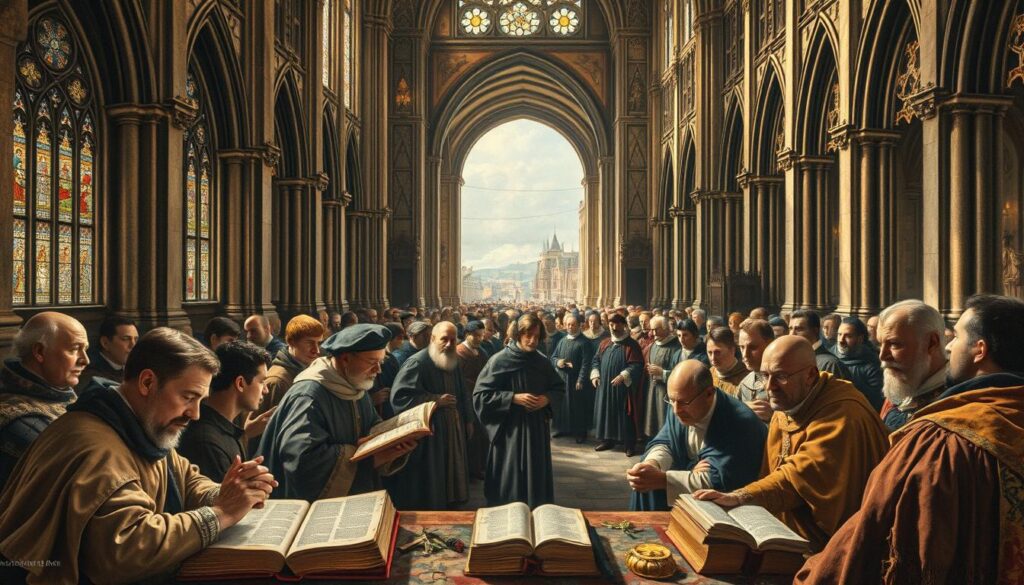
A spiritual revolution reshaped England’s religious landscape during the 1500s. While Martin Luther sparked reforms in Germany, English thinkers blended new ideas with local concerns. This fusion created a distinctive Reformation path—one tied to politics as much as theology.
Central to the upheaval was the belief that salvation comes through faith alone, not rituals or good deeds. This doctrine upended centuries of tradition, questioning practices like pilgrimages and saint veneration. As one reformer argued, “Why seek relics when Scripture holds all truth?”
Three factors made England’s experience unique:
- Royal power struggles influencing religious policy
- Vernacular Bible translations empowering laypeople
- Preservation of some Catholic traditions alongside reforms
William Tyndale’s English Bible became a game-changer. By translating Scripture into common language, he gave ordinary believers direct access to sacred texts. Church authorities initially banned these translations, but the genie was out of the bottle.
Henry VIII’s personal dramas accelerated changes. Though he maintained Catholic doctrines personally, his break with Rome created space for reformers. This odd mix of political calculation and spiritual yearning defined England’s religious transformation—a story where royal weddings mattered as much as theological debates.
Breaking with Rome: Henry VIII and the English Reformation
Royal ambition collided with religious tradition when Henry VIII sought to rewrite marital—and spiritual—rules. What began as a personal quest for a male heir sparked England’s seismic break from papal authority.
A King’s Ultimatum
After 18 years of marriage, Henry’s frustration peaked in 1527. Catherine of Aragon had borne only one surviving daughter. Desperate for a son, he petitioned Pope Clement VII to annul the union. When Rome refused, the king turned Parliament into his divine battering ram.
The 1533 Act in Restraint of Appeals declared England’s legal independence from foreign powers. This bold move let Archbishop Thomas Cranmer dissolve Henry’s marriage—a decision that would ripple through centuries. By 1534, the Act of Supremacy crowned Henry as the English church’s unquestioned leader.
Monastic Wealth Reshapes a Nation
Between 1536-1540, commissioners dismantled nearly 900 religious houses. Monasteries controlling vast lands saw their treasures seized:
- Gold chalices melted into royal coins
- Illuminated manuscripts repurposed as bookbinding material
- 12,000 monks and nuns pensioned off or displaced
This wealth transfer turbocharged the Crown’s power. Former monastic lands became noble estates, creating new political alliances. Yet Henry kept Catholic rituals intact—a paradox that left England doctrinally confused but fiercely independent.
As one court observer noted, “The king took Rome’s gold but kept its incense.” This delicate balance between reform and tradition would define the English church for generations.
The Role of Thomas Cranmer and the Book of Common Prayer
Imagine worship transformed from exclusive ritual to communal experience. This vision drove Thomas Cranmer, the first Protestant Archbishop of Canterbury, to craft a liturgical masterpiece. His Book of Common Prayer didn’t just change services—it reshaped how millions connected with faith.
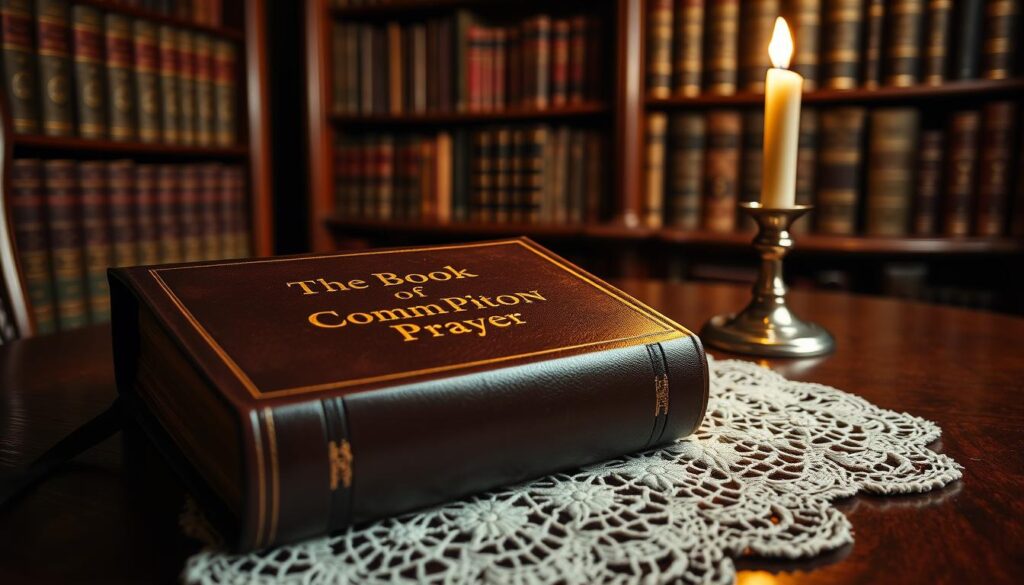
Published in 1549, Cranmer’s work replaced Latin with clear English prayers. For the first time, ordinary people understood every word of worship. A farmer could now recite the same psalms as nobles—a radical shift toward spiritual equality.
The 1552 revision took bold theological steps. It rejected Catholic Mass doctrines, emphasizing communion as symbolic remembrance. “Take and eat this in remembrance,” declared the updated liturgy, aligning with Reformed views of salvation through faith alone.
Beyond theology, Cranmer’s words shaped culture. Phrases like “till death us do part” and “read, mark, learn” entered daily speech. The book’s rhythmic language influenced writers from Shakespeare to modern novelists.
Three lasting impacts stand out:
- Standardized worship across England, uniting diverse communities
- Preserved traditional rituals while advancing Protestant ideas
- Created a literary legacy still quoted in weddings and funerals
Today, over 85% of Anglican churches worldwide use prayer book derivatives. As one historian notes, “Cranmer gave faith a voice that still echoes in chapels and living rooms.” His balance of beauty and belief remains his enduring gift.
Defining Anglican Doctrine: Thirty-Nine Articles and Liturgical Tradition
Foundations of faith often emerge from fiery debates. In 1571, Parliament sealed England’s religious identity by approving the Thirty-nine Articles—39 doctrinal statements balancing Catholic rituals with reformed theology. These became the North Star for Anglican belief, answering questions that once divided Christians.
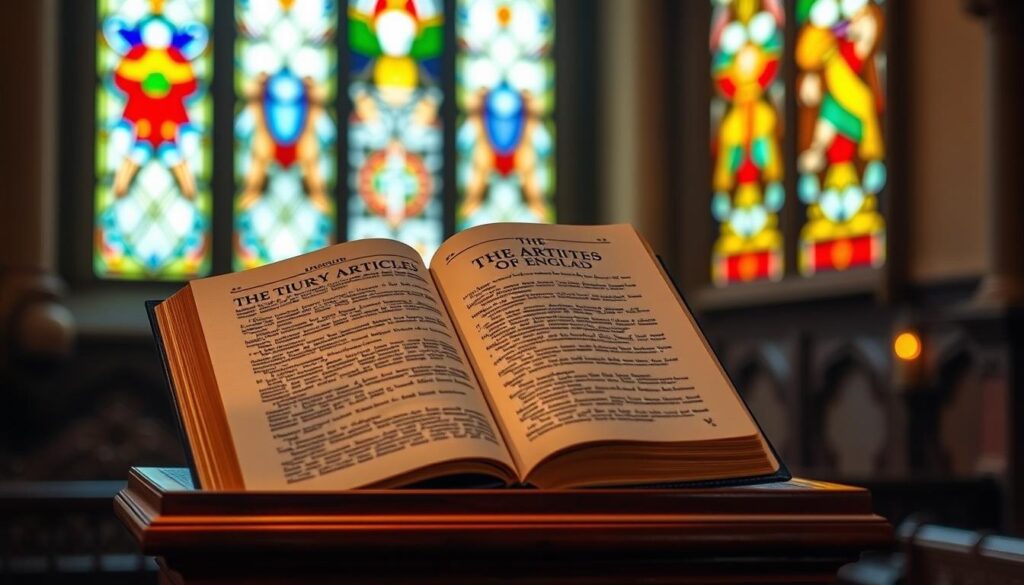
Thomas Cranmer’s fingerprints appear throughout these texts. Though finalized after his death, the Articles reflect his vision of a church honoring tradition while embracing change. Together with the Book of Common Prayer, they created worship that felt both familiar and revolutionary.
What makes these doctrines unique? Consider their middle path:
| Topic | Catholic View | Anglican Position | Protestant Stance |
|---|---|---|---|
| Scripture | Church interprets | Supreme authority | Sole authority |
| Salvation | Faith + works | Grace through faith | Faith alone |
| Sacraments | 7 sacraments | 2 primary rites | Symbolic acts |
| Church Structure | Papal hierarchy | Bishops + Parliament | Local governance |
This table shows how the Articles carved a distinct identity. They affirmed Protestant ideas like justification by faith but kept bishops and ancient creeds. As one scholar notes, “They built bridges where others dug moats.”
Today, these 450-year-old statements still guide 85 million Anglicans. Modern churches debate their application, but the core remains—proof that thoughtful compromise can outlast rigid dogmas. The Thirty-nine Articles remind us that unity often lives in balance, not extremes.
Exploring the Protestant Church of England: Theology and Doctrinal Diversity
Anglican theology thrives on a unique balancing act. Its via media approach blends Catholic rituals with Protestant teachings, creating space for diverse interpretations. This middle way allows everything from incense-filled high church services to simple evangelical gatherings under one institutional roof.
Four main traditions coexist: Anglo-Catholic, high church, central, and low church. The evangelical wing within low church circles emphasizes Scripture, while Anglo-Catholics value sacramental practices. Despite differences, shared worship through the Book of Common Prayer unites them.
Doctrinal authority rests on scripture, reason, and tradition. Leaders weigh ancient texts against modern insights, seeking relevance without losing core identity. This three-legged stool model encourages dialogue between historical faith and contemporary questions.
This flexibility helps the institution adapt while maintaining continuity. By honoring multiple perspectives, it remains a spiritual home for millions across varying beliefs.
FAQ
How did Henry VIII’s marriage disputes lead to the English Reformation?
Henry VIII sought to annul his marriage to Catherine of Aragon, but the Pope refused. This led Henry to break ties with Rome, declare himself Supreme Head of the English Church, and initiate reforms that laid the groundwork for a distinct religious identity.
What role did Thomas Cranmer play in shaping Anglican practices?
As Archbishop of Canterbury, Cranmer authored the Book of Common Prayer, which standardized worship in English. His work blended Protestant theology with traditional liturgy, creating a foundation for Anglican spiritual life.
Why are the Thirty-Nine Articles important to Anglican doctrine?
Established in 1563, these articles outline core beliefs, such as justification by faith and the authority of Scripture. They balance Reformed ideas with Catholic traditions, reflecting the Anglican commitment to a “middle way” in theology.
How did the Dissolution of the Monasteries impact England?
Henry VIII disbanded monasteries between 1536–1541, redistributing their wealth and land. This weakened Catholic influence, strengthened royal power, and shifted social and economic structures across the country.
What defines the Anglican Communion’s global presence today?
The Communion unites 85 million members worldwide under shared traditions, like the Book of Common Prayer, while allowing regional flexibility. The Archbishop of Canterbury serves as a symbolic leader, though each province governs independently.
How does the Anglican tradition approach doctrinal diversity?
Anglicanism emphasizes unity through shared liturgy rather than strict dogma. This allows for varied interpretations on issues like sacraments or leadership roles, fostering inclusivity among “high church” and evangelical factions.
When did women gain the right to become bishops in the Anglican Church?
The first female bishops were ordained in 2014 after decades of debate. This milestone reflected evolving views on gender and leadership within the tradition, though some conservative groups still oppose the change.