Welcome to an exploration of one of Christianity’s most impactful movements. Emerging in the 16th century, this tradition reshaped spiritual practices and beliefs across continents. At its heart lies a focus on direct connection with Scripture and the idea that grace, not deeds, defines salvation.
This movement began as a call to reform how people practiced their beliefs. Leaders emphasized personal interpretation of the Bible and rejected rigid hierarchies. Today, over 800 million people identify with its teachings, making it a cornerstone of modern religious life.
What makes this tradition unique? Three principles stand out: Scripture as the ultimate authority, salvation through faith alone, and the belief that every believer has equal spiritual value. These ideas sparked social change, influencing education, politics, and culture worldwide.
Whether you’re new to religious studies or curious about different Christian traditions, this guide offers clear insights. We’ll trace its origins, unpack key doctrines, and show how centuries-old teachings remain relevant today.
Key Takeaways
- Originated in 16th-century Europe as a reform movement
- Teaches salvation through faith rather than works
- Over 800 million followers globally
- Shaped modern concepts of individual religious freedom
- Emphasizes direct engagement with biblical texts
Introduction to Protestantism and Its Relevance Today
From bustling cities to remote villages, Protestantism’s influence stretches across the world. With nearly one billion members, it’s not just a historical movement—it’s a living force shaping communities today. Its teachings on personal responsibility and equal spiritual access continue to inspire social change.
Protestant denominations now make up 30% of global Christianity. This growth reflects diverse cultural adaptations—from vibrant African congregations to tech-savvy American megachurches. Their shared focus on Scripture and grace unites believers despite differing traditions.
Education and democracy owe much to Protestant ideas. Early reformers pushed for universal literacy to enable Bible reading, laying groundwork for public schooling. Congregational governance models later influenced modern democratic systems. As one historian noted: “Where Bibles spread, classrooms followed.”
Modern churches tackle 21st-century challenges while staying rooted in core beliefs. Many run food banks, disaster relief programs, and job training centers. Others advocate for environmental care or racial equality—proving ancient teachings can address new problems.
Economic progress in some regions links to Protestant ethics of hard work and community service. These values foster entrepreneurship and civic engagement. Meanwhile, interfaith dialogues show how its principles adapt to a connected world, keeping Protestantism relevant today and tomorrow.
Understanding the Protestant Faith
Five Latin phrases form the backbone of this tradition’s core beliefs. Known as the Five Solae, they outline principles that guide millions: Scripture alone, faith alone, grace alone, Christ alone, and glory to God alone. These ideas reject reliance on human institutions, placing ultimate trust in divine authority.

Central to these teachings is the conviction that salvation comes through God’s grace, not human effort. As one reformer famously declared: “We are saved by faith, not deeds.” This belief offers spiritual security, assuring individuals they’re accepted through Christ’s sacrifice.
The Bible serves as the supreme guide—not church traditions. Early leaders translated Scripture into common languages, empowering ordinary people to study it themselves. This practice birthed diverse denominations but maintained shared doctrines about grace and redemption.
Every believer holds equal value in this framework. There’s no need for intermediaries—prayers go straight to God, and personal Bible study fuels spiritual growth. This approach shaped modern concepts like religious freedom and literacy.
While practices vary across congregations, the Five Solae unite them. From baptisms to Sunday services, these principles remind followers where true authority lies. They continue shaping lives, proving ancient wisdom adapts to new generations.
Historical Origins and the Reformation Movement
A monk’s bold act in 1517 sparked a transformation in Christian history. When Martin Luther nailed his Ninety-Five Theses to a church door, he challenged powerful institutions. This moment lit the fuse for the Protestant Reformation—a movement that reshaped Europe’s spiritual landscape.
Sixteenth-century Europe simmered with discontent. Many criticized the Catholic Church’s wealth and political meddling. The sale of “indulgences”—payments to reduce punishment for sins—became a flashpoint. As Luther argued: “Why does the pope not empty purgatory for love rather than money?”
New technologies accelerated change. Gutenberg’s printing press spread reform ideas faster than ever. Pamphlets and Bibles translated into local languages empowered ordinary people. For the first time, many could read Scripture without relying on clergy.
| Aspect | Pre-Reformation | Post-Reformation |
|---|---|---|
| Religious Authority | Centralized papal control | Local interpretation of Scripture |
| Political Impact | Church influenced kingdoms | Rulers gained independence |
| Text Access | Latin-only Bibles | Vernacular translations |
National pride fueled the movement. German princes saw a chance to break from Rome’s authority. Swiss cities developed their own reformed traditions. What began as internal critique became a lasting split—creating denominations we recognize today.
Though aimed at renewal, the Protestant Reformation changed more than church practices. It reshaped education, governance, and how people viewed personal responsibility. These sixteenth-century debates still influence modern discussions about authority and individual rights.
Key Figures Who Shaped the Reformation
The Reformation’s dramatic spread relied on bold thinkers who dared to rethink centuries of tradition. Three visionaries stand out: a fiery German monk, a meticulous French theologian, and a Swiss innovator. Their ideas lit spiritual fires across Europe—and still guide millions today.
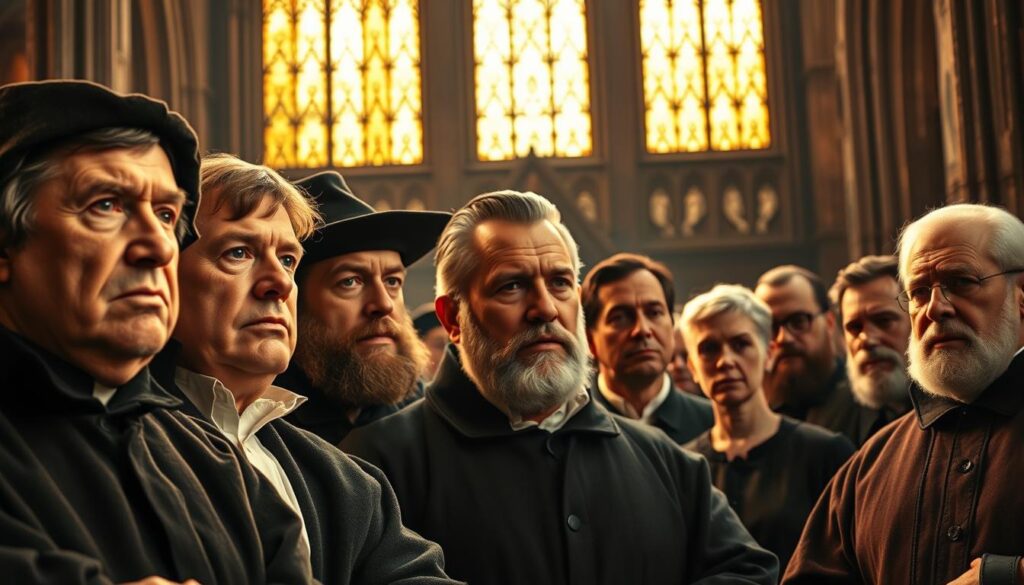
Martin Luther and the Ninety-Five Theses
Martin Luther never planned to start a revolution. As a troubled monk, he simply wanted honest discussions about church practices. His 1517 document—ninety-five debate points nailed to a door—exposed corruption in indulgence sales. “Why doesn’t the pope use his wealth to help the poor instead of building cathedrals?” he famously asked.
Luther’s German Bible translation changed everything. Suddenly, ordinary people could read Scripture themselves. This empowered individuals and fueled literacy rates. His hymns and writings made complex theology relatable, proving ideas could travel faster than armies.
John Calvin, Huldrych Zwingli, and Other Reformers
While Luther sparked change in Germany, John Calvin organized it in Switzerland. His systematic teachings about God’s sovereignty shaped Presbyterian and Reformed traditions. “True wisdom,” he wrote, “consists in knowing God and knowing ourselves.” His Geneva became a model for community-based faith.
Huldrych Zwingli took a different path in Zurich. He redesigned worship services, removed statues, and argued sacraments were symbolic—not magical. Meanwhile, figures like John Knox brought Reformed ideas to Scotland, showing how local cultures could shape religious renewal.
| Reformer | Key Contribution | Lasting Impact |
|---|---|---|
| Martin Luther | Bible translation, justification by faith | Empowered lay believers |
| John Calvin | Systematic theology, predestination | Shaped Reformed churches |
| Huldrych Zwingli | Symbolic sacraments, civic reform | Influenced Anabaptists |
These leaders disagreed on details but shared core goals. They wanted Scripture accessible to all people, worship rooted in biblical truth, and church structures serving communities. Their courage created a spiritual legacy that still inspires others seeking meaningful change.
The Significance of the Ninety-Five Theses in Church History
A single document reshaped Christianity forever. In 1517, Martin Luther nailed his Ninety-Five Theses to All Saints’ Church door in Wittenberg. What began as academic debate points became fuel for religious revolution.
The Catholic Church sold indulgences—payments claiming to reduce punishment for sins. Luther saw this as exploiting believers. “Why should the pope’s wealth grow from the poor’s fear?” he argued. His theses questioned both financial abuse and deeper spiritual truths.
Beyond criticizing money practices, Luther tackled salvation itself. He insisted forgiveness came through repentance, not payments. This challenged the Catholic Church‘s authority over grace. Ordinary people began questioning medieval religious hierarchies.
| Before Theses | After Theses |
|---|---|
| Salvation mediated by clergy | Personal faith emphasized |
| Latin-only religious texts | Vernacular Bible translations |
| Centralized church power | Local interpretations grew |
The printing press spread Luther’s ideas like wildfire. Within months, Europe buzzed with reform talks. Wittenberg earned its title as the “cradle of the Protestant movement” through this explosive mix of theology and technology.
Centuries later, the theses remind us how bold questions can change history. They established Scripture-based debate models still used in religious scholarship today. What started on a church door continues shaping spiritual discussions through time.
Biblical Foundations and the Principle of Sola Scriptura
Imagine a world where sacred texts were locked away, understood only by religious elites. The Reformation shattered this reality by declaring Scripture alone as Christianity’s ultimate authority. This radical idea—Sola Scriptura—shifted power from church hierarchies to everyday believers.

The Authority of Scripture in Protestant Belief
Reformers like Luther argued the Bible contained all necessary truth for salvation. “God’s word stands above human tradition,” he insisted. This principle challenged papal decrees and medieval practices not explicitly biblical.
Early reformers removed statues and artwork from churches, replacing visual symbols with Scripture readings. Calvin’s Geneva became a prime example, where biblical texts adorned walls instead of saints’ images. This shift created new worship patterns centered on personal engagement with the Bible.
Interpretation and Accessibility of the Bible
Translating Scripture into common languages sparked a literacy revolution. For the first time, farmers and shopkeepers could read God’s word themselves. One English reformer noted: “Christ’s truth belongs to plowboys as much as priests.”
Different denominations developed unique approaches:
- Lutherans focused on Christ-centered interpretations
- Calvinists emphasized systematic Bible study
- Anabaptists prioritized practical application
Despite these differences, all agreed on Scripture’s supreme authority. Modern scholarship continues this legacy, using historical analysis to uncover original meanings while maintaining the Bible’s transformative power.
Core Doctrines: Sola Fide, Sola Gratia, and the Five Solae
What if eternal security didn’t depend on rituals or good deeds? This radical idea lies at the heart of Protestant teachings. Five Latin phrases—called the Five Solae—form a theological compass guiding millions toward spiritual freedom.
Justification by Faith Alone
Sola Fide changed how people viewed salvation. Martin Luther argued: “True righteousness comes through trusting Christ, not counting good deeds.” This doctrine reassured believers they didn’t need perfect behavior—just genuine trust in Jesus.
Good works became responses to grace rather than requirements. A farmer could find peace knowing their faith mattered more than church rituals. This teaching lifted burdens of guilt while inspiring compassionate living.
Grace, Christ Alone, and Glory to God
Sola Gratia emphasizes divine generosity. Salvation isn’t earned—it’s gifted through God’s kindness. As one reformer wrote: “We bring empty hands to receive heaven’s treasure.”
Three other principles complete the picture:
| Doctrine | Meaning | Impact |
|---|---|---|
| Solus Christus | Christ as sole mediator | Eliminated saint veneration |
| Soli Deo Gloria | Glory to God alone | Simplified worship practices |
| Sola Scriptura | Bible as final authority | Empowered personal study |
Together, these doctrines create a faith rooted in divine initiative. They remind followers that salvation flows from God’s love—not human effort. Centuries later, this message still offers hope and shapes churches worldwide.
The Universal Priesthood of Believers and Its Implications
Imagine stepping into a spiritual role once reserved for clergy. That’s the revolutionary idea behind the universal priesthood of believers. This principle declares every person has equal value in spiritual matters—no special titles required.
Direct Access to God
Gone are the days when people needed intermediaries to connect with the divine. The Reformation taught that prayer and Scripture study belong to everyone. As one reformer put it: “God hears the farmer’s cry as clearly as the bishop’s.”
This freedom reshaped communities. Ordinary believers began leading prayers, teaching Bible classes, and even challenging corrupt systems. Literacy rates soared as people sought to read Scripture themselves.
The implications stretched beyond church walls. Ideas about personal responsibility influenced early democratic government structures. Today, this legacy lives on—anyone can start a Bible study, lead worship, or advocate for justice.
By trusting ordinary believers with spiritual authority, this teaching created lasting freedom. It reminds us that sacred work isn’t confined to institutions—it thrives wherever people seek truth with open hearts.
FAQ
What sparked the Reformation movement in the 16th century?
The Reformation began as a response to practices within the Roman Catholic Church, such as the sale of indulgences. Martin Luther’s Ninety-Five Theses, posted in 1517, challenged these traditions and emphasized salvation through grace and Scripture alone.
How do teachings like sola fide and sola gratia shape beliefs?
A: Sola fide (faith alone) and sola gratia (grace alone) highlight that salvation comes through God’s unearned favor, not human deeds. These ideas remain central to many Christian denominations rooted in Reformation theology.
Why is the Bible so important in churches influenced by the Reformation?
The principle of sola Scriptura asserts that Scripture is the ultimate authority—above church traditions. This belief encourages believers to engage directly with the Bible, fostering personal interpretation and spiritual growth.
What role did figures like John Calvin play in the Reformation?
Calvin and reformers like Huldrych Zwingli expanded Reformation ideas, emphasizing predestination, church governance, and simplicity in worship. Their writings and teachings helped shape denominations such as Presbyterianism and Reformed churches.
How does the “priesthood of all believers” impact daily life?
This doctrine teaches that every Christian has direct access to God without needing a human mediator. It empowers individuals to pray, study Scripture, and serve others without relying solely on clergy.
What distinguishes Protestant worship from Roman Catholic practices?
Key differences include rejecting papal authority, prioritizing Scripture over tradition, and viewing sacraments like communion as symbolic rather than literal. Worship styles also vary, with many groups favoring congregational participation.
Are groups like the Church of England part of the Reformation legacy?
Yes! The Anglican Church, established during England’s break from Rome, blends Reformed theology with traditional liturgy. Its Book of Common Prayer reflects this unique mix of Protestant and Catholic elements.
Why do some denominations baptize infants while others don’t?
Baptism practices stem from differing interpretations of Scripture. For example, Lutherans and Anglicans baptize infants as a covenant sign, while Baptists reserve it for professing believers, reflecting their view of personal faith.