Throughout history, royal leaders have shaped nations through their beliefs and policies. This guide explores how religious identity transformed governance in Europe, focusing on rulers who championed new spiritual movements. Their decisions often sparked cultural shifts and redefined the relationship between church and state.
During pivotal moments in the past, monarchs faced unique challenges balancing personal faith with political demands. Many navigated tensions between different religious groups while maintaining authority. These leaders left lasting legacies, influencing everything from legal systems to international alliances.
We’ll analyze how their titles and ceremonies reflected evolving power structures. Coronation rituals, for example, often blended tradition with statements of religious allegiance. Such symbols reinforced their role as both political figures and spiritual representatives.
From diplomacy with foreign powers to managing diverse populations, these rulers adapted to complex realities. Their stories reveal how personal convictions shaped entire eras—and how modern constitutional monarchies still carry echoes of their influence.
Key Takeaways
- Religious identity played a crucial role in reshaping European governance structures
- Monarchs often balanced spiritual beliefs with practical political needs
- Coronation rituals and titles reflected evolving church-state relationships
- Diplomatic strategies addressed tensions between different faith communities
- Historical decisions continue to influence modern constitutional systems
Historical Context and the Rise of a New Monarchy
In the shadow of crumbling cathedrals and burning villages, Europe’s power structures underwent seismic shifts during the 16th century. France became ground zero for this transformation, where religious identity collided with royal authority. For 36 years, civil wars tore through the country, fueled by clashes between Catholics and Huguenots.
Religious Turmoil and the Wars of Religion
The 1572 St. Bartholomew’s Day Massacre marked a turning point, eliminating much of France’s Protestant leadership. Tensions had simmered since 1562, when Catholic forces slaughtered Huguenots at Vassy. By the 1550s, nearly 10% of France’s population had embraced Protestant teachings—a minority large enough to challenge church dominance but too small to secure political control.
The Transition from Catholic Dominance to a Protestant Reign
Henry of Navarre’s 1589 ascension to the throne tested France’s unity. As the first Bourbon monarch and a Huguenot leader, he faced widespread distrust. His famous 1593 conversion to Catholicism—”Paris is worth a Mass”—demonstrated the delicate balance between personal religion and statecraft.
This strategic compromise paved the way for the 1598 Edict of Nantes, granting limited religious freedoms. The edict didn’t create full equality but established crucial precedents for separating spiritual beliefs from civic participation. Through such measures, the monarchy evolved from enforcing doctrinal purity to managing diverse populations.
Church and State: The Evolving Dynamics of Faith and Power
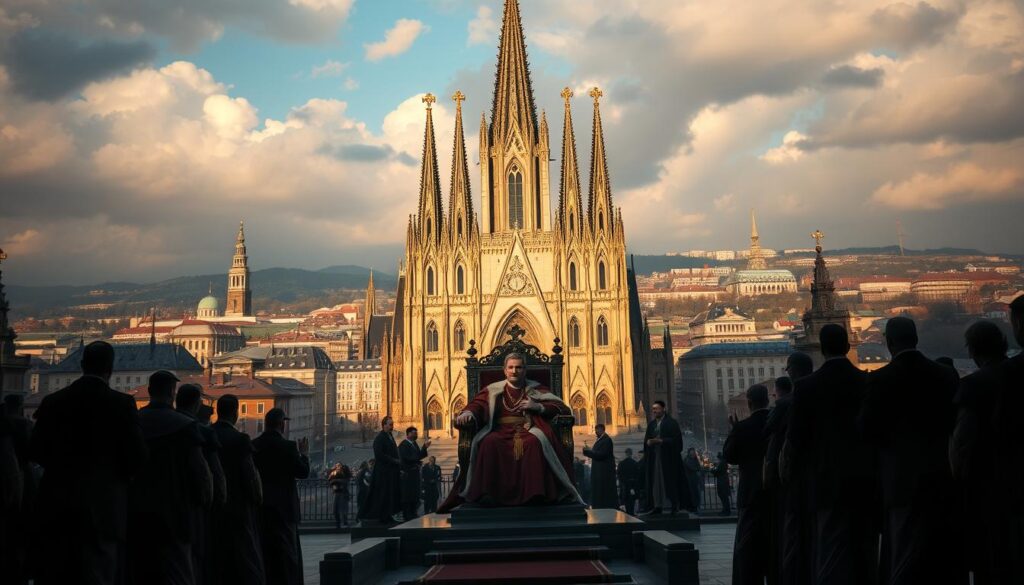
European rulers reshaped spiritual authority through bold institutional changes. The Church of England became a blueprint for blending religious structures with governance. This fusion created unique legal frameworks that still influence modern political order.
The Shifting Role of Royal Titles and Ecclesiastical Authority
Henry VIII’s 1534 Act of Supremacy made monarchs the ultimate head of England’s church. Today, Charles III holds the title “Defender of the Faith”—a role originally granted by the Catholic Church before the Reformation. These titles evolved into tools for asserting state control over spiritual matters.
The Church of England remains legally tied to the crown, unlike Scotland’s independent church structure. This distinction shows how different regions balanced doctrine with local governance needs.
| Aspect | Church of England | Church of Scotland |
|---|---|---|
| Leadership | Monarch as Supreme Governor | No royal authority |
| Establishment | 1534 Act of Supremacy | 1560 Reformation |
| Governance | Parliament involvement | Local presbyteries |
Erastianism and its Legacy in Government
Thomas Erastus’ ideas transformed how nations handle spiritual law. His doctrine argued civil leaders should oversee church operations—a view embedded in England’s 39 Articles. Article 37 clearly states royal power extends over “all estates” in the realm.
This approach influenced constitutional systems worldwide. Modern democracies still debate the proper role of religious institutions in public life, proving these historical decisions remain relevant.
The Enduring Legacy of the Protestant King
Leadership decisions made centuries ago still shape how nations handle religious diversity today. Henry IV’s 1593 conversion to Catholicism—despite his Huguenot roots—demonstrates how rulers prioritized national unity over personal belief. This strategic choice ended France’s brutal wars and set precedents for modern constitutional monarchy.

Conversion, Political Strategy, and Reconciliation
Henry’s partnership with minister Sully rebuilt France after decades of conflict. Their 1598 Edict of Nantes granted Huguenots limited rights—a revolutionary step for its time. Though assassinated in 1610, Henry’s policies showed how kings could balance competing faiths through compromise.
Comparative Insights from Henry IV and Contemporary Monarchs
James II’s 1685 coronation reveals similar pragmatism. The pope approved his Protestant-led ceremony to maintain England’s stability. Modern royals like Britain’s Windsor family continue this tradition, serving as symbols of unity in multi-faith societies.
These historical examples prove lasting truths: effective governance often requires bridging divides. From Henry’s reign to today’s ceremonial thrones, leaders who adapt to their country‘s needs leave enduring marks on history.
Symbolism, Ceremonies, and Religious Identity in Royal History
Crowns glimmer and scepters shine, but royal rituals carry deeper meanings. These ceremonies blend centuries-old traditions with modern values, reflecting how religion shapes national identity. From coronation oaths to architectural symbolism, every detail tells a story of evolving faith and governance.
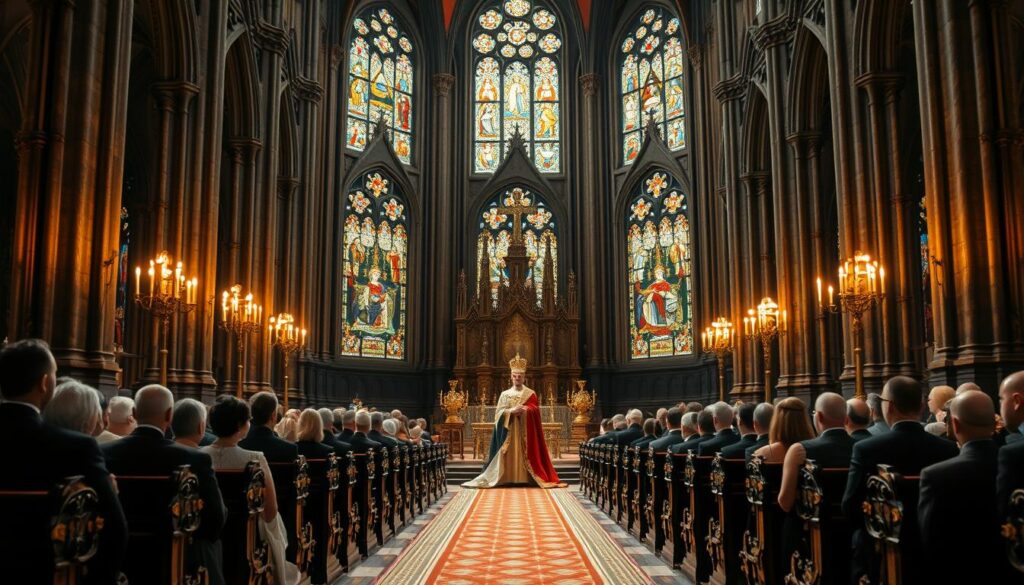
Ceremonial Traditions and Established Churches
King Charles III’s 2023 coronation showcased this balance. He vowed to uphold the Church of England while welcoming leaders from other faiths. “I shall inviolably maintain the Settlement of true Religion,” he declared, echoing language from 16th-century reforms.
Henry VIII’s marriage disputes sparked lasting changes. His 1536 break with Rome created the Church of England, shifting spiritual authority to the throne. Later monarchs like Elizabeth I reinforced this doctrine through laws blending religious and civic order.
Impacts on National Identity and Legal Reforms
Legal milestones reveal shifting attitudes. The 1829 Catholic Relief Act softened restrictions against Roman Catholic participation in public matters. Centuries earlier, James II’s 1685 Protestant-led coronation—approved by the pope—proved even divided faiths could find common ground.
Three key reforms shaped modern systems:
- The Act of Supremacy (1534) made monarchs head of state and church
- Coronation oaths evolved to acknowledge regional churches
- Interfaith collaborations became standard in royal ceremonies
These changes transformed how people view leadership. Today’s monarchs symbolize unity across diverse beliefs while honoring historical ties to established churches—a delicate dance between past and present.
Conclusion
The dance between throne and altar has written many chapters in Europe’s story. Monarchs navigated complex relationships with the Catholic Church, often reshaping faith traditions to suit political needs. Their choices created frameworks for balancing spiritual ideals with practical governance.
Henry IV’s compromises and England’s royal-led church reforms show how power adapts. These leaders understood that unifying divided populations required acknowledging diverse religion practices. Their legacy lives in modern systems separating civic duties from personal belief.
Today’s constitutional monarchies still reflect these historical negotiations. While the Catholic Church no longer holds medieval influence, its past conflicts with kings taught valuable lessons. True leadership often means finding common ground—even when sacred and secular worlds collide.
FAQ
How did religious conflicts shape the role of European monarchs?
Religious divisions, like the Wars of Religion, forced rulers to balance faith with political stability. Many adopted policies to unify their realms, such as establishing state-aligned churches or granting limited religious freedoms to avoid civil strife.
What was Erastianism, and how did it influence governance?
Erastianism emphasized state control over religious institutions. This doctrine allowed leaders like Elizabeth I to consolidate power by overseeing church operations, blending spiritual and political authority to strengthen national unity.
Why did Henry IV of France convert to Catholicism?
Henry IV famously said, “Paris is well worth a Mass”, prioritizing peace over personal faith. His conversion from Huguenot Protestantism to Roman Catholicism in 1593 helped end the French Wars of Religion and stabilize the nation.
How did royal ceremonies reinforce religious identity?
Coronations, oath-taking rituals, and church-led events symbolized the monarch’s role as both head of state and defender of the faith. These traditions reinforced national identity, as seen in England’s Anglican liturgy or Scandinavia’s Lutheran practices.
What legal changes occurred under Protestant-aligned rulers?
Monarchs like Henry VIII enacted laws separating their realms from papal authority. The Acts of Supremacy in England, for example, declared the crown as the Supreme Head of the Church of England, reshaping legal frameworks around marriage, land ownership, and governance.
How do modern monarchs handle religious diversity compared to past rulers?
Today’s constitutional monarchs often serve as symbolic heads of multi-faith societies, unlike historical figures who enforced state religions. For instance, the British crown still holds the title “Defender of the Faith” but promotes interfaith dialogue to reflect contemporary values.