Born in 1553 at Château de Pau, Henry IV grew up in a world torn by religious conflict. His mother, Jeanne III of Navarre, raised him in the Protestant faith despite his Catholic baptism. This unique upbringing shaped his ability to navigate France’s bitter Wars of Religion later in life.
Henry first ruled as King Navarre after his mother’s death in 1572. His early reign tested his skills as both a military leader and diplomat. Through marriage alliances and battlefield victories, he positioned himself as a unifying figure during chaotic times.
In 1589, Henry became king of a fractured nation. His reign (1589–1610) marked a turning point for France. Though initially opposed for his religious background, he famously declared “Paris is worth a Mass” when converting to Catholicism to secure his throne.
The first monarch from the House of Bourbon brought lasting changes. He issued the Edict of Nantes in 1598, granting limited religious freedom to Protestants. This groundbreaking policy helped heal divisions while maintaining Catholic dominance.
Key Takeaways
- Henry IV uniquely balanced Protestant roots with Catholic political realities
- His early rule in Navarre prepared him for national leadership challenges
- The Bourbon dynasty began with his unexpected rise to power
- Religious tolerance became a cornerstone of his legacy
- Military success and political flexibility defined his 21-year reign
Historical Context: France Before the Reformation
Sixteenth-century France simmered with tension as Protestant ideas challenged centuries of Catholic rule. By 1555, nearly 1.25 million French citizens—called Huguenots—followed John Calvin’s teachings. This growing minority reshaped the nation’s social fabric while most citizens clung to traditional faith.
Fractured Throne, Divided Nobles
Three weak Valois kings—Francis II, Charles IX, and Henry III—struggled to control their realm. Their mother Catherine de Médicis became the real power, playing noble families against each other. Political alliances split along religious lines:
| Family | Religion | Power Base |
|---|---|---|
| Guise | Catholic | Eastern France |
| Montmorency | Moderate Catholic | Paris Region |
| Bourbon | Protestant | Southern Territories |
Faith Becomes a Weapon
The Duke of Guise led hardline Catholics against Huguenot communities. Meanwhile, Protestant nobles like the Bourbons demanded religious rights. Catherine’s attempts at peace often backfired spectacularly, like her failed marriage alliance between Catholic Marguerite and Protestant Henry of Navarre.
This explosive mix of faith and ambition made violence inevitable. When thousands died in the 1572 St. Bartholomew’s Day Massacre, it shocked Europe—but surprised few in France. The stage was set for decades of wars of religion that would ultimately reshape the monarchy.
Era of Religious Turmoil and the French Wars of Religion
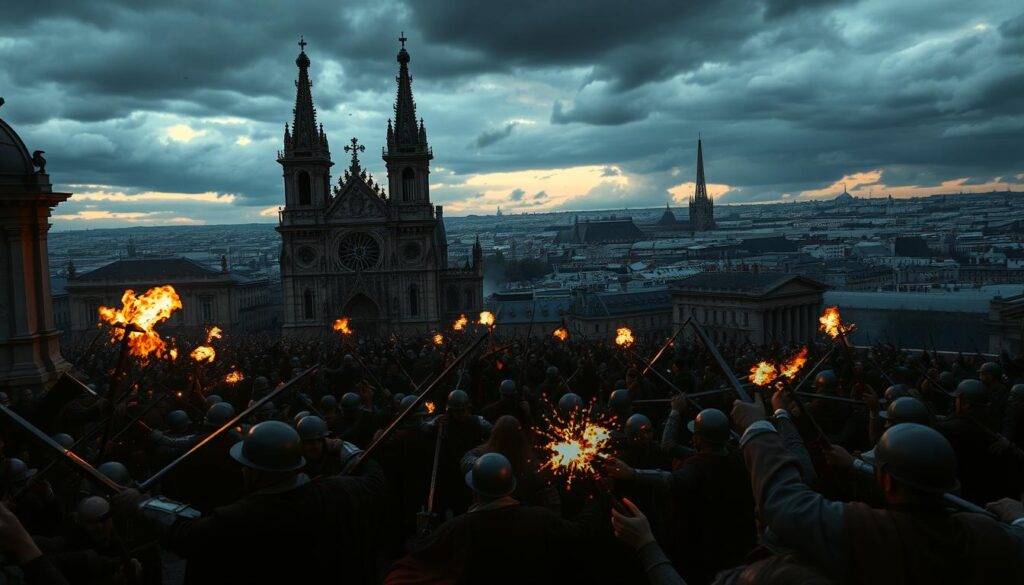
In 1562, a single act of violence sparked thirty-six years of chaos. The Duke of Guise ordered his troops to attack Huguenots praying in Vassy, slaughtering dozens. This massacre lit the fuse for eight brutal wars of religion that would redefine France.
Key Conflicts and Atrocities
Violence escalated like wildfire. Each attack bred fiercer retaliation. By 1572, tensions peaked during a royal wedding in Paris. What began as a celebration turned into the St. Bartholomew’s Day Massacre – three days of targeted killings that left 10,000 dead nationwide.
Catholic mobs hunted Huguenot leaders using pre-marked houses. Bodies floated in the Seine as Henry III’s government struggled to control the carnage. Survivors called it “blood wedding,” a turning point where religious disputes became existential warfare.
Entire regions chose sides through fear or faith. Villages fortified churches while nobles stockpiled weapons. For ordinary people, daily life meant navigating checkpoints and coded symbols to avoid persecution.
These conflicts created lasting scars but also set the stage for change. The Duke of Guise‘s extremism ultimately weakened Catholic hardliners, creating space for compromise. As smoke cleared from burnt villages, France slowly inched toward reconciliation.
Rise of a Monarch Amidst Chaos
The sudden death of France’s heir in 1584 changed everything. When Francis, Duke of Anjou, passed unexpectedly, his brother Henry III lost his designated successor. This left the throne France might inherit to a Protestant cousin – Henry of Navarre.
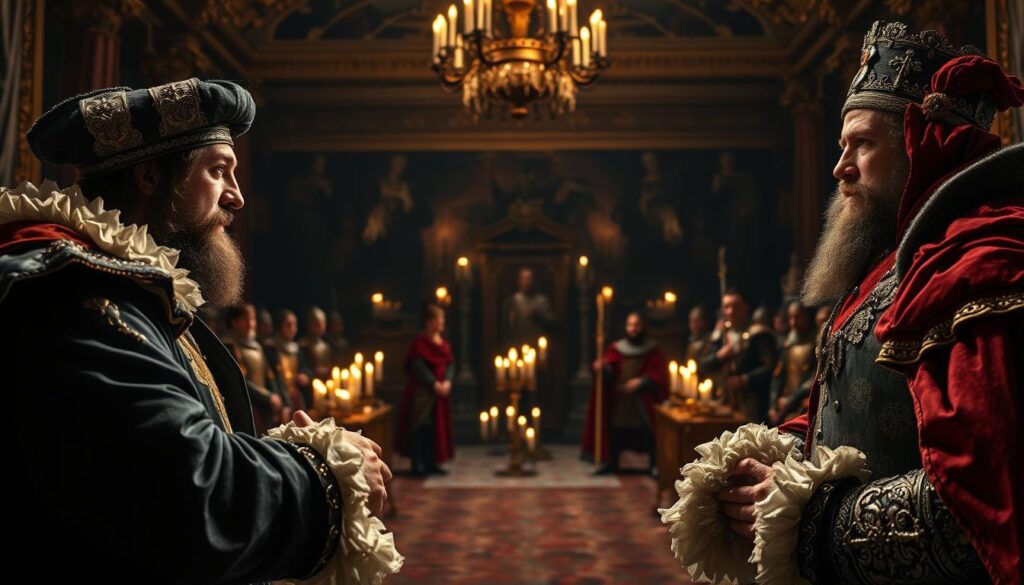
What followed became known as the war three henrys. Three powerful men claimed authority: the reigning monarch Henry III, Protestant leader Henry of Navarre, and Catholic hardliner Henry de Guise. Each represented competing visions for the nation’s future.
Desperate moves backfired spectacularly. In 1588, Henry III ordered the duke guise‘s assassination, hoping to crush Catholic opposition. Instead, furious mobs drove the king from Paris. His power shrank to a few towns along the Loire River.
Navarre seized this chaos skillfully. While others focused on revenge, he built alliances and won key battles. By 1589, the french crown hung within reach. France stood at a crossroads – would it accept a ruler from the “wrong” faith?
Henry III’s final days saw strange bedfellows. The weakened king allied with his Protestant cousin against remaining Catholic forces. This partnership paved Navarre’s path to power, though neither man would live to see peace restored.
The Transformation of Henry of Navarre into King Henry IV
A single knife thrust changed France forever. On August 1, 1589, Jacques Clément assassinated Henry III outside Paris. With his dying breath, the monarch named Henry of Navarre as successor—a stunning twist for a man raised Protestant in defiance of royal norms.
Path to the Throne
Henry’s survival during the St. Bartholomew’s Day Massacre proved crucial. Though forced to convert temporarily, he escaped the French court in 1576. These experiences taught him vital political flexibility. To rule France,” he later remarked, “one must listen to both church bells and battle drums.
His mother Jeanne d’Albret shaped his early resilience. As Huguenot leader after 1572, Henry mastered wartime strategy and peacemaking. When Henry III died childless, these skills helped him claim the throne France desperately needed.
The new monarch’s journey revealed ironies. Persecution strengthened his resolve, while captivity taught courtly diplomacy. By balancing these lessons, he transformed from regional ruler to national unifier—setting the stage for his historic reign.
Diplomacy and Military Campaigns in His Early Reign
Henry IV’s early reign was forged on battlefields and negotiation tables alike. While cannons roared across France, he balanced battlefield grit with shrewd political deals. This dual approach helped turn military wins into lasting authority.
Notable Battles: Ivry and Arques
The Battle of Ivry (1590) became Henry’s masterpiece. Outnumbered Catholic League forces crumbled under his bold cavalry charges. His iconic white-plumed helmet rallied troops as he shouted: “Follow my white plume!”
Earlier at Arques (1589), he’d proven survival skills. Using fog-covered terrain, his forces ambushed larger armies. These victories showed skeptics a Protestant leader could defend French soil.
Strategies Against the Catholic League
Henry faced more than local rebels. Spanish gold and troops backed the duke guise‘s faction, creating a European-scale conflict. He countered by offering pardons to defecting nobles and blocking enemy supply routes.
Though Paris resisted his 1590 siege, Henry kept chipping away at opposition. His mix of mercy for converts and firmness against hardliners gradually won over war-weary citizens. This paved his path from battlefield commander to accepted ruler.
FAQ
Why was Henry IV’s reign significant for France?
Henry IV ended decades of religious conflict by uniting a divided nation. His policies, like the Edict of Nantes, granted rights to Huguenots while stabilizing the monarchy, paving the way for France’s recovery.
What caused the French Wars of Religion?
Tensions between Catholics and Huguenots, combined with power struggles among noble families like the Guises and Bourbons, fueled violence. Political instability and competing claims to the throne worsened the conflict.
How did the St. Bartholomew’s Day Massacre impact France?
The 1572 massacre intensified distrust between religious groups. Thousands of Huguenots were killed, deepening divisions and prolonging the wars until Henry IV’s rise brought compromise.
What challenges did Henry face before becoming king?
As a Huguenot leader, Henry faced opposition from the Catholic League and rival claimants like Henry III. Surviving assassination attempts and winning key battles, like Ivry, secured his path to the throne.
Why did Henry IV convert to Catholicism?
His famous quote, “Paris is worth a mass,” reflected practical politics. Converting in 1593 helped him gain broader acceptance, though he still protected Huguenot rights through laws like the Edict of Nantes.
What was the War of the Three Henrys?
This 1580s conflict pitted Henry III, Henry of Guise, and Henry of Navarre (later Henry IV) against one another. It ended with Guise’s assassination and Navarre’s eventual succession after Henry III’s death.
How did the Edict of Nantes change France?
Issued in 1598, it granted Huguenots religious freedom and civil rights, reducing sectarian violence. This landmark decree promoted coexistence and strengthened royal authority after years of chaos.
What was Henry IV’s lasting legacy?
He rebuilt France’s economy, centralized power, and fostered peace. His pragmatic leadership and reforms, aided by advisor Sully, laid the foundation for the Bourbon dynasty’s dominance.