Be sure to insert a strong, clear roadmap for readers who want to understand how leadership and service connect in this global faith.
This article explains who leads, who serves, and how roles link parish life to wider governance.
We will cover deacons, priests, bishops, cardinals, and the pope, and describe related offices that shape worship and daily ministry around the world.
The ordering of ministries aims to serve jesus christ and support the faithful through prayer, sacraments, and pastoral care.
Along the way, we’ll show how tradition and law work together to keep continuity across ages and across thousands of dioceses and parishes.
Key Takeaways
- The guide explains ranks from local parish ministers to universal leaders in Rome.
- Roles include deacons, priests, bishops, cardinals, and the pope, plus related offices.
- The system orders ministries to serve Jesus and support sacramental life.
- Thousands of dioceses and many parishes connect local worship to global unity.
- Both tradition and canon law maintain stability and continuity over time.
How the Church’s “Holy Ordering” Works Today
A practical view of holy ordering reveals how ordained ministry and legal codes work together. Holy ordering means a sacred system set up to preserve unity, enable mission, and assign authority for governance and sacramental life.
The code of canon law supplies the legal backbone across Latin and Eastern codes. It clarifies responsibilities, procedures, and protections for clergy and the faithful. This legal structure helps titles match real duties and avoids confusion.
Bishops hold ordinary authority in their dioceses, while priests and deacons carry out day-to-day ministry as members of the clergy. The Church distinguishes the hierarchy of order (sacramental ordination) from the hierarchy of jurisdiction (governing offices) so worship and governance remain distinct.
Worldwide coordination happens when bishops meet in conferences, approve measures by the required majority, and seek confirmation from the Holy See. These steps keep local practice aligned with universal norms while allowing appropriate diversity.
- Titles may be functional or honorary; the code ensures the right people hold the right offices.
- Authority exists to serve the Gospel, making ministries accountable and effective for consistent teaching and pastoral care.
From Parish to Province: The Basic Structure of the Catholic Church
Local congregations form the daily face of faith, where worship, service, and fellowship happen close to home. This section traces how life at the neighborhood level connects upward to regional oversight and cooperation.
Parishes and pastors: the front line of pastoral care
A parish is the local community where people attend Mass, receive sacraments, and build friendships. The pastor leads worship, preaches, offers pastoral care, and manages parish staff and ministries.
Many parishes also run outreach programs that meet practical needs in the city or town. Note: about 19.3% of parishes lack a resident pastor; 1,948 are entrusted to a deacon or lay minister.
Dioceses and bishops: governance, jurisdiction, and unity
Parishes roll up into a diocese, overseen by a bishop who holds ordinary authority at that level. Bishops support pastors, set policy, and coordinate clergy assignments across a state or region.
Dioceses vary in size and resources, but each shares the same mission: proclaim the Gospel, celebrate sacraments, and organize care for the vulnerable. As of December 31, 2020, there were 2,903 dioceses and equivalent jurisdictions worldwide.
Archdioceses and ecclesiastical provinces: metropolitans and suffragan dioceses
Some dioceses are large or historically prominent and are called an archdiocese, led by an archbishop. Archdioceses often head a province, where a metropolitan helps foster collaboration among suffragan dioceses.
“A parish is like a city; a diocese functions like a state; a province is a regional partnership.”
Orders of Clergy: Deacons, Priests, and Bishops
Three sacramental orders—deacon, priest, and bishop—define roles for worship, teaching, and leadership. Each order shares a common mission to serve the People of God while carrying distinct duties and responsibilities.

Deacons: service, preaching, baptisms, and pastoral assistance
Deacons proclaim the Gospel, preach, baptize, and witness marriages. They lead charitable outreach and bring attention to social needs.
By focusing on service, deacons free priests to concentrate on sacramental ministry and pastoral care in the parish.
Priests: celebrating the Eucharist and the sacraments in parishes
Priests celebrate the Eucharist, hear confessions, and anoint the sick. They preach, teach, and shepherd parish communities day by day.
Working with lay ministers and volunteers, priests keep parish life active and sacramental life central.
Bishops: fullness of Holy Orders and guardians of doctrine and governance
Bishops possess the fullness of Holy Orders and hold the authority to ordain deacons, priests, and other bishops. They safeguard teaching and oversee governance across a diocese.
While all clergy preach and care for the faithful, only priests and bishops can celebrate certain sacraments, and only bishops can confer Holy Orders.
- Order distinguishes roles but unites ministry through worship, teaching, and leadership.
- Collaboration among deacons, priests, and the bishop strengthens parish and diocesan initiatives.
Episcopal Roles Beyond the Diocese
Many episcopal duties reach past a single local community. Some leaders stay focused on parish oversight. Others take roles that serve regional needs or the global governance of the faith.
Diocesan ordinaries and canonical jurisdiction
A diocesan bishop (the ordinary) holds ordinary authority in his territory. He coordinates clergy, parishes, and diocesan offices to meet pastoral needs.
Auxiliary and coadjutor support and succession
Auxiliaries assist with sacramental ministry and administration. A coadjutor helps the ordinary and automatically succeeds when the see is vacant.
Titular bishops: Curia and diplomatic service
Titular bishops often work in the Roman Curia or serve as papal diplomats. Their title links them to the wider governance structure while they represent universal interests.
Metropolitans and provincial leadership
An archbishop who is metropolitan offers limited oversight, fosters cooperation, and supports suffragan dioceses for the common good.
- The code secures orderly succession and collaboration among bishops.
- Episcopal conferences handle regional liturgy and pastoral norms while respecting universal law.
Though offices vary, the episcopal order remains one: each bishop serves the Gospel and the faithful according to his specific mandate.
Cardinals and the Pope: Offices, Titles, and Election
A small body of senior advisers links local leadership to the universal governance of the faith.

The College of Cardinals: orders, precedence, and advisory role
Cardinals are senior clerics appointed to advise the pope and to elect his successor. They form the College of Cardinals and are ranked in three orders: cardinal bishops, cardinal priests, and cardinal deacons.
Many cardinals serve as archbishop leaders of major sees or head offices in Rome. This dual role bridges local ministry and universal service.
Conclave basics: how a new pope is elected
After a pope dies or resigns, the interregnum follows rules in Universi Dominici Gregis. Cardinal electors gather in a conclave to pray, deliberate, and vote in strict secrecy.
- Cardinals assemble and are sequestered in the Sistine setting.
- Repeated secret ballots occur, requiring a two‑thirds majority unless rules change.
- Smoke signals announce progress: black for no decision, white for a new pope.
The Pope’s titles and offices: Bishop of Rome, Vicar of Christ, and more
The pope is first and foremost the Bishop of Rome. His other formal titles explain different aspects of his role:
| Title | Meaning | Practical Role | Scope |
|---|---|---|---|
| Vicar of Jesus Christ | Representative of Christ for the faithful | Pastoral leadership and teaching | Universal |
| Supreme Pontiff | Highest visible pastor | Defines pastoral priorities | Global |
| Sovereign of Vatican City State | Civil authority over the state | Governance of Vatican institutions | State-level |
| Servant of the servants of God | Humility in service | Modeling charity and service | Symbolic and pastoral |
Roman Curia: global governance in service of the universal mission
The Roman Curia is the administrative network that helps the pope govern. It includes congregations, dicasteries, tribunals, and offices that implement norms from the code and apostolic constitutions.
Curial leaders advise the pope, manage global initiatives, and handle discipline. Together with the College of Cardinals, they keep governance rooted in law and tradition while serving the faithful worldwide.
Eastern Catholic Leadership: Patriarchs, Major Archbishops, and Eparchs
The East offers parallel structures where historic titles carry real pastoral power.
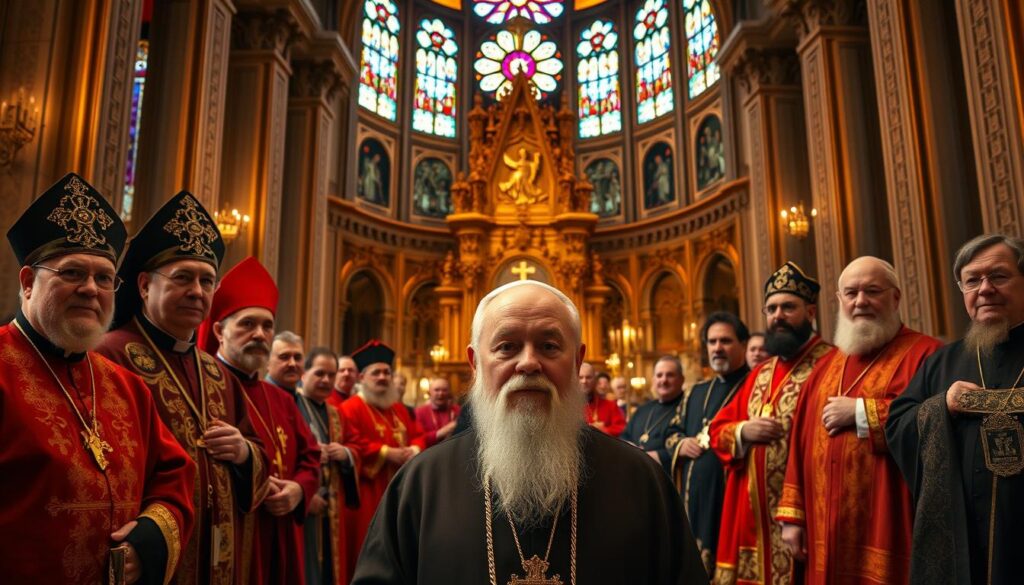
Patriarchs head sui iuris churches such as Coptic, Maronite, Syriac, Chaldean, Armenian, and Melkite. They preside over bishops, clergy, and the faithful within their own rites and hold precedence shaped by long tradition.
Patriarchs of sui iuris Churches: authority and precedence
Patriarchs exercise genuine authority in governance and liturgy, always in communion with the pope. Their precedence over other bishops reflects historic status and pastoral scope.
Major archbishops and the Catholicos title: leadership parallels
Major archbishops lead autonomous churches with powers like patriarchs. In some cases, for example the Syro‑Malankara, the leader bears the Catholicos title while exercising comparable duties.
Eparchs, exarchs, and Eastern structures alongside the Latin Church
Eparchs serve as the Eastern equivalent of diocesan bishops; exarchs govern missionary or special territories. Synods of bishops usually elect these leaders, who then collaborate with the Holy See.
- Titles signal real pastoral responsibility across diverse rites.
- Eastern leaders often join global bodies while keeping their own liturgical law.
- Despite different structures, the same Gospel mission unites East and West.
catholic church hierarchy in Canon Law and Order of Precedence
Canon law lays out clear rules for who takes precedence at liturgies and official acts.
How precedence is set: first by sacramental order—bishops, then presbyters, then deacons. Next comes the hierarchy of jurisdiction: those with active governing office precede those with only a titular title or emeritus status.
Office outranks honor because active governance ensures clear leadership. A diocesan bishop who governs takes precedence over a retired or titular holder of the same rank.
“Precedence protects charity and order by making responsibilities visible, not by promoting rivalry.”
- Tie‑breakers include earlier promotion to an office, earlier ordination to an order, and the date a cardinal’s name was published.
- Patriarchs of autonomous churches generally precede other bishops; cardinals receive special norms that may alter placement.
- Papal representatives (nuncios) follow diplomatic practice and often rank as titular archbishops.
Lists of precedence extend from the pope down to pastors, vicars, religious superiors, and deacons. The code and custom resolve overlaps so ceremonies and governance run smoothly.
- Order (sacramental rank) determines basic placement.
- Jurisdiction (active office) adjusts that order.
- Honors and emeritus titles fill remaining positions by seniority.
Why it matters: these norms help clergy and laity know who presides at liturgy, who signs documents first, and how to show mutual respect while ministry proceeds without confusion.
Personal Jurisdictions: Beyond Geography
Not every pastoral jurisdiction is defined by a map; some follow groups of people instead. These non‑territorial structures meet needs that a territorial diocese cannot always cover.
Personal ordinariates and Anglican patrimony
A personal ordinariate gathers communities by shared patrimony rather than place. It serves members who enter into full communion while preserving familiar rites, music, and pastoral customs.
Like a diocese, an ordinariate has an ordinary who provides leadership, parish life, catechesis, and sacramental ministry. These arrangements enrich the catholic church by welcoming gifts from Anglican tradition while ensuring full doctrinal and sacramental unity.
Military ordinariates and other non‑territorial care
Military ordinariates provide steady pastoral care to service members, families, and civilian staff who move often. They operate across bases and deployments so the faithful never lack access to the sacraments.
Other personal jurisdictions address special circumstances or ethnic communities. In each case, authority and local offices tailor outreach and governance to the group’s needs.
- How they work: person‑based jurisdiction mirrors a diocese in structure and functions.
- Why it matters: members and communities keep spiritual ties while joining the wider mission.
This arrangement helps ensure that everyone—wherever they serve or travel—has pastoral support and a clear place in the wider life of the churches.
Living the Hierarchy in the United States
Across the United States, local leadership adapts long-standing structures to meet varied urban and rural needs.
Archdiocese of New York: an example of archdiocesan leadership in a major city
The Archdiocese of New York shows how an archbishop coordinates complex ministries in a dense, diverse city.
The archbishop guides schools, charities, and diocesan offices so parishes share a common vision.
Parishes and pastors: caring for the faithful at the local level
At street level, a pastor leads daily worship, visits the sick, and mobilizes volunteers for works of mercy.
Priests and deacons celebrate sacraments, teach, and support lay leaders so parish life stays vibrant and responsive.
States, provinces, and dioceses: a helpful civic analogy
Think of a diocese like a state and a parish like a city: each level matches governance to need.
Provinces help bishops collaborate across neighboring dioceses, while canon law and good administration keep roles clear.
- Bishops mentor clergy and invest in priestly and diaconal formation.
- Archbishops often pilot outreach and youth programs that benefit nearby dioceses.
- The result is better care and faster local responses—from Manhattan parishes to small towns nationwide.
Conclusion
Viewed together, titles and offices form a living framework that supports ministry at every level. This system organizes worship, teaching, and service so the faithful receive care in every parish and diocese. Parishes remain the heartbeat, while dioceses and archdioceses provide scale and steady support across time and place.
Priests and deacons carry daily ministry; bishops, as successors of the apostles, keep doctrine sound, sacraments accessible, and governance stable. Titles and precedence—shaped by tradition and the code—clarify who presides and who signs, avoiding confusion in public ministry.
Eastern churches and personal jurisdictions add legitimate diversity and pastoral reach. See the pope’s ministry and the wider structure not as mere bureaucracy but as service that points to jesus christ, builds communion, and equips the world for mission.
FAQ
What are the main ranks and roles in the church leadership?
Leaders include deacons, priests, and bishops. Deacons serve by assisting in liturgy and charity. Priests lead parishes and celebrate the Eucharist. Bishops hold the fullness of ordained ministry, oversee dioceses, and safeguard teaching and governance.
How does “holy ordering” work today?
Holy ordering follows sacramental ordination. A man is ordained to the diaconate, priesthood, or episcopate through the laying on of hands and prayer. Canon law and local bishops regulate formation, faculties, and pastoral assignments to ensure proper ministry and care.
What is the difference between a parish and a diocese?
A parish is a local community led by a pastor and serves daily pastoral needs. A diocese is a regional jurisdiction overseen by a bishop who provides governance, sacramental oversight, and unity among parishes.
What role does an archdiocese or metropolitan play?
An archdiocese is a principal see led by an archbishop. A metropolitan has limited supervisory duties over a group of nearby dioceses, called a province, promoting coordination and support among suffragan dioceses.
What do deacons typically do in parish life?
Deacons proclaim the Gospel, preach, baptize, witness marriages, assist at liturgies, and engage in ministries of charity and outreach, acting as a bridge between clergy and laity.
What are a priest’s primary responsibilities?
Priests celebrate Mass, hear confessions, anoint the sick, teach, and provide day-to-day pastoral care for parishioners as pastors or chaplains.
What distinguishes a bishop’s ministry from a priest’s?
Bishops govern a diocese, ordain clergy, confirm the faithful, and ensure fidelity to doctrine. They exercise both teaching and juridical authority in communion with the Pope.
What is a diocesan bishop or ordinary?
A diocesan bishop, or ordinary, has canonical authority over a specific territorial church. He sets pastoral priorities, appoints pastors, and oversees administration, liturgy, and formation.
What are auxiliary and coadjutor bishops?
Auxiliary bishops assist the diocesan bishop with pastoral and sacramental duties. A coadjutor also assists but has the right of succession when the diocesan bishop retires or the see becomes vacant.
Who are titular bishops and where do they serve?
Titular bishops hold the title of an ancient diocese that no longer functions territorially. They often serve in the Roman Curia, as diplomats, or in specialized ministries outside a territorial diocese.
What is the role of metropolitans and archbishops?
Metropolitans lead archdioceses and carry a coordinating role within an ecclesiastical province. Archbishops may also represent their region in national conferences and handle certain appeals or oversight tasks.
What is the College of Cardinals and what do they do?
The College of Cardinals is a body of senior prelates who advise the Pope and, in a conclave, elect a new Pope. Cardinals hold various offices and ranks, contributing to global governance and pastoral planning.
How does a papal conclave work?
When the See of Rome is vacant, eligible cardinals meet in a secluded voting process. They cast ballots in successive rounds until one candidate receives a two‑thirds majority and is then asked to accept the office.
What titles does the Pope hold?
The Pope is Bishop of Rome and commonly referred to as Vicar of Christ and Supreme Pontiff. These titles reflect his pastoral and teaching primacy for the universal community.
What is the Roman Curia’s purpose?
The Roman Curia is the administrative apparatus that assists the Pope in governing the global community. It includes congregations, councils, and tribunals that handle doctrine, liturgy, clergy, and diplomatic matters.
How do Eastern rites fit into overall leadership structures?
Eastern churches have patriarchs, major archbishops, and eparchs who govern their sui iuris churches. They maintain distinct liturgical and canonical traditions while remaining in communion with Rome.
What are patriarchs and major archbishops?
Patriarchs lead ancient autonomous churches and hold high precedence. Major archbishops lead large self‑governing churches with responsibilities similar to patriarchs in matters of governance and liturgy.
What are eparchs and exarchs?
Eparchs are bishops of Eastern dioceses (eparchies). Exarchs often lead missionary or provisional jurisdictions, providing pastoral care where structures are developing.
How does canon law define order and precedence?
Canon law distinguishes the order of sacramental ministry (bishops, priests, deacons) from jurisdictional authority (who governs a territory or office). It also outlines protocols for honors, appointments, and emeritus status.
What is emeritus status?
Emeritus is an honorific given to retired bishops and pastors who have resigned after reaching the age or for health reasons. They retain sacramental ministry but no longer govern the office.
What are personal ordinariates and who do they serve?
Personal ordinariates are non‑territorial jurisdictions established to welcome groups with Anglican patrimony into full communion while preserving aspects of their liturgical and spiritual heritage.
What are military ordinariates and similar structures?
Military ordinariates provide pastoral care to armed forces and their families across regions without being tied to a specific territory. Similar personal jurisdictions exist for other groups with special needs.
How does leadership operate in the United States?
Leadership in the U.S. is organized by dioceses and archdioceses, such as the Archdiocese of New York, which oversee parishes, schools, and ministries. Bishops coordinate with state and regional bodies to address pastoral priorities.
Why is the Archdiocese of New York often cited as an example?
The Archdiocese of New York is a prominent see with many urban parishes, social services, and cultural outreach. Its activities illustrate how an archdiocese combines pastoral care, education, and civic engagement.