Imagine living in an era where questioning authority could cost you everything. The 16th-century religious reform movement reshaped Europe’s spiritual identity, sparking debates that still influence faith practices today. At its core, this transformation began when bold thinkers challenged long-standing traditions, advocating for direct engagement with scripture over institutional intermediaries.
Central to this shift was Martin Luther’s 1517 publication of critiques against certain practices. His ideas spread like wildfire through newly invented printing presses, empowering ordinary people to rethink their relationship with faith and community. This period didn’t just alter rituals—it redefined who could access spiritual truth.
What made these changes revolutionary? For the first time, individuals could interpret sacred texts without relying solely on established hierarchies. This movement wasn’t just about theology—it laid groundwork for concepts like personal accountability and freedom of belief that resonate in modern societies.
Key Takeaways
- The 16th-century religious shift started with critiques of traditional practices
- Printing technology accelerated the spread of reformist ideas
- Individuals gained unprecedented access to spiritual resources
- New interpretations of faith challenged institutional authority
- Lasting impacts include modern principles of religious self-determination
Historical Origins and Early Developments
When a single document can shake empires, you know history is being rewritten. By 1517, frustration with spiritual shortcuts had reached boiling point across Europe. Many clergy quietly questioned why forgiveness became a transaction rather than a sacred promise.
Setting the Stage for Change
The sale of indulgences epitomized the growing divide between doctrine and practice. A traveling preacher named Johann Tetzel famously claimed, “As soon as the coin in the coffer rings, the soul from purgatory springs.” This commercialization of faith alienated thinkers like Martin Luther, who saw scripture being overshadowed by profit.
Breaking Point in Wittenberg
On October 31, 1517, Luther nailed his critiques to a local chapel door—a normal way to spark academic debate. But his 95 Theses struck deeper chords:
“Why does not the pope empty purgatory for the sake of holy love… rather than for the sake of miserable money?”
The newly invented printing press turned these ideas into wildfire. Within months, translated copies reached farmers in France and merchants in England. For the first time, ordinary people debated theology using accessible pamphlets rather than Latin texts.
| Aspect | Pre-1517 | Post-1517 |
|---|---|---|
| Scripture Access | Latin-only | Vernacular translations |
| Indulgences | Widely sold | Publicly challenged |
| Religious Power | Centralized | Decentralized |
These years transformed how communities viewed spiritual leadership. What began as doctrinal disagreements soon reshaped kingdoms—and ultimately, the modern world’s approach to faith.
Key Figures and Their Revolutionary Ideas
History often turns on the courage of individuals who dare to rethink the unthinkable. Two thinkers in particular became architects of spiritual transformation through their writings and convictions. Their work created ripples that became waves, reshaping how communities understood divine truth.
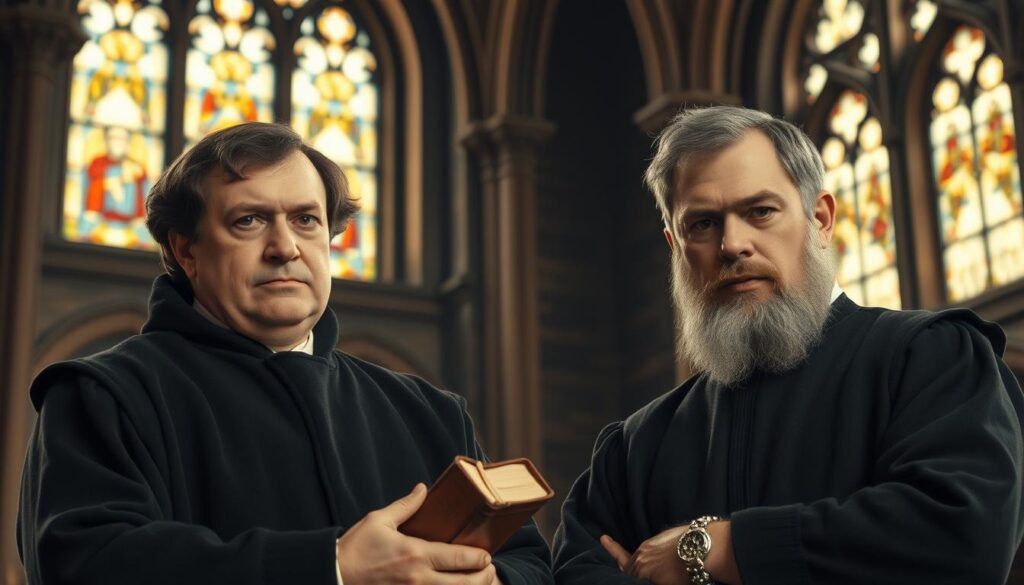
The Monk Who Moved Mountains
Martin Luther started as an Augustinian monk wrestling with questions of salvation. His academic training led him to challenge the sale of indulgences, which he saw as corrupting true faith. In 1517, he famously drafted 95 arguments against this practice—a document now called the 95 Theses.
Luther’s productivity stunned his era. Between 1518-1525, he published more works than the next 17 leading reformers combined. The printing press turned his writings into bestsellers, letting farmers and kings alike debate his ideas.
The Systematizer of Faith
John Calvin approached spiritual questions with legal precision. His Institutes of the Christian Religion (1536) outlined a theology emphasizing God’s supreme authority. Calvin taught that divine will shaped human destiny—a concept called predestination.
Geneva became his laboratory for implementing teachings. By 1541, the city transformed into a haven for exiles seeking to build communities based on scripture-first principles. Calvin’s influence soon reached Scotland, France, and beyond through trained ministers.
| Aspect | Martin Luther | John Calvin |
|---|---|---|
| Key Focus | Salvation by faith | God’s sovereignty |
| Major Work | 95 Theses | Institutes |
| Lasting Impact | Personal scripture access | Church governance models |
Though differing in methods, both men shared a goal: empowering ordinary people to engage directly with sacred texts. Their beliefs laid foundations for modern spiritual independence, proving that ideas could indeed move mountains.
Religious Movements and Cultural Shifts
Transformative ideas rarely arrive alone—they spark movements that redefine societies. By the 1520s, France became a battleground for competing visions of spiritual renewal. Two distinct approaches emerged: one seeking gradual change from within, the other demanding immediate separation.
Emergence of Evangelical and Humanist Trends
Humanist reformers like Erasmus focused on returning to original biblical texts. They aimed to purify religious practices through education, arguing that rituals should align with scripture. “The essence of faith lies in understanding, not repetition,” wrote one scholar, capturing their emphasis on personal study.
Meanwhile, radical thinkers embraced Luther’s call for complete independence. Their movement rejected traditional authority structures, creating new communities centered on direct scriptural interpretation. This split reshaped Europe’s spiritual map within a generation.
Impact of the Printing Press on Religious Thought
Gutenberg’s invention became the engine of change. Luther’s works appeared in French by 1524, spreading from Paris to Lyon and beyond. Printed pamphlets turned complex theological debates into public conversations.
| Aspect | Humanist Movement | Evangelical Movement |
|---|---|---|
| Focus | Internal church reform | Complete separation |
| Key Tool | Greek/Latin manuscripts | Vernacular translations |
| Audience | Educated elites | General population |
This technological leap empowered ordinary people. Merchants debated scripture during market days, while craftsmen shared pamphlets like modern social media posts. The way people engaged with faith shifted permanently—from passive observance to active participation.
Impact and Legacy of the protestant church 1500s
What happens when millions rewrite their spiritual playbook? The seismic shifts of the 16th-century religious overhaul didn’t just alter Europe—they forged new ways of thinking that crossed oceans. At its heart lay a radical idea: every person holds the right to shape their spiritual journey.

Shaping Independent Spirituality
Before this era, sacred texts stayed locked in ancient languages. The movement changed that forever. Farmers could now read scripture in their own words, sparking debates around kitchen tables. “Faith isn’t a spectator sport,” wrote one reformer, capturing the shift from passive observance to active engagement.
This empowerment birthed modern concepts like religious self-determination. Families began teaching children through home Bible studies rather than relying solely on clergy. Personal accountability became central to spiritual life—a legacy visible in today’s emphasis on individual conscience.
Influence on American Religious Identity
Early settlers carried these ideas like precious cargo across the Atlantic. The Mayflower Compact echoed Reformation principles, valuing diverse beliefs within communities. By 1791, these ideals crystallized in the First Amendment’s guarantee of religious rights.
| Aspect | Pre-Reformation | Post-Reformation |
|---|---|---|
| Scripture Access | Priest-mediated | Personal study |
| Worship Style | Uniform rituals | Varied denominations |
| Spiritual Authority | Central hierarchy | Local congregations |
From Puritan meeting houses to modern megachurches, the influence persists. Over 40% of Americans change religious affiliations during their lives—a testament to lasting ideals about personal faith journeys. This cultural DNA shapes everything from volunteerism to free speech debates.
Protestantism in England: From Henry VIII to the Puritans
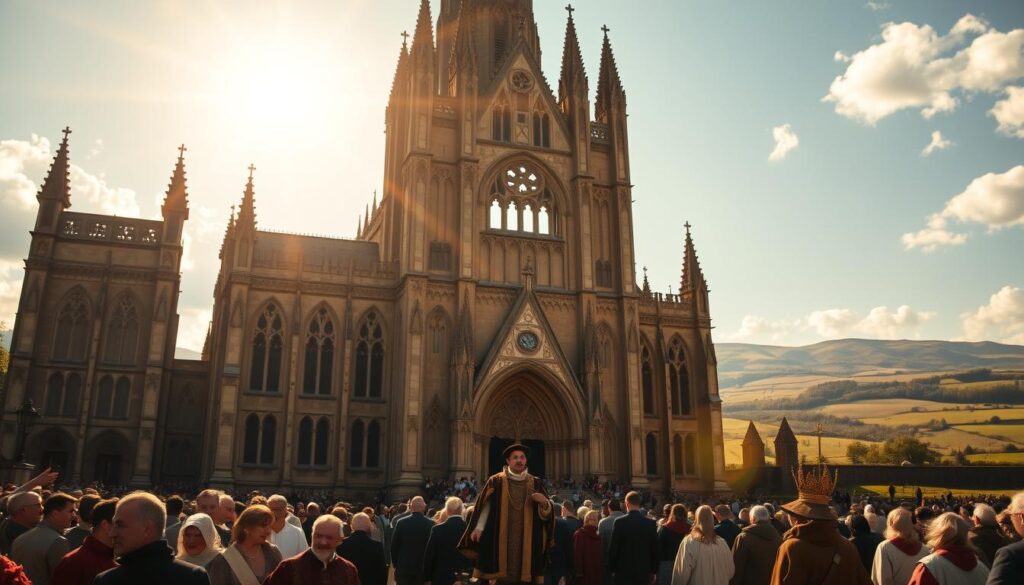
Royal drama reshaped England’s spiritual landscape when Henry VIII clashed with Rome over his marriage. In 1534, the king declared himself head of a new national institution—the Church of England—after the pope refused to annul his union with Catherine of Aragon. This bold move fused traditional rituals with reformed ideas, creating a religious identity distinct from Europe’s other movements.
The Establishment of the Church of England
The Act of Supremacy gave the throne unprecedented control over spiritual matters. Though services initially resembled Catholic Mass, English Bibles soon appeared in parishes. Henry VIII maintained many old practices but severed ties to papal authority, proving political needs could drive religious change.
Conflicts and Reforms in English History
After Henry’s death, the nation became a theological pendulum. Young King Edward VI accelerated reforms before Queen Mary I restored Catholicism, earning her the nickname “Bloody Mary” for persecuting dissenters. Elizabeth I’s 44-year reign brought compromise:
| Monarch | Policy | Impact |
|---|---|---|
| Edward VI | Protestant reforms | English prayer books |
| Mary I | Catholic restoration | 300+ executions |
| Elizabeth I | Middle Way | Stable hybrid system |
Not everyone embraced Elizabeth’s approach. Puritans demanded stricter reforms, splitting into two factions. Separatists later sailed to America seeking freedom, while non-separatists worked to “purify” the Church of England from within. These divisions planted seeds for future democratic ideals about faith and governance.
Comparative Perspectives: Lutheranism, Calvinism, and the Catholic Church
When spiritual paths diverge, history gains new momentum. By the mid-16th century, three distinct approaches to faith emerged—each shaping societies through unique beliefs and practices. These differences didn’t just divide communities; they sparked cultural innovations still felt today.
Differences in Beliefs and Practices
Lutheranism spread across northern Europe, emphasizing salvation through faith alone. Calvinists focused on God’s sovereignty, creating strict moral codes in cities like Geneva. Meanwhile, the Roman Catholic tradition maintained sacraments and papal authority as cornerstones of worship.
The Role of the Counter-Reformation
The Catholic Church responded to the Protestant Reformation with its own reforms. The Council of Trent (1545-1563) clarified doctrines while addressing corruption. New orders like the Jesuits blended spiritual rigor with global education efforts—proving even ancient institutions could adapt.
This era’s debates reshaped everything from art to politics. While reformation movements empowered individual interpretation, the Catholic Church’s renewal efforts preserved unity for millions. Their competing visions still influence how we balance tradition with change.
FAQ
What sparked the Reformation in the 1500s?
Growing frustration with corruption and practices like selling indulgences in the Roman Catholic Church led reformers like Martin Luther to demand change. His 95 Theses in 1517 became a catalyst for challenging religious authority and inspiring new beliefs.
How did Henry VIII influence religious change in England?
Henry VIII’s desire to annul his marriage led him to break from Rome, creating the Church of England. This shift gave the monarchy control over spiritual matters and fueled ongoing debates about worship practices and clergy roles.
What’s the difference between Lutheranism and Calvinism?
Lutheranism focused on faith alone for salvation, while Calvinism emphasized predestination—the idea that God preordains who is saved. Both rejected papal authority but had distinct views on governance and human free will.
Why was the printing press important during the Reformation?
The printing press let reformers spread ideas quickly. Pamphlets and translated Bibles reached ordinary people, weakening the Catholic Church’s monopoly on religious teachings and sparking broader cultural shifts.
How did the Catholic Church respond to Protestant reforms?
Through the Counter-Reformation, the Catholic Church addressed criticisms by reforming clergy training and clarifying doctrines. Groups like the Jesuits also worked to reclaim influence through education and missionary work.
What role did the Church of England play in shaping spirituality?
It blended Catholic traditions with Protestant ideas, creating a middle ground. This approach allowed flexibility in worship but also caused conflicts, leading to movements like Puritanism that sought stricter reforms.
How did reformers like Calvin challenge traditional beliefs?
Calvin’s teachings on predestination and strict moral discipline reshaped communities. His Institutes of the Christian Religion became a foundation for Reformed churches, influencing governance and daily life in regions like Geneva.