The sacraments lie at the heart of life in the Catholic Church. They are visible rites that carry an invisible reality: God’s free gift of grace to strengthen faith and shape daily living.
Each sacrament combines a clear form with deep meaning. Instituted by Jesus Christ, these rites let the faithful encounter divine life in a concrete way. Some mark a lifelong identity. Others are celebrated often to renew hope and healing.
We will group them as Sacraments of Christian Initiation, Sacraments of Healing, and Sacraments at the Service of Communion. Expect practical notes on who celebrates each rite, common ages when people receive them, and how families and children usually first meet this spiritual life.
Key Takeaways
- These rites are visible signs that communicate God’s grace.
- They were founded by Jesus Christ to share divine life.
- Some are received once; others are repeated for ongoing care.
- Groups: Initiation, Healing, and Service of Communion.
- Families and children often begin with Baptism and First Communion.
Understanding Sacraments: Visible Signs of an Invisible Reality of Grace
Outward signs—water, oil, words—make an invisible divine gift tangible. A sacrament is a visible rite with a clear form that communicates an invisible reality. Rooted in the saving work of Jesus Christ, this visible action invites people into a deeper spiritual life.
The form and the rite are not mere symbols. They are the means through which God shares grace—a free gift that draws us into salvation. Concrete elements like water and anointing oil point to effects such as cleansing, strengthening, healing, or commissioning.
“Grace is God’s initiative: freely given, not earned.”
This reflection shows why material signs matter. Our faith is incarnational; God chooses to meet us in things we can see and touch. Believing in this sacramental reality helps sustain faith through joy, trial, service, and calm contemplation.
https://www.youtube.com/watch?v=34pSVZxRW8M&pp=ygUIIzE1MXllYXI%3D
The Sacraments of Christian Initiation: Baptism, Confirmation, and the Eucharist
The path that brings a person into full life and faith in the catholic church is a threefold journey called christian initiation.
Baptism: Entry into new life in the name of the Father, the Son, and the Holy Spirit
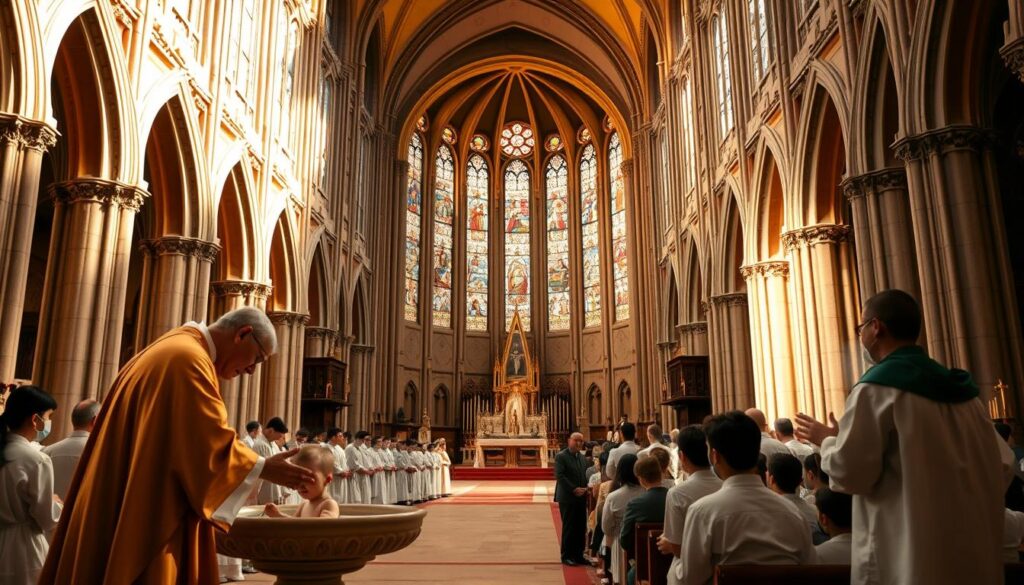
Baptism welcomes a child or adult into the faith through water and the Trinitarian words: “I baptize you in the name father, and of the Son, and the Holy Spirit.”
This rite cleanses original sin, gives sanctifying grace, and cannot be repeated. In an emergency, anyone may baptize if they intend what the Church intends.
Eucharist (Holy Communion): Nourishment, Real Presence, and First Communion
The sacrament eucharist, also known as holy communion, is the central act of worship. Bread and wine are consecrated and become Christ’s Body and Blood.
Children usually receive First Communion around age seven or eight after preparation and a first confession. Catholics may receive this gift frequently to grow in faith.
Confirmation: Sealed and sent with the Holy Spirit
Confirmation completes initiation through the laying on of hands and anointing with chrism by a bishop or priest. This rite seals a person with the holy spirit and strengthens baptismal grace for mission.
Many children receive confirmation in early adolescence; adults who are baptized later receive confirmation at the same celebration.
| Rite | Key Elements | Typical Timing |
|---|---|---|
| Baptism | Water + Trinitarian formula; entry into faith | Infancy for many, or any time; emergency baptism allowed |
| First Communion | Consecrated bread and wine; real presence after consecration | First Communion around age seven or eight, after confession |
| Confirmation | Laying on of hands; anointing with chrism; gifts of the Spirit | Early adolescence for cradle members; at baptism for adult converts |
“Baptism begins new life, Confirmation strengthens it, and the Eucharist sustains it.”
The Sacraments of Healing: Reconciliation and Anointing of the Sick
Reconciliation: Examination, confession, and renewed communion
The sacrament reconciliation heals the soul by naming and turning from sins. A penitent makes an examination of conscience, confesses sins to a priest, and says an act of contrition.
After confession the priest gives absolution and assigns a penance that fosters ongoing conversion. Frequent confession helps a person grow in holiness and restores full communion with the community.
Anointing of the Sick: Oil, prayer, and hope beyond Last Rites
Anointing sick is given by a priest who anoints the forehead and hands with the Oil of the Sick and offers prayer for strength. This rite unites the sick person’s suffering to Christ and brings spiritual healing even when physical cure is not granted.
The sacrament may be received whenever serious illness or major surgery arises and can be repeated as conditions change. When death nears, last rites commonly include confession (if possible), anointing, and the Eucharist with a special blessing.
| Rite | Key Elements | When to Receive |
|---|---|---|
| Reconciliation | Examination of conscience; confession to a priest; absolution; penance | Regularly for spiritual growth; before receiving Communion if conscious of grave sins |
| Anointing of the Sick | Anointing with oil; prayer by a priest; grace for strength and peace | Serious illness, before major surgery, or when health worsens; repeatable |
| Last Rites (near death) | Confession (if possible); anointing; Eucharist or final blessing | When death is imminent to prepare the person for passing |
“These healing rites reconcile us to God and support us through suffering.”
The Sacraments of Service: Holy Matrimony and Holy Orders
In a life of service, two special rites shape how people give themselves for others.
Holy Matrimony: Lifelong covenant reflecting Christ’s love and open to life
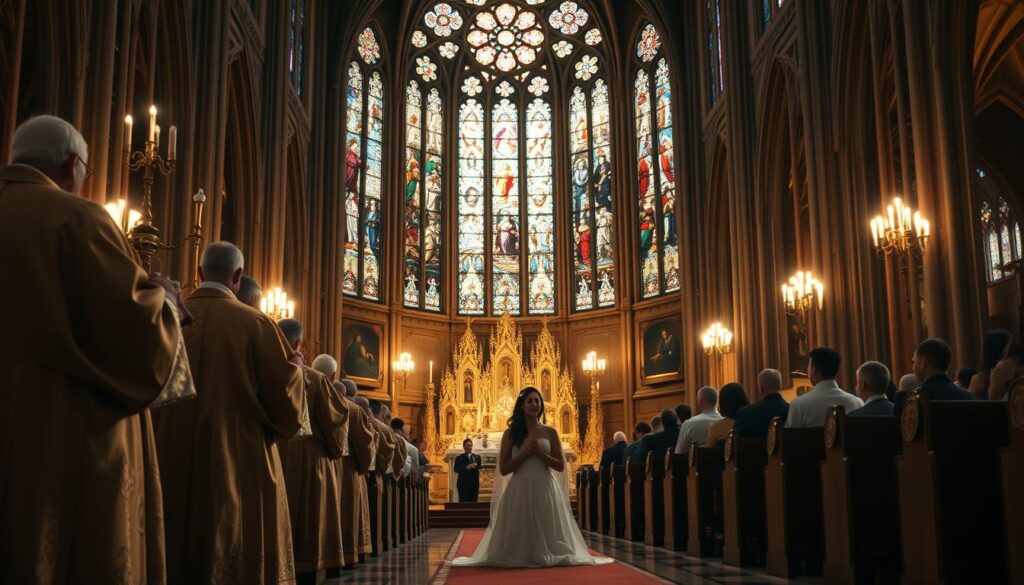
Marriage is a covenant in which a baptized man and woman freely exchange consent. They are the ministers who confer the sacrament on one another.
A priest normally stands as witness during the rite, often within a Nuptial Mass. Public consent, vows, and the marital union form an indissoluble bond.
Marriage mirrors Christ’s faithful love for the Church and forms the domestic church that nurtures faith across generations.
Holy Orders: Ordination by a bishop with the laying on of hands
Holy Orders has three degrees—deacon, priest, and bishop—conferred by a bishop’s laying on of hands and the prayer of consecration.
Deacons preach, baptize, and witness marriages. Priests celebrate the Eucharist and absolve sins. Bishops ordain and shepherd the local church.
A man responds to a call to serve. Ordination includes investiture and sometimes anointing with oil to seal pastoral ministry.
- Commission to serve: Both rites order a person or couple to build families, parishes, and the wider community in love.
- Dependence on grace: Each vocation relies on God’s grace to live commitments faithfully for the life of the world.
“Service in marriage and ordination forms the People of God through faithful love and dedicated ministry.”
| Rite | Key Action | Role |
|---|---|---|
| Marriage | Exchange of consent; public vows | Husband and wife as ministers; priest witness |
| Holy Orders | Bishop’s laying hands; prayer of consecration | Deacon, priest, bishop with distinct ministries |
Seven sacraments of catholic church: A concise guide for life, faith, and love
Think of these rites as a simple roadmap that brings new birth, healing, and service into our everyday living.
Summary: The seven sacraments form God’s plan to share grace with every person—beginning with new birth, deepening formation, and bearing fruit in service.
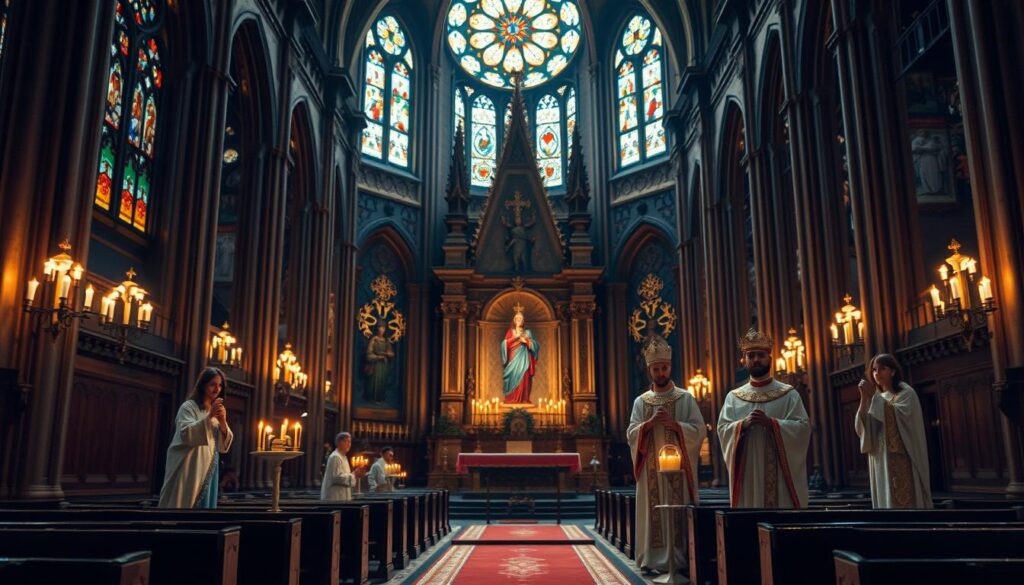
Quick snapshot: Baptism gives new life; Confirmation brings the Holy Spirit; the Eucharist or sacrament eucharist feeds the soul as Holy Communion. Reconciliation and Anointing offer healing. Matrimony and Holy Orders form and send people to serve.
Family milestones matter. Children are baptized young, and a child usually prepares for First Communion around age seven or eight after first confession. These rites shape faith during key life moments.
Practical note: Pay attention to the visible form—water, oil, vows, laying on of hands—because these signs convey real grace. Prepare with prayer and, when unsure, speak with a priest who can guide the next steps for individuals and families.
“Receive sacrament frequently where appropriate, prepare with prayer, and participate with attention to its sacred reality.”
- Baptism: new birth and membership in the faith community.
- Confirmation: strengthened by the Spirit for mission.
- Eucharist: Jesus Christ’s real presence that nourishes faith and love.
- Reconciliation & Anointing: spiritual and sometimes physical healing.
- Matrimony & Holy Orders: service and lifelong commitment.
Conclusion
Conclusion
Through the seven sacraments, grace meets us in clear, concrete rites. These gifts unite visible signs—water, oil, and the laying on of hands—with the Holy Spirit at work in daily life.
Take a next step: enter by baptism, be strengthened in confirmation, receive holy communion, and seek reconciliation with known confession when sins burden your heart.
Anointing sick brings comfort in illness; Last Rites gather prayer, oil, and Communion at life’s threshold. Service in holy orders or in marriage forms communities that share this gift.
Pray, speak with a priest or bishop, and let these sacred encounters deepen your faith and transform the world by grace and truth.
FAQ
What are the sacraments that begin Christian life?
Baptism, Confirmation, and the Eucharist mark entry into Christian life. Baptism welcomes a person into the Christian community in the name of the Father, Son, and Holy Spirit. Confirmation strengthens the baptized with the gifts of the Holy Spirit through anointing and laying on of hands. The Eucharist, or Holy Communion, is regular reception of Christ’s real presence and spiritual nourishment.
At what age do children typically receive First Communion?
Many parishes prepare children for First Communion around age seven or eight, when they can understand the meaning of the Eucharist and examine their conscience. Preparation usually includes catechesis, practice, and participation in Mass with a parent or sponsor.
How does the Eucharist differ from a symbolic meal?
The Eucharist is understood as the Real Presence of Jesus Christ, not merely a symbol. Through the liturgy and consecration, bread and wine become Christ’s body and blood in a mysterious but real way, which believers receive for spiritual life and unity.
What happens in the sacrament of Confirmation?
In Confirmation a bishop or priest lays hands on the candidate and anoints with holy oil (chrism). This rite calls down the Holy Spirit’s gifts—wisdom, understanding, counsel, fortitude, knowledge, piety, and fear of the Lord—to strengthen faith and help the person live as a Christian witness in the world.
When should someone go to Reconciliation (Confession)?
Catholics are encouraged to go regularly, especially after serious sin. Reconciliation involves an examination of conscience, confession to a priest, penance, and absolution. It restores relationship with God and the community and brings spiritual healing.
What is the Anointing of the Sick and when is it given?
Anointing of the Sick uses blessed oil and prayer by a priest to bring comfort, strength, and, if God wills, physical healing. It is appropriate for those facing serious illness, major surgery, or the frailty of advanced age. It is related to, but not limited to, last rites.
What does Holy Matrimony signify and require?
Holy Matrimony is a lifelong covenant between spouses that reflects Christ’s love for the Church and is ordered to the good of the spouses and to procreation. It requires free consent, openness to life, and mutual fidelity, normally celebrated within a parish liturgy with a priest or deacon.
Who receives Holy Orders and what does it confer?
Holy Orders confers the ministry of the deacon, priest, or bishop through ordination by a bishop with the laying on of hands. It empowers the ordained to serve the community through preaching, sacramental ministry (including presiding at the Eucharist), and pastoral leadership.
How do sacraments relate to grace and daily life?
Sacraments are visible signs that confer grace, strengthening faith, love, and Christian life. They connect ordinary life—marriage, family, illness, community worship—with an invisible reality of God’s presence and help, shaping how believers live and serve.
Can non-Catholics receive these rites?
Practices vary by rite and circumstance. Generally, Baptism given in a Trinitarian form is recognized across many Christian traditions. The Eucharist and Reconciliation are typically reserved for those fully initiated in the faith. Pastoral exceptions may apply in emergencies or special pastoral arrangements.
What is the role of a priest or bishop in giving sacraments?
Priests and bishops act in persona Christi (in the person of Christ) when celebrating most sacraments. Bishops ordain clergy and confirm in many dioceses. Priests preside at the Eucharist, hear confessions, anoint the sick, and witness marriages. Their ministry helps the community receive grace through ritual and prayer.
How should families prepare children for initiation rites?
Families should engage in regular prayer, attend Mass, and participate in parish preparation programs. Parents and godparents support catechesis, help children learn basic prayers and the meaning of sacraments, and model a life of faith and love.
Are there visible signs used in these rites?
Yes. Common signs include water in Baptism, oil in Confirmation and Anointing of the Sick, bread and wine in the Eucharist, the laying on of hands in Confirmation and Orders, and exchanging of vows in Matrimony. These signs communicate spiritual realities and grace.
What if someone wants to return to the sacraments after a long absence?
The door is open. Reconciliation is a place to begin: a sincere confession, penance, and absolution restore communion. Parish priests and pastoral ministers can guide steps for returning to full participation in the life of faith and receiving other sacraments.