Imagine a time when Europe stood at a crossroads. A single monk’s bold act in 1517 sparked over a century of upheaval, reshaping nations and beliefs. What began as theological debates grew into clashes that mixed faith, power, and identity in ways no one could predict.
These struggles weren’t just about religion. Rulers used spiritual divisions to gain political control, while communities fought for cultural survival. The term “Wars of Religion” emerged much later, showing how future generations saw these events as warnings about mixing belief systems with governance.
You’ll see how ideas from this period still shape modern life. Concepts like religious freedom and national sovereignty took root amid the chaos. Even military tactics and art evolved as societies adapted to endless conflict.
Key Takeaways
- Lasted over 100 years, starting with Martin Luther’s Ninety-five Theses in 1517
- Blended religious disputes with political power struggles across Europe
- Introduced early ideas about state authority and personal belief systems
- Term “Wars of Religion” coined decades after the conflicts ended
- Helped transition Europe from medieval traditions to modern governance
Introduction to the Era of Religious Conflict
A wave of reform swept through Europe, challenging centuries-old traditions. By 1517, simmering frustrations about church corruption collided with fresh ideas about personal spirituality. This mix created explosive conditions that reshaped societies from Paris to Prague.
Historical Context and Background
Europe’s clergy faced growing criticism for selling forgiveness and living lavishly. Peasants and nobles alike resented Rome’s influence over local affairs. Meanwhile, Ottoman forces advanced into Christian territories, making unity seem urgent yet impossible.
The printing press changed everything. For the first time, religious debates reached ordinary people through pamphlets written in German and French. This technology turned theological arguments into public conversations that rulers couldn’t control.
The Rise of the Reformation
Martin Luther’s realization about “faith alone” sparked a revolution. His 1517 protest against indulgences gave voice to widespread anger. As he later wrote: “When the coin clinks in the chest, greed increases—but salvation comes through divine mercy.”
Other reformers soon added their voices. Ulrich Zwingli in Zurich and John Calvin in Geneva developed competing visions for churches free from papal authority. Local leaders saw chances to seize land and power once held by Rome, blending spiritual goals with political ambition.
Early Conflicts and the Spark of the First War
Tensions reached a breaking point in 1562. What began as theological disagreements exploded into full-scale military action. This shift changed how communities viewed faith, loyalty, and survival.
The Massacre at Wassy and the Outbreak of Violence
March 1, 1562, marked a turning point. Duke François de Guise discovered Protestants worshipping in a Wassy barn. His forces killed over 60 unarmed civilians, igniting nationwide fury. “The blood spilled here will drown us all,” wrote one witness.
Louis de Bourbon, Prince of Condé, seized Orléans weeks later. His call to arms transformed scattered believers into organized troops. Cities became battlegrounds as both sides mobilized forces.
Key Figures and Regional Turmoil
Extremists fueled the flames. Protestant Baron des Adrets destroyed Catholic towns in Provence. Catholic Blaise de Montluc retaliated with equal brutality. Civilians faced impossible choices—convert, flee, or die.
The Battle of Dreux in December 1562 showed war’s new face. Royal troops clashed with Condé’s army in freezing conditions. Though inconclusive, it proved conflicts now involved professional soldiers, not just angry mobs.
The Second and Third Wars: Escalation and International Intrigue
Europe’s religious tensions exploded into global power struggles after 1567. Local disputes now drew foreign kings and mercenaries into French territory. This shift turned neighborhood quarrels into battles shaping continental politics.
Events of 1567-1570 and Shifting Alliances
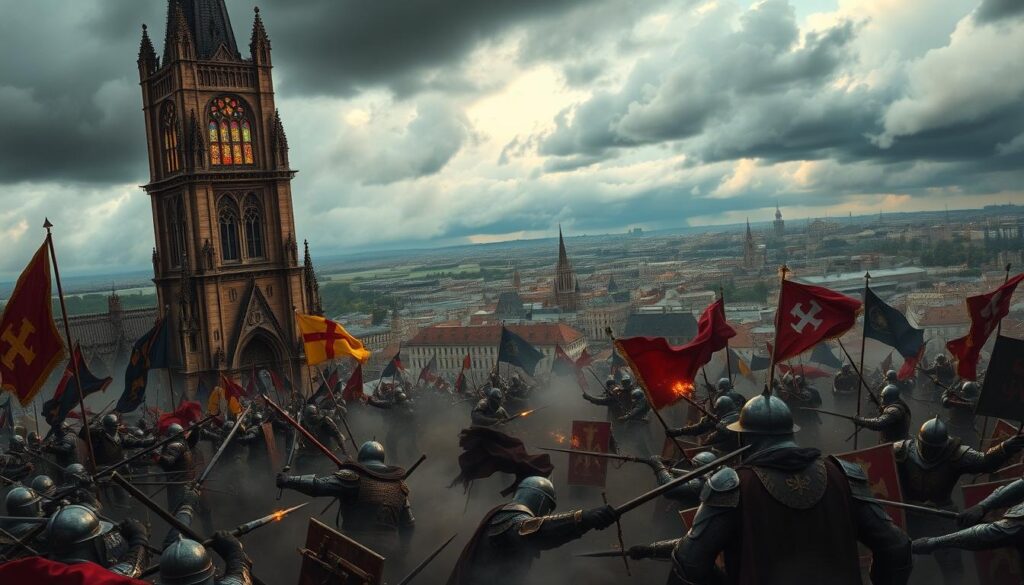
Protestant leaders staged a daring move in 1567—the Meaux surprise. They tried capturing young King Charles IX to free him from Catholic advisors. Though unsuccessful, this plot hardened divisions across France.
Violence peaked in Nîmes during the Michelade massacre. Dozens died when tensions between neighbors turned deadly overnight. Such sudden outbreaks showed how fragile peace had become.
Influence of Foreign Aid and Tactical Innovations
Spain’s Philip II bankrolled Catholic forces, while England’s Elizabeth backed Protestant rebels. The Dutch revolt against Spanish rule further complicated these alliance networks. Soldiers from Germany and Switzerland joined both sides.
Catholic troops scored major wins at Jarnac and Moncontour using new battlefield strategies. Cavalry charges and coordinated pike formations changed how army units fought. These clashes proved foreign support could swing outcomes dramatically.
As money and weapons flowed across borders, what began as civil wars became international showdowns. Rulers learned religious conflicts could advance their political aims far beyond home territories.
Understanding the “protestant wars”: An Ultimate Guide
Labels shape how we remember history. What we now call the Protestant Wars began as chaotic struggles without a unified name. Contemporaries described them as “public troubles” or “civil rebellions,” reflecting their local and political nature.
Defining the Term and Its Historical Impact
The phrase “Wars of Religion” first appeared in 1580s documents. Enlightenment thinkers later popularized it as a cautionary tale. Voltaire famously argued these clashes proved “faith makes poor governance” – a view influencing historians for centuries.
Early 20th-century scholars downplayed spiritual motives. Marxist analysts framed the conflict as economic class warfare. This interpretation dominated until recent decades.
Modern researchers like Natalie Zemon Davis changed the conversation. Through letters and diaries, they revealed how ordinary people saw their actions as holy missions. One farmer’s journal states: “We fight not for land, but for God’s true church.”
Today’s historians balance political, economic, and religious factors. The movement wasn’t just about theology – it reshaped ideas about power, community, and personal belief. Understanding these layered motives helps explain why the name still sparks debate 400 years later.
Key Battles and Turning Points in the Conflict
Frozen fields became killing grounds as Europe’s religious divisions reached their violent peak. Three decisive clashes and one horrific massacre would forever change how nations handled faith-based disputes.
The Battle of Dreux, Jarnac, and Moncontour
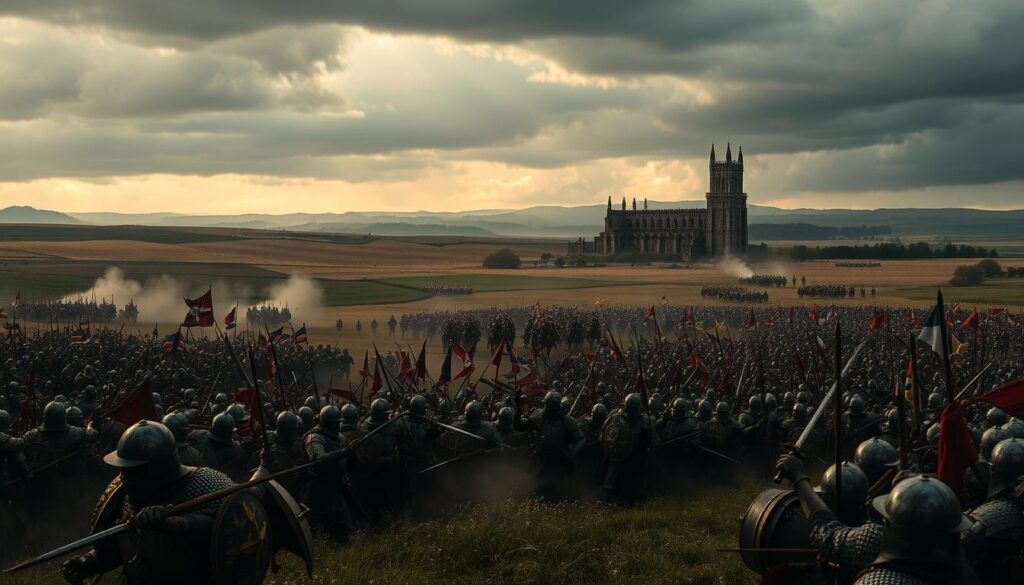
December 1562’s Battle of Dreux marked a new era of warfare. Royal forces used disciplined cavalry charges to overpower Protestant rebels. “We fought not as rabble, but as soldiers of Christ,” wrote one participant. The victory proved organized armies could crush spontaneous uprisings.
Seven years later, the Battle of Jarnac turned tragic when Protestant leader Condé fell in combat. His death left allies reeling. At Moncontour, Catholic troops nearly destroyed Protestant forces through superior tactics. Admiral Coligny’s narrow escape kept resistance alive.
Massacres, Sieges, and the Saint Bartholomew’s Day Crisis
The 1563 siege of Orléans showed how quickly fortunes could shift. Catholic commander Duke de Guise seemed poised to crush rebels—until an assassin’s blade ended his campaign. City defenders gained temporary relief through this shocking turn.
But August 1572 brought unparalleled horror. Four days after the king‘s sister married Protestant Henri de Navarre, Paris erupted. What began as targeted arms confiscations became six days of slaughter. “The gutters ran red with neighbor killing neighbor,” recorded a survivor. Nearly 10,000 inhabitants perished nationwide.
These events proved religious hatred could override royal authority. Each clash deepened divisions, making peace seem increasingly impossible.
Influence of Edicts, Treaties, and Political Maneuvering
French monarchs wielded royal decrees like surgical tools to mend their fractured kingdom. These documents tried to stitch together religious peace while keeping the crown’s authority intact. Each edict revealed the delicate balance between compromise and control.
The Edicts of Amboise, Longjumeau, and Boulogne
The 1563 Edict of Amboise marked France’s first major attempt at religious order. It allowed limited Protestant worship in noble homes—a temporary fix that satisfied neither side. “We grant this not from love, but necessity,” wrote Charles IX’s advisors.
Subsequent agreements grew weaker. The 1568 Edict of Longjumeau revived Amboise’s terms but collapsed within months. By 1573, the Edict of Boulogne confined Reformed worship to three towns. Catholic hardliners cheered these restrictions, while Protestants saw their rights shrinking.
| Edict | Year | Key Terms | Impact |
|---|---|---|---|
| Amboise | 1563 | Noble home worship | Temporary calm |
| Longjumeau | 1568 | Renewed Amboise terms | 5-month peace |
| Boulogne | 1573 | 3 approved towns | Protestant anger |
| Nantes | 1598 | Coexistence policy | Lasting solution |
Political Reforms and the Role of Royal Authority
Henry IV’s 1598 Edict of Nantes broke the cycle. It granted Huguenots 200 safe towns and political rights—but required Catholic practice in Paris. This shrewd move preserved the king’s image as protector of the kingdom’s traditional faith.
Earlier failures taught rulers that lasting peace required both carrots and sticks. The crown began appointing neutral judges to resolve disputes. Royal proclamations emphasized national unity over religious purity, planting early seeds of secular governance.
Military Innovations and the Gunpowder Revolution
Battlefields became laboratories for deadly new technologies during Europe’s spiritual crisis. The gunpowder revolution changed combat forever, making armored knights obsolete. Cannons could now smash castle walls in hours instead of weeks, forcing engineers to design star-shaped fortifications with angled bastions.
Infantry tactics evolved rapidly. Musketeers formed rotating lines to maintain constant fire, while pike squares protected reloading shooters. “A single volley now decides battles,” wrote a Spanish commander in 1572. These military innovations required professional armies, shifting power from nobles to centralized governments.
Artillery became lighter and more mobile. French forces dragged cannons through muddy fields using horse teams—a logistical nightmare that demanded new supply systems. The gunpowder revolution also spread destruction farther than ever before. Villages miles from front lines faced bombardment, blurring the line between soldier and civilian.
These military innovations reshaped societies as much as battlefields. Tax systems expanded to fund larger armies, while gunpowder factories became vital national assets. What began as tools for religious conflict ultimately built the foundations of modern warfare.
FAQ
What sparked the 16th-century religious struggles in Europe?
Rising tensions between Catholics and reformers over doctrine, political power, and social influence ignited the conflicts. Events like the Reformation’s spread and the Massacre at Wassy in 1562 acted as catalysts, deepening divisions across regions like France and the Holy Roman Empire.
How did foreign nations influence these conflicts?
Countries like Spain under Philip II and England backed opposing sides, providing troops, funds, and strategic alliances. This international involvement turned regional disputes into broader power struggles, shaping outcomes like the Saint Bartholomew’s Day crisis and sieges of key cities.
What role did edicts play in easing tensions?
Decrees like the Edict of Amboise (1563) and Edict of Nantes (1598) granted limited freedoms to Huguenots, aiming to balance Catholic authority with minority rights. These agreements temporarily reduced violence but often failed to address deeper political rivalries.
Which battles marked major turning points?
Clashes at Dreux (1562), Jarnac (1569), and Moncontour (1569) shifted momentum between factions. Sieges of La Rochelle and Paris also demonstrated how control of strategic locations could sway royal authority or rebel morale.
How did military tactics evolve during this period?
The use of gunpowder weapons, fortified cities, and mercenary armies transformed warfare. Leaders like Admiral Coligny adopted new strategies, blending traditional cavalry charges with artillery-focused sieges to outmaneuver opponents.
Why did the Saint Bartholomew’s Day massacre occur?
A failed assassination attempt on Gaspard de Coligny, a Huguenot leader, led to panic among Catholic elites. This triggered coordinated attacks in Paris, fueled by rumors of rebellion and Catherine de’ Medici’s political maneuvering to protect royal influence.
What long-term impacts did these conflicts have?
The struggles weakened centralized monarchies, empowered regional nobles, and set precedents for religious tolerance. They also paved the way for future reforms, reshaping Europe’s political and cultural landscape into the Thirty Years’ War era.