This short guide easterninvites U.S. readers to a clear, friendly look at one branch of the wider catholic church.
These eastern catholic churches are 23 self-governing communities in full communion with the pope. They keep distinct liturgies, histories, and spiritual rhythms while sharing core faith.
In this guide eastern catholic you will learn what defines the tradition, how it fits inside the wider faith, and why it matters for American Christians today.
Expect plain explanations of worship, sacraments, fasting, law, and governance. The sections move from basics to practical tips on visiting a parish, so you can skim or read in order at any time.
Keep an open mind: unity in faith thrives in diverse rites and cultures. Concrete examples will make the landscape easy to navigate for first-time visitors.
Key Takeaways
- One clear overview of the byzantine catholic church and its place in the catholic church.
- Practical roadmap from terminology to worship and parish visits.
- Focus on accessible language for newcomers and specific structures for deeper readers.
- Global presence with living communities in the United States.
- Tangible tips to experience prayer and community life respectfully.
What Is the Byzantine Catholic Church? A Friendly Overview for U.S. Readers
Many Americans find that the Byzantine Rite offers a vivid window into the diversity of the catholic church in the United States.
Plain answer: this tradition is part of the family of eastern catholic churches. It practices the Byzantine rite while remaining in full communion with Rome. Visitors from any background are welcome in parishes across the United States.
Full communion means shared sacraments, a common faith, and unity of leadership under the pope. In daily parish life this shows up as mutual hospitality and the ability for Latin and Eastern Catholics to attend each other’s liturgies freely.
Communities in the United States America trace roots to Eastern Europe and the Middle East. You will find lively parishes in cities and suburbs, with their own bishops, programs, and local customs.
- What to expect: chant, icons, and a communal flow of worship.
- Practical note: a Sunday liturgy here fulfills your Mass obligation.
- Tip: introduce yourself—parishioners are friendly and will guide you.
| Feature | Byzantine Tradition | How it fits in U.S. Catholic life |
|---|---|---|
| Rite | Byzantine liturgy and chant | Offered alongside Latin parish services |
| Authority | Sui iuris bishops, united with Rome | Shared sacraments and mutual recognition |
| Community | Ethnic roots; modern American parishes | Open to families and newcomers |
This short guide eastern invites you to keep reading for clear terms, history, and practical tips that make a first visit comfortable and memorable.
byzantine catholic church: Definition, Identity, and Full Communion
Think of this tradition as a distinctive branch that shares full communion with Rome while keeping its own life and rite.
The United States hosts one of the eastern catholic churches families, part of 23 sui iuris particular churches that are in communion with the pope.
These communities keep their own liturgy, spirituality, theology, and canon law. That patrimony is not merely style; the 1990 Code of Canons of the Eastern Churches protects it.
Being in communion means shared sacraments, common faith, and linked governance. These are not separate denominations but members of the same catholic church family.
Self-governance (sui iuris) allows each eastern catholic church to shape pastoral life while remaining united under the pope. Historic unions and dialogues restored and deepened this union over centuries.
- You may receive the Eucharist and other sacraments in these parishes as part of the wider catholic church.
- Their distinct worship and language are signs of richness, not division.
Terminology Matters: “Rite” vs. “Church” and Why Words Count
Clear terms help avoid confusion when reading parish notices or legal texts.
How the codes define autonomy
The Code of Canons of the Eastern Churches (CCEO) says a sui iuris community is a group with its own hierarchy recognized by the supreme authority (canon 27).
Canon 28 defines a rite as a liturgical, theological, spiritual, and disciplinary patrimony. The 1983 CIC also uses phrases like “ritual Church sui iuris” and “subjects of an Eastern rite.”
Why prefer “Eastern Catholic Churches”
Use Eastern Catholic Churches for communities and rite for worship style. U.S. bishops (1999) urged “Churches” rather than “rites” to avoid reducing identity to liturgy alone.
On “Uniate” and respectful language
“Uniate” fell from official use because it carries negative overtones. Choosing accurate language improves ecumenical dialogue and shows respect.
- term distinction: a rite = patrimony; a Church = a self-governing body within the catholic church.
- code canon law frameworks (CIC 1983 and CCEO 1990) shape how we speak about autonomy and law.
- Use precise terms when reading parish pages, diocesan notices, or reference works like the Robert Appleton Company entries.
| Word | Meaning | Where you’ll see it |
|---|---|---|
| term | Label used for clarity | Parish websites, bulletins |
| rite | Liturgical and spiritual patrimony | Liturgies, rubrics, historical notes |
| Church | Self-governing community (sui iuris) | Canon law, governance, directories |
Historical Roots: From Early Christianity to the Present
Across time, key councils and tense splits reshaped how different communities related to Rome and to each other.
Ephesus (431) and Chalcedon (451) mark early breaks. Ephesus separated groups later called the Church of the East. Chalcedon led to communities now often described as Oriental Orthodox.
The East–West Schism (1054) was a major rupture between Rome and Constantinople. Language, culture, and disputes over authority split the visible unity of the body of believers.
The Council of Florence (1431–1445) tried to bridge those gaps. It set a model for later agreements and opened pathways for reunion for some communities.
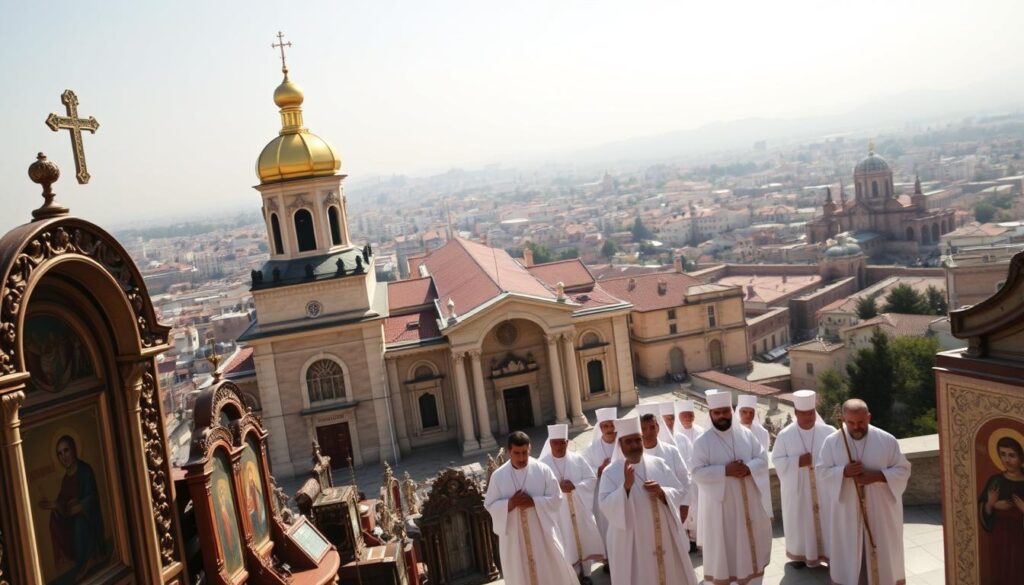
Later unions produced the eastern catholic churches we know today. Each returned to communion while keeping its own rite and heritage.
- Trace from apostolic time through councils to modern unions.
- Major moments shaped identity, governance, and worship.
- The Ukrainian Greek Catholic Church is a notable result of these processes.
History is often painful, yet it also shows persistent dialogue and reconciliation. These events remain living influences on the catholic church and on how communities welcome visitors today.
The Byzantine Rite: Liturgy, Spirituality, and Patrimony
Step inside a Divine Liturgy and you’ll notice an ancient pattern of prayer, chant, and symbol that shapes every moment. The Divine Liturgy of St. John Chrysostom is used most Sundays, while St. Basil’s appears on special days.
Icons, space, and sensory worship
The sanctuary is framed by an iconostasis, an icon screen that teaches the faith visually. Incense, processions, and chant engage sight, smell, and hearing to point worshipers toward the Kingdom breaking into the present.
Bread, spoon, and sacraments
Leavened bread is used, and Communion is given under both kinds from a spoon—an intimate sign of full communion. Chrismation (Confirmation) is normally given with Baptism and Eucharist to infants.
- Languages: English is common in U.S. parishes, with occasional Church Slavonic or Greek phrases.
- Rhythms: Fast seasons and unique feasts shape the year.
- Visitor tips: Follow the service book and ask a neighbor; parishioners gladly help newcomers receive Communion if eligible.
This rich eastern catholic liturgy complements other rites within the catholic church, showing how different traditions deepen shared belief across the various churches.
Sacraments and Christian Initiation in the East
Infant initiation in Eastern practice presents a single, graceful rite that links baptism, confirmation, and first communion.
In many eastern catholic churches infants receive Baptism, Chrismation, and the Eucharist in one liturgy. This ancient pattern highlights the unity of the sacraments and the work of the Holy Spirit from the start.
Baptism, Chrismation, and Eucharist for infants
The priest baptizes the child, anoints with chrism, and offers a small portion of Communion. Families see visible signs: oil, white garment, and a cut of hair (tonsure).
How Eastern practice compares to the Latin Church
Latin practice often spaces these sacraments over years. Both ways are fully valid within the catholic church and point to the same faith.
- Early communion is paired with ongoing catechesis as the child grows.
- Many Eastern churches ordain married men as priests; bishops are chosen from celibate clergy.
- Visitors will notice rich symbols rooted in the early Church and pastoral support for families.
| Topic | Eastern Practice | Latin Practice |
|---|---|---|
| Initiation timing | All at one liturgy | Separated over years |
| Who may be priest | Married men often allowed | Mostly celibate parish clergy |
| Focus | Immediate inclusion in communion | Gradual formation and catechesis |
Visit and ask parish clergy for specifics. Learning about different rites deepens unity across the churches and within the wider catholic church.
Fasting, Feasts, and the Liturgical Year
The liturgical year gives sacred time a clear shape, moving communities from preparation to celebration.
Major fasts: the Nativity Fast before Christmas, the Apostles’ Fast leading up to June 29, and the Dormition Fast before August 15. These seasons join Great Lent as important times of discipline.
How fasts prepare the faithful
Fasting combines prayer, abstinence, and almsgiving to ready hearts for feast days. Simple household practices—meatless meals, extra prayers, or acts of mercy—help families live the season without strain.
Joyful breaks in the calendar
Sundays and major feasts punctuate fasting with processions, special hymns, and moments of shared joy. The liturgy uses distinct melodies, propers, and readings that highlight each celebration.
- Parish practice can vary by region or eparchy, but the overall rhythm is consistent across these churches within the catholic church.
- Fasting norms are relaxed for the elderly, the ill, and young children; clergy provide pastoral guidance.
- Newcomers should attend a vigil or feast-day Divine Liturgy to experience the beauty of the rites firsthand.
Fasting seasons are hopeful journeys, not gloomy spells. They deepen longing for Christ’s coming and the glorification celebrated in our communities. Ask your parish for a calendar or bulletin that explains weekly themes and preparations within the catholic church.
Law and Governance: CCEO, Canon Law, and the Dicastery for Eastern Churches
A shared legal framework helps protect each tradition while keeping unity with Rome. The 1990 Code of Canons of the Eastern Churches (CCEO) is the first common code for the eastern catholic churches. It sets core rules while allowing each community to adopt particular law that fits its patrimony.

Code of Canons and particular law
The CCEO gives clear norms on sacraments, governance, and clerical life. Particular law fills in local details—fasting norms, liturgical usage, and parish practice.
Autonomy, hierarchy, and communion
Patriarchal, major-archiepiscopal, metropolitan, and other structures exercise self-rule under the pope. Some jurisdictions are immediately subject holy or subject holy see, so they report directly to Rome rather than a regional synod.
- The dicastery eastern churches (formerly the congregation eastern churches) supports pastoral and canonical needs.
- The 1983 Latin Code and the CCEO work together to regulate transfers, faculties, and shared ministry.
- The second vatican council urged Eastern communities to preserve their traditions, shaping later reforms.
Practical tip: when you move or marry, ask your pastor about canonical enrollment and rights in your Church of ascription. Legal terms can sound technical, but their aim is pastoral: to protect diversity in full unity.
| Topic | CCEO | Effect on parishes |
|---|---|---|
| Scope | Global code for Eastern communities | Sets minimum norms, allows particular law |
| Authority | Local hierarchies + pope | Parish practice shaped locally |
| Oversight | Dicastery for Eastern Churches | Guides eparchies, especially those immediately subject holy |
Eastern Catholic Churches at a Glance: Rites and Families
A quick map of liturgical families helps newcomers spot where local parishes belong.
Five living families shape Eastern Catholic liturgy: Alexandrian, Armenian, Byzantine, East Syriac, and West Syriac. Each family contains several distinct churches with shared melodies, calendars, and ritual patterns.
Who belongs where
- Alexandrian: Coptic, Ethiopian, Eritrean.
- Armenian: the Armenian tradition across global communities.
- Byzantine: Melkite, Romanian, Ruthenian, Ukrainian (examples).
- East Syriac: Chaldean, Syro-Malabar.
- West Syriac: Maronite, Syriac, Syro-Malankara.
Term note: a rite groups common liturgical patrimony; a church names the actual community with its own hierarchy. Some jurisdictions are immediately subject holy or directly subject holy see, which shapes their reporting and pastoral support.
| Family | Example Churches | Notes |
|---|---|---|
| Alexandrian | Coptic, Ethiopian, Eritrean | Distinct languages and chants |
| East Syriac | Chaldean, Syro-Malabar | Ancient Mesopotamian roots |
| West Syriac | Maronite, Syriac, Syro-Malankara | Rich hymnody and monasticism |
All these eastern catholic churches are in full communion with the pope and the wider catholic church, united under a communion bishop rome. Consult directories or the historical robert appleton company for guides. Visit parishes from different families to sense how ancient diversity enriches modern mission.
The Ruthenian (Byzantine) Catholic Church in the United States
The Ruthenian story in America blends immigrant roots with a steady push toward an English-speaking parish life. It began with the Union of Uzhhorod (1646) and grew into a prominent Greek Catholic Church presence across the United States.
From the Union to Pittsburgh
Early tensions over married clergy prompted some priests and faithful, led by Fr. Alexis Toth, to join the Orthodox Church America. Later, 37 parishes formed the American Carpatho-Russian Orthodox and the Carpatho-Russian Orthodox Diocese (1938).
Growth, English liturgy, and identity
The Byzantine Catholic Metropolitan Church of Pittsburgh was erected in 1969. Its seat is the Cathedral of Saint John Baptist in Munhall, Pennsylvania. Many Ruthenian Catholics embraced English liturgy and a clear American identity in parish life.
Married clergy norms and renewal
Post-Vatican II reforms shaped particular law (1999) and liturgical revisions (2007). These steps, supported by the Congregation for the Eastern Churches and advocates during Pope John Paul’s era, renewed catechesis and participation.
“Visit a Sunday Liturgy at Saint John Baptist to see this living heritage.”
| Moment | Significance | Note |
|---|---|---|
| Union of Uzhhorod | Origin | Root for many Ruthenian Catholics |
| 1938 | Jurisdiction split | American Carpatho-Russian Orthodox |
| 1969 | Metropolis formed | Cathedral of Saint John Baptist |
For historical detail see entries in the Robert Appleton Company and diocesan guides. Today parishes welcome diverse backgrounds and invite Catholics United States to experience the rite firsthand.
Key Jurisdictions and Structures Today
From Pittsburgh to Mukachevo, current jurisdictions show how pastoral care links local life with global oversight.
Metropolis of Pittsburgh and its eparchies
The Metropolis of Pittsburgh centers on the Archeparchy of Pittsburgh and its suffragans: Passaic, Parma, and Phoenix.
In 2022 the exarchate of Saints Cyril and Methodius of Toronto joined this network, extending pastoral care into Canada and strengthening parish ties.
Mukachevo and the Czech exarchate
The Greek Catholic Eparchy of Mukachevo (Ukraine) and the Apostolic Exarchate in the Czech Republic are immediately subject holy and report directly to Rome.
Both jurisdictions depend on the dicastery eastern churches for coordination. pope john paul II established the Czech exarchate in 1996, a move the congregation eastern churches had previously helped shape. retrieved march 2022.^
- These structures guide clergy assignments, including married priest where permitted.
- They cooperate on seminaries, liturgical texts, and catechetical resources for the catholic church.
- Different canonical statuses—metropolis, eparchy, exarchate—match pastoral needs while keeping unity across the churches.
| Type | Example | Role |
|---|---|---|
| Metropolis | Pittsburgh | Regional coordination and suffragan eparchies |
| Eparchy | Passaic / Mukachevo | Local governance and parish care |
| Exarchate | Czech Republic / Toronto | Pastoral outreach, sometimes directly to Rome |
Tip: visit eparchial websites to find parish locators, calendars, and pastoral letters from the ruthenian catholic church and other local bodies.
Second Vatican Council and the Renewal of Eastern Traditions
A major shift at Vatican II invited Eastern communities to reclaim their liturgical voice and heritage.
Orientalium Ecclesiarum: restoring dignity and ending Latinization
Orientalium Ecclesiarum affirmed the equality and dignity of the eastern catholic churches and urged them to keep their ancient rites. The document named past Latinization as a problem and asked for restoration of authentic practices.
Practical outcomes followed quickly. Bishops and theologians worked on new liturgical books, improved translations, and revived chant. Parishes began using vernacular words more wisely while guarding core traditions.
- Renewed catechesis: faithful learned why their customs matter, deepening active participation.
- Liturgical recovery: attention to original rites, music, and texts increased.
- Mutual respect: relations with Latin parishes grew warmer, building communion of hearts.
“The council called Eastern rites treasures of the catholic church, not relics of the past.”
| Outcome | What changed | Impact in parishes |
|---|---|---|
| Liturgical texts | New translations and editions | Clearer vernacular use and faithful participation |
| Music & chant | Revival of traditional melodies | Stronger congregational singing and identity |
| Catechesis | Focused teaching on meanings | Deeper understanding of rites and customs |
The renewal remains ongoing. Parishes keep refining translations, musical settings, and catechetical tools so traditions stay living and relevant. Newcomers should expect to find vibrant rites that are practiced with care and explained with hospitality.
Relations with Orthodox Churches: Shared Heritage, Distinct Communion
In many towns the worship, icons, and fasting traditions of Eastern Catholics and Orthodox feel familiar to one another.
Shared heritage: both groups draw from the same liturgical forms, monastic practices, and theological themes. This common past shows in chant, icon veneration, and the year of fasts and feasts.
Distinct communion: Eastern Catholic communities are in full communion with the pope, while Orthodox bodies are not. That difference affects governance and some sacramental recognition, even when worship is similar.
Relations vary locally. Some places see cooperation on social services, cultural events, and joint service projects. Other areas face tension from complex histories of union and separation.
- Use careful, respectful term choices when speaking across traditions.
- Personal friendships often ease official disagreements and build trust.
- Visitors from Orthodox backgrounds usually feel at home in liturgy, yet should note differences in ecclesial communion.
Example: the Ukrainian Greek Catholic community offers a large, living example of how Eastern heritage remains vibrant within full communion with Rome. Nearby parishes associated historically with Orthodox Church America often add to the same civic life.
“Pray for unity in truth and love, trusting that courteous engagement can ease misunderstandings.”
| Topic | Eastern Catholic Practice | Orthodox Practice |
|---|---|---|
| Worship style | Similar liturgy, icons, chant | Similar liturgy, icons, chant |
| Ecclesial status | In full communion with Rome | Not in communion with Rome |
| Local relations | Often cooperation on charity and culture | Cooperation or tension depending on history |
Above all, approach neighboring communities with curiosity and respect. Shared prayer and common service can help both sets of churches reflect Christ more fully in the United States.
Byzantine Catholics and the Wider Catholic Church in the United States
Shared worship and common care link Eastern parishes with the broader Catholic family across the United States. Attendance and sacramental sharing are ordinary: Latin and Eastern Catholics may attend Mass and receive sacraments in any parish that admits them. This practice shows real communion in everyday parish life.
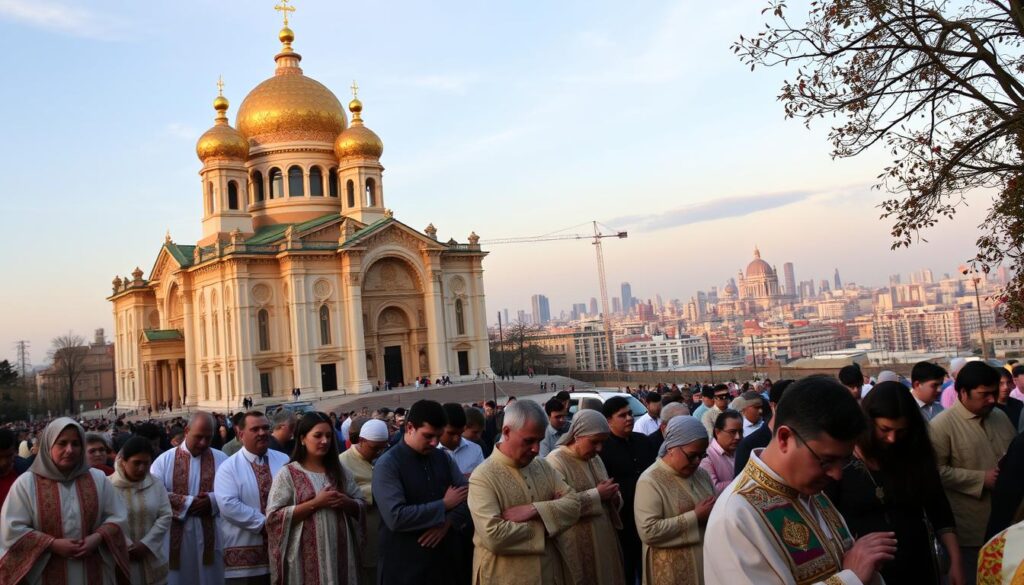
Mutual sacramental sharing and attending liturgy across rites
Visitors should not worry: you can usually receive the Eucharist when a parish permits it. Arrive early, follow the service book, and ask a priest or usher if you are unsure about reception rules. Most parishioners will welcome questions and guide you respectfully.
Catholic Near East Welfare Association and support networks
Groups such as the catholic near east agencies, near east welfare initiatives, and the east welfare association sustain Eastern communities worldwide. They fund seminaries, rebuild parishes, and assist refugees from conflict zones.
- These networks link U.S. generosity to needs in the Near East and beyond.
- Parishes in the catholic church also collaborate across rites on food pantries, youth ministry, and pro-life work.
- Subscribe to newsletters from catholic near east agencies to see where gifts and volunteer time make a difference.
Practical tip: attend a choir concert or festival at a nearby Eastern parish. Music, food, and feast days are easy ways for Catholics United States to build friendships and learn shared saints and devotions across the churches.
Notable Eastern Catholic Churches by Size and Presence
Two Eastern communities have especially large diasporas and active parishes worldwide.
Syro‑Malabar and the Ukrainian Greek Catholic today
The Syro‑Malabar Church is the largest of the eastern catholic churches as of 2022, with millions of faithful and parishes across Asia, Europe, North America, and Oceania. Its liturgical life and family ministries thrive in many immigrant communities.
The ukrainian greek catholic community follows closely in size. It maintains a vibrant diaspora with new missions, growing English resources, and expanding greek catholic eparchy structures in places of migration.
- Other greek catholic church communities include Romanian, Melkite, Ruthenian, Slovak, and smaller groups.
- Belarusian greek catholic communities remain small but important for heritage and pastoral care.
- Historical sources like the robert appleton company track the spread and growth; retrieved march 2022.^
| Community | Global presence | Strengths |
|---|---|---|
| Syro‑Malabar | Large diaspora; many parishes worldwide | Strong catechesis, family ministry, active liturgy |
| Ukrainian Greek Catholic | Wide diaspora; new missions and English resources | Parish outreach, cultural ties, episcopal visits |
| Smaller greek catholic church groups | Regional eparchies and missions | Cultural preservation, local service, pastoral care |
Support from leaders, including gestures by pope john paul, helped these communities flourish in freedom. Use a local parish finder to see nearby parishes and their languages. Attend a festival or a bishop’s visitation to experience how these churches enrich neighborhoods through outreach and family life.
How to Experience the Byzantine Rite Near You
A first visit to a Divine Liturgy often feels like joining a long conversation that uses chant, icons, and incense.
What to expect: Most parishes celebrate the Divine Liturgy of St. John Chrysostom on Sundays. The assembly sings robust responses, an iconostasis frames the sanctuary, and Communion is offered by spoon under both kinds.
Practical walk‑through: arrive a few minutes early and pick up a service book. Sit mid‑pew to see the icon screen and hear the deacon and choir clearly.
Tips for receiving and participating
Visitors who belong to the catholic church may receive Communion when permitted. Approach reverently, say your baptismal name quietly, and receive from the spoon. If unsure, ask the priest or a neighbor.
Expect more standing, frequent bows, and making the Sign of the Cross right‑to‑left. Families are welcome; children adapt quickly to the lively soundscape and post‑liturgy coffee hour.
- Follow the assembly for posture and responses.
- Return a second time—the flow becomes clearer with each visit.
- Ask for a short tour of icons after Liturgy; parishioners enjoy explaining saints and feasts.
Why go again: this rite complements Latin parish life and enriches your sense of communion across the churches. Give it a little time and you’ll notice new details that deepen appreciation.
Conclusion
As this guide closes, notice how an ancient liturgical life continues to shape vibrant pastoral care and community today.
The byzantine catholic church offers worship, teaching, and service that enrich the wider catholic church. Eastern identity remains distinct while living in church full communion with Rome.
The second vatican council encouraged the eastern catholic churches to preserve their rites. That renewal fuels liturgy, catechesis, and parish outreach across many local communities.
Visit a nearby parish, meet clergy and faithful, and let this tradition deepen the whole body of believers. Thank you for reading—share this guide and take the next step: find a liturgy, listen, and join the hospitality of these churches.
FAQ
What is this Eastern Catholic community and how does it relate to Rome?
This community belongs to the family of Eastern Catholics in full communion with the pope. It preserves its own liturgy, spiritual customs, and governance while recognizing the pope as the universal pastor. The relationship blends autonomy in traditions with unity in faith and sacraments.
What does “rite” mean compared to “church” and why does the distinction matter?
“Rite” refers to liturgical, theological, and spiritual customs. “Church” identifies a self-governing particular church. The Code of Canons of the Eastern Churches uses “sui iuris” to describe such self-governing communities, so using the right term respects identity and legal status.
How did historical councils and schisms shape these Eastern communities?
Key councils and later divisions reshaped doctrinal and jurisdictional lines over centuries. Events like Ephesus, Chalcedon, and the East–West Schism contributed to distinct paths. Some communities later entered union with Rome through agreements such as those reached at Florence and subsequent unions.
What are the main features of the Byzantine liturgical tradition?
The tradition centers on the Divine Liturgy (most commonly of St. John Chrysostom and sometimes St. Basil), rich chant, venerable iconography, the iconostasis screen, use of leavened bread, and communion often distributed with a spoon. Worship engages all senses to express theology and prayer.
How are baptism and initiation celebrated for infants in the East?
Infants normally receive Baptism, Chrismation (anointing with holy oil), and Eucharist together. This practice emphasizes full incorporation into the life of the community from the start, differing in ritual form and timing from typical Latin practice.
What is the typical fasting and feast structure across the liturgical year?
The calendar includes major fasts such as the Nativity Fast, Apostles’ Fast, and Dormition Fast, along with Great Lent before Pascha. Feasts and fasts shape communal prayer, fasting discipline, and preparation for major solemnities.
Which laws and institutions govern these churches today?
The Code of Canons of the Eastern Churches (CCEO) provides universal norms, while particular law and local hierarchies govern day-to-day life. The Dicastery for the Eastern Churches at the Vatican oversees relations and supports the distinctive traditions and autonomy of these churches.
What are the major Eastern Christian families and how do they differ?
Traditions include Alexandrian, Armenian, Byzantine, East Syriac, and West Syriac families. They differ in liturgy, language, chant, and pastoral customs while sharing apostolic roots and many sacramental beliefs.
How did the Ruthenian (Byzantine) community develop in the United States?
The Ruthenian presence in the U.S. grew from immigrants who brought their faith and pastoral customs, leading to organized eparchies and the Metropolis of Pittsburgh. Over time, English liturgy, pastoral adaptations, and clarified norms for married clergy shaped the American expression.
Can members of different rites receive sacraments across communities?
Yes. Catholics of varied rites who are in full communion may normally receive sacraments from one another, and they may attend liturgies across rites. Practical norms and local pastoral guidelines govern particular situations.
How did the Second Vatican Council affect Eastern traditions?
The council’s decree Orientalium Ecclesiarum affirmed the value of Eastern traditions, encouraged renewal, and called an end to Latinizing practices. It supported the preservation and authentic development of their liturgical and spiritual patrimony.
What resources help people find services and support networks in the U.S.?
Diocesan and eparchial websites, national organizations, and groups like the Catholic Near East Welfare Association provide directories, charitable support, and information. Local parish listings often note language, service times, and pastoral contacts.
Which Eastern communities have the largest presence today?
Among the larger communities are those from the East Syriac and Byzantine families, including sizable immigrant and ancestral groups. Presence varies regionally, with notable communities organized into eparchies and exarchates.
What should a visitor expect at a Divine Liturgy in this tradition?
Expect a formal, chant-rich liturgy with icons, processions, and set prayers. Participation may include standing for much of the service, responses, and the reception of Communion. Hospitality varies by parish, but newcomers are usually welcomed warmly.