Let’s explore a story that shaped nations and inspired generations. For over two thousand years, a global spiritual community has guided millions through faith, tradition, and service. This journey begins with humble origins and grows into one of humanity’s most enduring institutions.
The Catholic Church today unites 1.4 billion people across every continent. Its reach spans art galleries, universities, and neighborhood parishes. From ancient rituals to modern charities, its influence touches countless aspects of daily life.
You’ll see how early believers faced challenges and opportunities. Through empires rising and falling, this faith adapted while keeping its core message. Leaders emerged who changed the course of politics, science, and social justice.
Discover how 24 unique traditions work together under one spiritual umbrella. Each contributes to a vibrant tapestry of worship styles and cultural expressions. Together, they form a network of over 3,500 local communities worldwide.
Key Takeaways
- Global spiritual network serving 1.4 billion members
- Blends ancient traditions with modern social initiatives
- 24 distinct worship styles united under shared beliefs
- Shaped Western art, education, and ethical frameworks
- Maintains local presence through 3,500+ dioceses
Introduction: An Ultimate Guide to Roman Catholicism
Unlock the secrets of a 2,000-year-old tradition that still guides millions worldwide. This guide helps you navigate the catholic church’s remarkable journey from small gatherings to a global network of faith. Whether you’re curious about ancient rituals or modern outreach programs, we’ve got you covered.
Purpose and Scope of This Guide
Our roadmap explores three key areas:
- How theological ideas shaped art and education
- The growth of local communities into worldwide ministries
- Modern social programs addressing contemporary challenges
You’ll discover connections between sacred music and Renaissance politics, or how medieval monasteries influenced today’s hospitals. We break down complex topics into bite-sized explanations perfect for first-time explorers.
Understanding the Importance of Catholic History
Why does this matter? The church’s story is woven into humanity’s greatest achievements. Gothic cathedrals redefined architecture. Monks preserved classical knowledge during turbulent times. Missionaries created writing systems for unwritten languages.
By studying these developments, you gain new perspectives on:
- Ethical frameworks guiding modern societies
- Interfaith dialogue shaping global peace efforts
- Charitable work feeding 12 million people annually
This isn’t just about the past – it’s a living tradition shaping our shared future. Ready to begin your journey?
Apostolic Origins and Early Foundations
How did a small group of followers spark a worldwide movement? The answer lies in foundational events that shaped spiritual leadership for centuries. At its heart stands a carpenter-turned-teacher and his chosen messengers.
Jesus Christ and the Apostolic Mission
Jesus of Nazareth handpicked twelve students to continue his work. These apostles received clear instructions: “Go and make disciples of all nations.” Their mission gained momentum after Pentecost, when believers say divine power transformed frightened fishermen into bold preachers.
This event marks the church’s public launch. Within decades, communities sprang up across the Mediterranean. Early leaders faced persecution but kept expanding their network through:
- Shared meals celebrating Jesus’ last supper
- Letters guiding distant congregations
- Appointing local overseers (later called bishops)
The Legacy of Saint Peter
Among the twelve, Peter emerged as a central figure. Jesus famously told him: “You are Peter, and on this rock I will build my church.” This statement fuels the Catholic belief that Peter became the first bishop of Rome – a role now held by the pope.
While historians debate Peter’s exact travels, tradition holds that he helped establish Rome’s Christian community. Today’s popes trace their spiritual authority through an unbroken line from Peter, creating a unique leadership model among Christian groups.
The Birth of a Global Faith
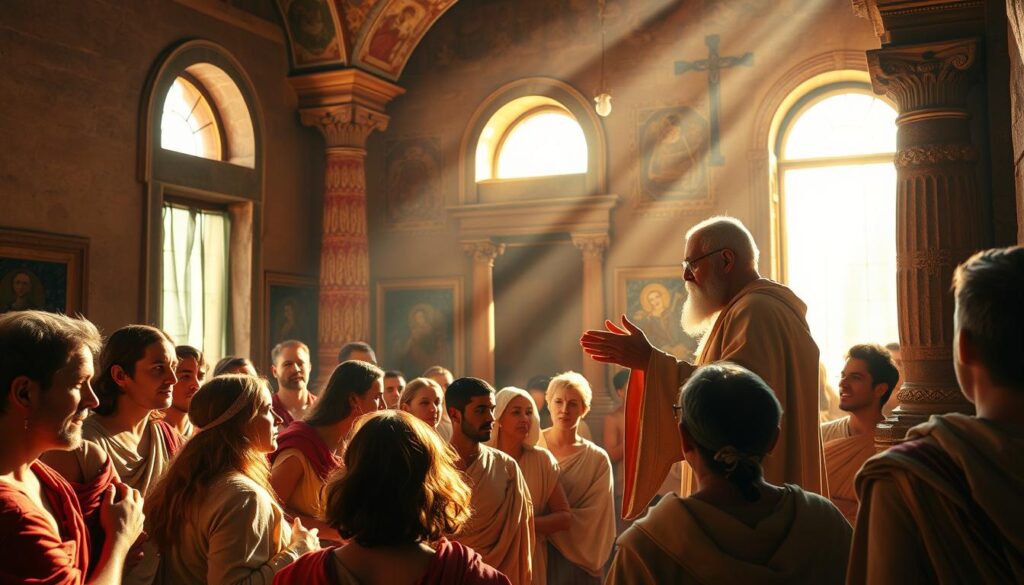
A spiritual revolution quietly transformed the ancient world. By 100 AD, over 40 vibrant Christian groups stretched from North Africa to South Asia. These weren’t just meeting places – they became hubs of hope reshaping how people understood community and purpose.
Formation of Early Christian Communities
The faith spread like wildfire through city markets and trade routes. While most churches started within the Roman Empire, daring believers planted communities in Armenia’s mountains and India’s spice ports. Slaves often heard the message first, then wealthy women used their homes as secret worship spaces.
Sunday gatherings became the heartbeat of this movement. What began as Jewish Sabbath additions evolved into unique rituals celebrating Jesus’ resurrection. Shared meals turned into sacred ceremonies, creating bonds stronger than family ties.
Leaders emerged to guide these growing groups. Bishops organized aid during plagues while teachers developed new ways to explain complex ideas. This network of local communities with global connections laid the groundwork for what would become the Roman Catholic Church’s worldwide structure.
From Persian market towns to Egyptian river ports, these early believers proved a radical truth: faith could cross any border. Their bold experiments in communal life still inspire how modern churches serve their neighborhoods today.
Defining Roman Catholicism History: Key Milestones
Critical moments reshaped Christianity’s path from underground movement to cultural cornerstone. These turning points established structures still guiding believers today. Let’s explore how bold decisions and heated debates forged a lasting spiritual legacy.
Timeline from Apostolic Era to Medieval Period
Emperor Constantine changed everything in 313 AD. His Edict of Milan stopped persecution, letting Christians worship openly. For the first time, believers could build permanent gathering spaces.
The church gained imperial muscle in 380 AD. Emperor Theodosius declared Nicene Christianity Rome’s official religion. This merger of spiritual and political power created Europe’s first faith-based governance model.
Leaders formalized their structure at the 451 AD Council of Chalcedon. While affirming Rome’s primacy, they granted Constantinople second-place status. This balance between central authority and regional hubs still defines the catholic church’s global operations.
Long before these imperial decrees, bishops laid groundwork through collaboration. By 200 AD, regional meetings helped standardize practices across growing communities. These synods became prototypes for today’s ecumenical councils.
Consolidation of Papal Authority and the Roman Curia
The roots of today’s Vatican hierarchy stretch back to pivotal fourth-century decisions. Between 350-500 AD, spiritual leaders in Rome transformed from local shepherds to global influencers. This shift didn’t happen overnight – it grew through strategic support for unified beliefs during heated theological debates.
Rise of Papal Primacy
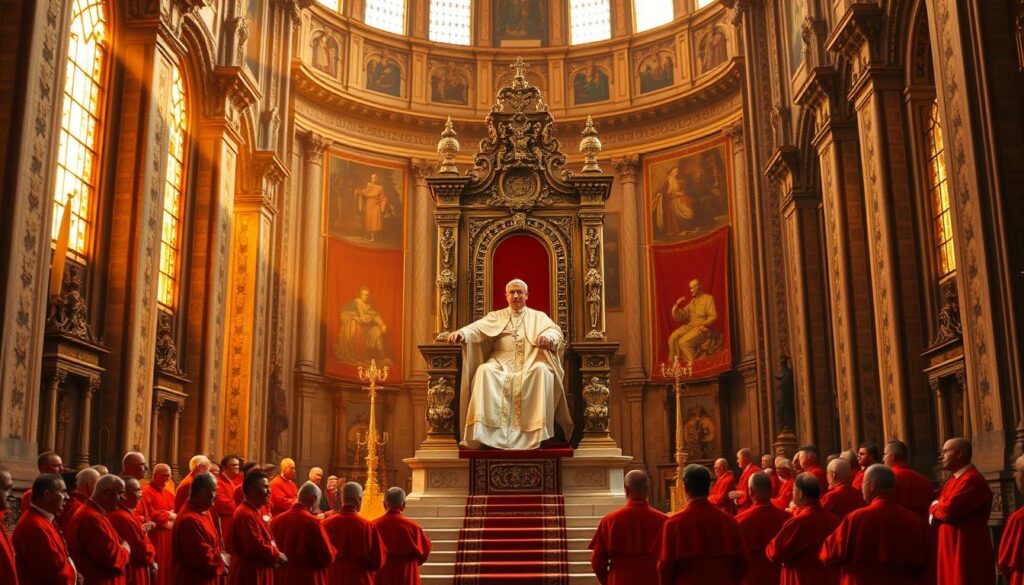
Roman bishops gained trust by resolving conflicts across Christian communities. When groups disagreed about core teachings, they increasingly turned to Rome’s leaders. One fifth-century pope boldly claimed: “The care of the whole church was placed on Peter alone.”
This idea took root through practical actions. Popes sent letters clarifying doctrines and mediating disputes. Their consistent backing of widely accepted beliefs made Rome the go-to source for spiritual guidance. By 500 AD, the bishop of Rome had become Christianity’s chief referee.
The Role of the Holy See
The administrative engine behind this growth emerged as the Roman Curia. This network of councils and departments handled everything from foreign relations to local parish concerns. Specialized groups managed:
| Department | Function | Impact |
|---|---|---|
| Congregation for Doctrine | Guarded teachings | Standardized beliefs |
| Apostolic Penitentiary | Handled complex cases | Centralized decision-making |
| Prefacture of the Household | Managed resources | Strengthened operations |
This system let the Holy See balance two roles effectively. The pope serves both as local leader for Rome’s faithful and global shepherd for 1.4 billion members. This dual structure remains central to the catholic church’s operations worldwide.
The Influence of Councils and Doctrinal Debates
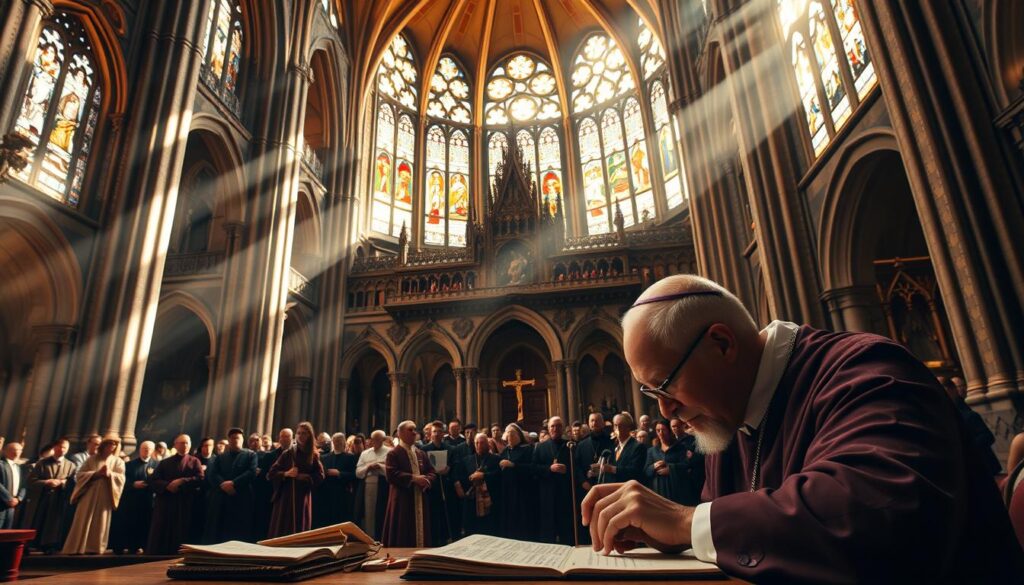
Imagine a room where ancient leaders shaped beliefs still followed today. From heated debates to unanimous votes, these gatherings defined what billions would believe for centuries. Their decisions settled cosmic questions and earthly power struggles alike.
Impact of Ecumenical Councils
Emperor Constantine started a bold tradition in 325 AD. He called the first ecumenical council at Nicaea to resolve disputes about Jesus’ divine nature. The resulting creed became Christianity’s foundation, though not everyone agreed. Arian Christians split off, creating rival communities across Europe and Asia.
The Council of Ephesus (431 AD) tackled another mystery: how divine and human natures coexisted in Christ. Leaders declared Mary “God-bearer,” affirming Jesus’ full humanity and divinity. This decision unified most believers but angered groups in Persia and Egypt.
| Council | Year | Key Decision | Lasting Impact |
|---|---|---|---|
| Nicaea | 325 | Affirmed Christ’s divinity | Created Nicene Creed |
| Ephesus | 431 | Defined Christ’s dual nature | Strengthened Marian devotion |
| Chalcedon | 451 | Confirmed papal authority | Centralized church leadership |
Chalcedon’s 451 AD meeting proved most consequential for the catholic church’s structure. “Peter has spoken through Leo,” declared bishops, cementing Rome’s supreme role. This framework let the church maintain consistent doctrine across expanding territories.
Through these councils, bishops balanced local needs with universal truth. Their collective wisdom created a playbook still used today – debating fiercely, then uniting behind shared beliefs. This process turned abstract ideas into practical guides for daily faith.
Medieval Transformations and Monasticism
A quiet revolution in communal living reshaped medieval Europe. Spiritual seekers created self-sufficient communities that balanced prayer with practical work. Their innovations would preserve knowledge and reshape entire societies.
The Rule of St. Benedict
In 530 AD, a monk crafted guidelines that changed religious life forever. Benedict’s simple motto – “Pray and work” – offered structure without rigidity. His Rule scheduled each day with equal time for worship, study, and manual labor.
This balanced approach spread rapidly across orders. Unlike earlier extremes of asceticism, Benedictine communities became models of sustainable spiritual practice. By 800 AD, nearly every European monastery followed these principles.
Monastic Contributions to Western Civilization
These communities became medieval powerhouses. Monks didn’t just copy ancient texts – they improved farming tools, developed musical notation, and pioneered water systems. Their scriptoria preserved 90% of surviving classical literature during turbulent times.
Three key areas show their lasting impact:
- Education: Created Europe’s first library networks
- Economy: Introduced crop rotation techniques
- Culture: Developed Gregorian chant traditions
The catholic church relied on these centers to train clergy and advise bishops. Through wars and plagues, monasteries remained islands of stability. Their dual focus on spiritual growth and earthly service continues inspiring modern religious orders worldwide.
Renaissance, Reformation, and Counter-Reformation
The 16th century reshaped religious landscapes through seismic shifts and spirited responses. As new ideas spread across Europe, the catholic church faced its greatest challenge yet. This era saw bold calls for change and equally determined efforts to preserve unity.
Impact of the Protestant Reformation
Martin Luther’s 1517 protests ignited the protestant reformation, challenging papal authority like never before. Over 20,000 Protestant congregations formed within decades, each interpreting scripture independently. This fracture created lasting divisions in Western Christianity.
Bishops scrambled to address growing dissent. Some leaders embraced dialogue, while others doubled down on traditional structures. The resulting split reshaped worship styles, governance models, and even national identities across Europe.
Catholic Revival Movements
In response, the roman catholic church launched its own renewal campaign. The Council of Trent (1545-63) clarified doctrine and standardized practices. New religious orders like the Jesuits became global missionaries, blending spiritual zeal with intellectual rigor.
Local parishes revived community engagement through art and education. Charity networks expanded, feeding the poor while reinforcing traditional teachings. These reforms strengthened the church’s ability to adapt without abandoning core principles.
FAQ
What role did Saint Peter play in early Christianity?
Saint Peter is recognized as the first bishop of Rome and a foundational leader of the early church. Tradition holds that Jesus entrusted him with spiritual authority, shaping the papacy’s development over centuries.
How did early Christian communities spread globally?
Early believers carried teachings across the Roman Empire through missionary work, trade routes, and cultural exchange. Persecution and resilience strengthened their unity, laying groundwork for a worldwide faith.
Why are ecumenical councils significant in Catholic doctrine?
Councils like Nicaea and Trent addressed theological disputes, clarified beliefs, and standardized practices. They reinforced unity under the Holy See while adapting to cultural and intellectual shifts.
How did monasticism influence Western civilization?
Monastic orders, such as the Benedictines, preserved ancient texts, promoted education, and advanced agriculture. Their disciplined lifestyle became a model for spiritual and communal growth.
What sparked the Counter-Reformation?
In response to Protestant critiques, the church initiated reforms through the Council of Trent. It reaffirmed sacraments, improved clergy training, and launched renewal movements like the Jesuits.
What is the significance of the Holy See?
The Holy See serves as the central governing body of the church, led by the pope. It oversees doctrine, diplomacy, and global Catholic institutions, ensuring doctrinal consistency and unity.
How did the Protestant Reformation impact Catholic practices?
It prompted revisions in liturgy, clergy education, and transparency. Art and architecture also evolved to reflect renewed spiritual fervor during the Counter-Reformation era.
Why is the apostolic era crucial to Catholic identity?
This period established core teachings, sacraments, and church structure. Direct links to Jesus’ apostles reinforce claims of historical continuity and divine authority.