Let’s explore a statement of faith that has shaped Christian spirituality for centuries. This ancient text offers a clear path to understanding foundational truths, connecting believers across generations through shared convictions. Its words echo in prayers, liturgies, and personal devotions, serving as a spiritual anchor.
Rooted in Scripture and early Church tradition, this profession outlines core teachings about God’s nature. It highlights divine relationships: the Father’s creative power, the redemptive work of Jesus Christ, and the sustaining presence of the Holy Spirit. These truths form a framework for worship and daily living.
Why does this matter today? In a world of shifting ideologies, it provides clarity. The creed’s concise language bridges complex theology with practical spirituality. It invites reflection on what unites believers rather than divides them.
Over the next sections, we’ll uncover its historical roots and modern applications. You’ll discover how this enduring declaration continues to inspire faith, deepen prayer life, and strengthen communal identity among millions worldwide.
Key Takeaways
- Explores a 2,000-year-old statement central to Christian belief
- Clarifies teachings about the Trinity: Father, Son, and Holy Spirit
- Connects ancient traditions with modern spiritual practices
- Used in personal prayer and communal worship worldwide
- Acts as a unifying force across diverse Christian communities
Introduction to the Apostles’ Creed
What if a single paragraph could unite millions across time and space? This ancient declaration does exactly that—packing profound truths into twelve concise articles. Its power lies in simplicity, distilling complex doctrines into words anyone can grasp.
What Is a Creed?
A creed acts like a spiritual fingerprint. Originating from the Latin “credo” (I believe), these statements link personal conviction with communal identity. Early believers used them as memory aids, ensuring core teachings survived persecution and oral tradition.
These formulas serve dual purposes. They educate newcomers about foundational truths while giving seasoned worshippers prayer anchors. Think of them as cheat sheets for eternal life—condensing Scripture’s essence without oversimplifying.
The Distilled Expression of Faith
Early versions focused on baptismal vows. One second-century example declares belief in “the Father Almighty, Jesus Christ our Savior, and the Holy Spirit the Paraclete.” This triad structure became Christianity’s backbone, separating it from rival philosophies.
| Aspect | Early Creeds | Modern Expression |
|---|---|---|
| Structure | 3-5 articles | 12 detailed clauses |
| Key Focus | Baptismal vows | Full Trinitarian doctrine |
| Usage | Initiation rites | Weekly worship |
| Theological Depth | Basic salvation | Creation to eternal life |
By AD 150, believers affirmed “the holy Church” and “remission of sins” alongside divine figures. These elements still shape how communities articulate hope for heaven and earthly purpose today.
History and Formation of the Apostles’ Creed
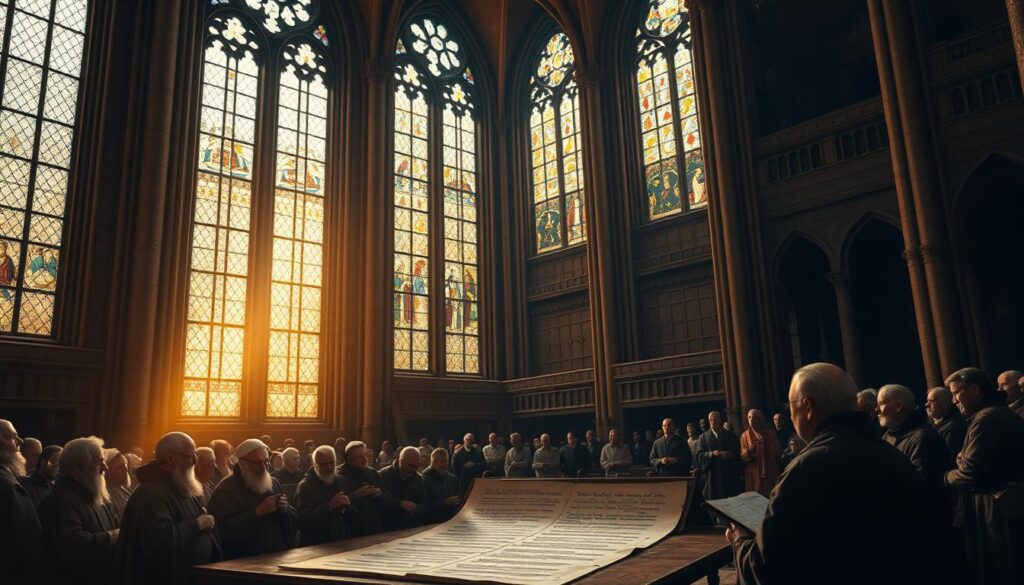
How did an ancient statement become Christianity’s most recognized summary of belief? Its journey began in the second century, when scattered believers needed shared language to guard against misunderstandings. Early leaders crafted concise formulas to preserve teachings passed down from the first disciples.
Early Church Origins and Credal Development
By AD 150, communities recited basic declarations during baptisms. These focused on God Father, Jesus’ divine sonship, and the Holy Spirit. As challenges arose—like Gnostic teachings denying Christ’s humanity—the statements grew more detailed. Church leaders expanded phrases to clarify truths about creation, forgiveness of sins, and eternal life.
The fourth-century Old Roman Creed added specifics: “born of the Virgin Mary” and “suffered under Pontius Pilate.” This version anchored worship across Europe, adapting to local needs while keeping core teachings intact.
The Evolution Through the Centuries
By the eighth century, the text we know today emerged. It unified Western believers with twelve clear articles, from “Maker of heaven earth“ to “resurrection of the body.” Though language evolved, the message stayed rooted in Scripture.
| Era | Key Features | Purpose |
|---|---|---|
| 2nd Century | Baptismal vows | Identity verification |
| 4th Century | Detailed clauses | Counter heresies |
| 8th Century | Standardized text | Unity across regions |
Today, this declaration bridges denominations. Lutherans affirm it in confirmation classes. Anglicans recite it during Eucharist. Presbyterians use it to teach covenant theology. Its endurance proves truth transcends day-to-day changes—a spiritual compass for all generations.
Core Beliefs Articulated in the Creed
What gives meaning to existence while offering hope beyond earthly struggles? The answer lies in three interconnected truths that shape Christian understanding of reality. These pillars address humanity’s deepest questions through divine relationships.
Belief in God the Father and Creation
Calling God Father Almighty does more than assign a title—it reveals character. This name combines infinite power with parental care. As the source of all heaven earth, He sustains galaxies and sparrows alike. Every sunrise whispers His commitment to creation.
The Redemption Through Jesus Christ and the Holy Spirit
Jesus Christ entered history as heaven’s rescue plan. His birth, death, and resurrection form a bridge between brokenness and wholeness. The third day victory over death opened doors to new life for all who trust this divine exchange.
After Christ’s ascension, the holy spirit became God’s active presence here and now. This helper transforms hearts, making ordinary people carriers of extraordinary love. Through spiritual gifts and daily guidance, believers experience ongoing renewal.
| Divine Person | Role | Human Impact |
|---|---|---|
| Father | Creator | Establishes purpose |
| Son | Redeemer | Offers forgiveness |
| Spirit | Sanctifier | Empowers growth |
Together, these truths form a complete picture. The Father initiates, the Son accomplishes, and the Spirit applies salvation. This triad answers our need for belonging, healing, and eternal life—a roadmap written in divine love.
apostles creed of the catholic church: Historical and Theological Insights
How do sacred words written centuries ago still guide millions today? They thrive by weaving together divine truth and human experience. This timeless declaration anchors the holy catholic church, showing how ancient wisdom meets modern spiritual hunger.
The Role of Scripture and Tradition
Imagine two rivers merging into one mighty stream. Scripture flows from biblical revelation, while Tradition carries the living faith of generations. Together, they preserve teachings about creation, salvation, and the communion saints.
Early Christians faced heresies denying Christ’s humanity or the Trinity. The declaration became a shield, clarifying that Jesus was “conceived holy spirit” yet fully human. Such phrases protect core truths while inviting deeper exploration.
Trinitarian Foundations and Divine Revelation
Why three persons in one God? The Trinity reflects eternal relationship—Father as source, Son as redeemer, and believe holy spirit as sustainer. This structure mirrors how love flows outward, seeking connection.
From the right hand father to the promise of life everlasting, each line reveals God’s desire to be known. The creed doesn’t just state beliefs—it invites us into a story where divine love repairs brokenness and unites all creation.
Line-by-Line Analysis of the Creed’s Articles
Unpacking each phrase reveals layers of meaning that anchor Christian identity. Let’s examine how specific wording shapes belief and connects to sacred texts.
Exploring Key Phrases and Their Meanings
“Born of the Virgin Mary” underscores both humanity and divinity. This miraculous birth fulfills Isaiah’s prophecy while affirming God’s tangible presence among us.
The mention of “Pontius Pilate” roots events in history. Unlike mythical tales, this Roman official’s role dates Christ’s sacrifice to AD 30-33—a verifiable timeframe.
Supporting Biblical References and Context
Resurrection claims gain strength from multiple accounts. Luke 24 details how women found an empty tomb, while 1 Corinthians 15 lists over 500 witnesses to the third day victory.
| Phrase | Biblical Anchor | Theological Impact |
|---|---|---|
| Ascended into heaven | Acts 1:9-11 | Affirms Christ’s ongoing divine authority |
| Seated at the right hand God | Psalm 110:1 | Symbolizes supreme honor and judgment power |
| Will come judge living | Matthew 25:31-46 | Motivates ethical living and hope |
These connections transform abstract ideas into lived faith. When believers recite “suffered under Pontius Pilate,” they’re not just recalling history—they’re embracing a love that entered time to redeem it.
The Creed’s Role in Faith Practice and Liturgy
Whispers of ancient words echo through modern chapels and living rooms alike. These phrases form spiritual rhythms—uniting whispered prayers at dawn with thunderous declarations in packed sanctuaries. Their power lies in repetition that shapes hearts while bridging diverse communities.
From Private Reflection to Shared Proclamation
Many begin mornings reciting truths about the Father Almighty and Christ who rose dead. These words anchor personal meditation, like roots steadying a growing tree. In the Rosary, they frame mysteries of joy and sorrow, transforming routine into sacred rhythm.
Communal worship gains depth when voices merge on Sundays. While the Nicene version often fills cathedrals, simpler phrases like “suffered under Pontius” resonate during Lent. This flexibility lets the declaration adapt without losing its essence.
Weaving Belief Into Shared Identity
Reciting these lines does more than recall facts—it forges bonds. A teenager in Texas and a grandmother in Manila affirm the same resurrection hope. Shared phrases become threads in a global tapestry of faith.
New believers learn through repetition. Children memorize “conceived holy” before grasping theology, planting seeds for lifelong understanding. Over time, these words shape how communities view forgiveness of sins and eternal promise.
| Setting | Function | Outcome |
|---|---|---|
| Personal Prayer | Focuses meditation | Deepens individual faith |
| Sunday Mass | Unites congregations | Strengthens communal ties |
| Catechism Classes | Teaches foundations | Preserves doctrine |
Conclusion
In a world of fleeting trends, the Apostles’ Creed stands as an unshakable compass. Its twelve articles don’t just recite doctrines—they map a journey from divine creation to eternal hope. Millions find here a shared language that transcends borders and generations, knitting diverse voices into one chorus of belief.
This ancient declaration remains startlingly practical. Parents teach its lines to children facing modern anxieties. Couples whisper its promises at hospital bedsides. Through phrases about forgiveness of sins and resurrection hope, theology becomes daily bread for hungry hearts.
Let these words move from memory to muscle. Recite them during morning coffee breaks or evening reflections. Each line invites deeper trust in a God who shaped heaven, entered our chaos, and promises life that outlasts death. Here, intellectual assent meets transformative practice—one sacred syllable at a time.
FAQ
Why is the Apostles’ Creed important to Catholic faith?
It summarizes essential Christian beliefs, like the Trinity, Christ’s resurrection, and the Church’s unity. Reciting it strengthens shared identity and connects believers to centuries of tradition.
How old is the Apostles’ Creed?
Its roots go back to the early 2nd century, evolving from baptismal formulas. The final form emerged around 700 AD, reflecting teachings passed down by Jesus’ followers.
Does the Creed mention the Holy Spirit?
Yes! It affirms belief in the Holy Spirit’s role in guiding the Church, forgiving sins, and uniting believers in eternal life—key to understanding the Trinity.
What does “communion of saints” mean in the Creed?
This phrase highlights the bond between living believers, those in purgatory, and saints in heaven. It reflects unity across time and space through shared faith.
Is the Apostles’ Creed used during Mass?
Many Catholics recite it at Baptism, Confirmation, and Sunday liturgies. It’s also a popular prayer for personal reflection, grounding daily life in core truths.
How does the Creed connect to the Bible?
Phrases like “rose from the dead” or “born of the Virgin Mary” echo Scripture. Early Christians wove biblical teachings into the Creed to preserve apostolic truth.
Why does the Creed call God “Father Almighty”?
This title emphasizes God’s loving authority and creative power. It roots faith in a personal, caring relationship rather than an abstract force.