Welcome to a journey through the heart of Catholic teachings! At its core, this faith centers on love—for God, others, and oneself. The foundation rests on Jesus’ words in Matthew 22: “Love the Lord your God with all your heart” and “love your neighbor as yourself.” These aren’t rigid demands but invitations to deeper spiritual growth.
The Catechism of the Catholic Church explains how these commandments shape daily life. The Ten Commandments, for example, expand this love into practical guidance. The first three focus on honoring God, while the remaining seven foster respect for community. As Pope John Paul II noted, Church law exists to guide, not control—a compass for those seeking meaning.
Many assume the faith revolves around strict regulations. In reality, most guidance comes through pastoral support and timeless wisdom. Doctrine isn’t about restriction but clarity—a way to align actions with compassion. Theology here weaves grace and responsibility into a cohesive worldview.
With over a billion members globally, the Catholic Church emphasizes unity through shared values. Its teachings adapt ancient truths to modern challenges, offering tools for personal and communal flourishing. Whether you’re exploring or deepening your faith, this framework encourages growth, not guilt.
Key Takeaways
- Catholic teachings prioritize love of God and neighbor as their foundation.
- The Ten Commandments provide practical applications of these core values.
- Church law serves as guidance, not a list of punishments.
- Doctrine offers clarity and direction for ethical living.
- Misconceptions about rigidity overlook the role of pastoral care.
- The faith balances ancient traditions with modern relevance.
Core Beliefs and Doctrines in the Catholic Church
At the heart of Catholic teachings lie timeless principles that shape everyday life. These ideas aren’t just ancient texts—they’re living guides for building relationships with God and others. Let’s explore how foundational concepts like the Ten Commandments and Beatitudes remain deeply relevant today.
God’s Two Great Commandments and the Ten Commandments
The Catechism of the Catholic Church describes the Ten Commandments as “rules for freedom” (CCC 2057). The first three focus on loving God—like honoring His name and keeping Sundays sacred. The remaining seven teach us to love our neighbor through actions like respecting parents and protecting life.
For example, “You shall not steal” (CCC 2401) isn’t just about theft. It encourages fairness in workplaces and communities. These teachings aren’t rigid demands but invitations to create harmony. As Jesus taught, all commandments flow from loving God and others wholeheartedly.
Beatitudes and the Works of Mercy
The Beatitudes offer hope when life feels heavy. Phrases like “Blessed are the peacemakers” (Matthew 5:9) remind us that struggles can lead to spiritual growth. They pair perfectly with the Works of Mercy—practical ways to live these values.
Corporal Works like feeding the hungry or visiting the sick address physical needs. Spiritual Works, such as comforting the grieving or forgiving injuries, heal hearts. Together, they show how doctrine becomes action. As the Catechism notes, these works help “fulfill Christ’s command to love” (CCC 2447).
Through these teachings, the Catholic Church provides structure while empowering the faithful to serve creatively. Whether through daily kindness or lifelong commitments, every act of love builds a better world.
Essential catholicism rules for a Faithful Life
Building a meaningful spiritual life involves practical steps woven into daily routines. The Church offers clear precepts and sacramental milestones to help believers grow closer to God and their community.
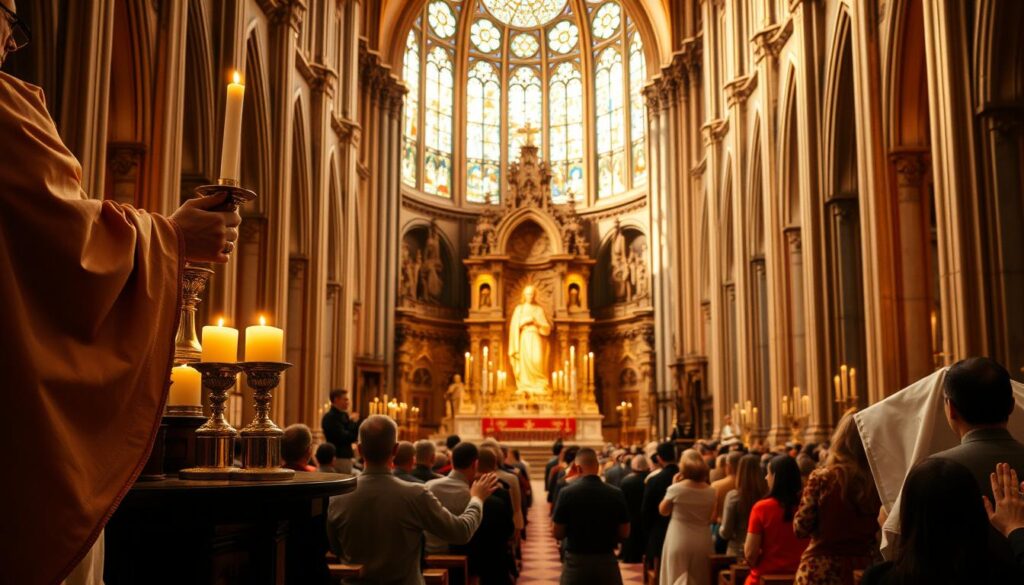
Overview of the Precepts of the Church
These five guidelines create a rhythm for spiritual health. They’re like guardrails—keeping us focused without limiting our journey. Here’s what they look like:
| Precept | Purpose |
|---|---|
| Sunday Mass & holy days | Strengthens community ties |
| Annual confession | Renews spiritual clarity |
| Easter Communion | Deepens connection to Christ |
| Fasting/abstinence | Builds self-discipline |
| Church support | Fuels global outreach |
For example, resting on Sundays isn’t about strict rules. It’s a chance to recharge and reflect. As the Catechism notes, these practices help “bind believers together in shared purpose” (CCC 2041).
Sacraments and Holy Days of Obligation
The seven sacraments mark life’s key moments—from birth to marriage. They’re grouped into three categories:
| Category | Sacraments | Life Stage |
|---|---|---|
| Initiation | Baptism, Confirmation, Eucharist | Foundational growth |
| Healing | Reconciliation, Anointing | Spiritual renewal |
| Service | Holy Orders, Matrimony | Vocational calling |
In the U.S., six holy days of obligation punctuate the year:
- January 1: Mary, Mother of God
- Ascension Thursday (40 days after Easter)
- August 15: Mary’s Assumption
- November 1: All Saints’ Day
- December 8: Immaculate Conception
- December 25: Christmas
Fasting rules are simple but meaningful. Adults skip one meal on Ash Wednesday and Good Friday. Everyone over 14 avoids meat on Lenten Fridays. These practices turn ordinary days into moments of solidarity.
Canon Law: Historical Developments and Modern Reforms
For nearly 2,000 years, canon law has guided communities while adapting to cultural shifts. This living tradition balances ancient wisdom with modern pastoral needs, creating a framework that supports both spiritual growth and practical governance.
Evolution from Ancient Canons to the 1983 Code
Early Christian communities used simple guidelines like the Didache (1st century) to address disputes. By the 12th century, scholars organized these laws into systematic collections. Four key eras shaped today’s Code of Canon Law:
| Period | Years | Key Development |
|---|---|---|
| Jus Antiquum | 33–1140 | Local councils created foundational rules |
| Jus Novum | 1140–1563 | First universal legal codes emerged |
| Jus Novissimum | 1563–1918 | Council of Trent standardized sacraments |
| Jus Codicis | 1918–present | Modern codes streamlined Church governance |
The 1983 revision simplified processes while preserving core principles. As one Vatican scholar noted, “Good law protects both truth and those seeking it.”
Matrimonial Nullity and Contemporary Legal Reforms
Pope Francis’ 2015 reforms made marriage annulments more accessible. Key changes include:
- Local bishops can now approve some cases
- Faster timelines for urgent situations
- Reduced costs for petitioners
“Mercy requires us to remove unnecessary barriers,” explained the Pontiff. These updates honor marriage’s sacredness while addressing modern relational complexities.
Liturgical Law and Its Impact on Worship
From the 1963 Sacrosanctum Concilium to recent Mass translations, liturgical laws shape how billions pray. Recent updates include:
| Document | Year | Effect |
|---|---|---|
| Summorum Pontificum | 2007 | Expanded traditional Mass access |
| Traditionis Custodes | 2021 | Recentered post-Vatican II norms |
These adjustments show how authority maintains unity while respecting diverse spiritual needs.
Living Out Catholic Doctrine in Everyday Life
Faith isn’t just Sunday rituals—it’s woven into daily choices. The Church offers two complementary guides: doctrine for understanding truth and law for shaping habits. While doctrine invites reflection, laws create shared rhythms that unite communities.
When Personal Conviction Meets Church Teaching
Consider a business owner inspired by Catholic social doctrine. They might offer healthcare benefits or fair wages—not because a law demands it, but from grasping human dignity. Similarly, Lenten abstinence from meat isn’t about punishment. It’s a voluntary penance aligning hearts with others’ needs.
The Catechism encourages this balance. For instance, teaching on marriage’s sacredness guides couples even without strict laws about birth control. Here, conscience formation through prayer matters most.
Faith That Moves Mountains—and Communities
From food banks to fair housing efforts, Catholic works of mercy address modern struggles. The Holy Spirit fuels this activism, turning ancient doctrine into neighborhood solutions. A parish supporting migrant families exemplifies teaching made tangible.
Whether through fasting or advocating justice, every act rooted in love builds bridges. As the Catechism reminds us: “Charity transforms rules into relationships.”
FAQ
What are the Ten Commandments’ role in Catholic teaching?
The Ten Commandments guide moral behavior, reflecting God’s covenant with humanity. They form the foundation for ethical decisions, emphasizing love for God and neighbor. The Catechism of the Catholic Church highlights their timeless relevance in shaping a faithful life.
How often must Catholics attend Mass?
Catholics are required to attend Mass every Sunday and on holy days of obligation, like Christmas or Easter. This fulfills the Church’s precept to honor God’s day and participate in the Eucharist, a central act of worship.
What changes did the 1983 Code of Canon Law introduce?
The 1983 Code modernized Church governance, emphasizing pastoral care over strict legalism. It simplified marriage annulment processes and clarified roles for laypeople. These reforms aimed to align canon law with Vatican II’s vision of inclusivity.
Why is confession important for receiving Communion?
Confession reconciles believers with God and the Church, especially after grave sins. The sacrament of Penance ensures spiritual readiness to receive the Eucharist, as taught in the Catechism. Catholics are urged to confess at least once a year.
How does Catholic doctrine address social justice?
Catholic social teaching emphasizes dignity, solidarity, and care for the vulnerable. Works of mercy, like feeding the hungry, put faith into action. The Church encourages advocacy for fairness, reflecting Christ’s love in community life.
Are fasting rules the same for all Catholics?
Fasting and abstinence apply to those aged 14–59, except for health reasons. On Ash Wednesday and Good Friday, one full meal and two smaller meals are permitted. Local bishops may adjust rules, as seen in the 1983 Code.
What defines a valid Catholic marriage?
A valid marriage requires free consent, openness to children, and adherence to canon law form (e.g., a priest or deacon as witness). Recent reforms under Pope Francis streamlined annulment procedures to address pastoral needs sensitively.
How do holy days of obligation vary globally?
While some days (like Christmas) are universal, others differ by country. For example, the US observes six holy days, whereas Italy includes Epiphany. Local bishops’ conferences set these dates, reflecting cultural and liturgical traditions.