What are Anglican beliefs in plain terms? Anglicanism names a global family of Christians shaped by the Bible, the historic Creeds, and a shared liturgical heritage from the Church of England.
This tradition blends Protestant reform and ancient catholic practice. Worship often follows the Book of Common Prayer, giving services a familiar rhythm across the church in many places.
At its heart, Anglican faith centers on Jesus Christ and on Scripture, Tradition, and Reason as guides for life and practice. The Communion links parishes around the world and looks to the archbishop of Canterbury as a symbolic first among equals.
We will sketch the history from early centuries through the English Reformation and into the modern century. You’ll see how belief becomes practice in prayer, Communion, and service in local parish life.
Key Takeaways
- Anglicanism combines Scripture, the Creeds, and liturgical worship rooted in the Book of Common Prayer.
- The tradition feels both reformational and ancient catholic, shaping how people worship and serve.
- Focus on Jesus Christ and a balanced authority of Bible, tradition, and reason guides practice.
- History from early centuries to the English Reformation explains its unique identity today.
- Anglican faith appears across the world in parish communities, public witness, and daily life.
Foundations of Anglicanism: From the early church to the 16th century Reformation
Anglican identity grew from early British Christianity and later Reformation choices in the 16th century. The story spans bishops at Arles in 314, monastic missions like St. Columba at Iona, and Augustine of Canterbury’s arrival in 596.
Anglicanism in brief: a Christian tradition shaped by Scripture, Creeds, and worship
This tradition kept the ancient creeds and liturgical forms while adapting language and practice for new times. Worship, catechesis, and parish life helped doctrine take a familiar, public form.
Roots in the early church and Britain’s Christian story
The Synod of Whitby (664) aligned northern practice with Roman usage, anchoring unity. Over centuries, the seat at Canterbury grew into a symbolic center for the church in Britain.
The 16th century break with Rome and Elizabethan settlement
Henry VIII’s rupture with the roman catholic Church led to reform under Archbishop Thomas Cranmer. The first Book of Common Prayer (1549) introduced English liturgy and shaped the anglican church’s distinct form.
Why the Book of Common Prayer and the Thirty‑nine Articles matter
The 39 Articles and successive editions of the book common prayer summarized teaching and standardized worship. By the 1662 Prayer Book and restored episcopal leadership, bishops and parish life followed a stable pattern that still informs practice today.
- Key markers: ancient creeds, the Prayer Book, the Articles.
- Continuity: early councils, missionary foundations, and episcopal governance.
Authority in Anglican life: Scripture, Tradition, and Reason held in balance
Authority in this church rests on a threefold method that guides teaching and practice. This balance shapes worship, pastoral care, and moral reasoning in parish life.
Scripture as the ultimate rule and standard of faith
The canonical Scriptures serve as the ultimate rule and standard of faith. They are read, preached, and used to form doctrine and daily discipleship.
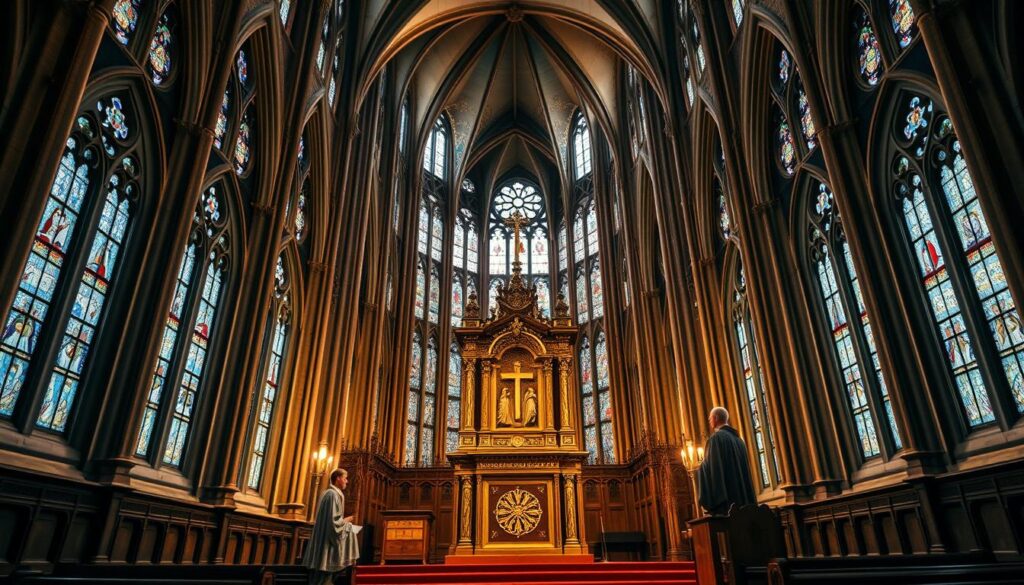
Tradition: the Apostles’ and Nicene Creeds, the early councils, and the 39 Articles
Tradition preserves the Apostles’ and Nicene Creeds and the witness of the early church. The Book Common and the common prayer shape how doctrine enters worship and life.
The Articles of Religion (often called articles religion) summarize teaching and limit extremes while keeping continuity with historic witness.
Reason: interpreting doctrine faithfully in each generation
Reason helps clergy and laity apply biblical truth without cutting ties to the past. This method keeps doctrine living and relevant across cultures.
The Chicago‑Lambeth Quadrilateral: Scripture, Creeds, Sacraments, and bishops
The Quadrilateral clarifies essentials for unity across the anglican communion. It names Scripture, the Creeds, Baptism and Holy Communion, and the historic episcopate as core markers. Bishops link local congregations to wider oversight and continuity.
| Element | Summary | Role | Practical Example |
|---|---|---|---|
| Scripture | Holy Bible as final rule | Guides teaching and faith | Sermons rooted in lectionary |
| Creeds | Apostles’ and Nicene creeds | Define core confession | Creedal recitation in worship |
| Sacraments | Baptism and Holy Communion | Means of grace and belonging | Regular Eucharist in parish |
| Historic episcopate | Ordered ministry of bishops | Symbol of unity and oversight | Diocesan confirmation visits |
What are Anglican beliefs? Core tenets at a glance
The church proclaims one God—Father, Son, and Holy Spirit—and trusts in Christ’s redemptive work.
Confessing one God in Trinity and Jesus Christ as Savior and Lord
Anglicans believe the Apostles’ and Nicene Creeds confess the Trinity. The community names jesus christ as Savior whose death and resurrection reconcile sinners to God.
“Faith is held in the company of Scripture, prayer, and the sacraments.”
Salvation, sin, grace, and the Anglican Formularies
The Formularies—the 39 Articles, the Book of Common Prayer, and the Ordinal—summarize key points of doctrine. They teach that human sin requires divine grace, and salvation comes by grace through faith.
- God offers pardon and new life through Christ and the work of the holy spirit.
- Scripture and liturgy guide how doctrine shapes worship and daily practice.
- The Formularies keep teaching concise while allowing room for reasoned reflection.
| Topic | Summary | Practical link |
|---|---|---|
| Trinity | One God in three persons | Creedal recitation in services |
| Christ | Death and resurrection secure salvation | Eucharist and preaching |
| Grace & Faith | Salvation by grace received in faith | Baptism and catechesis |
Sacraments and grace: Baptism and Holy Communion at the center
Two primary rites—Baptism and Holy Communion—structure entry and ongoing life in the church. These sacraments serve as ordinary means of grace in parish worship and daily devotion.
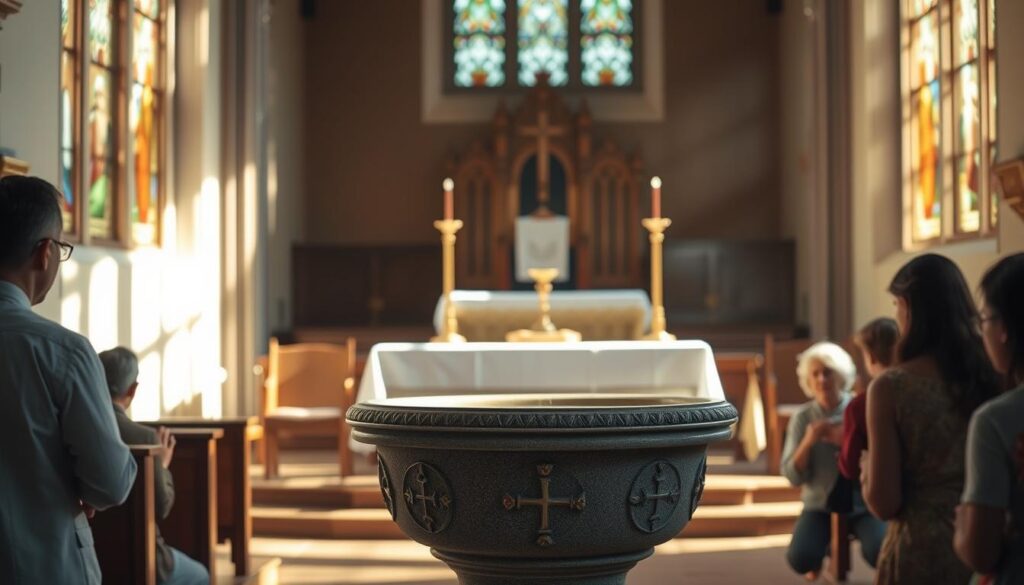
Holy Baptism: new birth and entry into the life of the Church
Baptism marks new birth by the holy spirit and incorporation into the body of Christ. Classical teaching affirms baptismal regeneration as the normative start of Christian life.
Parishes prepare candidates through instruction and prayer, and the Book Common Prayer supplies the liturgy for this rite.
Holy Communion: real spiritual presence and communion with Christ
On the Eucharist, believers receive Christ by faith in a real spiritual presence. This view affirms a meaningful encounter with Christ distinct from both transubstantiation and a merely symbolic meal.
Frequent Communion and careful pastoral catechesis help the congregation live out salvation in worship and service.
Other rites and ministries
Confirmation, marriage, ordination, penance, and anointing function as sacramentals. They strengthen faith and pastoral care across life’s milestones.
| Rite | Role | How the Prayer Book guides | Common parish practice |
|---|---|---|---|
| Baptism | Entry into the church | Form and vows in the Book Common Prayer | Preparation classes; baptism at Sunday liturgy |
| Holy Communion | Nourishment in Christ | Eucharistic prayers and rubrics in common prayer | Frequent Sunday celebration and weekday services |
| Confirmation & Ordination | Strengthening and ordering ministry | Services in book common prayer | Bishop’s visit; candidate preparation |
| Penance, Marriage, Anointing | Pastoral care and blessing | Rites provided in common prayer | Pastoral meetings; liturgical milestones |
Worship and daily practice: Prayer, the church year, and the Anglican way
The Anglican way links morning and evening rites, the Psalter, and festival seasons into a steady spiritual habit. These patterns help a church shape daily life and communal work in service.
The Daily Offices: Morning Prayer, Evening Prayer, and Evensong
The Daily Offices, adapted by Thomas Cranmer from monastic hours, form the heartbeat of worship. Morning Prayer begins the day with scripture and psalms. Evening Prayer closes the day in thanksgiving.
When Evening Prayer is sung, it becomes Evensong, rich with chant and an entry point for seekers and members alike.
Lectionaries, the Psalter, and the rhythm of the liturgical calendar
Traditional lectionaries guide steady Bible reading, using the Psalter regularly. Over a year, most of the Old Testament is read once and the New Testament several times.
The church year—Advent, Christmas, Epiphany, Lent, Easter, Pentecost—forms seasons of repentance and celebration. The book common and common prayer provide accessible forms for households and parishes to join this rhythm.
“Shared prayer knits congregations together in scripture, the Psalms, and intercession.”
Practical tip: begin with one Office each day, use the lectionary to find readings, and let music draw you in. Over time, private devotion will flow into merciful work in your neighborhood.
Structure and leadership: Bishops, priests, deacons, and the Anglican Communion
Leadership in the church links local worship to wider oversight through a threefold ministry.
Ordered ministry and pastoral care
Anglicans preserve bishops, priests, and deacons as the classic form of ministry. Bishops carry pastoral and doctrinal responsibility. Priests serve parishes. Deacons focus on service and proclamation.
How the global fellowship works
The anglican communion is a family of self‑governing provinces in fellowship with Canterbury. Instruments like the Lambeth Conference, Primates’ Meetings, and the Anglican Consultative Council foster counsel without centralized rule.
“Historic episcopate serves as a visible link across local churches and the wider world.”
Rooted in the 16th century English Reformation, this structure grew into a multinational body over each century since. Provinces share training, mission resources, and accountability while keeping local differences.
| Level | Role | Practical example |
|---|---|---|
| Bishops | Guard doctrine and unity | Diocesan visits and confirmations |
| Priests | Lead worship and pastoral care | Sunday Eucharist and parish ministry |
| Deacons | Service and outreach | Community programs and liturgical assistance |
Anglican diversity today: Parties, practices, and the U.S. landscape
Today’s anglican church family shows lively variety in worship styles, theological accents, and parish life across regions.
High Church or Anglo‑Catholic parishes favor ritual, incense, and sacramental emphasis. Low Church or Evangelical congregations stress preaching and outreach. Broad Church communities aim for comprehensiveness and liturgical flexibility.
Main differences and shared ground
All groups hold the Creeds and the two sacraments, so anglicans believe common anchors bind diverse local practices.
The U.S. picture
In the United States, The Episcopal Church remains within the Anglican Communion. The Anglican Church in North America formed in 2009 and aligns with GAFCON. Continuing Anglican bodies trace splits back to the 1970s.
“Mission and service keep congregations working together even amid disagreement.”
| Stream | Emphasis | Parish signs |
|---|---|---|
| High/Anglo‑Catholic | Liturgies & sacraments | Processions, chanted Eucharist |
| Low/Evangelical | Preaching & evangelism | Simpler liturgy, active outreach |
| Broad Church | Inclusiveness & reason | Varied worship, communal focus |
Compared with the roman catholic Church and other Protestant churches, differences surface on eucharistic theology, authority, and some ethics. Yet mission and local service unite most parishes in work across the world and keep shared articles and creeds at the center as part of a common story and history of the past century.
Conclusion
Strong, this tradition holds a single aim: to shape a steady way of worship and work that serves the world. It links Scripture, the Creeds, and the sacraments so life and practice match doctrine in daily habits.
Explore parish worship to see this way in action. Attend a service, try Evensong, or join a Bible group. Baptism and Holy Communion frame a prayerful life empowered by the holy spirit.
Authority in this church balances Scripture, Tradition, and Reason so teaching supports faithful mission. The history of the Communion equips local congregations to serve neighbors with mercy and justice.
Take a simple next step: visit a nearby parish, read the articles religion, or begin a short prayer rule. You’ll find a lived faith—prayer‑soaked, sacramental, and ready for service in the world.
FAQ
What is the core identity of Anglican Christianity?
Anglicans identify as a historic Christian tradition shaped by Scripture, the Apostles’ and Nicene Creeds, and a liturgical worship life centered on the sacraments. Worship and doctrine aim to balance Scripture, tradition, and reason while maintaining continuity with the early church.
How did the tradition form from the early church through the 16th century?
Roots trace to the early church and Britain’s long Christian story. In the 16th century, political and theological tensions with Rome led to a distinctive settlement under Henry VIII and Elizabeth I. That period produced enduring texts such as the Book of Common Prayer and the Thirty‑nine Articles, which shaped doctrine and worship.
Why is the Book of Common Prayer important?
The Book of Common Prayer provides liturgy, scripture readings, and pastoral rites that structure public worship and private devotion. Its language and forms foster unity across churches while allowing local adaptation, making it central to Anglican identity and daily prayer life.
What are the Thirty‑nine Articles and why do they matter?
The Thirty‑nine Articles are a 16th‑century summary of doctrine addressing key theological disputes of the Reformation. They helped define the tradition’s middle way between Roman Catholic and Protestant positions and remain a historic standard for many churches within the Communion.
How is authority understood in Anglican life?
Authority rests primarily in Scripture, interpreted within the living traditions of the church and guided by reason. This threefold approach encourages faithful reading of Scripture while valuing historic creeds, councils, and pastoral wisdom from bishops and local leaders.
What is the Chicago‑Lambeth Quadrilateral?
The Quadrilateral outlines four essentials for ecumenical agreement: the authority of Scripture, the historic creeds, the two sacraments of Baptism and Holy Communion, and the historic episcopate (bishops). It serves as a basis for dialogue with other churches.
How do followers describe God and Jesus?
The tradition confesses one God in three persons (Trinity) and recognizes Jesus Christ as Savior and Lord. Worship and prayer consistently affirm Christ’s life, death, resurrection, and ongoing role in salvation and the life of the Church.
What is taught about sin, grace, and salvation?
The tradition recognizes human sinfulness and affirms salvation by God’s grace. The Formularies—Prayer Book and Articles—explain how sacraments, faith, and repentance work together in the believer’s life toward spiritual healing and growth.
Which rites count as sacraments here?
Two primary sacraments are Baptism and Holy Communion. Other rites—confirmation, marriage, ordination, penance, and anointing—are often called sacramental or pastoral ministries. All serve the church’s pastoral life and spiritual formation.
What does Baptism signify?
Baptism marks new birth and formal entry into the church’s life. It symbolizes cleansing from sin, incorporation into Christ, and the start of a life lived in community and discipleship.
How is Holy Communion understood?
Communion affirms a real spiritual presence of Christ and offers true communion with him and fellow believers. Views on presence vary across the tradition, but the sacrament remains central to worship and grace.
What daily practices shape Anglican devotion?
The Daily Offices—Morning Prayer, Evening Prayer, and Evensong—structure regular prayer. Lectionaries and the Psalter guide scripture reading through the church year, offering a steady rhythm of worship and reflection.
How is church life organized and led?
Leadership typically includes bishops, priests, and deacons. Bishops provide pastoral oversight and link local churches into wider bodies. The global Anglican Communion gathers churches around shared heritage while allowing regional autonomy.
How does the Communion relate globally?
The Communion centers informally on the Archbishop of Canterbury and instruments like the Lambeth Conference. Member provinces cooperate on mission, education, and social witness while exercising independent governance.
What diversity exists within the tradition today?
Streams include High Church (Anglo‑Catholic), Low Church (Evangelical), and Broad Church expressions. Practices and emphases differ on liturgy, theology, and social issues, yet many shared commitments—Scripture, sacraments, and episcopal order—bind the family together.
How does this tradition compare with Roman Catholic and other Protestant churches?
It shares sacramental and apostolic ties with Roman Catholicism while embracing Reformation emphases on Scripture and justification. Compared with many Protestant bodies, it preserves a richer liturgical life and historic episcopacy, offering a middle way between traditions.
How do faith and daily life connect in this tradition?
Worship, prayer, and sacramental practice shape daily discipleship. The Prayer Book, church year, and parish life encourage spiritual formation, social service, and faithful work in the world as expressions of mission and vocation.
Where can someone learn more or find a local congregation?
Visit official provincial websites like The Episcopal Church (USA) or the Church of England for resources, local parish directories, and guides to worship. Many parishes welcome visitors to services, study groups, and community outreach events.