What makes the Catholic faith one of the world’s most enduring belief systems? For over 2,000 years, this tradition has connected generations through teachings rooted in Jesus Christ’s mission. At its core, Catholicism centers on a simple yet profound idea: love. Love for God and love for others shape every aspect of this spiritual journey.
The Church traces its origins to Christ’s Apostles, who shared His message across continents. This unbroken chain of wisdom—called the Deposit of Faith—remains alive through the Pope, bishops, and global communities. It’s not just about rules or rituals. Catholicism invites people into a living relationship with God, nurtured through prayer, worship, and acts of service.
Two commandments anchor this path: loving God fully and caring for neighbors selflessly. These principles come alive in Sacred Scripture (the Bible) and Holy Tradition, which together reveal God’s plan. Whether through Sunday Mass or helping those in need, believers express their faith in tangible ways.
Today, over 1.3 billion people find purpose in these teachings. From ancient cathedrals to modern cities, the Church continues to offer hope and connection. Ready to explore how this vibrant tradition shapes lives? Let’s begin our journey.
Key Takeaways
- Catholic teachings originate from Jesus Christ and have been preserved for two millennia
- The faith emphasizes loving God and others as its central mission
- Sacred Scripture and Holy Tradition work together to guide believers
- Active practices like prayer and service bring beliefs to life
- Catholicism remains globally relevant through adaptable yet consistent traditions
The Roots and History of Catholicism
How did a scattered group of disciples transform into a global spiritual force? The answer lies in the history of early Christianity. After Jesus Christ’s resurrection, His followers faced uncertainty. Yet within decades, they built a thriving network of communities across the Roman world.
Foundations in Early Christianity
The Acts of the Apostles shows believers evolving from fearful disciples to bold organizers. They created systems to preserve Christ’s teachings while adapting to new cultures. The Holy Spirit, described as guiding this growth, helped communities discern truth from falsehood.
By 200 AD, leaders like St. Irenaeus formalized three safeguards for authentic faith:
- New Testament writings
- Bishops as successors to the Apostles
- Living traditions shaping worship and doctrine
Continuity from the Apostolic Era
Major cities became spiritual hubs. Alexandria, Antioch, and Rome hosted episcopal centers where bishops maintained teaching consistency. This apostolic succession created an unbroken chain linking modern clergy to Peter and the original Twelve.
The Roman Catholic Church didn’t emerge overnight. It grew through careful preservation of core beliefs while addressing new challenges. Today’s practices—from Sunday Mass to Easter celebrations—still echo patterns established in those formative centuries.
Key Figures Shaping Catholic Doctrine
Throughout history, certain individuals have left an indelible mark on the Church’s path. Their unique approaches to faith and governance created lasting impacts still felt today.
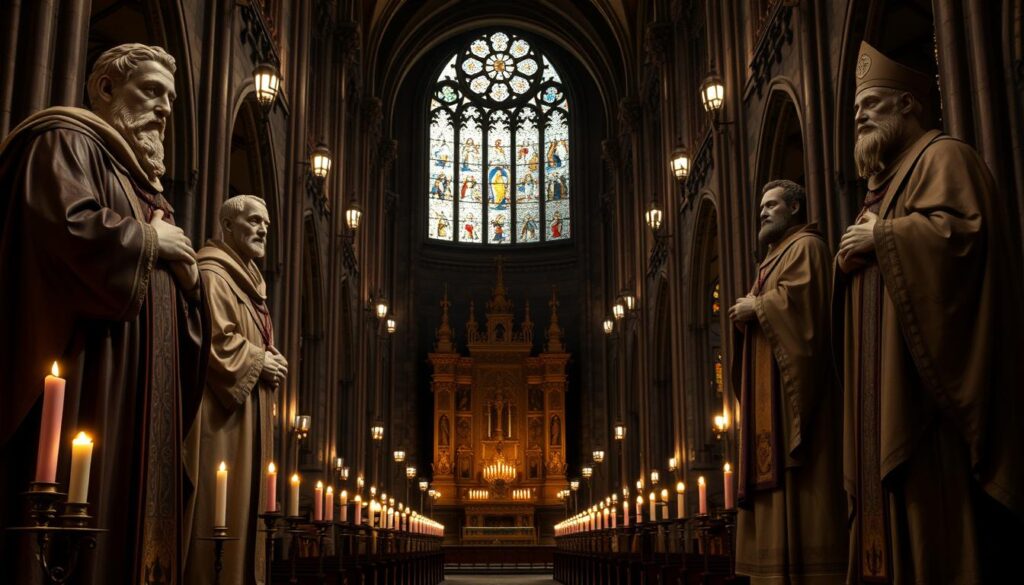
Charlemagne and His Legacy
This medieval ruler blended political power with spiritual vision. By 800 AD, he’d united much of Europe under Christian principles. His crowning as Holy Roman Emperor strengthened the Church’s authority, making faith central to law and education.
Charlemagne funded monasteries that preserved ancient texts. He required priests to improve literacy rates – a bold move that shaped religious understanding for centuries.
St. Gregory the Great and St. Francis of Assisi
Two saints redefined service in different eras. Gregory, a 6th-century pope, streamlined Church operations during plague outbreaks. He established:
- Standardized worship practices
- Social programs for the poor
- Gregorian chant traditions
Six centuries later, Francis chose radical simplicity. His famous prayer – “Lord, make me an instrument of your peace” – became a blueprint for humble service. Over 120 religious orders now follow his example.
| Figure | Role | Key Contribution |
|---|---|---|
| Charlemagne | Emperor | United Church and state authority |
| St. Gregory | Pope | Created administrative systems |
| St. Francis | Mystic | Modeled poverty-centered spirituality |
These leaders prove doctrine grows through action. Their lives show how timeless truths adapt to meet each generation’s needs.
Understanding Catholicism: Core Beliefs and Classics
At the heart of Catholic practice lies a treasure chest of spiritual wisdom. This collection—called the Deposit of Faith—combines Scripture and Tradition passed down from Christ’s Apostles. Like a family heirloom, it remains unchanged while gaining new meaning for each generation.
Guiding Light: The Catechism
The Catechism of the Catholic Church acts as a roadmap for modern believers. Updated in 1992, it organizes teachings into four practical areas:
- Core beliefs about God and salvation
- Moral principles for daily choices
- Worship practices and sacraments
- Methods for deepening prayer life
This 2,865-paragraph text isn’t just for scholars. Many parishes use simplified versions to help members grow in their spiritual journey. As Cardinal Ratzinger (later Pope Benedict XVI) noted: “The faith demands to be known, loved, and lived.”
Ancient Words, Modern Relevance
Centuries-old creeds still unite Catholics today. The Apostles’ Creed, recited at baptisms and Mass, packs essential teachings into twelve brief statements. Its opening words—“I believe in God, the Father Almighty”—echo through cathedrals and living rooms alike.
These tools create harmony across cultures and eras. Whether studying the Catechism or praying the Creed, believers connect to truths that have nourished souls for two millennia.
Exploring the Sacraments and the Liturgy
How do ancient practices remain vital in modern faith? For Catholics, the answer lies in seven sacred rituals that transform ordinary moments into encounters with the divine. These sacraments form a spiritual roadmap, guiding believers through life’s milestones with grace and purpose.
The Seven Sacraments Explained
Each sacrament addresses a core human need – from cleansing sin to celebrating love. They’re not mere symbols but visible signs of invisible grace, rooted in Jesus’ teachings. The Church traces their authority back to Christ’s command to His Apostles.
| Sacrament | Purpose | Biblical Basis |
|---|---|---|
| Baptism | Spiritual rebirth | John 3:5 |
| Eucharist | Divine nourishment | John 6:54 |
| Confirmation | Strengthening faith | Acts 8:17 |
| Penance | Merciful healing | John 20:23 |
| Anointing | Comfort in illness | James 5:14 |

The Beauty of the Eucharist
At every Mass, Catholics believe ordinary bread and wine become the body and blood of Christ. This miracle of transubstantiation fulfills Jesus’ command: “Whoever eats my flesh has eternal life” (John 6:54). The Eucharist isn’t a metaphor – it’s communion with God Himself.
The liturgy transforms worship into a multisensory experience. Incense, music, and shared prayers create unity across time and space. In a world that often questions faith, these rituals offer soul-deep nourishment, connecting believers to something eternal.
Living the Catholic Faith in Daily Life
What does it look like to walk the talk of Catholic beliefs? It starts with seeing every moment as a chance to reflect Christ’s love. Being Catholic means living faith through action – turning grocery runs into kindness missions and workdays into justice opportunities.

Following the Teachings of Jesus Christ
Jesus didn’t just preach – He healed, fed, and listened. Catholics are called to be His hands and feet in three practical ways:
- Prioritizing prayer before decisions big and small
- Treating strangers like family members
- Defending dignity in workplaces and communities
This way of life transforms ordinary routines. Making dinner becomes a chance to thank God for provisions. Commute time turns into prayer space. Even social media feeds can spread hope instead of hate.
Church teachings compare this commitment to family responsibilities. Just as parents care for children without being asked, Catholics serve others because it’s who they’re called to be. As St. Teresa of Calcutta said: “Not all of us can do great things. But we can do small things with great love.”
True Catholic life isn’t about comfort – it’s about courage. It means standing up for the bullied coworker. Donating time when you’re tired. Choosing forgiveness over grudges. Through these choices, believers become living answers to Christ’s command: “Love one another as I have loved you.”
Examining Catholic Morality and Social Teachings
Can centuries-old wisdom guide today’s complex ethical issues? The Church answers with a resounding yes. Its moral framework centers on community over self – a “we” approach that prioritizes the common good. Saints like Mother Teresa and Oscar Romero model this, showing how Christ’s teachings apply to modern struggles.
Ethics and Modern-Day Challenges
Catholic morality tackles everything from climate change to social media ethics. It views human dignity as non-negotiable, defending life from womb to natural death. Economic justice and care for creation aren’t trends – they’re timeless calls to action.
The Church’s 2,000-year dialogue with truth offers surprising relevance. Its teachings on bioethics help navigate IVF debates. Guidance on war and peace informs global conflicts. Even tech dilemmas find answers in principles about respecting human worth.
This isn’t about rigid rules. It’s a roadmap for flourishing through right relationships – with God, others, and our world. By learning from past moral issues, we build futures where everyone thrives.
FAQ
How does Catholicism connect to early Christianity?
The Catholic Church traces its roots directly to Jesus Christ and the Apostles. It maintains continuity through teachings, sacraments, and leadership roles like the papacy, which began with St. Peter. Early Christian practices, such as the Eucharist, remain central today.
Who were key figures in shaping Catholic doctrine?
Saints like Gregory the Great strengthened Church structure and liturgy, while St. Francis of Assisi emphasized humility and service. Charlemagne’s support helped spread Christian education and solidify the Church’s role in medieval Europe.
What is the Deposit of Faith in Catholicism?
The Deposit of Faith includes sacred Scripture and Tradition, which the Church preserves and interprets. These guide beliefs on topics like grace, salvation, and morality, ensuring teachings stay consistent across generations.
Why are the Seven Sacraments important?
Sacraments like Baptism and the Eucharist are visible signs of God’s grace. They mark spiritual milestones, deepen faith, and unite believers with Christ and the Church community. The Eucharist, in particular, celebrates Jesus’ sacrifice and presence.
How do Catholics live out their faith daily?
Daily prayer, acts of charity, and following Jesus’ teachings—like loving others and seeking justice—are key. Many also reflect on Scripture, attend Mass, and apply Catholic social teachings to modern issues like poverty or human dignity.
How does the Church address modern ethical challenges?
Catholic morality combines timeless principles with thoughtful engagement. Issues like bioethics or environmental care are approached through Scripture, reason, and Tradition, emphasizing the sanctity of life and the common good.
What role does the Catechism play?
The Catechism of the Catholic Church summarizes doctrines, sacraments, and moral teachings. It serves as a reliable resource for learning about worship, ethics, and living a life aligned with Christ’s example.