This short guide gives a clear, friendly roadmap to the Episcopal Church’s teaching on the Holy Eucharist. It explains how the sacrament serves as an outward sign of inward grace and how Christ’s real presence is understood in a way that honors mystery without strict philosophical labels.
The focus is thanksgiving, remembrance, and pastoral welcome. Worshipers meet at the table to share bread and wine, to be shaped for daily life, and to grow in unity with God and one another.
This guide answers common questions newcomers bring to the liturgy. It clarifies terms—Eucharist, the Lord’s Supper—and notes how Episcopal theology balances deep thought with warm practice.
Expect plain explanations of the Real Presence, how this view differs from other traditions, and practical notes on receiving the sacrament. The goal is to leave you confident and grounded in both faith and practice.
Key Takeaways
- The Holy Eucharist is the church’s central sacrament of thanksgiving.
- Episcopal teaching affirms Christ’s real presence while naming the encounter as a sacred mystery.
- Worship emphasizes remembrance of Jesus’ life, death, and resurrection.
- Receiving bread and wine connects worship to daily life and spiritual growth.
- Pastoral openness and unity at the table shape the Episcopal approach.
Holy Eucharist in the Episcopal Church: Meaning, Sign, and Sacred Meal
The Eucharist orders Sunday worship around a shared meal of prayer, bread, and wine.
“Outward and visible sign” and “inward and spiritual grace”
The church names a sacrament as an outward sign that points to inward grace. Here the visible gifts are bread and wine, and the inward gift is true sharing in Christ’s life.
Thanksgiving and remembrance of Jesus’ life, death, and resurrection
The service follows the Lord’s Supper pattern: the gifts are taken, thanks are given, the bread is broken, and the gifts are distributed.
- The Great Thanksgiving remembers salvation and asks the Holy Spirit to make holy the people and the bread wine.
- Christ’s presence is received by faith, so the congregation shares in the Body and the Blood of Christ.
- This sacred meal recalls life, death, and resurrection as the center of hope and service.
| Action | Gesture | Meaning |
|---|---|---|
| Took | Offertory of bread and wine | Invitation and offering |
| Gave thanks | Consecration prayer | Recall of salvation |
| Broke | Fraction of the bread | Sharing the Body |
| Gave | Distribution to the people | Union in the Blood of Christ |
What do Episcopalians believe about communion?
Episcopal teaching holds the Eucharist as a meeting place where Christ is truly present, while the Church avoids forcing that presence into a single philosophical formula.
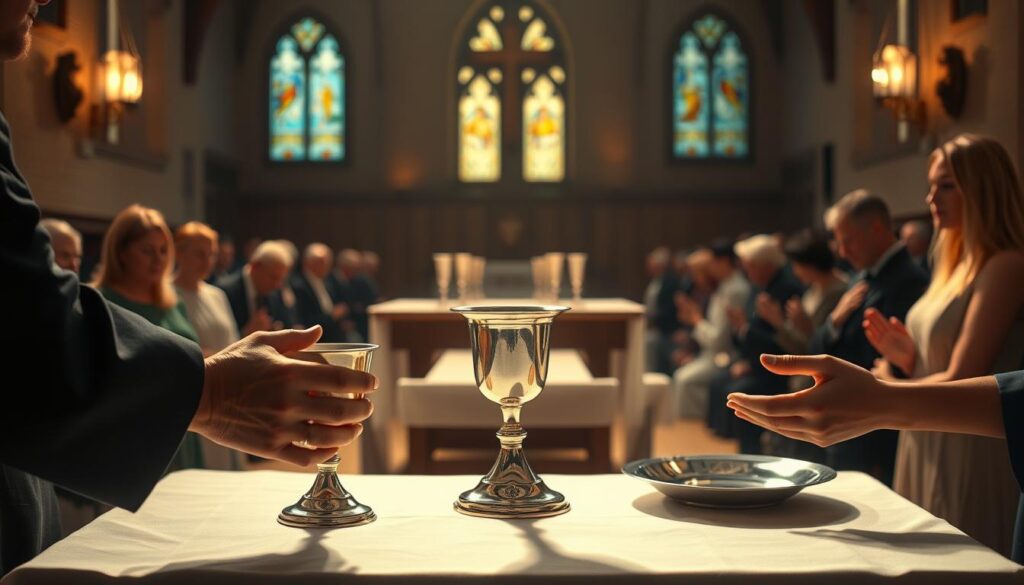
Real Presence explained
The real presence is affirmed plainly: Christ is truly with the gathered people at the altar. The claim does not insist on a detectable physical change in the bread or the wine.
Bread and wine, body and blood
The outward gifts of bread and wine remain signs through which the faithful receive the Body and Blood of Christ by the Spirit and faith.
Transubstantiation, consubstantiation, or neither?
The usual Episcopal reply is a humble “neither, both, and.” This avoids strict Roman Catholic formulas like transubstantiation and avoids reducing presence to a single technical theory such as consubstantiation.
Prayer, faith, and the altar
Faith and prayer shape reception: those who come worthily and with trust partake in the sacred meal. The Church’s theology keeps room for different devotional styles while centering on unity with Christ and one another.
| Claim | Episcopal stance | Practical effect |
|---|---|---|
| Reality of presence | Affirmed as a sacred mystery | Reverent reception and prayer |
| Physical change | Not defined as chemistry | Focus on faith, not senses |
| Comparison with other churches | Neither strictly Roman Catholic nor purely Lutheran | Welcomes varied devotional expressions |
How Communion is Celebrated Today: From altar to cup in the Episcopal Church
Worship often follows a fourfold pattern that shapes how the priest and people meet at the table. On Sundays and major feasts the service centers at the altar, and the priest leads the Great Thanksgiving so the sacrament forms daily life.
The fourfold action—took, gave thanks, broke, gave—guides the rite. After the invitation, “The gifts of God for the people of God,” people come forward, kneel or stand, and receive the bread in hand.
Took, blessed, broke, and gave: the fourfold action of the Lord’s Supper
The priest takes the gifts and prays. Thanks are offered, the bread is broken, and the holy things are given to the people. This sequence links ritual action to shared prayer and community.
Receiving the bread and wine: sip, intinction, gluten-free wafers, and accessibility
Communicants may eat the bread and sip from the chalice of wine, or dip the wafer (intinction). Gluten‑free wafers are available on request.
Those with limited mobility may receive at their seat. You are not required to drink; a light touch or crossing arms signals a blessing instead.
Who may receive: baptized Christians, seekers, children, and pastoral welcome
All baptized Christians are welcome to receive. Unbaptized visitors may come forward for a blessing and an invitation to explore baptism.
| Action | Who | Meaning |
|---|---|---|
| Took / Gave thanks | Priest | Great Thanksgiving and presence |
| Broke | Priest | Sharing the body blood christ |
| Gave | People | Union with one another and nourishment for life |
- Practical questions are normal; ushers and ministers help with flow and special needs.
- This pattern shows the sacrament as God’s gift and our shared participation at the altar.
Belief and practice in context: Episcopal theology alongside Roman Catholic and Lutheran views
Across traditions, Christians affirm that Christ gives himself in the sacrament, though they explain the reality in distinct ways.
Real Presence, transubstantiation, and consubstantiation
The Roman Catholic Church teaches transubstantiation: the bread and wine become the actual Body and Blood while keeping the same appearances. Lutherans have described consubstantiation as Christ present alongside the bread and wine.
The episcopal church upholds the real presence without forcing a single philosophical formula. Many sum this as “neither, both, and.” This leaves room for faithful reflection and conscience.
Living the mystery: unity, forgiveness, and new life
Practically, the Lord’s Supper unites worshipers to Christ and to one another. The rite proclaims Jesus’ death and resurrection and offers forgiveness, strength for daily life, and a foretaste of the heavenly banquet.
- Different words point to the same saving reality.
- The priest leads the prayers; the liturgy shapes the church’s theology.
- Receiving bread and wine meets body and spirit, forming faith in service and mercy.
Conclusion
The Holy Eucharist gathers a community to receive forgiveness, strength, and hope at the altar. In the Episcopal Church this sacrament holds a steady place: it names Christ’s presence and feeds faith through bread wine and shared prayer.
In this sacred meal we meet the Body and the Blood of Christ. The rite does not demand a single theory like the catholic church, but it affirms real encounter with the bread and wine—holy communion—received with gratitude and reverence.
The practical gifts are plain: forgiveness, unity, and sending into service. If you have questions, the priest and parish will help with an answer and a gentle way to receive. Keep returning to the table; over time the sacrament shapes both body and blood of our life together.
FAQ
What is the Holy Eucharist in the Episcopal Church?
The Holy Eucharist is the church’s central sacrament, a sacred meal remembering Jesus’ life, death, and resurrection. It functions as an outward and visible sign pointing to inward and spiritual grace. Worshipers give thanks, hear Scripture, and share bread and wine as a communal act of praise and renewal.
How do Episcopalians describe the “real presence” of Christ?
Episcopalians affirm that Christ is truly present in the Eucharist without insisting on a specific physical change in the elements. The presence is held as a mystery: spiritual and real, experienced by faith, prayer, and the community gathered at the altar.
Are the bread and wine believed to become Christ’s body and blood?
The church calls the bread and wine both sign and sacrament. They signify Christ’s body and blood and serve as means of grace. The tradition leaves room for mystery rather than dogmatic formulas, so explanations vary among clergy and congregations.
Is transubstantiation or consubstantiation the Episcopal view?
The Episcopal Church does not rigidly endorse Roman Catholic transubstantiation or Lutheran consubstantiation. Many prefer a “both/and” approach that honors sacramental reality while avoiding technical metaphysical claims.
How do prayer and faith shape the communion experience?
Prayer, repentance, and faith prepare people to receive the sacrament. The liturgy invites participants to approach with gratitude and trust, experiencing union with Christ and reconciliation with one another through the Eucharist.
What are the four actions of the Lord’s Supper?
The Eucharist traditionally moves through taking, blessing, breaking, and giving. These actions recall Jesus’ ministry and shape the congregation’s participation in the saving life offered in the sacrament.
How do people receive bread and wine in Episcopal services?
Reception practices include sipping from a common cup, intinction (dipping the bread into the wine), or receiving a separate cup. Many parishes provide gluten-free wafers and other accommodations to ensure accessibility for all communicants.
Who is invited to receive communion?
The Episcopal Church typically invites baptized Christians to the Lord’s Supper. Most congregations also welcome seekers and children to participate with pastoral sensitivity, encouraging full participation in the life of the church.
How does Episcopal Eucharistic theology compare with Roman Catholic and Lutheran views?
Roman Catholics affirm transubstantiation, holding that the elements become Christ’s substance. Lutherans often speak of consubstantiation or sacramental union. The Episcopal approach emphasizes real presence and mystery, resisting strict metaphysical definitions while affirming grace and unity.
What spiritual effects are associated with receiving the sacrament?
Communion strengthens unity with Christ and one another, offers forgiveness, and nurtures new life in the Spirit. It’s seen as a means of ongoing formation, sustaining faith between baptisms and other rites of passage.
Are the priest and altar central to the sacrament?
Clergy lead the liturgy and consecrate the elements, but the Eucharist is fundamentally communal. The altar serves as the focal place of offering, while the gathered people, joined in prayer, make the sacrament a living reality.
Can the sacrament be celebrated outside a church building?
Yes. The Eucharist may be celebrated wherever people gather for worship—hospital rooms, outdoor spaces, or chapels—so long as it follows authorized liturgy and is led by an ordained minister or authorized presider.