When most people think of the Catholic Church, they imagine Roman Catholic traditions. But did you know there are 24 distinct self-governing churches united under the Pope? These communities span six unique worship styles called liturgical rites, blending ancient customs with shared beliefs.
The largest group is the Latin Church, familiar to many in the West. The other 23 Eastern Catholic traditions – like Ukrainian or Chaldean – preserve vibrant cultural practices dating back centuries. Despite differences in language or ceremony, all recognize the Pope’s leadership while celebrating their heritage.
This rich variety developed through history. Early Christian communities adapted faith to local cultures, leading to diverse expressions of worship. Major events like the Great Schism and later reunions shaped today’s landscape of autonomous churches.
Many assume uniformity equals strength, but Catholicism’s global reach thrives on this balance. From incense-filled Armenian liturgies to Syriac chant traditions, each church offers a unique window into sacred practices. Let’s explore how these branches coexist while maintaining core teachings.
Key Takeaways
- The Catholic Church includes 24 self-governing churches with distinct traditions
- Only one church (Latin) follows Western liturgical practices
- Eastern Catholic communities preserve ancient cultural worship styles
- All churches share core beliefs and recognize the Pope’s authority
- Historical events shaped today’s global network of Catholic traditions
Introduction to the Diverse World of Catholic Traditions
What if I told you one faith blooms in 24 unique expressions worldwide? The Catholic Church thrives through a mosaic of spiritual practices that honor local cultures while keeping core beliefs intact. From the incense-rich worship of Middle Eastern communities to the vibrant processions in Latin America, this variety reveals faith’s universal appeal.
Church leaders have celebrated this richness for over a century. Pope Leo XIII called Eastern traditions “extremely ancient, singular memorials” in 1894, recognizing their role in spreading Christian truth through martyrs and missionaries. His words still echo today: “There flowered… the glories of preaching the True Faith to the nations.”
“All in the Church must preserve unity in essentials,” the Second Vatican Council later affirmed, while encouraging “proper freedom in spiritual life and liturgy.”
Setting the Stage: An Ultimate Guide
This guide unlocks why cultural adaptations matter. You’ll see how Syrian chant traditions coexist with Roman sacraments – all under one global family. Such diversity helps the Church speak to people everywhere in ways that resonate deeply.
Why Diversity Matters in Catholicism
Understanding varied practices strengthens unity among members. It shows how faith transcends borders while embracing local heritage. This flexibility also fuels dialogue with other Christians, proving shared values can flourish in many forms.
Historical Foundations of Catholic Denominations
History shows how faith grows through cultural roots and pivotal moments. The Church at Rome began during apostolic times, with St. Paul’s letter to Roman believers marking early Christian outreach. This foundation shaped how local churches developed unique identities while staying connected to core teachings.
The Role of the Apostolic Era
Early leaders like St. Clement of Rome called Peter the “rock” of the church. His leadership established Rome’s spiritual authority. By AD 100, three key figures documented this legacy:
- St. Ignatius of Antioch described Rome’s guiding role
- St. Irenaeus listed Peter as first bishop
- Paul’s epistles bridged Jewish and Gentile traditions
These actions created a blueprint. Future communities linked their practices to apostolic origins, blending local customs with shared beliefs.
Milestones Through the Centuries
Four major events reshaped the church’s journey:
- 313 AD – Constantine legalized Christianity
- 1054 – The Great Schism split East and West
- 16th century – Reunions began with Eastern groups
- 1990 – Code of Canons updated Eastern rites
“The Church breathes with two lungs – East and West,” Pope John Paul II later observed.
Political shifts and theological debates often sparked change. Yet each era reinforced unity through diversity, proving faith adapts without losing its essence.
Overview of the Roman Catholic Church
At the heart of Catholic spiritual life lies seven sacred actions that shape daily faith. The Roman Catholic Church teaches these seven sacraments – from baptism to last rites – form stepping stones connecting believers to divine grace. Unlike some Christian traditions, Roman Catholics view these rituals as visible signs of God’s invisible work.
Core Doctrines and Sacraments
Central to Roman Catholic doctrine is the belief in transubstantiation. During Mass, worshippers affirm that bread and wine transform into Christ’s body and blood. “This change the holy Catholic Church fittingly calls transubstantiation,” declared the Fourth Lateran Council in 1215, shaping worship practices for centuries.
Three unique teachings further define Roman Catholicism:
- Purgatory as a purification process before heaven
- The treasury of merit allowing saints’ virtues to aid others
- Mandatory priestly celibacy (with rare exceptions)
Liturgical Practices and Traditions
Sunday Mass follows a rhythm perfected over 800 years. The liturgical calendar marks seasons like Advent and Lent, while devotions like Eucharistic Adoration emphasize Christ’s physical presence. These traditions create continuity across 1.3 billion members worldwide.
Married priests remain uncommon in Roman Catholicism, unlike some Eastern churches. This discipline underscores the Latin Church’s distinctive approach to clerical life – a choice reflecting centuries of spiritual reflection rather than doctrinal necessity.
Exploring catholicism denominations
Words shape understanding – especially when exploring global faith communities. Many describe Catholic diversity using the term “denominations,” but this risks blurring crucial distinctions. Church leaders clarified this linguistic nuance in 1999: “We ought to speak, not of rites, but of Churches.”
Defining the Term and Its Significance
Why does vocabulary matter? Unlike Protestant groups, Catholic Churches share identical core beliefs while maintaining self-governance. The Code of Canons defines them as “Churches sui iuris” – communities with their own hierarchy recognized by Rome. This framework preserves unity without uniformity.
“A group of Christian faithful united by a hierarchy… recognized as sui iuris.”
Three key points clarify this concept:
- Autonomy applies to liturgy and discipline, not doctrine
- Papal approval ensures alignment with universal teachings
- The shift from “rites” to Churches honors their full ecclesial status
This precision prevents confusion with denominational splits. While Protestant branches often form over disagreements, Catholic Churches grow through cultural adaptation under shared leadership. Recognizing these differences helps appreciate how faith flourishes in varied forms.
Eastern Catholic Churches and Their Unique Traditions
Step into an Eastern Catholic liturgy, and you’ll experience faith through sight, sound, and scent. These 23 churches preserve worship styles older than the Roman Missal, blending ancient rituals with local customs. Their practices offer a living connection to Christianity’s earliest centuries.
Distinct Liturgical Rites and Practices
Five liturgical families shape Eastern traditions. The Byzantine rite uses honey-sweetened bread and golden icons, while Armenian services feature dramatic curtain movements symbolizing heaven’s veil. See how key rites compare:
| Rite Name | Example Churches | Unique Features | Geographic Roots |
|---|---|---|---|
| Alexandrian | Coptic, Ethiopian | 12-hour Easter vigils | North Africa |
| Chaldean | Syro-Malabar | Communion by intinction | Middle East |
| Byzantine | Ukrainian Greek | Leavened Eucharist bread | Eastern Europe |
Infants receive confirmation immediately after baptism in most Eastern churches – a practice dating to the 4th century. Chanted prayers and incense create multisensory worship, inviting full-body engagement with the sacred.
Cultural Influences and Heritage
From Lebanon’s cedar-carved Maronite altars to India’s palm-leaf Syro-Malabar manuscripts, local materials shape sacred spaces. Ethiopian Catholics maintain a 1,600-year-old calendar, celebrating Christmas on January 7.
“The variety of liturgical customs manifests the catholicity of the Church.”
These traditions aren’t museum pieces. Ukrainian Catholics in Minnesota still bake prosphora bread using ancestral recipes. Melkite communities in Texas blend Arabic hymns with English translations, proving heritage adapts while staying rooted.
Understanding Doctrinal Diversity Across Traditions
Imagine two chefs using identical ingredients to create distinct dishes. That’s how Eastern and Western Catholic traditions approach shared doctrine – same core truths, different theological flavors. The Second Vatican Council celebrated this creative harmony, noting methods for understanding divine mysteries vary while maintaining unity.
Comparing Doctrine and Theology
While all Catholic communities affirm Mary’s Assumption as doctrine, their theological expressions differ. Western teachings often use philosophical terms like “soul-body unity,” while Eastern perspectives might describe it as “participating in divine energies.” Consider these examples:
- The Trinity: Latin theology emphasizes divine unity, Eastern thought focuses on three distinct persons
- Original Sin: Western teachings highlight inherited guilt, Eastern traditions view it as ancestral wounding
- Sacraments: Roman Catholics count seven, some Eastern churches avoid rigid numbering
“Different theological formulations complement rather than contradict,” explains Vatican II’s Unitatis Redintegratio.
The Role of Tradition in Belief Formation
Cultural contexts shape how communities preserve tradition. Greek Catholic theology developed through Byzantine poetry, while Roman teachings grew from medieval scholastic debates. Both methods:
- Root themselves in Scripture
- Answer local spiritual needs
- Undergo papal verification
This diversity enriches global theology. A Ukrainian Catholic’s prayer rope and a Mexican Catholic’s rosary both express devotion through culturally shaped tools. As traditions evolve, they offer new lenses to view eternal truths – like sunlight refracting through stained glass.
Comparing Liturgical Practices Between East and West
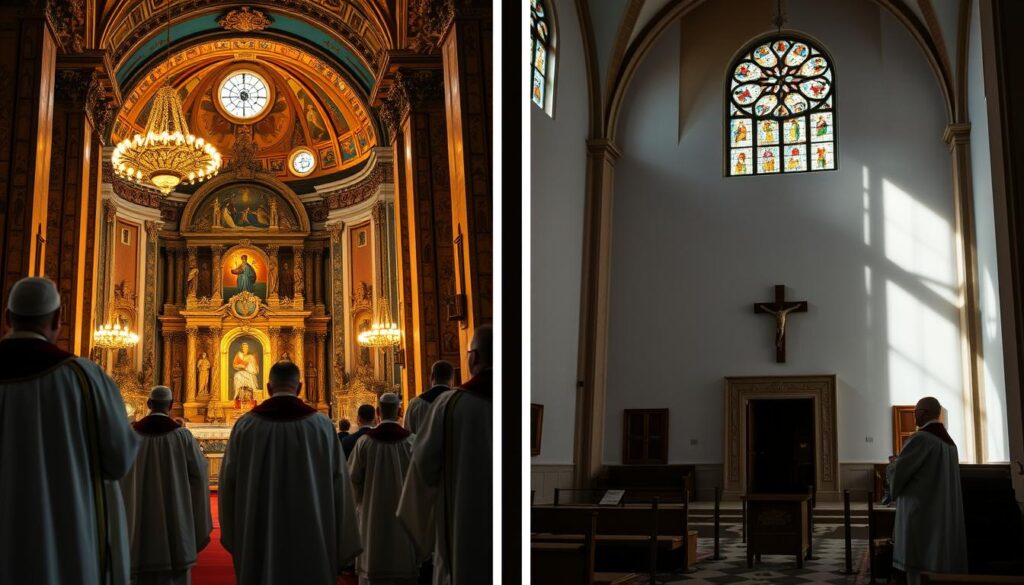
Sunlight streams through stained glass as worshippers kneel in silent prayer. Half a world away, golden icons glow under flickering candlelight while voices rise in ancient chant. These contrasting scenes reveal how Eastern and Western Catholic churches celebrate the same sacred mysteries through distinct cultural lenses.
Variations in Eucharistic Celebrations
The most visible difference lies in the bread used for Communion. Eastern traditions bake leavened loaves symbolizing Christ’s risen body, while Western churches use unleavened wafers recalling the Last Supper’s Passover meal. Both practices trace back to early Christian communities – Jerusalem’s Jewish roots versus Greek-influenced Antioch.
Though structured similarly, worship experiences feel worlds apart. A Roman Mass typically lasts 45 minutes with spoken responses. Byzantine liturgy stretches two hours through continuous singing. “The variety of liturgical customs manifests the catholicity of the Church,” notes the Code of Canons, affirming both styles as valid expressions.
Three key contrasts shape these celebrations:
- Eastern priests consecrate leavened bread with a liturgical spoon
- Western altars face the congregation post-Vatican II
- Byzantine churches screen the altar with an iconostasis
Incense swirls through Eastern services, engaging smell and touch. Western focus stays on visual symbols – stained glass, priestly gestures. Yet both traditions unite in their core purpose: making divine grace tangible through shared liturgy.
Influence of Leadership and Authority in the Church
Unity through shared leadership forms the backbone of Catholic communities worldwide. While practices vary, all 24 churches agree on one vital principle: collective guidance strengthens spiritual bonds across continents and cultures.
Guiding Lights: Papal and Episcopal Roles
Every Catholic church recognizes the Pope’s authority as successor to St. Peter. The 1990 Code of Canons confirms this role as “divinely appointed,” ensuring doctrinal unity. Bishops collaborate closely with Rome while addressing local needs – Roman Catholic dioceses report directly, while Eastern churches maintain self-governance through synods.
Two Models, One Mission
Western churches follow a centralized structure with the Vatican coordinating global efforts. Eastern communities operate through patriarchal councils, blending ancient traditions with modern challenges. For example, the Ukrainian Greek Catholic Church elects leaders while affirming papal primacy.
This dual approach allows flexibility without fragmentation. Whether in Roman Catholic parishes or Syro-Malabar dioceses, bishops serve as spiritual anchors – teaching timeless truths through culturally resonant methods. Such balance keeps the global church united yet responsive to 1.3 billion members’ needs.
FAQ
What’s the difference between the Roman Catholic Church and Eastern Catholic Churches?
The Roman Catholic Church follows the Latin liturgical tradition and recognizes the Pope’s authority. Eastern Catholic Churches, like the Ukrainian or Maronite Churches, maintain unique rites and cultural practices while remaining in full communion with Rome.
Why do some Catholic traditions have different liturgical practices?
Liturgical diversity stems from cultural, historical, and theological influences. For example, Eastern Churches often use leavened bread in the Eucharist, while the Roman Church uses unleavened bread, reflecting ancient traditions tied to their origins.
How does the Pope’s authority apply to Eastern Catholic Churches?
The Pope is recognized as the universal leader of all Catholics. However, Eastern Churches have their own hierarchies and governance structures, preserving autonomy in areas like liturgy and discipline while upholding shared doctrines.
Are sacraments the same across all Catholic traditions?
The seven sacraments are central to all Catholic communities. However, rituals like baptism or marriage may vary slightly in form, reflecting the theological emphases and cultural heritage of each tradition.
What role does tradition play in Catholic belief systems?
Tradition, alongside Scripture, shapes Catholic theology. Practices like Marian devotion or the veneration of saints developed over centuries, reflecting the lived faith of communities while staying rooted in core teachings.
How have cultural influences shaped Eastern Catholic practices?
Eastern Churches, such as the Syro-Malabar or Chaldean Catholic Churches, blend local languages, art, and customs into worship. This creates rich, diverse expressions of faith that remain united under Catholic doctrine.
Do all Catholic denominations accept the Nicene Creed?
Yes, the Nicene Creed is a foundational statement of belief for all Catholics. Differences in interpretation, like the Holy Spirit’s procession (Filioque), were historically debated but don’t undermine shared core truths.
How does governance differ between Eastern and Western Catholic Churches?
The Roman Church is centralized under the Pope and diocesan bishops. Eastern Churches, led by patriarchs or major archbishops, often govern through synods, emphasizing communal decision-making within their traditions.