How did a religious movement become one of America’s most enduring cultural forces? From colonial meetinghouses to modern megachurches, faith communities rooted in Protestant traditions have left an indelible mark on the nation’s identity. Today, over 140 million Americans identify with these denominations—nearly half the country’s population.
Twelve of the original Thirteen Colonies embraced these beliefs, creating a foundation that shaped early laws and social norms. Maryland’s unique Catholic history highlights how religious tolerance emerged alongside dominant Protestant values. Ideas like personal accountability and democratic participation became cornerstones of American society.
This exploration goes beyond church pews. We’ll see how concepts like individual conscience influenced everything from education systems to civil rights movements. You’ll also discover the surprising diversity within these groups, from quiet Quaker meetings to lively evangelical gatherings.
As we trace this journey, you’ll gain fresh insights into debates about morality, freedom, and community that still shape national conversations. The story of these faith traditions isn’t just about the past—it’s key to understanding modern America’s evolving cultural landscape.
Key Takeaways
- Over 140 million Americans align with Protestant traditions, making the U.S. home to the world’s largest Protestant community
- Early colonial governments integrated Protestant values into foundational legal and social frameworks
- Principles like religious freedom and self-governance directly shaped America’s democratic systems
- Modern Protestantism includes diverse groups, from traditional denominations to contemporary nondenominational movements
- These faith communities continue influencing debates on social issues, education, and civic engagement
Overview of Protestantism’s Impact in America
What foundational ideas transformed a 16th-century religious revolt into America’s cultural bedrock? At its heart lies a radical shift in spiritual authority that reshaped how people viewed their relationship with divinity and each other.
Breaking Chains of Spiritual Hierarchy
Protestant reformers like Martin Luther upended medieval church structures by declaring scripture the ultimate guide. “The Bible alone holds the keys to salvation,” Luther argued, rejecting the need for priestly intermediaries. This belief in personal interpretation became spiritual fuel for democratic thinking.
Seeds of Equality in Sacred Soil
Early settlers carried three revolutionary concepts across the Atlantic:
- Direct communication with the divine
- Equal spiritual worth for all believers
- Salvation through faith rather than rituals
These principles proved explosive in colonial society. When the Massachusetts Bay Colony declared “No king but Christ,” they planted seeds of self-governance that would later blossom into political independence.
| Protestant Principle | American Manifestation |
|---|---|
| Priesthood of all believers | Town hall democracy |
| Sola Scriptura (Bible alone) | Public education movements |
| Individual conscience | Bill of Rights protections |
“A Christian man is the most free lord of all, subject to none.”
This theological DNA continues influencing debates about freedom and community. From abolitionist pulpits to civil rights marches, Protestant ideals have repeatedly shaped the nation’s moral compass.
Early Beginnings: Colonial Era and Puritan Influence
How did small bands of believers lay the groundwork for a nation’s spiritual identity? The answer lies in the daring journeys of 17th-century reformers who crossed stormy seas to plant their vision in unfamiliar soil.
The Courage of Dissenting Groups
England’s religious landscape during this period forced radical choices. Dissenters faced fines, imprisonment, and social exclusion for rejecting the Anglican Church’s authority. One frustrated Separatist wrote, “We are hunted like foxes in the land that bore us.”
Blueprint for a New Society
Two settlements became crucibles for American religious identity:
| Colony | Year Established | Key Contribution |
|---|---|---|
| Plymouth | 1620 | Mayflower Compact (self-governance pact) |
| Massachusetts Bay | 1629 | First printed book in British America |
“We found a hideous and desolate wilderness, full of wild beasts and wild men.”
The Massachusetts Bay Colony’s rapid growth shocked European observers. Within three years, its population quintupled as word spread of a place where communities could shape their own religious practices.
These pioneers established patterns still visible today. Their emphasis on public education led to Harvard College’s 1636 founding. Strict moral codes evolved into enduring cultural values about work ethic and civic responsibility.
The Role of the Pilgrims and Puritans in Shaping American Faith
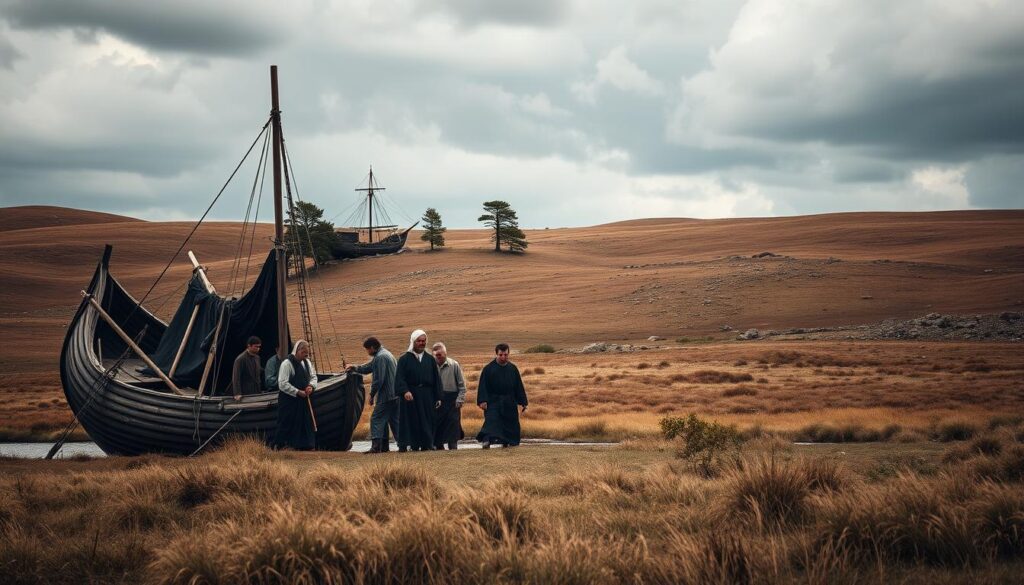
When families boarded ships to cross the Atlantic in 1630, they carried more than just supplies—they brought a blueprint for spiritual community. This wave of 20,000 settlers sought something radical: the freedom to build societies aligned with their strict religious convictions. Their journey marked the start of a cultural experiment that would shape the nation’s character for centuries.
Migration Motivations and Religious Freedom
These reformers called themselves “non-separating Congregationalists,” believing they could purify the Church of England from within. Their vision extended beyond personal salvation. As one leader proclaimed, “We shall be as a city upon a hill—the eyes of all people are upon us.” This idea of America as a moral beacon still influences how the United States engages with the world.
Three key innovations emerged from their settlements:
- Self-governing churches that practiced local decision-making
- Public education systems ensuring biblical literacy
- Economic habits linking hard work to divine approval
Harvard College’s 1636 founding revealed their commitment to educated leadership. Though initially restrictive, their approach to religious life planted seeds for broader liberties. The Puritan way of blending faith with daily routines became woven into America’s social fabric, proving that small communities can leave oversized legacies.
Evolution of Protestant Denominations in the US
Imagine a religious quilt stitched with threads from London, Wittenberg, and Geneva – that’s the fabric of American Protestant diversity. This vibrant tapestry took shape as immigrants brought distinct interpretations of Christian faith across the Atlantic.

Baptists, Presbyterians, Lutherans, and More
Baptists emerged as dominant players, now representing one-third of all American Protestants. The Southern Baptist Convention alone claims 13 million members – more people than the population of Pennsylvania. Their growth reflects a focus on personal conversion and local church autonomy.
Presbyterian churches took a different path. With their educated clergy and love for systematic theology, they founded universities like Princeton. Today’s Presbyterian Church (U.S.A.) maintains 8,700 congregations, blending intellectual rigor with social activism.
Lutheran groups preserved European traditions while adapting to new realities. The Evangelical Lutheran Church in America, with 2.9 million members, mixes formal liturgy with contemporary outreach programs. Their evolution shows how immigrant faiths became distinctly American.
This explosion of denominations wasn’t chaos – it embodied core Protestant values. As one 18th-century preacher noted, “Where the Spirit breathes, new life springs up in unexpected places.” From storefront chapels to cathedral-like megachurches, these varied expressions continue shaping spiritual landscapes nationwide.
The Impact of the Great Awakenings on American Religion
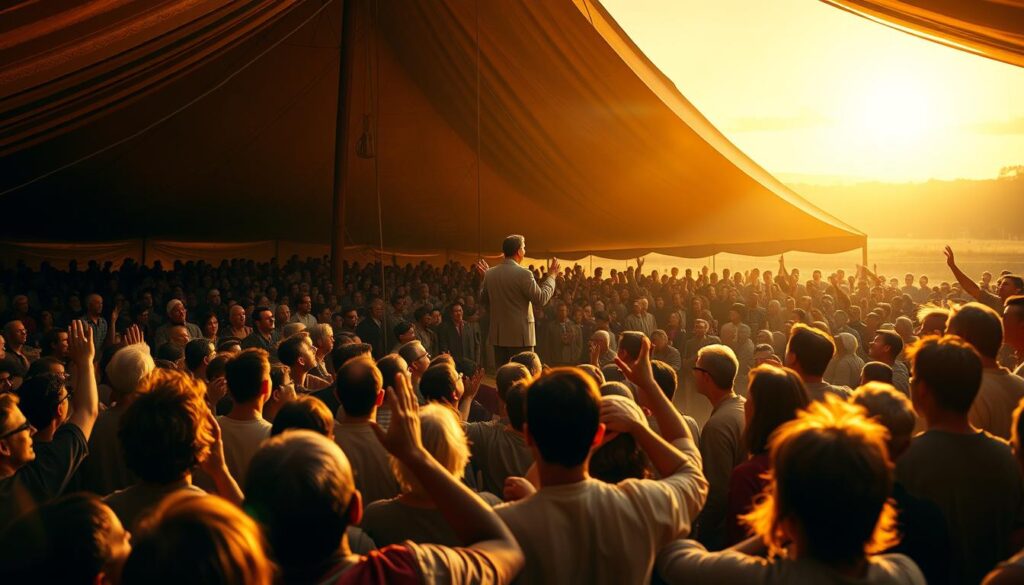
What sparked the first nationwide spiritual revolution in colonial America? The 1730s saw ordinary colonists gather in fields and barns, transformed by fiery sermons about personal salvation. This spiritual wildfire—known as the First Great Awakening—reshaped religious life and planted seeds of national identity.
Revival Movements and Spiritual Renewal
Jonathan Edwards lit the match in 1734 with his famous sermon “Sinners in the Hands of an Angry God.” His vivid descriptions of divine judgment made listeners feel “the ground shaking beneath their feet.” British evangelist George Whitefield then spread the flames, drawing crowds of 8,000—nearly Boston’s entire population.
Three radical changes emerged:
- Farmers and laborers gained equal spiritual standing with educated elites
- Worship shifted from formal rituals to emotional experiences
- Traveling preachers bypassed traditional church structures
| New Lights | Old Lights |
|---|---|
| Emotional preaching | Formal liturgy |
| Open-air revivals | Church buildings only |
| Personal conversion | Inherited faith |
“The God that holds you over the pit of hell, much as one holds a spider over fire, abhors you.”
Camp meetings became the country’s first mass religious events. Families traveled for days to attend week-long gatherings where Baptists, Methodists, and Presbyterians preached side by side. These movements didn’t just renew faith—they trained ordinary people to lead, debate, and organize communities.
By aligning spiritual rebirth with self-determination, revival culture helped forge America’s democratic character. As churches multiplied across the frontier, they became training grounds for citizenship—proving that spiritual revolutions can reshape nations.
The American Revolution and Shifts in Religious Alignments
War doesn’t just reshape borders—it rewires belief systems. When muskets fired at Lexington in 1775, faith communities faced impossible choices. Those tied to British authority scrambled to reconcile spiritual convictions with political rebellion.
Anglican ministers found themselves trapped by their oaths. “How can we pray for King George while our neighbors fight his troops?” one clergyman agonized. Over 80% of these leaders fled to Canada or England, leaving empty pulpits across the country. Their departure forced surviving congregations to reinvent themselves as the Protestant Episcopal Church—a name emphasizing independence from both London and Rome.
Quakers faced different battles. Their pacifist principles clashed with revolutionary fervor, costing them influence in Pennsylvania’s politics. “We became strangers in our own land,” wrote a Philadelphia Quaker, describing how neighbors distrusted their neutrality.
“The war tested souls more than bayonets tested flesh.”
These struggles forged unexpected outcomes. Patriots used the Anglican Church’s collapse to argue for separating church and state. By 1786, Virginia’s Statute for Religious Freedom—penned by Jefferson—became a model for the First Amendment. What began as a crisis of loyalty ultimately strengthened America’s commitment to diverse spiritual expression.
Modern-Day Trends: Declining Majority and Changing Dynamics
When did America’s religious landscape experience its most dramatic shift? The answer arrived quietly in 2012. For the first time since colonial days, groups rooted in Reformation traditions no longer claimed over half the population. This milestone revealed deeper transformations reshaping spiritual communities nationwide.
Mainline Protestant Decline versus Evangelical Stability
Traditional denominations like Methodists and Presbyterians have seen sharp membership drops since the late 20th century. Once dominant in cultural debates, these groups now face aging congregations and shifting social values. A study showed mainline churches lost 14% of adherents between 2009-2019 alone.
Meanwhile, evangelical communities buck the trend through adaptable approaches. Contemporary worship styles and digital outreach help maintain relevance. As one pastor noted, “We’re not changing our message—just how we share it.”
| Group | Trend | Key Factor |
|---|---|---|
| Mainline | Decline | Aging membership |
| Evangelical | Stable | Tech-savvy outreach |
| Black Churches | Steady | Community leadership |
Black congregations remain vital hubs for both faith and social action. Their stable numbers reflect ongoing roles in addressing inequality and fostering cultural pride.
“Our churches aren’t just buildings—they’re living networks of hope.”
Today, 46.5% of Americans identify with these traditions. While no longer a technical majority, this remains the largest religious grouping. The term “Protestant” now covers everything from historic cathedrals to skatepark worship spaces, proving adaptability remains key to survival.
Statistical Insights and Demographic Shifts Over Centuries
Numbers tell stories older than the nation itself. Recent figures reveal 141 million Americans align with faith communities tracing back to Reformation roots—nearly half the country’s population. This massive group continues evolving, blending historic traditions with modern spiritual expressions.
Key Figures and Census Data Analysis
Evangelical communities lead with 25.4% of the population, outpacing mainline groups at 14.7%. Black congregations maintain steady influence at 6.5%, serving as cultural anchors in many neighborhoods.
Baptists dominate individual branches with 15.4% adherence. Nondenominational groups surge at 6.2%, reflecting growing preference for flexible spiritual identities. The Southern Baptist Convention remains America’s largest single denomination, claiming 1 in 20 citizens.
| Tradition | Population Share |
|---|---|
| Evangelical | 25.4% |
| Mainline | 14.7% |
| Black Churches | 6.5% |
| Branch | Adherents |
|---|---|
| Baptist | 15.4% |
| Nondenominational | 6.2% |
| Methodist & Pentecostal | 4.6% each |
“Demographic shifts mirror America’s journey—constant reinvention within enduring frameworks.”
These patterns show centuries-old institutions adapting to new realities. While United Methodists maintain 3.6% representation, younger generations increasingly choose community-focused congregations over denominational labels. The data paints a portrait of faith in motion—honoring legacy while embracing change.
Understanding “protestantism in the us” Through Demographics
Charts and surveys reveal more than numbers—they uncover America’s spiritual heartbeat. Over 140 million people connect with traditions born from Reformation ideals, creating a mosaic of belief that defies simple labels. This community’s strength lies in its adaptability, reshaping itself through waves of immigration and cultural change.
Younger generations are rewriting the rules. While 25% of seniors attend services weekly, only 12% of millennials do—yet nondenominational groups thrive by blending ancient truths with modern lifestyles. Regional differences tell their own stories: Southern Baptists dominate the Bible Belt, while coastal cities see more eclectic spiritual blends.
These patterns show faith traditions evolving without disappearing. As one researcher notes, “Decline in some areas fuels innovation elsewhere.” From bilingual congregations to digital ministries, demographic shifts prove that what unites these communities isn’t uniformity—it’s a shared capacity to meet changing needs while honoring enduring values.
FAQ
How did Protestantism shape early American society?
Early settlers like the Puritans and Pilgrims established colonies rooted in Reformed theology, emphasizing communal worship, moral discipline, and self-governance. Their focus on education and individual interpretation of scripture laid foundations for later democratic ideals.
What role did the Great Awakenings play in American religious life?
The First and Second Great Awakenings sparked nationwide revivals, emphasizing personal conversion and emotional worship. These movements expanded denominations like Baptists and Methodists while fueling social reforms, including abolitionism and women’s rights.
Why did Protestant dominance decline in the 20th century?
Factors like urbanization, secularization, and growing religious diversity reduced the majority status of mainline groups. However, evangelical branches maintained influence through grassroots activism and media outreach.
How did the American Revolution affect religious alignments?
Post-Revolution, state churches dissolved, promoting voluntary membership. Concepts of religious freedom in the Constitution encouraged denominational growth and reduced Anglican influence, empowering Baptists and Presbyterians.
What denominations emerged as key players in US Protestantism?
Baptists, Methodists, Lutherans, and Presbyterians became major groups. Each adapted to regional cultures—for example, Southern Baptists grew in the South, while Lutherans clustered in Midwestern immigrant communities.
How do modern demographics reflect shifts in Protestant identity?
Census data shows a drop from 70% identifying as Protestant in the 1900s to around 40% today. Growth in non-Christian faiths and secularism reshaped the landscape, though evangelicals remain politically active.
Did early Protestant colonies truly practice religious freedom?
Initially, colonies like Massachusetts Bay enforced strict conformity, exiling dissenters. True pluralism emerged later, influenced by figures like Roger Williams, who founded Rhode Island as a haven for diverse beliefs.
What distinguishes mainline Protestants from evangelicals today?
Mainline groups, like Episcopalians, often embrace progressive social views and ecumenism. Evangelicals prioritize biblical literalism, missionary work, and conservative cultural stances, sustaining higher engagement rates.