What unites millions of believers across continents and centuries? The answer lies in a simple yet profound design: the Luther Rose. Created in 1530 during a pivotal moment in religious history, this emblem captures the heart of Christian faith and theological vision.
Martin Luther developed this iconic image while staying at Coburg Fortress. It wasn’t just artwork—it became his personal seal for letters and teachings. The design emerged during the Diet of Augsburg, a critical event where leaders debated church reforms.
Each element of the rose carries deep meaning. A cross, heart, and ring work together to visualize core beliefs about grace and salvation. For Luther, it was like a visual summary of everything he taught—a way to share complex ideas through imagery.
Today, the Luther Rose remains more than a historical artifact. It connects modern worshippers to foundational truths while bridging cultural gaps. This guide will unpack its rich layers, showing how one symbol can inspire generations.
Key Takeaways
- The Luther Rose originated in 1530 as Martin Luther’s personal seal during religious reforms
- Its design combines multiple Christian elements to communicate theological concepts visually
- Created during the Diet of Augsburg, the symbol reflects historical tensions and spiritual priorities
- Luther viewed the rose as a condensed version of his teachings about faith and grace
- Modern Lutheran communities worldwide use the emblem as a unifying visual identity
The Origins and Historical Context of the Lutheranism Symbol
How do great emblems become timeless? For the iconic Luther Rose, it began with unexpected moments that shaped religious history. Long before its final design, early versions appeared in surprising places.
Martin Luther and the Reformation Timeline
In 1520, a Leipzig printer made history. Wolfgang Stöckel included a rose woodcut in Luther’s sermon – the first visual portrait of the reformer. This simple flower became his unofficial emblem during explosive debates about church practices.
Luther’s doctoral ring offers clues to later designs. Its heart-shaped shield symbolized the Holy Trinity, showing how personal items carried deep symbolism. These early sparks would ignite a visual revolution.
Early Depictions and the Emergence of the Luther Rose
The rose transformed in 1530 through collaboration. Artist Lazarus Spengler sent Luther a seal sketch while he hid at Coburg Fortress. Prince John Frederick then delivered a signet ring featuring the design – turning ideas into lasting art.
Three key developments shaped the emblem:
- The 1520 woodcut established visual recognition
- Academic jewelry inspired core elements
- Political support turned personal art into official seals
This timeline shows how faith, politics, and personal thoughts blended to create an enduring symbol. What started as printer’s decoration became a beacon of reformed Christianity.
Exploring the “lutheranism symbol” and Its Profound Theological Meaning
Every color and shape in this renowned emblem tells a story. Let’s unpack how simple visuals became powerful messengers of faith and hope.
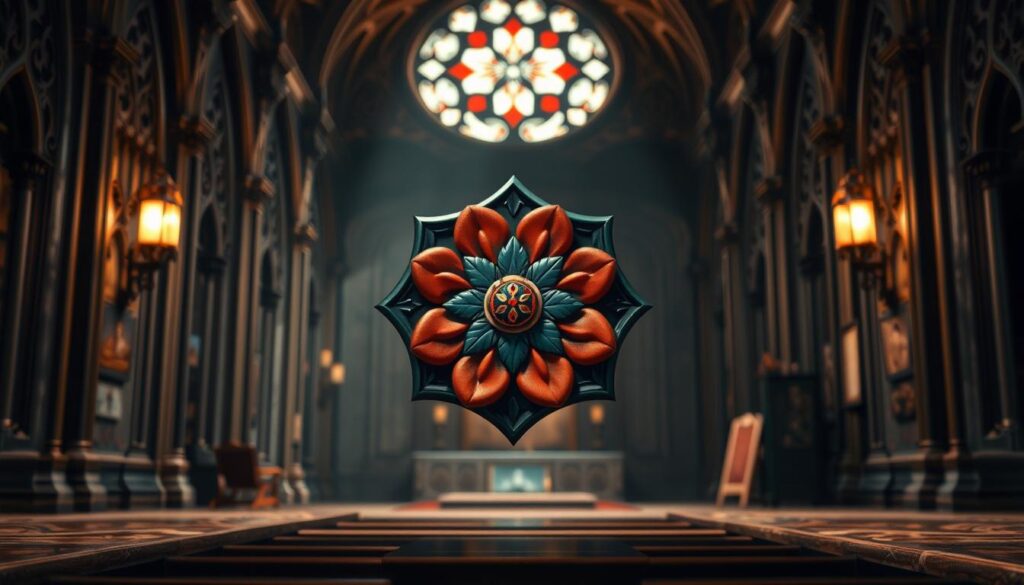
Decoding the Visual Theology
At the core sits a black cross within a heart. Luther explained this represents “faith crucified” – trusting Christ’s sacrifice while keeping our humanity intact. The heart’s natural color shows salvation preserves our true nature.
Surrounding this center blooms a white rose. Unlike worldly red roses symbolizing passion, this pure hue mirrors angelic spirits. It whispers of divine joy and peace that outshines earthly happiness.
A Letter That Changed History
In 1530, Luther sent artist Lazarus Spengler his now-famous explanation:
“The rose should stand in a sky-blue field, symbolizing heavenly joy grasped in hope… encircled by a golden ring showing eternal blessedness.”
Three key insights emerge from this letter:
- The blue background points to future glory we taste now through faith
- Gold’s unbreakable quality mirrors God’s everlasting promises
- Every element works together like a spiritual roadmap
This design isn’t just pretty art – it’s a compendium of Christian belief. Through colors and shapes, Luther gave believers a visual anchor for life’s storms and triumphs.
Modern Interpretations and Cultural Applications
How does a 16th-century emblem stay fresh in our fast-paced world? The Luther Rose answers through creative reinventions that honor its roots while speaking to new generations.
Community Identity Through Heraldry
Walk through German and Austrian towns like Rodgau or Greifenstein, and you’ll spot this iconic rose in unexpected places. Over a dozen communities feature it in their coats of arms, from Langenholtensen’s civic seals to Ramsau am Dachstein’s mountain-town banners.
These civic uses show how the Lutheran church’s teachings shaped regional identities. Local governments adopted the design not just as religious art, but as symbols of shared values like hope and communal strength.
Cross-Cultural Conversations
Ukrainian Lutheran congregations added a striking twist. Their version centers a three-barred Orthodox cross, blending Reformation theology with Byzantine traditions. This fusion respects cultural roots while keeping Luther’s core message intact.
Swiss artist Edwin Hassink reimagined the Luther seal for modern worship spaces. His design shows figures passing communion elements in a joyful circle. “It’s about joy flowing through community,” he explained, “like faith dancing off the page.”
From village crests to altar art, these adaptations prove great symbols don’t fossilize. They grow, reflecting eternal truths through ever-changing cultural lenses.
Conclusion
Five centuries haven’t dimmed the power of Martin Luther’s visual masterpiece. From its humble start as a black-and-white seal in early printed works to vibrant hand-colored editions, the rose evolved alongside the movement it represents. Printers painstakingly added color to Luther’s works, making each copy a unique testament to enduring faith.
This design brilliance lies in its simplicity. Luther packed complex theology into shapes anyone could grasp. The cross and heart spoke clearer than Latin debates. Communities worldwide adopted it because its reason resonated across cultures – a rare feat in religious art.
Today, the emblem thrives in digital and physical spaces. Modern believers find fresh meaning in its layers while honoring its roots. More than ink on paper, it remains a living bridge between past convictions and present-day hope.
As you encounter this historic seal, remember its purpose: to point beyond art to timeless truths. In our divided world, Luther’s rose still whispers unity through shared belief.
FAQ
What does the Luther Rose symbolize?
The Luther Rose represents core theological ideas like faith, joy, and peace. Its elements—a black cross, white rose, golden ring, and sky-blue field—highlight Christ’s sacrifice, hope, eternal blessedness, and divine truth. Martin Luther designed it to visually summarize his teachings.
How did Martin Luther’s Reformation influence the design?
During the Reformation, Luther sought a seal to express his beliefs. The Luther Rose emerged as a response to debates about grace and scripture. Its simplicity countered complex medieval imagery, focusing on Christ-centered theology and personal faith.
Why is the heart included in the Luther Rose’s description?
Though not visually part of the seal, Luther described the cross as “resting in the heart.” This emphasizes that true faith begins inwardly, transforming the believer’s life. The heart metaphor ties to his emphasis on scripture over human reason.
What role did Lazarus Spengler play in the symbol’s history?
Lazarus Spengler, a close ally of Luther, received a 1530 letter explaining the seal’s meaning. This letter became key to understanding its theology. Spengler helped popularize the design, ensuring its lasting role in Lutheran identity.
How is the Luther Rose used in churches today?
Modern churches incorporate the Luther Rose in stained glass, altars, and logos. Its adaptability allows variations, like Byzantine-style icons or minimalist designs. It remains a unifying emblem for Lutheran communities worldwide, reflecting shared beliefs.
Does the golden ring have a specific meaning?
Yes! The golden ring symbolizes eternal life and God’s unending love. Luther linked it to heavenly joy that “has no end,” contrasting earthly struggles. This element reinforces the promise of salvation central to Lutheran teachings.