The roots of the Catholic Church stretch back to a single Greek word: katholikos, meaning “universal.” First used by Ignatius of Antioch in 110 AD, this ancient term laid the groundwork for a religion that now spans continents and cultures. Imagine a small Mediterranean community growing into a global family of 1.3 billion people – that’s the story we’ll explore together.
Why did this idea of universality become so powerful? Early Christians wanted to emphasize unity across diverse communities. The blend of Greek words kata (about) and holos (whole) created more than just a name – it shaped a vision for connection. This definition still guides the Church’s mission today, from local parishes to worldwide outreach programs.
You’ll discover how art, philosophy, and social justice efforts grew from these ancient beginnings. We’ll look at stunning cathedrals, timeless traditions, and modern initiatives that show Catholicism’s living legacy. Whether you’re new to the subject or deepening your knowledge, this guide makes complex ideas easy to grasp.
Key Takeaways
- The term “Catholic” comes from Greek words meaning “universal” or “whole”
- First officially used in early 2nd-century Christian writings
- Grew from small communities to the world’s largest Christian group
- Combines spiritual practices with cultural and artistic traditions
- Continues to address modern issues through its global network
Introduction to the History and Significance of Catholicism
Spanning two millennia, the Catholic Church has shaped civilizations while preserving ancient wisdom. As a cornerstone of the Christian religion, it connects modern believers to first-century Palestine through unbroken traditions. Few institutions have influenced the world so profoundly – in art, education, and social justice.
This global faith began with twelve apostles and now serves 1.3 billion people. Through centuries of change, it maintained core teachings while adapting to new cultures. Key events like Emperor Constantine’s conversion (312 AD) and Vatican II (1962-1965) reshaped its role in society.
| Event | Year | Impact |
|---|---|---|
| Edict of Milan | 313 AD | Legalized Christianity |
| Great Schism | 1054 | Split Eastern/Western churches |
| Gutenberg Bible | 1455 | Spread Catholic texts |
| Vatican II | 1962-1965 | Modernized practices |
The Church’s tradition of learning preserved ancient texts during Europe’s Dark Ages. Monastic scribes copied Aristotle’s works while missionaries built schools across continents. Today, Catholic universities like Georgetown continue this legacy.
From Gothic cathedrals to hospital systems, the Church’s contributions touch daily life. Its teachings on human dignity inspired abolition movements and civil rights campaigns. This living history shows how faith evolves while staying rooted in ancient truths.
Etymology and Definition of Catholicism
Language shapes beliefs, and few words carry richer history than “Catholic.” This term began as a Greek puzzle piece – katholikos, blending kata (concerning) and holos (whole). Early Christians crafted this linguistic mosaic to describe a faith meant for everyone, everywhere.
Greek Origins and Linguistic Roots
Imagine second-century believers choosing words like architects. They paired katholikos with ecclesia – Greek for “called-out assembly.” Together, these terms formed “Catholic Church“: a universal community set apart for sacred purpose.
The definition spread like wildfire. As Christianity moved west, katholikos became Latin’s catholicus. This adaptation kept the original vision intact while crossing cultural borders. Missionaries carried both the word and its universality to new lands.
Evolution of the Term in Christian Context
By the fourth century, the term marked a crucial distinction. St. Augustine wrote of “what has been believed everywhere, always, by all” – capturing the essence of catholic. This idea fueled global outreach, from medieval monasteries to modern hospitals.
Today’s Catholic identity still echoes those Greek roots. The church maintains its worldwide mission while honoring ancient linguistic precision. Like a living language, it grows without losing its original grammar of faith.
The Historical Evolution of the Catholic Church
From a handful of followers in Jerusalem to a global spiritual network, the Catholic Church has navigated centuries of change. Its story unfolds through bold decisions, cultural shifts, and unshakable commitment to tradition.
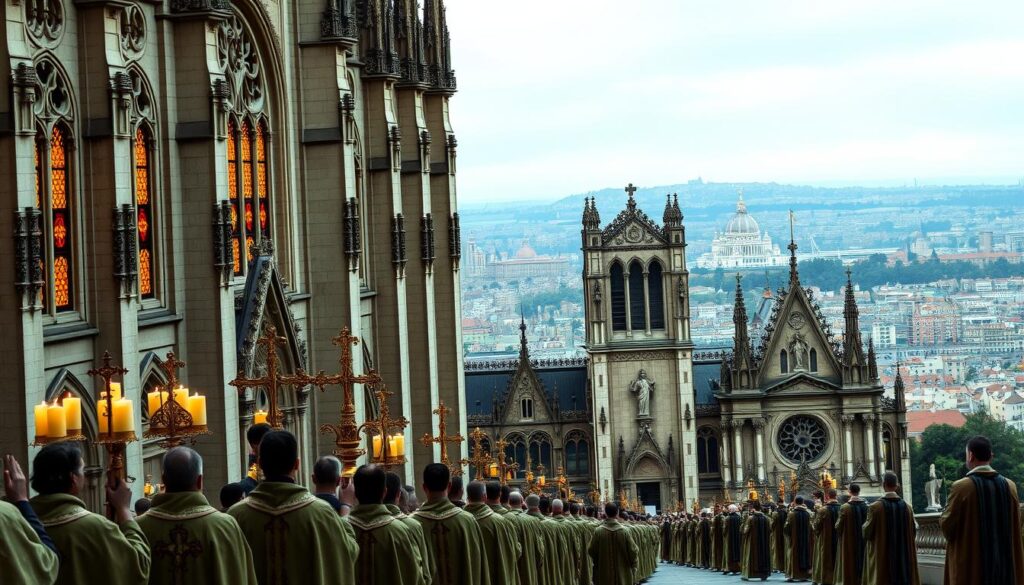
Key Milestones from the Early Church to Today
The first believers faced persecution but built lasting foundations. By 380 AD, Christianity became Rome’s official religion. This shift opened doors for church growth across the ancient world.
Medieval monks preserved knowledge while missionaries spread faith. The 16th-century Reformation sparked renewal efforts. Vatican II (1962-1965) modernized practices without losing core beliefs.
| Turning Point | Year | Significance |
|---|---|---|
| Edict of Milan | 313 | Ended Christian persecution |
| Council of Nicaea | 325 | Defined core doctrines |
| East-West Schism | 1054 | Split Christianity |
| Vatican II | 1962-1965 | Engaged modern society |
These moments show how the Catholic Church adapts while honoring its roots. From Gothic cathedrals to social justice programs, its history remains alive in today’s challenges.
Insights from Early Church Fathers
Two trailblazing leaders helped cement the church‘s identity during its formative years. Their writings and sacrifices created blueprints for Christian unity that still guide believers today.
Ignatius of Antioch and Polycarp’s Contributions
Ignatius of Antioch revolutionized Christian thought with a single phrase. As he faced martyrdom in 110 AD, he wrote:
“Wherever the bishop appears, there let the people be – just as wherever Jesus Christ is, there is the Catholic Church.”
This bold statement tied local congregations to universal truth. Ignatius saw bishops as living links to the original apostles – a concept that shaped church structure for centuries.
Polycarp carried this vision forward. A direct disciple of John the Apostle, he led the Smyrna community with unwavering faith. His famous letter declared:
“To all dioceses of the holy church in every place.”
Both men died defending their beliefs. Their martyrdoms became powerful examples of commitment. More importantly, their teachings established patterns of authority and unity that helped scattered churches function as one body.
Through their writings, these early fathers showed how diverse communities could share common practices. They proved that faith thrives when rooted in both tradition and courageous leadership.
The Role of Doctrinal Development in Shaping Catholicism
Imagine early Christians grappling with complex spiritual questions. How did ideas from Jesus’ teachings become formal doctrine? This process of doctrinal development acts like a bridge, connecting ancient beliefs to modern understanding.
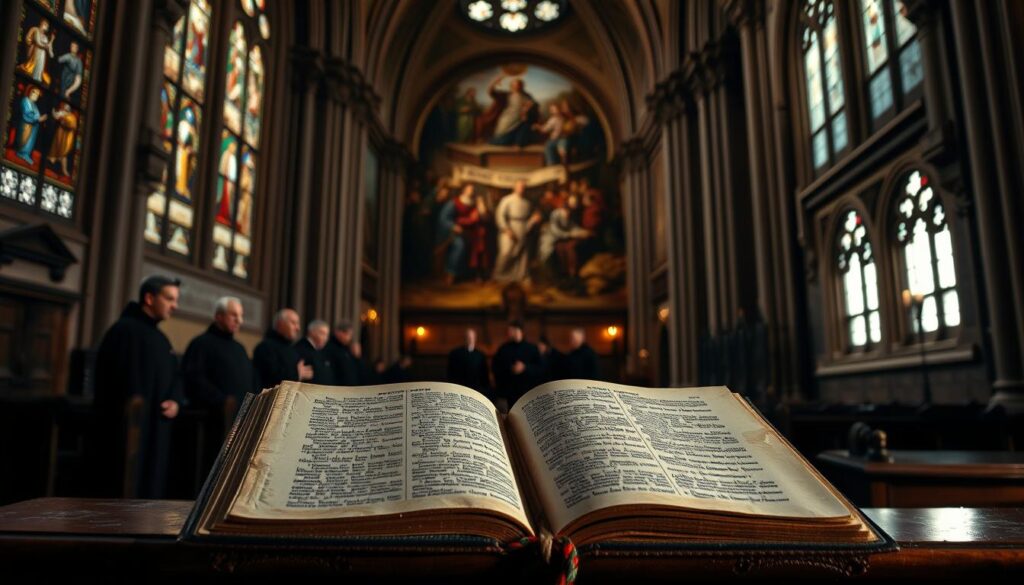
From Apostolic Tradition to Formal Doctrine
The Church didn’t invent new beliefs. Instead, it clarified what apostles taught. Take the Trinity – though never named in Scripture, Theophilus of Antioch first used the term around 180 AD. Church councils later refined this teaching to counter misunderstandings.
Why does this matter? Core ideas like salvation or sacraments needed precise language as Christianity spread. Local traditions and cultural shifts demanded clear answers. Through debates and councils, leaders preserved truth while addressing new challenges.
This work continues today. Papal letters and global meetings update how teachings apply to modern life. As one bishop noted:
“The deposit of faith remains constant, but our grasp of it deepens.”
Doctrinal development isn’t about change – it’s about clearer expression. Like polishing a diamond, the Church helps believers see timeless truths in fresh light.
Exploring “catholicism meaning” in Christian Doctrine
Across the spectrum of Christian belief, one term sparks both unity and debate: Catholic. While many associate it with Rome, numerous churches claim this identity through shared roots in early Christian practice. This diversity reveals a rich tapestry of interpretations about what makes a community truly universal.
Defining Universality and Apostolicity
The Catholic Church’s heartbeat lies in two principles: reaching all people (universality) and maintaining direct ties to Jesus’ first followers (apostolicity). As fourth-century theologian Vincent of Lérins wrote:
“We hold that which has been believed everywhere, always, by all.”
Eastern Orthodox and Lutheran communities apply these ideas differently. All cite the Nicene Creed’s “one holy catholic church,” yet disagree on which group embodies it fully. Roman Catholics emphasize papal authority, while Methodists focus on spiritual continuity with early believers.
This tension creates fascinating overlaps. Anglican scholar C.S. Lewis once noted:
“The Church exists for nothing else but to draw men into Christ.
Modern denominations showcase how unity in diversity works. Byzantine liturgies, African drum masses, and Latin American processions all express the same core faith. What binds them? A shared conviction that Christ’s message transcends cultural boundaries while requiring tangible connections to apostolic roots.
Understanding these concepts helps explain why the Christian religion maintains both global reach and localized expressions. It’s not about sameness, but about preserving essential truths while embracing human variety.
The Structure and Authority of the Roman Catholic Church
Navigating the complex structure of the Roman Catholic Church reveals a carefully designed system balancing spiritual authority with global administration. This framework supports over 1.3 billion members through local parishes and international councils alike.
Understanding the Papal Leadership
The Pope serves as both spiritual guide and organizational leader. Elected by cardinals, this role traces back to St. Peter’s original commission. Modern pontiffs combine ancient traditions with contemporary challenges, working closely with regional bishop conferences.
The Organizational Hierarchy and Councils
Below the papacy, cardinals oversee archdioceses while priests manage local communities. Major councils like Vatican II demonstrate how the Roman Catholic Church refreshes practices while maintaining core teachings. This layered structure ensures both unity and cultural adaptability across 3,000 dioceses worldwide.
From parish committees to the Vatican’s departments, every level contributes to shared decision-making. This system has guided the Church’s authority for centuries, proving flexible enough to address modern social issues while preserving historical foundations.
FAQ
What does the term "Catholic" mean in Christianity?
The word “Catholic” comes from the Greek katholikos, meaning “universal.” It reflects the belief that the Church embraces all people and teachings rooted in Jesus Christ’s mission. This universality unites Roman Catholics and other Christian communities under shared doctrines.
How did early Church leaders shape Catholic teachings?
Figures like Ignatius of Antioch emphasized unity under bishops and the Eucharist as central to faith. Their writings defended apostolic traditions, which later formed the foundation for formal doctrines like the Nicene Creed and papal authority.
Why is the Pope considered the leader of the Roman Catholic Church?
Catholics believe the Pope inherits spiritual authority from Saint Peter, whom Jesus called the “rock” of His Church. The Pope guides doctrine, interprets Scripture, and ensures consistency in teachings across global dioceses through councils like Vatican II.
How does the Catholic Church maintain unity across cultures?
Through its hierarchical structure—bishops, priests, and deacons—the Church upholds standardized practices like Mass and sacraments. Apostolic succession ensures teachings remain aligned with early Christian traditions, fostering shared identity despite cultural diversity.
What role do councils play in Catholic doctrine?
Councils, such as Trent or Vatican I, address theological debates and clarify beliefs. They reinforce doctrines like transubstantiation or Mary’s Immaculate Conception, ensuring the Church adapts while staying true to its apostolic roots.
How does Catholicism differ from other Christian denominations?
The Roman Catholic Church emphasizes sacraments, Marian devotion, and papal infallibility. Unlike many Protestant groups, it views tradition and Scripture as equal sources of authority, guided by the Magisterium’s interpretations.
Why is baptism important in Catholic practice?
Baptism cleanses original sin and initiates individuals into the Church. It reflects Jesus’ command to “make disciples of all nations,” symbolizing rebirth and membership in the global body of believers.