Every spiritual journey begins with a single step. For millions worldwide, that first step unfolds through a sacred rite that marks both a beginning and a profound transformation. This foundational sacrament opens doors to divine grace while creating an unbreakable bond with a faith community.
Unlike ordinary ceremonies, this one-time sacrament leaves an eternal imprint on the soul. Through flowing water and sacred words, participants receive more than symbolic cleansing – they gain spiritual rebirth. The ritual serves as both personal awakening and formal entry into a 2,000-year-old tradition.
Central to this experience is the belief in divine transformation. Recipients aren’t just welcomed into a church – they’re believed to receive sanctifying grace that reshapes their relationship with the divine. This grace, coupled with the Holy Spirit’s presence, forms the cornerstone of Christian spiritual growth.
Key Takeaways
- Serves as the first and essential sacrament in Christian initiation
- Creates permanent spiritual change through sanctifying grace
- Marks official entry into the global faith community
- Involves the Holy Spirit’s indwelling presence
- Required for salvation according to church teachings
- Transcends symbolism through actual divine action
Introduction to Catholicism Baptism
The moment of spiritual birth in the Catholic tradition sparks lasting change. More than water rituals, this sacrament rewrites spiritual DNA. Participants become God’s actual children, not just symbolic followers—claimed by divine love through Christ’s promise.
https://www.youtube.com/watch?v=ZJt92SgTRYg
Setting the Stage for Faith and Tradition
Imagine joining a family tree stretching back two millennia. Through sacred waters, the Holy Spirit binds individuals to a global community. Biological ties fade next to these eternal connections. Faith becomes the shared language across cultures and generations.
Overview of Baptism’s Role in the Catholic Church
Membership in the Church brings both honor and duty. The newly baptized carry torchlight passed through centuries, charged with keeping it burning bright. Spiritual growth becomes daily bread, not optional garnish.
| Life Aspect | Before | After |
|---|---|---|
| Divine Connection | Seeking God | Living in God’s family |
| Community Role | Observer | Active participant |
| Spiritual Growth | Personal effort | Grace-fueled journey |
Like saplings planted in rich soil, the baptized need nurturing. Regular prayer and service become sunlight and water for this new life. The journey starts at the font but stretches into eternity.
Historical Roots and Biblical Foundations
From covenant signs to living waters, faith’s markers evolve across centuries. Ancient practices laid groundwork for sacred rituals still shaping spiritual lives today.
Old Testament Connections and Early Church Practices
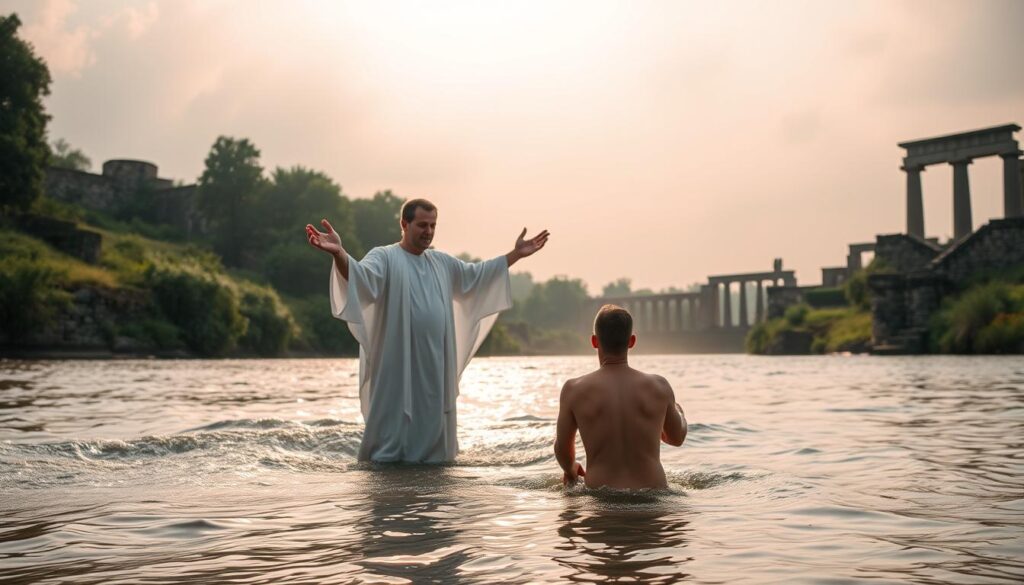
Long before water immersion, God’s people marked covenant membership through physical signs. Abraham’s descendants entered divine promises through circumcision – a practice performed on infants through parental faith. This ritual became the blueprint for incorporating children into God’s family.
Early Christians transformed this tradition. St. Paul declared in the New Testament:
“In Christ Jesus, neither circumcision nor uncircumcision counts for anything” (Galatians 5:6)
. Baptism emerged as the new covenant marker, washing awaysininstead of shedding blood.
New Testament Teachings on Baptism
Jesus’ words to Nicodemus revolutionized spiritual rebirth: “No one can enter God’s kingdom without being born of water and Spirit” (John 3:5). The apostles acted swiftly, baptizing entire households after conversions. St. Augustine later confirmed this wasn’t innovation but apostolic tradition.
Romans 6 reveals baptism’s deepest meaning: union with Christ. Believers symbolically die and rise with Him, receiving salvation through divine grace. This transformative act fulfills Jesus’ final command:
“Go make disciples of all nations, baptizing them” (Matthew 28:19)
.
Three key shifts occurred across Scripture:
- Physical sign (circumcision) → Spiritual cleansing (water baptism)
- National identity → Global community
- Blood covenant → Resurrection power
The Sacramental Structure of Baptism
Sacraments follow a divine blueprint – precise elements working together to channel grace. At their core lie three pillars: form, matter, and intent. These ensure every ritual carries both human meaning and heavenly power.
Understanding Form, Matter, and Intent
The baptismal formula acts like a spiritual key. When spoken over flowing water – “I baptize you in the name of the Father, Son, and Holy Spirit” – it unlocks Christ’s promise. This combination mirrors Jesus’ own command, linking each sacrament to the Trinity.
Water’s role goes beyond symbolism. As essential matter, it represents both cleansing and rebirth. Even a few drops fulfill the requirement, making grace accessible in emergencies or remote areas.
| Element | Requirement | Example |
|---|---|---|
| Form | Trinitarian formula | Spoken clearly during pouring |
| Matter | Natural water | Font, river, or hospital sink |
| Intent | Church’s purpose | Rejecting superstition |
Validity, Licitness, and Canon Law Aspects
A valid sacrament meets God’s criteria. An illicit one breaks Church rules. Imagine a nurse baptizing a dying baby – valid but illicit if done without parish approval. Canon Law prioritizes salvation while maintaining order.
Three common scenarios show this balance:
- Layperson performing emergency rites (valid + illicit)
- Deacon baptizing without permission (valid + illicit)
- Priest using wrong words (invalid + illicit)
These distinctions help Catholics trust the sacrament’s power while respecting its sacred administration. Through proper form and intent, ordinary water becomes a conduit for eternal life.
Exploring the Symbolism in Catholic Baptism
Sacred symbols transform ordinary elements into divine messages. Every object in the ritual acts like a spiritual translator, turning physical actions into eternal truths. These visible signs help believers grasp invisible transformations happening through the sacrament.
Water, Baptismal Fonts, and the Immersion Process
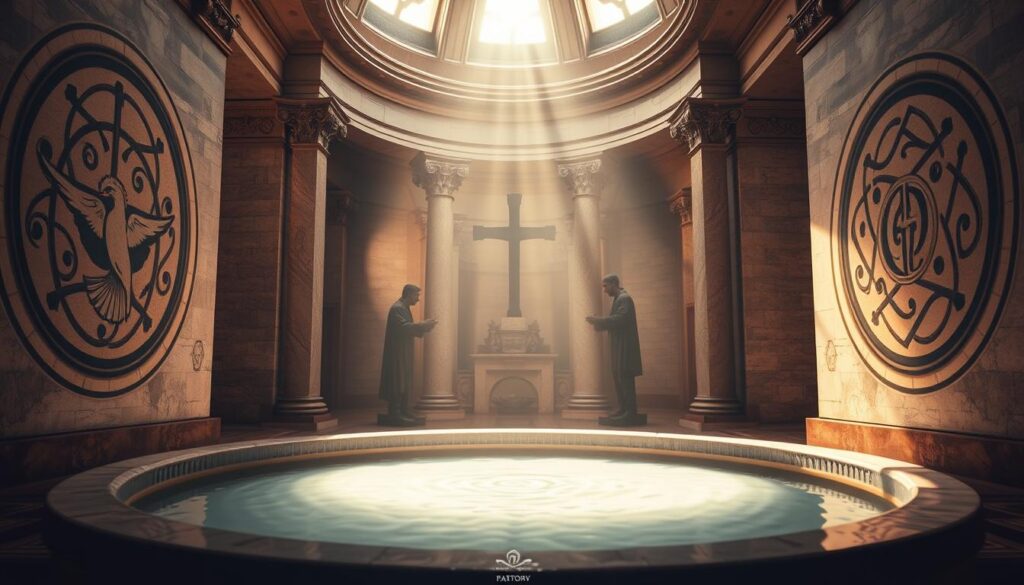
The font’s design carries echoes of ancient rivers where early believers were fully immersed. Modern vessels maintain this connection through flowing shapes and placement near church entrances. This reminds participants they’re entering new life through living water – a symbol Jesus used to describe spiritual renewal.
Three layers of meaning flow through the water:
- Cleansing from past burdens
- Birth into spiritual family
- Connection to Christ’s resurrection
The Significance of the White Gown and Baptismal Candle
New members emerge from the font wrapped in spotless white. This tradition mirrors St. Paul’s teaching about “putting on Christ.” The garment shouts without words: “Something sacred has changed here.”
The lit candle does double duty. Its flame represents personal faith needing constant care, while the wax reminds believers of Christ’s promise:
“I am the light of the world” (John 8:12)
. Together, these symbols create a spiritual roadmap for the journey ahead.
Sacred oils add final touches to this symbolic language. The Oil of Catechumens strengthens for spiritual battles, while Chrism consecrates the recipient as God’s special ambassador. Each element works together like puzzle pieces revealing God’s grace.
The Role of Family and Community in the Baptismal Journey
In the Catholic tradition, spiritual growth thrives within a network of support. Parents and godparents form the first circle of guidance, while the wider faith community provides lasting encouragement. Together, they create a safety net for the child’s religious development.
Parental Responsibilities and Faith Promises
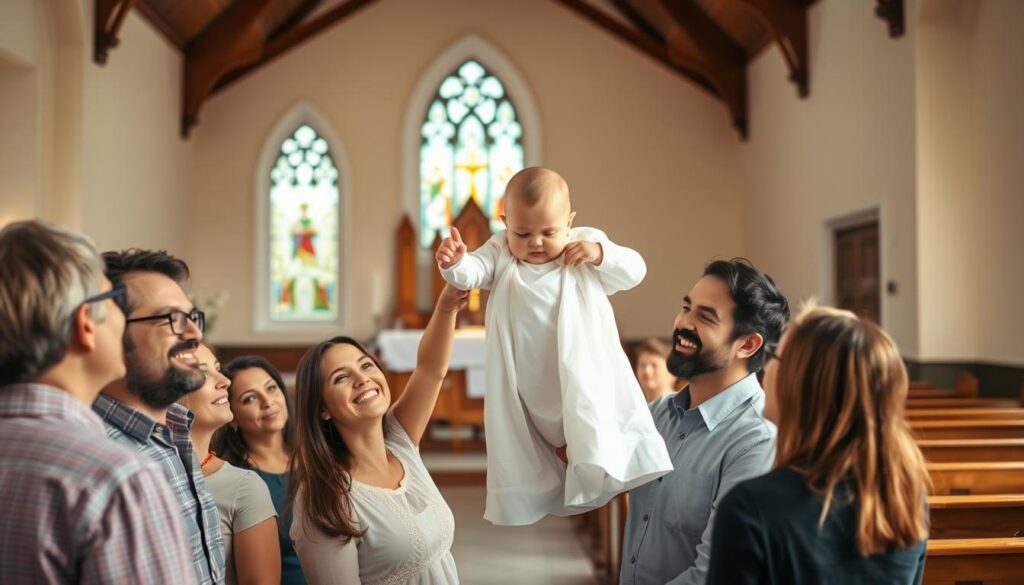
When parents bring their children to the font, they make three core commitments:
- Regular participation in Mass and sacraments
- Daily prayer within the family
- Religious education through formal programs
These promises turn homes into miniature churches. Parents become first teachers, showing through actions how faith shapes decisions and relationships.
Godparents as Spiritual Guides and Witnesses
Chosen godparents must meet strict criteria to ensure strong mentorship:
| Requirement | Purpose |
|---|---|
| Confirmed Catholic | Deep understanding of teachings |
| Age 16+ | Maturity for lifelong role |
| Eucharist recipient | Active participation in sacraments |
Beyond attending ceremonies, godparents serve as living examples. They’re prepared to step in if unforeseen circumstances prevent parents from fulfilling their duties. This dual support system helps the baptized person navigate faith challenges at every life stage.
Practical Steps for Baptism Preparation
Embarking on this spiritual milestone starts with organization and understanding. While the ceremony marks a sacred beginning, thoughtful planning ensures its deeper meaning shines through. These practical steps help families create lasting memories while honoring tradition.
Starting the Conversation With Your Church
Reach out to your local parish office early – many communities request 3-6 months’ notice. Bring birth certificates and complete basic paperwork to secure your date. Ask about witness requirements when choosing godparents, as parishes often verify their eligibility.
Engaging With Preparation Programs
Most churches require parents and sponsors to attend educational sessions. These meetings explore the sacrament’s significance and practical ceremony details. You’ll discuss ways to nurture faith in children through daily rituals and community involvement.
Preparation classes often cover:
- The role of sacred symbols like water and oil
- Responsibilities after the ceremony
- Connecting the rite to other sacraments
Many families find these sessions strengthen their own spiritual journey. By investing time beforehand, you ensure the event becomes more than tradition – it becomes a foundation for years of growth.
FAQ
Why is baptism considered essential in the Catholic faith?
Baptism marks the beginning of a person’s journey into the Church, cleansing original sin and uniting them with the risen Christ. The Catechism of the Catholic Church teaches it’s necessary for salvation, opening the door to grace and eternal life.
Can someone be baptized without water?
While water is the primary symbol, extraordinary circumstances allow for “baptism of desire” (yearning for the sacrament) or “baptism of blood” (dying for the faith). These are recognized by the Church when water isn’t accessible.
What role do godparents play in the ceremony?
Godparents serve as spiritual mentors, pledging to support the child’s growth in faith. They must be practicing Catholics, confirmed, and living in alignment with Church teachings to fulfill this sacred duty.
How do parents prepare for their child’s baptism?
Parents typically attend preparation sessions at their parish, reflecting on their own faith commitments. They also choose godparents and collaborate with the priest to plan the ceremony’s details.
Is adult baptism different from infant baptism?
Adults receive the sacrament after a period of formation (RCIA), professing their own faith. Infants rely on their parents’ and godparents’ promises, with the expectation they’ll later affirm their beliefs at confirmation.
Why is the white gown used during the rite?
The white garment symbolizes purity and the new life received through Christ. It echoes St. Paul’s teaching about being “clothed in Christ” and visually represents the soul’s transformation.
What if a family isn’t active in a parish?
The Church encourages families to reconnect with their local parish community. Pastors often guide them in renewing their faith practice to ensure the child’s spiritual upbringing aligns with baptismal promises.
Can non-Catholics attend a baptism ceremony?
Absolutely! The Church welcomes all to witness this joyful celebration. It’s a beautiful opportunity to share the faith and highlight the communal aspect of sacraments.