Picture a crisp white banner with a bold red cross against a sky-blue square. This iconic symbol began as a spontaneous idea during a Brooklyn Sunday school class in 1897. When a guest speaker didn’t show up, educator Charles C. Overton asked students to imagine a visual representation of their faith. That creative exercise sparked what we now recognize as one of Christianity’s most unifying emblems.
Every detail in this design carries spiritual significance. The white background reflects purity and peace, while the blue canton echoes baptismal waters and steadfast devotion. The crimson cross at the center serves as a vivid reminder of sacrifice and redemption. These elements combine to create more than fabric—they form a shared language for believers.
From its humble New York origins, this emblem spread rapidly across denominations. By 1942, it gained official recognition from major religious groups. Today, you’ll find it in sanctuaries from small-town chapels to international cathedrals, bridging theological differences through common imagery.
Key Takeaways
- Originated in 1897 during an unplanned Sunday school discussion in Brooklyn
- Color symbolism: white (purity), blue (faithfulness), red (sacrifice)
- Adopted by multiple denominations as a unifying visual element
- Appears in worship spaces worldwide despite denominational differences
- Maintains relevance through its focus on core Christian beliefs
History and Origins of the Protestant Church Flag
A pivotal moment in religious symbolism unfolded one autumn morning in Brooklyn. On September 26, 1897, Charles Overton faced an empty podium at Brighton Chapel’s Sunday school. With no guest speaker present, the New York educator turned a potential setback into a creative opportunity.
Early Beginnings and Inspiring Moments
Overton pointed to the American flag draped nearby and posed a bold question: “What if believers had their own banner?” His students envisioned a universal emblem for their faith—a concept that simmered for years. By 1907, Overton teamed with Ralph Diffendorfer, a Methodist leader, to transform that Sunday school discussion into tangible reality.
Their collaboration produced a simple yet powerful design. Churches across the nation began displaying the symbol voluntarily. This grassroots adoption mirrored America’s growing desire for spiritual unity during rapid social changes.
Evolution Through the Ecumenical Movement
The early 20th century’s push for interdenominational cooperation propelled the emblem’s rise. Missionaries carried it overseas, while local congregations embraced its message of shared beliefs. By 1942, major denominations formally recognized the design through the Federal Council of Churches.
From Coney Island classrooms to global sanctuaries, this symbol’s journey reflects Christianity’s adaptive spirit. Its acceptance across diverse traditions proves simple visuals can sometimes unite better than words.
Design and Symbolism Behind the Flag
Three colors and one simple shape tell a story spanning centuries. The Christian Flag’s design transforms everyday hues into sacred messages, blending visual simplicity with layered spiritual meaning.

Color Meanings: Red, White, and Blue in Christian Faith
The white field forms more than a backdrop—it embodies divine purity and the peace found through salvation. Like fresh snow covering imperfections, it reflects the cleansing power of belief.
Nestled in the upper left corner, the blue canton carries dual significance. Its azure tones recall baptismal waters initiating spiritual rebirth while honoring Christ’s eternal reliability. “Blue speaks to heaven’s constancy,” one theologian notes.
The Latin Cross and Its Significance
Centered in the blue square, the red Latin cross pulses with meaning. Its crimson shade memorializes sacrificial love, each drop of color whispering “This blood bought your freedom.”
Designers chose this cross style for instant recognition across cultures. Unlike ornate variations, its clean lines translate perfectly to banners and steeples alike. The vertical beam points toward divine connection, the horizontal arm embracing human community.
While sharing America’s patriotic palette, these colors rewrite the narrative. Red becomes redemption rather than revolution, white signifies sanctity instead of surrender, blue pledges heavenly fidelity over earthly governance. Together, they create a silent sermon hanging in worship spaces worldwide.
Trials and Traditions in Display and Usage
Where a banner hangs often reveals its cultural weight. Since 1938, congregations have followed James Russell Pollock’s guidelines to balance reverence with practicality. These protocols help worshippers honor sacred symbols while maintaining visual harmony in shared spaces.
Flag Placement in Church Sanctuaries
Two primary positions show proper respect for the emblem. It may stand at floor level outside the communion rail on the congregation’s right side, or occupy the right flank of elevated liturgical elements like altars. This placement strategy intentionally prioritizes spiritual authority over earthly power.
| Aspect | Christian Flag | American Flag |
|---|---|---|
| Position in Sanctuary | Right side (congregation view) | Left side |
| Dipping Protocol | Only to altar cross | No dipping |
| Placement Height | Equal when paired | Equal when paired |
| Symbolic Meaning | Spiritual allegiance | National identity |
Pledge Allegiance and Display Practices
Methodist minister Lynn Harold Hough penned the first formal promise in 1908. His version stressed unity: “One brotherhood under the Savior.” Later adaptations added doctrinal specifics about Christ’s resurrection, showing how different groups personalize the tradition.
During recitations, worshippers mirror patriotic customs with a twist—hands over hearts focus devotion heavenward. This blend of familiar gestures and sacred intent helps the symbol remain both accessible and spiritually potent.
The Protestant Church Flag in American Churches Today
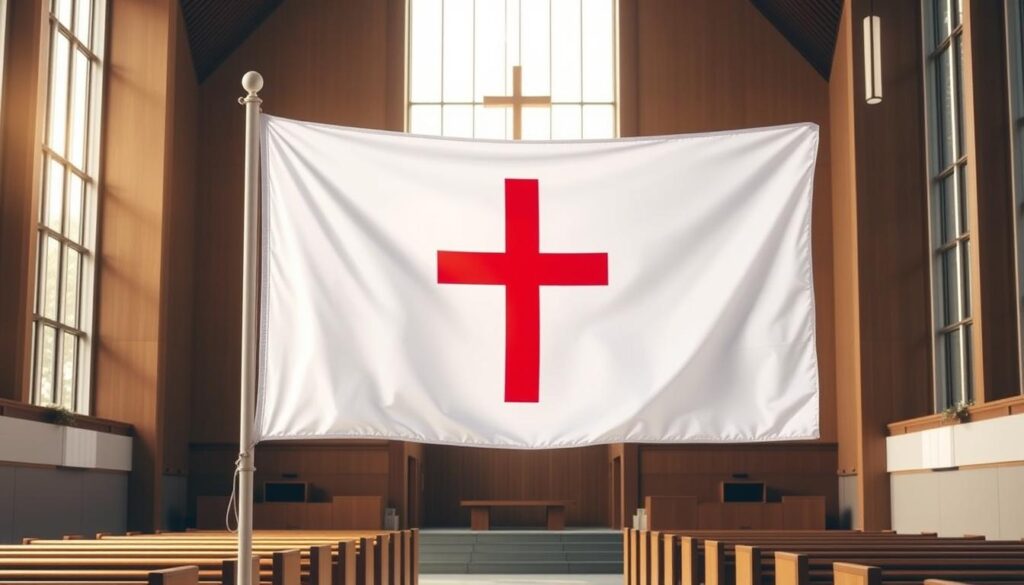
In sanctuaries across America, a vibrant tapestry of tradition meets modern practice. Since the 1980s, congregations have blended historical symbolism with fresh expressions of faith. This balance reflects both respect for heritage and adaptability to changing cultural landscapes.
Contemporary Worship and Symbolism
Modern services breathe new life into this century-old emblem. Many spiritual leaders use its colors as conversation starters during sermons. “The white field isn’t just background—it’s an invitation to personal renewal,” explains Reverend Sarah Mills of Tennessee.
Younger worshippers often encounter the banner through interactive lessons. Some congregations host art nights where members create personal versions using fabric markers. These activities help families discuss core beliefs while honoring shared history.
Integration with National and Church Flags
Display protocols continue evolving while maintaining key traditions. Most sanctuaries follow this pattern:
| Element | Position | Symbolic Purpose |
|---|---|---|
| Christian Flag | Congregation’s right | Spiritual unity |
| National Flag | Congregation’s left | Civil responsibility |
| Altar Cross | Central focus | Divine connection |
During patriotic holidays, some communities add historical context. A Missouri Lutheran pastor notes: “We explain how our grandparents displayed both banners during WWII—faith and patriotism walking hand-in-hand.”
This dual display remains popular in opening ceremonies. Many recite pledges to both emblems, creating a rhythm of devotion that honors sacred and secular commitments equally. The practice helps worshippers navigate complex modern identities while staying rooted in tradition.
Cultural Impact and Legacy in Christian Communities
Music and symbolism often walk hand-in-hand, creating lasting impressions across generations. The white-and-crimson emblem inspired more than visual displays—it sparked creative works that still resonate today.

Hymnody and the Influence of Fanny Crosby
Blind hymn writer Fanny Crosby gave the emblem a voice through her 1903 composition “The Christian Flag.” Her lyrics urged believers to “speed its glorious mission” across nations. Like the banner itself, Crosby’s work carried no copyright—a radical choice ensuring universal access.
This four-verse anthem became a teaching tool in Sunday schools. Children learned to connect the symbol’s colors with spiritual truths through catchy melodies. Missionaries often packed both fabric banners and hymn sheets when traveling overseas.
Ecumenical Unity and National Identity
From Brazilian storefront chapels to Nigerian megachurches, the emblem bridges cultural divides. Its presence in churches throughout the world reflects both American missionary efforts and local adaptations. Congregations from different traditions find common ground beneath its folds.
Consider these dual roles:
- Represents heavenly loyalty while respecting earthly governments
- Appears beside national banners without competing
- Encourages cooperation between denominations
Young believers in the United States now rediscover its meaning through art projects and social media. As one teen group in Texas demonstrated last year, digital designs featuring the emblem can spark conversations about faith’s role in modern life.
Conclusion
What began as a Brooklyn classroom exercise now flies in over 500,000 sanctuaries worldwide. The Christian Flag’s journey from chalkboard sketch to global emblem shows how simple ideas can spark lasting unity. Its open-source design philosophy—anyone can make or use it—keeps Charles Overton’s democratic vision alive.
The 1942 endorsement by the Federal Council of Churches gave formal recognition, but true power lies in grassroots adoption. From storefront chapels to cathedral altars, communities embrace this symbol on their own terms. As Christianity Today notes, its cross-cultural flexibility makes it “the ultimate ecumenical handshake.”
Modern congregations keep finding fresh meaning in its colors. Youth groups stitch quilt versions while historians display original 1907 prototypes. Missionaries still pack folded banners alongside Bibles, continuing the tradition started by early 20th-century pioneers.
This emblem’s endurance proves symbols outlive their creators. It doesn’t argue theology—it invites shared reflection. Whether draped beside the U.S. Flag or hung solo, it whispers the same message: common ground exists beneath sacred cloth.
As new generations reinterpret its legacy, the Christian Flag remains what Overton imagined—a blank canvas for collective hope. Its threads connect Sunday school kids in Kansas to believers in Kenya, weaving a tapestry of faith that transcends borders and generations.
FAQ
What’s the origin of the Christian flag used in many congregations?
The design emerged in 1897 after a Sunday school lesson by Charles Overton in New York. Ralph Diffendorfer later popularized it through the Federal Council of Churches, linking it to ecumenical unity and global outreach.
Why are red, white, and blue chosen for the flag’s colors?
Red symbolizes Christ’s sacrifice, white represents purity, and blue stands for faithfulness. These hues mirror core Christian values while aligning with the U.S. flag’s patriotic palette.
How should the Latin cross be positioned when displayed?
Tradition places it in the upper left corner, echoing its prominence in sanctuary spaces. This placement honors its role as a central symbol of faith and redemption.
Are there guidelines for flying it alongside national banners?
Yes! When paired with the U.S. flag, it typically sits to the right or lower position during services. Congregations often prioritize spiritual symbolism without diminishing national pride.
How did Fanny Crosby influence its cultural legacy?
Her hymns, like “To God Be the Glory,” reinforced themes of devotion tied to the flag. These songs became rallying points for unity and shared identity in worship settings.
Do modern churches still use it in contemporary services?
Many do! While styles evolve, congregations blend it with multimedia elements or youth programs. Its enduring symbolism bridges tradition and modern expressions of faith.
What’s the significance of reciting pledges to the flag?
Pledges, introduced in the 1940s, reaffirm loyalty to Christian principles over earthly nations. They’re often recited in Sunday schools or during patriotic-themed events.
How does it promote ecumenical unity among denominations?
Designed during the Federal Council of Churches era, it transcends doctrinal differences. Shared use across traditions fosters collaboration in missions and social justice efforts.