Over the past century, the landscape of religious affiliation has transformed in unexpected ways. While nearly one-third of the world identifies with Christian traditions today, where and how people practice has changed dramatically. This shift reflects evolving cultural, social, and political dynamics across continents.
In 1910, about 600 million people followed Christian teachings. By 2010, that number surpassed 2 billion – yet their share of the world remained steady at 32%. This growth reveals fascinating patterns: some groups expanded rapidly in Africa and Asia, while others stabilized or declined in traditional strongholds.
Tracking these changes involves complex methods. Researchers analyze data from diverse sources, balancing local reports with broader demographic trends. Differences in how groups define membership add layers of complexity to these statistic-driven studies.
Key Takeaways
- Christian traditions represent 32% of the global population, maintaining consistent growth rates since 1910
- Regional growth patterns vary significantly, with rapid expansion in the Global South
- Counting members across traditions requires adaptable research approaches
- Cultural adaptation plays a crucial role in modern faith community growth
- Demographic shifts impact resource distribution and leadership strategies
Global Trends in Christian Demographics
Christianity’s center of gravity has moved southward in an unprecedented demographic shift. While the total number of Christians worldwide quadrupled since 1910, their distribution tells a story of cultural adaptation and changing priorities.
From European Roots to Global Reach
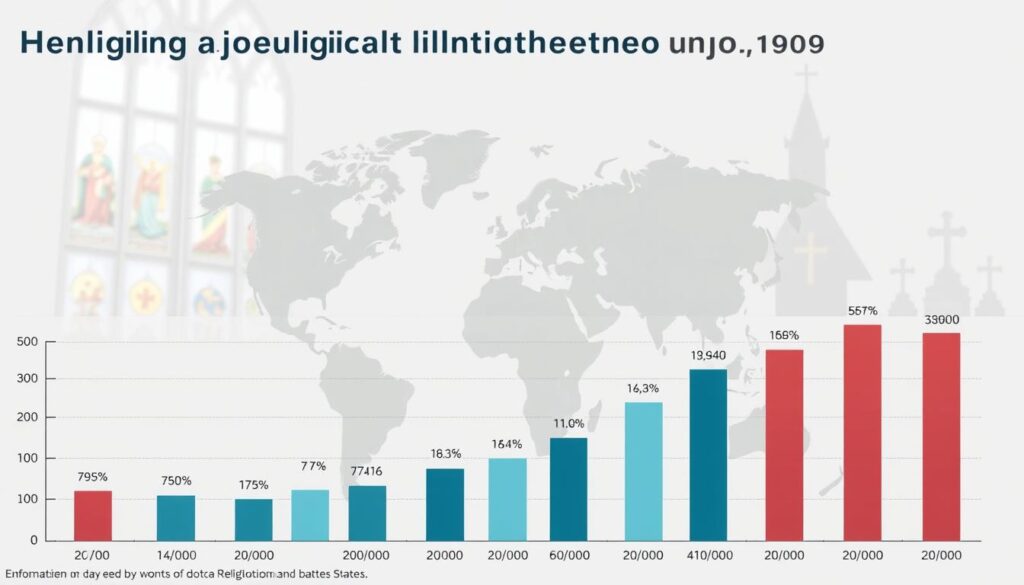
In 1910, Europe housed 66% of all believers. Today, it accounts for just 26%. This change mirrors larger patterns of migration, missionary work, and local leadership development. Sub-Saharan Africa saw the most dramatic growth – soaring from 9% to 63% of its regional population embracing the faith.
New Frontiers of Belief
The Americas still host 37% of Christians worldwide, but Asia-Pacific regions now claim 13% – up from 3% in 1910. These areas face unique challenges, blending ancient traditions with modern interpretations of scripture.
| Region | 1910 Christian % | 2010 Christian % |
|---|---|---|
| Europe | 95% | 76% |
| Sub-Saharan Africa | 9% | 63% |
| Asia-Pacific | 3% | 7% |
Three key factors drive these changes:
- Urbanization creating new community structures
- Local leadership adapting practices to cultural contexts
- Youth engagement strategies in developing nations
Current Trends in Protestant Church Population in the United States
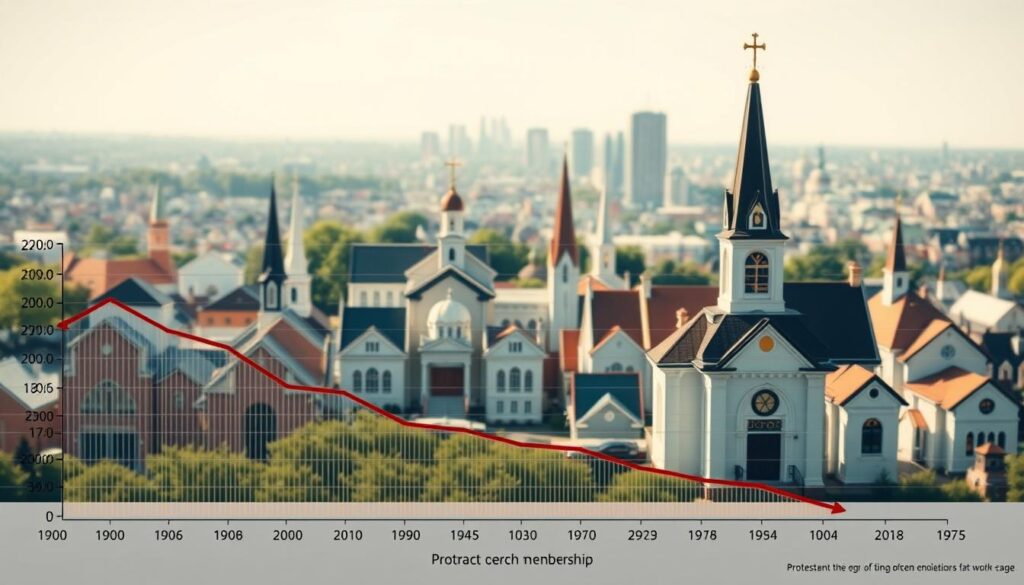
The U.S. faith landscape is undergoing its most significant transformation since record-keeping began. Gallup data shows membership in organized groups has dropped to 47% – the first time below majority status in 80 years of tracking. This marks a 29-point decline from its 1947 peak.
Statistical Overview and Membership Insights
While 140 million Americans align with Protestant traditions, no single group matches the Catholic Church’s unified presence. The Southern Baptist Convention leads with 13.7 million members, but faced a staggering loss of 500,000 adherents in 2022 alone.
| Denomination | Members (2022) | Annual Change |
|---|---|---|
| Southern Baptist | 13.68 million | -3.5% |
| National Baptist | 8.4 million | +0.8% |
| United Methodist | 6.3 million | -1.9% |
Younger generations are redefining spiritual engagement. Nearly 40% of adults under 30 claim no religious affiliation, compared to 10% in 1990. Regional differences also shape these patterns – Southern states maintain higher participation rates than the Pacific Northwest.
Traditional groups face dual challenges: retaining older members while attracting youth. Some evangelical movements grow through contemporary worship styles, while mainline denominations struggle with doctrinal debates. These shifts reshape community structures and resource allocation nationwide.
Regional Dynamics and the Global South Impact
Christianity’s heartbeat now pulses strongest in regions once considered peripheral. The Global South hosts 61% of believers worldwide – a staggering 1.3 billion people. This seismic shift reshapes how communities practice and propagate their faith across continents.
Growth in Latin America and Africa
Latin America remains a spiritual powerhouse, with 9 in 10 residents identifying with Christian traditions. While the Roman Catholic tradition claims 69%, vibrant evangelical movements gain ground through street-level outreach and pulsating worship services.
Africa’s transformation astonishes demographers. From just 9 million adherents in 1910, the continent now shelters 685 million believers. Nigeria alone boasts more Christians than Germany, France, and Italy combined – a testament to grassroots leadership development.
Developments in the Asia-Pacific Region
The Asia-Pacific area witnessed a tenfold surge since 1910, reaching 285 million followers. South Korea’s megachurches and China’s underground house networks reveal diverse expressions of belief. “Our faith wears local clothes,” observes Manila-based theologian Carlos Reyes. “It’s not imported – it’s reinvented daily.”
Three forces drive this southern surge:
- Indigenous leadership adapting rituals to cultural norms
- Youth-oriented ministries using music and technology
- Urban migration creating tight-knit spiritual communities
These changes position the Global South as Christianity’s innovation lab. With Brazil and the Philippines now housing some of the largest Christian communities, the faith’s future increasingly speaks Portuguese, Swahili, and Tagalog.
The Shifting Landscape of Church Membership
American spiritual engagement has entered uncharted territory. For the first time since polling began, less than half of adults belong to a congregation. This 25-year slide accelerated during the pandemic, with 2021 marking the tipping point below 50% membership.
Traditional groups face uneven challenges. The Roman Catholic community saw 39% of former members join the non-affiliated group. “We’re not just losing members – we’re losing their children and grandchildren,” notes a recent Pew Research analysis.
Denominational Divides in Modern America
Mainline groups struggle most, while some evangelical movements grow. The Southern Baptist Convention lost 3.5% of its base last year. Meanwhile, non-denominational congregations added 1.4 million attendees since 2010.
| Group | 2010 Membership | 2023 Membership | Change |
|---|---|---|---|
| Evangelical Lutheran | 4.2 million | 3.1 million | -26% |
| Non-denominational | 12.1 million | 13.5 million | +12% |
| United Methodist | 7.7 million | 5.8 million | -25% |
Regional patterns reveal deeper stories. Sun Belt states show stable attendance, while the Northeast reports 34% fewer regular worshippers since 2000. Urban areas blend tradition with innovation – 61% of new megachurches launched in metro regions.
Young adults drive much of this change. Only 36% of millennials claim affiliation, compared to 76% of Silent Generation members. Many seek spirituality beyond traditional structures, reshaping America’s religious future.
Underlying Cultural and Societal Factors
Cultural tides have reshaped spiritual engagement across modern societies. Traditional assumptions about belief systems now compete with evolving values, creating new patterns in how people connect – or disconnect – from organized practices.
Secularization and Changing Beliefs
Secular thinking now dominates many Western nations. Over half of former members cite lost belief in teachings as their main reason for leaving. This shift appears sharper in Europe, where participation rates fell earlier than in the United States.
Recent scandals accelerated distrust. High-profile institutional failures made headlines worldwide, cooling enthusiasm for structured groups. Many now seek purpose through personal spirituality rather than established frameworks.
Younger generations drive this transformation. Raised without regular participation, they’re redefining community bonds. Urbanization and tech access provide alternatives to traditional gathering spaces.
Educational trends play surprising roles. College graduates often question inherited beliefs, while scientific perspectives gain cultural cachet. Yet some find new ways to blend ancient wisdom with modern life.
These changes create complex challenges. While some Christian denominations adapt through contemporary outreach, others struggle to maintain relevance. The religious landscape continues evolving, reflecting our ever-changing world.
FAQ
How has the Protestant population in the U.S. changed recently?
Recent data shows a gradual decline in affiliation, particularly among younger generations. However, certain denominations, like non-denominational groups, have seen growth, reflecting shifting preferences in worship styles.
Which regions are driving growth in Christianity today?
The Global South, including Latin America and sub-Saharan Africa, now holds the largest share of believers. Countries like Brazil and Nigeria have seen rapid expansion due to evangelism and cultural alignment with local values.
What’s the largest Protestant denomination in the United States?
The Southern Baptist Convention remains the biggest, though membership has dipped slightly in recent years. Independent congregations and multiethnic communities are also reshaping the landscape.
Why is Latin America experiencing a surge in Protestant communities?
Many find evangelical teachings more relatable to daily struggles than traditional Catholic practices. Grassroots outreach and social support programs have also played a key role in attracting followers.
How do Protestant membership trends compare to other faith groups?
While mainline groups have declined, Catholicism remains stable globally. Meanwhile, the “religiously unaffiliated” category has grown, especially in North America and Europe, reflecting broader secularization trends.
What cultural factors influence declining membership in some areas?
Younger generations often prioritize individualism over institutional loyalty. Scandals, political polarization, and delayed marriage/family formation have also contributed to distancing from organized faith groups.