In 1517, Martin Luther sparked a religious revolution by posting his Ninety-Five Theses. This bold critique of Catholic practices birthed Protestantism, reshaping Christianity forever. Centuries later, a fresh wave of theological innovation emerged, challenging traditional beliefs.
The 19th century brought rapid social changes that demanded new approaches to faith. Thinkers began reexamining Scripture through modern lenses, blending spiritual traditions with evolving worldviews. This shift created space for groundbreaking interpretations of divine truth.
Ernst Troeltsch noted early reformers like Luther shared more with their Catholic contemporaries than modern believers. This observation highlights how cultural environments shape religious thought. As societies transformed, so did people’s relationship with spiritual concepts.
Today’s theological landscape still feels the ripple effects of these changes. From debates about biblical authority to fresh perspectives on salvation, this movement’s legacy remains vital. Our exploration will unpack its lasting impact on Christian practice and belief.
Key Takeaways
- Originated in 19th-century cultural and intellectual shifts
- Reinterpreted traditional Christian doctrines for modern contexts
- Emphasized personal faith experiences over rigid structures
- Influenced liberal theology and contemporary religious debates
- Balanced historical traditions with evolving societal values
- Spark ongoing discussions about biblical interpretation
Introduction to the Rise of Neo Protestantism
The 19th century reshaped Christianity like never before. Industrial revolutions and scientific breakthroughs made old answers feel inadequate. Religious thinkers split into two camps: those holding fast to tradition and others forging new paths.
Defining the Scope of the Ultimate Guide
This guide walks through three key transformations. First, how faith met Darwin’s evolution theories. Second, why biblical stories faced historical scrutiny. Third, what made personal spiritual experiences matter more than church rules.
You’ll see how thinkers balanced ancient texts with fresh ideas. Some kept core beliefs while updating practices. Others rewrote entire doctrines to match modern thought.
Context and Purpose
Four forces drove these changes:
| Challenge | Religious Response | Impact |
|---|---|---|
| Scientific discoveries | Reinterpreted creation stories | New Bible reading methods |
| Secular governments | Separated church power | Focus on personal belief |
| Romantic philosophy | Emphasized feeling over rules | Experiential worship styles |
| Historical research | Questioned scripture origins | Revised theology foundations |
These shifts created a movement that still affects how millions practice religion today. By understanding this history, we better grasp current debates about spirituality’s role in modern life.
Historical Roots and the Reformation Legacy
A single document reshaped Christianity’s trajectory in 1517. Martin Luther’s Ninety-Five Theses didn’t just critique church practices – they redefined humanity’s connection to the divine. This watershed moment birthed principles that still guide millions today.

Breaking Chains of Tradition
Luther’s bold stance against indulgences struck at a core belief: that human effort could influence salvation. “Why does the pope not empty purgatory for love’s sake?” he challenged, sparking debates about divine grace versus works.
Three revolutionary ideas emerged:
- Salvation through faith alone
- Scripture as ultimate authority
- Every believer as their own priest
Scripture Sparks a Revolution
The Reformation turned Bibles into battleaxes. For the first time, ordinary people could interpret God’s word themselves. This shift from Latin texts to vernacular translations democratized spiritual truth.
Printing presses spread new doctrines faster than ever. By 1550, over half of German literature focused on religious reform. This movement didn’t just change churches – it reshaped how societies viewed personal responsibility and divine connection.
Neo Protestantism: Understanding the Term
The late 1800s introduced a theological term that would spark heated debates: “neo-Protestantism.” This label described thinkers who reimagined Christian faith for modern minds. Unlike earlier reformers, they saw tradition as a starting point rather than fixed truth.
At its core, this movement sought to bridge ancient beliefs with 19th-century thought. Scholars began asking bold questions: Could Darwin’s theories coexist with Genesis? Did historical research change how we read scripture? Their answers reshaped religious theology.
Three key features defined their approach:
- Personal spiritual experiences over rigid doctrines
- Critical analysis of biblical texts
- Adaptation to scientific discoveries
The term itself caused controversy. Traditionalists argued it abandoned core principles, while progressives saw it as necessary evolution. One pastor famously remarked: “We’re not destroying the faith – we’re building it stronger foundations.”
This understanding of religion emphasized the changing nature of truth. Followers believed divine revelation could unfold through new insights. Their legacy? A Christianity that continually dialogues with culture while keeping faith at its heart.
Proto-Protestantism and Early Reforms
Centuries before Luther’s famous protest, brave voices challenged religious power structures. These early reformers planted seeds that would later blossom into full-scale reformation movements. Their stories reveal how faith always finds ways to renew itself.
The Hussites and Early Dissenters
Jan Hus lit a fire in 15th-century Bohemia with radical ideas. This university rector argued that church authority should come from scripture, not papal decrees. His followers, called Hussites, demanded communion for all believers – not just clergy.
The Waldensians showed even earlier reform instincts. Starting in the 12th century, these mountain-dwelling people lived by Christ’s word rather than church traditions. They translated the Bible into common languages, making God’s message accessible.
| Group | Time Period | Key Beliefs |
|---|---|---|
| Hussites | 1400s | Scripture over popes, lay participation |
| Waldensians | 1100s-1600s | Simple living, Bible translation |
| Lollards | 1300s | Critique of wealth, vernacular preaching |
These movements faced fierce opposition. Hus was burned at the stake in 1415, his ashes thrown into a river. Yet his work inspired later reformers. As one follower wrote: “Truth does not drown – it floats to new shores.”
Early dissenters proved that faith could thrive outside official structures. Their emphasis on personal connection to God became a blueprint for future religious changes. Through persecution and underground networks, they kept reform hopes alive.
Key Figures in Protestant History
Religious transformation often begins with courageous voices. Two thinkers reshaped Christianity’s landscape through bold ideas that still echo today. Their teachings became cornerstones for understanding faith and divine connection.
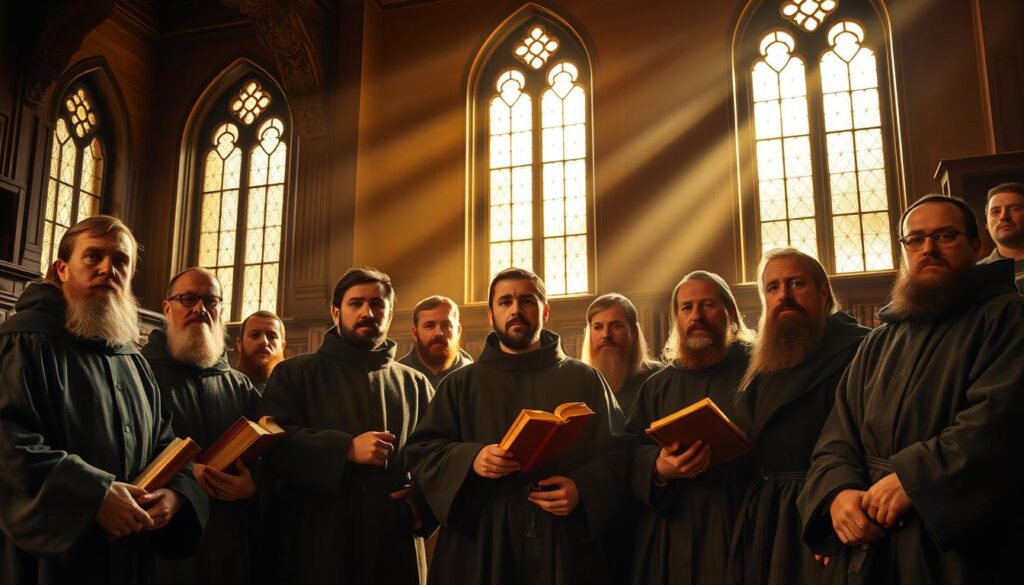
Martin Luther’s Revolutionary Vision
A German monk’s inkpot changed everything in 1517. Luther’s radical claim – that grace alone saves – challenged centuries of tradition. His translation of scripture into German let ordinary people access God’s truth directly.
Three principles defined his theology:
- Scripture as ultimate authority
- Salvation through faith, not deeds
- Every believer’s right to interpret God’s word
John Calvin’s Systematic Approach
While Luther sparked the fire, Calvin built the furnace. His Institutes of the Christian Religion organized Protestant thought into clear doctrine. The concept of predestination became his hallmark – the belief that God’s plan shapes human destiny.
Calvin’s Geneva became a laboratory for religious ideas. His emphasis on education created lasting impacts:
- Schools for biblical literacy
- Systematic view of scripture
- Church-state cooperation models
Other reformers like Zwingli and Knox expanded these ideas across Europe. Their work proved that belief could adapt to cultural changes while keeping Jesus Christ central. Together, they laid groundwork for ongoing religious dialogue – a legacy that still shapes modern spirituality.
Theological Concepts and Core Doctrines
Five Latin phrases transformed how believers understood their relationship with God. The Five Solae became bedrock principles of Reformation theology, offering clear alternatives to medieval Catholic teachings. These concepts still shape debates about salvation and spiritual authority today.
Sola Scriptura, Sola Fide, and Solus Christus
Sola Scriptura placed the Bible above church tradition. Reformers argued scripture alone held divine truth, challenging papal decrees. This principle empowered ordinary people to interpret God’s word personally.
Sola Fide redefined salvation as a gift received through faith, not earned by good deeds. As Luther wrote: “Faith is the yes of the heart.” This shift made personal trust in Jesus Christ central to Christian faith.
Solus Christus declared no human mediator needed between believers and God. “There’s one God and one mediator,” stated Paul’s letter to Timothy. Reformers used this to dismantle priestly hierarchies.
| Principle | Core Idea | Modern Influence |
|---|---|---|
| Sola Scriptura | Bible as ultimate guide | Encourages personal Bible study |
| Sola Fide | Faith-based salvation | Inspires grace-centered worship |
| Solus Christus | Direct Christ connection | Supports diverse prayer practices |
| Sola Gratia | Unearned divine favor | Shapes humility teachings |
| Soli Deo Gloria | God-focused purpose | Informs service-oriented faith |
Later thinkers would expand these ideas in unexpected ways. Some blended grace with human experience, while others saw God’s glory in everyday actions. Yet all grappled with the reformers’ original vision – a belief system rooted in scripture, faith, and Christ alone.
The Role of the Bible in Shaping Faith
Sacred texts have always shaped how communities understand divinity. For centuries, the Bible stood as humanity’s ultimate guide to truth, its pages seen as direct messages from God. But the 19th century brought seismic shifts that reshaped this belief.
Biblical Authority and Interpretation
Earlier generations viewed scripture through unwavering devotion. Most people saw biblical stories as literal fact, their meaning fixed for all time. This changed when scholars began treating the text as both divine inspiration and historical artifact.
Three key developments altered biblical understanding:
- Archaeological discoveries challenged traditional timelines
- Scientific theories reshaped creation narratives
- Literary analysis revealed cultural influences
These changes didn’t weaken faith for many believers – they deepened it. As one theologian noted: “True religion grows when we engage both heart and mind.” Modern readers now balance spiritual authority with critical knowledge, creating dynamic conversations about God’s living word.
FAQ
How does modern Protestant thought connect to the Reformation?
Modern movements build on ideas from the 16th-century Reformation, like sola scriptura and grace through faith. Figures like Martin Luther and John Calvin laid the groundwork for today’s emphasis on scripture and personal faith.
What role does the Bible play in shaping these beliefs?
The Bible is seen as the ultimate authority, guiding teachings and practices. Sola Scriptura—meaning “Scripture alone”—emphasizes its centrality, rejecting traditions that conflict with biblical truth.
Who were key influencers in early Protestant history?
A: Martin Luther sparked the Reformation by challenging church practices in 1517. John Calvin later shaped Reformed Theology, focusing on God’s sovereignty and predestination. Earlier reformers like Jan Hus also paved the way.
How do doctrines like Sola Fide impact daily faith?
A: Sola Fide (“faith alone”) teaches that salvation comes through belief in Christ, not deeds. This idea fosters a personal relationship with God and influences how believers approach worship and ethics.
What distinguishes modern movements from earlier reforms?
Earlier reforms focused on correcting church practices. Today’s discussions often address cultural shifts, science, and social justice while upholding core doctrines like grace and biblical authority.
Why is Karl Barth significant in recent theological discussions?
A: Karl Barth reshaped 20th-century theology by stressing God’s revelation through Jesus Christ. His work countered liberal theology, reviving interest in scripture and divine grace.
How did groups like the Hussites influence later changes?
The Hussites, led by Jan Hus, challenged church authority a century before Luther. Their calls for reform and emphasis on scripture inspired later movements, showing dissent’s role in shaping faith.