Imagine a spiritual tradition where ancient chants meet Reformation theology. This is the heart of a unique Christian practice that blends vibrant Eastern worship styles with Lutheran teachings. Let’s explore how this tradition honors cultural roots while staying true to its doctrinal foundations.
This branch of Christianity uses liturgies rooted in the Byzantine Rite—the same worship form found in Eastern Orthodox churches. Yet its teachings align with Martin Luther’s emphasis on salvation through grace alone. The result? A worship experience that feels both timeless and refreshingly direct.
Communities practicing this tradition first took shape in Ukraine during the 16th century. Today, they thrive across Central Europe, creating spaces where ornate icons share walls with simplified Lutheran altars. These churches prove that deep faith can flourish in diverse cultural settings.
Key Takeaways
- Combines Byzantine worship practices with Lutheran theology
- Originated in Ukraine and spread across Central Europe
- Maintains core Reformation beliefs about grace and scripture
- Uses Eastern Christian liturgy without Orthodox doctrines
- Demonstrates cultural adaptability within Protestant traditions
What makes these congregations special is their balance of tradition and clarity. The Lutheran church framework ensures accessible teachings, while the Eastern-inspired services connect worshippers to centuries of spiritual heritage. It’s a living example of how Christianity evolves while keeping its essence intact.
Historical Foundations and Development
Blending ancient rituals with Reformation ideals wasn’t an overnight process. The roots of this unique Christian practice stretch back to 20th-century Ukraine, where believers reimagined worship while honoring their spiritual heritage.
Early Beginnings and Byzantine Influences
In 1926, a groundbreaking church emerged in Poland-controlled Galicia. Ukrainian Christians crafted a new worship model using the Divine Liturgy of St. John Chrysostom. They infused it with Reformation principles rather than adopting Western practices.
This bold move required careful theology work. Leaders balanced Byzantine rituals with Martin Luther’s teachings on grace. By 1933, they published the first official liturgy—a milestone in Christian tradition.
The Impact of the Reformation on Eastern Traditions
Lutheran ideas first reached Eastern Europe during the 16th century. While popular, political conflict and lack of state support stalled growth. The Ukrainian church’s 20th-century success proved these teachings could thrive outside Western contexts.
| Western Lutheran Churches | Eastern Lutheran Developments |
|---|---|
| Used Latin Mass adaptations | Modified Byzantine liturgy |
| Established in 16th century | Formalized in 20th century |
| State-supported in Germany | Grew despite political challenges |
This fusion shows how faith communities adapt while preserving core beliefs. The Ukrainian example inspired similar movements worldwide, proving cultural context shapes religious expression.
Distinctive Liturgy and Worship Practices
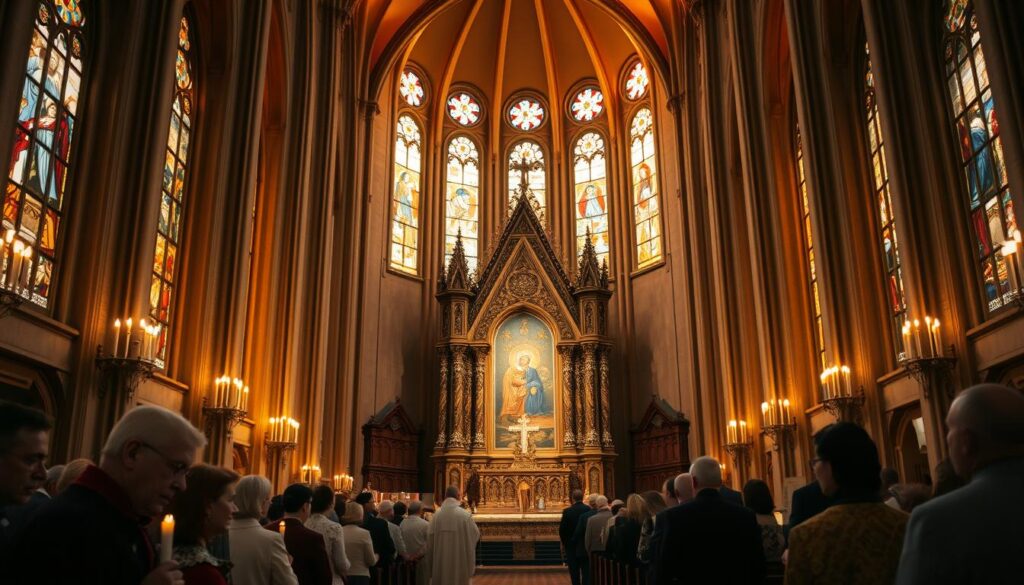
Step into a Byzantine Lutheran service, and you’ll witness a sacred dance of ancient rituals meeting Reformation clarity. These communities honor centuries-old traditions while keeping worship accessible through familiar Lutheran teachings.
Byzantine Rite Elements in Lutheran Services
The Divine Liturgy of St. John Chrysostom forms the backbone of worship, but with key changes. Lutheran theology reshapes prayers to emphasize God’s grace over human effort. Icon screens still separate sanctuaries, yet sermons focus sharply on Scripture’s authority.
Churches feature domed ceilings and intricate mosaics like their Orthodox neighbors. But look closer—the altar lacks relics, reflecting Lutheran views on sacraments. Worshipers bow and cross themselves during prayers, blending physical reverence with heartfelt faith.
Observance of the Julian Calendar and Feast Days
While most Christians decorate trees in December, these congregations fast for Advent. Following the Julian calendar shifts Easter celebrations by weeks—sometimes months. This creates unique teaching moments about Christ’s resurrection timing.
| Western Lutheran Practice | Byzantine Lutheran Custom |
|---|---|
| Gregorian calendar | Julian dating system |
| Christmas on Dec 25 | Christmas Jan 7 (modern calendar) |
| Simple church interiors | Iconostasis screens |
| Western hymns | Byzantine chant tones |
Great Lent brings intense spiritual preparation. Members abstain from meat and dairy, mirroring Orthodox practice. But sermons focus on the Holy Spirit’s role in personal transformation rather than ritual obligation.
Saints’ days honor both early church figures and Reformation leaders. This dual calendar reminds believers that faith bridges cultural divides. Through these practices, worship becomes a living conversation between past and present.
Theology and Doctrinal Insights
Where ancient incense meets Reformation clarity, a unique theological tapestry unfolds. This tradition holds tight to Martin Luther’s core ideas while weaving in Eastern Christian expressions. The result? A faith practice that honors both Scripture’s authority and centuries of spiritual wisdom.
Merging Two Worlds of Thought
Scholars worked carefully to blend 16th-century Reformation teachings with Eastern philosophical depth. They kept Luther’s focus on grace through Jesus Christ while using Byzantine prayer structures. The Word of God remains central, but now echoes through chanted psalms and incense-tinged air.
| Western Lutheran Theology | Eastern Blend |
|---|---|
| Filioque in Creed | Filioque in brackets |
| Formula Missae liturgy | Revised St. John Chrysostom rite |
| Focus on law/gospel | Emphasis on Holy Spirit’s work |
| Augsburg Confession | Lutheran confessions + Eastern elements |
Navigating Theological Crossroads
How do these communities handle tough debates? The Augsburg Confession anchors their beliefs, while sensitive issues get creative solutions. Take the filioque clause—included but bracketed to show respect for different views.
Sacraments reveal this balance best. Baptism still marks God’s free gift of grace. But prayers now highlight the Holy Spirit’s ongoing work in believers’ lives. It’s faith made visible through ancient-new rituals.
This approach keeps doctrine pure while letting worship breathe. As one theologian noted: “We’re not mixing water and oil—we’re showing how two streams can flow from the same spring.”
Cultural and Political Influences on Eastern Lutheranism
History shows how faith can both unite communities and challenge oppressive systems. The 20th century brought intense trials for believers merging ancient traditions with Reformation teachings.
State Power and Sacred Resistance
Communist government policies targeted religious groups in Soviet-controlled regions. From 1939-1945, many clergy faced imprisonment or death for leading worship. Theodor Yarchuk, a leader in the Ukrainian Lutheran Church, became a martyr when authorities tortured him for refusing to abandon his congregation.
Ordinary people suffered equally. Thousands of lay members were sent to labor camps, never returning home. The state seized church buildings, forcing believers to meet secretly in homes.
New Life After Oppression
When the Soviet Union collapsed, a remarkable revival began. Communities rebuilt using hidden copies of the Augsburg Confession and oral traditions preserved through generations. Today, these churches honor their past while training new leaders for modern challenges.
This movement proves spiritual resilience outlasts political conflict. As one survivor noted: “Our faith wasn’t in buildings—it lived in our hearts all along.”
FAQ
How does Eastern Lutheranism differ from other Lutheran traditions?
Eastern Lutheranism blends Lutheran theology, like the Augsburg Confession, with elements from the Eastern Orthodox Church, such as Byzantine-style liturgy. This includes practices like using icons or observing the Julian calendar for certain feast days, creating a unique worship experience.
What role did Martin Luther play in shaping Eastern Lutheran practices?
While Martin Luther’s Reformation focused on justification by faith and Scripture, Eastern Lutherans later adapted his ideas to local contexts. They incorporated Orthodox traditions like the Divine Liturgy, merging Lutheran doctrinal clarity with Eastern spiritual expressions.
Why do some Eastern Lutheran churches follow the Julian calendar?
Many Eastern Lutheran communities, especially in historically Orthodox regions, retain the Julian calendar to align with cultural and religious heritage. This helps maintain unity with neighboring Orthodox Christians during major celebrations like Christmas and Easter.
How did the Reformation influence Eastern Lutheran theology?
The Reformation emphasized sola Scriptura (Scripture alone) and grace through faith. Eastern Lutherans upheld these principles while preserving sacramental and mystical elements from Orthodox tradition, fostering a distinct theological identity.
What challenges did Eastern Lutheranism face under communist regimes?
During the 20th century, communist governments often suppressed religious groups, including Lutherans. Churches faced persecution, property seizures, and restrictions. Despite this, underground networks kept traditions alive, leading to a post-communism revival.
Are Eastern Lutheran services similar to Roman Catholic or Orthodox worship?
Services often resemble Eastern Orthodox worship in structure, using chanted hymns and icons, but include Lutheran elements like vernacular language and emphasis on preaching. The blend reflects both Reformation ideals and ancient Christian practices.
What doctrinal debates are unique to Eastern Lutheranism?
Debates often center on balancing Lutheran confessional standards with Orthodox teachings, such as the role of tradition or the veneration of saints. These discussions shape how communities interpret the Book of Concord in multicultural settings.