The Anglican faith is rooted in the early Christian church, with its core principles and creeds forming the foundation of Anglican beliefs. The Anglican Church of Australia’s constitution states that Anglicans hold the Christian faith as professed by the Church of Christ from primitive times.
This faith is particularly set forth in the Nicene and Apostles’ Creeds, which summarize the fundamental tenets of Christianity. As a result, Anglican faith is characterized by a commitment to traditional Christian values, while also embracing a spirit of inclusivity and diversity.
Key Takeaways
- Anglican beliefs are rooted in the early Christian church.
- The Nicene and Apostles’ Creeds are fundamental to Anglican faith.
- Anglicanism is characterized by a commitment to traditional Christian values.
- The Anglican Church values inclusivity and diversity.
- Anglican beliefs are summarized in the creeds.
Overview of Anglicanism
Understanding Anglicanism requires a look into its historical development and core beliefs. Anglicanism, a Christian tradition that emerged from the Church of England during the English Reformation, is characterized by a unique blend of Catholic and Protestant elements.
Historical Background of the Anglican Church
The Anglican Church has its roots in the 16th-century English Reformation, a period marked by significant religious and political changes in England. The Church of England, under the leadership of King Henry VIII, broke away from the Roman Catholic Church, establishing the monarch as the head of the church. This historical event laid the foundation for the development of Anglican theology, which sought to balance Catholic traditions with Protestant reforms.
Over time, Anglicanism spread beyond England, influenced by British colonial expansion, and evolved into a global communion with diverse regional expressions.
Key Principles of Anglican Beliefs
At its core, Anglican doctrine is based on the authority of Scripture, the importance of tradition, and the role of reason in interpreting faith. Anglicans believe in the sacraments, with Baptism and the Eucharist being central to worship. The Anglican Communion is guided by a commitment to unity and diversity, allowing for a wide range of practices and interpretations within the bounds of its core beliefs.
The key principles are reflected in the Book of Common Prayer, a foundational text that has shaped Anglican worship and theology. This text provides a common liturgical framework, while allowing for local variations in worship practices.
The Authority of Scripture
In Anglican tradition, Scripture is regarded as the primary source of authority in matters of faith and practice. The Anglican Church places a high value on the Bible, considering it the ultimate standard for faith and conduct.

Interpretation of Scripture in Anglicanism
Anglicans believe that the Old and New Testaments contain all things necessary for salvation. The interpretation of Scripture is a critical aspect of Anglican faith, with reason and tradition playing significant roles in understanding biblical teachings.
The use of reason involves applying logical and critical thinking to the interpretation of Scripture, ensuring that it is understood in a way that is relevant and applicable to contemporary life. Tradition, on the other hand, provides a link to the historical and communal understanding of the Bible, guiding Anglicans in their interpretation.
Key aspects of Anglican biblical interpretation include:
- Understanding the historical context of biblical texts
- Applying biblical teachings to modern life
- Considering the role of tradition in interpreting Scripture
By balancing reason, tradition, and Scripture, Anglicans aim to develop a comprehensive and nuanced understanding of their faith.
The Sacraments in Anglicanism
Anglican beliefs place significant emphasis on the sacraments as a means of experiencing God’s grace. The sacraments are considered essential elements of worship and spiritual growth within the Anglican tradition.
Understanding the Two Primary Sacraments
The Anglican Church recognizes two primary sacraments: Baptism and the Eucharist (also known as Holy Communion). Baptism is seen as the sacrament of initiation into the Christian community, where individuals are welcomed into the body of Christ through water and the Word.
The Eucharist, on the other hand, is central to Anglican worship. It is a sacrament where believers participate in the life, death, and resurrection of Jesus Christ through the consumption of bread and wine. The Eucharist is believed to be a means of grace, where Christ is present among the faithful.
The Concept of Sacramental Grace
Sacramental grace refers to the belief that God’s grace is conveyed through the sacraments. In Anglican theology, the sacraments are not just symbolic acts but are vehicles of divine grace. This understanding is rooted in the idea that Christ is present in the sacraments, offering salvation and spiritual nourishment to the participants.
| Sacrament | Significance | Elements |
|---|---|---|
| Baptism | Initiation into the Christian community | Water, Word |
| Eucharist (Holy Communion) | Participation in Christ’s life, death, and resurrection | Bread, Wine |
The sacraments in Anglicanism are thus integral to the faith and practice of Anglicans, serving as a tangible connection to the divine and to the community of believers.
The Book of Common Prayer
At the heart of Anglican tradition lies the Book of Common Prayer, a text that has shaped the faith and practices of Anglicans worldwide. This foundational document, first compiled by Thomas Cranmer in 1549, is a unifying element among Anglican churches globally.

Significance of the Book of Common Prayer
The Book of Common Prayer is more than a liturgical text; it is a cornerstone of Anglican church beliefs. Its significance lies in its ability to guide worship, shape doctrine, and foster a sense of community among Anglicans. The prayers, rituals, and sacraments outlined in the Book of Common Prayer have been a source of spiritual nourishment for generations of Anglicans.
The historical context in which the Book of Common Prayer was created is crucial to understanding its importance. Emerging during the English Reformation, it was designed to provide a coherent and unified form of worship, distinct from both Catholic and Protestant extremes.
Structure and Use in Worship Services
The structure of the Book of Common Prayer is designed to guide Anglicans through various stages of worship and spiritual life, from daily prayers to sacraments like baptism and communion. Its use in worship services is characterized by a balance between tradition and flexibility, allowing for a rich liturgical life that is both rooted in history and relevant to contemporary contexts.
In modern Anglican worship, the Book of Common Prayer continues to play a vital role. It is used in a variety of settings, from traditional cathedral services to smaller parish churches, adapting to the needs of diverse congregations while maintaining the integrity of Anglican liturgical tradition.
The Nature of God in Anglican Belief
At the heart of Anglican beliefs lies a profound comprehension of the divine. Anglicans believe in one God, eternally existing in three persons: the Father, the Son, and the Holy Spirit. This foundational belief shapes their understanding of God’s relationship with humanity.
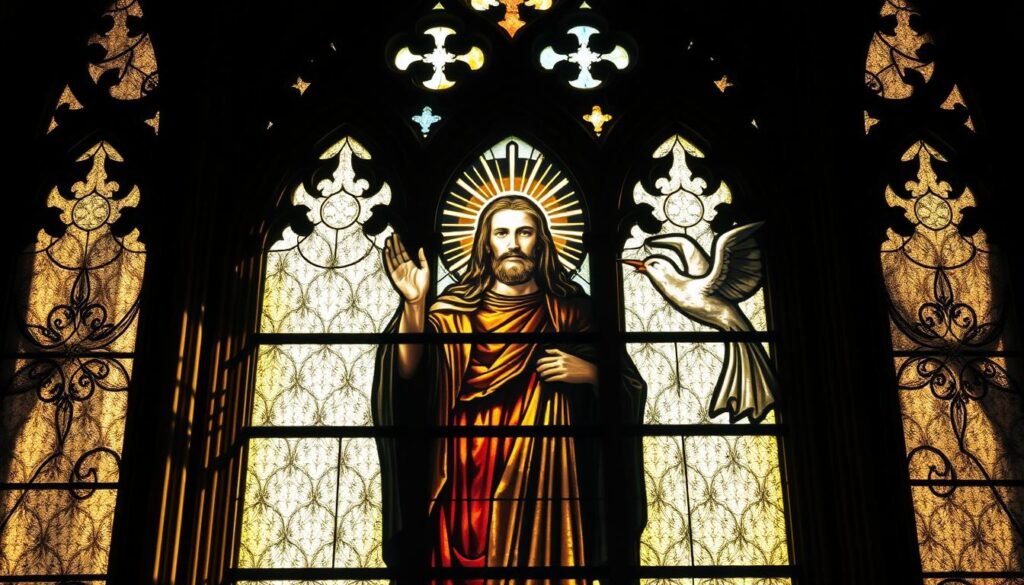
The Trinity: Father, Son, Holy Spirit
The doctrine of the Trinity is central to Anglican theology. It emphasizes the unity of God in three coequal and coeternal persons. This belief is not just a theological concept but a living reality that influences Anglican worship and daily life.
Key aspects of the Trinity in Anglican belief include:
- The Father as the creator and sustainer of all things.
- The Son, Jesus Christ, as the redeemer of humanity.
- The Holy Spirit as the presence of God in the world and in the lives of believers.
God’s Relationship with Humanity
Anglicans understand God’s relationship with humanity primarily through the person and work of Jesus Christ. Jesus is seen as the embodiment of God’s love and mercy, offering salvation to humanity through his life, death, and resurrection.
This understanding is reflected in various ways, including:
- The importance of prayer and worship in relating to God.
- The role of sacraments as means of grace.
- The commitment to serving others as a way of serving God.
By understanding God’s nature as revealed in the Trinity, Anglicans cultivate a deep and personal relationship with God, guided by faith, prayer, and action.
Salvation and Grace
The Anglican view on salvation underscores the role of faith, grace, and the transformative power of God’s love. At the heart of Anglican doctrine is the belief that salvation comes through faith in Jesus Christ, accompanied by a life of good works as a response to God’s grace.
Understanding Salvation in Anglicanism
Anglicans believe that salvation is a process initiated by God’s grace, through which individuals are reconciled to God. This reconciliation is made possible by the death and resurrection of Jesus Christ.
The process of salvation involves faith, repentance, and a commitment to follow Jesus Christ. It is not just a one-time event but a journey of growth in faith and holiness.
The Interplay of Faith and Works
In Anglican belief, faith and works are not separate entities but are deeply interconnected. Faith is seen as the foundation of the Christian life, while good works are the natural outcome of a living faith.
Good works are considered essential as they demonstrate a believer’s commitment to their faith and serve as a witness to the transformative power of God’s grace.
Key Aspects of Salvation and Grace in Anglicanism
| Aspect | Description |
|---|---|
| Faith in Jesus Christ | Central to Anglican doctrine, emphasizing salvation through faith. |
| Role of Good Works | Seen as a response to God’s grace, demonstrating a living faith. |
| Process of Salvation | Involves faith, repentance, and a commitment to follow Jesus Christ. |
Worship Practices in Anglican Churches
Worship in Anglican churches is deeply rooted in liturgical practices, which play a crucial role in the spiritual lives of its adherents. The Anglican tradition places a significant emphasis on liturgy, which is reflected in its worship practices.
Liturgy and Its Importance
Liturgy is at the heart of Anglican worship, providing a structured framework for religious services. The Eucharist, also known as Holy Communion, is central to Anglican liturgy. It is considered a sacrament and a key element in worship services.
“The Eucharist is the principal act of worship in the Anglican tradition, representing the presence of Christ among his people.”
The liturgy is not just a ritual but a means of connecting with the divine. It involves a combination of prayers, readings from Scripture, and the administration of sacraments.
| Element | Description | Significance |
|---|---|---|
| Eucharist | Sacrament involving bread and wine | Central to Anglican worship, symbolizing Christ’s presence |
| Prayers | Various prayers, including the Lord’s Prayer | Means of communicating with God, expressing gratitude and seeking guidance |
| Scripture Readings | Readings from the Bible | Provides spiritual guidance and insight into Christian teachings |
The Role of Music and Hymns
Music and hymns play a vital role in enhancing the liturgical experience in Anglican worship. They contribute to the richness and diversity of worship services, creating an atmosphere of reverence and celebration.
The use of hymns and music in Anglican churches is not merely decorative; it is an integral part of the worship experience. It helps to convey the message of the Gospel and to express the faith of the community.
In conclusion, Anglican worship practices are characterized by a deep commitment to liturgy and the meaningful integration of music and hymns. These elements work together to create a rich and fulfilling worship experience.
Anglican Views on Social Issues
Anglican communities worldwide are actively engaged in addressing social issues, guided by their faith and theology. The Anglican Communion’s approach to social issues is rooted in its understanding of Christian values and its commitment to promoting justice and compassion in society.
The Anglican Church has taken stances on various social matters, including human rights, environmental stewardship, and family relationships. This engagement is not limited to official church positions but is also reflected in the personal actions and advocacy of Anglican adherents around the world.
Stance on Family and Relationships
The Anglican Church values the institution of family and recognizes its importance in society. Anglicans are encouraged to uphold Christian values in their personal and family lives, including love, forgiveness, and mutual respect. The Church has discussed issues related to marriage, divorce, and the role of women and men in society, often taking a nuanced stance that balances tradition with contemporary understanding.
In addressing family and relationships, the Anglican Communion seeks to promote healthy, supportive family environments that are grounded in Christian teachings. This includes discussions around parenting, the role of the family in nurturing faith, and support for diverse family structures.
Engagement in Social Justice
Anglicans are called to be actively involved in social justice, striving for a more just and equitable society. This involves advocacy for human rights, care for the environment, and engagement in community service. The Anglican Communion’s commitment to social justice is based on its theological understanding of God’s love for all creation and the imperative to act justly.
The Church’s engagement in social justice issues is multifaceted, including campaigns against poverty, inequality, and environmental degradation. Anglicans are encouraged to work towards creating a world that reflects the values of the Kingdom of God, characterized by justice, peace, and love.
By living out their faith in the world, Anglicans aim to be a positive force for change, addressing social issues in a spirit of compassion and service. This commitment to social justice is a key aspect of Anglican identity and a reflection of the Church’s understanding of Christian discipleship.
The Global Anglican Communion
The Anglican Communion is a global fellowship of churches that share a common heritage and commitment to the gospel. With a diverse membership spanning across various cultures and theological perspectives, the communion is united in its faith.
Diversity and Unity
The Anglican Communion encompasses a wide range of cultural and theological diversity. Despite these differences, the communion remains united through its adherence to Anglican beliefs and tradition.
Global Perspectives and Beliefs
Global perspectives significantly influence Anglican beliefs, shaping the communion’s stance on various issues. This diversity enriches the Anglican tradition, allowing the communion to engage with contemporary challenges while remaining true to its core values.
The Anglican Communion’s ability to balance diversity with unity is a testament to its strength and resilience. As a global community, it continues to navigate the complexities of a changing world, guided by its commitment to the gospel and the Anglican tradition.
FAQ
What are the core principles of Anglican beliefs?
Anglican beliefs are rooted in the early Christian church and summarized in the creeds, emphasizing the authority of Scripture, the importance of tradition, and the sacraments.
How does Anglicanism interpret the Bible?
Anglicanism interprets the Bible using reason, tradition, and the guidance of the Holy Spirit, recognizing the importance of understanding the historical and cultural context of the scriptures.
What are the primary sacraments in Anglicanism?
The two primary sacraments in Anglicanism are Baptism and Holy Communion, which are considered essential for spiritual growth and salvation.
What is the significance of the Book of Common Prayer in Anglican worship?
The Book of Common Prayer is a foundational element in Anglican worship, providing a structured liturgy that guides the community in prayer, worship, and sacraments, shaping Anglican identity and practice.
How do Anglicans understand the nature of God?
Anglicans believe in the doctrine of the Trinity, understanding God as Father, Son, and Holy Spirit, and affirm God’s loving relationship with humanity, emphasizing the importance of faith, love, and service.
What is the Anglican view on salvation?
Anglicans believe that salvation comes through faith in Jesus Christ, and that good works are a natural response to God’s grace, emphasizing the importance of living out one’s faith in daily life.
How do Anglicans approach worship?
Anglican worship is characterized by liturgy, music, and hymns, which are considered essential elements in expressing devotion to God and fostering a sense of community among worshipers.
What is the Anglican stance on social issues?
Anglicans are called to engage in social justice, advocating for the dignity and well-being of all people, and to uphold the values of compassion, justice, and love in their communities.
How does the Global Anglican Communion navigate its diversity?
The Global Anglican Communion is a diverse community of churches, and it navigates its differences through dialogue, mutual respect, and a shared commitment to the core principles of Anglican faith, seeking to maintain unity in the face of diversity.
What is the role of tradition in Anglican theology?
Tradition plays a significant role in Anglican theology, as it provides a link to the early Christian church and the heritage of the faith, informing Anglican beliefs and practices.
How do Anglicans understand the concept of sacramental grace?
Anglicans believe that sacramental grace is the means by which God’s love and forgiveness are conveyed to believers through the sacraments, particularly Baptism and Holy Communion.