Clear, welcoming, and rooted in history: this guide explains the Christian faith as held in the Anglican tradition. Anglicans center life on Jesus Christ, read the Bible as the authoritative story of God’s work, and lean on the Nicene and Apostles’ Creeds for core truths.
Across the United States and around the world, people find a blend of Scripture, Tradition, and Reason shaping worship and daily life. The tradition affirms sacraments like Baptism and Holy Communion and values common prayer as a shared spiritual rhythm.
This short tour shows how bishops, priests, and deacons maintain historic continuity, how the creeds name one God—Father, Son, and Holy Spirit—and how faith connects to service and community today.
Key Takeaways
- Anglicans place Jesus Christ at the center of faith and practice.
- The Bible is read as the authoritative story of God’s work.
- Historic creeds and sacraments shape worship and daily discipleship.
- Leadership includes bishops, priests, and deacons to keep apostolic ties.
- Belonging to a global family links local parish life to wider mission.
What Do Anglican Churches Believe?
Anglican tradition holds to the ancient christian faith summarized in the Apostles’ and Nicene Creeds. It affirms one God—Father, Son, and Holy Spirit—and names the three divine persons at the heart of identity.
The Old and New Testaments are received as containing things necessary for salvation and as the ultimate standard of faith. Scripture guides teaching, worship, and the means by which grace is offered in the life of the church.
Worship and sacraments make belief practical. Baptism and Holy Communion are the primary means by which people receive God’s gift of salvation in community. Prayer, readings, and common liturgy shape a shared way of life.
- Creeds summarize creation, incarnation, cross, resurrection, and hope.
- Scripture contains all things necessary for faith and life with God.
- The threefold ministry—bishops, priests, deacons—keeps apostolic continuity.
In short, the person of Jesus Christ stands central, and faith becomes discipleship lived in worship, service, and study.
Core Authorities of Faith: Holy Scriptures and the Ancient Creeds
For many congregations, authority flows from the canonical books and the ancient summaries of faith. These sources shape teaching, worship, and pastoral life across the Communion.
Holy Scriptures as the ultimate rule and standard of faith
Anglicans receive the canonical Old and New Testament books as the ultimate rule and standard faith. Ministers read Scripture for teaching, correction, and encouragement.
This practice means doctrines are tested against the Bible and pastoral care looks to the text for guidance.
The Nicene Creed and the Apostles’ Creed as faithful summaries
The nicene creeds and the apostles creed serve as concise statements that summarize the Bible’s message about God, creation, and redemption.
Saying these creeds in worship connects local congregations to the wider church across centuries.
Containing all things necessary for salvation
Anglican teaching affirms that Scripture is “containing things necessary” for salvation. In other words, the Bible provides the truths needed for necessary salvation without hidden additions.
- The same books guide preaching and catechesis.
- Creeds offer quick touchstones for unity.
The Anglican Way of Knowing: Scripture, Tradition, and Reason
The tradition keeps faith steady by holding Scripture, inherited worship, and reason in constant conversation. This trio often appears as a simple image: a three-legged stool that supports teaching and pastoral life.
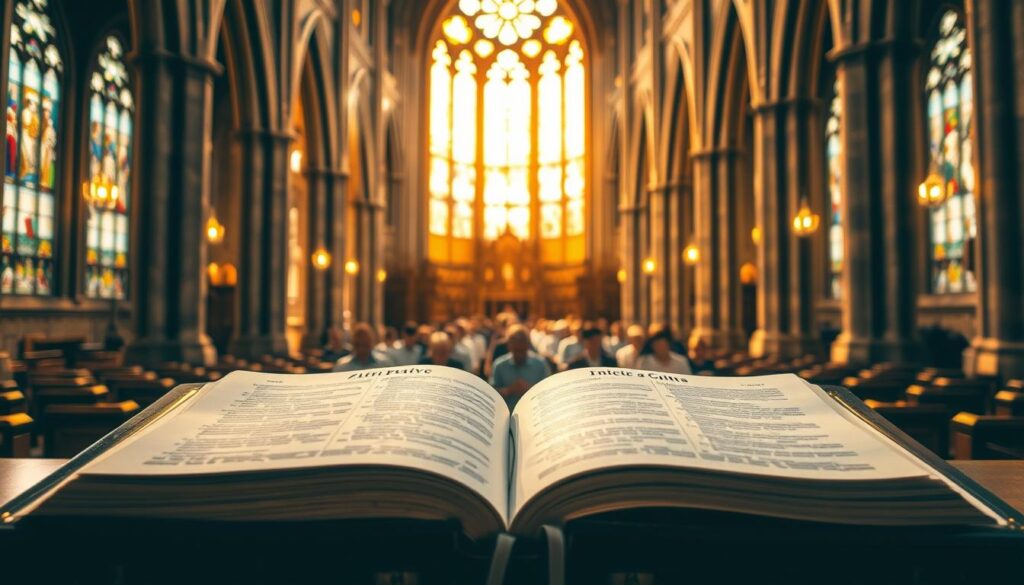
Scripture: the authoritative story of God’s work in the world
Scripture tells the central story of god work from creation through covenant and redemption. Reading the books of the Bible in common prayer guides people toward trust and obedience.
Tradition: wisdom from the early church to the 16th century
Tradition preserves the creeds, the Book of Common Prayer, and the articles religion from the early church through the 16th century. Those resources shape worship, teaching, and a shared way of life.
Reason: interpreting the faith for each century
Reason helps the community apply ancient truth to new questions. By balancing all three legs, the way keeps the gospel clear while welcoming honest study and pastoral care across every century.
- Scripture anchors the message about Jesus and daily discipleship.
- Tradition links current worship to the past.
- Reason equips people to speak the faith to each new age.
Sacraments and Worship: Baptism and Holy Communion at the Center
Anglican liturgy centers around two visible signs that connect people to Christ and each other.
Baptism and Holy Communion as the two sacraments commanded by Christ
Jesus instituted two sacraments—baptism holy communion—and Anglicans administer these sacraments as means of grace. Baptism marks new life and entry into the community. Holy Communion nourishes faith and sends people into service.
Common prayer in practice: the Book of Common Prayer and the church year
The Book of Common Prayer gives shared texts and weekly patterns for worship. Using common prayer helps people learn doctrine by praying it together.
The liturgical cycle from Advent to Pentecost shapes preaching, readings, and song. The Eucharist often stands as the principal act of Sunday worship, where Scripture is read, the gospel proclaimed, and thanksgiving offered over bread and wine.
- These sacraments unite local parishes across diverse styles of worship.
- Prayer books and companion books keep worship grounded in Scripture and tradition.
Historic Episcopate and Ministry
A living line of ordained leaders links local congregations to the church’s earliest mission. This continuity is called the historic episcopate and it shapes how leadership functions across dioceses.
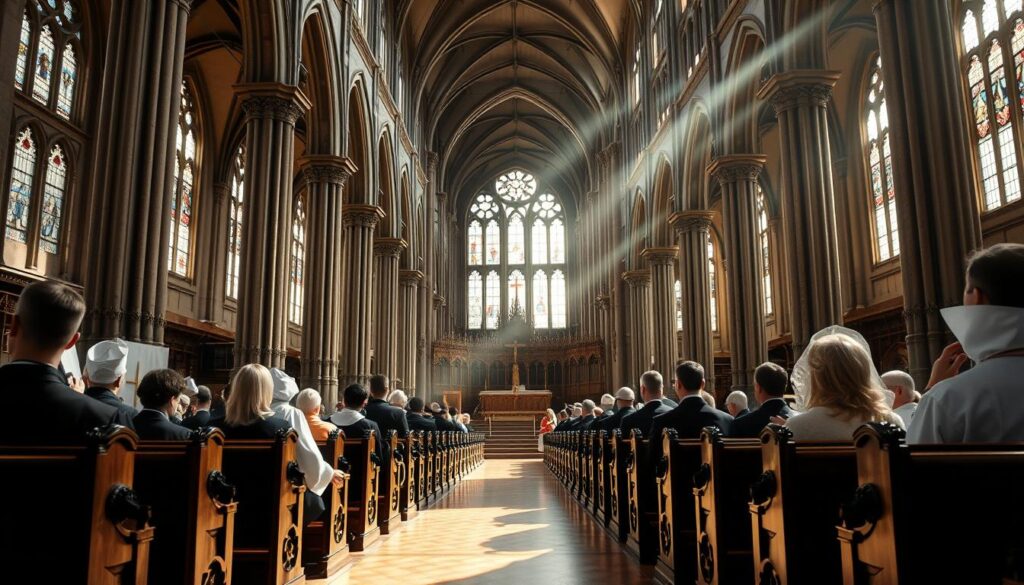
Bishops, priests, and deacons in apostolic ministry
Anglicanism preserves three orders: bishops, priests, and deacons as part of ordered ministry. Bishops serve as chief pastors and teachers, safeguarding unity in worship and doctrine across the wider church.
Apostolic succession and the one holy catholic and apostolic church
Apostolic succession ties today’s leaders to the apostles’ mission. This bond affirms belonging to the “one holy catholic and apostolic church” and grounds shared faith across the world.
- The historic episcopate means the anglican church keeps bishops, priests, and deacons as part of apostolic order.
- Priests preach, celebrate sacraments, and shepherd local persons and communities.
- Deacons lead in service, linking worship to needs in the world so the whole body can serve.
Via Media: Catholic and Reformed Identity
Rooted in the Reformation yet reaching back to the early councils, this identity aims for balance rather than extremes. The phrase via media captures a commitment to both continuity and renewal.
Confessing one God in a catholic and reformed way
Anglicans believe the Christian faith confesses one God—Father, Son, and Holy Spirit—and keeps both catholic practice and reformed conviction in view. At the center is Jesus Christ, proclaimed in preaching and embodied in sacramental worship.
Continuity and conversation with the wider church
The via media grew from 16th century reforms and developed across the next century into a stable identity. It honors the early church while engaging charitably with Roman Catholic and Orthodox communities for shared witness in the world.
- Balanced teaching keeps essentials central and secondary matters secondary.
- The person of the Spirit guides how truth and grace are held together.
The Anglican Communion and the U.S. Context Today
Today the global communion includes about 110 million adherents, organized into autonomous provinces that share prayer, mission, and a common heritage.
The archbishop of Canterbury serves as primus inter pares, convening assemblies like the Lambeth Conference and encouraging cooperation rather than exercising control.
The worldwide bond with Canterbury
Provinces remain self-governing yet linked by mutual recognition, shared liturgy, and regular meetings of primates and bishops. This structure helps people across cultures learn from one another.
The U.S. expression: the Episcopal Church
After the American Revolution, English-speaking parishes formed the Protestant Episcopal Church as a distinct province. It maintains ties through the Book of Common Prayer and the Articles of Religion, rooted in Scripture and the creeds.
Diversity of worship
Local services range from simple spoken liturgies to sung choral Eucharists. Styles vary, but the aim is the same: centered on the gospel and the Table, forming communities that serve their neighborhoods.
- Global ties encourage mission partnerships and mutual learning.
- Shared worship patterns keep unity while allowing local expression.
The Chicago-Lambeth Quadrilateral: A Concise Standard of Faith and Order
Formulated during the 1880s, this four-point summary restates essentials that bind the Communion across different contexts. It serves as a clear touchstone for shared doctrine and practical order.
Scripture: the rule and ultimate standard of faith
The Quadrilateral names holy scriptures as the rule and ultimate standard of faith. It affirms that the canonical books contain the things necessary for salvation and guide teaching and order.
Creeds: Nicene and Apostles’ Creeds
It points to the nicene creeds and the apostles creed as concise summaries that state the essentials all may confess together. These creeds aid unity without overloading local practice.
Two Sacraments: Baptism and Holy Communion
The Quadrilateral names the two sacraments—baptism holy communion—as instituted by Christ and central to church life. The font and the Table shape worship, mission, and formation.
Historic Episcopate: bishops in the apostolic ministry
Finally, it commits to the historic episcopate, with bishops overseeing ordered ministry. This continuity helps preserve sound teaching and unity across the world.
Conclusion
This tradition brings together Scripture, the creeds, sacraments, and ordered ministry into a clear story that guides daily life. It forms a people who hear the gospel, pray together, and serve their neighbors.
Week by week, worship and the church year lead communities into deeper trust. Baptism holy and holy communion stand as visible means that shape faith and formation.
The Book of Common Prayer and related resources give patterns for prayer and practice. If you are exploring, visiting a local parish and joining common prayer is a warm, practical way to experience this life together.
FAQ
What is the basic focus of Anglican faith?
Anglican faith centers on worshiping God as revealed in Scripture, the creeds, and the person of Jesus Christ. It emphasizes both communal liturgy and personal devotion, blending catholic and reformed elements into a distinctive way of following Jesus.
What texts guide Anglican belief and practice?
The Holy Scriptures serve as the primary rule and standard of faith, complemented by the Apostles’ Creed and the Nicene Creed. Historic formularies such as the Book of Common Prayer and the Thirty-Nine Articles shape worship and doctrine across congregations.
How do the creeds function in Anglican worship?
The Apostles’ Creed and the Nicene Creed summarize essential Christian convictions about the Trinity, Christ’s work, and the church. They offer a concise, shared statement of faith used in public worship and teaching.
What does “containing all things necessary for salvation” mean?
That phrase points to the belief that Holy Scripture—Old and New Testaments—provides what people need to know for salvation, guidance, and the life of faith, without adding extra written requirements beyond the Bible and its faithful interpretation.
How do Scripture, tradition, and reason interact in Anglican thought?
Anglicans rely on a threefold method: Scripture as the authoritative story of God’s work, tradition as the ongoing life of the early church through the Reformation, and reason to apply faith in changing contexts. Together they shape teaching and pastoral care.
What role does the Book of Common Prayer play?
The Book of Common Prayer provides liturgies, prayers, and responses that form the backbone of corporate worship. It sets the church year, guides sacraments, and helps congregations pray together in a shared language.
Which rites are considered sacraments in Anglicanism?
Baptism and Holy Communion are recognized as the two sacraments instituted by Christ and necessary to the church’s life. Other rites—confirmation, ordination, marriage, reconciliation, and anointing—are important pastoral practices rooted in tradition.
How important is baptism and Eucharist?
Baptism initiates people into the body of Christ, while Holy Communion sustains the gathered community’s union with Christ. Both are central means of grace and communal identity across Anglican worship styles.
What is the historic episcopate and why does it matter?
The historic episcopate refers to the ordination of bishops in an unbroken line traced to the apostles. Many Anglicans see it as a safeguard of continuity, teaching, and pastoral oversight within the “one holy catholic and apostolic church.”
Who serves in ordained ministry?
Ordained ministry typically includes bishops, priests, and deacons. Bishops provide pastoral and doctrinal leadership, priests preside at the sacraments, and deacons serve liturgical and charitable roles.
How does Anglicanism balance catholic and reformed elements?
This “via media” holds catholic continuity—sacraments, creeds, and apostolic order—alongside reformed emphases like Scripture’s primacy and justification by faith. The result is both liturgical depth and theological diversity.
Does Anglicanism connect to other global churches?
Yes. The Anglican Communion links provinces worldwide around historic ties to the See of Canterbury. Relationships with Roman Catholic and Orthodox churches remain active through dialogue and shared heritage.
What distinguishes the Episcopal Church in the United States?
The Episcopal Church is the American expression of the Anglican tradition, shaped by local history and culture while keeping core authorities: Scripture, creeds, sacraments, and the Book of Common Prayer.
How diverse is Anglican worship today?
Worship ranges from simple, contemporary services to richly ceremonial liturgies. Regardless of style, gatherings focus on Scripture, prayer, and Christ-centered sacraments that form the heart of communal life.
What is the Chicago-Lambeth Quadrilateral?
The Quadrilateral outlines four essentials for ecumenical dialogue: Scripture as the rule of faith, the Nicene and Apostles’ Creeds, the two sacraments of baptism and Holy Communion, and the historic episcopate. Many churches use it as a concise standard for unity and order.