Welcome — this short guide invites readers to explore how the Anglican church lives out its core beliefs today.
Anglican practice stresses common prayer and worship as the place belief meets daily living. Basic anchors include Scripture, the Apostles’ and Nicene Creeds, and a Trinitarian confession that shapes public and private faith.
Many describe this tradition as a via media, a balanced way that holds Scripture, Tradition, and Reason together. That blend links the Bible’s story with faithful action in the wider world.
The church welcomes honest questions and learning from the historic books that shaped its teaching. Belief is shown in prayer, service, sacraments, and a steady rhythm of life that connects doctrine to daily care.
Key Takeaways
- Anglican faith centers on prayerful worship, not just ideas.
- Scripture and the early Creeds form the tradition’s core.
- The via media balances Scripture, Tradition, and Reason.
- Belief is lived through sacraments, service, and routine worship.
- The church invites seekers to join in worship to learn in practice.
- Anglicanism holds historic conviction while engaging modern questions.
Overview: The Anglican Way in Today’s World
The Anglican way aims for a steady center that holds tradition and change in balance.
Via media and semper reformanda capture that outlook. Leaders describe a path between Roman Catholic forms and some Protestant extremes. This balance keeps the church rooted in historic creeds while open to needed renewal.
Anglican churches remain Trinitarian and place Scripture at the center. Worship gathers around Word and Sacrament. Common prayer and a shared liturgical practice shape daily life and influence mission.
How tradition and action meet
The heritage of the Book of Common Prayer and creeds supports decisions made through conversation and patience.
That structure lets communities adapt faithful practice without losing key convictions. Mission shows up in evangelism, church planting, and concrete work caring for the poor and the wider world.
- Balanced path: shared beliefs with diverse expression.
- Stable yet reforming: traditions that allow change.
- Common life: liturgy, sacraments, and practical service.
What do Anglicans believe? Core Christian doctrines
Anglican teaching rests on a few clear claims that shape worship and life.

One God in three persons
Anglican doctrine confesses one God revealed in three persons: Father, Son, and Holy Spirit. This Trinitarian claim shapes prayer and the church’s language about God.
Jesus Christ: fully God and fully human
Anglicans hold that Jesus Christ is both divine and human, a single person who entered the earth to redeem and reconcile. That conviction grounds hope and practical care in the world.
Salvation by grace through faith
Salvation is understood as God’s free gift. People receive it by grace through faith, not by human effort alone. This emphasis guides preaching, pastoral care, and mission.
Creeds and Scripture
The Apostles’ and Nicene creeds stand as sufficient, concise statements of faith linked to the early church. They unite local worship with historic confession.
Scripture serves as the rule and standard, trusted to contain all things necessary for salvation. Doctrine then shapes how believers live, pray, and love their neighbors on earth.
- Trinity: frames prayer and identity.
- Christ’s person: secures redemption and care.
- Scripture and creeds: anchor worship and teaching.
Scripture, Tradition, and Reason: How Anglicans discern faith and practice
Discernment in this tradition uses three complementary touchstones to keep teaching applied and balanced.
The “three-legged stool” and keeping balance
The three-legged stool—Scripture, Tradition, and Reason—helps congregations weigh questions with care.
Scripture is read as the rule that contains all things necessary for salvation, guiding teaching and pastoral care.
Tradition offers historic forms and books that shape worship and moral judgment.
The 16th-century heritage: Book of Common Prayer and the 39 Articles of Religion
The 16th century gave the church a shared liturgy and concise doctrinal guides.
The Book Common Prayer and the 39 articles set patterns for worship and clear statements for clergy and laity.
The Chicago–Lambeth Quadrilateral: essentials for unity
The Quadrilateral names four anchors: Holy Scripture, the ancient creeds, Baptism and Holy Communion, and the historic episcopate.
“Scripture as the rule and ultimate standard of faith remains central.”
| Source | Role | Practical use |
|---|---|---|
| Scripture | Rule of faith | Teaching, catechesis, claims about necessary salvation |
| Tradition (books, liturgy) | Historic practice | Worship shape, pastoral guardrails, Book Common Prayer use |
| Reason | Interpretation | Apply texts to new contexts, technology, and culture |
| Quadrilateral | Ecumenical summary | Focus on Scripture, creeds, sacraments, episcopate |
These tools keep decisions rooted yet flexible. Parish leaders use them for liturgy, teaching, and pastoral choices.
Word and Sacrament: Worship, sacraments, and daily life
Regular liturgy and shared prayers form the patterns that train congregations to live the gospel in ordinary days.
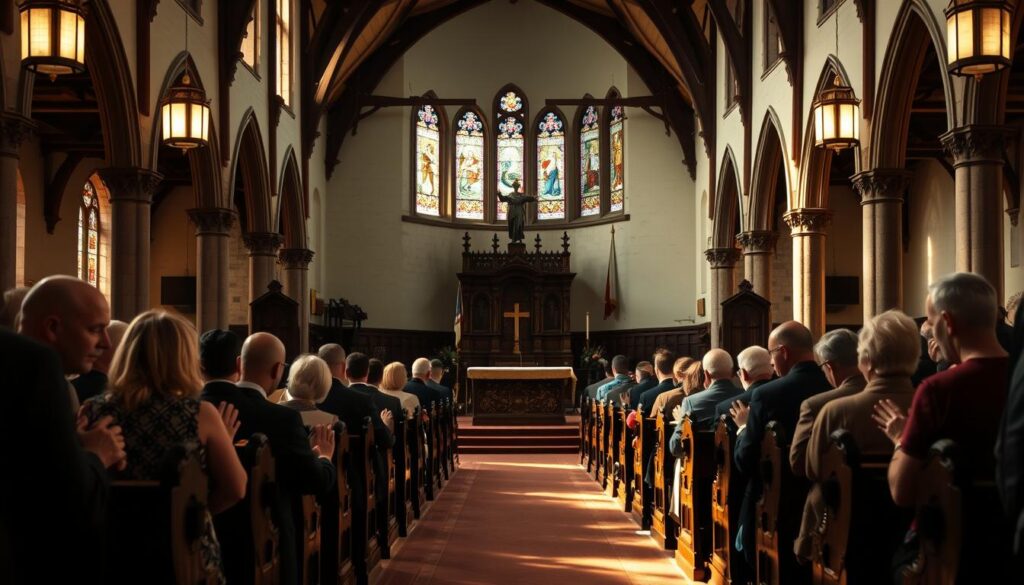
Common prayer and liturgical worship as a way of life
Worship centers on the public reading and preaching of Scripture, joined with set forms that shape habit and character.
Common prayer creates a shared rhythm of seasons, fasts, and feasts. That rhythm teaches patience, repentance, and praise across generations.
Baptism and Holy Communion: signs of grace and the Real Presence
The sacraments are external signs of interior grace, given by Jesus Christ to build up the church.
Baptism initiates a person into new life in the Holy Spirit. Holy Communion feeds the community and draws believers into ongoing union with Christ.
Many members speak of Christ’s Real Presence in the Eucharist while avoiding precise metaphysical claims. They also reject the idea that Christ is re-sacrificed at each celebration.
Liturgical habits link Sunday worship to weekday life and faithful work, equipping congregations for service and mission.
- Scripture read and preached with the sacraments forms the heart of communal worship.
- Common prayer resources extend worship into homes and small groups.
- Word and Sacrament nourish mission and practical care for neighbors.
The Church in community and mission
Ordained leaders guide communities so everyday service and global care stay connected.
Apostolic succession and shared oversight
Apostolic succession names a living chain of oversight. Bishops are consecrated in continuity back to the Apostles to guard the gospel and keep unity among churches.
Threefold ministry at work
The threefold ministry—bishops, priests, and deacons—organizes care and teaching across parish life.
Bishops teach doctrine and empower clergy. Priests lead worship and pastoral care. Deacons serve mercy and link worship to neighborhood action.
- Mission is both word and deed: evangelism, church planting, and mercy ministries.
- Parishes collaborate as part of a larger body, sharing resources and accountability.
- Service to the poor and care for creation flow from obeying Christ’s commands in the world.
| Role | Focus | Example work |
|---|---|---|
| Bishops | Teaching & unity | Clergy oversight, doctrinal care |
| Priests | Worship & pastoral care | Leading Eucharist, preaching, parish life |
| Deacons | Service & outreach | Mercy ministries, community programs |
Part of being a faithful church is mobilizing gifts for neighbors and the wider world. Healthy ministry structures help communities discern and sustain that work.
Distinctives and diversity within the Anglican Church
Many communities balance reasoned argument with steady worship. They welcome honest questions and expect study to deepen prayer and service.
Reasoned faith: interpreting Scripture in context and engaging the world
Faith here is practical and reflective. Leaders read the believe bible texts with attention to history, genre, and the witness of the early church.
The Book of Common Prayer shapes how people learn the books and the shared story of salvation. That liturgy keeps study grounded in worship so learning leads to love and action.
There is overlap with roman catholic and Orthodox traditions on sacraments and the Real Presence, yet room remains for conscientious differences.
- Reasoned reading honors authorship and literary forms instead of strict literalism.
- Tradition up to 787 AD informs judgment alongside Scripture and reason.
- Diversity in thought coexists with unity in worship and common practice.
In short, people are invited to test claims in prayer, study, and service. This approach helps communities face complex things with charity and honesty.
Conclusion
This tradition gathers faith, prayer, and service into a single, living practice. Anglicans believe in one God in three persons and confess Jesus Christ as Lord, trusting grace that leads to salvation by faith.
Scripture is held as containing the things necessary for salvation, guiding worship, teaching, and parish ministry on earth. The 16th century Book Common Prayer and the Articles of Religion still shape prayer and doctrine.
The sacraments of Baptism and Holy Communion gather the churches. Bishops serve in apostolic succession to guard teaching and foster mission through ordered ministry.
In short, anglicans believe one coherent faith summarized by the Creeds and Quadrilateral, lived in common prayer, service, and clear witness to the world. Join local worship to see this grace in action.
FAQ
What is the central claim of the Anglican tradition?
The tradition holds that there is one God in three persons—Father, Son, and Holy Spirit—and that Jesus Christ is fully God and fully human, whose life, death, and resurrection open the way to salvation by grace through faith.
How does the Anglican way approach doctrine and practice?
It follows a Via Media, or middle way, balancing Scripture, tradition, and reason. This “three-legged stool” encourages steady reform (semper reformanda) while keeping faithful to historic creeds and pastoral life.
Which texts guide worship and belief?
The Book of Common Prayer shapes public worship, devotion, and pastoral practice. The 39 Articles of Religion from the 16th century and the Bible provide doctrinal anchors, with Scripture regarded as sufficient for things necessary to salvation.
What role do the creeds play?
The Apostles’ and Nicene Creeds serve as concise summaries of essential faith. They function as shared, ecumenical statements that unite local churches with the historic Christian confession.
How are sacraments understood and practiced?
Baptism and Holy Communion are primary sacraments, seen as signs of God’s grace. Communion often affirms a real, Christ-centered presence while leaving room for diverse theological expressions across provinces.
What is the Chicago-Lambeth Quadrilateral?
It outlines four essentials for ecumenical unity: the authority of Scripture, the creeds, the two sacraments ordained by Christ, and the historic episcopate—an emphasis on continuity in ministry and order.
How is ministry organized?
Ministry works through bishops, priests, and deacons in apostolic succession. Bishops provide pastoral oversight, clergy lead worship and pastoral care, and deacons serve in ministries of service and justice.
How does reason factor into interpretation?
Reason helps interpret Scripture and tradition in light of modern knowledge and social realities. This reasoned faith encourages engagement with science, ethics, and public life while maintaining spiritual conviction.
Is there unity in belief across Anglican churches worldwide?
There is shared heritage and core conviction, but significant diversity exists in worship style, social teaching, and theological emphasis among provinces, dioceses, and parishes.
How does the tradition engage mission and the wider world?
Commitment to mission combines proclamation, education, social service, and advocacy. Historic Anglican institutions—schools, hospitals, and charities—reflect a long practice of faith in public life.