In 1529, a bold political act changed religious history forever. Six German princes and 14 cities stood against powerful authorities at the Diet of Speyer, refusing to abandon their beliefs. This protest didn’t just challenge rules—it sparked a movement that reshaped Christianity.
The term we now associate with this movement began as a nickname from critics. Opponents first used “Protestant” to mock reformers, unaware it would become a global identity. Over time, believers embraced the label as a symbol of their commitment to change.
Regional differences quickly emerged in how people described their faith. German followers preferred “evangelicals,” while French reformers became known as Huguenots. These names show how local cultures shaped the same core ideas.
Understanding this history helps us appreciate modern religious diversity. Today, millions across denominations share roots in that 16th-century stand for biblical principles. Their story reminds us how courage can redefine entire communities.
Key Takeaways
- The term originated from a 1529 political protest against religious restrictions
- Early reformers used regional names like “evangelicals” before “Protestant” spread
- Opponents created the label, which reformers later adopted proudly
- Different areas developed unique identities while sharing core beliefs
- Modern denominations maintain connections to these historical roots
Introduction to Protestant Churches
A religious transformation began reshaping societies from Germany to global frontiers. This shift created a distinct branch of Christianity that now connects over 900 million followers worldwide. Unlike older institutions, it championed personal engagement with sacred texts as a birthright for all believers.
Core Principles of the Movement
Three pillars define this approach to faith:
- Direct access to scripture without mandatory clergy interpretation
- Salvation through faith rather than ritual-based systems
- Priesthood of all believers empowering ordinary worshippers
These ideas sparked educational revolutions as people sought to read the Bible themselves. Colonial America saw this philosophy fuel demands for self-governance and individual rights.
Why Understanding This Matters Today
From hospital systems to literacy campaigns, this tradition’s fingerprints appear in modern life. Its emphasis on personal conviction continues shaping debates about ethics and social justice. Over 40% of Americans identify with denominations born from these historical roots.
Contemporary communities maintain this legacy through diverse worship styles while preserving core beliefs. Their global networks address humanitarian crises and drive interfaith dialogues, proving ancient ideas can meet modern challenges.
Historical Roots of Protestantism
Long before the 16th-century upheaval, discontent simmered across Europe. By the 1400s, educated thinkers began questioning practices that seemed far removed from biblical teachings. Shocking behavior among religious leaders fueled public anger—like Pope Alexander VI, who openly raised children born from affairs while leading the church.
Early Critiques and Reform Movements
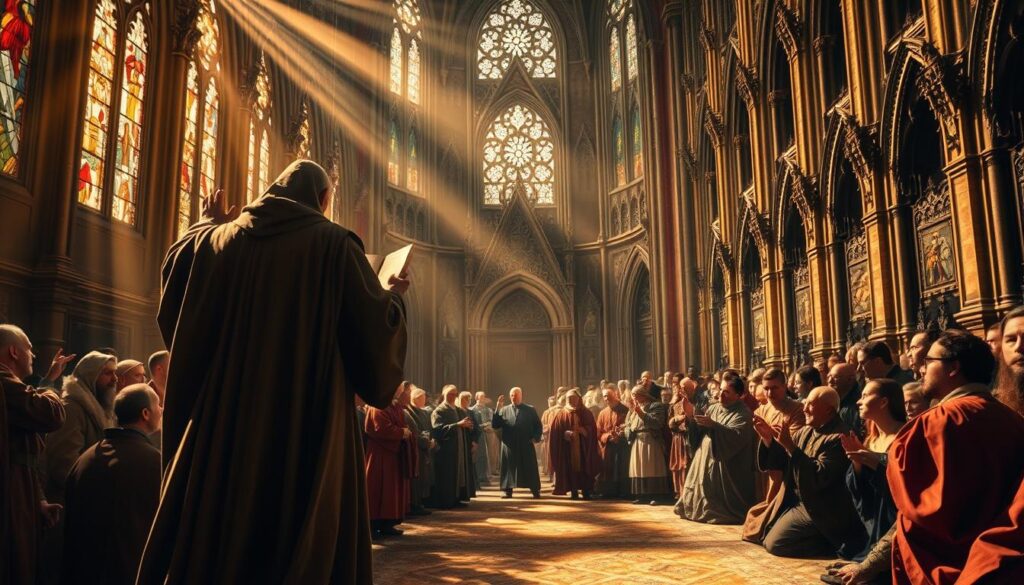
Visionaries laid groundwork for change decades before famous reformers emerged. Oxford scholar John Wycliffe produced the first English Bible translation, declaring “Every Christian must drink Christ’s teachings straight from scripture.” His ideas spread through handwritten copies, challenging the clergy’s exclusive authority.
Jan Hus in Bohemia and William of Ockham in Germany echoed these calls. Their demands for transparency created networks of believers hungry for spiritual renewal. When authorities silenced these voices through force, their followers kept the movement alive underground.
The Emergence of Reformation Ideals
Two powerful forces accelerated change: rising nationalism and accessible knowledge. As kingdoms resisted foreign control, local rulers supported religious reforms to assert independence. The printing press then turned Wycliffe’s handwritten Bibles into mass-produced tools for personal study.
Christian humanists like Erasmus added intellectual firepower. They exposed forged documents churches used to justify power grabs, asking “When did truth require deception?” This blend of grassroots passion and scholarly critique created fertile soil for lasting transformation.
Key Milestones in the Protestant Reformation
October 31, 1517, marked a turning point when Martin Luther nailed his 95 Theses to a German chapel door. This act challenged the sale of indulgences and ignited debates across Europe. Within months, handwritten copies of Luther’s arguments reached distant cities—a preview of the communication revolution to come.
The movement gained momentum through thinkers like Huldrych Zwingli in Zurich. He rejected fasting traditions, arguing “True worship comes from scripture, not human rules.” John Calvin later refined these ideas in Geneva, creating systematic teachings that spread to France and Scotland.
Three factors supercharged the Reformation:
| Catalyst | Impact | Result |
|---|---|---|
| Printing Press | Distributed 200,000 Luther works by 1520 | First mass media revolution |
| Political Support | German princes protected reformers | Regional religious independence |
| Theological Shifts | Salvation through faith alone | Empowered individual believers |
By the 17th century, Reformed traditions dominated parts of Holland and Britain. These groups emphasized God’s sovereignty, shaping modern democratic ideals. Meanwhile, Catholic leaders launched their own reforms at the Council of Trent, addressing corruption while reaffirming traditional doctrines.
This era’s legacy lives in global religious practices and educational systems. From translated Bibles to community-led worship, the Reformation reshaped how millions connect with spirituality.
What Does “protestant church called” Mean?
This question unlocks a fascinating journey through religious identity. Originally, the word described just two theological camps: Lutherans following Martin Luther’s teachings and Reformed groups influenced by John Calvin. These early believers rarely used the label themselves, preferring “evangelical” to emphasize their focus on scripture.
By the 1600s, meanings shifted with political winds. English authorities used the term to separate approved faith communities from newer movements like Baptists. Meanwhile, critics applied it broadly to anyone rejecting traditional authority structures. As one 17th-century observer noted: “They protest against Rome, yet protest among themselves.”
Three key phases shaped modern understanding:
| Period | Usage | Scope |
|---|---|---|
| 1520s-1600 | Specific schools of thought | Lutheran/Reformed only |
| 1601-1700 | Orthodoxy marker | Anglicans vs. dissenters |
| 1701-present | Umbrella category | 500+ denominations |
Today, the name connects vastly different worship styles. A traditional Lutheran church shares core principles with contemporary Pentecostal congregations, though their practices differ. This diversity explains why no single answer exists—each community reflects unique cultural blends while upholding Reformation roots.
Understanding this evolution helps navigate modern religious landscapes. From storefront chapels to cathedral-sized congregations, these denominations prove ideas born in protest can grow into global movements embracing both tradition and change.
Major Protestant Denominations Explored
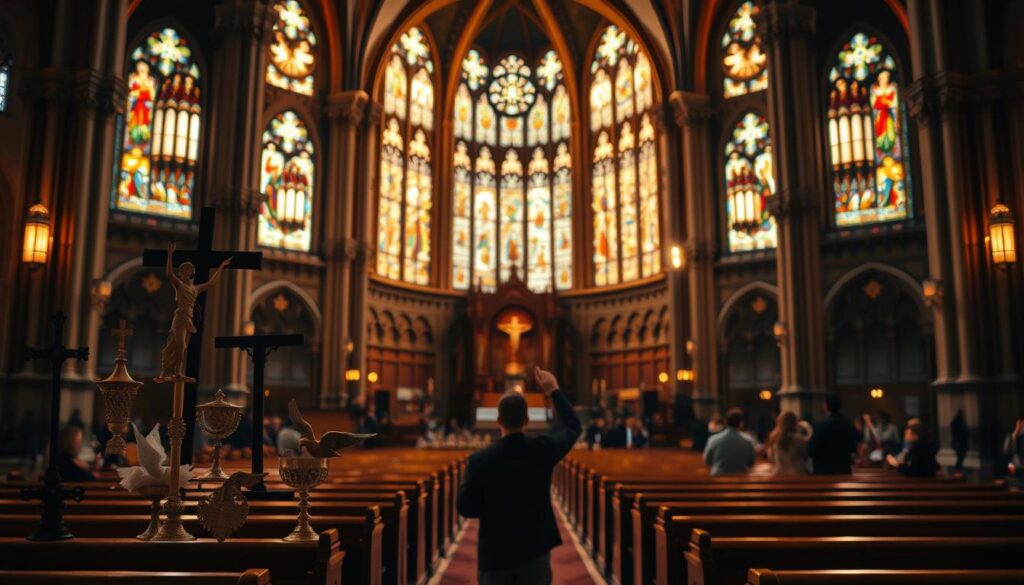
From grand cathedrals to modern auditoriums, faith communities have developed unique identities while sharing foundational principles. Nine main denominational families shape this landscape, each offering distinct approaches to spiritual life.
Diverse Doctrines and Worship Practices
Anglican traditions blend ancient rituals with reform ideals, serving 70 million members globally. Their worship form preserves choral music and structured prayers, creating what Queen Elizabeth I called “a bridge between old and new.”
Baptist congregations prioritize personal faith decisions, requiring adult baptism by immersion. This practice reflects their emphasis on individual commitment—over 40 million members gather in settings ranging from rural chapels to urban megachurches.
Examining Anglican, Baptist, Lutheran, and More
Lutheran churches, with 80 million adherents, maintain traditional liturgy while emphasizing grace-centered theology. Many use Martin Luther’s original catechisms during confirmation classes.
Modern trends show rising non-denominational groups that simplify organizational structures. One pastor explains: “We focus on core beliefs without historical baggage.” These communities often feature contemporary music and casual atmospheres.
| Tradition | Worship Style | Key Emphasis |
|---|---|---|
| Anglican | Liturgical | Sacramental unity |
| Baptist | Congregational | Personal conversion |
| Lutheran | Traditional | Grace doctrine |
| Non-Denominational | Contemporary | Community focus |
Pentecostal and Methodist denominations add vibrant expressions through spiritual gifts and social activism. This diversity proves shared roots can nurture varied spiritual practices while maintaining common ground.
Influential Reformers and Their Contributions
Personal convictions of a few sparked global religious transformations. At the heart of this change stood thinkers who reimagined faith’s role in daily life. Their ideas still guide millions today.
Martin Luther and the 95 Theses
A German monk’s spiritual crisis changed history. Martin Luther wrestled with feelings of unworthiness until he found peace in scripture. His 1517 document attacking indulgences became Christianity’s first viral message.
Luther’s three pillars revolutionized belief: faith over works, scripture over tradition, grace over human effort. He translated the Bible into German so farmers could read it. Hymns he wrote let congregations voice their faith directly.
John Calvin and Reformed Theology
While Luther sparked change, John Calvin built systems. The French thinker’s logical approach explained God’s complete control. His concept of predestination shaped communities from Geneva to Boston.
Calvin designed church leadership models still used today. Elders and pastors shared power, preventing single rulers. This structure influenced modern democracies’ checks and balances.
Other voices added depth to the movement. Huldrych Zwingli debated Luther about communion meanings. Philip Melanchthon turned fiery ideas into school curricula. Together, these reformers created a theological mosaic that remains vibrant five centuries later.
FAQ
How are communities born from the Reformation commonly identified?
Groups stemming from the 16th-century Reformation are often labeled by their core beliefs or founders, like Lutherans (Martin Luther) or Calvinists (John Calvin). They’re also broadly termed “evangelical” or “Reformed” based on shared doctrines.
Why is studying Reformation-era faith groups important today?
These traditions shaped modern democracy, education, and social ethics. Understanding their history clarifies debates on topics like religious freedom and the role of scripture in daily life.
What sparked the early critiques leading to the Reformation?
Concerns over practices like indulgences and clerical corruption in the Roman Catholic Church drove reformers like Luther to emphasize salvation through faith alone, not institutional rituals.
What major events defined the Reformation period?
Key moments include Luther’s 95 Theses (1517), the Augsburg Confession (1530), and the Peace of Westphalia (1648), which cemented religious diversity in Europe.
How did the term "Protestant" originate?
It comes from German princes “protesting” Catholic policies in 1529. Over time, it described all groups rejecting papal authority in favor of biblical teachings.
What distinguishes Anglican, Baptist, and Lutheran practices?
Anglicans blend traditional liturgy with Reformed theology, Baptists prioritize adult baptism and congregational governance, while Lutherans focus on grace through faith, as outlined in Luther’s writings.
How did John Calvin’s ideas differ from Martin Luther’s?
Luther emphasized justification by faith, while Calvin expanded on predestination and a structured church model, influencing Presbyterian and Reformed traditions.