With over 1.3 billion followers across six continents, this ancient spiritual tradition shapes lives and cultures worldwide. Rooted in teachings traced to the Apostles, it stands as one of Christianity’s oldest continuous traditions, blending timeless rituals with a deeply layered organizational framework.
Central to its identity is the papal system, led by the bishop of Rome. The Vatican serves as both spiritual compass and administrative hub, guiding matters of faith for diverse communities from Manila to Mexico City. This structure has remained remarkably consistent through centuries of social change.
Seven sacraments, devotion to saints, and emphasis on communal worship distinguish its practices from other Christian churches. Yet its influence extends beyond theology—medieval cathedrals, Renaissance art, and modern social justice movements all bear its imprint.
Why does this institution matter today? From shaping moral debates to preserving ancient manuscripts, its role in global heritage remains unmatched. We’ll unpack how tradition and adaptability let it thrive in our rapidly evolving world.
Key Takeaways
- Over 1.3 billion members make this faith the largest Christian denomination globally
- Direct historical ties to early Christian communities through apostolic succession
- Unique structure combines local parishes with centralized Vatican leadership
- Seven sacraments and Marian devotion distinguish its spiritual practices
- Significant influence on Western art, education, and ethical frameworks
- Balances ancient traditions with modern social engagement
Origins and History of Roman Catholicism
The roots of this global faith stretch back to ancient streets where early believers forged a spiritual legacy. Letters from apostles and archaeological finds reveal how small house churches grew into an enduring institution.
Apostolic Beginnings
First-century writings show vibrant communities forming after Jesus Christ‘s resurrection. St. Paul‘s New Testament letter to Roman believers—written around AD 57—details their struggles and hopes. Early bishops like Clement of Rome later emphasized Peter’s leadership there, creating a direct line of authority through apostolic succession.
By the second century, Rome’s status as imperial capital boosted its religious influence. Church leaders preserved tradition through turbulent times, maintaining unity as other Christian groups fractured.
Medieval Growth and Schism
The year 1054 marked a turning point. Theological disputes over the Nicene Creed and papal power split Eastern and Western believers. This schism formalized differences between Roman and Orthodox practices that still exist today.
Medieval monasteries became centers of learning while cathedrals rose across Europe. Crusades and royal alliances expanded the church’s political role, transforming it from underground movement to cultural cornerstone.
Foundational Beliefs and Doctrines
At the heart of this ancient faith lies a dynamic interplay between time-honored practices and spiritual truths. These principles guide daily life while connecting believers to centuries of theological wisdom.
Sacred Traditions and Scripture
Catholic doctrine draws from two rivers of revelation: biblical texts and church tradition. Unlike groups that prioritize Scripture alone, this approach sees the New Testament and sacred customs as complementary. St. Irenaeus famously described this threefold foundation as “Scripture, succession, and faith handed from apostles.”
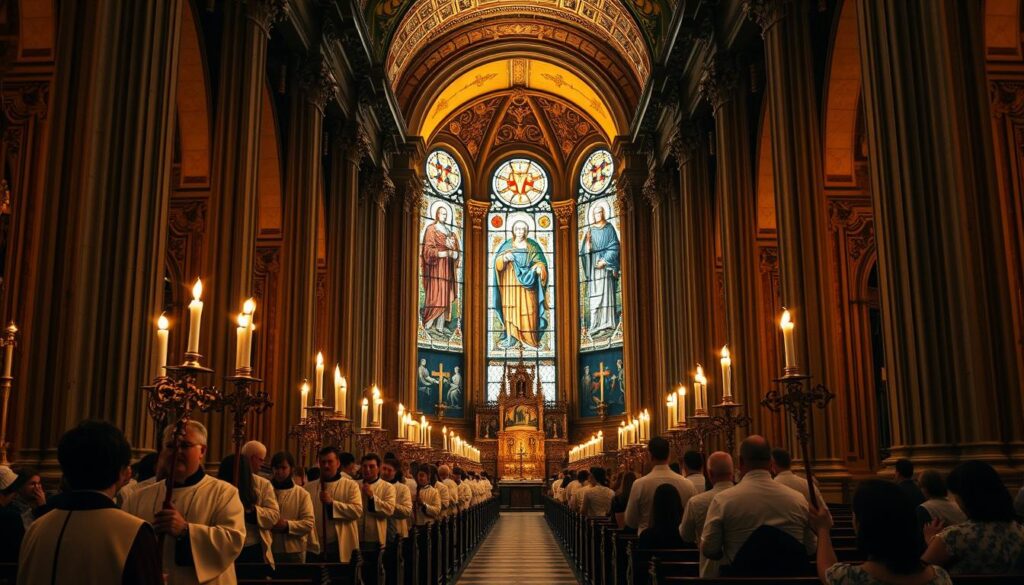
Central to worship is the belief in transubstantiation—the transformation of bread and wine into Christ’s body and blood during Mass. This literal interpretation of Jesus’ Last Supper words reflects the church’s emphasis on tangible holiness.
The Role of Saints and Miracles
Devotion to the Virgin Mary stands out among Catholic practices. Believers celebrate her sinless conception and bodily ascent to heaven, events not detailed in Scripture but preserved through tradition. Saints occupy similar reverence as spiritual mentors, with many praying to these holy figures for guidance.
The church maintains strict protocols for confirming supernatural events. Sites like Lourdes attract millions seeking healing, though only 70 miracles there meet official criteria since 1858. This careful validation process balances faith with rational inquiry.
Overview of Church Structure and Leadership
Distinctive organizational patterns define this global faith community. Its framework combines spiritual authority with administrative precision, creating a system that’s lasted nearly two millennia.
Papal Authority and Infallibility
At the pinnacle stands the pope, believed to inherit spiritual power from St. Peter. Since 1870, Vatican I declared papal infallibility when speaking ex cathedra—Latin for “from the chair” of Peter. A Vatican official clarifies: “This doesn’t mean the pope can’t make mistakes. It applies only to definitive teachings on faith or morals.”
Such declarations remain rare. Only two ex cathedra statements exist—the Immaculate Conception (1854) and Mary’s Assumption (1950). Cardinals serve as the pontiff’s closest advisors, wearing scarlet robes symbolizing readiness to defend faith “even unto blood.”
Hierarchy and Governance
The Roman Catholic Church operates through three sacred orders: bishops, priests, and deacons. Bishops govern dioceses as apostolic successors, ordaining new clergy while maintaining unity with Rome. Archbishops oversee larger regions, while cardinals focus on Vatican governance.
Local parishes connect this vast network. Priests lead worship and sacraments, adhering to celibacy rules rooted in apostolic times. Contrasting with Orthodox traditions, this requirement underscores dedication to spiritual fatherhood over biological family ties.
Behind the scenes, the Roman Curia manages global operations. Departments like the Congregation for the Doctrine of Faith safeguard teachings, while others coordinate missions or liturgy. This intricate system balances centralized authority with grassroots spiritual care across 3,000 dioceses worldwide.
Key Practices and Sacraments in the Roman Catholic Church
Sacred rituals shape daily life for millions of believers, connecting them to centuries of spiritual heritage. These visible signs of divine grace guide major life moments while nurturing ongoing faith journeys.
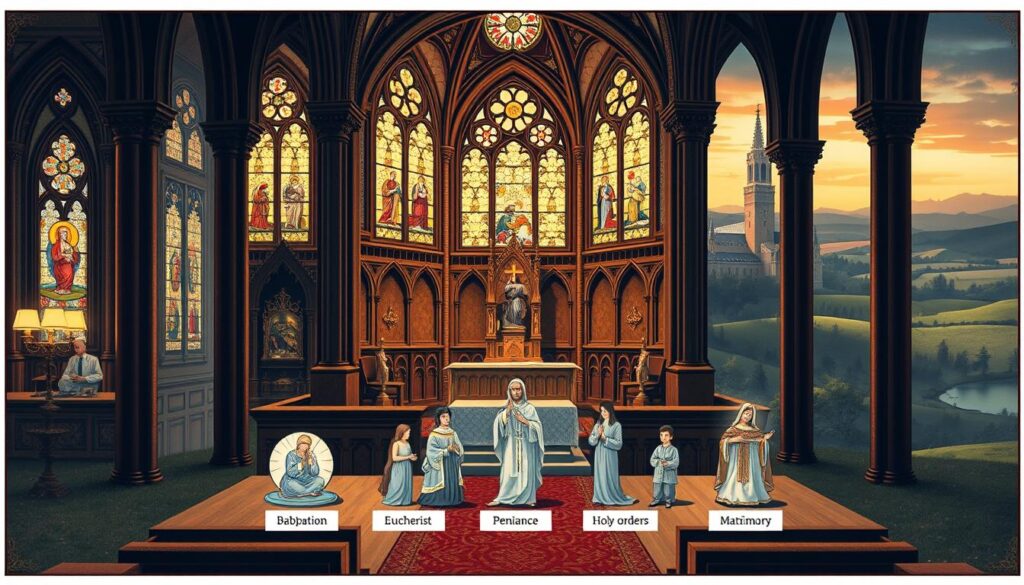
The Seven Sacraments
Seven sacraments serve as milestones marking spiritual growth. Each offers unique blessings, from cleansing original sin in baptism to healing the terminally ill through last rites. The Eucharist remains central—believers receive communion weekly, affirming Christ’s presence through transubstantiation.
| Sacrament | Purpose | Typical Age |
|---|---|---|
| Baptism | Spiritual rebirth | Infancy/adulthood |
| Confirmation | Strengthening faith | Teen years |
| Reconciliation | Moral renewal | Any age |
| Marriage | Lifelong union | Adulthood |
| Holy Orders | Clergy dedication | Adulthood |
Liturgy and Devotional Practices
Mass follows structured liturgy blending Scripture readings with ancient prayers. Many parishes hold Eucharistic Adoration, where consecrated hosts rest in ornate monstrances for meditation. The rosary—a bead-based prayer chain—helps devotees reflect on biblical events while honoring Mary.
Annual obligations like Easter communion trace back to 1215’s Fourth Lateran Council. Private confession maintains relevance too—over 70% of U.S. Catholics participate yearly according to recent surveys. These practices bridge personal spirituality with communal tradition.
Core Identity: what is roman catholicism and its Global Influence
Nearly one in seven people worldwide belong to this faith community, shaping societies through spiritual values and tangible action. Its teachings ripple through classrooms, hospitals, and legislative chambers, blending ancient wisdom with modern challenges.
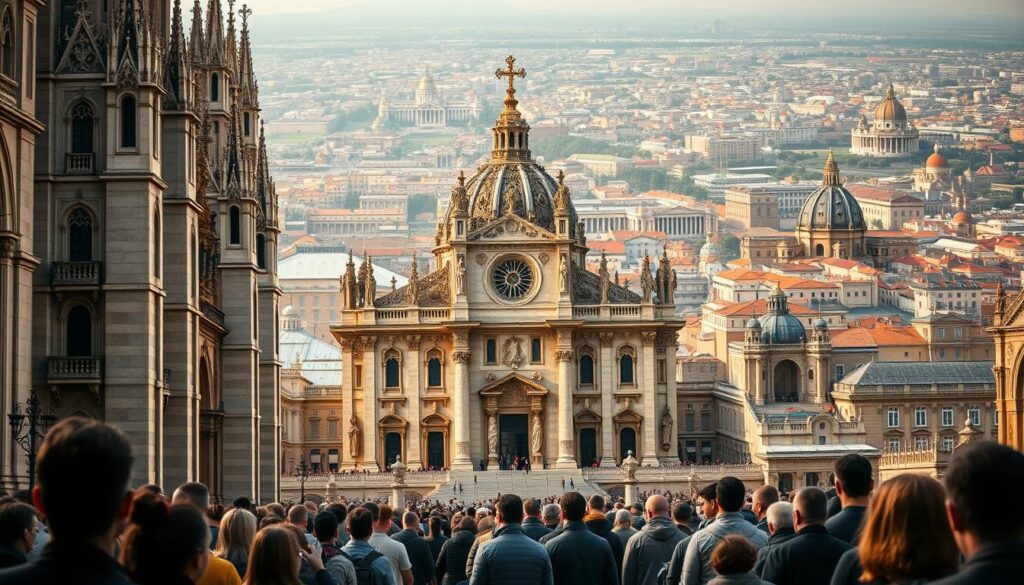
Cultural and Social Impact
The Catholic Church’s fingerprints appear in unexpected places. Renaissance painters like Michelangelo drew inspiration from biblical stories, while composers like Mozart scored masses still sung today. Gothic cathedrals—stone symphonies of faith—remain architectural marvels attracting millions annually.
Beyond art, this institution pioneered universal education. Over 140,000 schools worldwide educate 61 million students, regardless of belief. Catholic hospitals serve 1 in 6 patients globally, demonstrating faith through service.
| Sphere of Influence | Historical Example | Modern Impact |
|---|---|---|
| Art & Architecture | Chartres Cathedral (1194) | UNESCO World Heritage Sites |
| Education | Medieval universities | 94 U.S. Catholic colleges |
| Social Teaching | Rerum Novarum (1891) | Climate change advocacy |
Ethical frameworks developed by thinkers like Aquinas still shape debates about human rights and economic fairness. Recent popes have addressed artificial intelligence ethics, proving ancient traditions adapt to new frontiers.
From protecting migrant rights to preserving ancient texts, this global community bridges past and present. Its voice remains vital in conversations about human dignity across cultures and generations.
Interactions with Other Christian Traditions
Christian communities have navigated complex relationships for centuries, balancing shared beliefs with distinct practices. While divisions persist, modern efforts focus on building bridges across theological differences.
Schisms and Doctrinal Disagreements
The Great Schism of 1054 split Eastern and Western churches over papal authority and creed wording. Orthodox leaders rejected Rome’s claim to universal jurisdiction, creating separate structures that endure today.
Sixteenth-century reformers like Luther challenged tradition’s role in salvation. Protestant churches emerged, emphasizing Scripture alone over sacraments. These denominations reshaped Europe’s religious landscape through new worship styles and governance models.
Pathways to Ecumenism
Vatican II revolutionized Catholic relations with other Christian churches in the 1960s. The council declared: “Many elements of sanctification exist outside visible Church structures,” recognizing other means of spiritual growth.
Joint initiatives now address poverty and climate change. Over 75% of U.S. Catholic parishes partner with Protestant churches on food banks and disaster relief. Shared baptismal rites help overcome historical issues.
Key obstacles remain—papal authority and sacramental theology top the list. Yet annual prayer weeks unite denominations, proving collaboration outweighs centuries-old disputes.
Modern Developments and Reforms
The 1960s ushered in transformative winds of change through Roman Catholic communities worldwide. Sweeping updates reshaped worship styles, community roles, and global relationships while preserving core teachings.
A New Chapter in Church Life
Vatican II (1962-65) revolutionized daily church practices. Mass shifted from Latin to local languages, inviting broader participation. Lay members gained active roles in liturgy and parish matters, fostering deeper engagement.
Pope John Paul II became a global symbol of hope during his 27-year papacy. His support for Poland’s Solidarity movement helped dismantle communist regimes, proving faith’s power in political change. Mission growth surged in Africa and Asia under his leadership.
Modern challenges test the institution’s resilience. Clergy shortages in Western nations contrast with booming seminaries elsewhere. Recent scandals demand renewed focus on transparency and accountability. Yet the church continues adapting—embracing digital outreach while upholding ancient sacramental life.
FAQ
How does Roman Catholicism differ from other Christian denominations?
The Catholic Church emphasizes apostolic succession, recognizing the Pope and bishops as successors of Christ’s apostles. It also upholds Sacred Tradition alongside Scripture, along with teachings like the Virgin Mary’s Immaculate Conception and the seven sacraments, which many Protestant groups do not share.
What role do sacraments like Communion and Confirmation play?
A: Sacraments like the Eucharist (Communion) and Confirmation are seen as outward signs of divine grace. They mark spiritual milestones, such as receiving the Holy Spirit or reaffirming faith, and are central to Catholic worship and community life.
How has the Pope’s authority shaped Catholic doctrine?
The Pope, as head of the Roman Catholic Church, holds supreme teaching authority. Teachings on issues like papal infallibility—defined at the First Vatican Council—reinforce his role in guiding doctrine, such as Pope John Paul II’s contributions to bioethics and social justice.
Why are saints and the Virgin Mary important in Catholic teachings?
Saints, including the Virgin Mary, are viewed as intercessors and models of holiness. Veneration of saints reflects the belief in the communion between living believers and those in heaven, rooted in New Testament teachings about the “cloud of witnesses.”
What caused divisions between Catholicism and other Christian churches?
Key splits, like the Great Schism of 1054 and the Protestant Reformation, arose from disputes over papal authority, liturgical practices, and doctrines like justification. Modern ecumenical efforts, such as Vatican II, aim to bridge these gaps.
How do Catholic practices like confession and liturgy deepen faith?
A: Confession (Reconciliation) allows believers to seek forgiveness through clergy, while structured liturgy—like the Mass—connects worshipers to ancient traditions. These practices foster spiritual discipline and communal unity.
How did Vatican II modernize Catholic practices?
The Second Vatican Council (1962–1965) introduced reforms like Mass in local languages, greater lay participation, and dialogue with other faiths. It redefined the Church’s role in the modern world, emphasizing social justice and religious freedom.
What is the significance of marriage in Catholic life?
A: Marriage is a sacrament reflecting Christ’s union with the Church. It emphasizes lifelong commitment, mutual support, and openness to family life, guided by teachings on natural law and sacramental grace.