Welcome to a journey through one of Christianity’s most influential movements. Born from 16th-century reforms, Protestantism reshaped how millions connect with spirituality. At its heart lies a focus on direct access to God and the belief that Scripture guides life’s deepest questions.
This branch of the Christian church began as a call to simplify traditions and center teachings on Jesus Christ. Unlike other denominations, it emphasizes salvation through grace rather than rituals. Imagine a faith where personal study of the Bible matters more than hierarchies – that’s Protestantism’s legacy.
Today, nearly one billion people identify with this tradition. From Lutherans to Baptists, its diversity mirrors its global reach. You’ll find vibrant communities shaping culture, education, and social justice worldwide.
In this guide, we’ll explore how Protestant ideas sparked revolutions in thought and practice. You’ll discover its core principles, historical turning points, and why it still resonates. Let’s dive into a story of faith, courage, and enduring impact.
Key Takeaways
- Originated in 16th-century reforms emphasizing Scripture over tradition
- Teaches salvation through divine grace, not human effort
- Bible serves as ultimate authority for spiritual guidance
- Represents 30% of Christians globally with diverse denominations
- Encourages personal connection with God without intermediaries
- Influenced social movements and education systems worldwide
Understanding the Protestant Faith Meaning
At the heart of this Christian movement lies a revolutionary idea: connection with the divine needs no middleman. Central to its teachings are the Five Solae – Latin principles that shape spiritual identity. Sola fide (“faith alone”) declares salvation comes through trust in God’s grace, not rituals or deeds.
This approach flips traditional power structures. Instead of relying on a church hierarchy, believers build relationships directly with the sacred. “The Bible is God’s living voice,” one reformer argued, “not a relic locked in institutional vaults.”
Scripture’s supremacy forms the bedrock of these beliefs. While other traditions blend biblical wisdom with human authority, this movement treats ancient texts as complete guidance. Modern worshippers still carry pocket Bibles – a habit born from 16th-century cries for accessibility.
Personal interpretation fuels spiritual growth here. Congregations encourage members to wrestle with texts themselves, though this freedom sometimes sparks debate. As one pastor notes: “Our unity comes from shared devotion, not identical conclusions.”
These doctrines shape daily life in tangible ways. From hymn choices to community service projects, every practice ties back to biblical roots. Families often center homes around scripture studies, passing down interpretive skills through generations.
Historical Origins and the Protestant Reformation
Long before Luther’s famous stand, Europe simmered with religious tension. Corrupt clergy and complex rituals left many craving authentic spirituality. This hunger for change would ignite a firestorm across the continent.
Seeds of Change in Medieval Soil
Jan Hus lit the first sparks of reform in 15th-century Bohemia. His fiery writings condemned church corruption, declaring: “Truth alone makes free.” Though burned at the stake in 1415, his ideas spread like wildfire through underground networks.
Three key factors fueled early dissent:
- Growing literacy rates among common people
- Political leaders seeking independence from Rome
- Widespread frustration with church financial abuses
When Ideas Collided With Empire
The 16th century brought Luther’s explosive Ninety-Five Theses. His call for debate about indulgences became a rallying cry. At the 1521 Diet of Worms, authorities demanded he recant. Luther’s refusal marked the movement’s irreversible break from Catholic tradition.
This showdown changed everything:
- Printing presses spread reform ideas rapidly
- Local rulers adopted Protestant teachings
- New church structures emerged across Europe
These events didn’t just reshape religion. They redefined how societies confront power – a legacy still shaping modern democracies.
Key Protestant Reformers and Their Legacies
Visionary leaders transformed religious thought through bold actions and groundbreaking ideas. Their work created ripples still felt in churches worldwide today.
The Monk Who Shook Europe
Martin Luther’s 95 Theses sparked more than debate – they ignited a cultural earthquake. This former monk’s German Bible translation let ordinary people read scripture firsthand. His writings challenged church authority, declaring: “Every believer is their own priest.”
Luther’s legacy includes:
- Founding the Lutheran Church with 80 million members today
- Creating catechisms still used in religious education
- Pioneering hymns like A Mighty Fortress
Geneva’s Systematic Thinker
John Calvin turned a Swiss city into a Reformation laboratory. His Institutes of the Christian Religion became Protestantism’s first textbook. Geneva’s strict moral codes under his leadership drew both admiration and criticism.
Calvin’s influence spread through:
- Presbyterian governance models
- Emphasis on predestination theology
- Educational reforms in multiple continents
| Reformer | Key Contributions | Regions Influenced |
|---|---|---|
| Martin Luther | Bible translation, justification by faith | Germany, Scandinavia |
| John Calvin | Systematic theology, church governance | Switzerland, North America |
Other figures like Zwingli and Knox added unique flavors to the movement. Zwingli’s Zurich reforms prioritized scripture over rituals, while Knox shaped Scotland’s kirk tradition. Together, these leaders proved diverse approaches could share core principles.
Modern denominations from Baptists to Methodists trace their roots to these 16th-century innovators. Their courage to rethink tradition continues inspiring new generations of believers.
Theological Foundations and the Five Solas
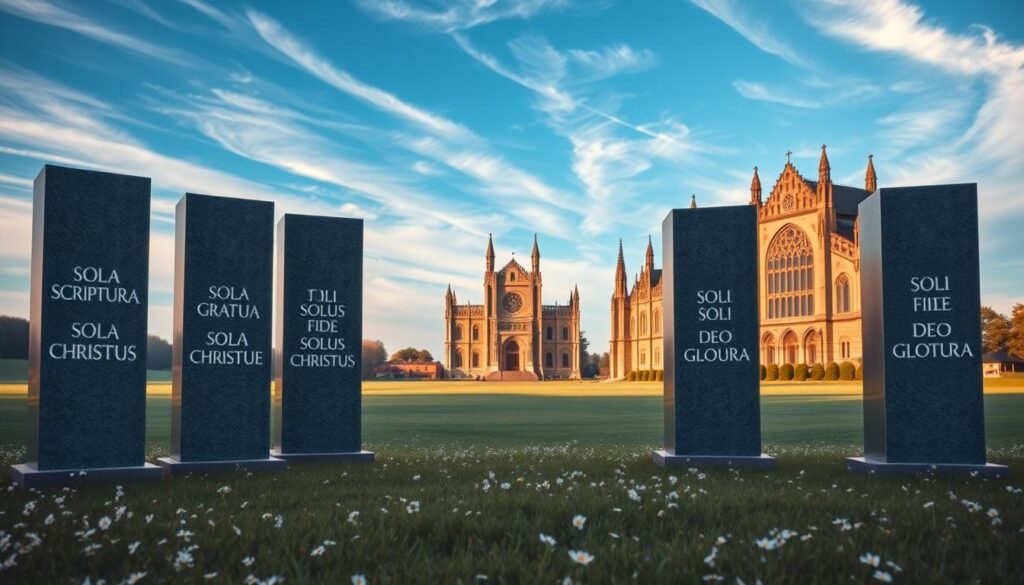
Imagine building a house where every brick matters. The reformers laid five bedrock principles that still support modern spiritual practice. These five solae – Latin for “alone” – became revolutionary declarations against medieval church practices.
Sola Scriptura and Sola Fide Explained
Sola scriptura places the Bible above all human traditions. A 16th-century pamphlet declared: “God’s word outlives marble monuments.” This principle fuels Bible study groups and personal devotionals today.
Faith alone reshaped how people view salvation. Unlike systems requiring rituals, this idea says trust in Christ’s sacrifice is enough. Luther compared it to “empty hands receiving a royal gift.”
Sola Gratia, Solus Christus, and Soli Deo Gloria
Three more pillars complete the foundation:
- Grace alone: Divine favor isn’t earned – it’s freely given
- Christ alone: No saints or priests needed for divine connection
- Glory to God: Worship focuses upward, not on human leaders
These ideas shape modern communities. Churches prioritize scripture readings over ceremonial displays. Hymns like Amazing Grace echo the god grace concept. Even church governance models reflect soli Deo gloria, avoiding hierarchical titles.
Together, the five solae form a spiritual compass. They guide decisions from charity work to parenting styles. As one theologian notes: “Our roots go deep, but our branches reach wide.”
Scripture as the Sole Authority in Protestantism
When English worshippers first heard the King James Bible read aloud in 1611, it marked a seismic shift. This translation became the ultimate source of divine truth for millions, embodying the reformers’ radical claim: God’s word outranks human institutions.
Interpreting the Bible in Protestant Traditions
Early reformers wielded scripture like a sword against medieval church teachings. Luther declared, “A simple milkmaid with her Bible knows more than the pope!” This belief birthed Bible study groups where farmers and nobles debated texts as equals.
Modern approaches blend personal insight with scholarly guidance. Some traditions use historical analysis, while others focus on spiritual application. Pentecostals might emphasize personal revelation, whereas Presbyterians lean on systematic theology.
Three factors revolutionized religious practice:
- Vernacular translations replacing Latin texts
- Printing presses spreading affordable Bibles
- Laypeople leading home scripture circles
This freedom to interpret fuels both unity and diversity. While Baptists and Methodists read the same verses, their applications differ. Yet all agree on scripture’s supreme authority – a principle that drives missionary work from Alabama to Zambia.
Today’s digital Bibles continue this legacy. Apps with audio readings and study tools let construction workers hear scripture on lunch breaks, just as 17th-century farmers once gathered around family Bibles at dusk.
Diverse Denominations and the Global Protestant Landscape
Picture a sprawling oak tree with branches reaching across continents. This mirrors the growth of spiritual communities rooted in shared Reformation ideals. From structured liturgies to spontaneous worship, these groups adapt core principles to local cultures while keeping biblical authority central.
Lutherans, Anglicans, and Reformed Traditions
Three major branches showcase how denominations interpret shared heritage differently:
- Lutherans preserve Martin Luther’s emphasis on grace, using catechisms for teaching
- Anglicans blend Protestant theology with ancient rituals in the Church of England tradition
- Reformed churches follow Calvin’s systematic approach to scripture and governance
The Church of England uniquely balances Protestant doctrine with bishops’ leadership. Its 25 million members worldwide sing from the same hymnal used during the English Reformation, blending tradition with modern relevance.
Emerging Independent and Nonconformist Churches
Newer movements like the Assemblies of God reflect ongoing innovation. These groups often:
- Prioritize spiritual experiences over formal structures
- Use contemporary music and casual services
- Plant churches in storefronts and homes rather than traditional buildings
From Brazilian favelas to Korean megacities, these communities prove Protestant principles adapt to any context. A pastor in Nairobi explains: “We keep the Bible open but let the Spirit write new chapters through our people.”
This global tapestry shows how denominations maintain unity through scripture while celebrating cultural diversity. Whether in a Swedish cathedral or Appalachian revival tent, the same core message resonates: grace transforms lives.
Ecclesiology, Liturgy, and Worship Practices
Communion cups clink softly as believers gather worldwide. This simple act connects modern worshippers to 500 years of spiritual heritage. Across diverse communities, shared practices reveal core beliefs about sacred gatherings and divine connection.
Understanding Sacraments and Worship Styles
Two sacred rituals anchor spiritual life in most churches. Baptism and the Lord’s Supper serve as visible expressions of inward grace. Lutherans describe communion as Christ’s presence “in, with, and under” the elements, while Reformed traditions emphasize spiritual nourishment through faith.
Worship styles range from high-church liturgies to casual services with rock bands. Three patterns emerge:
- Presbyterian services follow structured prayer books
- Baptist gatherings prioritize spontaneous prayer
- Pentecostal meetings embrace emotional worship songs
Pulpits remain central in many sanctuaries. “Scripture shapes our teachings,” explains a Methodist pastor. “Sunday sermons equip people for Monday challenges.” This focus turns pews into training grounds for daily life.
Baptism debates showcase interpretive diversity. Some churches sprinkle infants, recalling covenant promises. Others immerse adults as a public declaration. Both groups cite biblical examples to support their views on this initiation rite.
The Lord’s Supper continues sparking theological conversations. Whether served weekly or monthly, this meal unites communities across denominational lines. As one elder notes: “We taste grace together – that’s what matters most.”
Protestantism in Relation to Roman Catholicism
Differing views on spiritual authority define the Protestant-Catholic divide. While both traditions share Christian roots, their paths diverged over doctrines and practices. This split continues to shape worship styles and theological debates today.
Comparative Doctrinal Differences
At the heart of the divide lies religious authority. Protestants prioritize Scripture as the sole guide, while the Roman Catholic Church blends biblical teachings with papal decrees and tradition. A 16th-century reformer famously declared, “The Bible needs no interpreter but the Holy Spirit.”
Salvation beliefs further separate the traditions. The Catholic Church teaches grace through sacraments administered by clergy. In contrast, Protestant theology emphasizes direct access to divine mercy through Christ alone.
These differences extend to church structure. Roman Catholicism maintains a hierarchical system with the Pope as supreme leader. Protestant communities typically favor local governance, reflecting their commitment to individual spiritual responsibility.
FAQ
How does Protestant theology differ from Roman Catholic teachings?
Protestant beliefs emphasize Scripture alone as the ultimate authority, rejecting papal infallibility. Unlike Roman Catholicism, most traditions teach salvation through faith in Christ rather than sacraments or works. Disputes over practices like indulgences sparked the Reformation.
What role did Martin Luther play in the Reformation?
Luther, a German monk, challenged church corruption by posting his Ninety-Five Theses in 1517. His writings promoted justification by faith and translated the Bible into vernacular languages, empowering laypeople. This defiance at the Diet of Worms reshaped Christianity.
Why are the Five Solas central to Protestant doctrine?
The Solas—Scripture, faith, grace, Christ, and God’s glory—summarize core teachings. They reject human merit in salvation, affirming Christ’s sufficiency and the Bible’s authority. These principles unified reformers like Calvin and Zwingli despite denominational splits.
How do Protestant denominations vary in worship practices?
Lutherans and Anglicans retain liturgical elements like the Lord’s Supper, while Baptists or Pentecostals prioritize sermons and spontaneous prayer. Groups like the Amish or Quakers emphasize simplicity, reflecting diverse interpretations of New Testament models.
What sparked the global spread of Protestantism after the 16th century?
A> Missionary efforts, colonial expansion, and movements like Methodism fueled growth. Today, Assemblies of God and African Independent Churches reflect adaptability to local cultures, making Protestantism the world’s second-largest Christian branch after Catholicism.
Do Protestants recognize saints or Marian devotion?
Most reject veneration of saints, focusing instead on Christ’s mediation. While figures like Augustine are respected, prayer is directed to God alone. Exceptions exist in high-church Anglicanism, which sometimes honors traditional saints.
How did John Calvin influence Reformed churches?
Calvin’s Institutes of the Christian Religion systematized doctrines like predestination and covenant theology. His Geneva model blended church-state governance, inspiring Presbyterians, Puritans, and later, Reformed Baptists through his emphasis on God’s sovereignty.
Why is sola scriptura controversial within Christianity?
Critics argue it leads to fragmented interpretations without a unifying authority like the Magisterium. Protestants counter that the Holy Spirit guides believers, prioritizing personal engagement with Scripture over institutional decrees.