Two global Christian traditions share ancient roots but walk distinct paths. While both trace their origins to early Christianity, their journeys through history reveal unique approaches to worship, leadership, and spiritual practice. These differences matter to millions who find meaning in their respective communities.
The English Reformation shaped one tradition’s identity, blending Catholic heritage with Protestant ideas. This created a middle way that values ancient rituals while embracing reform. Across the ocean, another tradition maintained centralized leadership rooted in Rome. Both groups cherish sacraments and scripture but interpret authority differently.
Modern believers often notice contrasts in church governance first. One group follows a global network of self-governing churches, while the other answers to a single spiritual leader. These structures influence how communities adapt to cultural changes and address contemporary issues.
Shared beliefs about Jesus and the Trinity unite these faiths, yet practices like prayer styles and clergy roles highlight their uniqueness. Understanding these distinctions helps explain why people choose one tradition over another – and what keeps them connected through centuries of change.
Key Takeaways
- Both traditions share ancient Christian roots but developed unique identities
- Historical reforms created different approaches to leadership and worship
- Sacraments remain central, but interpretations of authority vary
- Church governance structures differ significantly between the two
- Modern practices reflect adaptation to cultural changes
- Shared core beliefs continue to unite these global faith communities
Historical Foundations of Anglican and Catholic Traditions
Historical events and theological debates forged separate identities within a common faith. Both traditions grew from seeds planted during Christianity’s spread across Europe, adapting to local cultures while keeping core beliefs intact.
Early Church Influences
Roman soldiers and Celtic monks first brought Christian teachings to Britain. By the 2nd century, communities blended Roman organizational methods with Celtic spirituality. This mix created worship styles that valued both structure and personal connection to faith.
The Impact of the Reformation
Political clashes in the 16th century reshaped England’s religious landscape. Unlike other European reforms, England’s changes focused on restoring independence rather than starting anew. Ancient practices like liturgy and church leadership remained, now paired with reformed theological ideas.
| Aspect | Historical Development | Key Influence |
|---|---|---|
| Governance | Local leadership networks | Roman administrative models |
| Reformation Approach | Restoration of autonomy | Political tensions with Rome |
| Cultural Adaptation | Celtic-Roman synthesis | Indigenous spiritual practices |
This blend of old and new explains why some churches kept stained glass and choirs while updating their teachings. Over 1,500 years, these traditions show how faith evolves while honoring its roots.
English Reformation and the Birth of Anglican Identity
A surprising mix of royal drama and spiritual awakening reshaped England’s religious landscape. While political conflicts sparked change, centuries of theological debate laid the groundwork for a new national faith.
Henry VIII and the Break with Rome
Henry VIII’s famous split from the Roman Catholic Church began as a personal crisis but became a turning point. Though his quest to annul a marriage drew attention, reformers like John Wycliffe had already questioned papal authority for 300 years. The king’s 1534 Act of Supremacy declared him head of the Church of England, shifting power from Rome to London.
This wasn’t just about royal convenience. Henry ordered English Bibles in churches and dismantled monasteries, redistributing their wealth. His actions blended political control with spiritual reform, creating a church that kept Catholic rituals but rejected foreign oversight.
The Elizabethan Settlement
Queen Elizabeth I transformed her father’s political experiment into lasting theology. Her 1559 settlement required Sunday services using the Book of Common Prayer – a way to unite people across beliefs. This compromise allowed:
- Traditional church structure with bishops
- Scripture-focused worship in English
- Flexibility in personal beliefs
By balancing Catholic practices with Protestant ideas, Elizabeth’s Church of England became a model for religious stability. Her approach prevented the violent conflicts seen in Europe, proving faith could evolve through law even though traditions remained cherished.
anglican vs catholicism: A Doctrinal Comparison
Christian belief systems reveal their core identities through how they define essential teachings. While both groups share ancient creeds about God and salvation, their approaches to doctrine showcase contrasting philosophies. One tradition prioritizes scriptural clarity, while the other embraces expanded teachings shaped over centuries.
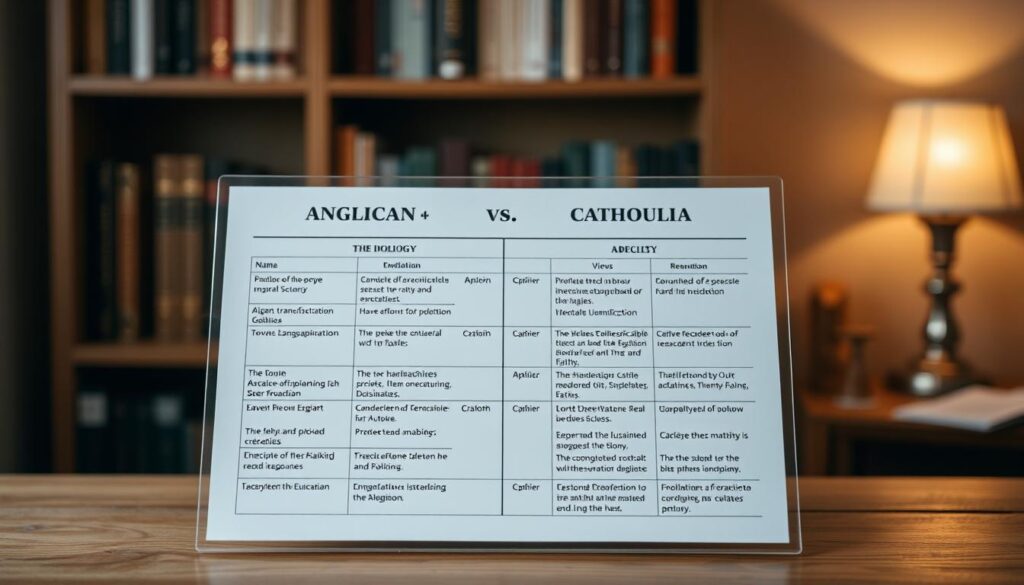
The Roman Catholic Church maintains detailed teachings on matters like Mary’s role and sacramental theology. These become required beliefs for members through official declarations. In contrast, Anglican tradition focuses on scripture’s sufficiency, stating only what’s “read therein or proved thereby” binds conscience.
| Aspect | Anglican Approach | Roman Catholic Teaching | Practical Impact |
|---|---|---|---|
| Core Authority | Scripture first | Scripture + Magisterium | Flexibility vs uniformity |
| Doctrinal Documents | 39 Articles (brief) | Catechism (detailed) | Interpretation range |
| Marian Beliefs | Optional devotion | Required doctrines | Prayer practices |
This table highlights how theology shapes daily faith. Anglicans might disagree on things like saintly intercession yet unite around baptism and communion. The church in Rome expects uniform acceptance of doctrines developed through councils and papal authority.
Both traditions value ancient creeds but differ in applying them. Where one sees room for exploration, the other provides definitive answers. This balance between mystery and clarity continues to guide millions in their spiritual journeys.
Understanding Authority, Scripture, and Tradition
What shapes a faith community’s core beliefs? The answer lies in how they balance ancient wisdom with modern understanding. Three elements form this foundation: sacred texts, historical practices, and who gets to interpret them.
Early Christian leaders set clear boundaries. Basil the Great and Augustine taught that Scripture alone defines essential doctrines. Their writings still guide many churches today. This principle became central to the Articles shaping one tradition’s approach.
Patristic Consensus and the Biblical Canon
Ancient teachers agreed on Scripture’s sufficiency. Gregory of Nyssa wrote: “The sacred word contains all things necessary for life.” This idea echoes through centuries:
- 66 books form the original Hebrew canon
- Early councils never officially expanded this list
- Key figures like Jerome used this shorter collection
| Aspect | Scripture-First Approach | Expanded Tradition |
|---|---|---|
| Source of Doctrine | Biblical text only | Church teaching + Scripture |
| Canon Size | 66 books | 73 texts |
| Required Beliefs | Minimal essentials | Detailed doctrines |
Roman Catholics added seven deuterocanonical works after 1440. These extra texts support doctrines like purgatory. But the original church leaders mostly used the shorter canon. This difference affects how communities apply ancient tradition today.
One tradition’s articles state plainly: “Nothing should be required for salvation that Scripture doesn’t command.” This keeps doctrine focused on the biblical word. The other tradition values ongoing interpretations from Rome, creating a living authority that adapts through time.
Liturgical Differences and the Role of the Book of Common Prayer
Worship styles reveal how communities express shared beliefs through unique practices. The Book of Common Prayer shapes spiritual rhythms for millions, blending structured prayers with flexible expression. Unlike rigid manuals, this text invites creative interpretation while maintaining core patterns.
Traditional Language vs Contemporary Worship
Modern churches face a delicate balance: preserving ancient words while making them relatable. The Book of Common Prayer offers both 16th-century phrasing and modern adaptations. This dual approach lets congregations choose services that resonate with their cultural context.
Anglican worship shows remarkable variety. One church might use incense and choirs, while another prefers acoustic guitars and casual language – all using the same liturgy framework. As one priest notes: “Our book provides the melody, but each community sings it in their key.”
| Feature | Anglican Practice | Roman Catholic Standard |
|---|---|---|
| Instruction Detail | Minimal rubrics | Detailed missal directives |
| Language Options | Multiple versions | Uniform translations |
| Ceremonial Freedom | Local customization | Centralized guidelines |
This flexibility stems from the Book of Common Prayer‘s design. It prioritizes theological substance over ceremonial rules, trusting local leaders to adapt expressions. The result? A living liturgy that feels timeless yet fresh across generations and cultures.
The Eucharist and Communion Practices
Sharing bread and wine forms a sacred bond across Christian communities, yet interpretations of this meal reveal profound theological contrasts. Both traditions cherish communion as a central act of worship, but their understanding of what happens during the ritual creates visible differences in practice.

Spiritual Presence Versus Transubstantiation
One group teaches that Christ meets believers through the elements rather than within them. Their view emphasizes spiritual nourishment received by faith, not physical transformation. As one historical document states: “The body of Christ is given to the worthy receiver no other way than spiritually.”
The Roman Catholic perspective differs dramatically. They maintain the bread and wine become Christ’s actual flesh and blood – a change called transubstantiation. This belief leads to practices like reserving consecrated hosts for adoration, which you won’t see in most other churches.
| Aspect | Spiritual Presence View | Roman Catholic Teaching |
|---|---|---|
| Elements After Consecration | Remain ordinary bread/wine | Become Christ’s body/blood |
| Required Preparation | Baptism + repentance | Confession + fasting |
| Reserved Elements | Not typically kept | Stored in tabernacles |
These approaches shape how communities experience communion. Some focus on the shared meal aspect, while others treat the sacrament with elaborate reverence. Both require preparation, but one stresses personal faith and the other emphasizes ritual purity.
Modern churches handle these differences in various ways. You might find one church using disposable cups next to another with golden chalices – outward signs of deeply held convictions about sacred meals.
Priesthood, Clergy, and Marriage in Faith Communities
Religious leadership models shape how communities live out their beliefs. While many churches share similar roles for clergy, practical differences emerge in daily church life. These variations affect everything from family dynamics to decision-making processes.
Married Priesthood and Ecclesiastical Structure
Roman Catholics maintain strict celibacy rules for priests, viewing undivided devotion as essential. Their bishops hold significant authority over regional dioceses. This structure creates a clear chain of command but limits personal flexibility.
Other traditions allow married clergy, seeing family life as enriching pastoral work. Bishops here often collaborate with local people when making decisions. For example, some churches let congregations help choose their leaders.
These approaches show how faith groups balance ancient traditions with modern realities. While Roman Catholics preserve uniform practices, others adapt to cultural shifts. Both models aim to serve their people effectively – just through different paths.
FAQ
What are the core differences between Anglican and Catholic beliefs?
While both value scripture and sacraments, Catholics emphasize papal authority and transubstantiation in the Eucharist. Anglicans prioritize a blend of scripture, tradition, and reason, allowing broader interpretations of communion and leadership.
How did the Reformation shape the Anglican tradition?
The Reformation led to the English Church breaking from Rome under Henry VIII. Later, the Elizabethan Settlement blended Protestant theology with Catholic liturgical practices, forming a distinct Anglican identity rooted in the Book of Common Prayer.
Why do Anglicans and Catholics view the Eucharist differently?
Catholics believe in transubstantiation, where bread and wine become Christ’s physical body. Anglicans often see communion as a spiritual presence, focusing on mystery and communal remembrance without strict doctrinal definitions.
Can Anglican priests marry, unlike Catholic clergy?
Yes! Anglican clergy can marry, while Catholic priests traditionally take vows of celibacy. This reflects differing views on how faith intersects with daily life and ecclesiastical structure.
How does the Book of Common Prayer influence Anglican worship?
The Book of Common Prayer unifies Anglican liturgy with structured prayers and services. It balances traditional language with modern adaptations, fostering both reverence and accessibility in worship practices.
Do Anglicans recognize the authority of the Pope?
No. Anglicans view the Archbishop of Canterbury as a spiritual figurehead but reject papal supremacy. Authority resides in scripture, tradition, and collective decision-making among bishops.
What role does tradition play in both faiths?
Catholics uphold tradition as equal to scripture, guided by papal teachings. Anglicans see tradition as a dynamic guide, interpreted alongside reason and cultural context, allowing for evolving practices.
How do their approaches to the Bible differ?
Both revere scripture, but Catholics rely on the Magisterium for interpretation. Anglicans encourage individual and communal discernment, often integrating historical scholarship and diverse perspectives.