This article opens with a clear question and a compact, factual answer. The faith traces its roots to 1st‑century Judaea in the Roman Empire and, by sacred tradition, to Jesus as founder. The public beginning is often placed at Pentecost in Jerusalem, where the Apostles began to act in a new, communal way.
Over time the movement grew into a global body. By 2025 it claims roughly 1.27–1.41 billion baptized members across the Latin Church and 23 Eastern churches. The pope serves as bishop of Rome and the Holy See, with governance centered in Vatican City.
The rest of this article will trace that path: from early testimony and persecutions to legalization, councils, schisms, reform, and the modern global presence. Readers will gain context for debates about authority, teaching, and unity that shape Christian history and life across the world.
Key Takeaways
- Pentecost in Jerusalem marks the public emergence of the movement tied to Jesus’ commission.
- The institution grew into the largest Christian body with over a billion members by 2025.
- The pope is the bishop of Rome and the chief pastor for global governance.
- The structure includes the Latin Church and 23 Eastern communities across thousands of dioceses.
- This article maps origins through major events that shaped doctrine and authority.
Short Answer: Tracing the Start of the Catholic Church to Pentecost in the 1st Century
Catholic tradition points to Pentecost as the pivotal moment that launched the community’s public life. The New Testament’s Acts of the Apostles recounts the descent of the Holy Spirit, an event Catholics identify as the beginning of public ministry tied to Jesus Christ’s Resurrection and the Great Commission.
Pentecost in Jerusalem: The Church’s public beginning
At Pentecost the Apostles began preaching openly. That preaching formed the first communities and gave shape to common worship and mission.
From 1st century Judaea to Rome: A rapid early expansion
From 1st‑century Judaea the message moved quickly along Roman roads and trade routes. Urban centers, including Rome, received itinerant preachers who linked local groups into a wider body.
In short: Catholics see apostolic preaching and the Holy Spirit’s descent as the basis for later teaching and authority. This short answer explains public origin, not later legal recognition, and prepares readers for the timeline and developments that follow.
when did catholic church start: A Timeline from Jesus Christ to the Early Church
This timeline links Jesus Christ’s ministry to the early communities recorded in the New Testament.
Jesus Christ, the Apostles, and the Great Commission
The Gospels record Jesus appointing the Twelve and sending them with a clear mission. His teachings and example shaped the first leaders and common worship. Small groups met, shared meals, and kept the memory of his life and words alive.
Acts of the Apostles: From Jerusalem to the wider Roman Empire
Acts narrates how mission moved from Jerusalem into Syria, Asia Minor, and Rome. Missionaries travelled along roads and ports. Local communities kept similar worship and core teachings, forming a recognizable network.
By the end of the 2nd century: Synods and emerging structures
By the late second century, regional synods met to settle disputes about belief and practice. Ordained leaders—bishops, presbyters, deacons—helped preserve unity and the rule of faith. Rome began to act as an appeal center by the next century.
Key points:
- Gospel accounts show appointment and mission of leaders.
- Acts traces rapid movement across the Roman world.
- Synods and episcopal order appear by the 2nd century.
| Time | Development | Impact |
|---|---|---|
| c. 30–33 AD | Jesus’ ministry and commissioning | Formation of Apostolic leadership |
| c. 33–100 AD | Acts: missionary expansion | Networks of local congregations |
| Late 2nd century | Regional synods and bishops | Doctrinal clarification, unity |
| 3rd century | Rome as court of appeal | Emerging central roles in governance |
Pentecost and the Apostolic Age: Foundations of Catholic Faith and Community
A new public ministry took shape after the Holy Spirit empowered the Apostles at Pentecost. That event, recounted in the New Testament, marks the moment followers of Jesus Christ began to gather openly for mission, teaching, and worship.
The descent of the Holy Spirit and the birth of public ministry
Pentecost energized the Apostles for witness and mission. They preached, baptized, and formed communities that lived out a shared faith.
Early communities, bishops, and teaching authority
Local groups met for prayer, instruction, and mutual care. Leaders emerged to guide worship and resolve questions of belief.
“They devoted themselves to the apostles’ teaching and to fellowship, to the breaking of bread and to prayer.” — Acts (New Testament)
- Pentecost empowered public witness and mission.
- Early life combined Scripture and living tradition in teaching.
- Bishops came to be seen as apostolic successors who preserve authority and unity.
| Aspect | Role in Apostolic Age | Long-term Impact |
|---|---|---|
| Holy Spirit at Pentecost | Initiated public ministry and witness | Foundation for liturgy and mission |
| Local communities | Worship, instruction, charity | Parish life and communal identity |
| Bishops and elders | Leadership, teaching, dispute resolution | Apostolic succession and episcopal structure |
| Scripture & tradition | Shared memory and teaching source | Basis for creeds, councils, and magisterial interpretation |
In sum: The Apostolic Age planted the seeds of doctrine, governance, and communal life. Authority and service were linked as leaders safeguarded the apostolic message for future generations.
Peter, the Bishop of Rome, and Apostolic Succession
Roots of papal claims trace back to a brief but pivotal exchange recorded in Matthew’s Gospel. That passage and later practice link a person named Peter to leadership and to ongoing claims about unity and authority within the wider church.
“You are the rock”: Matthew’s account and Catholic interpretation
In Matthew 16 Jesus addresses Peter with the word translated as “rock.” Catholics read this as a foundation for pastoral leadership and the passing of responsibility through successors.
“You are Peter, and on this rock I will build my church.”
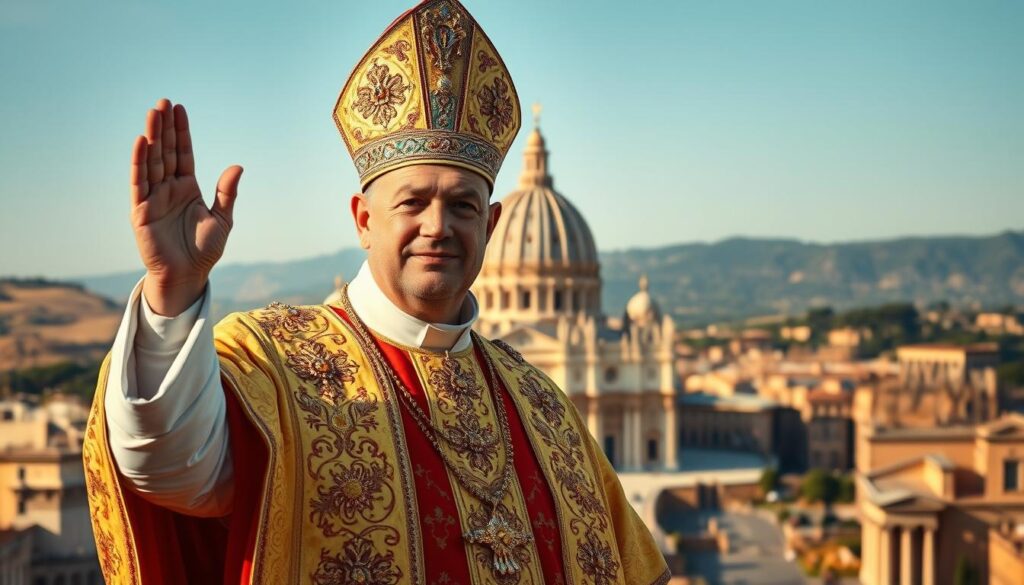
Bishop of Rome and the development of papal primacy
Over centuries the bishop of Rome became a center for appeals and consensus. That role evolved into the office now called the pope, seen by Catholics as linked to Peter’s mission and pastoral care.
Debates on Peter as first pope and historical nuance
Scholars note that a single-bishop structure in Rome likely solidified by the mid‑2nd century. Some question whether Peter functioned as a local bishop there, while Catholic teaching treats his role as foundational.
- Apostolic succession preserves continuity of teaching and sacraments.
- Appeals to Rome strengthened the practical primacy of its bishop.
- Both tradition and critical history shape our view of authority today.
When “Catholic” Meant Universal: Ignatius of Antioch and the Name of the Church
Around AD 110 a leader from Antioch used a word that would shape Christian self‑identity for centuries. Saint Ignatius of Antioch, writing from prison, referred to the “Catholic” community to signal a single faith shared across many local congregations.
Ignatius’ letters matter because they show how early believers described unity in worship and teaching. The Greek term katholikos meant “universal,” and it clarified that local groups belonged to a wider communion.
How the term set groups apart
By naming the community as catholic, writers like Ignatius and later Cyril of Jerusalem drew boundaries. The label distinguished orthodox teaching from rival claims and loose sects in the 2nd–4th centuries.
Language and authority worked together. This naming gave theological and practical weight to appeals, councils, and later imperial definitions of orthodoxy.
Where the bishop appears, there let the people be; just as where Jesus Christ is, there is the catholic community.” — Ignatius of Antioch
- Ignatius frames unity across local congregations.
- The term katholikos highlights universality in doctrine and worship.
- Later usage gave the label legal and conciliar significance.
| Period | Use of the term | Effect |
|---|---|---|
| c. AD 110 | Ignatius uses “catholic” to describe universal fellowship | Marks a shared identity across communities |
| 4th century | Cyril and others employ the term against heresies | Clarifies orthodox teaching and liturgical unity |
| Imperial/conciliar era | Legal and doctrinal adoption of the label | Strengthens institutional authority and definition |
The New Testament, Tradition, and Early Catholic Doctrine
Early teachers combined Scripture with living practice to guard the message passed from the apostles. The catholic church professes a single deposit of faith held in both the New Testament and sacred tradition.
Scripture and sacred tradition as the deposit of faith
Scripture and tradition work together to preserve apostolic witness. The magisterium claims authority to interpret that deposit faithfully for each generation.
Church Fathers and the rule of faith against heresies
Writers such as Ignatius, Irenaeus, Justin Martyr, and Augustine shaped early teaching. They used a concise “rule of faith” as a test of authentic account and practice.
- The New Testament canon and living tradition formed side by side.
- Leaders appealed to the rule of faith when facing Gnosticism and rival claims.
- Doctrinal clarity grew from preaching, worship, and pastoral dispute.
- This process led to later councils and the creeds that shaped catholic doctrine.
In short, unity of faith depended on shared texts, remembered teaching, and recognized authority. That combination kept the church rooted while the early world posed new challenges.
Persecution to Legalization: From the Roman Empire to State Recognition
Refusing public cult practices put followers at odds with Roman civic expectations and drew suspicion. That refusal, combined with secret meetings and rapid growth, made the group easy to mistrust.
Why early Christians were targeted
Social and political pressure
Authorities saw the movement as a challenge to social order and imperial religion. Monotheism and communal aid looked like a rival loyalty to the state.
Persecutions were sporadic, varying by place and time. Many episodes were local, while others became empire-wide crises that tested communal resilience.
Edicts that changed legal status
In 313, the Edict of Milan granted legal toleration and returned property. Imperial favor helped the catholic church expand buildings and public ministry.
In 380, the Edict of Thessalonica made Nicene Christianity the Roman state religion. That year reshaped relations between church and state across the empire.
- Legal status reduced fear and increased public worship and charity.
- Imperial support accelerated institutional growth and influence.
- State recognition also created new tensions about power and doctrine.
“Legalization transformed a persecuted religion into a public institution and set the stage for councils and creedal definitions.”
These shifts set the stage for ecumenical councils and formal doctrinal definitions that would follow in later centuries.
Councils, Creeds, and Canon: Defining Catholic Teaching in the Early Centuries
Key gatherings of bishops in late antiquity helped the catholic church set stable doctrine and public worship. These meetings clarified how the faithful speak about Jesus and which books guide prayer and teaching.
Nicaea, Ephesus, and Chalcedon: Christology and creed
The Council of Nicaea (325) tackled the question of Christ’s divinity and produced language that became central to the Nicene Creed.
Ephesus (431) defended the truth of the Incarnation, and Chalcedon (451) affirmed that Jesus is fully God and fully human in one person.
These decisions standardized wording so local teaching stayed consistent across regions and time.
Consolidating the biblical canon and the Vulgate
Late fourth‑century synods recognized lists of biblical books used for worship and instruction. Local councils and major sees reached consensus by the end of the century.
By 391 the Latin Vulgate translation began to shape Western liturgy, education, and theological order. Its use helped unify readings and catechesis across dioceses.
- The ecumenical council model addressed urgent disputes and preserved unity of belief.
- Precise creeds guided pastoral teaching and local worship practice.
- Canon recognition and the Vulgate reinforced the authority of Scripture in common life.
“Clear language about Jesus’ person resolved conflicts that threatened unity.”
| Council | Year | Key outcome |
|---|---|---|
| Nicaea | 325 | Nicene Creed on divinity |
| Ephesus | 431 | Incarnation affirmed |
| Chalcedon | 451 | Two natures in one person |
Structure and Governance: Pope, Bishops, and the Roman Curia
Leadership structures ensure consistent teaching and pastoral care across the globe. The pope serves as the bishop of Rome and chief pastor of the catholic church. The Holy See acts as central authority and represents the church in diplomacy and doctrine.
Holy See, dioceses, and episcopal polity
Local life is rooted in dioceses. Nearly 3,500 dioceses and eparchies form the basic units of governance. Each is led by a bishop who guides liturgy, education, and charity.
Bishops work with priests and lay ministers. National bishops’ conferences and synods coordinate regional priorities and pastoral planning.
Roman Curia and global administration
The Roman Curia is the administrative system the Holy See uses to manage teaching, liturgy, and mission worldwide. Departments handle doctrine, relations with states, and support for bishops.
“The Curia helps translate papal guidance into concrete programs that serve parishes, schools, and charitable works.”
- The communion of 24 sui iuris churches includes the Latin Church and 23 Eastern churches with distinct rites.
- Governance links local pastoral care to global teaching and continuity across centuries.
- Administrative structures enable evangelization, education, and social outreach worldwide.
| Level | Role | Effect |
|---|---|---|
| Holy See / Pope | Universal teaching and diplomacy | Unity of doctrine and global leadership |
| Roman Curia | Administration and departments | Operational support for bishops and programs |
| Diocese / Bishop | Local governance and pastoral care | Day‑to‑day liturgy, education, charity |
From a United Church to East-West Schism: Authority and Theology
Five ancient sees—Rome, Constantinople, Alexandria, Antioch, and Jerusalem—formed a governing rhythm for centuries. These centers, often called the pentarchy, carried special honor and shaped regional practice.
The pentarchy and growing tensions
The pentarchy linked leading bishops across vast territory. Over time, cultural differences and political rivalries widened gaps between East and West.
Language, liturgy, and imperial influence fed disputes. Debates about the pope’s role and other points of doctrine tested shared bonds.
1054 and beyond: Eastern Orthodoxy and Catholicism part ways
By the mid‑11th century tension reached a breaking point. The 1054 split formalized a division: the Eastern Orthodoxy saw divergent governance and the West affirmed papal primacy.
Both sides kept apostolic succession and the sacraments, even as governance and liturgical practice diverged.
- Shared faith and sacraments remained a common inheritance.
- Disagreements over papal authority became a central fault line.
- Later centuries saw councils, diplomacy, and ongoing dialogues aimed at reconciliation.
In historical perspective, the schism reshaped Christian geography and spawned distinct spiritual paths. Understanding this moment helps explain differences in worship, governance, and identity across the two great churches today.
Reformation and Counter‑Reformation: Catholicism in the Early Modern World
The 16th century transformed European religion and prompted urgent debate over doctrine and authority.
Protestant separations arose from disputes over justification, the role of scripture, and abuses in pastoral life. Reformers pressed for changes in teaching, liturgy, and clerical practice.
Protestant separations and the Catholic response
The catholic church moved to address these challenges through institutional reform and clearer doctrine.
“Reform was both corrective and creative: it disciplined leaders and renewed mission.”
Council of Trent and renewal of doctrine
From 1545 to 1563 the Council of Trent clarified sacramental theology, affirmed the canon, and condemned certain errors.
Trent mandated seminaries, tightened discipline, and standardized liturgy. These changes strengthened unity and spurred global mission.
- Doctrinal clarity on sacraments and justification
- Reforms in seminaries and religious life
- Standardized rites that aided missionary work
| Issue | Action at Trent | Long-term Effect |
|---|---|---|
| Doctrine | Clear teaching on sacraments | Doctrinal stability for centuries |
| Discipline | Seminaries and clerical reform | Improved pastoral formation |
| Liturgy | Standardized rites | Unity in worship and mission |
The roman catholic church’s reforms reshaped early modern history and set the stage for later developments in authority and renewal, including the Second Vatican Council.
Global Catholicism: Growth, Mission, and the Modern World
Mission and service propelled a wide expansion of institutions that now shape life across continents.
Expansion beyond Europe and the role of religious orders
Religious orders, missionaries, and local communities led outreach to Africa, Asia, and the Americas. They founded parishes, schools, and hospitals that anchored local life.
Education, health care, and social teaching worldwide
The catholic church today runs one of the largest networks of education and health services. It operates roughly 95,200 primary schools, 43,800 secondary schools, 18,000 clinics, 5,500 hospitals, and 16,000 nursing homes.
These institutions flow from social teaching that ties faith to care for the poor and vulnerable. Lay movements and small orders often lead local projects, blending evangelization with charity.
- Missionary expansion involved both large orders and local churches.
- Schools and hospitals shape education and public health across the world.
- Demographic shifts to the Global South influence worship, leadership, and culture.
In sum: Global growth reflects a living, adaptive communion that serves diverse peoples and links service with belief in daily life.
Second Vatican Council to Today: Continuity and Reform
Vatican II marked a careful renewal that balanced ancient teaching with pastoral needs for a new era. The council (1962–1965) updated the liturgy, affirmed Scripture and tradition together, and urged a universal call to holiness.
Vatican II’s impact on worship and the laity
Key documents reformed liturgy, promoted ecumenism, and expanded roles for lay ministries. Mass in the vernacular and renewed rites aimed to deepen participation and life in local communities.
Contemporary scale, challenges, and leadership
Today the catholic church counts roughly 1.27–1.41 billion members worldwide. The Holy See governs from Vatican City, and the pope serves as bishop of Rome, linking present leadership to apostolic roots.
- Renewed emphasis on Scripture, tradition, and pastoral teaching.
- Lay involvement in ministries and public witness increased.
- Ongoing reforms address transparency, safeguarding, and evangelization.
“Continuity and reform work together to shape communal life and mission.”
“Catholic Church” and “Roman Catholic”: Terms, Usage, and Meaning
Labels shape how people read history and identity. The official name used in the Catechism and councils is the Catholic Church, a phrase that traces back to the Greek katholikos, meaning universal.
Latin Church and Eastern Catholic Churches: unity in diversity
The Latin Church and 23 Eastern churches share full communion with the bishop rome. They keep distinct rites, languages, and customs while recognizing common sacraments and teaching.
This unity shows how one body can hold diverse liturgies and disciplines without losing shared authority.
How and why the term “Roman Catholic” emerged
In English the phrase roman catholic gained wide use after the Reformation to mark Western practice tied to Rome. Scholars and media still use it to distinguish the Latin tradition from Eastern rites.
Many prefer the single noun to stress universality and avoid regional labeling.
| Label | Meaning | Typical use |
|---|---|---|
| Catholic Church | Universal communion of believers | Official documents, councils |
| Roman Catholic | Often the Latin tradition linked to Rome | Historical, media, comparative contexts |
| Eastern Catholic | Autonomous rites in full communion | Regional liturgy and local identity |
The Catholic Church in the United States: History, People, and Influence
Immigration shaped a vibrant Catholic presence across American cities, towns, and rural parishes.
Growth through immigration and institutions
Waves of immigrants—Irish, Italian, Polish, Hispanic, and many others—built parishes, schools, hospitals, and universities. Dioceses and archdioceses organized local life and linked communities to the Holy See through the Roman Curia.
Catholic faith, doctrine, and public life in America
Belief and service guide public engagement. Catholic teaching informs work in education, health care, and social justice while respecting pluralism and religious freedom.
“Catholic institutions serve millions each year through education, health systems, and charities.”
- Parishes and schools anchor neighborhood life.
- Hospitals and charities provide care for diverse peoples.
- Diocesan structures connect local communities to the wider world.
| Institution | Role | Impact |
|---|---|---|
| Parishes | Worship and local support | Community cohesion and culture |
| Schools & universities | Education and formation | Shaping civic and moral life |
| Hospitals & charities | Health care and social services | Millions served annually |
Conclusion
This article closes by showing how a movement born at Pentecost in the 1st century grew into a global body that shapes belief and service today.
The Catholic Church traces public origins to that event and to apostolic leadership that passed teaching forward. Councils, legal milestones, and governance from the Holy See kept unity over time and helped define doctrine in history.
The church now spans the world with schools, hospitals, and outreach rooted in faith. Terms like Catholic and Roman Catholic help explain identity and practice across rites.
As you reach the end of this article, use the timeline to explore each era more deeply and stay curious about this living tradition.
FAQ
When did the Catholic Church begin?
Historians trace the public beginning to Pentecost in the 1st century, when early followers of Jesus gathered in Jerusalem and began organized ministry guided by the apostles and the Holy Spirit.
Why is Pentecost considered the start of the Church?
Pentecost is described in the New Testament as the moment the Holy Spirit empowered the apostles for public witness and teaching, prompting rapid growth of Christian communities and a formalized mission to proclaim Jesus’ message.
How did the movement spread from Judaea to Rome?
The Acts of the Apostles records missionary journeys, preaching, and communities forming across the eastern Mediterranean. Trade routes, Roman roads, and Jewish diaspora networks helped the faith reach major cities, including Rome, within decades.
What does “apostolic succession” mean and why does it matter?
Apostolic succession refers to bishops tracing authority back to the apostles through ordination. It provided continuity in teaching and sacramental ministry, shaping early church governance and claims of doctrinal legitimacy.
Was Peter the first pope?
Catholic tradition holds Peter as a key leader and the first bishop of Rome, interpreted as foundational for papal primacy. Historians note debate over the exact title and functions in the first century, but Rome’s prominence grew early.
When did the term “Catholic Church” first appear?
The name appears in the early second century in writings such as those by Ignatius of Antioch, who used “catholic” (meaning universal) to describe the whole church in contrast to local groups or heresies.
How did scripture and tradition shape early doctrine?
Early leaders used the New Testament writings alongside oral tradition and the teachings of the Church Fathers to form the “rule of faith.” This process defended against heresies and clarified core beliefs about Christ and salvation.
Why were early Christians persecuted?
Persecution stemmed from political suspicion, refusal to participate in imperial cults, and social tensions. Christians’ distinct beliefs and communal practices sometimes clashed with Roman expectations for public loyalty.
When did Christianity gain legal recognition in the Roman Empire?
The Edict of Milan in 313 granted religious toleration, and later the Edict of Thessalonica in 380 declared Nicene Christianity the state religion, which significantly altered the church’s legal status and influence.
What role did ecumenical councils play in early centuries?
Councils like Nicaea, Ephesus, and Chalcedon addressed doctrinal disputes, produced creeds, and helped define Christology. They also aided efforts to settle the biblical canon and standardize liturgical practice.
How did church structure develop—pope, bishops, and the Roman Curia?
Over centuries, a hierarchical structure emerged: local bishops oversaw dioceses, regional synods coordinated teaching, and the bishop of Rome gained special authority. The Roman Curia later evolved to assist papal governance worldwide.
What caused the East–West Schism of 1054?
Longstanding theological, cultural, and jurisdictional tensions—over papal authority, liturgical practices, and language—culminated in formal separation between Rome and Constantinople, producing distinct Eastern Orthodox and Western churches.
How did the Reformation affect the church?
Protestant movements in the 16th century challenged doctrines and practices, prompting the Catholic Counter‑Reformation. The Council of Trent clarified teaching, reformed clergy, and renewed sacramental and pastoral life.
How did Catholicism become a global religion?
Missionary activity, colonial expansion, and the work of religious orders helped spread the faith beyond Europe. Catholic institutions in education, health care, and social services supported long-term growth worldwide.
What was the impact of the Second Vatican Council?
Vatican II (1962–1965) reformed liturgy, encouraged lay participation, promoted ecumenical dialogue, and updated pastoral approaches, balancing continuity with renewal in the modern world.
What’s the difference between “Catholic Church” and “Roman Catholic”?
“Catholic” means universal and applies to the whole church, including Eastern Catholic Churches in communion with Rome. “Roman Catholic” often refers specifically to the Latin Church and its Roman liturgical tradition.
How did Catholicism develop in the United States?
Growth came largely through immigration, establishing dioceses, schools, hospitals, and charitable institutions. Catholic leaders influenced social life, education, and public policy while adapting to American pluralism.