The story of the Catholic Church begins with a humble foundation rooted in ancient traditions. Many believers trace its origins to the life of Jesus Christ and his closest followers. These early teachings spread through dedicated apostles who carried his message across diverse regions.
A pivotal moment occurred during Pentecost, when the Holy Spirit empowered Christ’s disciples to share their faith boldly. This event marked the birth of organized ministry efforts. Over time, communities grew into structured institutions under Roman influence.
The Roman Catholic Church evolved through centuries of cultural exchanges and theological debates. Its leadership model, centered on papal authority from Saint Peter, became a defining feature. This system blended spiritual guidance with practical governance.
From Jerusalem to global outreach, the church adapted to political shifts and philosophical ideas. Greek thought and Jewish customs shaped its early doctrines. Today, it stands as one of the world’s most influential religions, impacting billions through rituals, teachings, and traditions.
Key Takeaways
- The Catholic Church traces its spiritual roots to Jesus Christ and the apostles
- Pentecost symbolizes the formal start of its public ministry
- Papal succession claims an unbroken line from Saint Peter
- Roman governance structures influenced early church organization
- The faith integrates elements from Greek and Jewish traditions
- Growth from local gatherings to worldwide institution took centuries
Historical Foundations of Catholicism
At the heart of Catholic tradition lies a direct connection to its first-century origins. The New Testament serves as the primary record of events that shaped this global faith, documenting how spiritual leadership evolved through generations.
The Original Teachers and Their Mission
Central to the Catholic Church’s identity is Jesus Christ’s selection of twelve followers. These apostles received specific training to spread his message after his resurrection. Their work gained momentum during Pentecost, when believers say the Holy Spirit empowered them to launch public ministries.
Passing the Torch Through Generations
Church leaders teach that modern bishops inherit spiritual authority from those first disciples. This concept of unbroken succession helps maintain doctrinal consistency. A key moment appears in Matthew’s Gospel, where Jesus tells Peter: “You are the rock on which I’ll build my church.”
Three pillars support this historical framework:
- Written accounts in sacred texts
- Continuous leadership through ordained ministers
- Shared practices across diverse cultures
This system not only preserved early teachings but also allowed the faith to adapt while staying rooted in its core truth. Through challenges and changes, these foundations helped shape a unified religious institution.
Exploring “where does catholicism come from”
To grasp the origins of the Roman Catholic Church, we must explore its cultural and theological crossroads. Early believers blended spiritual teachings with practical wisdom from surrounding societies, creating a faith that resonated globally.
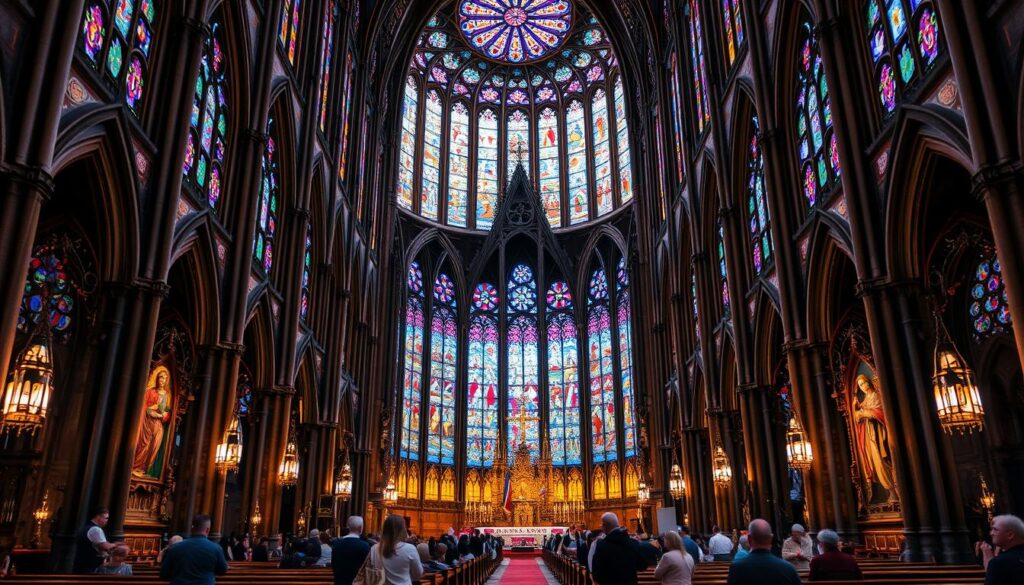
Cultural and Theological Perspectives
The word “Catholic” means universal – a perfect description of its mission. Leaders adapted core teachings to local customs while maintaining essential doctrine. This balancing act allowed the religion to grow without losing its identity.
Three key influences shaped its development:
| Influence Source | Contribution | Lasting Impact |
|---|---|---|
| Greek Philosophy | Frameworks for understanding God and ethics | Systematic theology development |
| Roman Law | Models for church governance | Hierarchical structure |
| Jewish Traditions | Scriptural foundations | Sacraments and liturgy |
Greek thinkers like Plato helped explain complex spiritual concepts. Roman organizational skills built durable institutions. Jewish roots provided continuity with ancient prophecies.
This blend of ideas created a religion that could speak to diverse populations. By honoring multiple traditions, the Catholic Church became both adaptable and enduring – qualities that fueled its worldwide growth.
The Birth of the Early Christian Community
A remarkable transformation reshaped history when a group of uncertain followers became bold pioneers. Fifty days after Easter, their collective faith ignited during an event that would define spiritual communion for centuries.
Pentecost and the Formation of the Church
The Catholic Church marks Pentecost as its explosive beginning. Acts of the Apostles describes windswept flames resting on disciples, granting them multilingual abilities to share teachings across cultures. This gathering birthed the first organized Christian assembly.
Previously hesitant followers suddenly preached confidently in crowded streets. Their message resonated with diverse crowds, creating instant connections. The Holy Spirit‘s arrival transformed private grief into public purpose.
This supernatural experience forged three critical elements:
- Clear methods for preserving Jesus’s original message
- Strategies for expanding beyond Jewish communities
- Standards to identify authentic teachings
Early believers pooled resources, sharing meals and prayers daily. Their radical generosity attracted thousands within weeks. By century’s end, this model reached major Roman cities through traveling missionaries.
The church maintained unity through letters and visits between communities. Shared rituals like baptism created bonds across distances. These practices laid groundwork for today’s global communion of 1.3 billion members.
Evolution of Church Organization and Governance
By the second century, a new system of leadership began taking shape in Christian communities. What started as informal gatherings transformed into an organized institution with clear chains of command. This shift mirrored the Roman Empire’s administrative genius while preserving spiritual priorities.
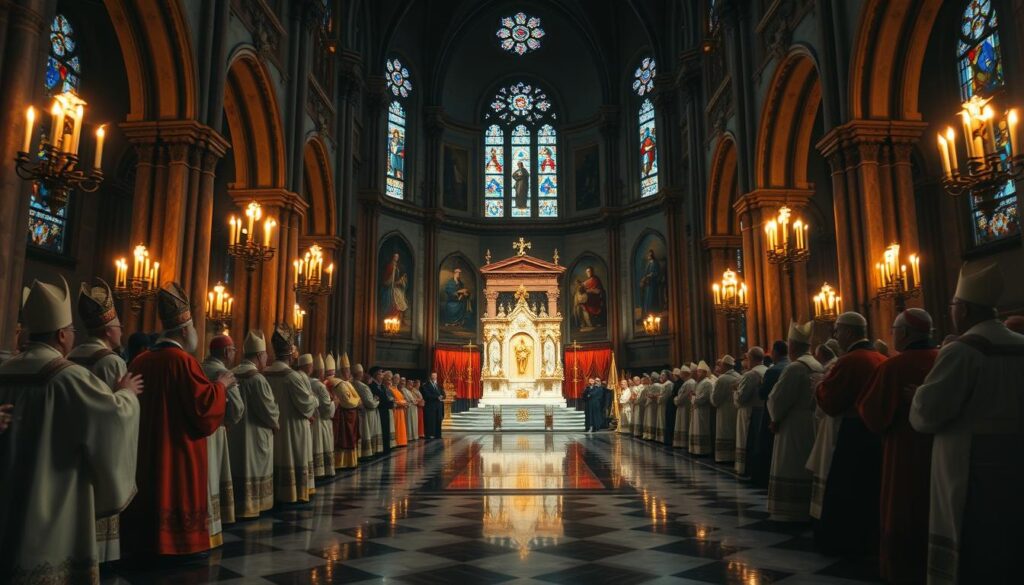
The Emergence of the Bishopric and Papacy
Early believers initially shared leadership among multiple elders. By 150 AD, most communities adopted a single bishop model. These leaders gained authority to resolve disputes and standardize teachings through regional meetings called synods.
Major cities naturally became hubs of influence. Bishops in urban centers like Alexandria and Antioch guided nearby congregations. Catholic historian Eamon Duffy notes:
“Rome’s bishop became the final referee in theological debates by the 200s AD.”
Three factors propelled this change:
- Growing membership requiring efficient administration
- Need for consistent doctrine across regions
- Political ties to imperial infrastructure
The bishop of Rome gradually gained prominence through claims of Peter’s martyrdom there. This authority evolved into the papacy – a unique office combining spiritual guidance and organizational power. By aligning with Roman administrative patterns, the church built stability during turbulent times.
This structured hierarchy allowed Christianity to maintain unity while expanding globally. The system proved durable enough to outlast the empire that helped shape it.
The Impact of the Roman Empire on Early Christianity
Ancient superhighways and common tongues became unexpected allies in faith’s journey. The Roman Empire provided a unique environment where spiritual ideas could travel faster than ever before. Its advanced systems created pathways for belief systems to connect distant communities.
Pax Romana and the Spread of the Faith

Rome’s famous peace period transformed religious expansion. For nearly 200 years, the Pax Romana let missionaries move safely across territories. Soldiers patrolled roads, while shared laws reduced tribal conflicts that once blocked cultural exchange.
Three imperial advantages supercharged the church’s growth:
| Roman Advantage | Impact | Outcome |
|---|---|---|
| Road Network | Enabled rapid missionary travel | 40+ communities by 1st century |
| Common Greek | Unified communication | Consistent teachings |
| Urban Centers | Concentrated audiences | Faster conversions |
| Legal Protections | Allowed assembly rights | Stable congregations |
Coastal cities like Corinth and Ephesus became springboards for new believers. Missionaries used Roman ships to cross the Mediterranean, reaching Jewish diaspora communities first. By 100 AD, these efforts planted churches from Spain to Syria.
The empire’s structure gave the Roman Catholic tradition its early shape. What began as scattered house meetings grew into a world religion, thanks to history’s first multinational system.
Canonical Foundations and Sacred Tradition
Finalizing sacred texts became a defining task for early church leaders. Between the 4th and 5th centuries, councils worked to unify beliefs across growing communities. Their decisions shaped the Catholic Church’s enduring identity.
Scriptural Heritage and Early Creeds
Church councils carefully sorted through countless religious writings. The Council of Rome (382 AD) first listed approved New Testament books we recognize today. This process ensured only texts reflecting apostolic truth became scripture.
Jerome’s Vulgate translation (391 AD) gave Latin-speaking regions a standard Bible. Later, the Council of Carthage (397 AD) confirmed the final canon. These steps prevented conflicting teachings and strengthened doctrinal authority.
Alongside written texts, oral traditions preserved essential practices. The Catholic Church calls this dual foundation “Scripture and Tradition.” Together, they guide worship and belief while honoring ancient roots.
This careful work created stability during turbulent times. Modern believers still use these 4th-century decisions as their spiritual compass. The results show how faith adapts while staying anchored in core doctrine.
FAQ
How did Jesus Christ and the Apostles shape Catholicism?
Catholicism traces its spiritual roots to Jesus Christ, who commissioned His Apostles to spread His teachings. The New Testament documents their mission, and early leaders like Peter—considered the first pope—established communities that evolved into the Roman Catholic Church. Their teachings on sacraments, worship, and authority remain central today.
What is apostolic succession, and why does it matter?
Apostolic succession refers to the unbroken lineage of bishops, starting with the Apostles, who preserve the Church’s teachings. Figures like Ignatius of Antioch emphasized this continuity, ensuring doctrinal unity. This tradition reinforces the authority of the pope and bishops in guiding the Church’s doctrine and governance.
How did the Roman Empire influence early Christianity?
The Pax Romana’s stable infrastructure allowed missionaries to spread the faith across regions. Emperor Constantine’s Edict of Milan (313 CE) legalized Christianity, merging Roman culture with Christian theology. This relationship shaped practices like Christmas and Easter, blending local traditions with Catholic doctrine.
What role did Pentecost play in forming the Church?
Pentecost, described in Acts 2, marks the Holy Spirit’s descent upon the Apostles, empowering them to preach. This event birthed the first Christian community in Jerusalem, establishing shared worship, communal living, and sacraments like baptism. It’s celebrated as the Church’s “birthday.”
When did the papacy become a central authority?
The bishop of Rome (later called the pope) gained prominence by the 4th century, as leaders like Leo I asserted spiritual authority. Claims of Peter’s martyrdom in Rome bolstered the papacy’s role in resolving disputes, defining creeds, and unifying churches under Roman Catholic governance.
How did early creeds and scripture solidify Catholic beliefs?
Councils like Nicaea (325 CE) produced creeds to counter heresies, clarifying beliefs in the Trinity and Christ’s divinity. The Church also canonized the Bible, combining Old Testament texts with New Testament writings. Sacred Tradition, upheld alongside scripture, remains vital to Catholic doctrine under the pope’s guidance.
Why does the Catholic Church venerate saints and Mary?
Early Christians honored martyrs as holy intercessors, a practice that grew into saint veneration. The Virgin Mary’s role as Jesus’ mother earned her titles like “Mother of God” at Ephesus (431 CE). These traditions reflect Catholicism’s emphasis on communion between earthly and heavenly believers.