At 39, after serving 20 years in ministry and raising three sons with my wife Missy in California’s Sierra Nevada foothills, I made a life-changing decision. What began as deep theological study evolved into an unexpected shift in my spiritual path. This wasn’t about emotions or frustration – it started with simple questions about early Christian practices during my Bible teaching sessions.
As someone who dedicated years to Protestant leadership, I never imagined reconsidering foundational beliefs like sola scriptura. Yet the more I examined Church history and Scripture’s relationship with tradition, the clearer the answers became. My blog, A Faith-Full Life, now documents how intentional exploration reshaped my understanding of ancient Christian continuity.
This story isn’t just mine – it reveals how anyone committed to truth can experience transformation. Whether you’re content in your current tradition or curious about other expressions of Christianity, my journey shows how authentic seeking often leads to surprising destinations.
Key Takeaways
- Spiritual shifts can occur through scriptural study rather than emotional triggers
- Church history plays crucial role in understanding Christian continuity
- Leadership experience doesn’t prevent new theological discoveries
- Family life and ministry often intersect with faith evolution
- Documenting personal journeys helps others navigate similar paths
Personal Background and Early Faith Experiences
From my earliest memories, Scripture and prayer shaped our family’s rhythm like daily meals. My parents wove Christian faith into every aspect of our life, treating Bible study as essential as breakfast. This immersion gave me a deep love for God’s Word long before I understood theological debates.
Growing Up in a Christian Home
Our home buzzed with discussions about biblical truths. Mom would say, “Truth isn’t just memorized—it’s lived.” Dad’s well-worn Bible, marked with decades of notes, showed me how Scripture could guide real-world decisions. Their approach made faith feel alive rather than academic.
Initial Encounters With Different Denominations
By age twelve, I’d experienced churches ranging from fire-and-brimstone revivals to quiet liturgical services. One congregation insisted women wear only skirts, while another debated whether dancing was sinful. These extremes taught me two things:
- All Christian communities share core beliefs about Christ
- Human interpretations create endless variations
The contrast between rigid rules and loose theology sparked my first questions about church authority. Why did equally devout groups read the same Bible so differently? This tension would later fuel my search for historical continuity in Christian practice.
Spiritual Questions and Biblical Challenges
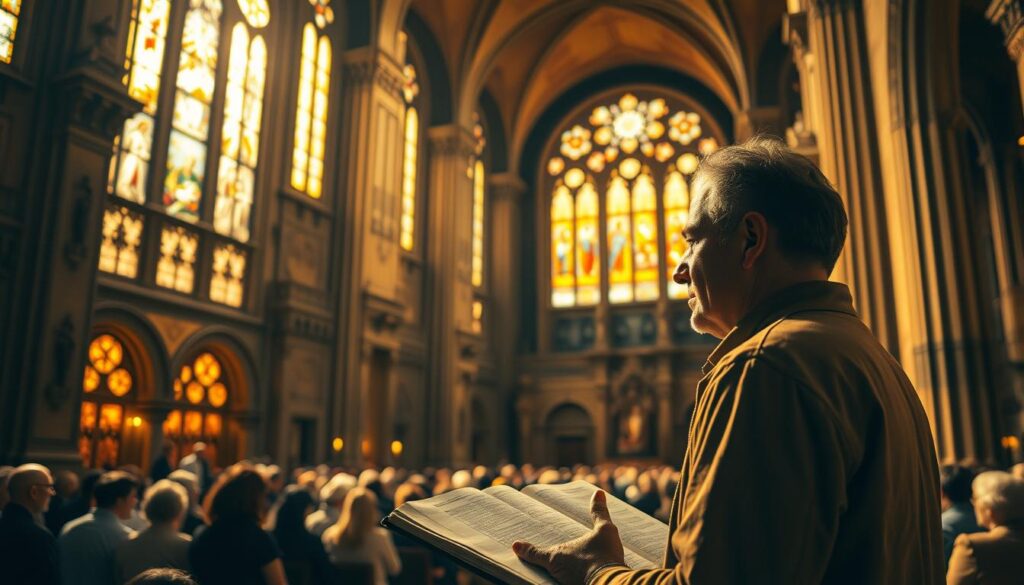
My teenage years sparked a journey of theological inquiry that reshaped my understanding of divine authority. At seventeen, I stumbled upon a puzzle: If Scripture alone guides faith, why doesn’t Scripture explicitly teach this?
Struggles With Sola Scriptura
The Bible-only doctrine felt like building a house without blueprints. I searched Scripture for authority claims but found God speaking through priests, prophets, and living tradition instead. My logical mind rebelled against the circular reasoning: “We know Scripture’s supreme because Scripture says so… somewhere?”
Confusion Over Literal vs. Symbolic Interpretations
Churches I attended disagreed fiercely on baptism, communion, and end-times prophecies – all using the same Bible. One pastor insisted Genesis described six 24-hour days, while another called it symbolic poetry. This table shows how conflicting interpretations created doctrinal chaos:
| Biblical Passage | Literal View | Symbolic View |
|---|---|---|
| John 6:53-54 | Physical eating of Christ’s flesh | Spiritual metaphor for belief |
| Revelation 20:1-6 | Future thousand-year reign | Church age allegory |
| Exodus 20:8-11 | Saturday Sabbath observance | Rest principles for any day |
These questions about interpretation methods made me wonder: If God’s word requires human consensus to understand, where does real truth reside? My search for answers would eventually point toward historical Christian continuity.
Pursuit of Theological Education and Self-Study
Debt forced me out of Bible college, but it couldn’t stop my hunger for divine truth. At nineteen, I enrolled at Western Baptist College – now Corbin College – with dreams of becoming a youth minister. My fiancée and I accumulated $40,000 in debt within a year, a staggering sum that reshaped our priorities overnight. Marriage and bills demanded practical solutions, so I traded classrooms for construction sites.
Yet my theology education didn’t end with dropped courses. Nights became my classroom, with worn paperbacks as professors. I devoured Protestant thinkers like Bonhoeffer and Lewis, comparing their insights during lunch breaks. My father-in-law’s advice stuck: “You can’t buy wisdom – it grows through study and sweat.”
Those years taught me unexpected lessons. Expensive degrees don’t guarantee spiritual depth – time spent wrestling with ideas does. Independent exploration exposed me to diverse viewpoints most seminaries never cover. Without realizing it, I was building mental tools to evaluate ancient Christian claims years later.
This season proved foundational. By treating every book as a dialogue partner rather than dogma, I learned to separate cultural assumptions from timeless truth. The skills honed during those late-night reading sessions would later help me navigate far weightier theology questions with clarity and care.
Experiences in Bible College and Early Ministry
Leading worship services revealed unexpected divides in our shared faith. While preparing communion liturgy one Sunday, a volunteer asked, “Why do we bother with crackers and juice every month?” Their casual attitude shocked me – this meal anchored early Christian life according to Scripture.
My ministry peers often treated the Lord’s Supper as optional symbolism. Yet Jesus’ words in John 6:53-54 gripped me: “Unless you eat the flesh of the Son of Man… you have no life in you.” Churches I served displayed conflicting approaches:
| Scriptural Reference | Common View | Frequency Observed |
|---|---|---|
| John 6:53-58 | Symbolic remembrance | Quarterly observance |
| 1 Corinthians 11:27-29 | Optional ritual | Monthly at best |
| Acts 2:42 | Neglected practice | Rarely emphasized |
These inconsistencies troubled me. If early believers “devoted themselves” to breaking bread (Acts 2:42), why did modern church communities treat it as secondary? My study of early Christian writings revealed startling continuity – second-century believers risked death to celebrate what they called “the medicine of immortality.”
Over time, I noticed a pattern. Churches with strong teaching on Christ’s real presence fostered deeper reverence. Those viewing communion as mere metaphor often struggled with spiritual apathy. This disconnect between ancient practice and modern interpretation would later reshape my understanding of Christian unity.
Reconciling Faith with Intellectual Inquiry
The collision between heartfelt belief and rational inquiry became impossible to ignore. Scripture’s role as ultimate authority felt increasingly unstable – like building on shifting sand. How could the same divine text justify both lifelong celibacy and polygamy among devout followers?

When Biblical Interpretation Creates Chaos
I witnessed sincere believers weaponize verses to validate questionable choices. One friend quoted Proverbs about “diligent hands” to justify 80-hour work weeks that destroyed his marriage. Another cited “judge not” to silence concerns about a pastor’s affair. This table reveals how conflicting applications created spiritual whiplash:
| Life Decision | Supporting Verse | Opposing View |
|---|---|---|
| Divorce | Malachi 2:16 (“God hates divorce”) | 1 Corinthians 7:15 (Unbelievers may depart) |
| Wealth Accumulation | Proverbs 10:22 (“Lord’s blessing enriches”) | Luke 12:33 (“Sell possessions”) |
| Church Leadership | 1 Timothy 3:2 (“Husband of one wife”) | Galatians 3:28 (“No male/female in Christ”) |
These contradictions weren’t academic – they shaped real lives. A woman tearfully confessed she’d remarried because “God told me” through random Bible flipping. Yet her ex-husband claimed the same method confirmed their union was eternal.
My crisis crystallized during a Bible study on Matthew 16:18. When asked who determines correct interpretations, our group leader shrugged: “The Holy Spirit guides each heart differently.” But if that were true, why did Spirit-led conclusions clash so violently?
The search for truth demanded confronting an uncomfortable reality: human reason alone couldn’t untangle Scripture’s complexities. Without an anchor beyond personal opinion, even faith rooted in Christ drifted into subjectivism. This realization would later point me toward ancient solutions for modern dilemmas.
Doctrinal Inconsistencies in Protestant Settings
Navigating church teachings felt like walking through a doctrinal fog. Many congregations I served embraced uncertainty as spiritual virtue, creating communities where core beliefs shifted like sand. A pastor once confessed during staff meeting: “We can’t know anything for sure – that’s why we need faith.” This mindset left members adrift on essential questions about salvation, sacraments, and moral living.
When Humility Becomes Hesitation
Leaders often hid behind doctrine of human limitation to avoid tough stances. I witnessed churches split over baptism methods while shrugging off questions about Christ’s resurrection. The table below shows common areas of confusion:
| Biblical Teaching | Common Response |
|---|---|
| Real presence in communion | “Multiple views are valid” |
| Role of good works | “God’s grace covers uncertainty” |
| End times prophecy | “No one can really know” |
This reluctance to teach with authority created spiritual whiplash. Members craved clear guidance but received endless qualifiers. One elder argued, “Our finite minds can’t grasp divine certainty,” yet this logic made Scripture feel like a puzzle without solutions.
The irony struck me during a youth group debate. Teens asked why their church avoided taking stands on moral issues other denominations addressed boldly. Our leadership team couldn’t agree – we’d become prisoners of our own certainty about uncertainty. This crisis exposed a fatal flaw: when every interpretation holds equal weight, truth becomes whatever the majority decides.
Encountering the Richness of Catholic Tradition
My bookshelf became an unexpected bridge to ancient Christianity. For years, I’d cherished works by C.S. Lewis and Dietrich Bonhoeffer without realizing how deeply their ideas echoed older tradition. Then a friend handed me Thomas Merton’s journals – writings that crackled with spiritual vitality I’d never associated with Catholicism.
Discovering Historical Continuity
Henri Nouwen’s reflections on community shattered my assumptions. Here was a Catholic Church priest articulating truths my Protestant circles rarely discussed. Thomas Aquinas’ systematic theology revealed how early believers wrestled with questions modern churches still face. Merton’s observation struck me: “We are already one. But we imagine we are not.”
Three insights reshaped my perspective:
- Every essential Christian doctrine predates the Reformation
- The early Church Fathers wrote about sacraments with reverence
- Scholars like Augustine shaped Western thought for centuries
Studying history became a treasure hunt. I traced practices like Lent and liturgical prayer through generations of believers. The Catholic Church suddenly appeared less like an institution and more like a living thread connecting Pentecost to the present.
This journey through time showed me something vital. Tradition isn’t about rigid rules – it’s the collective wisdom of millions seeking Christ across millennia. What I’d dismissed as empty ritual turned out to be faith’s backbone, preserved through wars, schisms, and cultural shifts.
Scripture as a Guiding Light for Conversion
The Bible became my compass during this spiritual journey. Like Lois Day, who discovered Catholic truth through relentless New Testament study, I found God’s word guiding me toward unexpected destinations. Years of ministry hadn’t prepared me for how the Holy Spirit would illuminate familiar passages with fresh meaning.
My approach mirrored the Bereans in Acts 17:11 – testing every teaching against Scripture. For the first time, I set aside assumptions about sacraments and church authority. The text began speaking with clarity I’d never experienced, revealing patterns that pointed toward ancient Christian practices.
| Scriptural Focus | Previous Understanding | New Insight |
|---|---|---|
| John 6:54 | Symbolic language | Literal nourishment |
| 1 Timothy 3:15 | Local congregation | Universal Church |
| James 5:14-15 | Prayer ritual | Sacramental healing |
The Holy Spirit transformed my reading experience. Passages about Peter’s authority and Eucharistic meals suddenly aligned with early Christian writings. God’s word ceased being a theological battleground – it became a roadmap showing where truth had always resided.
This conversion journey proved Scripture needs no defense, only faithful exploration. When read through the lens of historic Christianity, the Word of God reveals surprising continuity. What begins as personal study often becomes a divine invitation to deeper unity.
Transitioning from Protestant to Catholic Faith
The journey from one Christian tradition to another unfolded through quiet nights of soul-searching. What began as intellectual curiosity became a spiritual necessity – moments where truth outweighed comfort. Every theological assumption required re-examination under Scripture’s light and history’s lens.
Critical Moments of Reflection
One midnight study session changed everything. Reading Ignatius of Antioch’s letters, written just decades after Christ’s resurrection, I realized how early believers viewed communion. Their reverence contrasted sharply with modern casual approaches. Faith demanded asking hard questions: Had my community preserved or diluted apostolic teachings?
Three turning points clarified my path:
- Discovering unanimous early Church support for Christ’s real presence
- Recognizing how sola scriptura created doctrinal divisions
- Seeing sacraments as divine encounters rather than symbols
Each revelation required time to process. Letting go of familiar practices felt like losing spiritual family. Yet peace grew as I understood this wasn’t abandonment – it was returning to roots deeper than the Reformation.
The final hurdle involved relationships. Explaining this conversion to loved ones tested my courage. But truth, once seen, can’t be unseen. What began as personal study became a bridge to unity I’d always prayed for.
My Path from protestant to catholic
The final steps of this journey revealed truth’s timeless nature. Like many converts from Protestant backgrounds, I discovered historical Christian continuity answers modern questions. My study of early Church writings became a bridge connecting Scripture with lived faith across centuries.
Key Doctrinal Revelations
Three insights transformed my perspective. First, the body of believers preserved essential teachings long before denominational splits. Second, sacraments emerged not as later additions but as Christ’s direct gifts. Finally, Catholic teaching on authority resolved endless interpretation debates that once troubled me.
An Evolving Understanding of the Eucharist
Communion became the heart of worship rather than symbolic footnote. Early Christians risked persecution for this sacred meal they called “the medicine of immortality.” Modern practices preserving this reverence helped me see communion as divine encounter rather than ritual obligation.
This path taught me that truth withstands time’s test. What began as personal seeking became a homecoming to faith’s ancient foundations. For fellow travelers, remember: questions often lead us where answers live.
FAQ
How does Catholic tradition differ from Protestant views on scripture?
The Catholic Church teaches that Sacred Tradition and Scripture form a single sacred deposit of faith. This contrasts with some Protestant traditions that prioritize sola scriptura (Scripture alone), which can lead to varied interpretations without historical continuity.
What drew you to the Eucharist in Catholic theology?
The understanding of Christ’s Real Presence in the Eucharist became pivotal. Unlike symbolic views common in many Protestant communities, Catholic teaching emphasizes Christ’s true body and blood, rooted in ancient Christian witness and biblical accounts like John 6.
How did church authority influence your decision?
Protestantism’s decentralized structure often creates doctrinal inconsistencies. The Catholic Church’s unified teaching authority, tracing back to apostolic succession, provided clarity on moral and theological matters that private interpretation couldn’t resolve.
Did historical Christianity play a role in your conversion?
Absolutely. Studying early Church Fathers like Ignatius of Antioch and Augustine revealed a continuity of practice—including sacraments and hierarchy—that aligned more closely with Catholicism than modern Protestant movements.
How did intellectual struggles shape your journey?
Wrestling with apparent scriptural contradictions in Protestant frameworks led to deeper study. Catholic theology’s integration of faith and reason, along with its rich philosophical tradition, offered cohesive answers to complex questions about grace and salvation.
What surprised you most about Catholic worship?
The liturgical depth stood out—sacraments, sacred art, and communal prayers created a tangible connection to centuries of believers. This contrasted with more individualistic worship styles I’d previously experienced.
How does Mary’s role affect Catholic-Protestant differences?
While initially challenging, understanding Mary as Mother of the Church deepened my appreciation for communion of saints. This teaching, supported by early Christian devotion, reflects the Church’s holistic view of Christ’s redemptive work.