For over two thousand years, the Catholic Church has shaped cultures, inspired art, and guided millions in their spiritual journeys. As the largest Christian denomination, it unites 1.4 billion followers across the world, blending ancient traditions with modern practices. This global community spans every continent, from bustling cities to remote villages, united by shared beliefs and rituals.
Rooted in the teachings of Jesus Christ, the Catholic Church maintains a unique structure of 24 self-governing branches. These include the well-known Latin Church and 23 Eastern Catholic traditions, each preserving distinct customs while upholding core doctrines. From sacraments like baptism to weekly Mass, these practices create a vibrant tapestry of faith that adapts to local cultures without losing its essence.
History buffs will appreciate how this religion influenced law, education, and social justice movements. The Church’s growth from a small group of believers to a worldwide institution reveals its enduring relevance. Today, parishes and dioceses work closely with the Vatican, ensuring unity amid diversity.
Key Takeaways
- The Catholic Church serves 1.4 billion members globally, making it the largest Christian denomination
- Its history spans two millennia, deeply influencing Western civilization and beyond
- 24 autonomous branches operate under shared core beliefs and practices
- Sacraments and traditions remain central to Catholic spiritual life worldwide
- Local communities adapt teachings to cultural contexts while maintaining unity
Introduction to Catholicism
What makes a faith truly universal? The answer lies in the term “Catholic” itself, born from the Greek word katholikos meaning “whole” or “for all.” This idea of spiritual unity took shape in 110 AD when Bishop Ignatius of Antioch first used the term, declaring:
“Wherever Jesus Christ is, there is the Catholic Church.”
Defining Catholic Identity
Being Catholic means belonging to a 2,000-year-old family spanning continents. Members share seven sacraments, pray the Nicene Creed, and see the Pope as Saint Peter’s successor. Unlike other Christian groups, they blend Bible teachings with Sacred Tradition – wisdom passed down through generations.
| Core Identity Markers | Unique Features | Global Impact |
|---|---|---|
| Apostolic leadership | 24 distinct traditions | 1.4 billion members |
| Seven sacraments | Scripture + Tradition | 3,000+ dioceses |
| Social justice focus | Latin & Eastern rites | 140+ countries |
Today’s Catholic identity mixes ancient rituals with modern life. Parishes host food drives while preserving Mass traditions. Young members learn catechism through apps, proving faith adapts without losing its soul.
Foundations of Faith and Belief
What binds over a billion people across 2,000 years and countless cultures? The answer lies in the Catholic Church‘s core teachings, perfectly captured in the Nicene Creed. This ancient statement of faith declares belief in the Trinity, Jesus’ resurrection, and the Church’s lasting mission.
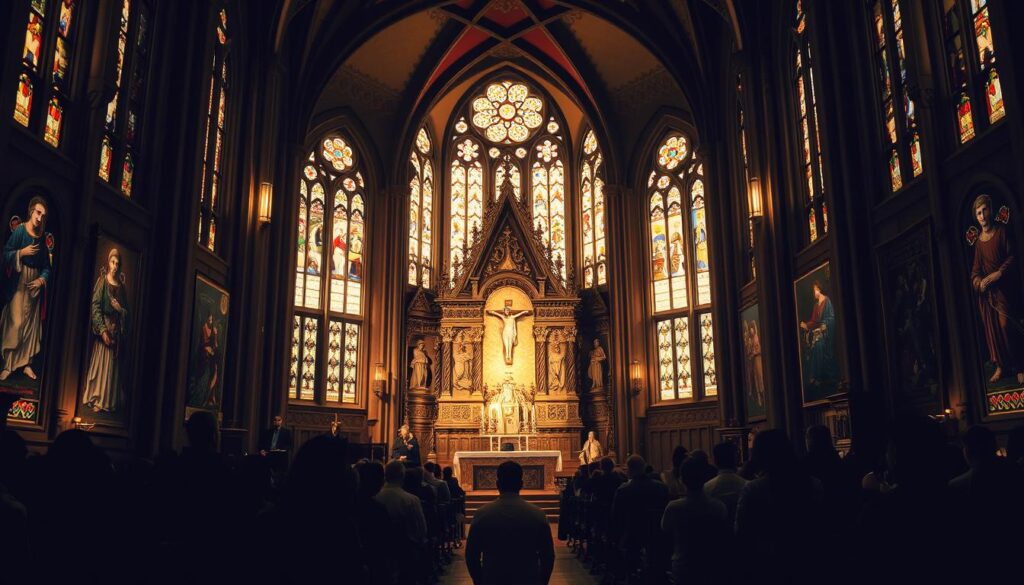
At its heart, the Catholic Church teaches that Jesus Christ is fully divine and fully human. This mystery of God becoming man forms the bedrock of worship and ethics. Believers see salvation as a gift received through sacraments like Baptism, which cleanses original sin, and the Eucharist, celebrated at every Mass.
Three pillars uphold these beliefs:
- Scripture and Tradition: The Bible works alongside sacred practices passed down through generations
- Magisterium: Bishops and Pope guide interpretation as successors to Christ’s apostles
- Faith in action: Good works and prayer fuel spiritual growth
The Catholic Church uniquely balances divine grace with human effort. While Protestants emphasize faith alone, Catholics believe grace transforms lives through both belief and service. This shapes everything from charity work to personal prayer habits.
Mary’s role highlights this blend of heaven and earth. Doctrines about her sinless conception and heavenly assumption show how the Catholic Church honors holy examples. These teachings connect modern believers to a living chain of saints across centuries.
Through its clergy and rituals, the Catholic Church makes ancient truths feel fresh daily. Whether lighting candles or serving neighbors, members live out a faith that’s both timeless and urgently present.
Catholicism in Historical Context
How did a small group of believers become a global spiritual force? The Catholic Church‘s story unfolds through pivotal moments that shaped both religion and world history. From underground meetings to grand cathedrals, each era brought new challenges and adaptations.
Key Timeline Events
Early Christians faced Roman persecution until Emperor Constantine changed everything. His 313 Edict of Milan granted religious freedom, and by 380, Christianity became Rome’s official faith. This shift transformed the church from rebel movement to cultural cornerstone.
| Event | Year | Impact |
|---|---|---|
| Pentecost | 33 AD | Birth of Christian ministry |
| Edict of Milan | 313 | Legalized Christianity |
| Great Schism | 1054 | Split Eastern/Western churches |
| Protestant Reformation | 1517 | Sparked Counter-Reformation |
The medieval period saw the Catholic Church build Europe’s first universities. Monks preserved ancient texts while artists created stunning religious works. By the 11th century, disagreements over authority caused the East-West split.
When Martin Luther nailed his 95 Theses in 1517, the church faced its biggest crisis. The Council of Trent (1545-1563) answered with reforms, clarifying doctrines and improving clergy education. These changes kept the Catholic Church relevant through turbulent times.
Today’s traditions blend original practices with modern insights. The Second Vatican Council (1962-1965) opened windows to contemporary issues while keeping core beliefs intact. This balance helps the faith thrive across cultures and centuries.
The Roman Catholic Church: Structure and Legacy
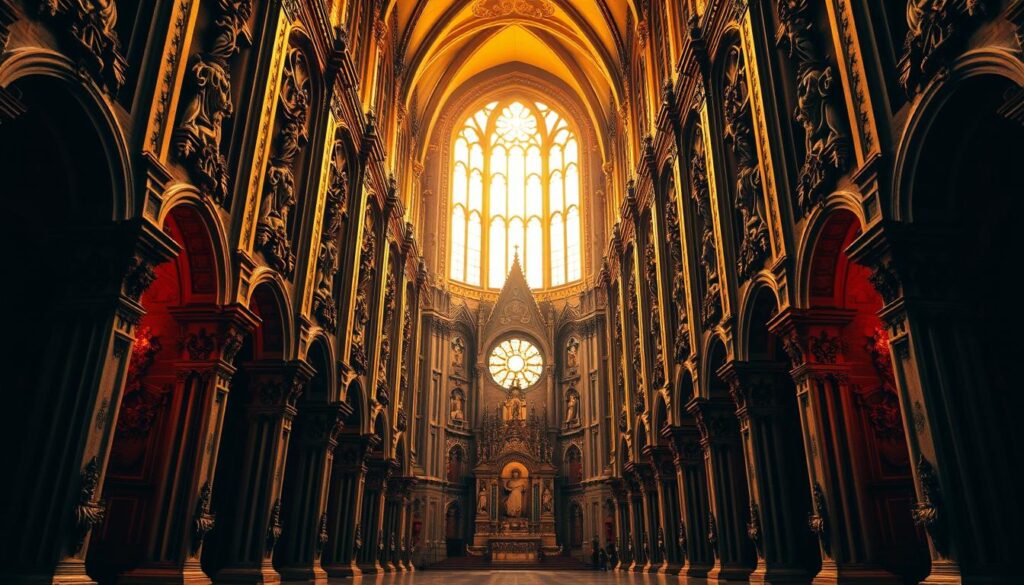
With over 3,500 dioceses worldwide, the Catholic Church operates like a well-oiled spiritual machine. Its 24 self-governing branches – one Latin and 23 Eastern – form a unique network balancing unity with cultural diversity. Each diocese, led by bishops as apostolic successors, functions as a local hub for worship and community support.
The Pope sits at the helm of this global organization, guiding 1.4 billion members through shared beliefs while respecting regional traditions. This structure allows Ukrainian Greek Catholics to celebrate divine liturgy in their style, while Nigerian Latin-rite parishes use drums in Mass. The system’s flexibility explains its endurance across two millennia.
| Church Type | Members | Key Features |
|---|---|---|
| Latin Church | 1.3 billion | Western liturgical traditions |
| Eastern Churches | 18 million | Byzantine & Oriental rites |
| Global Dioceses | 3,500 units | Local leadership by bishops |
Over 5,400 bishops and 400,000 priests keep this vast network running. They oversee parishes, schools, and hospitals – the church operates 140,000+ schools globally. This infrastructure makes it the world’s largest non-government provider of education and healthcare.
The Roman Catholic Church’s legacy shines through its lasting cultural impacts. From medieval universities to modern social justice movements, its institutions have shaped societies while maintaining spiritual focus. Today’s deacons and lay ministers continue this mission, proving ancient structures can meet modern needs.
Papacy and Leadership in Catholicism
Who holds the keys to spiritual authority for 1.4 billion believers? The answer lies in the Bishop of Rome, a role tracing back to Jesus’ words in Matthew’s Gospel:
“You are Peter, and on this rock I will build my church.”
The Role of the Bishop of Rome
The Pope serves as both spiritual guide and organizational head of the Roman Catholic Church. Unlike other Christian leaders, he claims direct succession from Saint Peter – the apostle entrusted with shepherding Christ’s followers. This unique position blends ancient tradition with modern global leadership.
Three key powers define the papacy:
- Appointing bishops worldwide to maintain doctrinal unity
- Settling disputes about faith through infallible pronouncements
- Guiding the clergy in addressing contemporary moral questions
The First Vatican Council (1870) cemented papal authority, declaring the Pope’s rulings on faith irreformable. Yet this power isn’t unlimited – it activates only when speaking officially (ex cathedra) on matters of belief.
Beyond spiritual duties, the Pope governs Vatican City and directs the Catholic Church‘s vast network. Cardinals assist him like an ancient senate, preserving continuity through centuries of change. This balance of sacred tradition and practical governance keeps the institution anchored yet adaptable.
Theology and Doctrinal Development
How does a global community maintain consistent beliefs across centuries? The Catholic Church answers through dynamic theological growth rooted in ancient truths. Its teachings evolve like a river – flowing forward while staying connected to the source.
At the heart of this system lies the Magisterium, the Church’s teaching authority. This living guide interprets Scripture and tradition to address modern questions. Early councils shaped core ideas like the Trinity, while medieval scholars explored Christ’s divine-human nature.
| Theological Concept | Development Period | Key Impact |
|---|---|---|
| Trinitarian Doctrine | 4th-5th centuries | Defined God’s threefold nature |
| Sacramental Theology | Middle Ages | Explained grace through rituals |
| Social Teachings | 19th-21st centuries | Addressed labor rights, ecology |
The Second Vatican Council (1962-1965) revolutionized Catholic Church approaches. It encouraged dialogue with other groups and updated worship practices. Today’s theologians tackle AI ethics and climate change while staying grounded in 2,000-year-old principles.
Diverse schools of thought enrich this tradition. Franciscans emphasize creation’s beauty, while Thomists use logic to explore faith. The Catechism distills these ideas into clear teaching, helping ordinary believers grasp complex theology.
Liturgy, Sacraments, and Worship Practices
Every Sunday, millions gather for a sacred meal that forms the core of their faith. The Catholic Church structures spiritual life through seven sacraments – visible encounters with divine grace. These rituals mark life’s key moments, from cradle to grave, connecting believers across generations.
The Eucharist and Mass
At Mass, ordinary bread and wine become holy communion through priests‘ consecration. This moment of transubstantiation – when elements transform into Christ’s body and blood – forms Christianity’s most ancient ritual. The service blends Scripture readings with sacramental action, creating a two-part rhythm:
- Liturgy of the Word: Bible passages and teachings
- Liturgy of the Eucharist: Offering and sharing communion
Participants leave nourished both spiritually and communally. Over 75% of U.S. Catholics call this practice essential to their faith journey.
Understanding Other Sacraments
Six additional rites complete the Catholic Church‘s sacramental system. Each serves as a doorway to grace at critical life stages:
| Sacrament | Purpose | Minister |
|---|---|---|
| Baptism | Spiritual rebirth | Priest/deacon |
| Confirmation | Strengthening faith | Bishop |
| Matrimony | Sacred union | Couple |
Priests administer most sacraments, though marriage requires couples’ mutual consent. Seasonal observances like Lent and Advent frame the year, while personal devotions like rosary prayers add depth to communal worship.
Tradition, Scripture, and the Role of Sacred Texts
How do ancient writings stay relevant in a modern world? The Catholic Church answers through a dynamic dance between scripture and lived experience. Sacred texts like the Bible work hand-in-hand with oral teachings passed down through generations.
The Church views scripture as “God’s word in human language,” while tradition preserves how believers use these truths daily. This dual approach appears in Vatican II’s Dei Verbum, which states:
“Sacred tradition and scripture form one sacred deposit of the word of God.”
Sacred tradition in the Catholic Church includes practices like the rosary and liturgical rites. These complement biblical teachings, creating a full spiritual toolkit. Early Christian letters of apostles show this blend – written guidance paired with community customs.
This living approach helps the Catholic Church address new questions without losing roots. Modern believers use apps for Bible study while keeping candlelit vigils. The Catechism organizes these elements, making ancient wisdom accessible today.
Through careful use of letters, rituals, and teachings, the faith remains both timeless and timely. It’s how a first-century fisherman’s words still guide skyscraper-dwelling souls in 2024.
FAQ
What defines someone as Catholic?
A Catholic identifies with the teachings, sacraments, and authority of the Roman Catholic Church. Central to this identity are beliefs in the Trinity, the resurrection of Jesus, and the leadership of the Pope as the successor of Saint Peter.
How does the Pope influence Catholic practices?
The Pope, as Bishop of Rome and head of the Church, guides doctrine, appoints bishops, and serves as a spiritual leader. His role includes interpreting sacred tradition and fostering unity among Catholics worldwide.
What are the seven sacraments?
Baptism, Confirmation, Eucharist, Reconciliation, Anointing of the Sick, Holy Orders, and Matrimony. These rituals mark key spiritual moments, emphasizing grace and connection to God’s presence in daily life.
How does Catholicism differ from Protestant Christianity?
Key differences include the authority of the Pope, the veneration of Mary and saints, and the belief in transubstantiation during Mass. Catholics also emphasize tradition alongside scripture in shaping doctrine.
What is the significance of the Mass?
The Mass commemorates Jesus’ Last Supper, where the Eucharist—considered the body and blood of Christ—is central. It unites worshippers in prayer, reflection, and communal celebration of faith.
Why is Vatican City important to Catholics?
Vatican City is the spiritual and administrative center of the Roman Catholic Church. It houses the Pope, major basilicas like St. Peter’s, and serves as a symbol of the Church’s global mission and history.
How does Catholic teaching address social issues?
The Church advocates for human dignity, care for the poor, and peace, guided by documents like papal encyclicals. Its teachings often blend moral theology with calls for justice and compassion in society.
What role do saints play in Catholic tradition?
Saints are seen as holy examples and intercessors. Catholics honor them through feast days, prayers, and devotions, believing they offer guidance and support in spiritual journeys.