Recent Posts

Lutheran Urgent Care: Quality Healthcare When You Need It


When minor illnesses or injuries disrupt your day, reliable medical help shouldn’t require long waits or high costs. Facilities like those in Colorado and Wisconsin offer convenient healthcare solutions for non-life-threatening issues. With evening and weekend availability, these centers ensure you get timely support without the stress of emergency room visits.

Many locations operate extended hours, including holidays, to accommodate busy schedules. Whether it’s a sprained ankle, flu symptoms, or a minor burn, trained professionals provide efficient evaluations. Their services bridge the gap between primary care appointments and critical emergencies, prioritizing your well-being when every minute counts.

It’s important to know when to visit these clinics versus heading to emergency services. For severe chest pain, major injuries, or difficulty breathing, always call 911 immediately. But for issues like ear infections or mild allergic reactions, these centers deliver cost-effective care with shorter wait times. They also follow strict safety protocols to protect patients and staff.

Key Takeaways

  • Extended hours at multiple locations make healthcare accessible outside traditional office times
  • Treatment focuses on non-life-threatening conditions like minor injuries and common illnesses
  • Visits typically cost less and take less time than emergency room alternatives
  • Strict safety measures ensure a clean, secure environment for all patients
  • Always seek emergency services for severe or potentially critical health concerns

Service Overview and Benefits

Finding quality medical help quickly can make all the difference when health issues arise. Our directory simplifies access to trusted facilities focused on non-emergency needs. These centers combine expertise with convenience, offering same-day support for families and individuals alike.

Introducing Our Trusted Urgent Care Directory

The directory features certified specialists trained in pediatric and adult care. For example, the Colorado center serves families across six communities with weekday appointments. Their team holds advanced certifications to treat everyone from infants to teens.

Extended hours and walk-in availability mean no waiting weeks for a doctor’s visit. Services range from diagnostic tests to minor procedures – all delivered in welcoming environments. Every location meets strict standards for cleanliness and patient safety.

Who Benefits from Our Services

Parents appreciate clinics designed for children’s unique needs. Professionals value quick visits that fit around work commitments. Older adults get help managing chronic conditions without hospital trips.

Travelers also benefit from clinics accepting most insurance plans. Whether it’s a sudden fever or a sprained wrist, these centers provide personalized attention when you need it most. Their goal? To keep communities healthy through accessible, compassionate care.

lutheran urgent care Locations & Hours

a detailed map of urgent care locations with clear directions, displayed on a large digital screen in a modern, well-lit medical facility lobby. The map is prominently featured, taking up the majority of the screen. The locations are marked with distinct icons and labels, making it easy to quickly identify each urgent care site. The background is clean and minimalist, with a soft, warm lighting that creates a calming, professional atmosphere. The overall composition is balanced and visually appealing, drawing the viewer's attention to the critical information being presented.

Quick access to medical services starts with knowing where to go and when facilities are open. Two primary centers serve patients in Colorado and Wisconsin, offering streamlined navigation for time-sensitive needs.

Finding Your Nearest Facility

The Wheat Ridge center sits west of Wadsworth Boulevard and 32nd Avenue. Visitors enter via Lutheran Parkway, following signs to the Medical Pavilion’s second floor. Free parking eliminates stress for families managing unexpected health concerns.

In Onalaska, find comprehensive services at 3111 Gundersen Drive. This campus combines urgent treatment with specialty clinics, creating a one-stop healthcare hub. Clear signage guides patients from the main road to available parking spots.

Flexible Scheduling Options

Both locations operate daily from 7:00 AM to 10:00 PM, accommodating early-morning rushes and late-night emergencies. Walk-ins welcome most patients, though calling (608) 782-7300 in Wisconsin helps gauge current wait times.

Special Occasion Adjustments

Holiday hours balance staff availability with community needs:

  • Thanksgiving & Christmas: Morning-only services
  • National holidays: Modified 7:00 AM-3:00 PM schedules
  • New Year’s Eve: Early closure at 5:00 PM

These adjustments ensure continuous care during festive seasons when accidents often occur.

Patient Services and Safety Measures

Safety and transparency guide every aspect of our medical services. We prioritize creating environments where individuals feel protected while receiving quality support for their health needs.

Visitor Procedures and Safety Protocols

All facilities maintain strict entry guidelines to protect everyone. Visitors complete health screenings and follow mask policies based on current recommendations. These steps help reduce infection risks while keeping treatment areas accessible.

Staff members clean exam rooms between appointments using hospital-grade disinfectants. Clear signage reminds guests about hand hygiene and social distancing practices. These efforts ensure a secure space for those receiving care.

Insurance Coverage and Payment Options

Most major insurance plans are accepted, including Medicare and Medicaid. Our team recommends confirming coverage details with your provider before your visit. Transparent pricing helps avoid surprises – ask about self-pay discounts or payment plans if needed.

On-site lab work and X-rays save time for busy patients. Diagnostic services operate during extended hours, with weekend availability for urgent cases. Referrals streamline access to specialists when further evaluation is necessary.

Navigating Immediate Care and Emergency Options

Knowing where to seek help during a health scare can save time and stress. Let’s explore how to choose between walk-in services and emergency departments based on your needs.

A well-lit, welcoming COVID testing walk-in clinic, with a modern, minimalist design. The entrance features a large glass door, allowing natural light to flood the space. In the foreground, a reception desk with a friendly staff member, ready to assist patients. The middle ground showcases an orderly queue of individuals waiting to be tested, maintaining social distance. The background reveals private testing rooms, with medical professionals in PPE performing tests efficiently. The overall atmosphere conveys a sense of professionalism, care, and safety, mirroring the values of the healthcare provider.

When Immediate Care Makes Sense

Minor health issues like sprains, fevers, or cuts often don’t require emergency rooms. These facilities handle:

  • Seasonal allergies and rashes
  • Broken fingers or twisted ankles
  • Ear infections and sore throats

X-rays and lab tests are available on-site for quick diagnoses. Staff can stitch minor wounds or prescribe medications during your visit.

COVID Testing Made Simple

Walk-in clinics offer testing for both symptomatic and asymptomatic cases. Those with coughs or fevers receive same-day evaluations before testing. Need results for travel? Schedule appointments through LiveWell for faster processing.

Test results appear in your LiveWell account within 48 hours. This system helps families plan trips or return to work confidently.

Recognizing True Emergencies

Head straight to emergency services for:

  • Chest pain lasting more than 2 minutes
  • Sudden numbness or confusion
  • Uncontrolled bleeding or head injuries

When in doubt, call 911. Paramedics can assess situations en route to hospitals, providing critical interventions during transport.

Conclusion

Access to quality healthcare shouldn’t depend on rigid schedules or complicated logistics. Facilities across multiple states now offer same-day solutions for everyday health needs, operating seven days a week with evening availability. This flexibility helps working parents, busy professionals, and travelers alike.

Choosing these clinics for minor injuries or illnesses can save families time and money compared to emergency rooms. Clear directions and ample parking make visits stress-free, while transparent pricing keeps budgets predictable. Many locations also provide lab tests and X-rays during extended hours.

Safety remains a top priority, with thorough cleaning protocols and insurance-friendly payment options. Staff members focus on creating welcoming environments where patients feel heard. However, always head to emergency departments for chest pain, severe bleeding, or sudden confusion.

With smart planning and awareness of your healthcare options, you can address minor concerns efficiently while reserving hospitals for critical needs. Trusted clinics stand ready to support your well-being – no appointment required.

FAQ

Where can I find Lutheran urgent care clinics near me?

Our clinics are conveniently located across multiple neighborhoods. Use our online directory to search by zip code, view real-time wait periods, and get step-by-step directions to your nearest facility.

What services do your clinics offer for non-emergency needs?

We treat common illnesses, minor injuries, and provide physicals, vaccinations, and lab work. Our team handles everything from sprains and infections to flu symptoms and allergy relief.

Are walk-in appointments available, or do I need to schedule ahead?

Walk-ins are welcome! You can also check in online to reduce wait times. Same-day visits are prioritized to address your concerns quickly.

How does urgent care differ from emergency room visits?

Immediate care is ideal for conditions like fevers, cuts, or minor fractures. For life-threatening issues (chest pain, severe burns), head directly to an ER. We’ll guide you if unsure.

Do you accept insurance plans or offer payment options?

Yes! We work with most major insurers. Self-pay options and transparent pricing are available for those without coverage. Contact us beforehand to verify your plan.

What safety measures are in place for patients and visitors?

Mask requirements, sanitized spaces, and distanced waiting areas are standard. We follow CDC guidelines to protect everyone—check our website for current protocols before arriving.

Can I get COVID-19 testing at your clinics?

Absolutely. Rapid antigen and PCR tests are offered daily. Walk-ins are accepted, though pre-registering online speeds up the process.

Are your facilities open during holidays or outside standard hours?

Select locations stay open on holidays with adjusted hours. Visit our “Special Hours” page or call ahead to confirm availability during these times.

Understanding the Fundamental Tenets of Lutheranism


With over 77 million followers worldwide, this Protestant denomination traces its roots to 16th-century reforms led by Martin Luther. A monk-turned-reformer, Luther challenged certain church practices while emphasizing a return to biblical teachings. His ideas sparked a movement that reshaped Christianity’s landscape.

At its heart, this tradition focuses on three pillars: Scripture as the ultimate guide, salvation through faith, and God’s unearned favor. Unlike some Christian groups, Lutherans teach that divine grace – not human effort – determines one’s spiritual standing. This understanding shapes how believers approach worship and daily life.

You’ll notice unique perspectives on sacraments like baptism and communion. While honoring the Trinity and Christ’s divinity, Lutheran theology interprets these rituals through the lens of God’s promises. Good works matter, but they’re seen as responses to grace rather than requirements for salvation.

Key Takeaways

  • Originated from Martin Luther’s 16th-century reforms
  • Prioritizes Scripture over human traditions
  • Teaches salvation through faith in Christ alone
  • Emphasizes God’s grace as unmerited gift
  • Maintains traditional Christian views of the Trinity
  • Interprets sacraments as visible expressions of faith

Historical Roots of Lutheranism

October 31, 1517, marks a pivotal moment when theological debate reshaped Europe’s spiritual landscape. A German monk’s bold critique of religious practices ignited changes that still influence Christian denominations today.

Martin Luther and the 95 Theses

Martin Luther, a former Roman Catholic friar, grew troubled by the sale of indulgences – payments claimed to reduce punishment for sins. His 95 arguments, nailed to Wittenberg’s Castle Church door, questioned the Catholic Church’s authority. Luther aimed to spark dialogue, not create division.

The Reformation Movement and Early Confessions

By 1529, German leaders at the Diet of Speyer protested restrictions on reform efforts – birthing the term “Protestant.” Luther collaborated with scholars and rulers to draft foundational texts like the Augsburg Confession. These documents clarified differences with Rome while preserving core Christian teachings.

Event Date Impact
95 Theses Posted 1517 Challenged church authority
Diet of Speyer 1529 Formalized Protestant identity
Augsburg Confession 1530 Defined theological positions

This period saw ordinary people gain access to Scripture in their native language. Local leaders helped spread Reformation ideas, proving faith discussions could transform societies over time.

Lutheranism Core Beliefs

At the heart of these teachings lies a revolutionary view of divine mercy. This approach transforms how people understand their standing before God, focusing on what’s given rather than what’s earned.

Justification by Grace Through Faith

Imagine being declared innocent in court without presenting evidence. That’s how justification works here – God views believers as righteous through their trust in Jesus Christ. This legal act happens instantly, not gradually.

Human efforts play no role. As one reformer noted, “We contribute nothing but our need.” The Holy Spirit creates this faith, making it a gift rather than a personal achievement.

Salvation as a Divine Gift

Many faith traditions compare salvation to climbing a ladder. Here, it’s more like catching a life preserver. Grace does all the heavy lifting, with people simply receiving what’s offered.

This brings deep comfort. Followers find peace knowing their spiritual security rests on Christ’s perfection, not their fluctuating devotion. Even during struggles, their status remains unchanged.

Unlike systems requiring constant self-improvement, this view celebrates God’s completed work. Good deeds flow naturally from gratitude rather than obligation – like children sharing toys because they feel loved, not to earn approval.

Foundations of Lutheran Theology

Like three pillars holding up a grand cathedral, Lutheran theology stands firm on principles that transformed Christian thought. These ideas answer life’s biggest questions: Where do we find truth? How do we connect with God? Let’s explore the framework shaping this tradition.

A serene, contemplative scene depicting the three solas of Lutheran theology - Sola Scriptura, Sola Gratia, and Sola Fide. In the foreground, an open Bible lies on a simple wooden lectern, its pages gently fluttering. Soft, warm lighting casts a gentle glow, creating an atmosphere of reverence and spiritual contemplation. In the middle ground, three candles - representing the three solas - flicker, their flames casting dancing shadows on the walls. The background is a tranquil, minimalist space, with muted tones and clean lines, allowing the central elements to take center stage. The overall composition conveys the foundational principles of Lutheranism - a focus on scripture, grace, and faith alone.

The Three Solas: Sola Scriptura, Sola Fide, Sola Gratia

Sola Scriptura places the Bible above human traditions. Luther called Scripture “the cradle where Christ lies” – the ultimate authority revealing God’s plan. Every teaching gets tested against this living word.

Sola Fide centers on trust, not checklists. Imagine friendship built on loyalty rather than favors – that’s faith alone in action. It’s embracing Christ’s work as complete, not scrambling to earn approval.

Sola Gratia flips achievement culture upside down. God’s grace arrives like surprise birthday gifts – unearned and undeserved. As one hymn puts it: “Nothing in my hand I bring, simply to Thy cross I cling.”

Sacraments as Means of Grace

Water, bread, and wine become divine delivery systems. Through baptism and communion, sacraments become means grace – tangible ways God keeps promises. It’s like getting love letters you can touch and taste.

These practices aren’t magic tricks. They combine physical elements with Christ’s word, creating moments where heaven meets earth. The focus stays on receiving rather than achieving – a perfect echo of God’s grace.

Lutheran Worship and Sacramental Practices

Sunday mornings in these congregations feel like opening a treasure chest – ordinary elements reveal extraordinary gifts. Physical objects become channels for divine connection, blending ancient traditions with personal faith experiences.

Baptism: Entry into the Faith

Water splashes mark spiritual rebirth rather than simple rituals. Lutherans view Baptism as God’s initiation ceremony – His promise working through H2O. Even infants receive this gift, trusting that faith grows like seeds in fertile soil.

This practice echoes Luther’s analogy: “A baby eats before understanding nutrition.” The sacrament’s power comes from Christ’s command, not human readiness. Through water and Word, forgiveness washes over believers of all ages.

The Lord’s Supper: Celebrating the Real Presence

Communion tables become encounter zones where bread and wine host mysteries. Unlike symbolic memorials or magical transformations, Lutherans teach Christ’s presence coexists with earthly elements. “In, with, and under” describes this sacred partnership.

Churches often practice closed communion, not to exclude but to protect. As one pastor explains: “We guard the meal like family recipes – not secret, but special.” Participants unite through shared understanding of the Lord’s Supper’s depth.

These practices anchor worship in tangible grace. Whether feeling water’s drip or tasting bread and wine, worshippers touch promises older than cathedrals yet fresh as morning dew.

The Significance of Sola Scriptura

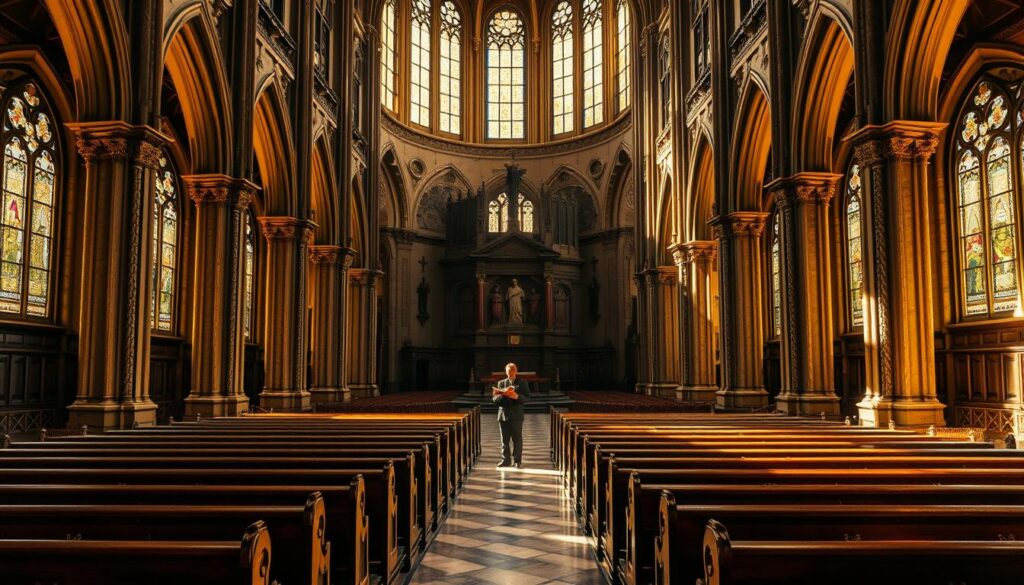
Imagine building a house where every wall aligns with an architect’s blueprint. That’s how Sola Scriptura shapes this tradition – treating the Bible as the authority guiding every spiritual decision. Unlike systems relying on human wisdom, this principle makes God’s word the final judge for doctrines and daily living.

A grand cathedral's interior, illuminated by warm, golden light filtering through stained glass windows. In the center, a lone figure stands at a podium, an open book in hand, symbolizing the authority and primacy of Scripture. Ornate wooden pews stretch out before the pulpit, casting long shadows across the marble floors. The architecture features soaring arches and intricate carvings, evoking a sense of reverence and solemnity. The scene conveys the profound importance of Sola Scriptura, the fundamental Lutheran principle that the Bible alone is the ultimate source of spiritual authority.

Bible as the Ultimate Authority

Scripture acts like a compass in stormy seas. Lutherans see it containing everything needed for salvation and Christian growth. As one reformer declared: “The Bible is the cradle where Christ is laid.” This view empowers believers to engage directly with divine truth.

Church traditions hold value only when they mirror biblical teachings. Think of it like sorting family heirlooms – keeping what reflects your heritage, discarding what doesn’t fit. The Augsburg Confession (1530) formalized this approach, testing every practice against Scripture’s light.

Ordinary people don’t need special training to grasp essential truths. The Bible’s clarity works like street signs – guiding all who seek direction. This understanding fuels confidence in personal Bible study while preventing power imbalances in church leadership.

Through Sola Scriptura, worship stays anchored in God’s promises rather than shifting cultural trends. Hymns echo biblical themes, sermons unpack Scripture’s layers, and prayers mirror its language. It’s a living dialogue between ancient text and modern faith.

Church Organization and Governance in Lutheranism

Picture a dance between independence and teamwork – that’s how Lutheran churches manage their affairs. This tradition values both local decision-making and shared commitments, creating a flexible structure that adapts to community needs while preserving unity.

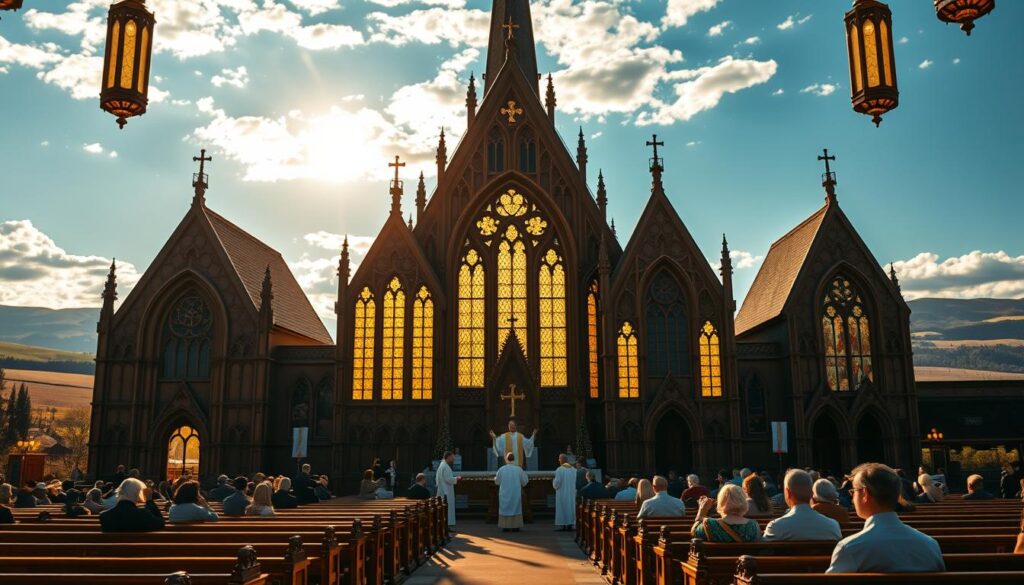
A grand Lutheran church with a towering steeple and intricate gothic architecture, set against a backdrop of rolling hills and a serene blue sky. The interior is bathed in warm, golden light filtering through stained glass windows, revealing ornate wooden pews and an elevated pulpit where the pastor delivers their sermon. Figures of clergy and congregants are gathered, engaged in the rituals and traditions that define Lutheran church governance. A sense of reverence and community permeates the scene, reflecting the hierarchical structure and democratic principles that guide this Christian denomination.

Synods and Local Autonomy

Each Lutheran congregation operates like a self-governing family, choosing its own pastors and managing budgets. But these families belong to larger networks called synods. Think of synods as neighborhood associations – they coordinate resources without controlling local choices.

North America’s three main Lutheran churches demonstrate this balance:

Church Body Congregations Distinctive Focus
Evangelical Lutheran Church in America (ELCA) 8,900 Social justice & ecumenical partnerships
Lutheran Church—Missouri Synod (LCMS) 6,000 Traditional doctrine & education
Wisconsin Evangelical Lutheran Synod (WELS) 1,200 Conservative interpretation of Scripture

Synods hold conventions where people from member churches vote on shared policies. These gatherings help maintain consistent teachings across denominations while funding mission projects no single church could handle alone.

Confessional Documents and Ecclesiastical Structure

The Augsburg Confession (1530) still guides modern Lutheran churches, acting like a recipe book for doctrine. Local churches use democratic systems – Voters’ Assemblies let members approve budgets, while Boards of Elders oversee spiritual matters.

This structure ensures both clergy and laypeople share responsibility. As one council member notes: “Our work succeeds when everyone’s voice matters.” Through this blend of tradition and participation, congregations stay rooted yet responsive to their communities.

Distinctions Between Lutheran and Catholic Beliefs

While sharing roots in early Christianity, these two traditions took divergent paths after the 16th century. Their differences reveal how faith communities interpret ancient texts and organize spiritual life.

Scripture Versus Tradition

Lutherans prioritize the Bible as the ultimate guide. Martin Luther championed “Scripture alone”, rejecting extra-biblical traditions. The Roman Catholic Church maintains that both Scripture and sacred tradition hold equal authority.

Catholics look to the Magisterium – church leaders – for interpretation. Lutherans encourage personal engagement with biblical texts. This contrast shapes everything from worship styles to ethical decisions.

Clergy Roles and Church Authority

The Catholic Church operates through a strict hierarchy with the Pope at its head. Lutheran congregations often choose local leaders while staying independent. Martin Luther argued all believers share spiritual responsibility.

Sacraments showcase another divide. Catholics view them as channels requiring priestly mediation. Lutherans see sacraments as God’s direct promises – no human authority needed beyond Christ’s words.

These differences extend to salvation views. While both value good works, Lutherans see them as gratitude responses rather than requirements. This distinction continues to shape modern Christian practice.

FAQ

What does "justification by grace through faith" mean in Lutheran theology?

It emphasizes that salvation comes solely through God’s grace, received by faith in Jesus Christ—not by human effort or good works. This belief underscores trust in divine mercy over personal merit.

How do Lutheran sacraments differ from other Christian traditions?

Lutherans recognize two sacraments—Baptism and the Lord’s Supper—viewed as tangible gifts where God’s grace is actively present. Unlike some traditions, they emphasize Christ’s “real presence” in communion, though not through transubstantiation.

Why is Sola Scriptura important to Lutheran identity?

The Bible is considered the ultimate authority for teaching and practice, surpassing church traditions or human interpretations. This principle shapes worship, doctrine, and daily life for believers.

How does Lutheran teaching contrast with Catholic views on salvation?

While both affirm Christ’s role, Lutherans reject earning salvation through works. They stress faith alone, whereas Catholicism integrates faith with sacraments and deeds as part of justification.

What role do synods play in Lutheran church governance?

Synods are regional or national bodies that support congregations while respecting local autonomy. They provide guidance, resources, and foster unity without centralized control.

How did Martin Luther’s 95 Theses shape Lutheran history?

Published in 1517, Luther’s critiques of Catholic practices sparked the Reformation. His emphasis on Scripture, faith, and grace laid the groundwork for Lutheran theology and church practices.

Do Lutherans believe in predestination?

Lutherans teach that God predestines believers to salvation through grace, but reject the idea of predestination to damnation. Human free will cooperates with God’s call through the Gospel.

Why is the Lord’s Supper central to Lutheran worship?

It celebrates Christ’s real presence—body and blood—”in, with, and under” bread and wine. This sacrament strengthens faith and unites believers with Jesus’ sacrifice and forgiveness.

The Lutheranism Map: A Visual Guide


Exploring America’s religious landscape reveals fascinating stories of community and heritage. One denomination’s journey stands out for its deep ties to history and geography. With nearly 9,000 congregations nationwide, this faith tradition has shaped regions from snowy Midwestern towns to sunny Caribbean islands.

Why are so many churches clustered in places like Minnesota? The answer lies in 19th-century immigration. Scandinavian settlers sought familiar climates and farmland, creating hubs that still thrive today. Cities like Minneapolis-St. Paul became cultural anchors, though the denomination’s headquarters settled in Chicago.

Modern tools now let us visualize this growth like never before. Interactive resources show how congregations spread across states, adapting to new environments while preserving traditions. From Alaskan villages to Hawaiian parishes, these communities reflect both resilience and diversity.

This guide unlocks the patterns behind their distribution. Discover how historical roots meet modern innovation—and why geography still matters in faith communities today.

Key Takeaways

  • Over 9,000 congregations serve diverse regions across the U.S. and Caribbean
  • Upper Midwest clusters trace back to Scandinavian farming communities
  • Interactive tools reveal settlement patterns and membership trends
  • Historic immigration shaped current demographic concentrations
  • Technology bridges centuries-old traditions with modern exploration
  • Geographic adaptability defines the denomination’s ongoing story

The Landscape of Lutheranism in the United States

Crossing stormy Atlantic waters in wooden ships, Scandinavian families carried more than belongings—they brought a spiritual legacy that would reshape America’s heartland. From 1820 to 1920, over 2 million people from Sweden, Norway, and neighboring nations arrived seeking farmland and freedom.

Seeds of Faith in New Soil

These settlers chose the Upper Midwest for its familiar winters and fertile soil. Minnesota’s forests mirrored Norway’s pine-covered hills, while Dakota’s plains recalled Sweden’s farmlands. Communities formed around church buildings that doubled as cultural hubs, hosting Scandinavian language classes and holiday celebrations.

By 1900, lutefisk dinners and St. Lucia festivals became cherished traditions. Families passed down Lutheran teachings through confirmation classes and hymn-singing circles. This blend of old-world customs and new-world opportunities created lasting bonds.

Unity Through Change

Three major Lutheran groups merged in 1988, forming the Evangelical Lutheran Church in America (ELCA). This union combined resources while respecting regional differences.

“Our strength lies in shared beliefs, not identical practices,”

notes an ELCA archivist.

Modern congregations balance tradition with innovation. Many churches now offer bilingual services and community gardens. From urban food pantries to rural youth programs, these adaptations ensure Lutheran values remain relevant across generations and geographic areas.

Exploring the “lutheranism map” Across America

Color-coded dots on digital screens tell stories of service spanning from Texas border towns to Great Lakes suburbs. The ELCA’s interactive tools reveal how 9,000+ faith communities connect through shared missions and localized outreach.

A highly detailed interactive congregation map of the Evangelical Lutheran Church in America (ELCA), showcasing its vast network of churches across the United States. The map occupies the foreground, rendered with precise geographical accuracy and vibrant colors, highlighting the diverse locations of ELCA congregations. In the middle ground, a subtle yet informative legend provides context, guiding the viewer's understanding of the map's data. The background features a softly blurred landscape, hinting at the rich cultural and historical tapestry that the ELCA is woven into, creating a sense of depth and immersion. The lighting is natural and warm, evoking a sense of welcoming and community. The overall composition and attention to detail convey the scope and significance of the ELCA's presence across the American landscape.

Mapping Congregational Impact and Presence

Three distinct markers guide users through this living network:

  • Orange: Welcoming congregations providing migrant support
  • Black: Sanctuary synods offering legal resources
  • Green: AMMPARO-affiliated groups aiding refugee families

Urban churches in Chicago and Houston host ESL classes alongside Sunday services. Rural parishes in Iowa and Nebraska organize crop-sharing programs. “Our locations aren’t random—they’re responses to community needs,” explains an ELCA outreach coordinator.

These visual resources help families find food pantries, youth mentors, or immigration assistance. Real-time updates show pop-up vaccination clinics or disaster relief efforts. By partnering with Central American counterparts, the network extends its impact beyond U.S. borders.

The system’s true power lies in linking isolated members. A farmer in Montana accesses Spanish-language Bible studies. A teacher in Florida connects with trauma counselors. Through coordinated work across regions, the church maintains its relevance in rapidly changing communities.

Regional Narratives: Alaskan, Hawaiian, and Southwestern Congregations

America’s most remote Lutheran communities thrive where roads end and traditions begin. Three distinct regions reveal how faith adapts to unique landscapes while serving local needs.

Alaskan Outreach and Community Resilience

Shishmaref Lutheran Church stands as the ELCA’s northernmost congregation. On this 2-square-mile island, 600 people—40% under 18—balance Iñupiat traditions with modern challenges. Permafrost thaw threatens homes, yet the church anchors community life through shared meals and youth programs.

“Our work isn’t just Sunday worship,” says a local leader. “It’s helping families haul water during freeze-ups.” The church blends subsistence living values with Christian teachings, creating a safety net in harsh climates.

Hawaiian Hospitality, Music, and Ministry

Oahu’s Lutheran Church of Honolulu harmonizes island warmth with urban outreach. Since 1915, its choir has drawn visitors while serving kōkua (help) to homeless individuals and food-insecure families. High living costs—median homes exceed $1 million—make their food pantry vital.

Members also welcome LGBTQIA+ folks through inclusive worship. “Aloha means caring for every person,” explains a volunteer. “Our doors stay open through storms and sunshine.”

Rock Point’s Spiritual Identity and Service

In Arizona’s desert, the Navajo Lutheran Mission transforms lives daily. Key services include:

  • Hózhó Café: 200+ meals served weekly
  • Solar power programs for off-grid homes
  • Water access for 40% without plumbing

Over 2,000 families rely on their food bank. Youth programs teach Navajo and Christian values side by side. “This isn’t charity—it’s partnership,” says a mission worker. “We build solutions with our neighbors, not for them.”

The Shifting Dynamics: ELCA Membership Trends and Challenges

Mainline Protestant groups face a critical crossroads in modern America. For the ELCA, membership shifts reveal both challenges and unexpected opportunities. Since 2003, baptized members dropped from 5 million to under 3 million—a change reshaping how congregations operate nationwide.

A serene, data-driven visualization of ELCA membership trends over time. A line graph in the foreground, crafted with a delicate, hand-painted aesthetic, showcases the gradual decline in membership against a softly blurred background of a traditional Lutheran church, bathed in warm, golden light filtering through stained glass windows. The graph's lines flow organically, conveying a sense of fluidity and change. In the middle ground, subtle icons and symbols allude to the complex social and cultural factors shaping the ELCA's evolving landscape. An atmosphere of contemplation and introspection pervades the scene, inviting the viewer to ponder the shifting dynamics within American Lutheranism.

Statistical Insights and Declining Membership

The 2009 policy shift on same-sex relationships marked a turning point. Over 250,000 members left within a year—equivalent to losing every resident of Pittsburgh. Today, confirmed members number 1.5 million fewer than two decades ago.

Older members often maintain ties through baptism records, while younger generations disengage faster. This creates financial strain: 70% of congregations now serve fewer than 100 weekly worshippers. “We’re running ministries designed for 1950s-sized groups,” shares a Minnesota pastor. “Our heating bills don’t shrink with attendance.”

Future Opportunities for Mainline Lutheranism

Creative adaptations offer hope. Some churches convert underused spaces into community kitchens or childcare centers. Others partner with immigrant groups, blending traditions through shared meals and language exchanges.

“Our mission isn’t about filling pews—it’s feeding souls through action,”

explains a Texas church leader. Digital worship reaches homebound members, while urban gardens provide fresh produce and neighborly connections.

The denomination’s legacy of social justice remains its strongest asset. Food pantries, climate initiatives, and LGBTQIA+ alliances attract folks valuing faith-driven service. By focusing on relationships over rosters, Lutheran communities might write their next chapter—one lived mission at a time.

Conclusion

From frozen tundras to sunbaked deserts, nearly 9,000 faith communities prove service knows no zip code. These congregations feed hungry families in Minnesota, shelter storm survivors in Puerto Rico, and teach sustainable farming in Navajo Nation. Each ministry reflects a simple truth: “God’s love knows no boundaries, even if maps do.”

Modern tools help connect this vast network. Interactive resources share real-time information about food pantries, language classes, and disaster relief efforts. Yet the heart of this work remains face-to-face relationships—a volunteer handing out water bottles, a pastor learning local traditions.

The Lutheran Church thrives by meeting people where they live. Urban parishes host job fairs alongside worship services. Rural congregations preserve immigrant heritage through folk schools and festivals. This blend of tradition and adaptability keeps ministries vibrant across generations.

Looking ahead, these communities continue writing their story through action. Whether restoring wetlands or mentoring children, they show faith isn’t just a Sunday thing—it’s hands-on work building hope, one neighborhood at a time.

FAQ

How did Lutheran communities first establish roots in the U.S.?

Many arrived with European immigrants in the 17th–19th centuries, settling in regions like the Midwest. They built churches to preserve cultural traditions, worship practices, and theological teachings, creating tight-knit hubs that still thrive today.

What makes Alaskan Lutheran ministries unique?

Congregations in Alaska often blend traditional teachings with local Indigenous values. They prioritize community resilience through outreach programs, food banks, and partnerships addressing rural challenges like isolation and resource access.

How does the ELCA address declining membership trends?

The Evangelical Lutheran Church in America focuses on revitalizing ministries through youth engagement, social justice work, and interfaith collaboration. Efforts include reimagining worship styles and expanding digital outreach to connect with younger generations.

Why do Hawaiian congregations emphasize music in ministry?

Music bridges cultural gaps and celebrates Hawaii’s diverse heritage. Hymns often incorporate ‘Ōlelo Hawaiʻi (Hawaiian language) or instruments like the ukulele, fostering unity and reflecting the islands’ spirit of aloha.

How do Southwestern churches adapt to their communities?

In areas like Rock Point, congregations integrate Navajo traditions with Lutheran theology. Bilingual services, community gardens, and education initiatives address local needs while honoring spiritual and cultural identities.

What role do maps play in understanding congregational impact?

Visual tools highlight where ministries actively engage with social issues, like disaster relief or immigrant support. They reveal patterns of growth, service areas, and how regional demographics shape outreach strategies.

Lutheranism and Martin Luther: Exploring the Reformation


What began as one man’s quest to improve his church ignited a spiritual revolution. In 16th-century Germany, a young scholar’s doubts about religious practices grew into ideas that reshaped Christianity. His journey started with personal struggles but led to changes still felt today.

Born in 1483, this thinker joined a monastery seeking answers about faith and salvation. As a teacher, he questioned traditions that seemed disconnected from scripture. His bold act of challenging authority in 1517 sparked debates across Europe—and marked the beginning of a new era.

What started as academic arguments soon became a full-fledged movement. Millions embraced fresh perspectives on worship and God’s grace. Though intended to reform existing structures, these ideas created lasting divisions—and opportunities—within Christian history.

Key Takeaways

  • A German monk’s questions about church practices led to worldwide religious changes
  • The 1517 publication of critical debates started a chain reaction across Europe
  • Original goals focused on improvement rather than creating separate groups
  • Core ideas about personal faith and scripture access defined the new approach
  • Over five centuries, these beliefs grew into a major global tradition
  • Modern impacts include worship styles and theological discussions still relevant today

The Roots of Lutheranism and the Reformation

A clash between tradition and new ideas set the stage for a spiritual upheaval. In early 16th-century Europe, the Roman Catholic Church controlled nearly every aspect of religious life. Ordinary people relied on its teachings for guidance, yet many felt disconnected from its increasingly political operations.

When Faith Became a Transaction

Salvation teachings at the time required both belief and actions like buying indulgences—documents claiming to reduce punishment for sins. This system created deep anxiety. As one critic noted, “Fear of divine judgment turned worship into a marketplace.”

Tools for Change

Two developments accelerated reform. First, educated leaders like Martin Luther began questioning practices using biblical analysis. Second, the printing press let these ideas spread faster than church authorities could contain them. By 1520, Luther’s writings reached half of Europe’s literate population.

This period marked the beginning of a seismic shift. Where medieval Christianity emphasized rituals, the Protestant Reformation championed personal connection with scripture. What started as theological debates soon reshaped the spiritual landscape of the Western world.

Early Life and Education of Martin Luther

Long before reshaping Christianity, a young German boy grew up under the weight of expectations. His journey from mining town to monastery reveals how personal battles forged a revolutionary thinker.

a young Martin Luther, in the early 16th century, sitting at a wooden desk in a dimly lit study, surrounded by books and parchments. The scene is illuminated by a single candle, casting warm, flickering light on his pensive expression as he contemplates his studies. The background is subdued, with hints of architectural details suggesting an academic setting, conveying a sense of scholarly focus and contemplation. The overall mood is one of intellectual rigor and the beginnings of a spiritual journey that would shape the course of the Reformation.

Childhood, Family, and Early Inspirations

Born to ambitious parents in rural Germany, Luther’s life began with strict discipline. His father Hans worked tirelessly in copper mines, dreaming his son would become a lawyer. “My schooling felt like hell and purgatory combined,” Luther later recalled about his harsh education.

At 17, he obeyed his family’s wishes by studying law. But a terrifying storm changed everything. When lightning nearly struck him in 1505, he vowed to become a monk—a decision that shocked his practical-minded father.

Experiences in Monastic Life and Scholarship

Monastic work brought new struggles. Luther obsessed over spiritual perfection, once confessing sins for six hours straight. “No matter how hard I tried,” he wrote, “I felt unworthy of God’s grace.”

His academic brilliance offered an escape. After earning a theology doctorate, he became Wittenberg University’s star professor. Students flocked to his lectures on biblical languages and ancient texts.

This scholarly way of life gave him tools to question traditions. As one colleague noted, “He didn’t just read scripture—he wrestled with it.” These battles would soon ripple across Europe, changing religious times forever.

Martin Luther’s Bold Challenge to the Roman Catholic Church

The act of questioning authority sparked an unexpected revolution. In autumn 1517, a theology professor took issue with how spiritual forgiveness was being sold like bread at market. His concerns would ripple across nations, turning a local debate into a continental firestorm.

The Ninety-Five Theses and Their Impact

What began as an invitation for scholarly discussion quickly escaped university walls. Originally written in Latin, the document gained explosive power when translated into everyday language. Within weeks, printers spread copies farther than anyone imagined. “When the Catholic Church sells salvation,” one critic observed, “it turns faith into a business transaction.”

The writings specifically targeted Johann Tetzel’s indulgence campaigns. Tetzel’s famous slogan—“When the coin in the coffer rings, the soul from purgatory springs”—clashed with biblical teachings about grace. Ordinary people suddenly had clear arguments against practices they’d long questioned.

Aspect Intention Outcome
Language Academic Latin debate German translations for public use
Church Response Expected private discussion Public relations disaster
Spiritual Impact Reform existing practices Created new worship traditions

This bold move required immense courage. Defying papal authority risked execution, yet the professor stood firm. His ideas gave voice to widespread frustrations about church corruption. By 1519, these arguments reached kitchens and workshops across Europe—not just lecture halls.

The Ninety-Five Theses did more than critique indulgences. They offered ordinary believers a roadmap for direct spiritual connection, bypassing traditional intermediaries. This shift would permanently alter how millions experienced their faith.

Understanding Justification by Faith Alone

The search for spiritual peace led to a groundbreaking discovery. After years of wrestling with guilt, a German scholar found freedom in a simple truth: salvation comes not through human effort but divine generosity. This realization became the heartbeat of a theological revolution.

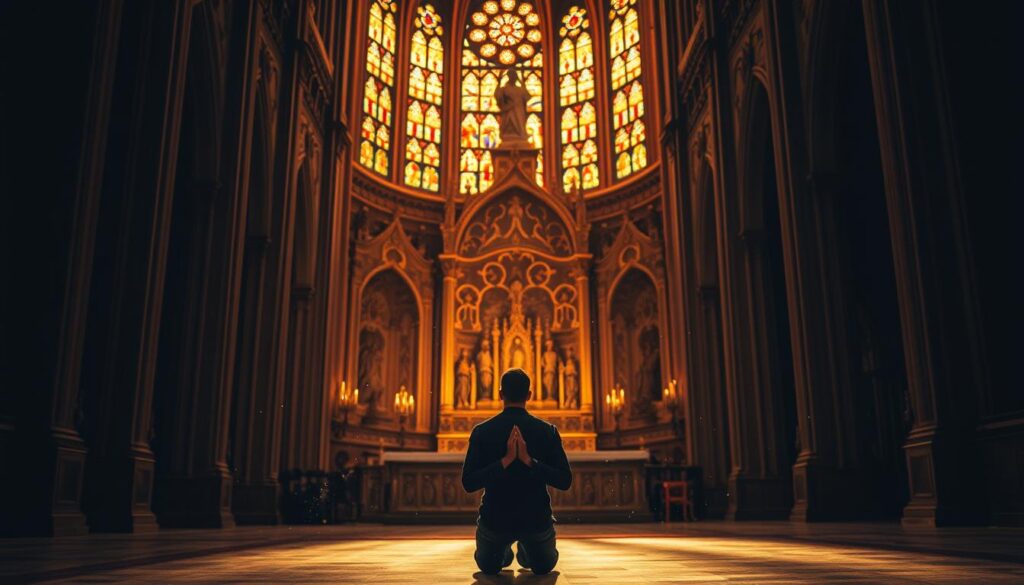
A majestic cathedral interior, the stained glass windows casting warm, golden light upon the ornate altar. In the foreground, a lone figure kneels in prayer, hands clasped, face upturned with a look of profound reverence and faith. Surrounding the figure, swirling motes of dust dance in the divine illumination, lending an ethereal, transcendent quality to the scene. The architecture recedes into the middle ground, its soaring arches and intricate carvings conveying a sense of grandeur and spiritual weight. In the background, the shadowed aisles and alcoves suggest the expansive nature of the sacred space, inviting the viewer to contemplate the magnitude of the divine.

Theological Foundations and Scripture’s Role

Deep study of Romans and Galatians revealed a pattern. Passages like “The righteous shall live by faith” (Romans 1:17) showed salvation as God’s gift, not a reward. Ephesians 2:8-10 cemented this view—grace arrives through faith alone, making human works unnecessary for redemption.

Martin Luther compared this to wearing someone else’s coat. “Christ’s perfection covers our flaws,” he wrote, describing how believers receive righteousness externally through divine grace. This idea reshaped how people viewed their relationship with higher power.

Contrast With Catholic Teachings

Traditional views required both belief and actions like sacraments or charity. The new approach removed this dual requirement. Where church teachings emphasized earning favor, Luther’s doctrine declared favor already given.

A 16th-century priest summarized the conflict: “We argued about whether heaven’s door needs pushing or simply opens when approached.” This split birthed the Reformation solasfaith alone, grace alone, scripture alone—that still guide Protestant worship today.

Luther’s Role in the Protestant Reformation

A single act of defiance can reshape history’s course. When religious authority demanded silence, one man’s refusal to compromise ignited irreversible change across Europe.

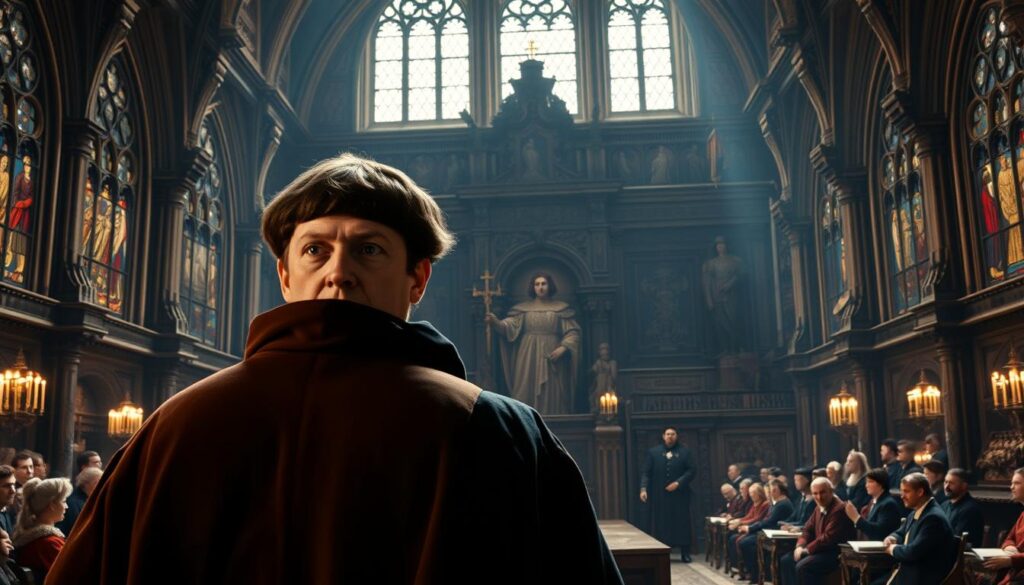
A grand, cinematic scene of the historic "Diet of Worms" confrontation between Martin Luther and the Holy Roman Emperor Charles V. In the foreground, Luther stands resolute, his face etched with determination, as he defends his Ninety-Five Theses before the imperial court. The middle ground is a grand, ornate hall, with intricate Gothic architecture and stained glass windows casting a warm, dramatic light. In the background, the solemn, austere presence of the Holy Roman Empire looms, represented by the imposing figures of Charles V and his advisors. The atmosphere is one of high-stakes drama, as the future of the Reformation hangs in the balance. Rendered in a realistic, oil painting-like style, with attention to historical accuracy and the gravitas of the moment.

Key Events: Diet of Worms and Excommunication

Pope Leo X’s 1520 ultimatum gave Martin Luther 60 days to retract his writings. Instead, the reformer burned the papal decree in a public bonfire—a symbolic rejection of Catholic Church control. By January 1521, his excommunication became official.

The showdown reached its peak at April’s Diet of Worms assembly. Facing Emperor Charles V, Luther stood by every word:

“My conscience is captive to the Word of God. To go against conscience is neither right nor safe.”

Defending Conscience and Scripture

This historic moment did more than challenge church leaders—it redefined spiritual authority. Ordinary people saw that scripture could outweigh tradition, and personal conviction might triumph over institutional power.

  • The Reformation shifted from debate to action as new congregations formed
  • Biblical literacy surged with translated texts replacing Latin-only materials
  • Political allies protected Luther, allowing his ideas to spread safely

By risking his life for these principles, the reformer showed how individual courage could alter the way millions practiced faith. His stand at Worms remains a landmark day in religious freedom’s evolution.

lutheranism martin luther: Defining a Lasting Movement

A theological revolution born from questioning traditions grew into a global legacy. The movement’s foundation rested on three pillars: grace as divine gift, scripture as ultimate guide, and faith as humanity’s response. These ideas shaped communities that valued personal connection with sacred texts over rigid hierarchies.

Core Doctrines and Doctrinal Shifts

The Book of Concord (1580) became the movement’s compass, clarifying beliefs still followed today. Unlike other groups, followers emphasized God’s unconditional love rather than earned favor. This shift made worship more accessible—no special rituals required, just sincere trust.

The Spread of Lutheran Ideals Globally

From northern Europe to bustling cities worldwide, these teachings adapted without losing their core. By 2019, over 80 million people across six continents identified with the tradition. Rapid growth in Africa and Asia shows how ancient ideas still meet modern spiritual needs.

Today’s churches blend centuries-old practices with local cultures. Hymns might mix traditional harmonies with global instruments, proving that foundational truths can thrive in changing times. The movement’s endurance reminds us that bold questions often yield lasting answers.

FAQ

What sparked the Protestant Reformation?

The Reformation began when a German monk challenged certain practices of the Roman Catholic Church, particularly the sale of indulgences. His bold critique, outlined in the Ninety-Five Theses, ignited debates about theology, authority, and salvation.

How did the idea of "faith alone" differ from Catholic teachings?

The belief in justification by faith emphasized that salvation comes through trust in God’s grace, not human deeds. This contrasted with teachings that highlighted rituals and good works as pathways to spiritual redemption.

Why was the Diet of Worms significant?

At this 1521 assembly, church leaders demanded the monk recant his writings. His refusal to abandon his conscience or scriptural interpretations marked a turning point, deepening the divide between reformers and traditional authorities.

How did early worship services change under this movement?

Services shifted to focus on scripture, congregational singing, and preaching in local languages. These changes aimed to make worship more accessible and centered on the teachings of the Bible rather than elaborate rituals.

What role did the Bible play in spreading these ideas?

Translating scripture into everyday language allowed broader access to biblical texts. This empowered individuals to engage directly with teachings, fostering literacy and personal faith across communities.

How did monastic life shape the reformer’s views?

Years in a monastery deepened his study of theology but also led to spiritual struggles. These experiences fueled his critiques of rigid practices and his emphasis on divine grace over human effort.

What global impact did this movement have?

Its teachings spread rapidly through pamphlets, hymns, and universities. Today, millions worldwide identify with churches rooted in these doctrines, which continue to shape Christian thought and culture.

Lutheranism: Understanding the Foundations of This Christian Denomination


What began as one man’s quest to reform religious practices sparked a movement that reshaped Christianity. In the 1500s, Martin Luther challenged long-standing church traditions, emphasizing direct engagement with scripture and personal faith. His ideas spread like wildfire across Europe, thanks to new technologies like the printing press and growing public demand for change.

This movement became a cornerstone of Protestant Christianity. Unlike other reforms of the time, it focused on salvation through grace rather than rituals. By the 21st century, over 77 million people globally identified with these teachings—a testament to their enduring appeal.

Interestingly, the name “Lutheran” wasn’t chosen by its followers. Critics first used the term to describe those who supported Luther’s views. The tradition’s real strength lies in its adaptability, thriving in diverse cultures while maintaining core principles about scripture and community.

Key Takeaways

  • Originated from Martin Luther’s 16th-century efforts to reform Christian practices
  • Grew rapidly due to technological advances and social changes during the Renaissance
  • Now includes over 150 independent church groups worldwide
  • Term “Lutheran” was originally used by critics, not supporters
  • Focuses on scripture-based faith rather than institutional rituals
  • Second-largest Protestant tradition after Baptist churches today

Introduction: The Emergence of Lutheranism

Amidst Europe’s recovery from plague and political shifts, a new religious perspective emerged. The 15th century brought seismic changes—cities grew, literacy spread, and old social hierarchies wobbled. When Martin Luther posted his critiques in 1517, he tapped into a society already questioning traditions.

Setting the Context

The Black Death (1347-1351) had reshaped Europe. With fewer workers, commoners gained bargaining power. New universities sprouted, and the 1455 Gutenberg Bible let people read scripture themselves. Luther, a Bible professor, saw how Roman Catholic practices like selling forgiveness clashed with scriptural teachings.

Overview of Lutheranism’s Impact

Luther’s 95 Theses sparked debates that became the Protestant Reformation. His ideas about personal faith and scriptural authority spread through pamphlets—early social media. Local rulers used these teachings to challenge papal power, reshaping Europe’s political map.

Aspect Pre-Reformation Post-Reformation
Religious Authority Pope-centered Scripture-focused
Education Latin-only Vernacular schools
Economic Practices Indulgences common Tithing reformed

These changes still matter today. Modern churches balance 16th-century theology with contemporary issues—proof that good doctrine adapts without losing its core.

Historical Roots and the Protestant Reformation

One autumn day in 1517 changed religious history forever. A monk named Martin Luther nailed a list of arguments to a church door in Wittenberg, not knowing his act would ignite a continental firestorm. This wasn’t a call for rebellion—it began as an invitation for academic debate about indulgences, certificates sold by the Roman Catholic Church to reduce punishment for sins.

A medieval parchment scroll unfurled, revealing the Ninety-Five Theses handwritten in ornate calligraphy against a backdrop of a dimly lit Gothic cathedral. Sunlight streams through stained glass windows, casting a warm, reverent glow over the historic document. In the foreground, a quill pen and ink well rest on a worn wooden table, symbolizing the profound impact of Martin Luther's radical ideas that sparked the Protestant Reformation. The atmosphere is one of solemn contemplation, a pivotal moment in the birth of Lutheranism captured in a single, evocative image.

From Local Protest to Continental Debate

Luther’s main target was preacher Johann Tetzel, who claimed buying indulgences could free souls from purgatory. “When coins clink in the chest, souls escape their test,” Tetzel declared. Luther countered that true forgiveness came through faith, not payments. His 95 Theses spread faster than wildfire—German translations reached every major city in weeks.

Crossing Oceans and Cultures

By the 1530s, Scandinavian kings adopted Luther’s teachings to strengthen their rule. German immigrants later brought these ideas to America, founding early churches in Delaware. Political leaders everywhere saw value in challenging papal power, creating alliances that helped the movement thrive.

Region Time Period Key Driver
Germany 1517-1520s Printing press distribution
Scandinavia 1530s-1600s Royal decrees
North America 1638 onward Immigrant communities

The speed of this spread shocked everyone. What started as a local debate became a blueprint for religious freedom—proving ideas can outpace armies when given wings.

Exploring lutheranism definition world history

Between 1510 and 1520, a quiet revolution brewed in Martin Luther’s study. As he taught biblical texts like Psalms and Galatians, patterns emerged that challenged centuries of tradition. His students witnessed firsthand how scripture contradicted common church practices around confession and forgiveness.

From Scholar to Reformer

Luther’s lectures revealed a radical truth: salvation came through divine grace alone, not rituals. This clashed with the Catholic Church’s emphasis on sacraments and priestly mediation. By 1519, he openly questioned whether papal decrees held more weight than biblical teachings.

A turning point arrived in June 1520. Pope Leo X issued Exsurge Domine, demanding Luther retract 41 statements. The document gave him sixty days to submit—or face expulsion from the church. Instead of backing down, Luther burned the papal bull publicly that December, declaring:

“Unless I’m convinced by Scripture, my conscience is captive to God’s Word.”

Year Event Significance
1510-1520 Scripture study period Developed justification by faith doctrine
June 1520 Papal ultimatum issued First formal break attempt
Dec 1520 Bull burning Symbolic rejection of authority
Jan 1521 Excommunication Official separation from Rome

These events created a new blueprint for Christian practice. Where the Catholic Church required sacraments and works, Luther taught that faith alone connected believers to God. This shift reshaped everything from personal spirituality to community worship structures.

Modern Christians still feel these changes. The idea that grace comes through divine love—not human effort—remains central to Protestant thought. As Luther himself wrote, true freedom springs from trusting God’s promises more than institutional rules.

Doctrinal Foundations and Core Beliefs

At the heart of Lutheran teaching lies a radical idea: divine grace trumps human effort. This principle reshaped Christian thought, offering believers direct access to salvation through trust rather than rituals. Let’s unpack the ideas that still guide millions today.

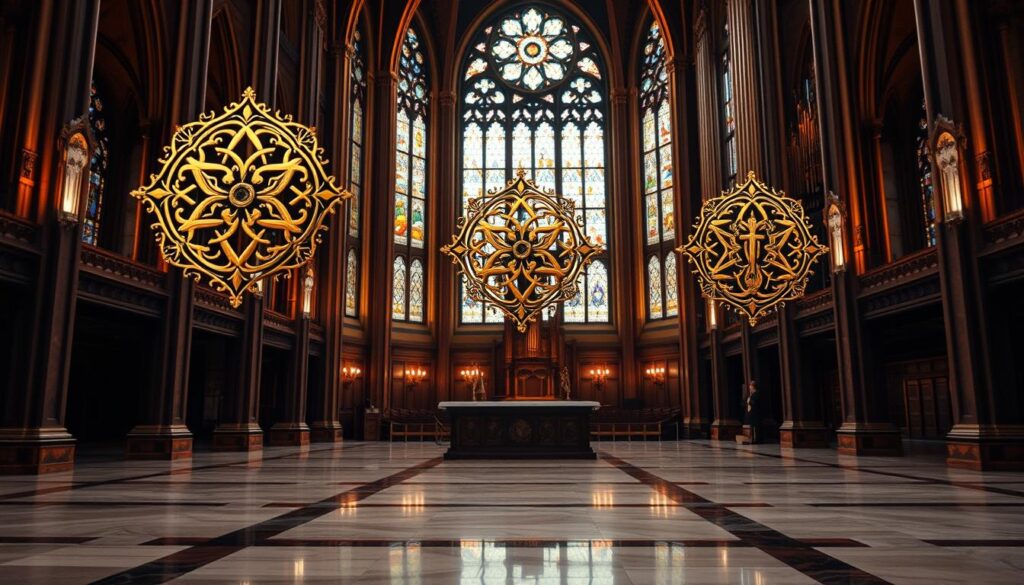
A grand cathedral interior, illuminated by warm, soft lighting. In the foreground, three solas of Lutheran doctrine stand out - Sola Scriptura, Sola Gratia, and Sola Fide - represented as ornate, gilded symbols floating above an altar. The middle ground features intricate stained glass windows, casting a kaleidoscope of colors onto the polished marble floor. In the background, a majestic pipe organ towers, its pipes gleaming, symbolizing the importance of music and worship in Lutheran tradition. The overall atmosphere is one of reverence, solemnity, and the weight of centuries-old beliefs.

Justification by Faith and the Three Solas

Lutherans see faith as a lifeboat, not a ladder. Their famous slogan—“faith alone”—means God’s forgiveness comes freely, not through good works. This ties into three core principles:

Principle Meaning Impact
Sola Scriptura Bible as ultimate authority Replaced church traditions
Sola Gratia Grace as unearned gift Ended indulgences
Sola Fide Faith as key to salvation Simplified worship

As Luther wrote in 1520:

“Faith is a living, daring confidence in God’s grace.”

This confidence became the movement’s engine.

The Rejection of Papal Authority

Lutherans traded hierarchy for hands-on spirituality. They kept just two sacraments—baptism and communion—seeing others as human inventions. Original sin explains why this matters: everyone needs grace, since Adam’s disobedience tainted humanity.

Unlike Catholic teachings, Lutheran doctrine says faith isn’t something you earn. It’s a gift that lets you receive what God already offers. This shift created simpler, scripture-focused churches where everyone reads the Bible themselves.

Evolution of Lutheran Worship and Practices

The rhythm of hymns and the structure of prayer define Lutheran communal practice. Unlike many Protestant groups, these services retain medieval liturgical elements while emphasizing congregational participation. This balance reflects Martin Luther’s vision: reforming traditions without abandoning their spiritual roots.

Liturgical Traditions and Musical Heritage

Sunday services often mirror Catholic Mass formats—readings, sermons, and communion. But Luther added a revolutionary twist: music for everyone. He composed hymns like A Mighty Fortress so worshippers could sing their faith. Today, choirs and pipe organs remain central to Lutheran worship, blending ancient chants with Reformation-era energy.

Distinctive Sacramental Practices

At the communion table, Lutherans experience what they call Real Presence. They believe Christ joins them through bread and wine—not by magic, but divine promise. This sacramental focus extends to baptism, seen as God’s gift rather than human ritual. Confession sometimes appears too, though simpler than in Catholic practice.

These worship patterns show how Luther’s reforms valued continuity. By keeping liturgy accessible yet profound, they invite modern believers to participate in a 500-year conversation about grace.

FAQ

How did Martin Luther’s teachings challenge the Roman Catholic Church?

Martin Luther emphasized salvation through faith alone, rejecting practices like indulgences. His Ninety-Five Theses sparked debates about papal authority, leading to the Protestant Reformation and the creation of Lutheran churches.

What distinguishes Lutheran beliefs about grace and good works?

Lutherans teach that grace is a free gift from God, not earned by good works. While actions matter, they believe salvation comes solely through faith in Jesus Christ, a core idea called “justification by faith.”

Why is the Augsburg Confession important to Lutheran theology?

Written in 1530, the Augsburg Confession outlined key Lutheran doctrines, such as the role of sacraments and the authority of Scripture. It remains a foundational text for many Lutheran churches worldwide.

How does Lutheran worship differ from other Christian traditions?

Lutheran services often blend traditional liturgy with hymns, reflecting their musical heritage. They emphasize sacraments like baptism and communion, viewing them as means of receiving God’s grace.

What role did the Formula of Concord play in Lutheran history?

The Formula of Concord (1577) resolved theological disputes among Luther’s followers. It clarified teachings on topics like free will and Christ’s presence in communion, uniting Lutheran churches under shared beliefs.

How do modern Lutheran denominations like the Missouri Synod operate?

Groups like the Lutheran Church—Missouri Synod maintain traditional practices and doctrines, such as biblical inerrancy. Others, like the Evangelical Lutheran Church in America, adopt more progressive stances on social issues.

Why is the Lutheran emphasis on Scripture called “sola Scriptura”?

“Sola Scriptura” means “Scripture alone.” Lutherans believe the Bible is the ultimate authority for faith, rejecting additional sources of religious authority promoted by the Roman Catholic Church during the 16th century.

The Lutheran Legacy of Jamestown, VA


For over 135 years, a remarkable organization has shaped lives in western New York. What began as a safe haven for orphaned immigrant children now serves families across multiple generations. Founded in 1886, this institution started by addressing urgent community needs through residential care for vulnerable youth.

Through decades of change, the mission has stayed rooted in core values of dignity and respect. Services expanded thoughtfully as populations aged and new challenges emerged. Today, families find support through specialized programs ranging from memory care facilities to youth development initiatives.

The organization’s evolution mirrors America’s shifting social landscape. From its original focus on Scandinavian immigrants, it now assists diverse groups through:

  • Assisted living options
  • Home health services
  • Community education programs

This adaptive approach keeps care relevant while honoring founding principles. Recent expansions include modern nursing home facilities blending medical expertise with compassionate support. Neighborhood outreach efforts strengthen connections across age groups and backgrounds.

Key Takeaways

  • 135-year legacy serving New York communities
  • Evolved from children’s home to multi-generational support
  • Faith-based values guide modern care practices
  • Offers residential and community-based services
  • Focuses on independence across all age groups
  • Adapts programs to meet changing needs

History and Community Impact

In the years following America’s Civil War, waves of Swedish immigrants faced unimaginable hardships. Many families arrived after losing parents during dangerous journeys, creating urgent needs for child care solutions. This crisis sparked a movement that would reshape support systems across New York State.

Origins and Founding Values

Forty-three faith groups united in 1886 to address a growing problem: abandoned children with nowhere to turn. Their solution became a landmark residence called “the castle on the hill,” initially sheltering 12 orphans. By 1900, this safe haven housed over 90 youth, teaching practical skills through farm work and community projects.

The founders emphasized education and dignity for all residents. Children learned reading and arithmetic alongside Lutheran traditions, preparing them to become contributing adults. This focus on holistic development created ripple effects that strengthened entire neighborhoods.

Evolution of Services Over the Decades

As former residents started families of their own, the organization adapted to new challenges. The 1960s brought two major expansions:

  • A Learning Center for teens needing specialized education
  • Housing options for elderly immigrants lacking family support

These changes addressed critical gaps in community services. Therapeutic foster care programs later emerged, helping over 100 families provide stable homes. Today, the original children’s home legacy lives through modern programs supporting people across all life stages.

Lutheran Jamestown: Comprehensive Services Directory

Families seeking senior care solutions find peace of mind through tailored support systems. With multiple living arrangements and specialized therapies, this organization helps older adults thrive while maintaining independence.

A warm and inviting senior care facility, bathed in soft, natural lighting. In the foreground, a group of elderly residents engaged in a friendly board game, their faces animated with laughter and camaraderie. In the middle ground, a nurse attentively assists an older adult with mobility, their kind expression conveying compassion. The background reveals a cozy, well-appointed lounge area, with plush armchairs and a fireplace, creating a sense of comfort and security. The overall atmosphere exudes a feeling of dignity, respect, and the nurturing support that the Lutheran community of Jamestown, VA, is known to provide.

Personalized Care Environments

The 148-bed retirement community shines with a 5-star rating for quality care. Licensed nurses provide 3.6 daily care hours per resident, blending medical expertise with compassionate support. Three specialized units cater to distinct needs:

  • Memory care with secure spaces for dementia patients
  • Short-term rehabilitation programs
  • Long-term skilled nursing services

Costs remain transparent, ranging from $1,900 for basic care to $9,125 for intensive medical support. “Our team adapts care plans as needs change,” explains a senior staff member.

Holistic Wellness Programs

Therapy services form the backbone of recovery initiatives. In-house specialists deliver:

  • Occupational therapy for daily living skills
  • Physical therapy for mobility improvement
  • Speech therapy partnerships

Active adults enjoy 200+ housing options through Edgewood Communities. One-bedroom apartments and duplex homes promote social connections through clubs, gardening spaces, and intergenerational activities. Religious services and art classes round out the wellness-focused lifestyle.

Recent Changes and Community Updates

New York State’s senior care landscape shifted dramatically in late 2023. A major provider announced the closure of its Falconer Street nursing home and rehabilitation program, affecting dozens of families and care professionals.

Understanding the Facility Closure

The decision to close the 49-bed facility came after months of financial strain. Occupancy rates sat at 65% – far below the 90% needed for sustainability. Rising costs and shrinking Medicaid reimbursements made quality care increasingly difficult to deliver.

“This wasn’t about willingness, but viability,” explained leadership. The closure preserves resources for other programs like assisted living and senior housing options. Warner Place Adult Day Care, inactive since pandemic restrictions, will also permanently close.

Local Responses and Next Steps

Mayor Eddie Sundquist called the closure “a loss for our entire community.” County Executive PJ Wendel confirmed aging services staff would help relocate residents. Employees receive job placement assistance through state partnerships.

Current residents transition to other facilities by January 2024. Edgewood Communities and Hultquist Place remain open, continuing to serve older adults with housing and care services. The changes highlight ongoing challenges in balancing quality care with operational realities.

Conclusion

For over a century, this organization has woven compassion into community life. What began as shelter for immigrant youth now helps families navigate life’s challenges at every age. Though recent changes closed some facilities, the core mission thrives through modern care solutions.

Today’s residents find dignity in options like Hultquist Place and Edgewood Communities. These housing programs blend independence with skilled support for seniors. Youth initiatives continue helping young adults build life skills, maintaining the original vision.

The closure of Falconer Street’s nursing home reminds us that quality services require adaptable solutions. Yet remaining programs prove community bonds grow stronger through change. Staff still prioritize personalized plans meeting each person’s unique needs.

This legacy shows how Lutheran Jamestown evolves while keeping values rooted in respect. From home-based care to group living spaces, every service honors life’s journey. As new challenges emerge, this enduring commitment will keep shaping brighter tomorrows for all.

FAQ

What types of senior care services are available in Jamestown?

The community offers skilled nursing, assisted living, memory care, and short-term rehabilitation. Support programs include physical therapy, social activities, and personalized care plans to meet individual needs.

How have recent facility closures impacted local care options?

While some locations have consolidated, services remain focused on quality care. Partnerships with regional providers ensure continued access to health programs, home-based support, and specialized therapies.

What makes memory care programs unique here?

Facilities prioritize safety, structured routines, and cognitive therapies. Trained staff use evidence-based approaches to support residents with dementia while fostering dignity and engagement.

Are there financial assistance options for senior housing?

Many programs accept Medicaid, Medicare, and private insurance. Financial counselors help families explore payment plans, veterans’ benefits, or state-funded aid to reduce out-of-pocket costs.

How can families get involved in community activities?

Residents’ loved ones are encouraged to join events, volunteer, or participate in educational workshops. Regular family councils and open communication channels ensure collaborative care decisions.

Has New York State policy affected senior care standards?

Updated regulations emphasize staff training ratios, infection control, and transparency in care quality. Local providers adapt quickly to meet these requirements while maintaining compassionate service.

Do facilities offer intergenerational programs?

Yes! Partnerships with schools and youth groups create mentorship opportunities. Activities like art projects or story-sharing bridge gaps between seniors and younger generations.

What residential options exist beyond traditional nursing homes?

Independent living cottages, respite care suites, and affordable senior apartments provide flexibility. Edgewood Communities, for example, blends privacy with access to 24/7 support.

How can I advocate for improved senior services locally?

Contact area representatives or join coalitions like the Chautauqua County Office for Aging. Sharing experiences at town halls also helps shape policies prioritizing elder care needs.