Gratitude in the Bible: Discovering the Countless Times it is Mentioned
In the Bible, gratitude is a recurring theme that resonates with people of all walks of life. From the Old Testament to the New Testament, countless verses remind us of the importance of expressing gratitude in our daily lives. In fact, the word “thank” appears nearly 250 times in the Bible, showing just how significant gratitude is in the eyes of God.
Discovering the instances where gratitude is mentioned in the Bible can be a transformative experience. It not only helps us cultivate a heart of gratitude, but also deepens our understanding of God’s character and love for us. Whether it is giving thanks for answered prayers, offering gratitude for blessings, or expressing thanks to God for His faithfulness, the Bible provides a rich tapestry of gratitude-filled verses to draw from.
In this article, we will explore the countless times gratitude is mentioned in the Bible, delving into specific verses and passages that highlight the power and beauty of thankfulness. Join us on this journey as we uncover the depth and significance of gratitude as revealed in the Scriptures.
The concept of gratitude in the Old Testament
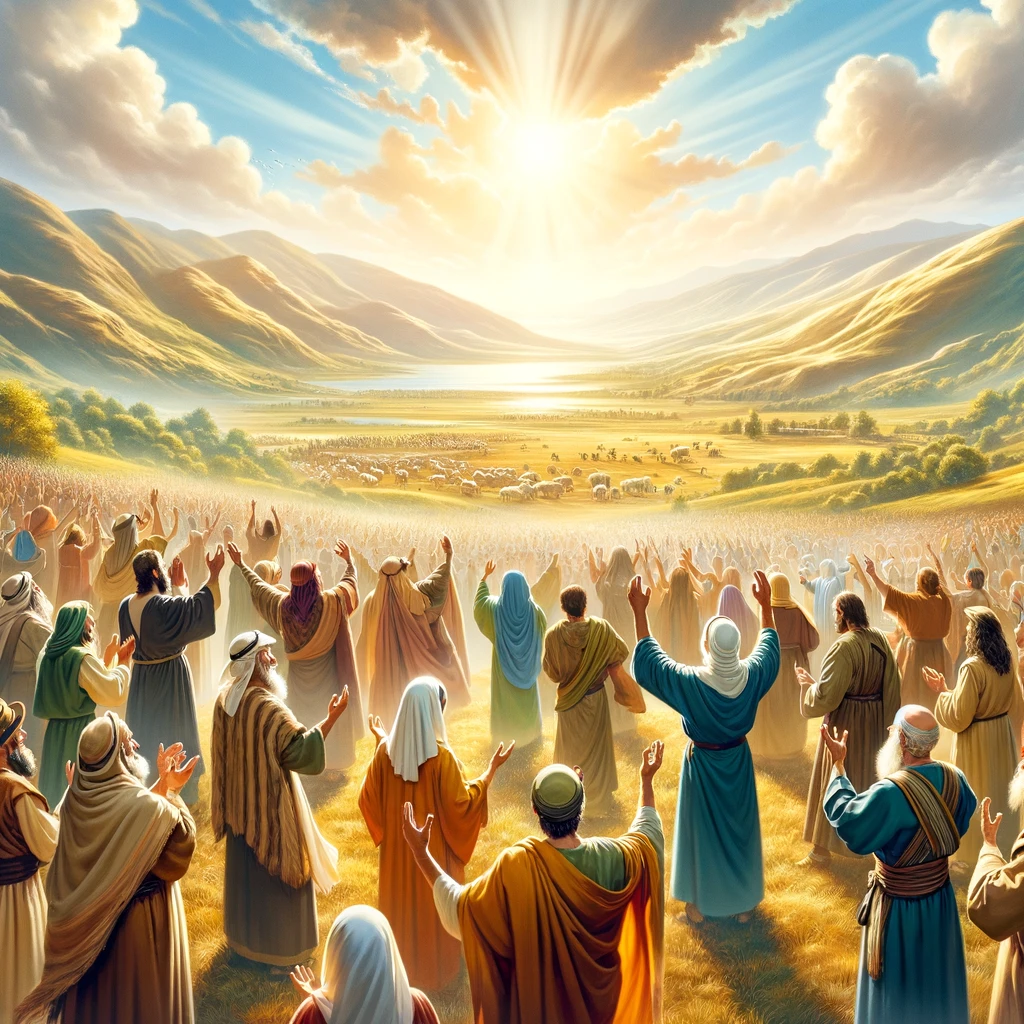
The concept of gratitude in the Old Testament is deeply rooted in the Jewish tradition. In Hebrew, the word for gratitude is “todah,” which also means “thanksgiving” or “praise.” The Old Testament emphasizes the importance of expressing gratitude to God for His blessings and acts of deliverance. One of the most well-known examples of gratitude in the Old Testament is the story of King David, who frequently expressed his gratitude to God through psalms and songs of thanksgiving.
The book of Psalms, in particular, is filled with verses that highlight the importance of gratitude. Psalm 100:4 says, “Enter his gates with thanksgiving and his courts with praise; give thanks to him and praise his name.” This verse shows that gratitude is not just a personal act, but also a communal one. It encourages us to come together as a community of believers and give thanks to God for His goodness and faithfulness.
Gratitude is also expressed through various rituals and sacrifices in the Old Testament. The Israelites were instructed to offer thanksgiving offerings, known as “sacrifices of thanksgiving,” to express their gratitude to God. These offerings were a tangible way for the Israelites to show their appreciation for God’s provision and protection.
Examples of gratitude in the Old Testament
Throughout the Old Testament, there are numerous examples of individuals expressing gratitude to God. One such example is found in the story of Hannah. In 1 Samuel 2:1-10, Hannah offers a prayer of thanksgiving to God after He blessed her with a son, Samuel. Her prayer is a beautiful expression of gratitude, praising God for His faithfulness and provision.
Another example is the story of the ten lepers in Luke 17:11-19. Jesus healed all ten lepers, but only one of them returned to express gratitude. Jesus asked, “Were not all ten cleansed? Where are the other nine?” This story serves as a reminder of the importance of gratitude and the need to acknowledge God’s blessings in our lives.
The role of gratitude in the life of Jesus
Gratitude played a significant role in the life of Jesus. He often expressed gratitude to God the Father for His guidance, wisdom, and provision. In Matthew 11:25, Jesus said, “I praise you, Father, Lord of heaven and earth, because you have hidden these things from the wise and learned, and revealed them to little children.” This verse shows Jesus’ gratitude for the revelation of God’s truth to His disciples.
Jesus also taught his followers the importance of gratitude. In Luke 17:15-16, Jesus healed a group of lepers, and only one of them returned to express gratitude. Jesus asked, “Were not all ten cleansed? Where are the other nine?” This story serves as a powerful reminder that gratitude should be a natural response to God’s blessings in our lives.
Gratitude in the teachings of Jesus
In His teachings, Jesus often emphasized the importance of gratitude. In Matthew 6:25-34, Jesus encourages His followers not to worry about their needs but to trust in God’s provision. He says, “Therefore I tell you, do not worry about your life, what you will eat or drink; or about your body, what you will wear. Is not life more than food, and the body more than clothes?”
Jesus’ teachings remind us that gratitude is not only about expressing thanks for what we have received but also about trusting in God’s faithfulness and provision for the future. It is a reminder to shift our focus from our worries and anxieties to God’s abundant blessings.
The Power of the Passover: How Exodus 12 Shaped Jewish Tradition
For over 3,000 years, the Passover holiday has been a cornerstone of Jewish tradition, serving as a powerful reminder of the Israelites’ liberation from slavery in ancient Egypt. Rooted in the biblical account of Exodus 12, the story of the Passover holds immense significance in the lives of Jewish people around the world.
In this article, we delve into the power of the Passover and how Exodus 12 has deeply shaped Jewish tradition. From the symbolic Seder meal to the retelling of the ten plagues, each element of the Passover celebration carries profound meaning and serves as a connection to the past. We explore the historical and cultural importance of this annual observance, shedding light on its continued relevance in the modern world.
By understanding the origins of the Passover and its central role in Jewish practice, we gain a deeper appreciation for the rich tapestry of traditions and customs that have been passed down through generations. Join us as we uncover the transformative power of the Passover and its enduring impact on Jewish identity and faith.
The significance of the Passover lamb
The Passover lamb, known as the “korban Pesach” in Hebrew, plays a central role in the observance of Passover. As commanded in Exodus 12:3-6, each household was instructed to select a lamb without blemish and slaughter it on the 14th day of the first month. The blood of the lamb was then to be placed on the doorposts as a sign for the Lord to pass over that house during the final plague, sparing the firstborn.
This act of sacrificing the lamb symbolized the Israelites’ obedience to God’s commandments and their faith that His protection would be upon them. It also foreshadowed the ultimate sacrifice of Jesus, who is often referred to as the “Lamb of God” in Christian theology. The Passover lamb continues to be a powerful symbol of redemption and deliverance for Jewish communities worldwide.
The unleavened bread and its symbolism
Another significant element of the Passover celebration is the consumption of unleavened bread, known as “matzah.” As the Israelites prepared to flee Egypt, they had no time to allow their bread to rise, and thus, they baked it unleavened. This unleavened bread represents both the haste in which the Israelites left Egypt and the humility they embraced during their journey to freedom.
The absence of leaven also symbolizes the removal of sin and impurity, as leaven is often associated with corruption and swelling. By consuming matzah during Passover, Jewish people are reminded of the importance of humility, repentance, and the pursuit of righteousness. The unleavened bread serves as a tangible reminder of the Israelites’ reliance on God’s provision and their commitment to living a holy life.
The blood of the lamb and its redemption
One of the most powerful symbols in the Passover story is the blood of the lamb that was placed on the doorposts. This act of obedience served as a sign for the Lord to pass over and spare the Israelite households from the final plague, which claimed the lives of the firstborn in every Egyptian home.
The blood of the lamb represents redemption and deliverance. It was a tangible demonstration of the Israelites’ trust in God’s promise of protection. This act of sacrifice and faith paved the way for their liberation from slavery and the beginning of their journey to the Promised Land.
The tradition of the Seder meal
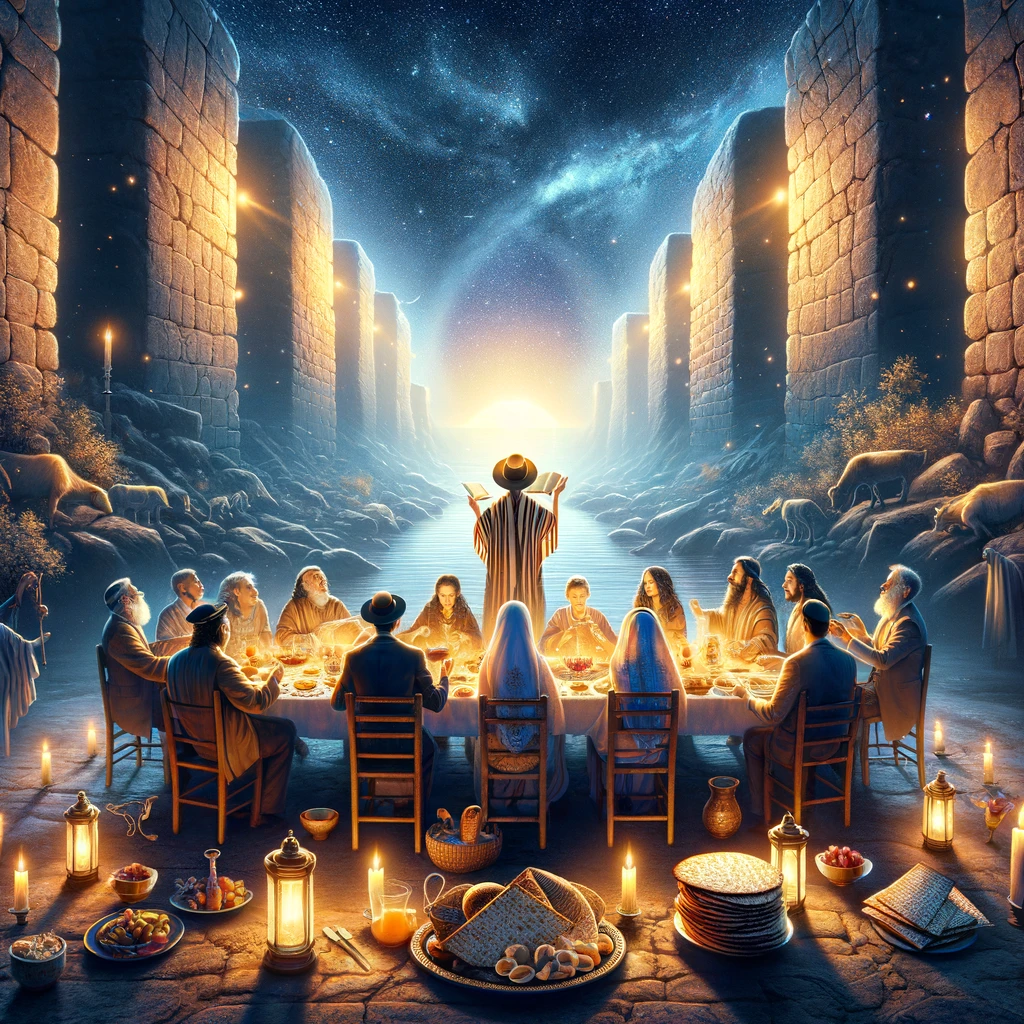
Central to the Passover celebration is the Seder meal, a ritualistic feast that commemorates the Exodus from Egypt. The word “Seder” means “order” in Hebrew, and it refers to the specific order of the meal and the retelling of the Exodus story.
During the Seder, family and friends gather around the table to partake in a carefully curated sequence of symbolic foods, prayers, and readings. Each element of the Seder meal holds deep meaning and serves as a connection to the past. From the bitter herbs representing the bitterness of slavery to the charoset symbolizing the mortar used by the Israelites, every item on the Seder plate tells a story of the Jewish people’s journey to freedom.
The Four Questions and Their Meaning
A significant part of the Seder tradition is the Four Questions, known as the “Ma Nishtana” in Hebrew. These questions are asked by the youngest person at the table, and they serve as a means to engage in a dialogue about the significance of Passover and its rituals.
The Four Questions focus on the differences between the Passover celebration and ordinary meals, prompting a discussion about the unique aspects of the holiday. By asking these questions, Jewish families encourage the younger generation to actively participate in the Passover experience and to gain a deeper understanding of their heritage.
The Exodus story and its influence on Jewish identity
The story of the Exodus from Egypt is a foundational narrative in Jewish tradition. It recounts the Israelites’ journey from slavery to freedom, highlighting the power of faith, courage, and God’s intervention.
The Exodus story serves as a constant reminder of the Jewish people’s resilience and their ability to overcome adversity. It reinforces the importance of remembering and retelling the tales of the past to ensure that future generations understand and appreciate their heritage. The story of the Exodus has shaped Jewish identity, instilling a deep sense of pride, faith, and community among Jewish communities worldwide.
Passover customs and rituals
Alongside the Seder meal, Passover is marked by various customs and rituals that have been observed for centuries. These practices not only connect Jewish individuals to their ancestors but also serve as a means of expressing gratitude and devotion to God.
Some of the customs include the removal of leavened products from the home, known as “chametz,” which symbolizes the removal of sin and impurity. The search for chametz the night before Passover, accompanied by a blessing, is a symbolic act of cleansing and preparation.
Additionally, the recitation of the Haggadah, a text that recounts the story of the Exodus, is an integral part of the Passover observance. Through the recitation of prayers, songs, and readings, the Haggadah creates a collective experience that connects Jewish individuals across time and space.
Passover’s relevance in modern times
Despite the passage of thousands of years, the Passover holiday remains relevant in the modern world. Its themes of freedom, liberation, and the pursuit of justice resonate with people from all walks of life.
The story of the Exodus serves as a constant reminder of the importance of standing up against oppression and advocating for the rights of the marginalized. Passover offers an opportunity for reflection, introspection, and a renewed commitment to social justice.
Moreover, the tradition of the Seder meal provides an avenue for families and communities to come together, fostering a sense of belonging, unity, and shared purpose. In a fast-paced and increasingly disconnected world, the Passover celebration offers a time of connection, reflection, and renewal.
Conclusion: The enduring legacy of Exodus 12 in Jewish tradition
The power of the Passover and its deep-rooted connection to Exodus 12 cannot be overstated. For thousands of years, Jewish communities have embraced the rituals, symbols, and stories of the Passover, passing them down from one generation to the next.
Through the symbolism of the Passover lamb, the unleavened bread, and the blood on the doorposts, Jewish people are reminded of their history, their faith, and their commitment to living a righteous life. The Seder meal, the Four Questions, and the customs and rituals associated with Passover all contribute to the rich tapestry of Jewish tradition.
As we celebrate the Passover each year, we honor the journey of the Israelites, pay tribute to their courage and faith, and reaffirm our own commitment to freedom, justice, and the pursuit of a better world. The power of the Passover continues to shape Jewish tradition, serving as a testament to the enduring legacy of Exodus 12.
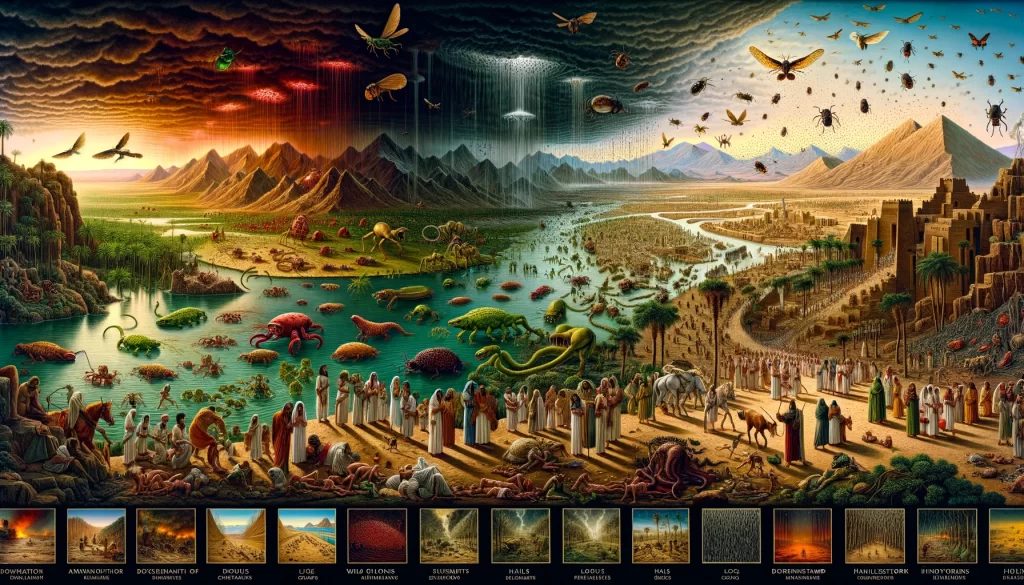
The story of the Ten Plagues, as recounted in Exodus 7-12, is one of the most dramatic and powerful narratives in the Bible. It describes the series of disasters God inflicted upon Egypt to persuade Pharaoh to release the Israelites from slavery. This narrative is not only a cornerstone of Jewish faith but also holds significance in Christian and Islamic traditions, symbolizing the struggle for freedom and the demonstration of divine power.
The Ten Plagues are a testament to the struggle between God and Pharaoh, embodying themes of justice, resilience, and liberation. Each plague serves as both a punishment for the Egyptians’ oppression of the Israelites and a demonstration of God’s supremacy over the Egyptian gods. This story has resonated through centuries, influencing religious rituals, artistic expressions, and cultural narratives around the world.
As we delve into the details of each plague, we’ll explore their descriptions in the scripture, their symbolic meanings, and the lessons they impart. This exploration will not only enhance our understanding of a pivotal biblical event but also reflect on its lasting impact on faith, culture, and history.
The First Plague: Water into Blood
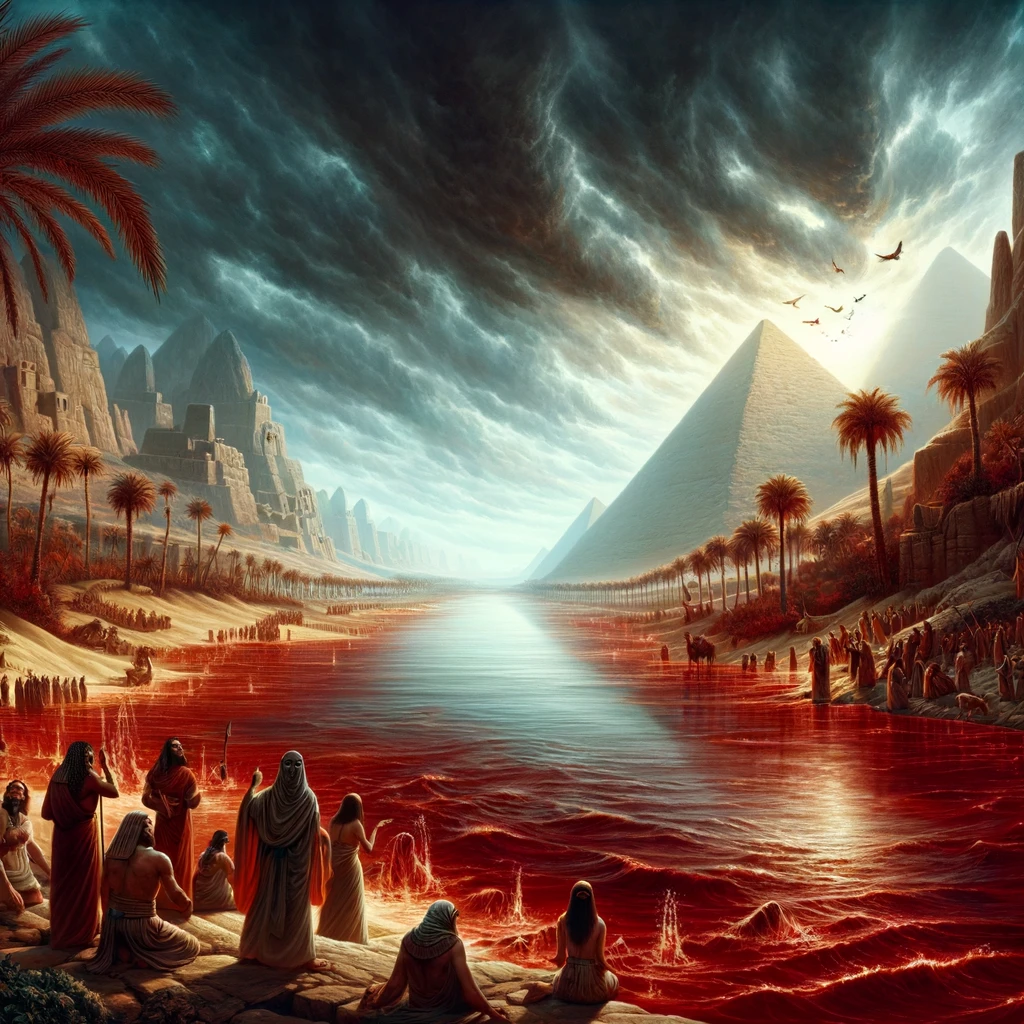
The narrative of the Ten Plagues begins with a dramatic transformation that sets the tone for the divine interventions to follow. In the First Plague, God instructs Moses to warn Pharaoh that if he refuses to release the Israelites from bondage, the waters of Egypt will turn into blood. Despite the warning, Pharaoh’s heart remains hardened, and through Aaron’s staff, the Nile River—Egypt’s lifeline—along with all its canals, ponds, and even the stored water, is turned to blood (Exodus 7:14-24).
This act is not only a display of divine power but also a direct challenge to Egypt’s polytheistic beliefs, specifically targeting the god Hapi, the deity of the Nile, and symbolizing the lifeblood of Egypt’s agriculture and daily life. The transformation renders the water undrinkable, causing fish to die and a stench to fill the land, thereby crippling the Egyptian economy and disrupting the natural order.
The plague of blood serves as a stark warning of the consequences of defiance against God and sets the stage for the escalating series of plagues to come. It highlights the themes of judgment and the sovereignty of the God of Israel over the natural world and the gods of Egypt. This event forces Pharaoh and the Egyptians to confront the power of God, yet their continued resistance lays the groundwork for further divine actions aimed at securing the Israelites’ freedom.
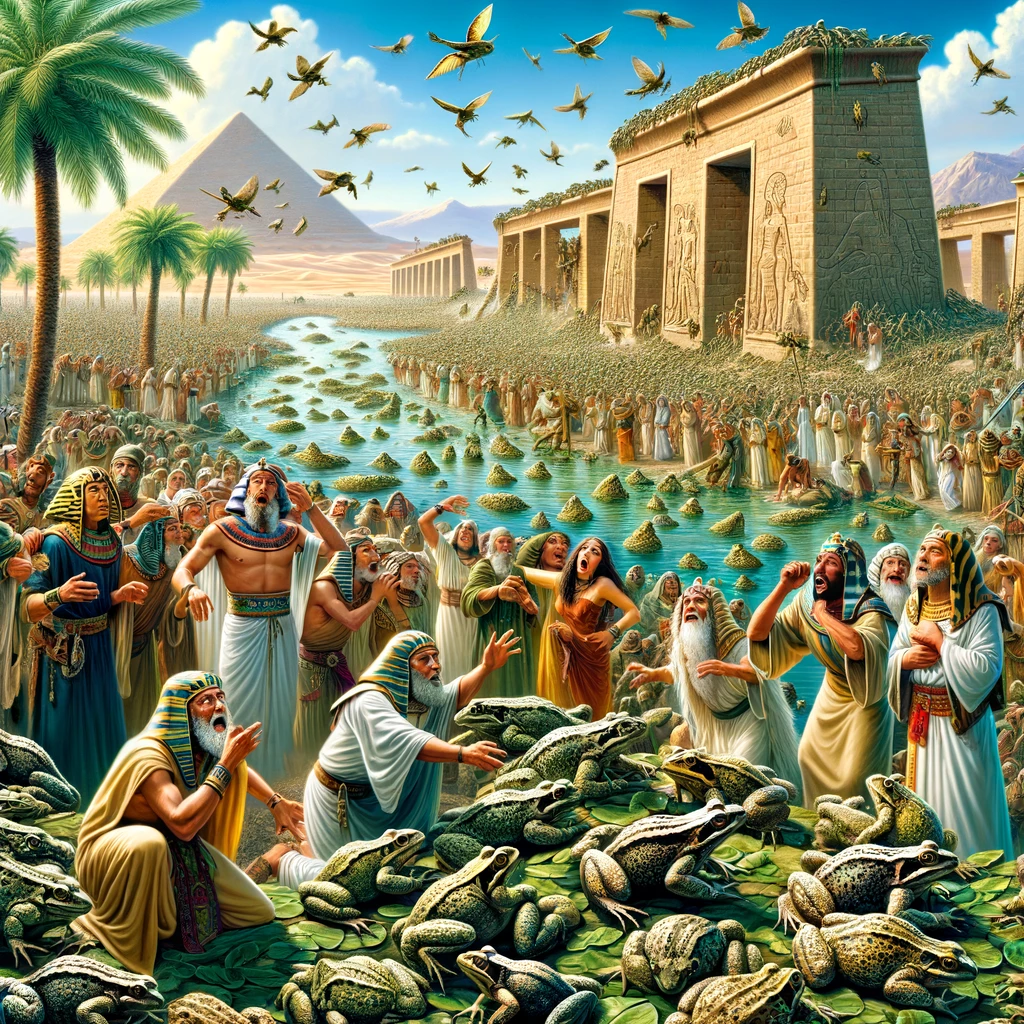
The Second Plague: Frogs
Following the initial plague, the Second Plague brought an overwhelming infestation of frogs from the Nile River, covering the Egyptian landscape (Exodus 8:1-15). God instructs Moses to command Aaron to stretch out his hand with his staff over the streams, canals, and ponds, causing frogs to swarm Egypt’s houses, bedrooms, and even into the beds and ovens of the Egyptian people. This plague was not only a physical inconvenience but also a profound psychological torment, invading the most private and sacred spaces of Egyptian life.
The frog, symbolically associated with fertility and also revered in Egyptian mythology, here becomes a symbol of chaos and disorder. The Egyptian goddess Heqet, depicted with a frog’s head and believed to protect against child mortality, is directly challenged, highlighting the contest between the Egyptian deities and the God of Israel. This plague mocks the Egyptians’ reverence for frogs, turning their symbol of life and fertility into an unbearable curse.
Pharaoh’s initial promise to let the Israelites go in exchange for relief from the frogs is quickly broken once the plague is lifted, showcasing a recurring theme of deceit and hard-heartedness. The plague of frogs emphasizes the disruptive power of God, capable of turning the natural order into chaos and penetrating the deepest sanctuaries of Egyptian life, further illustrating Pharaoh’s stubbornness and the escalating divine judgment upon Egypt.
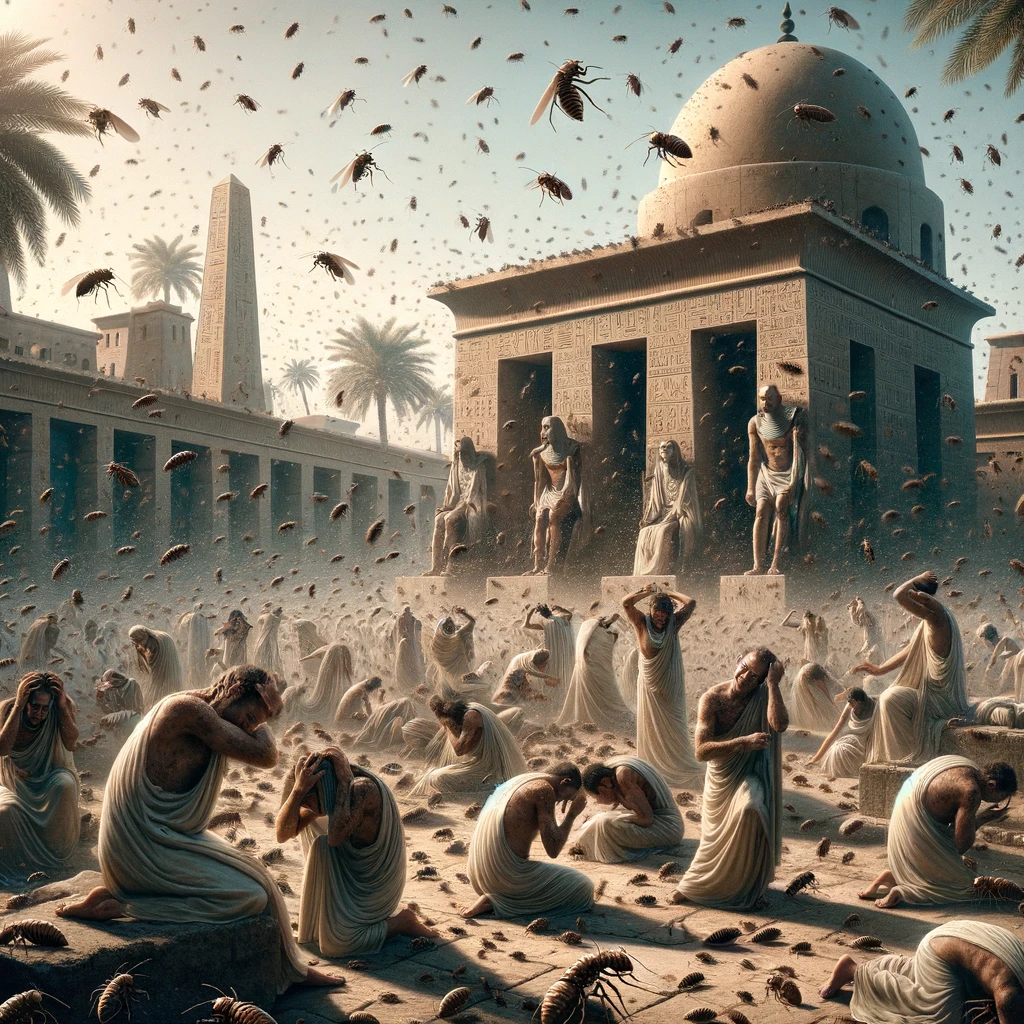
The Third Plague: Lice
In the escalation of divine judgments, the Third Plague introduced lice from the dust of the earth, afflicting humans and animals alike across Egypt (Exodus 8:16-19). This time, without warning to Pharaoh, Aaron strikes the dust of the ground with his staff, and it becomes lice, infiltrating every aspect of Egyptian life. The immediate and pervasive nature of this plague underscores a new level of divine intervention, directly impacting the physical well-being of the Egyptian people and their livestock.
Unlike the previous plagues, this one is particularly humiliating for the Egyptian magicians, who, despite their attempts, cannot replicate this feat and are forced to acknowledge, “This is the finger of God.” However, Pharaoh’s heart remains unyielded, deepening the narrative of resistance against undeniable divine power.
The lice, possibly fleas or gnats, represented not only a physical discomfort but also a spiritual defilement, rendering the Egyptians ritually unclean. This plague directly challenges the Egyptian priests’ purity, who prided themselves on cleanliness in their rituals. The omnipresence of the lice disrupts the societal and religious order, marking a profound demonstration of God’s power over the most intimate and personal aspects of life.
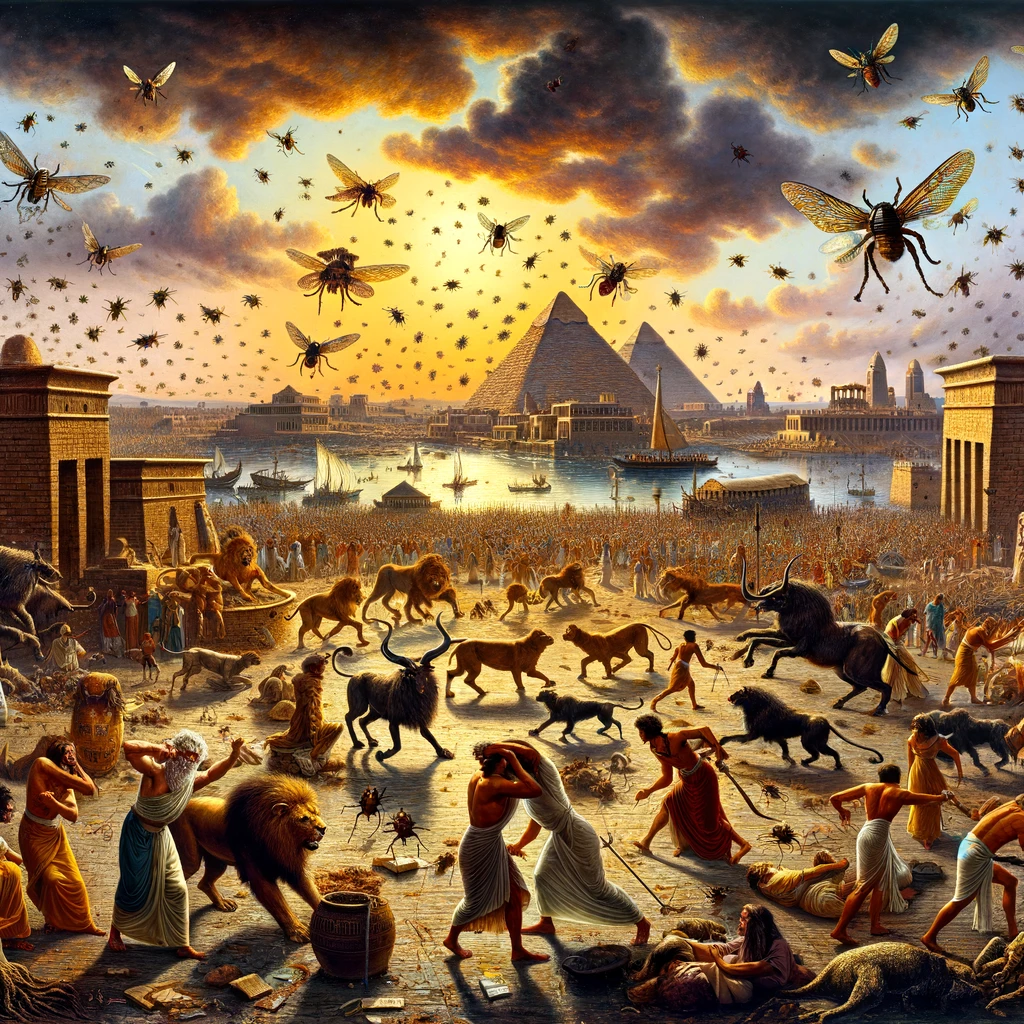
The Fourth Plague: Wild Animals or Flies
The Fourth Plague marks a significant shift in the nature of the divine plagues, with the invasion of either wild animals or swarms of flies, depending on the translation (Exodus 8:20-32). This plague specifically targets the open spaces of Egypt, sparing the Israelites in Goshen, demonstrating a clear distinction between the Egyptian and Israelite communities for the first time. The purposeful separation underscores God’s protection over His people, further illustrating the plagues’ selective judgment.
Moses warns Pharaoh of the impending disaster, yet once again, the warning is ignored, leading to the release of a horde of either wild animals that wreak havoc across Egypt or dense swarms of flies that infiltrate Egyptian homes and the royal palace, causing widespread distress. This plague directly challenges the Egyptian gods associated with protection and sovereignty over nature, such as Seth, the god of chaos and disorder.
Pharaoh’s response to this plague begins to show signs of concession, as he negotiates with Moses, offering to let the Israelites sacrifice to their God within Egypt. However, the negotiation is short-lived, and once the plague is lifted, Pharaoh reneges on his promise, hardening his heart once more. The Fourth Plague not only signifies God’s dominion over nature and the Egyptian deities but also begins to reveal the fractures in Pharaoh’s resolve, albeit temporarily.
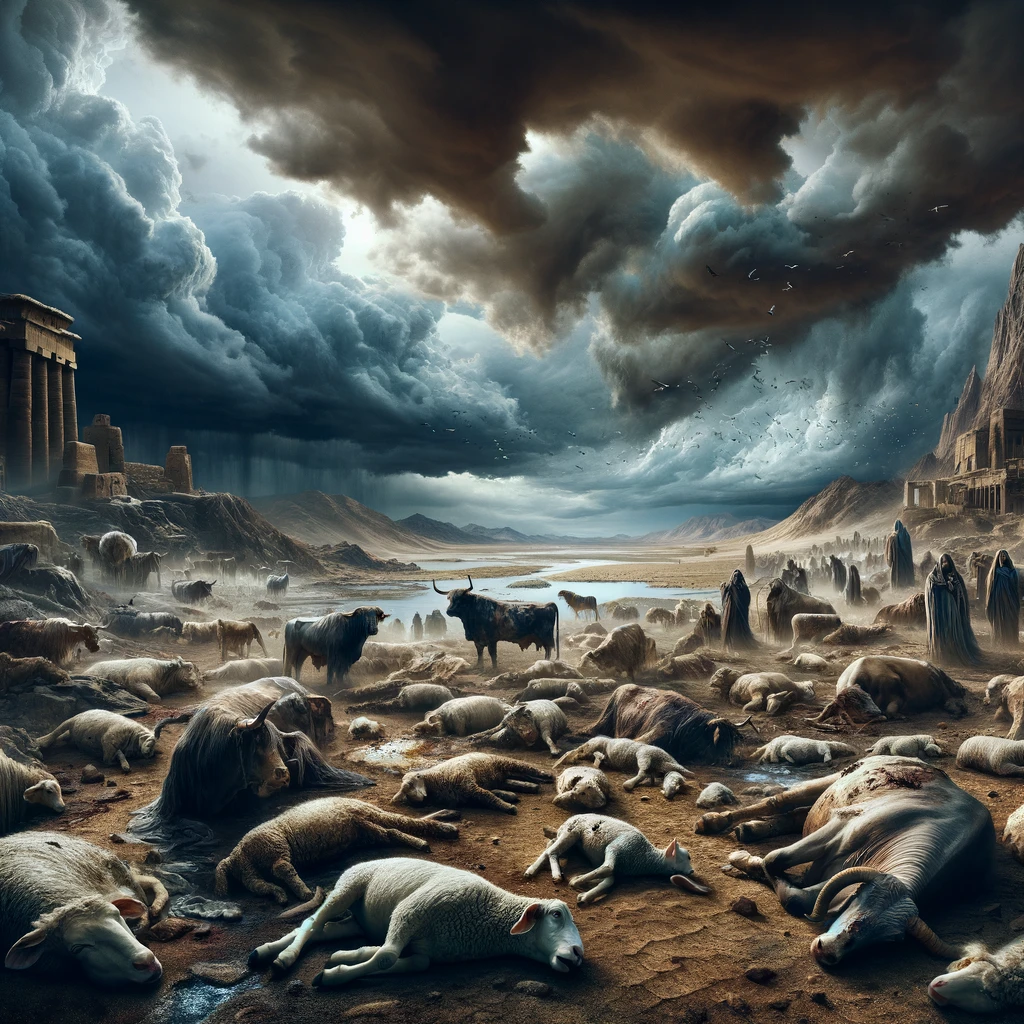
The Fifth Plague: Pestilence on Livestock
The Fifth Plague introduces a devastating pestilence that strikes the livestock of Egypt, sparing those of the Israelites (Exodus 9:1-7). This targeted affliction further emphasizes the distinction between the Egyptians and the Israelites, demonstrating God’s ability to protect His people while executing judgment on Egypt.
The plague directly impacts the economic foundation of Egyptian society, affecting horses, donkeys, camels, cattle, sheep, and goats. The loss of livestock symbolizes a significant blow to Egypt’s wealth, labor force, and status, undermining the gods associated with animal fertility and health, such as Hathor, the cow goddess, and Apis, the bull deity.
In this instance, the precise fulfillment of Moses’ warning showcases the power of the God of Israel to inflict selective destruction. The distinction made between the Egyptian and Israelite animals highlights the covenantal protection over God’s chosen people, reinforcing themes of divine sovereignty and mercy.
Pharaoh’s reaction to this plague is notably different; he investigates the aftermath, confirming that the Israelites’ livestock were indeed spared. Despite this undeniable evidence of divine intervention, Pharaoh’s heart remains hardened, refusing to release the Israelites. This stubbornness not only perpetuates his people’s suffering but also sets the stage for more severe judgments to follow.
The Sixth Plague: Boils
The Sixth Plague brings an intensely personal affliction upon the Egyptians, as Moses and Aaron scatter soot from a furnace into the air, and it becomes fine dust over all of Egypt, causing painful boils to break out on humans and animals alike (Exodus 9:8-12). This act of scattering soot, a symbol of purification and judgment, directly confronts the Egyptians with their impurity and the consequences of their defiance.
The boils, a manifestation of disease and discomfort, penetrate every social class, including Pharaoh’s magicians, who are rendered powerless and unable to stand before Moses because of the boils. This signifies a complete breakdown of the Egyptian religious and magical practices, showcasing the supremacy of the God of Israel over the Egyptian deities, particularly Imhotep, the god of medicine and healing.
This plague marks a turning point in the narrative, as it is the first to directly affect the bodies of the Egyptians, making the divine judgment undeniably personal and inescapable. The physical affliction serves as a potent symbol of the corruption and decay within Egypt, a direct result of Pharaoh’s hardened heart and his refusal to heed God’s commands.
Despite the severity of this plague, Pharaoh’s response is unchanged; his heart is hardened further, demonstrating a willful blindness to the suffering of his people and the clear signs of divine power. The Sixth Plague thus deepens the narrative of judgment, highlighting the stubbornness of Pharaoh and the inevitable escalation of divine intervention.
The Seventh Plague: Hail
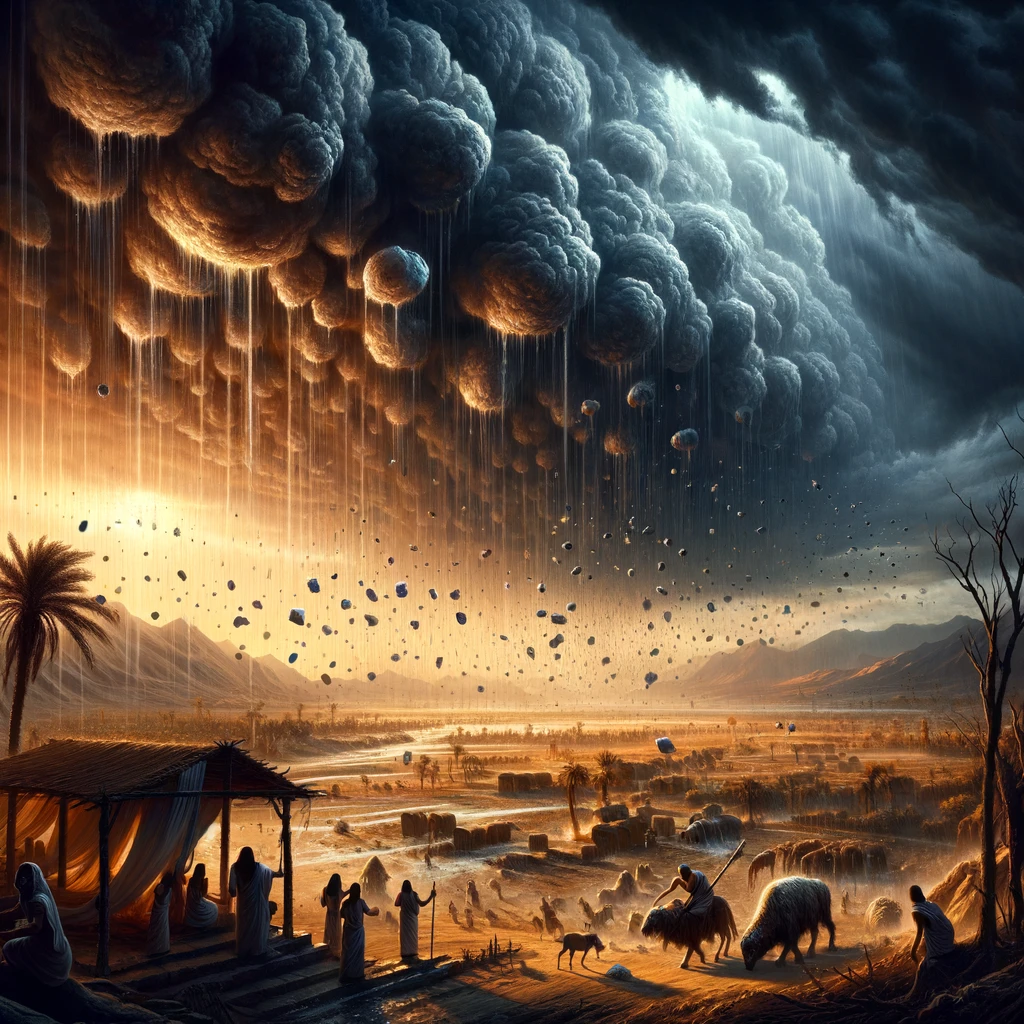
The Seventh Plague unleashes a catastrophic storm of hail mixed with fire upon Egypt, sparing only the land of Goshen where the Israelites reside (Exodus 9:13-35). This unprecedented meteorological event is heralded by a warning from Moses to Pharaoh, offering a chance for Egypt to shelter their servants and livestock from the impending disaster.
The hailstorm, described as being so severe that nothing like it had ever been seen in Egypt before, devastates crops, livestock, and anyone caught in the open, directly challenging the Egyptian deities associated with the sky and agriculture, such as Nut, the sky goddess, and Isis, the goddess of fertility.
This plague represents a divine display of power over nature and a direct attack on Egypt’s food supply and economic stability, further illustrating the futility of Pharaoh’s resistance against God. The selective destruction, sparing the Israelites, reinforces the notion of God’s covenantal protection and the distinction between God’s people and the Egyptians.
For the first time, Pharaoh admits to sinning against the Lord and Moses, requesting relief from the plague, signifying a temporary acknowledgment of God’s supremacy. However, once the storm ceases, Pharaoh’s heart hardens once again, retracting his confession and refusing to release the Israelites. This cycle of defiance, temporary repentance, and subsequent hardening of the heart underscores the deepening conflict and the inevitability of further divine action.
The Eighth Plague: Locusts
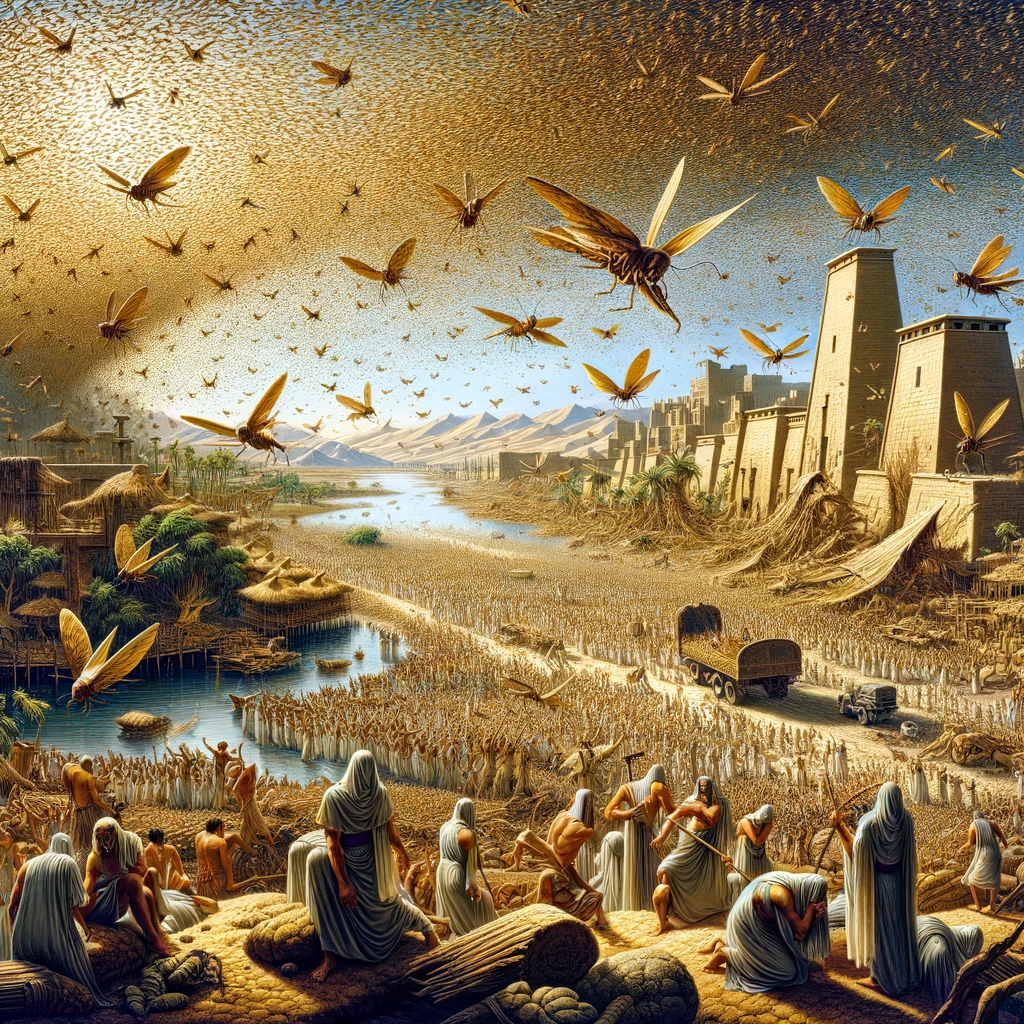
The Eighth Plague introduces a devastating swarm of locusts that covers Egypt, consuming what little was left of the country’s vegetation after the hailstorm (Exodus 10:1-20). This plague represents an acute attack on Egypt’s ability to sustain itself, decimating crops and further crippling the economy.
God commands Moses to stretch out his staff over Egypt, bringing the locusts as a form of judgment that obliterates the remnants of the fields, including trees and plants. The severity of this plague is such that it threatens to erase any hope of recovery for the Egyptian people, emphasizing the depth of Pharaoh’s folly in resisting God’s command.
The locusts, in biblical terms, symbolize a divine instrument of punishment and destruction, challenging the Egyptian gods associated with fertility and harvest, such as Osiris, the god of vegetation and rebirth. This plague starkly illustrates the consequences of Pharaoh’s hardened heart, not only for him but for all of Egypt, as the entire nation suffers from the king’s stubborn refusal to heed Moses’ warnings.
Despite the unprecedented devastation, Pharaoh’s response follows a now-familiar pattern: he briefly acknowledges his sin and begs for relief, only to harden his heart once the threat is removed. This recurring cycle of acknowledgment and recalcitrance highlights Pharaoh’s deep-seated pride and the tragic consequences of his refusal to submit to God’s will.
The Ninth Plague: Darkness
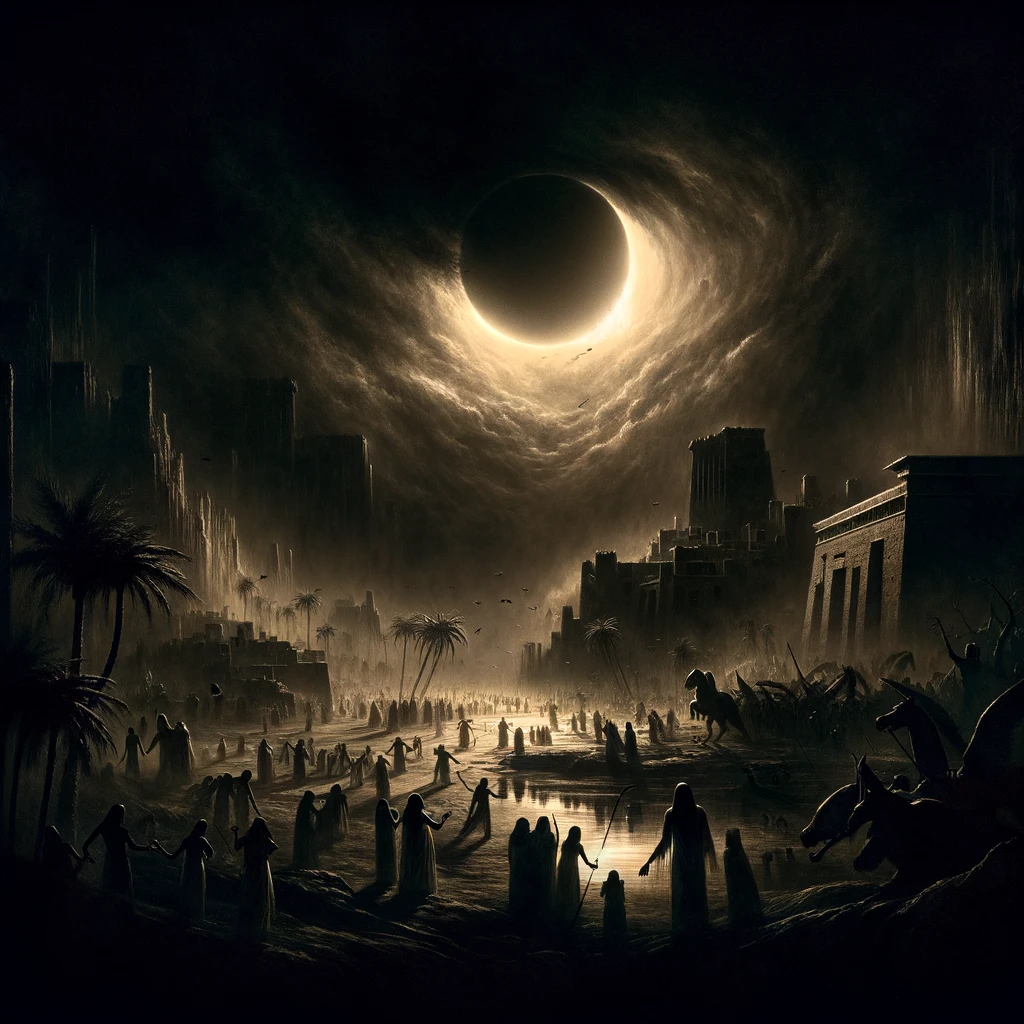
The Ninth Plague casts a palpable darkness over Egypt for three days, a darkness so profound that it could be felt, rendering the Egyptians unable to see one another or leave their homes (Exodus 10:21-29). This supernatural darkness, unlike any ordinary eclipse or storm, represents a direct affront to the sun god Ra, one of the most important and powerful deities in the Egyptian pantheon, who symbolized light, life, and order. The plague of darkness disrupts the very essence of Egyptian religious life, casting doubt on Ra’s power and, by extension, the authority of Pharaoh, who was considered Ra’s earthly embodiment.
This darkness, symbolic of spiritual blindness and the deepening chaos within Egypt, isolates the nation in a tangible manifestation of the judgment they face for their oppression of the Israelites. The selective nature of this plague, sparing the Israelites in Goshen, who enjoy light in their dwellings, underscores the distinction between God’s people and the Egyptians, reinforcing the theme of divine protection and segregation.
Pharaoh’s reaction to the Ninth Plague is increasingly desperate. He offers Moses a compromise, allowing the Israelites to leave but demanding they leave their livestock behind. Moses refuses, insisting on total compliance with God’s demands. Despite the severity of the plague, Pharaoh’s heart remains unyielding, leading to a final, devastating ultimatum from Moses that sets the stage for the tenth and most severe plague.
The Tenth Plague: Death of the Firstborn
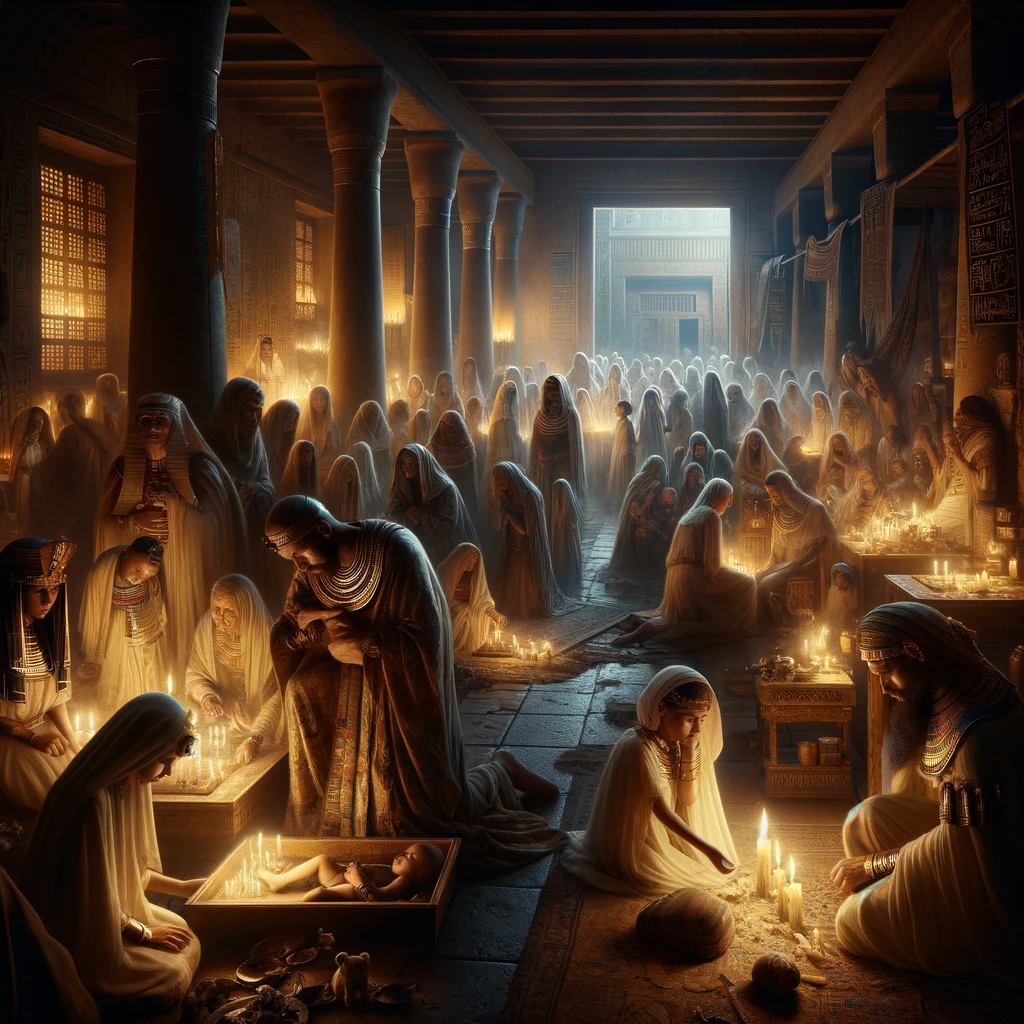
The culmination of the divine judgments against Egypt is the Tenth Plague, the death of all firstborn in the land, from the firstborn of Pharaoh who sits on his throne to the firstborn of the slave girl who is at her hand mill, and all the firstborn of the cattle as well (Exodus 11:1-10, 12:29-30). This final plague is not only a profound act of judgment but also a direct strike at the heart of Egyptian society and its future, symbolizing the ultimate cost of Pharaoh’s stubborn defiance against God’s command to let the Israelites go.
The plague specifically targets the firstborn, a status highly significant in ancient societies for inheritance and succession, thereby threatening the continuity and stability of Egyptian families and their social structure. It also challenges the divine status of Pharaoh, who was considered a god among his people, showing that not even he could protect his own child from the judgment of the God of Israel.
This event is preceded by the institution of the Passover, where the Israelites are commanded to mark their doorposts with the blood of a lamb, ensuring that the angel of death would pass over their homes. The Passover becomes a lasting ordinance for the Israelites, commemorating their deliverance from slavery and the sparing of their firstborn.
The impact of this plague finally breaks Pharaoh’s resistance, compelling him to release the Israelites. However, the grief and devastation left in its wake are immense, marking a turning point in the biblical narrative and the history of the Israelite people. The Tenth Plague serves as a stark reminder of the consequences of opposing divine will and the power of God to deliver His people from bondage.
The narrative of the Ten Plagues, culminating in the death of the firstborn, underscores themes of judgment, redemption, and the sovereignty of God. As we transition to discussing the theological significance and cultural impact of these events, we can reflect on their enduring legacy in religious tradition and their profound implications for understanding divine justice and mercy. Let me know if you would like to proceed with the analysis of these broader themes or if there are other aspects of the story you’d like to explore further.
In the heart of the desert, beneath the scorching sun and amidst the endless sands, there lay a mountain known as Horeb, the Mountain of God. This is where our story unfolds, a tale of divine encounter and a mission that would forever change the course of history.
Encounter at Horeb
Moses, once a prince of Egypt, now a humble shepherd, led his flock through the wilderness, navigating the arid landscape in search of grazing land. His life had taken many turns, from the palaces of Pharaoh to the quiet, pastoral life among the Midianites. Yet, on this ordinary day, Moses would stumble upon the extraordinary.
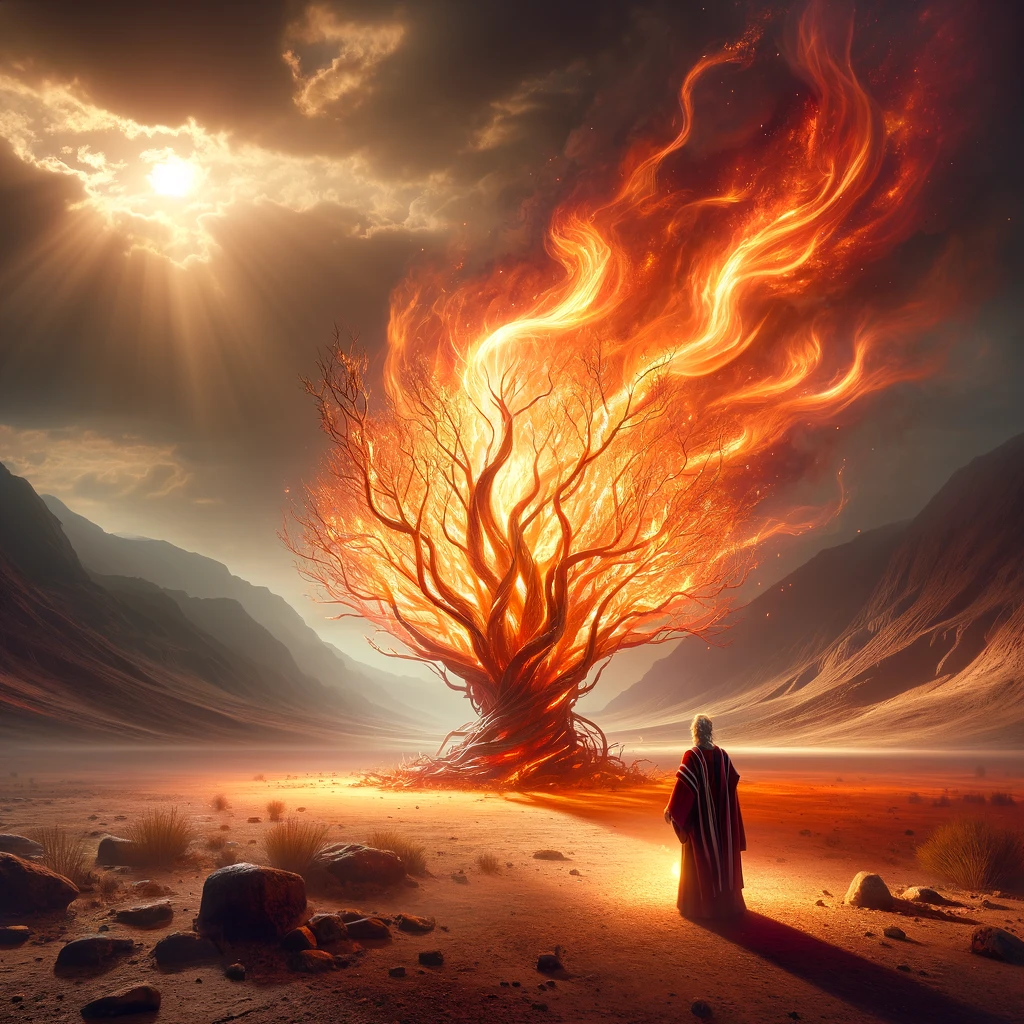
As he approached the mountain, a curious sight caught his eye—a bush ablaze, engulfed in flames, yet not consumed. Intrigued and drawn by this miraculous vision, Moses decided to investigate. “I must turn aside and see this great sight, why the bush is not burned,” he thought.
The Voice from the Flames
As he drew near, a voice called out from the midst of the fire, “Moses, Moses!” Startled, Moses responded, “Here I am.” The voice, powerful and filled with authority, instructed him, “Do not come near; take your sandals off your feet, for the place on which you are standing is holy ground.” Moses obeyed, a mixture of fear and awe enveloping him.
The voice identified itself as the God of his fathers, the God of Abraham, the God of Isaac, and the God of Jacob. Moses hid his face, afraid to look at God.
A Divine Mission
God spoke of the suffering of the Israelites in Egypt, their cries of distress from their bondage reaching His ears. He revealed His plan to deliver them from the Egyptians and bring them to a land flowing with milk and honey. Moses was chosen for this monumental task—to confront Pharaoh and lead the Israelites out of Egypt.
Moses, overwhelmed by the weight of this mission, doubted his ability, “Who am I that I should go to Pharaoh and bring the children of Israel out of Egypt?” God assured him, “I will be with you,” and gave him a sign, promising that after the people were freed, they would worship God at this very mountain.
As Moses questioned further, concerned about the Israelites’ belief in him and his message, God revealed His name, “I AM WHO I AM,” a declaration of His eternal, self-existent nature. He instructed Moses to say to the Israelites, “I AM has sent me to you.”
Preparation for the Journey
God further instructed Moses on what to say to the elders of Israel and how to appeal to Pharaoh. Despite God’s assurances, Moses remained apprehensive, leading to further instructions and signs to convince both the Israelites and Pharaoh.
Thus, armed with God’s command and reassured by His promises, Moses set out from the mountain, his life forever changed. He was no longer just a shepherd in the desert; he was now a leader on a divine mission, a mission that would lead to the liberation of his people and the demonstration of God’s power and faithfulness.
The burning bush, more than just a miraculous sign, served as a symbol of God’s presence, guidance, and the unbreakable bond between Him and His chosen people. It marked the beginning of a journey not just for Moses but for all of Israel, a journey from slavery to freedom, from despair to hope.
The Challenge Ahead
Armed with the divine mandate, Moses embarked on the daunting journey back to Egypt. His heart was heavy with the responsibility laid upon his shoulders, yet the encounter with the Divine at the burning bush had ignited a flame within him, a flame of courage and faith that would not be extinguished.
Convincing the Elders
Moses’ first task was to convince the elders of Israel that the God of their fathers had appeared to him, that He had heard their cries and was determined to deliver them. With Aaron, his brother, by his side, Moses gathered the elders and shared his extraordinary encounter, performing the signs as God had instructed.
The elders, witnessing these wonders, believed. A wave of hope spread among the people, hope that their cries for deliverance had finally been heard, that their God had not forsaken them. They bowed down and worshiped, their spirits lifted by the promise of redemption.
The Encounter with Pharaoh
Yet, the path to freedom was fraught with challenges. Moses and Aaron’s plea to Pharaoh, “Let my people go,” was met with scorn and disbelief. Far from granting their request, Pharaoh increased the Israelites’ burden, accusing them of laziness and seeking to distract them from their labor with false promises.
The increased hardship faced by the Israelites led to doubt and despair. Moses, bearing the weight of their suffering, questioned God, “Why have you done evil to this people? Why did you ever send me?” God’s response was a reassurance of His commitment to the promise made to Abraham, Isaac, and Jacob. He instructed Moses to speak to Pharaoh once again, assuring him that He would compel Pharaoh to let the Israelites go through His mighty hand.
A Test of Faith
The journey from the burning bush back to Egypt and the subsequent confrontations with Pharaoh were not just a test of Moses’ faith, but also a test for the people of Israel. Each refusal by Pharaoh, each miraculous sign performed by Moses and Aaron, and each ensuing hardship served to strengthen their faith, to forge a people who would trust in their God against all odds.
The plagues that followed, each a demonstration of God’s power over the gods of Egypt, were a direct challenge to Pharaoh’s authority and a testament to the Israelites that their God was indeed the one true God. With each plague, Pharaoh’s heart grew harder, setting the stage for the final, devastating act that would ultimately lead to their liberation.
The Road to Freedom
The story of the burning bush is but the beginning of a larger narrative of faith, courage, and divine intervention. It sets the stage for the miraculous events that would lead to the Exodus, the parting of the Red Sea, and the journey to the Promised Land. Through trials and tribulations, through moments of doubt and acts of faith, the burning bush remains a beacon of God’s presence, a reminder that He is always with His people, guiding them, challenging them, and delivering them to freedom.
As Moses led the Israelites out of Egypt, the memory of the burning bush, the voice of God calling out from the flames, would forever remind them of their divine mission and destiny. It was a journey that began in the heart of the desert, at a mountain called Horeb, where a shepherd encountered God in a burning bush and emerged as a leader of a nation destined for greatness.
In the land of Egypt, where the Hebrews lived as strangers, their numbers grew and filled the land. The blessing of their proliferation, however, turned into their curse when a new Pharaoh, who knew not of Joseph’s good deeds, ascended to the throne. Fearing the Hebrews’ burgeoning numbers might align with Egypt’s enemies, Pharaoh subjected them to cruel bondage, appointing taskmasters over them to afflict them with heavy burdens. Yet, the more they were oppressed, the more they multiplied, fulfilling the promise made to their forefathers.
The Pharaoh’s Decree
Pharaoh’s fear of the Hebrews’ increasing numbers led him to a dark decision. He commanded the Hebrew midwives, Shiphrah and Puah, to kill every Hebrew boy at birth, but to let the girls live. These midwives, however, feared God more than Pharaoh and did not do as the king of Egypt commanded them. They let the boys live. When questioned by Pharaoh, they replied that the Hebrew women were vigorous and gave birth before the midwives could reach them. God dealt well with the midwives, and the people multiplied and grew very strong.
In his wrath, Pharaoh issued a more dire decree, commanding all his people, saying, “Every son that is born to the Hebrews you shall cast into the Nile, but you shall let every daughter live.”
The Birth of Moses
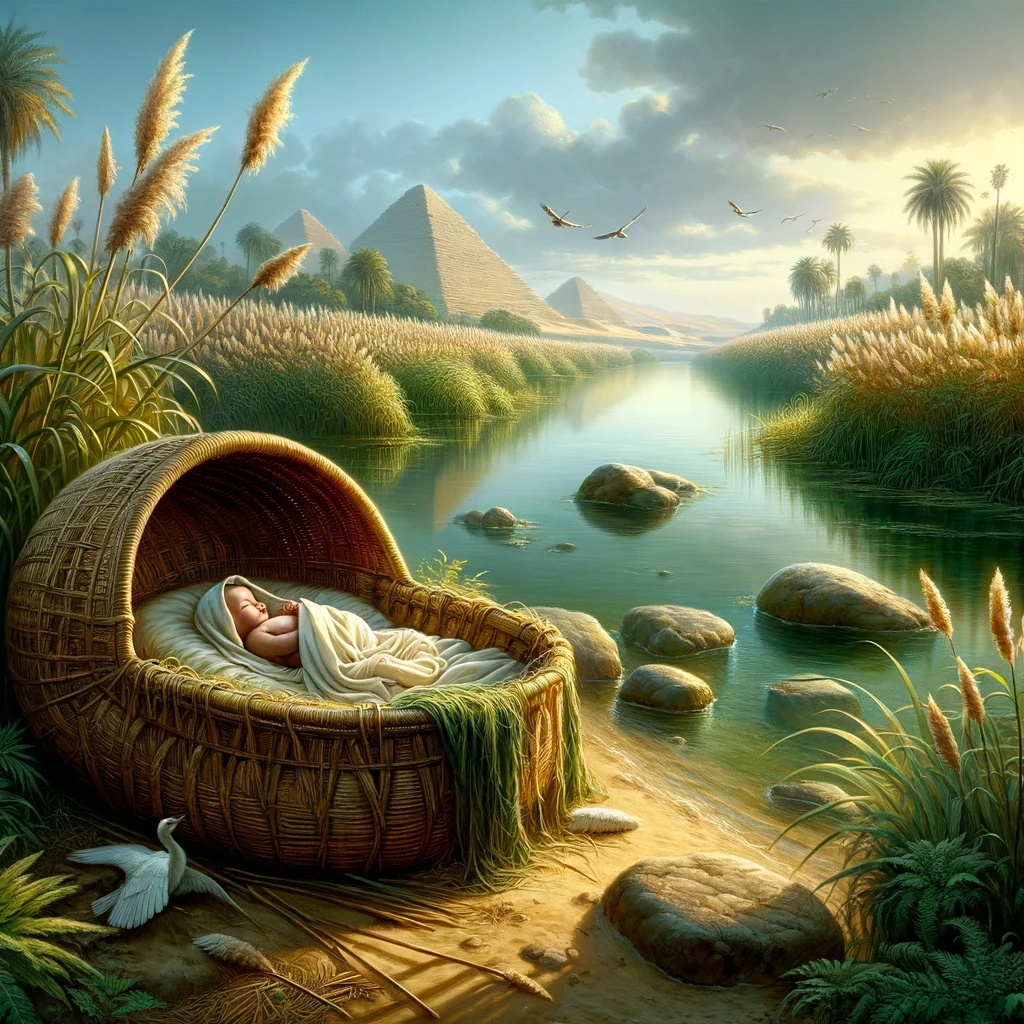
During this time of sorrow and fear, a man from the house of Levi took a Levite woman as his wife. The woman conceived and bore a son, and when she saw that he was a fine child, she hid him for three months. But when she could hide him no longer, she took for him a basket made of bulrushes and daubed it with bitumen and pitch. She placed the child in it and put it among the reeds by the river bank.
The child’s sister stood at a distance to know what would be done to him. Then Pharaoh’s daughter went down to the Nile to bathe, and her attendants walked along the riverbank. Seeing the basket among the reeds, she sent her servant to get it. When she opened it, she saw the baby. He was crying, and she felt sorry for him. “This is one of the Hebrews’ children,” she said.
Then the baby’s sister approached Pharaoh’s daughter. “Shall I go and get one of the Hebrew women to nurse the baby for you?” she asked. Pharaoh’s daughter agreed, and the girl fetched the baby’s mother. Pharaoh’s daughter said to her, “Take this baby and nurse him for me, and I will pay you.” So the woman took the baby and nursed him. When the child grew older, she brought him to Pharaoh’s daughter and he became her son. She named him Moses, saying, “I drew him out of the water.”
Moses: The Early Years
Moses grew up in the palace of Pharaoh, educated in all the wisdom of the Egyptians. He was mighty in words and deeds. Yet, his heart was with his people, the Hebrews. As a young man, he went out to his people and saw their hard labor. He saw an Egyptian beating a Hebrew, one of his own people. Looking this way and that and seeing no one, he killed the Egyptian and hid him in the sand. The next day, he went out again and found two Hebrews fighting. He asked the one in the wrong, “Why are you hitting your fellow Hebrew?”
The man replied, “Who made you ruler and judge over us? Are you thinking of killing me as you killed the Egyptian?” Then Moses was afraid and thought, “What I did must have become known.”
When Pharaoh heard of this matter, he sought to kill Moses. But Moses fled from Pharaoh and went to live in Midian, where he sat down by a well. In Midian, he was welcomed by Jethro, the priest of Midian, whose daughters he helped water their flock. Moses was given Zipporah, one of Jethro’s daughters, as his wife, and they had a son named Gershom, for he said, “I have become a foreigner in a foreign land.”
Conclusion
The story of Moses’ birth and early years is a testament to God’s providence and protection. It underscores the theme of deliverance and sets the stage for the great deliverance of the Hebrews from Egypt. Moses’ journey from a child hidden in the reeds to a prince of Egypt, and then to a fugitive in Midian, demonstrates the mysterious ways in which God prepares His chosen instruments for His purposes. Through every trial and tribulation, the hand of God was upon Moses, guiding him towards his destiny to lead the Israelites out of bondage and into the Promised Land.
This narrative not only recounts the miraculous preservation of a child who would grow up to be one of the most important figures in biblical history but also reflects the enduring faith of a people under persecution. It reminds us of the power of faith, the importance of obedience to God’s will, and the ultimate triumph of God’s plans over the designs of men.
The Book of Exodus, the second book of the Bible, is a foundational text that recounts the epic story of the Israelites’ deliverance from slavery in Egypt, their journey through the wilderness, and the establishment of their covenant with God at Mount Sinai. Within its chapters, Exodus unfolds a series of dramatic, inspirational, and deeply spiritual narratives that have shaped the beliefs and practices of countless generations. The 23 Bible stories selected from this book capture the essence of faith, resilience, and the quest for freedom and identity under divine guidance.
These stories range from the miraculous birth and rise of Moses, the reluctant leader chosen by God to liberate his people, to the awe-inspiring events leading to the Exodus itself, including the ten plagues and the parting of the Red Sea. They encompass the trials and tribulations faced by the Israelites in the desert, their encounters with God, and the revelation of the Law, including the Ten Commandments, which continue to be moral and ethical cornerstones in the Judeo-Christian tradition.
Through these narratives, the Book of Exodus explores themes of faith, obedience, justice, and redemption, offering profound insights into the nature of God and the relationship between the divine and humanity. The stories serve not only as historical accounts but also as spiritual lessons that address the universal human condition, the struggle for freedom, and the longing for a covenantal relationship with the divine.
This introduction to 23 Bible stories from the Book of Exodus invites readers to embark on a journey through one of the most powerful and influential texts in human history. It promises a deeper understanding of the spiritual heritage shared by Jews and Christians alike and offers timeless lessons on leadership, faith, and the power of divine intervention in shaping human destiny.
The Birth of Moses(Exodus 1-2): The story of Moses’ early life, his birth during a time when Pharaoh orders all newborn Hebrew boys to be killed, his rescue by Pharaoh’s daughter, and his upbringing in the Egyptian court.
The Burning Bush (Exodus 3): Moses encounters God in the form of a burning bush on Mount Horeb (Sinai), where he is called to lead the Israelites out of Egypt.
The Ten Plagues (Exodus 7-12): God sends ten plagues upon Egypt when Pharaoh refuses to release the Israelites from bondage, culminating in the death of the firstborn of Egypt.
The Passover(Exodus 12): The institution of the Passover as a perpetual observance to commemorate the Israelites’ deliverance from Egypt, specifically the passing over of the houses of the Israelites by the angel of death during the tenth plague.
The Exodus from Egypt (Exodus 12-15): The departure of the Israelites from Egypt, including the parting of the Red Sea, allowing them to escape Pharaoh’s army.
The Manna and Quail(Exodus 16): God provides manna and quail for the Israelites to eat in the desert.
The Water from the Rock (Exodus 17): Moses strikes a rock at Horeb, and water flows out for the people to drink.
The Battle with Amalek (Exodus 17): The Israelites fight and defeat the Amalekites with Joshua as the commander and Moses holding up his hands for victory.
The Covenant at Mount Sinai (Exodus 19-24): The Israelites arrive at Mount Sinai, where they enter into a covenant with God, receiving the Ten Commandments and other laws.
The Golden Calf (Exodus 32): While Moses is on Mount Sinai, the people create a golden calf to worship, leading to Moses breaking the tablets of the law in anger.
The Construction of the Tabernacle (Exodus 25-31, 35-40): Detailed instructions are given for the construction of the Tabernacle, a portable dwelling place for God among the Israelites, and its actual construction and dedication.
he Appointment of Bezalel and Oholiab (Exodus 31, 35-36): God appoints Bezalel and Oholiab with wisdom, understanding, and knowledge in all manner of workmanship to construct the Tabernacle and its furnishings, illustrating the importance of skill and craftsmanship in worship.
The Sabbath Law (Exodus 31, 35): Alongside the construction of the Tabernacle, the importance of the Sabbath as a day of rest is reiterated, highlighting its role as a sign of the covenant between God and the Israelites.
Moses’ Radiant Face (Exodus 34): After Moses returns from his second 40-day stay on Mount Sinai with the new set of tablets, his face shines from speaking with God, symbolizing his close relationship with the divine and the sanctity of the law.
The Renewal of the Covenant (Exodus 34): Following the incident of the Golden Calf, God renews the covenant with Israel, providing Moses with a new set of stone tablets and reiterating the laws and commandments that the Israelites are to follow.
The Cloud and the Glory of the Lord (Exodus 40): Upon the completion of the Tabernacle, the cloud covers the tent of meeting, and the glory of the Lord fills the Tabernacle, signifying God’s presence among His people and His approval of their work.
The Setting Up of the Tabernacle (Exodus 40): The Tabernacle is erected and anointed on the first day of the first month in the second year after the Exodus, marking a pivotal moment in the Israelites’ journey as they establish a formal place of worship.
Liberation from Egypt: The story of the Israelites’ exodus from Egypt is a central narrative that showcases God’s power, faithfulness, and the theme of liberation from oppression. This narrative includes the calling of Moses, the ten plagues, the Passover, and the crossing of the Red Sea.
Covenant and Law: At Mount Sinai, the Israelites receive the law, including the Ten Commandments, which are central to Jewish religious identity and ethics. This event marks the establishment of the covenant between God and the Israelites, defining their obligations to God and to each other.
Worship and Presence: The instructions for and the construction of the Tabernacle are detailed in Exodus. The Tabernacle serves as a portable sanctuary where God dwells among His people. The rituals and priesthood associated with the Tabernacle set the foundation for Israelite worship.
Leadership and Guidance: Moses’ leadership is a key focus, from his initial call to his role in leading, interceding for, and instructing the Israelites. His interactions with God provide a model of faithfulness and direct communication with the divine.
Challenges and Renewal: The journey of the Israelites is not without challenges, including internal rebellion (e.g., the Golden Calf incident) and external threats. These stories highlight the importance of faithfulness to God and the consequences of disobedience, as well as God’s willingness to forgive and renew His covenant with His people.
Divine Presence and Glory: The manifestation of God’s presence through the cloud and the glory filling the Tabernacle emphasizes God’s immanence and the sanctity of the space where He dwells among His people.