Recent Posts

Bible story about The Famine and Journey to Egypt


The story of the famine and the journey to Egypt, found in Genesis chapters 42 through 45, is a tale of family, reconciliation, and divine providence. It unfolds during a time of widespread famine, affecting not only Egypt but also the surrounding lands, including Canaan where Jacob and his sons reside.

As the famine grows severe, Jacob learns that there is grain in Egypt, and he sends ten of his sons, sparing Benjamin, the youngest, to buy provisions. Unbeknownst to them, their brother Joseph, whom they had sold into slavery years before, has risen to become the governor of Egypt, second only to Pharaoh. In this role, Joseph is overseeing the distribution of food.

When Joseph’s brothers arrive in Egypt, they do not recognize him, but he immediately recognizes them. Instead of revealing his identity, Joseph decides to test their character. He accuses them of being spies, but eventually agrees to sell them grain on the condition that they bring their youngest brother to him, to prove their honesty. Joseph insists on keeping one brother, Simeon, as a hostage until they return.

Back in Canaan, the brothers relay their experiences to Jacob, who is initially reluctant to send Benjamin to Egypt. However, as the famine worsens, Jacob has no choice but to agree, sending his sons back to Egypt with gifts and double the money, hoping to appease the Egyptian governor and secure Simeon’s release as well as more grain.

Upon their return to Egypt, Joseph’s brothers are received hospitably. Joseph is moved to tears when he sees Benjamin but still does not reveal his identity. He continues his test by planting a silver cup in Benjamin’s sack and then accusing the brothers of theft. When the cup is found in Benjamin’s sack, Joseph demands that Benjamin stay in Egypt as his slave. Judah steps forward, offering himself as a slave in place of Benjamin, explaining the devastating effect Benjamin’s loss would have on their father, Jacob.

Moved by Judah’s display of self-sacrifice and the brothers’ unity, Joseph can no longer control his emotions. He reveals his identity to his astonished brothers and assures them that their actions were part of God’s plan to save lives during the famine. Joseph forgives his brothers for their past misdeeds and sends for Jacob, inviting the entire family to live in Egypt, in the region of Goshen, where he can provide for them.

Jacob is stunned but overjoyed to learn that Joseph is still alive. The family, along with all their possessions, moves to Egypt, where Joseph reunites with his father and introduces him to Pharaoh. The story culminates in a poignant family reunion and the fulfillment of God’s promise to Abraham, Isaac, and Jacob, as the Israelites begin their sojourn in Egypt, setting the stage for future events in the biblical narrative.


The continuation of the story emphasizes the profound transformation within Joseph’s family and the fulfillment of God’s sovereign plan. After revealing his identity, Joseph reassures his brothers, telling them not to be distressed or angry with themselves for selling him into slavery. He explains that it was God who sent him ahead of them to preserve life and to save their family during the famine. This moment is pivotal, showcasing Joseph’s deep faith and understanding of God’s providence over the events of his life.

Joseph instructs his brothers to return to Canaan, gather their father, their families, and their belongings, and come back to Egypt. He promises them the best of the land and assures them that he will provide for them, as there are still five years of famine to come. This plan aligns with God’s earlier promises to make Abraham’s descendants into a great nation and to care for them.

When the brothers return to Canaan and tell Jacob that Joseph is still alive and is the governor of all Egypt, Jacob is initially overwhelmed and incredulous. However, upon seeing the carts and goods sent by Joseph to transport him and his household to Egypt, Jacob’s spirit is revived. He declares that he must go and see Joseph before he dies, illustrating the emotional depth of the father-son bond and the joy of rediscovered hope.

The journey to Egypt marks a significant moment in the biblical narrative, symbolizing not just a physical relocation but a transition in the covenant relationship between God and His people. When they arrive in Egypt, Joseph meets Jacob in Goshen, and their reunion is marked by tears and joy, symbolizing the healing of past wounds and the restoration of family unity.

Joseph then introduces his father and some of his brothers to Pharaoh, who welcomes them to live in the best part of the land and to take care of their livestock. The Israelites settle in Goshen, and they gain possessions there, multiplying exceedingly. This period in Egypt sets the stage for the growth of Jacob’s family into the twelve tribes of Israel, fulfilling God’s promise to Abraham, Isaac, and Jacob.

However, the story also foreshadows the future challenges the Israelites will face in Egypt, leading to their eventual enslavement and the need for God’s deliverance through Moses. This narrative thread underscores the theme of God’s faithfulness and sovereignty, weaving through the lives of individuals and entire nations to accomplish His divine purposes.

The story of Joseph and his family’s journey to Egypt is a testament to the power of forgiveness, the importance of faith, and the overarching narrative of redemption that characterizes the biblical story. It teaches lessons about God’s ability to work through human actions and intentions, turning them towards good ends and the fulfillment of His promises.

Bible story about The Coat of Many Colors


The story of the Coat of Many Colors is a captivating narrative found in Genesis 37:3-4, which unfolds within the broader saga of Joseph, one of the twelve sons of Jacob, who is also known as Israel. This tale is not just a story about a piece of clothing but symbolizes favoritism, jealousy, and the beginning of a journey that would eventually lead to redemption and the fulfillment of divine prophecy.

Jacob had twelve sons, but Joseph, the son of his beloved wife Rachel, held a special place in his heart. To express his deep affection for Joseph, Jacob made him a richly ornamented robe, often described as a coat of many colors. This coat was not just an ordinary garment; it was a symbol of Jacob’s preferential love for Joseph and signified that he was held in higher esteem than his brothers.

The brothers, already envious of Joseph’s close relationship with their father, saw this coat as a tangible proof of Jacob’s favoritism. Their envy turned into deep-seated hatred, to the point where they could not speak a kind word to him. This animosity set the stage for the subsequent events in Joseph’s life, where his brothers’ jealousy would lead them to conspire against him, ultimately selling him into slavery.

The coat of many colors, therefore, stands as a pivotal element in the narrative, representing the complexities of family dynamics, the consequences of favoritism, and the beginning of a divine plan that would unfold in unexpected ways. Through Joseph’s eventual rise to power in Egypt and his reconciliation with his family, the story teaches lessons about forgiveness, providence, and the mysterious ways in which God’s plans

The story unfolds as follows:

  • Joseph’s Dream: Joseph shares two dreams with his family, which imply that his brothers and even his parents will bow down to him one day. These dreams, combined with his father’s favoritism, further inflame his brothers’ jealousy.
  • The Plot Against Joseph: Joseph’s brothers conspire against him. When Joseph comes to check on them tending their flocks, they initially plan to kill him but ultimately decide to throw him into a pit. Reuben, the eldest brother, secretly plans to rescue Joseph later. However, before he can do so, the others sell Joseph to a caravan of Ishmaelites traveling to Egypt.
  • The Coat of Many Colors: After selling Joseph, the brothers dip his coat in goat’s blood and present it to their father, Jacob, leading him to believe that Joseph has been killed by a wild animal. Jacob is heartbroken.
  • Joseph in Egypt: Joseph is sold into slavery in Egypt, where he ends up serving Potiphar, the captain of Pharaoh’s guard. Despite facing adversity, including being wrongfully imprisoned due to a false accusation by Potiphar’s wife, Joseph’s faith in God and his ability to interpret dreams eventually lead to his rise to power in Egypt, becoming Pharaoh’s second-in-command.
  • Reunion and Forgiveness: During a famine, Joseph’s brothers come to Egypt seeking food. They do not recognize Joseph, but he recognizes them. After a series of tests to prove their character and repentance, Joseph reveals his identity to his brothers. He forgives them and reassures them that their actions were part of God’s plan to save lives. Joseph invites his entire family to live in Egypt, where he can provide for them.

Continuing from the reunification and forgiveness themes in Joseph’s story, the narrative not only highlights personal growth and redemption but also showcases profound lessons on family dynamics, divine intervention, and the complexity of human emotions.

Family Reconciliation

The climax of Joseph’s story, where he reveals his identity to his brothers, is a powerful moment of reconciliation and forgiveness. This scene underscores the importance of family, forgiveness, and the ability to move past grievances. Joseph’s decision to forgive his brothers, despite their betrayal, demonstrates a remarkable capacity for compassion and forgiveness. It’s a pivotal moment that leads to the healing of broken family ties and the survival of Jacob’s family line during a severe famine.

Divine Providence

A recurring theme in Joseph’s story is the idea of divine providence. Despite the series of misfortunes that Joseph endures, including slavery and imprisonment, he remains faithful to God. Joseph himself acknowledges that his plight was part of a larger divine plan to save lives, including his own family’s. His ability to interpret dreams, which eventually leads to his rise in the Egyptian government, is portrayed as a gift from God. This theme suggests that even in hardship, there can be a purpose that serves a greater good, highlighting the biblical perspective that God is at work even in difficult circumstances.

The Complexity of Human Emotions and Actions

Joseph’s story is rich in its exploration of human emotions — jealousy, hatred, guilt, regret, compassion, and forgiveness. The initial envy and hatred Joseph’s brothers feel towards him lead to actions they later regret. This guilt comes full circle when they find themselves unknowingly at Joseph’s mercy in Egypt.

Bible story about The Death of Isaac


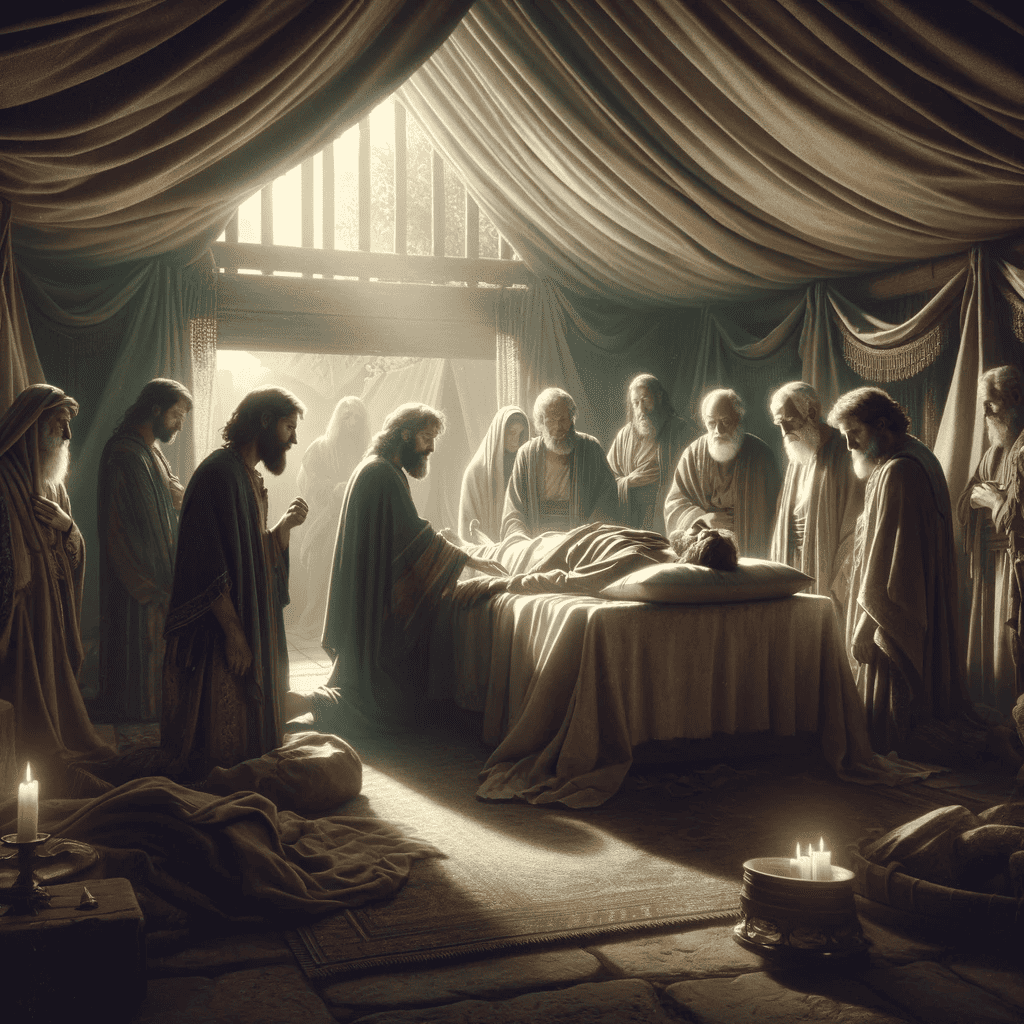
The Death of Isaac, as narrated in Genesis 35:27-29, offers a moment of profound transition and reflection within the biblical narrative, particularly within the context of the patriarchal history. This passage marks the end of Isaac’s journey on earth and serves as a bridge to the continued unfolding of God’s covenant through his descendants.

Isaac, the son of Abraham and Sarah, and the father of Esau and Jacob, returns to Mamre, also known as Hebron, where his father once lived. This place is significant in the Abrahamic family’s history, having been the stage for many of God’s revelations and promises. Isaac’s return to Mamre towards the end of his life symbolizes a full circle, connecting the past promises of God with the present and future fulfillment through his lineage.

At the ripe age of 180, Isaac breathes his last, surrounded by his sons, Esau and Jacob. Despite the earlier discord and rivalry between the two brothers, their coming together at their father’s deathbed signifies a moment of reconciliation and unity. This reunion is not just a personal family moment; it reflects the broader theme of God’s promise to Abraham that his descendants would be as numerous as the stars and that through them, all nations on earth would be blessed.

Isaac’s death and the subsequent burial in the cave of Machpelah, alongside his wife Rebekah and his parents, Abraham and Sarah, underscore the continuity of God’s promises across generations. The cave of Machpelah, purchased by Abraham as a family burial plot, becomes a tangible symbol of the patriarchs’ faith and the enduring covenant between God and Abraham’s descendants.

This moment in Genesis also highlights the legacy of faith passed down through the generations. Isaac, who lived a life marked by faith, patience, and quiet strength, leaves behind a legacy that would shape the destiny of the Israelites. Through his sons, Esau and Jacob, the narrative of God’s chosen people continues to unfold, with Jacob’s lineage leading to the twelve tribes of Israel.

In this reflective transition, the death of Isaac not only marks the end of an era but also sets the stage for the emergence of Jacob (later named Israel) as a central figure in the unfolding narrative of God’s people. As Isaac’s life concludes, the biblical account subtly shifts focus toward the fulfillment of the covenant through Jacob’s lineage, emphasizing the dynamic continuity of God’s promises through generations.

This moment of Isaac’s passing is deeply emblematic of the biblical theme of generational faithfulness to God. Isaac, who had been a living link between Abraham, the father of faith, and Jacob, the bearer of the twelve tribes, now passes the torch of God’s covenantal promise to his descendants. The peaceful passing of Isaac, surrounded by both his sons, despite their earlier strife, signifies a moment of divine grace and reconciliation. It reminds the faithful of the power of forgiveness and the possibility of unity in the midst of previous discord.

Furthermore, Isaac’s death and burial in the cave of Machpelah alongside his ancestors underscore a profound respect for familial bonds and the sacredness of legacy. This burial place, a tangible sign of the family’s history and God’s enduring promise, becomes a place of memory and hope. It is here that the patriarchs rest, each having played their role in the story of God’s people, and each resting in the promise of a future fulfillment that would extend beyond their lifetimes.

The narrative surrounding Isaac’s death also serves as a theological anchor, reminding readers of the covenant’s resilience through trials, separations, and reconciliations. The gathering of Esau and Jacob around their father in his final moments is a poignant testament to the underlying unity that God’s covenant promises to Abraham’s descendants, despite human frailty and conflict. This unity foreshadows the eventual gathering of the tribes of Israel, illustrating how God’s purposes are worked out through both harmony and discord within the chosen family.

As the story progresses beyond Isaac’s death, the biblical text delves deeper into the complexities of Jacob’s life and his twelve sons, who will become the progenitors of the Israelite tribes. The narrative arc from Abraham to Isaac, and then to Jacob, illustrates a divine tapestry woven through human history, where faith, promise, and fulfillment intersect across generations.

In essence, the account of Isaac’s death encapsulates a moment of solemn reflection on the enduring nature of God’s promises and the intricate interplay of faith, legacy, and divine purpose. It reinforces the theme that God’s covenant with Abraham stretches beyond individual lifetimes, moving through history with a momentum that carries forward the hope and promise of redemption for all humanity. This story, rich in symbolism and meaning, invites readers to ponder the depth of God’s faithfulness and the profound legacy of faith that links generations in a continuous story of grace and promise.

Bible story about The Blessing of Ephraim and Manasseh


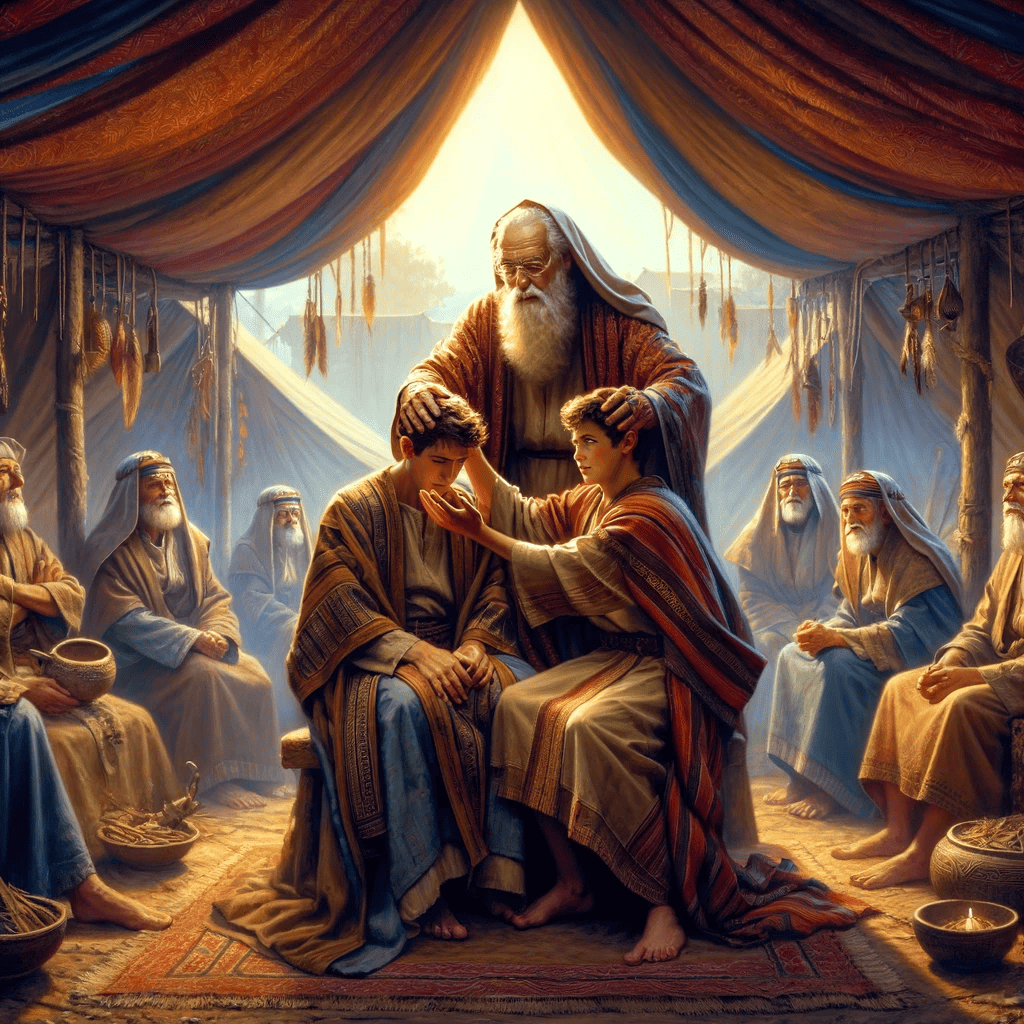
The story of the blessing of Ephraim and Manasseh, recounted in Genesis 48, unfolds as one of the most poignant moments in the biblical narrative, rich in symbolism and foreshadowing the future of the tribes of Israel.

As the story begins, we find Jacob, also known as Israel, in the twilight years of his life, dwelling in Egypt. He has been told that his son Joseph, whom he once thought dead, is not only alive but has risen to become the governor of all Egypt, second only to Pharaoh. Jacob’s heart swells with both joy and a longing to see his beloved son once more. As his health begins to wane, Joseph is informed that his father is ill. Accompanied by his two sons, Manasseh and Ephraim, born to him in Egypt, Joseph rushes to his father’s side.

Upon their arrival, Jacob musters his strength and sits up on his bed. He recounts to Joseph the divine promises given to him at Luz in the land of Canaan—promises of offspring as numerous as the stars, inheriting the land as an everlasting possession. This moment is not just a recounting of the past but a reaffirmation of the covenant between God and Abraham, Isaac, and now Jacob, linking the generations in a chain of faith and promise.

Jacob then turns his attention to Joseph’s sons, declaring that they too will be counted among his own sons, just as Reuben and Simeon are. In this act, Jacob elevates Ephraim and Manasseh from their status as grandchildren to direct heirs, ensuring Joseph’s lineage a double portion of the inheritance. This gesture is significant, not only for its immediate impact but for its lasting effect on the configuration of the tribes of Israel.

As Joseph brings his sons closer for Jacob to bless them, he positions Manasseh, the elder, at Jacob’s right hand, and Ephraim, the younger, at his left, expecting the greater blessing to go to the firstborn as was customary. However, Jacob, guided by a divine insight, crosses his arms, placing his right hand on Ephraim’s head and his left on Manasseh’s. When Joseph tries to correct his father, thinking him confused by his failing sight, Jacob insists, revealing that while both sons will become great, Ephraim will surpass Manasseh in greatness. This action by Jacob, blessing the younger over the elder, echoes the ways of God’s mysterious choices throughout the biblical narrative, where the younger is often chosen for a greater destiny, as was the case with Jacob over Esau.

Jacob’s blessing to the boys is profound, as he invokes the names of his ancestors Abraham and Isaac, and blesses Ephraim and Manasseh in the hope that they will grow into a multitude in the midst of the earth. This blessing is not only for prosperity but for a legacy that will continue the covenantal relationship with God.

In the final verses of the chapter, Jacob bequeaths to Joseph a portion of land that he won from the Amorites, not with sword or bow, but with God’s help. This gift, beyond its material value, symbolizes the fulfillment of God’s promises, a tangible sign of the covenant that God will fulfill with Jacob’s descendants.

As the narrative of Genesis 48 concludes, the scene fades from the intimate chamber of Jacob’s final days to etch itself into the broader tapestry of Israel’s history. The blessing of Ephraim and Manasseh by Jacob serves not only as a personal testament to the faith and foresight of the patriarch but also as a pivotal moment in the unfolding story of the Israelite people.

Jacob’s decision to adopt Ephraim and Manasseh as his own sons, granting them equal status with his biological sons, is a profound act of inclusion and expansion of the covenantal promise. This act not only ensures Joseph’s line a double inheritance but also symbolizes the inclusivity and adaptability of the covenant to encompass all who are brought into the fold of Israel, whether by birth or by blessing.

The crossing of Jacob’s hands, placing the right hand on the younger Ephraim and the left on the elder Manasseh, is a moment replete with divine irony and wisdom. It is a motif that recurs throughout the biblical narrative, where God’s choices defy human expectations and norms. From Abel over Cain, Isaac over Ishmael, Jacob over Esau, to now Ephraim over Manasseh, this theme illustrates that God’s blessings and purposes are not bound by human conventions of birthright or status but are guided by divine wisdom and foresight.

This moment also foreshadows the future roles and fortunes of their descendants. Ephraim would indeed grow into a powerful tribe in Israel, often representing the northern kingdom itself, while Manasseh, though great, would not eclipse the prominence of Ephraim. This dynamic between the two brothers, blessed by their grandfather, hints at the complex interplay of unity and rivalry, cooperation, and conflict that would characterize the history of the tribes of Israel.

Jacob’s final act of blessing Joseph with an extra portion, symbolized by the piece of land taken from the Amorites, is significant. It not only rewards Joseph’s faithfulness and service in Egypt but also reaffirms the promise of the land to Jacob’s descendants. This land, won not by force but given by God’s provision, serves as a foretaste of the Promised Land that the Israelites would inherit after their exodus from Egypt and their wanderings in the desert.

The story of Ephraim and Manasseh’s blessing, therefore, is more than a family affair; it is a microcosm of the larger biblical narrative of covenant, promise, and faith. It speaks to the heart of what it means to be part of the people of Israel: to be included in a story larger than oneself, to be part of a promise that spans generations, and to witness the mysterious ways in which God works through history, choosing the unlikely, the younger, the weaker to fulfill divine purposes.

As Jacob’s life draws to a close, his blessings upon Ephraim and Manasseh stand as a testament to the enduring faith of the patriarchs and the perpetual motion of God’s covenant with Israel. It is a story that reminds us of the depth of God’s faithfulness, the breadth of His promises, and the unexpected ways in which He fulfills them, weaving through the lives of individuals and nations a tapestry of grace that reaches beyond time and into eternity.

Bible story about Wrestling with God (Genesis 32:22-32)


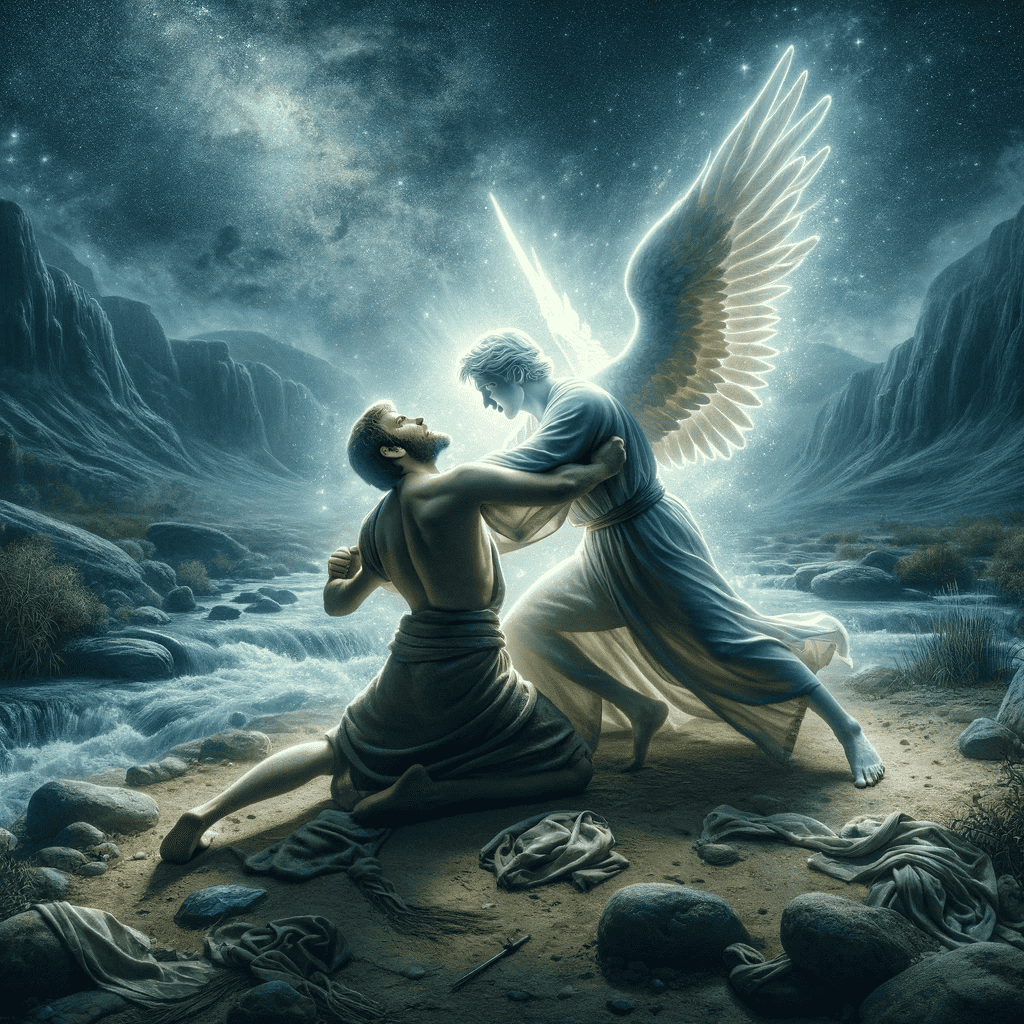
The story of Wrestling with God, found in Genesis 32:22-32, is one of the most profound and symbolic narratives in the Bible. It unfolds as Jacob, later known as Israel, experiences a transformative encounter on the banks of the Jabbok River.

Jacob, preparing to meet his estranged brother Esau from whom he had fled many years earlier due to deception and fear of retribution, sends his family and possessions across the river, leaving himself utterly alone in the darkness. It is in this isolation, at the lowest and most vulnerable point in his life, that Jacob encounters a mysterious figure with whom he engages in a physical struggle until the break of dawn.

This struggle is not just physical but deeply spiritual and symbolic. The man, often interpreted as an angel or even a manifestation of God Himself, wrestles with Jacob throughout the night. Despite the intensity of the fight, Jacob refuses to let go, insisting on a blessing. This determination marks a pivotal moment in Jacob’s life, reflecting his tenacity, his struggles with human and divine, and his quest for reconciliation and blessing.

As dawn approaches, the mysterious figure realizes that he cannot overpower Jacob. In an enigmatic move, he touches the socket of Jacob’s hip, wounding him and causing him to limp. This injury symbolizes Jacob’s vulnerability and humanity, yet it also marks him as someone who has encountered the divine and survived. The man then asks Jacob his name, and upon hearing it, he declares that Jacob will no longer be known by that name but as Israel, meaning “he who struggles with God,” for he has struggled with God and with humans and has overcome.

Jacob, realizing the significance of his adversary, asks for the man’s name but does not receive an answer. Instead, he names the place Peniel, saying, “For I have seen God face to face, and yet my life is preserved.” The encounter leaves Jacob limping as the sun rises, a permanent reminder of his struggle and his direct encounter with the divine.

The narrative of Jacob wrestling with God serves as a profound metaphor for the spiritual journey, encompassing the themes of transformation, perseverance, and divine encounter. This story is not just about physical struggle but also about the inner conflict and the pursuit of a meaningful relationship with the divine.

Jacob’s experience at Peniel is a turning point in his life. Up until this moment, Jacob had relied on his cunning and strength to navigate through life’s challenges. However, the wrestling match represents a moment of utter dependence on God and a shift from self-reliance to divine reliance. The change of Jacob’s name to Israel signifies not just a personal transformation but also the birth of a new identity for an entire people. Israel, as a name and a nation, carries with it the legacy of struggle, resilience, and divine engagement.

The injury Jacob sustains—a limp—is symbolic on multiple levels. It serves as a constant reminder of his encounter with God, a mark of his vulnerability, and yet, paradoxically, a symbol of his strength. This limp signifies that true strength often comes through acknowledgment of one’s weaknesses and reliance on God. It teaches that human vulnerability can be the very place where divine strength is manifested.

Moreover, the story underscores the idea that encounters with God can leave one changed. For Jacob, this change was not only in name but also in character. Following this divine encounter, we see a more humble and reconciled Jacob, ready to face his brother Esau, whom he had wronged. This reconciliation with Esau can be seen as a direct outcome of Jacob’s transformation at Peniel, demonstrating how divine encounters can lead to healing of human relationships.

The narrative concludes with Jacob, now Israel, limping away from Peniel as the sun rises, a powerful image of hope, renewal, and the promise of a new day. This image resonates with the idea that struggles, even those that leave us wounded, can also lead to blessing and new beginnings.

In essence, the story of Jacob wrestling with God is a testament to the power of faith, the importance of perseverance in the face of trials, and the transformative potential of encountering the divine. It reminds believers that struggle is an integral part of the spiritual journey, and that through these struggles, one can emerge stronger, more resilient, and closer to God.

Bible story about Rachel and Leah (Genesis 29:1-30:24)


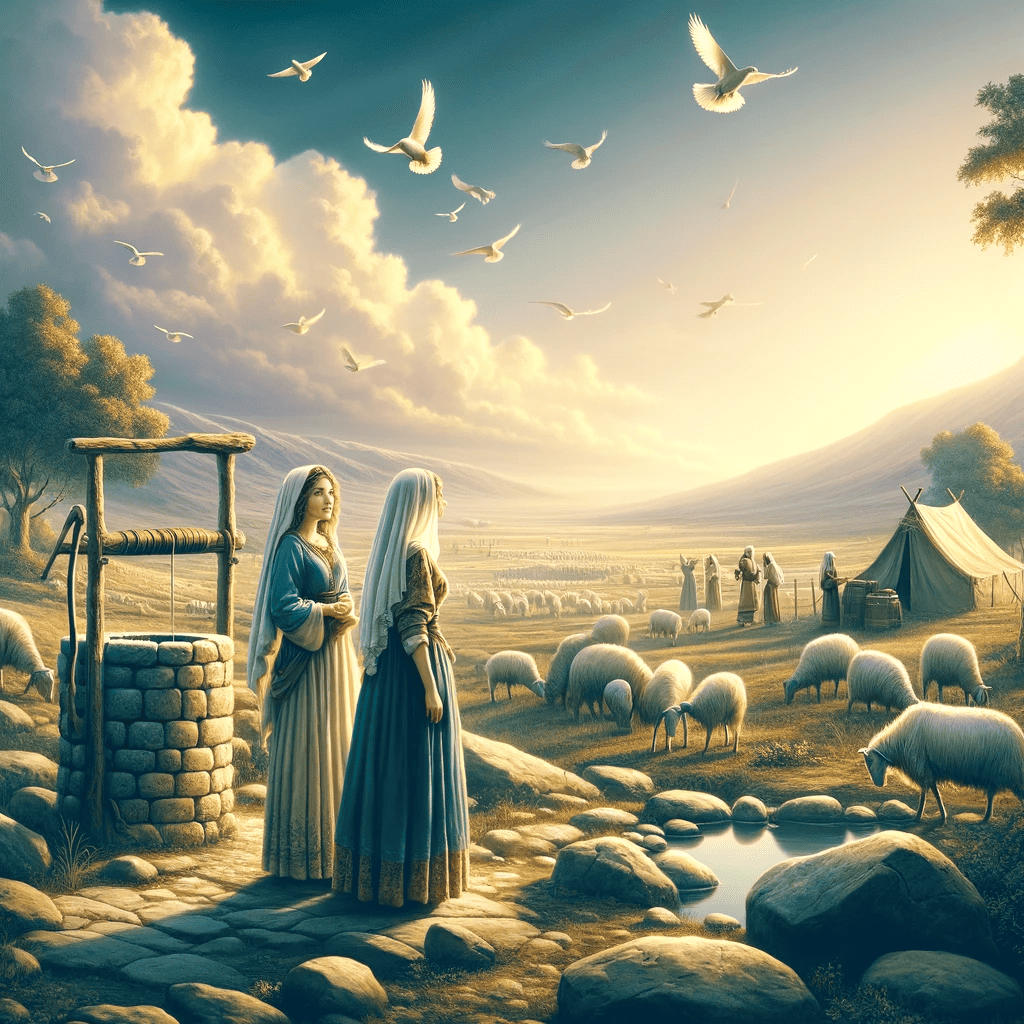
The story of Rachel and Leah is a poignant narrative of love, envy, and God’s providence, found in the Book of Genesis (29:1-30:24). It begins with Jacob’s journey to his mother’s homeland to find a wife from among his kin, as instructed by his parents, Isaac and Rebekah. Upon arriving at a well near Haran, Jacob encountered Rachel, the daughter of his uncle Laban, tending to her father’s sheep. Struck by her beauty and moved by their kinship, Jacob rolled the stone away from the well’s mouth and watered Laban’s flock. He then kissed Rachel and wept aloud in joy, for he had found his relatives.

Jacob was welcomed into Laban’s household and soon agreed to work for seven years to marry Rachel, whom he loved deeply. However, Laban deceived Jacob by substituting Leah, Rachel’s older sister, on the wedding night. In the culture of the time, it was customary for the elder daughter to marry before the younger. Jacob, realizing the deceit the next morning, confronted Laban. Laban offered Rachel to Jacob in marriage as well, on the condition that Jacob serve another seven years. Jacob accepted, marrying Rachel a week after Leah but serving Laban in total for fourteen years because of his love for Rachel.

Leah, though the first wife, was unloved compared to Rachel. God saw Leah’s plight and opened her womb, while Rachel remained barren for a time. Leah gave birth to four sons: Reuben, Simeon, Levi, and Judah, hoping each time that her husband would grow to love her. Rachel, consumed by envy at her sister’s fertility, pleaded with Jacob to give her children, to which Jacob responded in anger, pointing out that it was God who had withheld offspring from her.

In her desperation, Rachel gave Jacob her servant Bilhah as a concubine, through whom she bore two sons, Dan and Naphtali, considered Rachel’s by custom. Not to be outdone, Leah then gave Jacob her servant Zilpah, who bore two more sons, Gad and Asher. Leah herself bore two additional sons, Issachar and Zebulun, and a daughter named Dinah. Finally, God remembered Rachel, opening her womb to bear Joseph, and later Benjamin, though she died giving birth to the latter.

As the story unfolds, the intricate dynamics between Rachel, Leah, and Jacob serve not only to advance the narrative of the Israelite people but also to convey deeper spiritual and moral lessons.

Leah’s situation underscores the value of being seen by God even when overlooked by others. Despite being unloved by Jacob, Leah found favor in God’s eyes, who blessed her with children, including Judah, through whom the royal line of David and ultimately Jesus Christ would come. This aspect of the story highlights God’s sovereignty and the idea that human worth and divine blessing are not contingent upon human favor.

Rachel’s struggle with barrenness and her eventual joy at bearing Joseph and Benjamin remind readers of the theme of patience and faith in God’s timing. Rachel’s initial barrenness and later joy parallel the stories of other matriarchs in Genesis, such as Sarah, reinforcing the motif of God opening the womb in His time and for His purposes. Joseph’s birth is particularly significant, as he becomes a central figure in the Genesis narrative, leading to the Israelites’ eventual migration to Egypt.

The sibling rivalry between Leah and Rachel, while causing much personal strife, also serves to illustrate the consequences of human actions and the complexity of family relationships. Yet, through this rivalry and its outcomes, God’s plan for Israel unfolds. The sons born to Jacob, Leah, Rachel, and their handmaids become the patriarchs of the twelve tribes of Israel, each playing a unique role in the nation’s history.

The story also reflects on the practice of marriage and societal norms of the time, such as polygamy and the use of handmaids as surrogates, providing historical context and insight into the challenges and customs faced by the patriarchal families.

Moreover, Jacob’s enduring love for Rachel, despite the years of labor and deception, speaks to themes of love’s persistence and the complexities of human relationships. His willingness to work fourteen years for Rachel’s hand in marriage is often interpreted as a testament to the depth of his love and commitment, contrasting with the pain and jealousy that arise from unequal love within the family.

In conclusion, the story of Rachel and Leah is multifaceted, weaving together themes of love, envy, faith, and divine providence. It serves as a reminder of God’s presence in the midst of human imperfection and conflict, and His ability to bring about His purposes through even the most complicated family dynamics. Through this narrative, the Bible teaches lessons about human nature, the power of faith, and the importance of God’s timing, all of which resonate through the generations.