Recent Posts

Pray the Hail Mary: A Catholic Tradition


Welcome to the Ultimate Guide that gently explains what the Hail Mary is and why it matters. This short intro sets the stage for a friendly, practical look at the prayer’s biblical roots in Luke and its Christ-centered focus on Jesus Christ.

This guide shows how the Hail Mary fits into daily life and parish rhythms. You will learn the exact wording, the historical origin, and how it appears in the Rosary alongside the Our Father, Glory Be, and the Creeds.

Expect clear, actionable help—from learning the words to using the prayer in home, school, and communal devotion. We also clarify the difference between honoring Mary and worship reserved for God.

Whether you are new or experienced, this United States-focused guide offers respectful, scripture-rooted insights to help you grow in faith and daily devotion.

Key Takeaways

  • Learn the prayer’s text and biblical origin in Luke.
  • See how it centers on Jesus Christ within devotional life.
  • Understand its role in the Rosary and companion prayers.
  • Get practical tips for home and parish practice.
  • Find clarity on honoring Mary versus worship of God.

What is the Hail Mary? Quick answer and why it matters today

The hail mary is a short, scripture-rooted prayer that combines Gabriel’s greeting and Elizabeth’s blessing from Luke.

Its basic meaning is simple: it addresses the virgin mary with biblical words and asks her to pray for us. The form centers on Jesus’ name while honoring God’s work through Mary.

The devotion matters now because it ties believers to the Incarnation and to the steady flow of grace God offers across every age. It is easy to memorize, so beginners often start here.

People pray it privately, in families, and in groups—sometimes many times a day. Across different time zones, millions use this short text to steady faith during busy days.

  • Quick to learn and repeat
  • Scripture-based and Christ-centered
  • Used for asking intercession and strength
Setting Use Benefit Frequency
Private devotion Personal intent Comfort, focus Daily
Family Shared prayer Formation, unity Often
Community Group recitation Tradition, support Regular

The exact Hail Mary prayer text used in the Catholic Church

Below is the standard English wording used across U.S. parish life and printed prayer books. It is short, memorable, and rooted in Scripture, which helps when praying alone or with others.

“Hail Mary, Full of Grace, The Lord is with thee. Blessed art thou among women, and blessed is the fruit of thy womb, Jesus. Holy Mary, Mother of God, pray for us sinners now, and at the hour of our death.”

Key biblical lines come from Luke: “Hail Mary, full of grace” (Luke 1:28) and “Blessed art thou among women” (Luke 1:42). Notice the clear Christ focus in “blessed is the fruit of thy womb, Jesus.”

The second half is an intercessory petition: “Holy Mary, Mother of God, pray for us sinners now and at the hour of our death.” Its steady rhythm makes the text ideal for group recitation and for repeating in the Rosary.

Traditional words like “thee” and “thy” reflect older English and remain familiar to many. Minor regional wording exists, but the core text is consistent—learn it word-for-word to pray confidently in home and parish settings.

Origin and history: From Gabriel and Elizabeth to the Church’s prayer

Roots of this brief devotion reach back to two Gospel moments in Luke where God’s plan touches everyday life. The first half of the text is lifted directly from Scripture: Gabriel’s greeting (Luke 1:28) and Elizabeth’s Spirit-filled acclamation (Luke 1:42).

Over medieval time, Christians began to set those lines together as a single invocation. By the 11th century, communities repeated the words in devotion. Later generations added the intercessory second half so the full form could ask for help in daily need.

Saints, theologians, and popes commented on and promoted the text across centuries. Its steady use in the Rosary put it at the heart of common practice and family life.

God’s grace was at work in this development: biblical phrases, liturgical shaping, and pastoral use merged to keep the focus on Jesus Christ while inviting the faithful to seek aid in trouble and thanksgiving in joy.

Source Content Role over time
Luke 1:28 Angel’s greeting Scriptural foundation
Luke 1:42 Elizabeth’s blessing Confirmation in testimony
Medieval devotion Added petition for intercession Liturgical and family use

Scriptural roots explained: “Full of grace” and “Blessed art thou among women”

Scripture anchors the key phrases, linking angelic greeting and Spirit-led blessing. These lines from Luke shape meaning and help readers enter the Gospel events.

Annunciation: “The Lord is with thee” (Luke 1:28)

Gabriel’s words — including full grace and lord thee — point to God’s favor and presence at the Annunciation.

They signal that God acts, not human effort. This greeting invites quiet listening and trust.

Visitation: “Blessed is the fruit of thy womb” (Luke 1:42)

Elizabeth’s voice declares the blessed fruit and affirms the gift in faith.

Her phrase about fruit thy and the child makes the moment public and joyful.

Why Jesus’ holy name is central to the prayer

Calling the son by name keeps the focus on the Savior. Saying thy womb stresses the real Incarnation: the eternal virgin mary bore God made flesh.

  • Scripture first: words come from Luke.
  • Devotional bridge: they move private faith into public prayer.
  • Practice tip: pray these phrases slowly to let their meaning sink in.
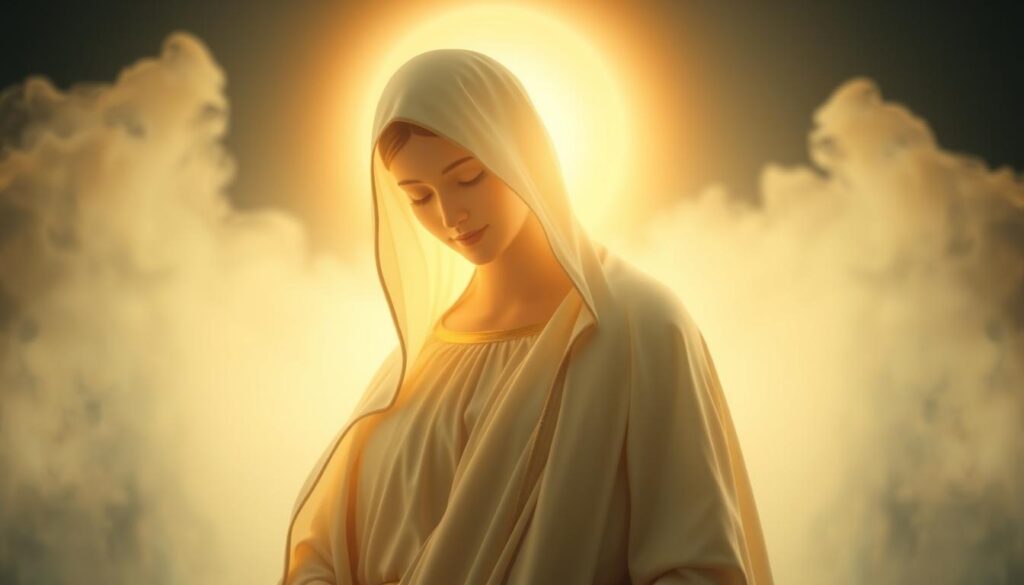
A serene and tranquil scene of the Blessed Virgin Mary, surrounded by a halo of divine light. In the foreground, her face radiates with a gentle, loving expression, her eyes cast downward in a posture of humility and grace. She is depicted in a flowing, ethereal gown, the folds of the fabric subtly illuminated by a soft, heavenly glow. In the middle ground, a celestial aura emanates from behind her, casting a warm, celestial luminance across the scene. The background is shrouded in a dreamlike, ethereal mist, creating a sense of mystery and transcendence. The overall atmosphere conveys a profound sense of peace, reverence, and the profound spiritual significance of the "full of grace" descriptor from the Hail Mary prayer.

Line-by-line meaning: Heart, theology, and devotion

A close look at each phrase reveals layers of faith, theology, and personal comfort. Read slowly so the meaning can sink in and shape daily devotion.

Hail Mary, full of grace

“Hail” is a greeting that honors God’s work in one person’s life. It points to a receptive heart shaped by God’s favor.

“Full of grace” recognizes a gift, not human merit. It invites us to see vocation as a divine calling that models humility and openness.

Blessed art thou among women

This phrase honors a unique role in salvation history without overshadowing God’s glory. It says someone is set apart to play a key part in God’s plan.

Blessed is the fruit of thy womb, Jesus

The focus lands squarely on the fruit—Jesus. The line magnifies Christ as the source of salvation and keeps attention on him as the center.

Holy Mary, Mother of God

Calling her Mother of God confesses Jesus’ divinity and the real human birth that brought God into our world.

Pray for us sinners now and at the hour of our death

Asking a holy friend to intercede shows how community and mercy work together. The plea covers present needs and final trust before death.

  • Pray slowly, one line at a time to let theology become lived faith.
  • Journal short reflections or pair lines with Scripture for ongoing growth.
  • Use the phrases as prompts for quiet meditation and real-life intention.

The hail mary prayer catholic church

Many families and parish groups lean on this brief devotion as a steady practice across life’s changes.

In daily life, people use it before meals, at bedside, during commutes, and at moments of need. It sits alongside the Our Father and Glory Be as a familiar line in both private meditation and public devotions.

Beginners and lifelong believers often learn the text in childhood and return to it in times of grief, joy, and decision. The short form helps keep the Incarnation before the heart throughout each day.

In communal settings—rosary groups, parish gatherings, and processions—the shared recitation builds unity. It also pairs well with Scripture study to create a balanced spiritual life.

Parishes can integrate this devotion into catechesis and sacramental prep by offering simple routines: morning, midday, and evening recitations to anchor one’s day in focused devotion.

“Used in Mass devotions, family routines, and private meditation, this short text supports both new learners and seasoned faithful.”

Setting Typical Use Benefit Who
Home Before meals, bedtime Comfort, habit formation Families, children
Parish Rosary groups, processions Community, unity All ages
Private Meditation, commutes Focus, calm Beginners, long-time faithful

How to pray the Hail Mary: Step-by-step for beginners

For beginners, a short, steady routine helps turn words into real devotion. Start with the Sign of the Cross and breathe slowly for a few seconds to steady the heart.

Posture, reverence, and focus of the heart

Choose a calm posture: sit or kneel where you can be still. Keep hands folded or hold a rosary to anchor attention.

Let reverence shape your breath—short pauses help you listen instead of rushing through the lines.

Adding intentions and praying with Scripture

Before each repetition, name a simple intention: family, a friend, the sick, or a private need. This keeps the words connected to life.

Link the words to Luke 1:26–56. Read those verses slowly, then pray to enter the Annunciation and Visitation with a listening heart.

  • Step 1: Sign of the Cross.
  • Step 2: Pray the text slowly and clearly.
  • Step 3: Finish with a brief silent reflection.

Tips for beginners: try three each morning and evening, pair each with an Our Father and Glory Be for a short set, and bring a pocket rosary or card for on-the-go devotion mary.

Practice When Benefit
Three short sets Morning / Evening Build habit
Pair with Scripture Weekly reading Deeper meaning
Carry a card Commute / Breaks Easy access

The Hail Mary in the Rosary: Mysteries, decades, and rhythm

A single decade creates a small, focused space for reflection on a mystery of jesus christ. This pattern helps prayer become listening, not just saying words.
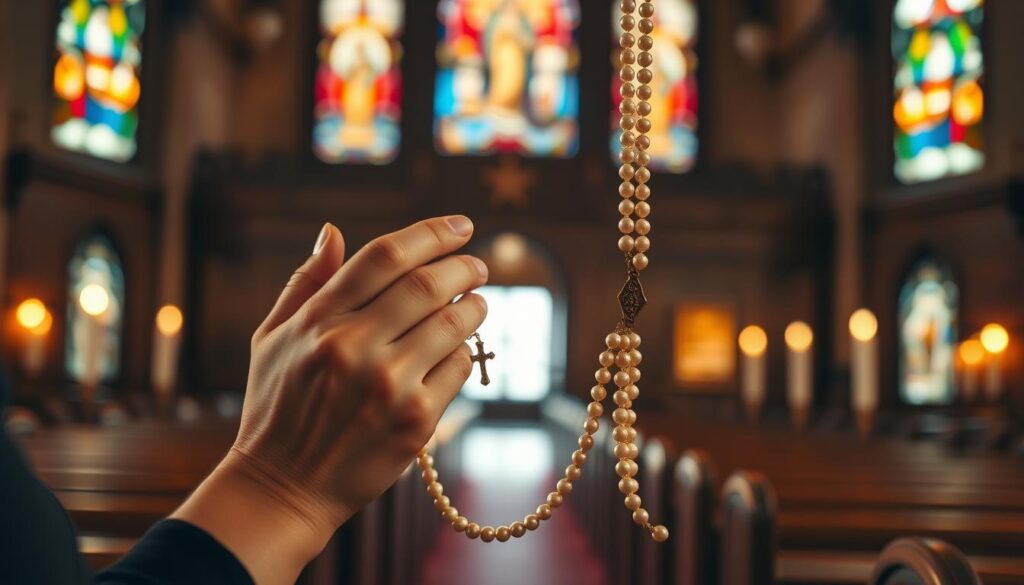
Pray rosary: a serene scene of a woman's hands holding a delicate pearl rosary beads, fingers gently caressing each bead as she prays with devotion. The background is a dimly lit chapel, the warm glow of candlelight casting a reverent ambiance. Stained glass windows cast soft, multicolored light, creating a contemplative, sacred atmosphere. The woman's face is not visible, but her posture conveys a sense of profound focus and inner peace as she meditates on the Mysteries of the Rosary. Soft, diffused lighting accentuates the textures of the wooden pews and the intricate details of the rosary, inviting the viewer to join in this timeless Catholic tradition.

Structure of a decade

Each decade begins with one Our Father, then ten hail mary recitations, and ends with one Glory Be. Many people add the Fatima Prayer after the Glory Be.

Why repetition aids meditation

Saying the same short line sets a steady pace. That rhythm frees the mind to imagine Gospel scenes and to enter them with the heart.

From “full of grace” to the Salve Regina

The phrase full of grace frames the mysteries—Joyful, Sorrowful, Glorious, and Luminous—so each bead points back to Christ. After five decades, pray the holy queen (Salve Regina) as a loving appeal to Mary as mother.

Beginners can start with one decade and grow to five. A single decade also marks a calm pause in the hour of a busy day. Praying together in family or parish groups brings added encouragement and unity.

Beyond the Rosary: Angelus, Magnificat, and other Marian devotions

Brief devotions beyond the Rosary help keep Gospel moments close through the day. They offer quick, scripture-based pauses that families and individuals can adopt.

The Angelus: Remembering the Incarnation with short versicles

The Angelus is prayed morning, noon, and evening to recall the Incarnation. It uses three short versicles, each followed by a Hail line, which ties the Gospel mystery into daily timekeeping.

Many parishes ring bells at the appointed hours. Those chimes invite a communal pause and gentle focus on jesus christ and the gift of grace.

The Magnificat: “All generations will call me blessed”

The Magnificat is Mary’s canticle from Luke 1:46–55. It praises God’s mercy and faithfulness across generations and fits naturally at evening prayer or after a Rosary set.

“My soul proclaims the greatness of the Lord; my spirit rejoices in God my Savior.”

Practical tips: post the Angelus and Magnificat texts at home for quick reference. Pick set moments for the Angelus to build a family habit. Add a short mary prayer or hymn after the Magnificat to close gently.

Devotion When Primary focus How it links to the Rosary
Angelus Morning, Noon, Evening Incarnation, Gospel verses Includes three Hail lines; keeps Gospel close
Magnificat Evening / After Rosary God’s mercy, praise Scriptural canticle that deepens reflection
Marian hymns & litanies Any time Devotional praise Complements Rosary themes and fosters memory
  • Invite family members to choose a bell or clock cue for the Angelus.
  • Keep printed texts handy to encourage regular use at home.
  • Explore additional hymns and litanies that honor the virgin mary with biblical depth.

More Marian devotions that amplify the Hail Mary

Small sacramentals and set meditations offer practical ways to grow in trust and discipleship.

Scapular of Our Lady of Mount Carmel is a visible sign of Marian devotion and a daily reminder to live the Gospel under Mary’s protection. Wearing it prompts simple acts of faith and attention throughout the day.

Miraculous Medal came from a 19th-century apparition and encourages the faithful to ask for graces through Mary’s intercession. A blessed medal can be a gentle prompt to pause and offer a short intention.

Seven Sorrows devotion invites meditation on moments of the mother’s grief united to her Son’s saving work. This set of seven short reflections helps people enter the mystery of redemption with compassion.

Consecration to Jesus through Mary

Consecration—often prepared over 33 days—is a structured way to entrust one’s life and discipleship to Christ with Mary’s help. Many find a spiritual director or parish program helpful when discerning this step.

Start simply: wear a blessed medal, read a five-minute daily reflection, or add one short devotional line to family routines before deepening practice.

  • Goal: growth in love for Christ, holiness of life, and service of neighbor.
  • Pair these devotions with the Rosary line to reinforce a Christ-centered relationship with the holy mother of believers.
  • Ask parish resources or a spiritual director for guidance when considering full consecration.

Every authentic Marian devotion leads to deeper union with Jesus and fidelity to the Church.

“Hour of our death”: Hope, mercy, and the Christian finish line

Facing the final hour, many find words that name both present need and the hope of a holy ending. The phrase that reaches from now to the decisive moment links everyday choices with trust in God’s mercy.

Living ‘now’ well means simple habits: regular prayer, frequent sacraments, acts of charity, and quick steps to forgive. These practices shape the heart so the last hour can be met in peace.

Why ask for intercession at death? It is a plea for help to persevere in grace. Countless saints and ordinary faithful prayed this line through life and into their final hours, finding courage and calm.

Practical steps include a short daily intention for the dying, periodic examinations of conscience, and regular reconciliation. These small routines help orient life toward eternal hope.

“Align your heart with hope; live each day as a gift oriented toward eternal life.”

Do Catholics worship Mary? Veneration, intercession, and Jesus at the center

Many readers wonder whether honoring Mary ever becomes worship. Clear, simple terms help answer that concern and reduce confusion.

Honor versus worship in Catholic teaching

The tradition distinguishes worship (latria) given to God alone from honor given to the saints (dulia). Mary receives a higher form of honor (hyperdulia), but not worship. This difference protects the praise due only to the one true God.

“Holy Mary, Mother of God” and the glory of her Son

Calling her Mother of God safeguards the truth about Jesus Christ’s divinity. The title points directly to the Son, not away from him. Saying “art thou” in older translations echoes Scripture and keeps the focus on Jesus.

Asking Mary to pray for sinners is like asking a close friend to intercede. The request points to God’s mercy and to Christ’s saving work.
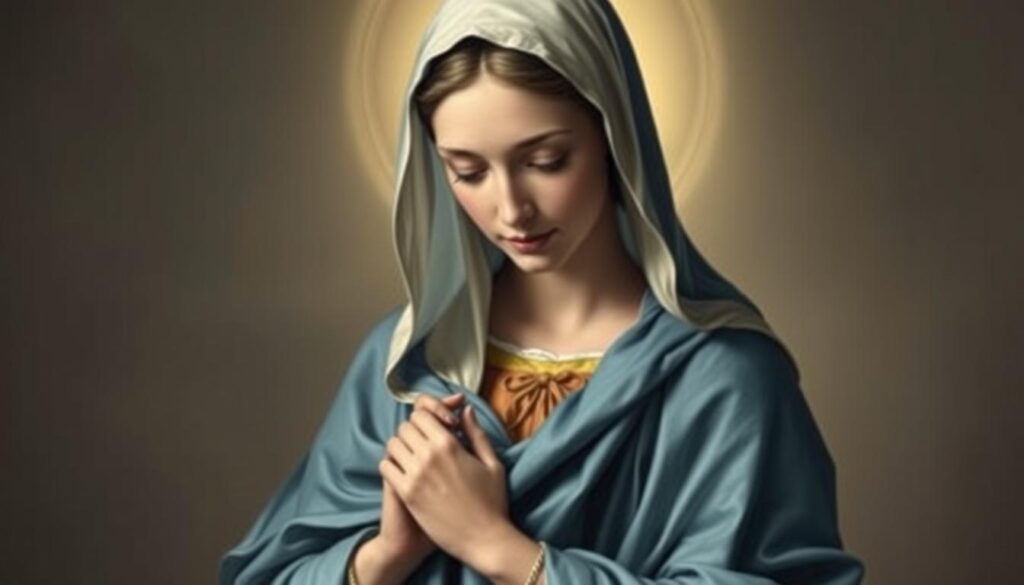
A serene and ethereal image of the Holy Mother, Mary, depicted in a classical Renaissance style. Her delicate, beatific expression radiates a gentle, maternal grace, her gaze downcast in contemplation. She is adorned in a flowing, azure mantle, the folds of the fabric cascading around her in intricate, graceful lines. The lighting is soft and diffused, creating a halo-like effect around her head, emphasizing her divine, spiritual nature. The background is a tranquil, muted palette, allowing the focus to remain on the reverent, contemplative figure of the Virgin Mary, the embodiment of purity, humility, and the divine feminine.

“Authentic devotion to Mary leads believers deeper into love for Jesus Christ and faithful obedience to the Gospel.”

  • Scripture and teaching: the Bible and church tradition guide the distinction.
  • Pastoral effect: Marian devotion strengthens prayer life and charity.
  • Examples: many saints honored the mother of God while centering their lives on Jesus.

In short: honoring the holy mother supports worship of God by pointing hearts to Christ, not replacing him.

Praying with the Church: Core Catholic prayers that accompany the Hail Mary

Praying with the wider community brings familiar, time-tested texts into everyday life. These short, scripted pieces shape private devotion and group worship alike.

Our Father and Glory Be

The Our Father begins each decade and names our shared trust in God. The Glory Be closes a decade, offering brief praise. Together they frame ten repetitions and give rhythm to a set of beads.

Apostles’ Creed and Nicene Creed in daily life

The Creeds state core beliefs about jesus christ, the son, and salvation. Saying them roots short devotion in firm doctrine. Start with the simpler Creed, then add the longer one as understanding grows.

End a Rosary with the holy queen to ask the mother’s aid in a loving way. Use small cards or a parish booklet to learn exact wording and build confidence.

“Praying with the Church unites believers across time and place.”

Language notes, style, and variations you may hear

Different regional editions and hymnals preserve older wording that some find both poetic and reverent. These variants affect pronouns and small word choices, but not the core meaning.

Traditional pronouns: Words like thee, thou, and thy come from older English used in many hymnals and prayer cards. They give a formal, rhythmic tone that many communities still treasure.

Among vs. amongst: Some editions say among, others amongst women. Both mean the same. “Blessed art thou” mirrors older style and keeps a reverent cadence.

The Lord is with thee is faithful to longstanding translations that many memorize early in life. Modern versions may simplify pronouns for ease of speech.

  • Stick with one form first to aid memorization.
  • Listen with charity when you hear variants.
  • Compare versions side-by-side to notice stylistic nuance.

“The unity of the text lies in its meaning and purpose, not in minor stylistic differences.”

Everyday practice in the United States: Home, parish, and community

Everyday moments—meals, bedtime, and brief pauses—are ideal for introducing the text to children. Start small so routines stick and faith becomes part of daily life.

Teaching children the Hail Mary

Begin with the Sign of the Cross and one short line. Use a colorful card or a simple rosary bead set to make learning tactile and fun.

Repeat the line each evening and add one more phrase as kids grow. Invite grandparents or godparents to join so children link the memory to loving faces.

Many parishes host groups that meet before Mass or on weeknights. These gatherings welcome newcomers and model how to pray rosary in community.

Teens and young adults can form monthly groups or use simple apps to keep a steady habit. Parish events—May crownings, processions, and retreats—offer natural chances to join others in devotion.

“Small, shared practices shape a resilient, Christ-centered rhythm that comforts families in joy and sorrow.”

Practical tips: pray one decade together at evening time, start kids with one line, and use apps or beads for on-the-go focus. Over time, these small steps strengthen bonds and help a family live its faith well.

Common intentions with the Hail Mary: Life, family, work, and sinners

A brief set of intentions helps move words from memory into real care for others. Use simple, concrete aims so each repetition connects to daily life.

Praying for grace, protection, and deeper devotion

Sample intentions: personal conversion, family unity, growth in virtue, healing for the sick, and needs of the wider community.

Ask for grace in small decisions at home and at work. Name one choice before you begin so your heart focuses on action, not just words.

Remember to pray sinners gently: include the lonely, the poor, and anyone facing addiction or anxiety. Offer a decade for those most in need.

  • Dedicate a week to parenting, exams, or a new job.
  • Entrust children and loved ones to the mother’s care, asking her to draw them closer to the Son.
  • Keep a short intentions journal to sharpen focus before each session.
Intention When Suggested focus
Personal conversion Daily Humility, small changes
Family unity Weekly Patience, listening
Work and decisions Morning Wisdom, integrity
The sick & sinners Any time Healing, mercy

Offer a Rosary for parish projects and community needs. Steady intercession builds hope, charity, and a stronger bond with Christ the Son.

Conclusion

Here we bring together Scripture, history, and practice so you can begin a steady habit of devotion. The guide showed how short Gospel lines grew into a lasting text that points to Jesus Christ and shapes daily life.

Remember the core phrases: full grace and blessed art thou anchor the words in Luke. Asking the holy mother to pray for us “now and at the hour of our death” names both need and hope.

Learn the hail mary slowly. Memorize a line, add a decade on a commute, or join a parish rosary group. Today, pray one hail mary prayer slowly and let God’s grace work in your heart and home.

FAQ

What is the short answer about the Hail Mary and why does it still matter?

The Hail Mary is a traditional Catholic invocation to the Virgin Mary built from Gospel greetings and later liturgical additions. It remains relevant because it centers Christians on Christ through Mary’s role, invites reflection on salvation history, and offers a simple, repeatable prayer for daily needs, intentions, and spiritual focus.

What is the exact traditional text used in liturgy?

The commonly used English version begins with the words “Hail Mary, full of grace,” continues with Elizabeth’s greeting and the blessing of Jesus, and ends asking Mary to pray for us sinners now and at the hour of our death. This form preserves phrases like “full of grace” and “fruit of thy womb, Jesus,” which link the prayer to Luke’s Gospel passages.

Where did the prayer originate?

Its roots are scriptural: the angel Gabriel’s greeting (Luke 1:28) and Elizabeth’s acclamation (Luke 1:42). Over centuries the medieval Church added devotional phrases, shaping the complete prayer used today. The development blended biblical language with pastoral petitions.

What do key phrases mean, such as “full of grace” and “blessed among women”?

“Full of grace” signals God’s favor given to Mary in the Annunciation. “Blessed among women” acknowledges Elizabeth’s proclamation that Mary holds a unique role in salvation history. Both phrases point to God’s action in Mary and the centrality of Jesus, the fruit of her womb.

How should a beginner pray this devotion? Any simple steps?

Begin with a quiet posture, breathe, and recall the Gospel scene. Speak the words slowly, focusing on Jesus and the intention you bring. You can add a short personal intention after the petition and finish with a moment of silence or an Our Father to center your prayer.

How does this prayer fit into the Rosary?

Each decade of the Rosary includes ten repetitions of this prayer, framed by an Our Father and followed by the Glory Be. Its repetitive rhythm supports meditation on the Mysteries—events in the lives of Jesus and Mary—making reflection more accessible.

Are there other devotions that use the same phrases?

Yes. The Angelus and the Magnificat echo similar language about the Incarnation and Mary’s role. Marian devotions like the scapular, Miraculous Medal practices, and consecration prayers often incorporate or build around these biblical phrases.

What does “at the hour of our death” mean?

That phrase asks for Mary’s intercession at life’s end, a moment Christians view with hope and reliance on God’s mercy. It expresses trust that Mary will pray for a peaceful passage and for closeness to Christ in final moments.

Do people worship Mary when they pray this?

No. Catholic teaching distinguishes veneration (honor) from worship, which belongs to God alone. Saying this prayer asks Mary to intercede with her Son; the focus remains on Christ and his saving work.

Why do some versions use “among” or “amongst,” and why “thee/thou” appears?

Differences reflect translation choices, historical English usage, and liturgical tradition. “Amongst” and archaic pronouns come from older translations. Modern translations often use contemporary language to aid understanding while keeping theological meaning intact.

How can families and parishes use this devotion in everyday life?

Families teach children by short, consistent practice—bedtime or mealtime prayer, simple explanations, and repetition. Parishes support rosary groups, brief community recitations before Mass, and educational sessions that explain the prayer’s biblical roots and spiritual purpose.

What common intentions do people bring when they say it?

People typically pray for family, life decisions, work, healing, forgiveness for sinners, and deeper spiritual growth. It’s often offered for specific needs or as a daily habit to seek grace, protection, and closer relationship with Jesus through Mary’s intercession.
The Seven Sacraments of the Catholic Church


The sacraments lie at the heart of life in the Catholic Church. They are visible rites that carry an invisible reality: God’s free gift of grace to strengthen faith and shape daily living.

Each sacrament combines a clear form with deep meaning. Instituted by Jesus Christ, these rites let the faithful encounter divine life in a concrete way. Some mark a lifelong identity. Others are celebrated often to renew hope and healing.

We will group them as Sacraments of Christian Initiation, Sacraments of Healing, and Sacraments at the Service of Communion. Expect practical notes on who celebrates each rite, common ages when people receive them, and how families and children usually first meet this spiritual life.

Key Takeaways

  • These rites are visible signs that communicate God’s grace.
  • They were founded by Jesus Christ to share divine life.
  • Some are received once; others are repeated for ongoing care.
  • Groups: Initiation, Healing, and Service of Communion.
  • Families and children often begin with Baptism and First Communion.

Understanding Sacraments: Visible Signs of an Invisible Reality of Grace

Outward signs—water, oil, words—make an invisible divine gift tangible. A sacrament is a visible rite with a clear form that communicates an invisible reality. Rooted in the saving work of Jesus Christ, this visible action invites people into a deeper spiritual life.

The form and the rite are not mere symbols. They are the means through which God shares grace—a free gift that draws us into salvation. Concrete elements like water and anointing oil point to effects such as cleansing, strengthening, healing, or commissioning.

“Grace is God’s initiative: freely given, not earned.”

This reflection shows why material signs matter. Our faith is incarnational; God chooses to meet us in things we can see and touch. Believing in this sacramental reality helps sustain faith through joy, trial, service, and calm contemplation.

https://www.youtube.com/watch?v=34pSVZxRW8M&pp=ygUIIzE1MXllYXI%3D

The Sacraments of Christian Initiation: Baptism, Confirmation, and the Eucharist

The path that brings a person into full life and faith in the catholic church is a threefold journey called christian initiation.

Baptism: Entry into new life in the name of the Father, the Son, and the Holy Spirit

Baptism welcomes a child or adult into the faith through water and the Trinitarian words: “I baptize you in the name father, and of the Son, and the Holy Spirit.”

This rite cleanses original sin, gives sanctifying grace, and cannot be repeated. In an emergency, anyone may baptize if they intend what the Church intends.

Eucharist (Holy Communion): Nourishment, Real Presence, and First Communion

The sacrament eucharist, also known as holy communion, is the central act of worship. Bread and wine are consecrated and become Christ’s Body and Blood.

Children usually receive First Communion around age seven or eight after preparation and a first confession. Catholics may receive this gift frequently to grow in faith.

Confirmation: Sealed and sent with the Holy Spirit

Confirmation completes initiation through the laying on of hands and anointing with chrism by a bishop or priest. This rite seals a person with the holy spirit and strengthens baptismal grace for mission.

Many children receive confirmation in early adolescence; adults who are baptized later receive confirmation at the same celebration.

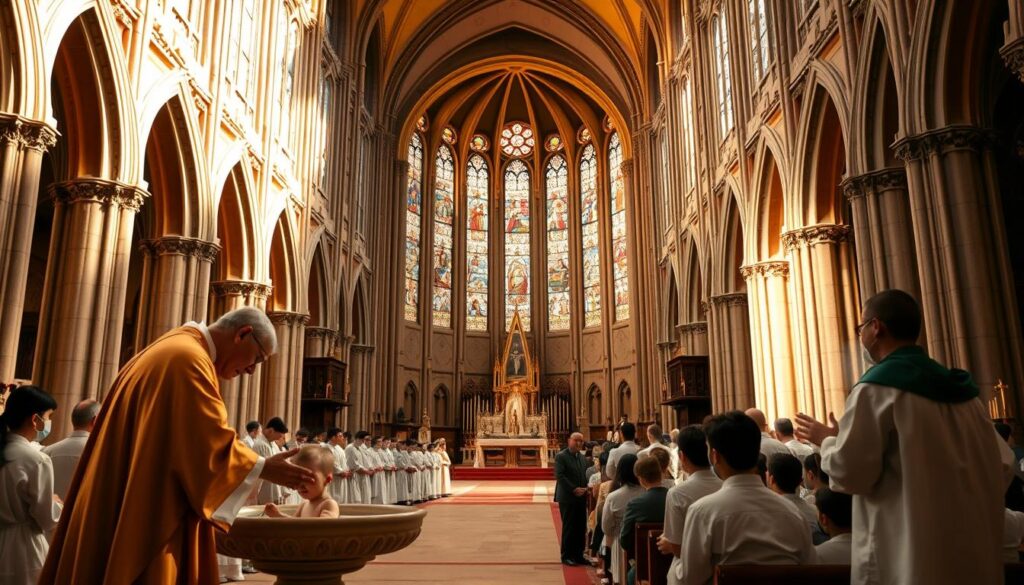
A vast and ornate Catholic cathedral, its soaring arches and stained glass windows bathed in warm, golden light. In the foreground, a priest in flowing robes performs the sacrament of baptism, gently lowering a child into the font as onlooking parishioners bear witness. In the middle ground, a group of young people kneel before the altar, receiving the sacrament of confirmation as the bishop lays his hands upon their heads. In the background, the congregation partakes in the Eucharist, sharing in the body and blood of Christ. An atmosphere of reverence, tradition, and spiritual renewal permeates the scene.

Rite Key Elements Typical Timing
Baptism Water + Trinitarian formula; entry into faith Infancy for many, or any time; emergency baptism allowed
First Communion Consecrated bread and wine; real presence after consecration First Communion around age seven or eight, after confession
Confirmation Laying on of hands; anointing with chrism; gifts of the Spirit Early adolescence for cradle members; at baptism for adult converts

“Baptism begins new life, Confirmation strengthens it, and the Eucharist sustains it.”

The Sacraments of Healing: Reconciliation and Anointing of the Sick

Reconciliation: Examination, confession, and renewed communion

The sacrament reconciliation heals the soul by naming and turning from sins. A penitent makes an examination of conscience, confesses sins to a priest, and says an act of contrition.

After confession the priest gives absolution and assigns a penance that fosters ongoing conversion. Frequent confession helps a person grow in holiness and restores full communion with the community.

Anointing of the Sick: Oil, prayer, and hope beyond Last Rites

Anointing sick is given by a priest who anoints the forehead and hands with the Oil of the Sick and offers prayer for strength. This rite unites the sick person’s suffering to Christ and brings spiritual healing even when physical cure is not granted.

The sacrament may be received whenever serious illness or major surgery arises and can be repeated as conditions change. When death nears, last rites commonly include confession (if possible), anointing, and the Eucharist with a special blessing.

Rite Key Elements When to Receive
Reconciliation Examination of conscience; confession to a priest; absolution; penance Regularly for spiritual growth; before receiving Communion if conscious of grave sins
Anointing of the Sick Anointing with oil; prayer by a priest; grace for strength and peace Serious illness, before major surgery, or when health worsens; repeatable
Last Rites (near death) Confession (if possible); anointing; Eucharist or final blessing When death is imminent to prepare the person for passing

“These healing rites reconcile us to God and support us through suffering.”

The Sacraments of Service: Holy Matrimony and Holy Orders

In a life of service, two special rites shape how people give themselves for others.

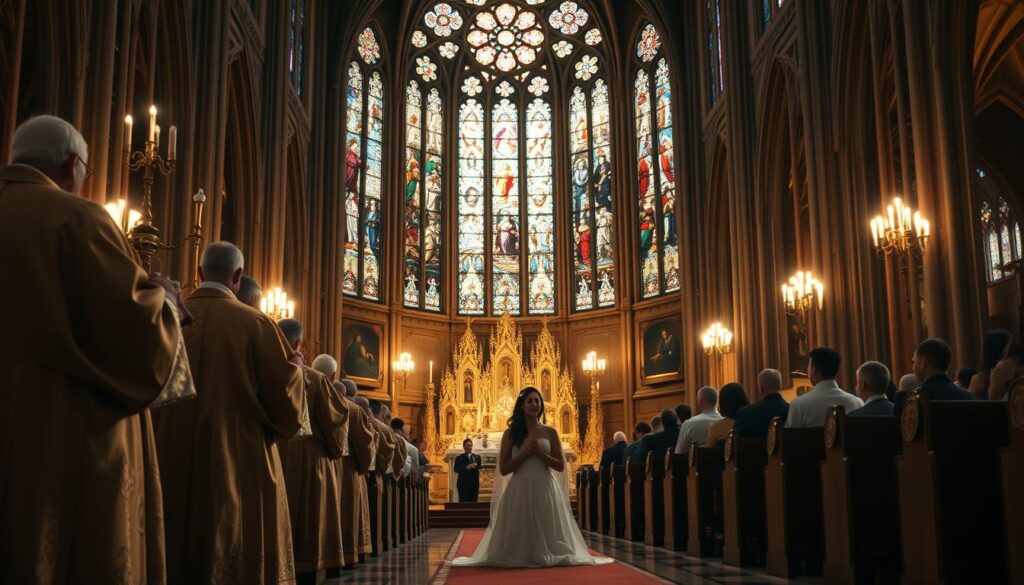
A grand cathedral interior, bathed in soft, warm lighting. In the foreground, a solemn procession of clergy in ornate vestments, carrying the sacred elements of the Eucharist. In the middle ground, a couple kneeling at the altar, hands clasped in prayer, their faces alight with reverence. The background is filled with intricate stained glass windows, casting a kaleidoscope of colors across the scene. The atmosphere is one of profound reverence and spiritual significance, capturing the essence of the Sacraments of Service - Holy Matrimony and Holy Orders.

Holy Matrimony: Lifelong covenant reflecting Christ’s love and open to life

Marriage is a covenant in which a baptized man and woman freely exchange consent. They are the ministers who confer the sacrament on one another.

A priest normally stands as witness during the rite, often within a Nuptial Mass. Public consent, vows, and the marital union form an indissoluble bond.

Marriage mirrors Christ’s faithful love for the Church and forms the domestic church that nurtures faith across generations.

Holy Orders: Ordination by a bishop with the laying on of hands

Holy Orders has three degrees—deacon, priest, and bishop—conferred by a bishop’s laying on of hands and the prayer of consecration.

Deacons preach, baptize, and witness marriages. Priests celebrate the Eucharist and absolve sins. Bishops ordain and shepherd the local church.

A man responds to a call to serve. Ordination includes investiture and sometimes anointing with oil to seal pastoral ministry.

  • Commission to serve: Both rites order a person or couple to build families, parishes, and the wider community in love.
  • Dependence on grace: Each vocation relies on God’s grace to live commitments faithfully for the life of the world.

“Service in marriage and ordination forms the People of God through faithful love and dedicated ministry.”

Rite Key Action Role
Marriage Exchange of consent; public vows Husband and wife as ministers; priest witness
Holy Orders Bishop’s laying hands; prayer of consecration Deacon, priest, bishop with distinct ministries

Seven sacraments of catholic church: A concise guide for life, faith, and love

Think of these rites as a simple roadmap that brings new birth, healing, and service into our everyday living.

Summary: The seven sacraments form God’s plan to share grace with every person—beginning with new birth, deepening formation, and bearing fruit in service.

A solemn, reverent scene depicting the seven sacraments of the Catholic Church. In the foreground, a striking representation of the seven sacraments - baptism, confirmation, Eucharist, penance, anointing of the sick, holy orders, and matrimony - each rendered with careful attention to symbolic details. The middle ground features a grand, ornate cathedral interior, bathed in warm, soft lighting that imbues the scene with a sense of timeless spirituality. In the background, stained-glass windows cast kaleidoscopic patterns of color, adding depth and mystique to the overall composition. The overall mood is one of reverence, devotion, and the profound significance of these sacred rites that guide the faithful through life, faith, and love.

Quick snapshot: Baptism gives new life; Confirmation brings the Holy Spirit; the Eucharist or sacrament eucharist feeds the soul as Holy Communion. Reconciliation and Anointing offer healing. Matrimony and Holy Orders form and send people to serve.

Family milestones matter. Children are baptized young, and a child usually prepares for First Communion around age seven or eight after first confession. These rites shape faith during key life moments.

Practical note: Pay attention to the visible form—water, oil, vows, laying on of hands—because these signs convey real grace. Prepare with prayer and, when unsure, speak with a priest who can guide the next steps for individuals and families.

“Receive sacrament frequently where appropriate, prepare with prayer, and participate with attention to its sacred reality.”

  • Baptism: new birth and membership in the faith community.
  • Confirmation: strengthened by the Spirit for mission.
  • Eucharist: Jesus Christ’s real presence that nourishes faith and love.
  • Reconciliation & Anointing: spiritual and sometimes physical healing.
  • Matrimony & Holy Orders: service and lifelong commitment.

Conclusion

Conclusion

Through the seven sacraments, grace meets us in clear, concrete rites. These gifts unite visible signs—water, oil, and the laying on of hands—with the Holy Spirit at work in daily life.

Take a next step: enter by baptism, be strengthened in confirmation, receive holy communion, and seek reconciliation with known confession when sins burden your heart.

Anointing sick brings comfort in illness; Last Rites gather prayer, oil, and Communion at life’s threshold. Service in holy orders or in marriage forms communities that share this gift.

Pray, speak with a priest or bishop, and let these sacred encounters deepen your faith and transform the world by grace and truth.

FAQ

What are the sacraments that begin Christian life?

Baptism, Confirmation, and the Eucharist mark entry into Christian life. Baptism welcomes a person into the Christian community in the name of the Father, Son, and Holy Spirit. Confirmation strengthens the baptized with the gifts of the Holy Spirit through anointing and laying on of hands. The Eucharist, or Holy Communion, is regular reception of Christ’s real presence and spiritual nourishment.

At what age do children typically receive First Communion?

Many parishes prepare children for First Communion around age seven or eight, when they can understand the meaning of the Eucharist and examine their conscience. Preparation usually includes catechesis, practice, and participation in Mass with a parent or sponsor.

How does the Eucharist differ from a symbolic meal?

The Eucharist is understood as the Real Presence of Jesus Christ, not merely a symbol. Through the liturgy and consecration, bread and wine become Christ’s body and blood in a mysterious but real way, which believers receive for spiritual life and unity.

What happens in the sacrament of Confirmation?

In Confirmation a bishop or priest lays hands on the candidate and anoints with holy oil (chrism). This rite calls down the Holy Spirit’s gifts—wisdom, understanding, counsel, fortitude, knowledge, piety, and fear of the Lord—to strengthen faith and help the person live as a Christian witness in the world.

When should someone go to Reconciliation (Confession)?

Catholics are encouraged to go regularly, especially after serious sin. Reconciliation involves an examination of conscience, confession to a priest, penance, and absolution. It restores relationship with God and the community and brings spiritual healing.

What is the Anointing of the Sick and when is it given?

Anointing of the Sick uses blessed oil and prayer by a priest to bring comfort, strength, and, if God wills, physical healing. It is appropriate for those facing serious illness, major surgery, or the frailty of advanced age. It is related to, but not limited to, last rites.

What does Holy Matrimony signify and require?

Holy Matrimony is a lifelong covenant between spouses that reflects Christ’s love for the Church and is ordered to the good of the spouses and to procreation. It requires free consent, openness to life, and mutual fidelity, normally celebrated within a parish liturgy with a priest or deacon.

Who receives Holy Orders and what does it confer?

Holy Orders confers the ministry of the deacon, priest, or bishop through ordination by a bishop with the laying on of hands. It empowers the ordained to serve the community through preaching, sacramental ministry (including presiding at the Eucharist), and pastoral leadership.

How do sacraments relate to grace and daily life?

Sacraments are visible signs that confer grace, strengthening faith, love, and Christian life. They connect ordinary life—marriage, family, illness, community worship—with an invisible reality of God’s presence and help, shaping how believers live and serve.

Can non-Catholics receive these rites?

Practices vary by rite and circumstance. Generally, Baptism given in a Trinitarian form is recognized across many Christian traditions. The Eucharist and Reconciliation are typically reserved for those fully initiated in the faith. Pastoral exceptions may apply in emergencies or special pastoral arrangements.

What is the role of a priest or bishop in giving sacraments?

Priests and bishops act in persona Christi (in the person of Christ) when celebrating most sacraments. Bishops ordain clergy and confirm in many dioceses. Priests preside at the Eucharist, hear confessions, anoint the sick, and witness marriages. Their ministry helps the community receive grace through ritual and prayer.

How should families prepare children for initiation rites?

Families should engage in regular prayer, attend Mass, and participate in parish preparation programs. Parents and godparents support catechesis, help children learn basic prayers and the meaning of sacraments, and model a life of faith and love.

Are there visible signs used in these rites?

Yes. Common signs include water in Baptism, oil in Confirmation and Anointing of the Sick, bread and wine in the Eucharist, the laying on of hands in Confirmation and Orders, and exchanging of vows in Matrimony. These signs communicate spiritual realities and grace.

What if someone wants to return to the sacraments after a long absence?

The door is open. Reconciliation is a place to begin: a sincere confession, penance, and absolution restore communion. Parish priests and pastoral ministers can guide steps for returning to full participation in the life of faith and receiving other sacraments.

Assumption Catholic Church: A Guide to Its Beliefs and Practices


This short guide explains how the Assumption is understood and lived out by parish communities across the United States.

We cover what the doctrine means for the Virgin Mary and why it matters for everyday believers. You’ll get clear, friendly explanations of history, prayer, and local celebrations.

Expect practical tips on finding Mass times, where a website or link lists schedules, and how to join processions or Adoration at your parish.

The article offers a roadmap through theology and practice, connecting the name of the feast to Saint Mary and showing how St. Thomas resources help make doctrine tangible in worship.

Key Takeaways

  • Clear, readable overview of the feast for families and newcomers.
  • Practical steps to find parish schedules and livestream links.
  • Connections between belief, prayer, and liturgical life.
  • How churches honor the Blessed Virgin Mary with Mass and processions.
  • Guidance on what to read or ask at a local parish office.

What the Assumption Means in Catholic Belief

Believers see the end of Mary’s earthly life as a sign of hope: tradition holds that the Blessed Virgin was taken into heavenly glory, both body and soul. This teaching points to our shared promise of resurrection and frames Mary as intimately united with her Son’s victory over death.

The Blessed Virgin Mary: Body and Soul Taken into Heaven

On November 1, 1950, Pope Pius XII defined this dogma in Munificentissimus Deus, giving formal shape to what many faithful had long celebrated. The definition says Mary, having completed her earthly life, was assumed body and soul into heavenly glory.

Assumption versus Dormition in Christian traditions

Eastern Christians usually speak of the Dormition, the “falling asleep” of the Mother of God. Both East and West honor the same mystery but use different terms and emphases: the East often affirms a natural death followed by glorification.

Early books and witnesses—like the Liber Requiei Mariae, the Six Books Dormition Apocryphon, and traditions recorded by John Damascene—show long-standing devotion. The New Testament is silent about Mary’s end, so scholars consult these sources and other citations to trace how belief developed.

Immaculate Conception and the Assumption: Distinct Marian Dogmas

Two central Marian dogmas bookend the life of the virgin mary: one speaks to her spotless origin, the other to her final glorification.

The immaculate conception means Mary was preserved from original sin from the first moment of her existence. It does not refer to Jesus. Clear use of these terms helps avoid common mistakes.

The mary assumption refers to Mary being taken, body and soul, into heavenly glory at the end of her earthly life. The solemnity is celebrated on August 15 and points to the hope of bodily resurrection.

  • Separate but related: each dogma highlights a different stage of the blessed virgin mary’s role in salvation.
  • Theology and tradition: thinkers like thomas aquinas and classic books shape how the catholic church expresses these beliefs.
  • Feasts matter: December 8 (mary immaculate conception) and August 15 (mary assumption) guide parish catechesis and devotion.

How Catholics Celebrate the Assumption: Liturgy, Vigil, and Holy Day Practices

Each August 15, parishes mark a communal feast that blends liturgy, song, and local custom.

August 15 is a holy day in the United States, and many faithful attend a Vigil Mass the evening before to make participation easier. Parishes often offer multiple Mass times—early morning, midday, and evening—to fit work schedules.

August 15 Holy Day of Obligation in the United States

Parish liturgies focus on Marian prayers, hymns, and readings that highlight hope in the resurrection. Families can check a parish website for the holy day schedule and a link to livestreams when they cannot attend in person.

Vigil Mass, blessings, and seasonal customs

Many churches add festive elements such as processions and the blessing of herbs, a summer custom that honors the Blessed Virgin as a garden of grace.

  • Vigil Masses make the celebration accessible for workers and families.
  • Local processions and hymns give the day a joyful, communal tone.
  • Parish websites usually post schedules and livestream links for homebound faithful.
Practice Where Seen Purpose
Vigil Mass Urban and suburban parishes Allows wider participation
Blessing of herbs Regions with strong folk devotions Connects creation and Marian devotion in summer
Procession & hymns Parish feast days Public witness and communal prayer
Livestreamed Mass Parish website Includes homebound and curious visitors

assumption catholic church

Communities named Saint Mary of the Assumption serve as hubs of prayer, service, and art. A cathedral saint dedication often marks a regional center for diocesan liturgies and major celebrations.

People who search the name “assumption catholic church” usually want Mass times, confession hours, or feast-day details. Most parish homepages include a clear link to schedules, bulletins, and livestreams to help plan a visit.

These parishes show strong devotion to the Virgin Mary and the Blessed Virgin through rosaries, novenas, processions, and visible art. Iconography and paintings of the Assumption invite prayer and reflection.

  • Services: daily Mass, confession, and sacramental preparation.
  • Community: ministries from faith formation to outreach.
  • Welcome: searching by saint mary helps newcomers find a nearby community quickly.

From Early Traditions to Dogma: A Brief History of the Assumption

Traces of the Dormition appear in early Christian writing and moved from local memory into public worship.

Apocryphal Dormition texts and early Church witnesses

Early communities kept stories about the Virgin Mary’s end in simple, treasured accounts. Books such as the Liber Requiei Mariae and the Six Books Dormition Apocryphon date to the second through fourth centuries.

These original narratives are not Scripture, yet they show devotion that lasted for years. By around AD 600 the feast was in the East during Emperor Maurice’s time. Roman use followed by the late seventh century.

Pope Pius XII and Munificentissimus Deus (1950)

After many petitions and a worldwide consultation, Pope Pius XII defined the teaching in Munificentissimus Deus on November 1, 1950.

The document draws on liturgy, patristic citations, and archived original petitions to explain the message it proclaims. Its day of proclamation affirmed what the faithful had long celebrated: a promise of glorification and hope.

Period Source Significance
2nd–4th centuries Apocryphal books Preserved early Dormition traditions
c. AD 600 Eastern liturgy Feast attested under Emperor Maurice
Late 7th century Roman usage Feast enters Western practice
1950 Munificentissimus Deus Papal definition by pope pius xii clarifying the mary assumption message

Saint Mary of the Assumption in the U.S.: Notable Cathedrals and Parishes

Some parish names point to local memory and architectural ambition; San Francisco’s cathedral combines both under Saint Mary’s title.

A magnificent cathedral standing tall, its Gothic architecture reaching skyward in a symphony of spires and arches. The facade is adorned with intricate carvings and sculptures, depicting scenes from the life of the Blessed Virgin Mary. Sunlight streams through the stained glass windows, casting a warm, ethereal glow over the grand interior. Rows of pews beckon the faithful, while the ornate altar stands as the centerpiece, a testament to the devotion and reverence for the Mother of God. The towering ceiling soars overhead, its vaulted arches creating a sense of awe and spiritual connection. This is the Cathedral of Saint Mary, a revered place of worship and a shining example of the devotion to the Assumption of the Blessed Virgin in the United States.

Cathedral of Saint Mary of the Assumption, San Francisco: Architecture and legacy

The Cathedral of Saint Mary of the Assumption at 1111 Gough St. is the archdiocese’s principal seat. It rises to about 190 feet and is crowned by a 55‑foot golden cross.

Designed by John Michael Lee, Paul A. Ryan, Angus McSweeney, with contributions from Pier Luigi Nervi and Pietro Belluschi, the building uses a hyperbolic paraboloid saddle roof. The modern form makes it one of the more distinctive cathedrals in the United States.

Old Saint Mary’s and evolving dedications

Old Saint Mary’s (1853–54) still stands near the financial district. The 1891 cathedral that followed was lost to fire in 1962, a reminder of resilience and renewal.

Across the country, many churches bear this name and mark vigils, processions, and local devotions to the Virgin Mary. Cathedrals and parish communities keep these practices alive, drawing on tradition from figures like Pius XII and saints such as St. Thomas.

Site Founded/Date Notable Feature
Old Saint Mary’s 1853–54 Historic downtown parish
1891 Cathedral 1891–1962 Destroyed by arson; memory preserved
Current Cathedral Completed 1971; dedicated 1996 Saddle roof; seats ~2,400

Inside the Cathedral of Saint Mary of the Assumption (San Francisco)

San Francisco’s cathedral greets visitors with a bold modern silhouette that lifts the eye and spirit. The interior draws sightlines upward, where the roof becomes a luminous canopy framing worship around the altar of st. mary.

Design and the iconic roof

The design is a collaboration: John Michael Lee, Paul A. Ryan, and Angus McSweeney worked with Pier Luigi Nervi and Pietro Belluschi. Their engineering work uses eight hyperbolic paraboloid segments to form the roof.

Key dates and milestones

The 1891 building was dedicated on January 11, 1891 and destroyed by arson on September 7, 1962. Cornerstone for the present structure was laid December 13, 1967; completion followed in 1971 and formal dedication came on October 5, 1996.

Papal and leadership moments

A historic liturgical highlight came when john paul celebrated a papal Mass in 1987. A long line of rectors and archbishops has guided parish life through these years.

Feature Detail Note
Plan 255 feet square Expansive nave and sightlines
Height 190 feet Roofline draws focus upward
Cross 55-foot golden cross Visual marker on the skyline
Capacity 2,400 Large diocesan gatherings

Parish Life and Practices: How Communities Live Marian Devotion

Bay Area parishes keep Marian practice alive through liturgy, prayer, and service. Ordinary rhythms—daily Mass, Adoration, and confession—shape devotion to the Blessed Virgin.

Mass, Adoration, Confession, and multilingual worship

Cathedral Basilica of St. Joseph offers Sunday Masses in English and Spanish. Holy Family streams daily Mass and Most Holy Trinity celebrates in English, Spanish, and Vietnamese.

Many parishes pray the rosary before daily Mass. St. Joseph of Cupertino posts confessions 3:30–4:45 p.m. on Saturdays. Queen of Apostles holds Saturday Adoration and Confession.

Examples from Bay Area parishes and cathedrals

St. Mary of the Immaculate Conception (Gilroy, Los Gatos) keeps a daily rosary and Thursday Adoration. Our Lady of La Vang supports extensive Vietnamese bilingual liturgies. St. Thomas Aquinas in Palo Alto coordinates daily Mass at three sites and a Sunday Gregorian Mass.

“Parish rhythm turns private prayer into a shared celebration.”

Parish pages usually include a link to livestreams and schedules to help visitors plan. If you are new, staff can help you join a choir, prayer group, or service ministry that honors the sacred heart of our faith and saint mary devotion.

Examples of Parish Schedules and Devotions (United States, California)

Practical schedules help visitors find Mass times, vigils, and livestreams. Below are sample rhythms from Bay Area parishes so you can plan a visit or join online.

St. Mary of the Immaculate Conception (Gilroy & Los Gatos)

Gilroy: daily Mass 8:30 a.m.; rosary 8:00 a.m.; Adoration Thursdays 7:00–8:00 p.m.; Saturday vigil 5:00 p.m.; Sunday 7:30, 9:00 (livestream), 11:00, 5:00 p.m.

Los Gatos: daily Mass 8:30 a.m.; rosary 8:00 a.m.; Saturday vigil 5:00 p.m. (livestream); Sunday 9:00 (livestream), 11:00, 5:00 p.m.

St. Joseph of Cupertino & St. Joseph (Mountain View)

Cupertino: confessions Sat 3:30–4:45 p.m.; Sunday 9:30 (livestream), 11:00, 3:00 (Young Adults), 5:00 p.m.

Mountain View: confessions Sat 4:00–5:00 p.m. (English/Spanish); weekday Masses 7:30 a.m. and 2:00 p.m.; Sunday Spanish 1:00 p.m., Korean 5:00 p.m.; regular adoration.

Sacred Heart, Holy Family, and Most Holy Trinity

Sacred Heart of Jesus (San Jose) and Holy Family offer multiple English and Spanish Masses with livestreams. Most Holy Trinity adds Vietnamese services and Sunday livestream at 11:00 a.m.

St. Thomas Aquinas Parish (Palo Alto)

Daily Mass 8:00 a.m. (St. Albert the Great) and 12:15 p.m. (St. Thomas); Sunday Gregorian Mass at noon; regular confession and adoration across sites.

“A parish link or website often makes the difference for travelers and the homebound.”

Parish Key Times Notable Devotion
St. Mary (Gilroy) Daily 8:30 a.m.; Sun 9:00 livestream Rosary before Mass; Thursday Adoration
St. Joseph (Cupertino) Sat Confession 3:30–4:45 p.m.; Sun 9:30 livestream Young adult Mass; frequent confessions
Sacred Heart (San Jose) Sat 5:00 p.m.; Sun multiple livestreams Bilingual worship and community outreach
St. Thomas (Palo Alto) Daily Masses; Sun noon Gregorian Mass Adoration and multi-site parish life

Marian Names and Titles Across Churches

A parish name can tell you much about a community’s history, language, and the way it prays to Mary.

Catholic communities call her Saint Mary, Our Lady, or by a local title like saint mary assumption to highlight a particular aspect of her role as mother of the faithful.

Titles such as Queen of Apostles, Our Lady of the Rosary, and Our Lady of La Vang show cultural roots and shared love for the virgin mary.

A serene, ethereal portrait of Saint Mary, the mother of Jesus, depicted in a warm, reverent light. Her face radiates a gentle, compassionate expression, her features delicately rendered with intricate detail. She is set against a softly blurred background, perhaps a church interior or a heavenly landscape, evoking a sense of spiritual tranquility. The lighting casts a subtle, heavenly glow around her, emphasizing her divine significance. The overall composition conveys a profound sense of veneration and devotion, befitting the Marian titles and beliefs honored across Catholic churches.

The word “Assumption” emphasizes her destiny in glory and invites believers to live as citizens of heaven now. Devotional groups often take a parish title to deepen their identity.

These names complement one another. Catechesis links each title to Scripture, liturgy, and doctrine so prayer grows richer.

“Devotion to Mary always leads us closer to Jesus,”

Theologians like st. thomas remind us prayer named for the Blessed Virgin points to Christ, the center of every title.

Title Local Meaning Typical Use
Saint Mary General devotion Parish and feast-day focus
Our Lady of the Rosary Prayer and family devotion Rosary groups and processions
Our Lady of La Vang Cultural identity Bilingual liturgies and festivals
Saint Mary Assumption Hope in glorification Feast on August 15; parish identity

Liturgical Calendar Notes: Summer Feasts and the Month of August

Mid‑summer brings a focused season of devotion. The month highlights a key feast on August 15 and invites communities to deepen prayer and service.

Parishes often add extra Confession times and special devotions in the week before the day to help people prepare. Outdoor processions and parish meals extend the liturgy into fellowship during warm summer evenings.

The blessing of herbs is a regional custom that links creation to praise. In some places, families set a simple home altar with flowers and an image of the virgin mary and pray a short nightly devotion through the month.

“Keeping the day well—Mass, a shared meal, and quiet reflection—helps the feast bear fruit all month.”

Practice When Purpose
Extra Confessions Week before Aug 15 Prepare hearts for the solemnity
Outdoor Procession Aug 15 or nearby weekend Public prayer and community fellowship
Blessing of herbs Aug 15 Celebrate creation and devotion
Two‑week fast (Eastern) Leading to Dormition Penitential preparation and prayer

August sits near harvest time, a fitting moment to give thanks. The rhythm of summer invites rest, and Marian celebrations turn that rest into worship offered back to God and the wider catholic church community.

The Role of Saints and Theologians: Thomas Aquinas to John Paul II

Careful thinkers and holy witnesses across centuries help turn ancient memory into living devotion about the Virgin Mary’s destiny.

A portrait of the 13th-century theologian Thomas Aquinas, wearing a brown robe and white surplice, gazing thoughtfully with a pensive expression. Warm lighting illuminates his face, casting gentle shadows that accentuate his features. The background is a dimly lit library, with rows of leather-bound books lining the shelves, creating a scholarly, contemplative atmosphere. The composition is carefully balanced, with Aquinas positioned slightly off-center, drawing the viewer's attention to his contemplative gaze and the intellectual depth he represents.

Thomas Aquinas models reasoned faith. His work links Scripture, liturgy, and tradition so doctrine feeds prayer in parish life.

St. John Damascene preserved early preaching about the blessed virgin and the empty tomb. His homilies show how recollection became shared worship.

  • Pope Pius and later popes used pastoral teaching to clarify belief for everyday disciples.
  • John Paul highlighted strong evidence in tradition for a death and glorification before the mary assumption.
  • Saints, monks, and laity across cultures kept devotion alive through prayer and service.

“Their writings send us to Christ, strengthening hope in the resurrection.”

Takeaway: theology and holiness work together. Scholars explain, saints show, and parishes pass these truths to families and catechists.

Resources, Links, and Citations to Explore Further

Use cathedral and parish web pages to find current Mass times, archived original bulletins, and music lineups before a holy day. These pages are the fastest way to confirm schedules, livestream links, and volunteer sign-ups.

Cathedral and parish websites for Mass times and livestreams

Check official sites like www.smcsf.org, https://www.stjosephcathedral.org/, and local parish pages for up-to-date schedules. Each website usually lists confession hours, Adoration times, and a livestream link for homebound visitors.

Key historical articles, archived material, and original sources

For study or pilgrimage, visit cathedral history pages that cite dedication programs, past rector lists, and architectural notes. Many pages include scanned archived original bulletins and citations to older work or books that document dates, architects, and even height in feet for the cathedral saint buildings.

Site What to find Why it helps
www.smcsf.org History, schedule, architecture Plan visits and verify facts
http://smpgilroy.org Rosary, Adoration, archived bulletins Prepare for feast-day participation
http://www.paloaltocatholic.net/ Multi-site Mass times, Gregorian liturgy Coordinate travel and study groups

Tips: use each official link to confirm times, cross-reference citations when preparing a talk, and save favorite websites so you can check seasonal changes quickly. For deeper reading, compare original narratives and modern summaries to trace sources and see how the history informs parish life.

Conclusion

Conclusion

Remembering Mary’s glory points us to hope in our own resurrection. The teaching defined by pope pius xii after many years of prayer crowns centuries of worship and practice.

From the immaculate conception to the way mary immaculate bears grace, the story shows how grace begins, grows, and blossoms into life eternal.

Join your parish on the day or across the month for a shared celebration. Use the link above to find Mass, Adoration, and clear terms for local devotion.

This final section invites you to bring these pages into prayer. Whether in a quiet chapel or the cathedral of saint mary assumption, let the blessed virgin and the virgin mary lead you to Christ. Thank you for reading; may study become service.

FAQ

What does the doctrine that Mary was taken into heaven teach?

The teaching holds that Mary, mother of Jesus, was preserved from corruption at death and was assumed, body and soul, into heavenly life. It honors her unique role in salvation history and affirms belief in the resurrection of the body for all faithful.

How is the Immaculate Conception different from Mary being taken into heaven?

The Immaculate Conception refers to Mary being preserved from original sin from the first moment of her life. Being taken into heaven concerns the end of her earthly life and her bodily glorification. Both are distinct Marian doctrines celebrated in the liturgical year.

When is the holy day that honors Mary’s entrance into heaven?

The principal feast that commemorates Mary’s entrance into heavenly life is celebrated on August 15. In many places it is observed as a holy day with special Masses, vigils, and blessings tied to the summer liturgical calendar.

What kinds of liturgy and devotional practices are common for this feast?

Parishes often offer a Vigil Mass the evening before, solemn Masses on the day, Marian prayers like the Rosary, and sometimes processions or seasonal blessings. Many cathedrals and parishes also livestream services and provide multilingual worship options.

How did the teaching become defined as dogma?

The doctrine was formally defined by Pope Pius XII in the 1950 apostolic constitution Munificentissimus Deus. He relied on longstanding tradition, early Christian accounts, and the sensus fidelium to proclaim the dogma.

Are there early texts or traditions about Mary’s dormition and translation?

Yes. Early apocryphal accounts and patristic witnesses recount Mary’s dormition (falling asleep) and her translation to heaven. These traditions influenced later theological reflection and popular devotion, even before formal definition.

Which U.S. cathedrals are notable for their dedication to Mary under this title?

Several major U.S. churches carry titles honoring Mary, including the Cathedral of Saint Mary of the Assumption in San Francisco and parishes named St. Mary of the Immaculate Conception. These sites often serve as architectural and pastoral centers in their communities.

What are key facts about the Cathedral of Saint Mary of the Assumption in San Francisco?

The cathedral is known for its modern design and distinctive roof geometry, completed in the 1970s after earlier structures and reconstructions. It hosts significant liturgies, episcopal events, and local parish ministries.

How do parish communities live Marian devotion throughout the year?

Devotion is expressed through Mass, Eucharistic adoration, Confession, the Rosary, feast-day celebrations, bilingual liturgies, and community outreach. Many parishes also keep schedules for daily Mass and special devotions tied to parish life.

Where can I find Mass times, livestreams, or historical resources for a cathedral or parish?

Most cathedrals and parishes publish schedules and livestream links on their official websites. Diocesan pages, archived articles, and local parish histories provide further context and primary sources for researchers and visitors.

Which saints and theologians shaped reflection on Mary’s role?

Medieval and modern theologians, including Thomas Aquinas in his theological work and recent popes like John Paul II, contributed to Marian theology. Their writings and homilies help guide pastoral practice and popular devotion today.

Are there regional examples of parish schedules and devotions in California?

Yes. Parishes such as St. Mary of the Immaculate Conception in Gilroy and Los Gatos commonly list daily Mass, Rosary, and adoration. Other nearby communities offer confession, multilingual liturgies, and livestreamed services to meet diverse needs.

How do parishes mark the vigil and holy day liturgically?

Parishes typically celebrate a Vigil Mass the evening before, special readings and prayers on the day itself, hymns honoring Mary, and sometimes processions or parish blessings. Local customs may add seasonal elements tied to the month of August.

Sacred Heart of Jesus Catholic Church: A Spiritual Haven


Welcome to a warm parish home where faith meets daily life. Our parish invites you into a friendly community that shares worship, service, and practical support.

We celebrate deep devotion and offer clear steps for anyone seeking connection, whether new, returning, or exploring faith again. You will find liturgy, formation, and outreach that fit every stage of life.

Parishioners enjoy predictable paths to the sacraments, easy access to Mass times, and opportunities for prayer and service. Staff and volunteers stand ready to guide you with care and clarity.

Join a local faith family where tradition meets modern needs. Come see how this place helps people grow in prayer, community, and everyday life.

Key Takeaways

  • A welcoming parish that supports worship, service, and formation.
  • Clear next steps for new and returning members.
  • Friendly paths to sacraments and regular Mass information.
  • Ministries that meet people at every stage of life.
  • Care and guidance from staff and volunteer parishioners.

Worship at Sacred Heart of Jesus Catholic Church

Our worship life offers daily rhythm and options to fit every schedule. You will find early a.m., noon, and evening p.m. services that make regular attendance realistic for busy families and workers.

Mass schedule includes 7 a.m. and 12:10 p.m.; 8 a.m.; 9:30 a.m. at St. Rita Mission in Nederland; 10 a.m.; 1 p.m. (Spanish); and 6 p.m. Many services are also available via livestream.

Livestreamed services

Can’t attend in person? Watch the 12:10 p.m. daily, the Sunday 10 a.m., or the Sunday 1 p.m. Spanish livestream on YouTube at “Sacred Heart of Jesus Boulder.” These options help you join parish prayer from anywhere.

Reconciliation and pastoral care

Confession times run Monday, Tuesday, and Thursday 11:30 a.m.-noon; Friday 11:30 a.m.-noon and 5-7 p.m. (English and Spanish); Saturday 11:30 a.m.-1 p.m. (bilingual); and Sunday noon-1 p.m. (Spanish). Private appointments with a priest are available.

“We welcome all who seek mercy and renewal.”

Sacramental care is available for the homebound. Fr. Mark makes visits for anointing, Eucharist, or confession. To arrange a visit, email Gina at arvizug@shjboulder.org.

  • Multiple a.m., noon, and p.m. options across the week
  • English and Spanish liturgies and confessions
  • Livestream access for busy days or travel

Ministries and Programs that Enrich Parish Life

Well-led music gives voice to prayer and strengthens parish life across seasons. The music program anchors worship from weekday Mass to major holy day celebrations and sacramental rites.

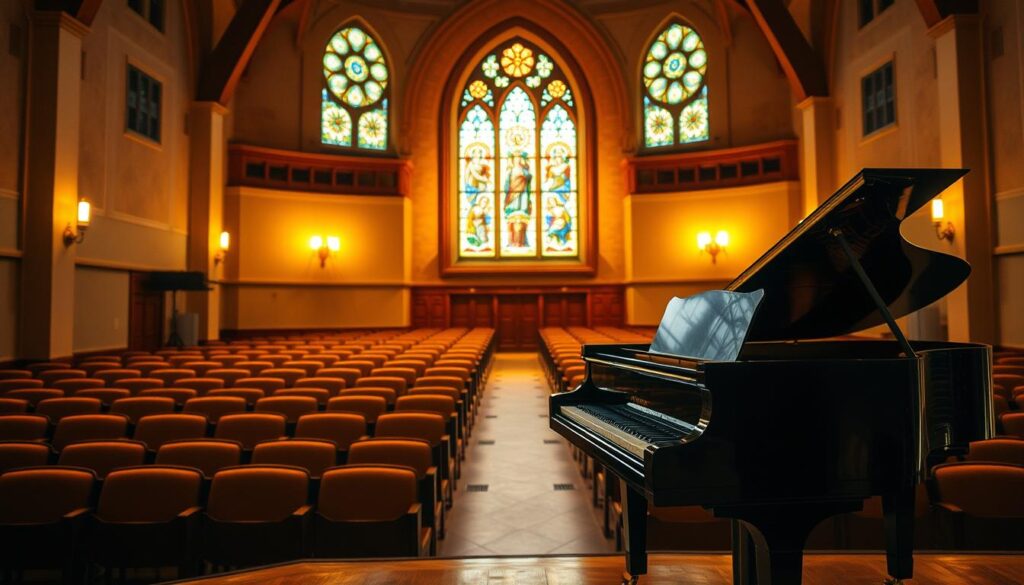
A serene concert hall illuminated by soft, warm lighting. In the foreground, a grand piano stands elegantly, its polished ebony surface reflecting the glow. Beyond it, rows of padded pews fill the middle ground, creating an inviting atmosphere for an intimate musical performance. The backdrop features ornate stained-glass windows, their intricate designs casting a kaleidoscope of colors across the space. The overall scene exudes a sense of reverence and spiritual contemplation, perfectly suited for a sacred music program within the hallowed walls of the Sacred Heart of Jesus Catholic Church.

Director of Music role: The Director plans and coordinates the entire music program for parish liturgies. They work with the pastor to choose music that supports readings and rites, direct choirs, serve at weekend and special liturgies, and meet families for wedding and funeral planning.

Choirs, cantors, and parish musicians

Parishioners with singing or instrumental gifts are invited to join rehearsals and training. Regular mentorship helps volunteers grow in skill and confidence while keeping focus on communal prayer.

  • Schedules and rehearsals that fit seasonal needs
  • Care for instruments, sound systems, and the music library
  • Compliance with diocesan guidelines and copyright

Interested in serving? If you feel called to join or to apply as Director of Music, contact Fr. Logue or Ed Dougherty, Parish Manager. The program welcomes new members and values musical leadership that uplifts the whole community.

Stay Connected with Our Parish Community

Keep up with parish life by syncing our calendar to your phone or desktop. Subscribing makes planning simple and helps you join worship, service, and formation.

Events calendar: iCal feed for Google Calendar and Mac

Get Feed for iCal (Google Calendar) — add this URL to iCal on Mac, Google Calendar, or any app that supports iCal. Copy the feed URL or download the ICS file to subscribe.

  • One subscription keeps parish programs, mass times, and special events in your calendar.
  • Automatic updates bring new items and changes so your week reflects community life day by day.
  • Use the feed to get reminders for morning a.m. gatherings and evening p.m. meetings.
  • The calendar often lists adoration hours, formation sessions, and service opportunities.

Please contact our parish office and clergy for support

If you need help adding the feed or finding a program that fits your schedule, please contact the parish office. Staff and clergy can point you to ministries, adoration times, or pastoral care.

Item How to Add Typical Times
General events Copy feed URL or download ICS Weekday a.m. and evening p.m. slots
Adoration Subscribe to see weekly hours Morning a.m. and select p.m. hours
Mass and special liturgies Add calendar for automatic updates Daily a.m. and weekend times

Please contact the office for questions or pastoral needs. Our team is ready to help you connect, serve, and grow with the parish community.

Conclusion

Find a steady path here where weekday a.m. routines and evening p.m. gatherings support your daily faith. At Sacred Heart, you’ll discover clear steps for worship, reconciliation, and service that fit real schedules.

Join a weekday a.m. liturgy, spend quiet time in adoration, or reconnect through confession. Our community walks with you through each season of life.

If you’re ready to get involved or have questions, please contact the parish office. Come often, bring a friend, and let the Sacred Heart guide your prayer and service.

FAQ

What are the regular Mass times, including a.m., noon, and p.m. options?

Our parish offers morning, midday, and evening Masses to fit busy schedules. Typical times include an early a.m. service, a noon Mass, and an evening p.m. Mass on weekdays and weekends. Check the parish bulletin or website for current days and holiday variations.

Is there a livestream for services, and where can I watch?

Yes. Weekend Masses are livestreamed on YouTube via the “Sacred Heart of Jesus Boulder” channel. The feed is viewable on smart devices and embeds on our site for those unable to attend in person.

When is reconciliation (confession) available, and are Spanish times offered?

Reconciliation times include scheduled Saturday sessions and by-appointment slots. Spanish-language confession is offered periodically; call the parish office to confirm times and arrange a bilingual priest if needed.

How can I request sacramental care, such as anointing or home Eucharist visits?

Contact the parish office to request visits for anointing of the sick, Eucharist at home, or pastoral prayer. Clergy and trained ministers respond promptly for hospital or home-bound parishioners.

Who leads the music program and how are liturgies supported musically?

A professional Director of Music oversees liturgical planning, coordinates musicians, and selects repertoire. The director works with clergy to ensure music supports prayer and seasonal celebrations.

How can I join a choir, become a cantor, or play as a parish musician?

New members are welcome. Auditions are typically informal. Contact the music office to learn rehearsal schedules, vocal expectations, and instrument opportunities for all skill levels.

How do I add parish events to my Google Calendar or Mac using an iCal feed?

The parish publishes an iCal feed for the events calendar. Copy the feed URL from the website and add it to Google Calendar (Add by URL) or to the Mac Calendar app (File > New Calendar Subscription).

What is the best way to contact the parish office or clergy for support?

For scheduling, pastoral needs, or general questions, call the parish office during business hours or email the staff. Emergency pastoral care is available by phone outside regular hours—details are posted on the contact page.

What Bible Does the Catholic Church Use?


Clear guidance matters when picking a sacred text that fits belief and practice. This introduction explains which editions carry official approval, how the 73-book canon was affirmed by councils, and which translation you’ll hear at Mass in the United States.

Many readers prefer a version that balances accuracy and readability. For liturgy, the New American Bible appears in most U.S. parishes. For study, teachers often point to the Revised Standard Version, Catholic Edition.

Practical tips help you mark pages without damaging thin paper. Use extra-fine pens and colored pencils. Look for editions approved by the Apostolic See or a bishops’ conference to match Church teaching.

Next, we’ll explain approvals, compare translations, and share simple tools for daily reading and long-term study so modern readers can engage Scripture with confidence.

Key Takeaways

  • The Church affirms a 73-book canon approved at historic councils.
  • U.S. liturgy commonly uses the New American Bible.
  • Revised Standard Version, Catholic Edition, is popular for study.
  • Seek editions approved by the Apostolic See or bishops’ conference.
  • Use fine pens and colored pencils to protect thin pages.
  • Choose a translation that fits your reading and study goals.

What Bible Does the Catholic Church Use?

For reliable prayer and study, pick a version that lists all 73 books and shows formal approval.

A Catholic bible contains 73 books: 46 in the old testament and 27 in the New Testament. That total includes seven deuterocanonical books plus extra sections in Esther and Daniel.

Canon law (c. 825 §1) requires that published editions and vernacular translations have approval from the Apostolic See or a conference of bishops. Look for an imprimatur or official notice in the front matter.

“Approved translations protect readers by ensuring texts match Church teaching and liturgical needs.”

In the united states, translations such as NABRE and NRSV‑CE carry episcopal approval for prayer and study. Different translations offer varied language and notes, but all approved Catholic bibles share the same canon.

Feature What to Check Why It Matters
Contents 73 books listed Confirms full canon and deuterocanonical books
Approval Imprimatur or bishops’ notice Ensures conformity with doctrine and liturgy
Translation NABRE, NRSV‑CE, RSV‑CE Language choices for reading, study, and Mass

How Catholic Bible Approvals Work: Translation, Imprimatur, and Ecclesial Authority

Approval gives readers confidence that a published text fits liturgical and teaching needs. Canon 825 §1 assigns responsibility for vernacular translations to the Apostolic See or episcopal conferences. That legal framework shapes which english translation editions receive formal endorsement for prayer and catechesis.

A dimly lit ecclesiastical setting, with an ornate wooden desk in the foreground. Atop the desk, an open book with gilded edges and a Catholic cross insignia, symbolizing the imprimatur, or official endorsement, of the Church. The background features intricate stone arches and stained glass windows, casting a warm, reverent glow over the scene. The lighting is soft and directional, creating deep shadows and highlights that accentuate the textures and details of the materials. The overall atmosphere is one of solemn authority and sacred tradition, conveying the gravity and significance of the Catholic Church's role in the translation and approval of Holy Scripture.

Imprimatur and bishop approval: what to look for on the title pages

Check the front matter for an imprimatur or a notice from a bishops’ conference. These brief statements show an edition passed review and is approved for Catholic use.

Translation vs. paraphrase: why word-for-word matters for Bible study

A faithful translation converts original languages into clear, accurate text. Scholars prefer translations for study because they preserve doctrinal nuance.

“Proper ecclesiastical approval—including an imprimatur—indicates conformity with teaching and suitability for prayer and study.”

  • Translation aims for accuracy.
  • Paraphrases may aid casual reading but can lose precise wording.
  • When in doubt, check the copyright page to confirm translation method.
Item What to check Why it matters
Approval Imprimatur or bishops’ notice Shows conformity with canon law
Translation type Formal equivalence vs. paraphrase Impacts study accuracy
Language English translation specifics Affects clarity for local readers

The Catholic Canon: 73 Books, the Deuterocanon, and Why It Matters

A full canon draws on Greek and Hebrew streams to form a 73‑book collection that guides worship and study.

The full list at a glance

There are 46 Old Testament books and 27 New Testament books in this canon. Included are deuterocanonical books such as Tobit, Judith, Wisdom, Sirach, Baruch, and 1‑2 Maccabees.

Deuterocanonical books explained

These texts appear in the Greek Septuagint and not always in the Hebrew Masoretic Text. Councils at Hippo, Carthage, Florence, and Trent reaffirmed their place.

How contents differ from Protestant editions

Many Protestant editions omit the deuterocanon. Historic king james version printings included an Apocrypha section, creating an 80‑book set in some copies.

“Knowing which books are present prevents confusion when verses appear only in certain editions.”

Area What to expect Why it matters
Contents 73 books (46 OT, 27 NT) Matches liturgy and catechesis
Deuterocanonical Tobit, Judith, Wisdom, Sirach, Baruch, 1‑2 Maccabees, added Esther/Daniel Provides history, prayer, and wisdom themes
Comparison Some Protestant editions omit these books Check contents when choosing translations like the Jerusalem Bible family
  • Tip: Always verify the contents page when buying a study edition.

Official and Liturgical Use in the United States

Mass readings in many U.S. parishes come from a single, widely accepted English edition.

In the united states, the New American Bible (NAB/NABRE) supplies most lectionaries and is the version you hear proclaimed at Mass. That makes it a familiar choice for home reading and parish study.

New American Bible (NAB/NABRE): the translation you hear at Mass

Approved by bishops, NABRE reflects updates in language and notes for modern readers. Many parishes use lectionary texts that slightly differ from base edition wording, so listeners may notice small variations between personal copies and proclaimed scripture.

Lectionaries, RSV-2CE, and special cases

Regional and ritual diversity matters. The RSV‑2CE lectionary serves the Antilles and personal ordinariates for former Anglicans. The CTS New Catholic Bible presents a Jerusalem Bible revision aligned with lectionary norms.

“Lectionary requirements can shape published editions and their notes, helping readers match parish proclamation.”

  • Tip: Match a study edition to lectionary phrasing if you serve at Mass.
  • Verify edition year and approval notices before purchase.
  • Remember directives on sacred names affect liturgical text language and translation choices.

Buyer’s Picks: Comparing Trusted Catholic English Translations

Choosing an English translation comes down to reading style, study goals, and notes that guide interpretation.

A well-worn leather-bound book, its cover embossed with a simple cross, rests on a wooden table illuminated by soft, warm lighting. The pages have a slight yellow tint, hinting at the age and history contained within. The book's title, "Revised Standard Version", is prominently displayed, reflecting the authoritative nature of this trusted Catholic English translation. The scene exudes a sense of reverence and scholarly elegance, inviting the viewer to explore the depths of this important religious text.

Revised Standard Version, Catholic Edition (RSV‑CE / RSV‑2CE)

Balanced and literal-leaning. Many teachers recommend this catholic edition for study. It reads clearly and appears often in catechetical material.

New American Bible (NAB / NABRE)

Modern and liturgical. This version is common in U.S. parishes. It offers extensive notes and updated Old Testament language for readers.

NRSV‑CE and Jerusalem Bible family

NRSV‑CE suits academic use with careful scholarship. The jerusalem bible editions bring literary flair and helpful introductions for study.

Study formats

Study bibles like The Great Adventure add timelines, color coding, and guides that help readers trace salvation history.

“Match edition features—notes, cross-references, margins—to your study habits for better long-term use.”

Edition Strength Good For
RSV‑CE / RSV‑2CE Literal clarity, reverent language Close study, catechesis
NAB / NABRE Readable prose, strong notes Parish reading, lectionary match
NRSV‑CE / Jerusalem Scholarship, literary style Academic study, reflective reading

Tip: Start with an RSV‑CE or NABRE and add a study edition later if you want extra notes and tools.

Practical Buying Checklist: Get the Right Catholic Bible for You

A careful checklist saves money and ensures the edition matches liturgical and study needs.

Detailed still life of a wooden table with a warm, natural lighting. In the foreground, place a checklist on a clipboard with various items like "Catholic Bible", "Bible translation", "Leather/hardcover", "Footnotes/commentary", and "Ribbon bookmark". In the middle ground, arrange an open Bible, a pen, and a magnifying glass. In the background, have bookshelves filled with various Bible editions. Capture a serene, contemplative atmosphere that invites the viewer to consider their Bible purchasing options.

Confirm approval first. Check the contents page for all 73 books and look in the front matter for an imprimatur or a bishops’ notice. That approval protects readers and shows canonical completeness.

Match features to your habits. Decide if you want a literal translation for close study or a smoother edition for daily reading. Compare notes, maps, cross-references, and timelines to see how each edition supports long-term study and teaching.

Pick durable format and tools. Prefer sewn bindings, thicker covers, and paper that resists ghosting. If the edition uses India paper, test extra‑fine pens (Zebra) on a back page and favor colored pencils to mark passages without bleed‑through.

“Test pens and inspect binding—small checks now save hours of frustration later.”

  • Create a simple color system for notes and themes.
  • Choose print size and margins you’ll actually use for annotations.
  • For portable reading pick a compact edition; for study choose larger layouts with study aids.
Item Check Benefit
Contents & Approval 73 books, imprimatur or bishops’ notice Canonical accuracy and ecclesial approval
Features Notes, maps, cross-references Improves study and retention
Format & Tools Sewn binding, paper type, pens/pencils Longevity and clean annotation

Nova Vulgata and Tradition: The Church’s Official Latin Reference Text

A standardized Latin text provides a stable point of comparison for modern translations.

The Nova Vulgata is the Church’s official Latin reference used in documents and liturgy. It serves as a benchmark for wording, theological terms, and liturgical norms across languages.

At Trent, the Vulgate’s authority was affirmed for the Latin tradition while scholars were still urged to consult original-language manuscripts. Modern practice follows that guidance.

From Vulgate to Nova Vulgata: what “official” means today

Popes and scholars endorse rigorous methods for translation. Textual criticism, manuscript comparison, and linguistic study guide editors in restoring ancient readings.

“Original-language texts remain the highest authority, and Latin acts as a unifying reference for global editions.”

  • Nova Vulgata: a Latin standard for documents and liturgy.
  • Original texts: primary authority for translators and scholars.
  • Translation principles: critical scholarship ensures faithful modern versions.
Role Focus Benefit
Nova Vulgata Latin reference Consistency in theological and liturgical language
Original-language texts Hebrew, Aramaic, Greek Primary basis for accurate translation
Translation practice Textual criticism & manuscripts Reliable modern editions for study and worship

Conclusion

strong, wrap-up: A clear plan helps you read more often and learn more well. Start with one trusted edition for daily reading and a study bible for deeper dives.

Many teachers point to Revised Standard Version (RSV‑CE) for study and New American (NAB/NABRE) for lectionary alignment in the united states. For guided plans try the Great Adventure Bible or other adventure bible formats that add timelines and simple tools.

Choose an edition that lists all 73 books and shows approval. Pair clear notes, maps, and cross‑references with a compact copy for daily reading. Over time, your notes become a roadmap for ongoing bible studies and steady growth.

FAQ

What English translations are officially approved for use at Mass in the United States?

The New American Bible Revised Edition (NABRE) is the approved lectionary translation for most U.S. liturgies. Other editions like the Revised Standard Version, Second Catholic Edition (RSV‑2CE) appear in special cases, such as personal use or in certain ordinariates with episcopal permission.

How can I tell if a translation has ecclesial approval?

Look for an imprimatur and a nihil obstat on the title page or front matter. Those declarations show a bishop or competent authority reviewed the text for doctrinal fidelity. Publishers often note “Catholic Edition” and include full canon contents as well.

What’s the difference between a translation and a paraphrase for study?

Translations aim for accurate rendering of original languages, either word‑for‑word or sense‑for‑sense. Paraphrases prioritize contemporary readability over literal accuracy. For study and teaching, a formal translation like the RSV‑CE, NRSV‑CE, or NABRE is preferable.

How many books are in the Catholic canon and what are the deuterocanonical books?

The canon includes 73 books: 46 in the Old Testament and 27 in the New Testament. The deuterocanonical books—Tobit, Judith, 1 and 2 Maccabees, Wisdom, Sirach, Baruch, and additions to Esther and Daniel—appear in Catholic editions but not in most Protestant canons.

Why do these extra books matter for faith and study?

They provide historical, liturgical, and theological material used in tradition and teaching. Many early Christians and Church Fathers used these texts, and they inform sacramental theology, prayer, and moral instruction.

How do Catholic editions differ from common Protestant versions like the King James Version?

Key differences include the inclusion of the deuterocanonical books and Catholic‑oriented footnotes and cross‑references. Translation philosophy and manuscript bases also vary; KJV relies on later manuscripts and Elizabethan language, while Catholic editions use modern critical texts and contemporary English.

Which translation will I hear most often at Mass in the U.S.?

You’ll most often hear readings from the NABRE lectionary. Parishes sometimes provide missals or worship aids based on that text to match proclaimed Scripture during liturgy.

Are there special lectionaries or translations used in certain regions or groups?

Yes. Some dioceses, the Personal Ordinariates, and English‑speaking regions outside the U.S. may approve RSV‑2CE, Jerusalem Bible derivatives, or regionally adapted texts with permissions from local bishops.

Which English editions are best for study and small groups?

RSV‑CE/RSV‑2CE and NRSV‑CE are scholarly and clear for group study. NABRE offers strong study notes tied to liturgical use. The Jerusalem Bible and New Jerusalem Bible have literary strengths and helpful commentary choices.

What study editions add helpful tools like timelines, maps, and notes?

Editions such as The Great Adventure Study Bible and other study‑focused publications include timelines, character charts, maps, and developer notes that aid reading and adult faith formation programs.

How do I confirm a print edition contains all 73 books?

Check the table of contents or the publisher’s product description for the full Old and New Testament listings, including the deuterocanonical books. “Catholic Edition” labeling and an imprimatur are additional confirmations.

What features should I prioritize when buying a durable study copy?

Choose readable type size, a sturdy binding, sewn signatures, indexed tabs if desired, wide margins for notes, and paper quality that resists bleed‑through from pens and highlighters.

What role does the Nova Vulgata play in official texts?

The Nova Vulgata is the Church’s official Latin reference text. Modern English translations reference it for liturgical and doctrinal consistency, but vernacular translations use original Hebrew, Aramaic, and Greek manuscripts alongside that Latin tradition.

Where can I find trustworthy study resources and editions recommended for parish groups?

Look for publishers like Ignatius Press, Oxford University Press, and the United States Conference of Catholic Bishops (USCCB) for approved editions and companion study guides that include ecclesial endorsements and reliable commentary.

Explore the Cardinal Catholic Church


Welcome to a clear, friendly guide on one of the most enduring offices in the global faith tradition. This section explains who the senior advisors are, why the role matters, and how the title connects to centuries of practice.

The word itself comes from the Latin for “hinge,” a fitting image: these leaders help the pope govern and, above all, select his successor. Historically, laymen sometimes held the honor, but modern rules limit membership to ordained clergy, usually priests or bishops.

These advisors wear scarlet symbols and hold a ring and Roman titles that link them back to the Diocese of Rome. The rank is prestigious but not a new sacramental order; it does not grant higher spiritual power beyond a bishop.

Over time the number of members has changed—from a few in the Middle Ages to roughly 180 today—shaping how the college meets and decides on vital matters for the world faith community.

Key Takeaways

  • These senior leaders advise the pope and help steer the worldwide faith community.
  • The name traces to a Latin word meaning hinge, highlighting their central role.
  • The title is a papal appointment, not a new sacrament, and generally goes to ordained clergy.
  • Symbolic vestments and a ring point to sacrifice, fidelity, and unity with the See of Peter.
  • The College of members has changed in number over time, affecting governance and elections.

The cardinal catholic church: origins, meaning, and why cardinals matter

What began as an address in Rome evolved into a body of trusted counselors. The name traces to cardo, Latin for hinge, reflecting how early popes like Sylvester I relied on local clergy to anchor governance in the city.

By the 12th century the advisors formed a formal college. Since 1059 they have had the exclusive duty to elect a new pope and to advise the pontiff on major decisions. That electoral role ties their early Roman identity to an enduring global purpose.

Over time the number and reach of members changed. A long-standing cap of 70 gave way in the 20th century as popes of the modern era—Paul VI, Pope John Paul II, and Pope Francis—named leaders from diverse dioceses and catholic churches worldwide.

Key points:

  • The title began as a Roman parish address and kept the hinge metaphor.
  • The college expanded from local clergy to a worldwide college with titular ties to Rome.
  • While the rank is conferred by the pope, it is not a separate order of ordination; modern practice usually requires episcopal consecration before elevation.

Inside the College of Cardinals: ranks, titles, and governance

The College divides its members into three distinct ranks that shape both ceremony and governance.

Three ranks cardinals — cardinal bishops, cardinal priests, and cardinal deacons — set roles and precedence.

A cathedral interior bathed in warm, golden light. In the foreground, three cardinal bishops stand solemnly, their crimson robes and elaborate miters commanding attention. Their faces are thoughtful, their posture dignified, as they confer on matters of church governance. In the middle ground, a grand throne sits empty, awaiting the arrival of the pope. The background is filled with intricate architectural details - vaulted ceilings, stained glass windows, and ornate columns that rise up to meet the heavens. An atmosphere of reverence and tradition permeates the scene, reflecting the enduring power and influence of the College of Cardinals.

The three ranks and what they do

Cardinal bishops are the senior group historically tied to the suburbicarian sees around Rome. Today this rank also includes patriarchs eastern catholic who keep high office and senior officials.

Cardinal priests are usually bishops or archbishops who lead major dioceses worldwide or serve in the roman curia and hold a titular Roman parish.

Cardinal deacons often serve as officials roman curia or are honored theologians linked to ancient deaconries.

Titles, governance, and duties

Every member must hold a Roman title. That titular connection binds global service to the Diocese of Rome while day-to-day parish care stays local.

“Titles are symbolic: they mark membership in Rome’s clergy without replacing local leadership.”

The college is led by the dean college cardinals and a vice-dean, chosen from the bishops in the senior group and confirmed by the pope. These officers coordinate meetings, represent the body, and help maintain continuity in its work.

Consistory and conclave: how cardinals elect a new pope and advise the Church

A consistory blends ceremony with counsel. It is the formal rite where the pope creates new cardinals and a working meeting where members advise the supreme pontiff on world matters.

What a consistory is

New cardinals receive a red biretta, a ring, and a Roman title. That investiture links each person to a titular church or deaconry in Rome and marks their formal membership in the college.

Conclave essentials

The conclave is the closed election to elect new pope. Only members under the age of 80 may enter and vote in the conclave.

By rule, no more than 120 eligible electors is the usual cap, though Paul VI and John Paul II at times exceeded that to broaden global representation.

Counting members over time

The total number of members can far exceed the number eligible to vote. Examples include snapshots like 117 electors out of 183 members or 128 electors after the Nov. 28, 2020 consistory.

Between popes

During a vacant See of Peter, the college manages ordinary governance, preserves continuity, and prepares the conclave to elect the next pontiff. Senior members, including bishops, deacons, and officials from the roman curia, keep advising even after they lose voting rights at age 80.

“Transparent rules — caps, age thresholds, and clear procedures — help ensure a legitimate vote conclave that the faithful can trust.”

Conclusion

The college cardinals stands as a bridge between Rome’s history and leaders who serve dioceses across the world.

The three ranks — cardinal bishops, cardinal priests, and cardinal deacons — give a clear model of roles and precedence. Each member must hold title to a Roman parish or deaconry to signify membership in the Roman clergy.

The dean college cardinals, chosen from the cardinal bishops, helps coordinate work with the roman curia. Modern consistories and new cardinals have broadened global representation, while rules like the age-80 voting limit and elector caps keep conclaves orderly.

In short: the rank cardinal is an honor tied to service, not extra sacramental power. From eastern catholic churches and patriarchs to officials roman curia, the college unites diverse ministries. Learn more locally about your dioceses, bishops, and deacons to see how this global framework lives in daily pastoral care.

FAQ

What does the term that comes from “cardo” (hinge) mean in Church history?

The word derived from Latin “cardo” originally described something pivotal. In Church history it came to name the senior clergy who serve as principal advisors and electors for the pope. They historically linked the local Roman clergy to the wider global leadership that guides dioceses and major offices.

How did these senior clergy evolve from local Roman roles to a global college?

Over centuries the group moved beyond Rome as the Church expanded. Leaders from bishops, priests, and deacons around the world received titles tied to Rome but served in local dioceses and the Roman Curia. This shift created a formal college that balances pastoral duties with governance and papal elections.

What are the three ranks within this college and what do they do?

The three ranks are bishops, priests, and deacons within the college structure. Those holding the bishop rank often oversee sees near Rome or are senior officials. The priest rank usually includes diocesan bishops worldwide who hold a titular church in Rome. The deacon rank covers officials in the Roman administration and those serving temporary assignments before promotion.

How does leadership inside the college work, especially the roles of dean and vice-dean?

The dean leads meetings of the members and coordinates during a vacant See of Peter, while the vice-dean steps in when needed. Both are elected by their peers and receive papal confirmation. Their duties include organizing consistories and representing the college in formal functions.

Why do members hold titular churches or offices in Rome?

Holding a Roman title symbolizes unity with the See of Peter and links global leaders to the Church’s historical center. Even when serving in distant dioceses or the Roman Curia, these titles preserve an institutional bond with Rome and its pastoral mission.

How are Eastern patriarchs integrated into the bishop rank?

Leaders of Eastern Catholic Churches who are patriarchs may be elevated while keeping their own patriarchal see. They often receive honors that recognize their ancient traditions and can be placed among the bishop rank without losing autonomy in their Eastern jurisdictions.

What is a consistory and what happens during one?

A consistory is a formal gathering where the pope creates new members, confers titles, and seeks counsel. It can be ceremonial—when new members receive their insignia—or administrative, addressing governance matters and major Church initiatives.

Who can vote in a conclave to elect a new pope and what are the age rules?

Only members who have not reached their 80th birthday before the day a See becomes vacant may vote in a conclave. The college sets a cap on electors at times to keep the voting body manageable, though the pope can name new members at consistories.

How does the total number of members compare to the number of electors over time?

The total membership often exceeds the number of eligible electors because many members surpass the age limit or hold honorary roles. Popes adjust appointments to maintain a balance between experienced leaders and active electors, so numbers have fluctuated historically.

What duties does the college have between popes during a vacant See of Peter?

During a sede vacante the group governs limited day-to-day affairs, manages the transition, and prepares for the conclave. They must avoid major decisions that would bind the next pope but ensure continuity in essential functions and communications.