Welcome to a journey through one of Christianity’s most enduring traditions. Anglicanism blends ancient spiritual practices with thoughtful modern faith, rooted in the teachings of Jesus Christ. This tradition emerged during the 16th-century Reformation, carving a unique path that honors both Catholic heritage and Protestant reforms.
At its core, this Christian tradition emphasizes the Trinity—Father, Son, and Holy Spirit—and the transformative power of Christ’s life, death, and resurrection. Scripture and early church creeds form its foundation, while worship often reflects a balance of structured liturgy and personal reflection.
You’ll discover how Anglicans navigate faith through a “middle way,” respecting historical continuity while embracing diverse perspectives. From timeless hymns to community-driven ministries, this tradition remains vibrantly alive across continents.
Key Takeaways
- Originated during the Protestant Reformation, blending Catholic and Protestant influences
- Centers on the Trinity and Christ’s role in human salvation
- Uses the Bible and ancient creeds as primary guides
- Known for its “via media” approach to Christian practice
- Maintains global presence with localized cultural expressions
Foundations of Anglican Belief
The Anglican way of faith stands on three timeless pillars that guide belief and practice. This balanced approach weaves together divine revelation, historical wisdom, and thoughtful reflection—a framework often called the “three-legged stool.”
The Role of Scripture as the Ultimate Rule
At the stool’s center sits Scripture—the 66 books of the Bible containing God’s self-revelation. Anglicans view these texts as the supreme authority, offering everything needed for salvation and spiritual growth. From Genesis to Revelation, they form the “rule and standard” for doctrine and daily living.
Tradition and Reason in Shaping Faith
Two other legs support this foundation. Tradition connects believers to ancient creeds and Reformation insights, while Reason invites engagement with God-given intellect. Together, they help interpret Scripture through the lens of church history and modern challenges.
| Scripture | Tradition | Reason |
|---|---|---|
| 66 biblical books | Apostles’ & Nicene Creeds | Critical thinking |
| Divine revelation | Early church practices | Cultural context |
| Salvation essentials | Reformation principles | Ethical application |
This triad works harmoniously, allowing Anglicans to honor biblical truth while embracing the guidance of the Holy Spirit in changing times. It’s why ancient prayers feel fresh, and modern questions find answers in enduring wisdom.
The Historical Roots of Anglicanism
Long before cathedrals dotted England’s landscape, Christian communities quietly shaped its spiritual identity. By the early 3rd century, believers gathered in homes and hidden spaces—their faith surviving Roman occupation and cultural shifts.
Early Christian Influences and the Primitive Church
Three British bishops made history in 314 AD at the Council of Arles. Representing London, York, and Lincoln, they revealed an organized church structure decades before Rome’s official adoption of Christianity. This early foundation blended Celtic traditions with Mediterranean practices.
Missionaries like St. Patrick transformed Ireland’s spiritual landscape during the 5th century. Meanwhile, Roman influence returned through St. Augustine’s 596 AD mission from Pope Gregory. These efforts created a vibrant tapestry of worship styles.
The pivotal 664 Synod of Whitby settled key disputes. Northumbrian leaders chose Roman Catholic Easter calculations over Celtic methods, aligning England with continental practices. This decision strengthened connections to wider Christian traditions.
Scholars like the Venerable Bede preserved this rich history. His writings show how Saxon, Celtic, and Roman threads wove together—forming a unique religious culture that valued both local identity and universal truth.
These ancient roots explain why Anglican worship today feels both familiar and distinctive. The echo of early saints’ devotion resonates in modern prayers, while the balance of unity and diversity remains a lasting legacy.
Development of the Book of Common Prayer and Liturgical Tradition
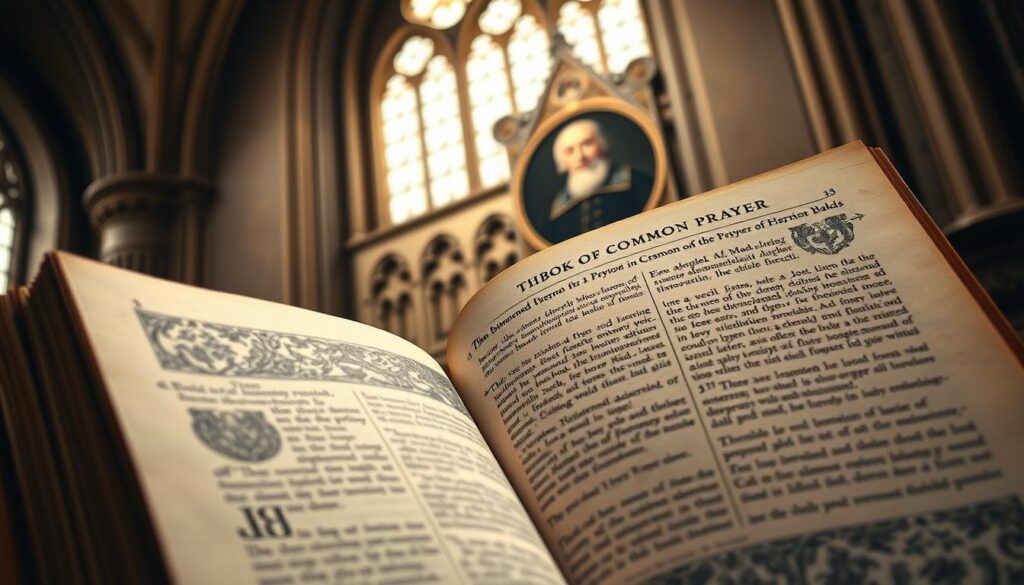
In 1549, a revolutionary text transformed Christian practice across England. Archbishop Thomas Cranmer’s Book of Common Prayer replaced Latin rituals with vibrant English worship. This groundbreaking work became the heartbeat of Anglican spirituality, blending medieval traditions with Reformation ideals.
Origins and Significance of the Book of Common Prayer
Cranmer’s masterpiece did more than translate services. It created common ground for believers through shared prayers and sacraments. The 1549 edition preserved ancient patterns while making worship accessible to all. Parishioners could now fully participate instead of watching silently.
Evolution of Anglican Worship and Sacraments
The 1662 version became the gold standard, shaping global Anglican practice for centuries. Its baptism and communion rites reveal core sacramental theology. These services teach through participation—believers experience grace rather than just hear about it.
| Edition | Innovation | Lasting Impact |
|---|---|---|
| 1549 | First English-language liturgy | United national worship |
| 1552 | Simplified ceremonies | Clarified Protestant stance |
| 1662 | Restoration-era revisions | Global standard for 350+ years |
Today’s Anglican services still echo Cranmer’s rhythm of Scripture, prayer, and sacrament. The prayer book remains a living tradition—adapting to new cultures while preserving essential truths. Its words continue shaping hearts across continents and generations.
What Are Anglican Beliefs: Core Doctrines Explored
Anglican teachings unite global communities through shared spiritual foundations. The 1880s Chicago-Lambeth Quadrilateral offers the clearest framework, outlining four non-negotiable articles that define this tradition’s heartbeat.
Creeds, Sacraments, and the Three-Legged Stool Philosophy
This four-part agreement anchors Anglican doctrine in Scripture’s authority while honoring ancient creeds. Believers affirm baptism and communion as Christ’s direct gifts—sacred moments where divine grace transforms lives. Baptismal waters symbolize spiritual rebirth, while communion becomes a mystical encounter with Jesus’ presence.
| Quadrilateral Pillar | Practical Expression | Spiritual Impact |
|---|---|---|
| Bible as ultimate standard | Guides ethical decisions | Creates scriptural unity |
| Apostles’ & Nicene Creeds | Weekly recitations | Connects to early church |
| Two sacraments | Baptism & Eucharist | Channels divine grace |
| Historic bishops | Global oversight | Preserves apostolic roots |
Episcopal Governance and Church Leadership
Anglicans maintain continuity through bishops tracing authority to early apostles. This three-fold leadership model—bishops, priests, deacons—ensures accountability while adapting to local needs. Regional autonomy exists within worldwide connection, like branches sharing one ancient trunk.
Through these structures, Anglican communities balance timeless truths with contemporary ministry. The blend of sacramental depth and flexible governance explains why this tradition thrives across 165 countries today.
Diverse Expressions Within the Anglican Communion
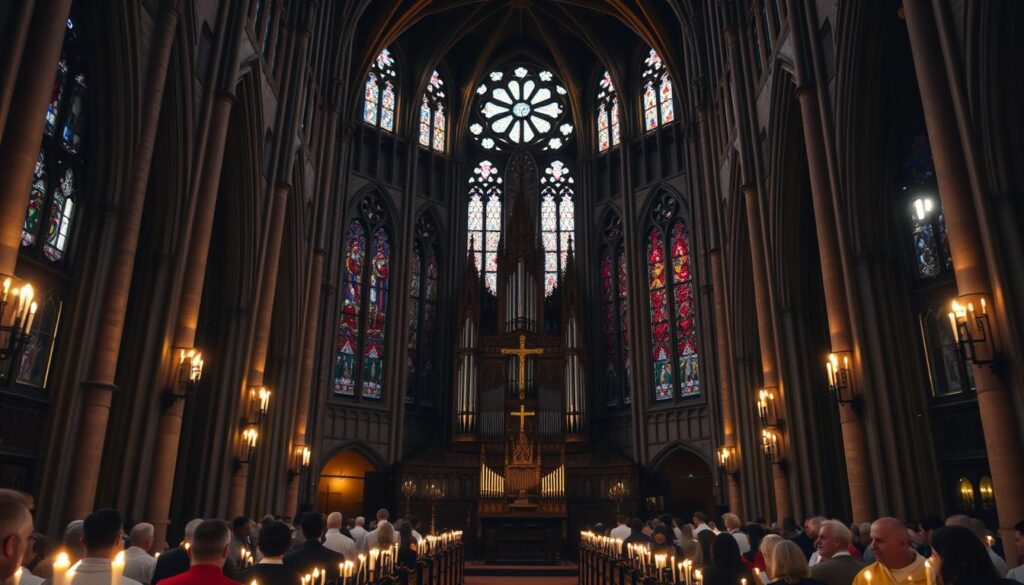
Walking into an Anglican church might surprise you. One congregation kneels before incense-filled altars, while another sings modern worship songs with hands raised. This vibrant spectrum reflects the Communion’s ability to hold varied practices within shared faith foundations.
High Church, Low Church, and Broad Church Traditions
High Church Anglicans treasure ancient rhythms. They emphasize bishops’ authority, structured liturgies, and sacraments as channels of grace. Gold chalices, priestly vestments, and chanted prayers connect them to Christianity’s earliest days.
In contrast, Low Church communities prioritize simplicity. Their services focus on biblical preaching and personal conversion. Many embrace evangelical outreach programs, reflecting Reformation-era values. You’ll find fewer rituals but lively Bible studies here.
The Broad Church approach bridges these worlds. It creates space for both traditionalists and progressives, united by core creeds. This “big tent” mentality allows diverse theological views within one global family.
Despite differences, all groups affirm the Chicago-Lambeth Quadrilateral’s essentials. Whether through incense or acoustic guitars, they share a common way of following Christ. This flexibility helps Anglican churches resonate across cultures while keeping ancient truths alive.
The Anglican Church in Modern America
American Anglicanism presents a living tapestry of faith traditions navigating contemporary challenges. Two distinct branches—The Episcopal Church (TEC) and Anglican Church in North America (ACNA)—reveal how historical roots adapt to modern spiritual landscapes.
Differences Between the Episcopal Church and ACNA
TEC maintains official ties to the global Anglican Communion through the Archbishop of Canterbury. ACNA, formed in 2009, aligns with the GAFCON movement emphasizing traditional practices. This split emerged from debates over scriptural interpretation and social ethics.
The division carries deep historical echoes. Some ACNA churches trace their origins to the 19th-century Reformed Episcopal split from TEC. Legal battles over property and leadership rights marked recent separations, creating parallel Anglican networks.
Terminology reveals theological identity. Episcopalian” now describes TEC members, while ACNA congregations prefer “Anglican.” Both groups share liturgical heritage but differ in applying ancient beliefs to 21st-century life.
This complex landscape shows how global religious movements take unique shape in American culture. Through changing times, these communities continue redefining what authentic Anglican witness means today.
FAQ
How does the Anglican Church balance scripture, tradition, and reason?
Anglicans view scripture as the ultimate authority, guided by tradition and informed by reason. This “three-legged stool” approach fosters a dynamic faith rooted in biblical teachings while respecting historical practices and thoughtful interpretation.
What role does the Book of Common Prayer play in worship?
The Book of Common Prayer, first published in the 16th century, unites Anglicans globally through shared liturgy. It structures prayer, sacraments, and worship, reflecting the blend of ancient early church traditions and Reformation-era reforms.
How does Anglican governance differ from other denominations?
Bishops hold a central role in leadership, tracing authority back to the primitive church. This episcopal governance emphasizes continuity with historic Christianity, distinguishing Anglicanism from many Protestant groups while maintaining independence from Roman Catholic hierarchy.
What distinguishes High Church and Low Church traditions?
High Church Anglicans emphasize formal liturgy, sacraments, and continuity with Catholic practices. Low Church traditions prioritize simplicity, preaching, and Reformation influences. Broad Church Anglicans often blend both approaches, reflecting the communion’s diversity.
How do the Episcopal Church and ACNA differ today?
The Episcopal Church (TEC) and Anglican Church in North America (ACNA) split over doctrinal and social issues. TEC leans progressive on topics like LGBTQ+ inclusion, while ACNA upholds conservative interpretations of scripture and tradition, aligning with global Anglican Communion guidelines.
What sacraments are central to Anglican beliefs?
Anglicans recognize baptism and the Eucharist as primary sacraments instituted by Jesus Christ. Five additional rites—confirmation, marriage, ordination, confession, and anointing—are seen as “sacramental” practices supporting spiritual life and mission.
How does Anglicanism connect to early Christian history?
The Anglican Church traces its roots to the early church through apostolic succession, creeds like Nicene, and liturgical practices. While shaped by the 16th-century Reformation, it retains ancient structures like bishops and sacramental theology.