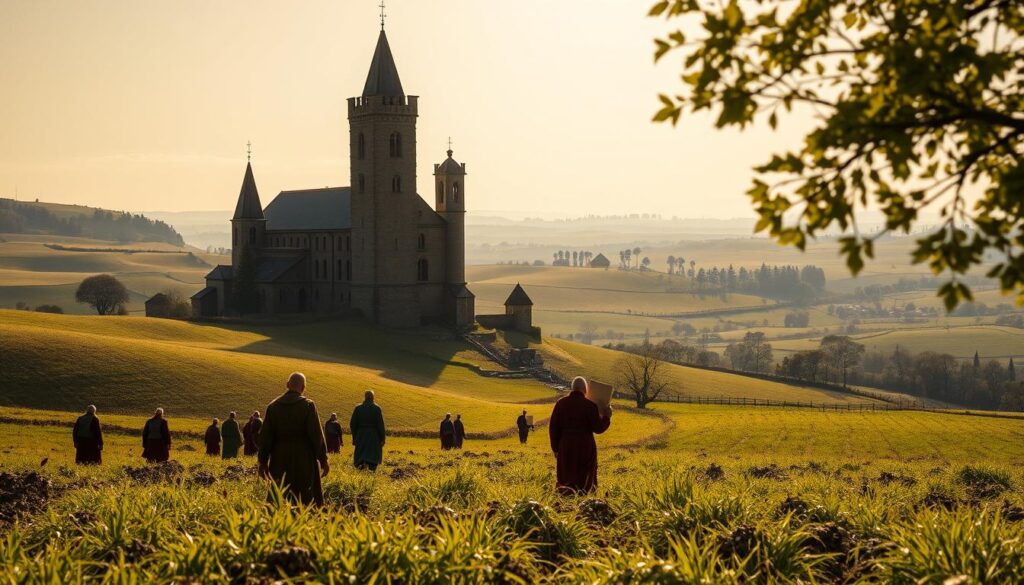
Imagine living in an age when questioning authority could spark a revolution. This is exactly what happened in 16th-century Europe through a religious awakening that reshaped societies and beliefs. What began as a call for change within the Church grew into a powerful movement altering spiritual practices across continents.
At the heart of this transformation lay bold ideas about personal faith and access to spiritual truth. Visionary thinkers challenged long-held traditions, advocating for direct connections between individuals and their understanding of divinity. These shifts didn’t just affect church services – they transformed art, education, and even how nations governed themselves.
The ripple effects of this cultural earthquake lasted over 130 years, creating new branches of Christian practice. From passionate debates in university halls to dramatic political changes, its legacy continues to influence modern discussions about belief and personal freedom.
Key Takeaways
- Religious movement spanning 1517-1648 challenged traditional authority structures
- Introduced new Christian denominations still active today
- Sparkled major changes in education and individual rights
- Created lasting impacts on European politics and global colonization
- Transformed art, literature, and daily spiritual practices
Historical Context and Origins
Europe’s spiritual landscape was a powder keg of conflicting interests long before 1517. The Roman Catholic Church held unmatched influence, blending sacred duties with earthly politics. Kings and popes often clashed over control, creating tensions that weakened trust in religious authority.
Medieval Church and Political Intrigues
By the 1400s, the church’s wealth and power overshadowed its spiritual mission. Lavish projects drained resources while ordinary people struggled. Critics pointed to corrupt clergy selling forgiveness through indulgences – a practice that prioritized money over faith.
Political alliances further complicated matters. Popes negotiated like diplomats, while local leaders resented Rome’s interference. This mix of greed and power struggles left many questioning traditional structures.
Early Reform Movements and Catalysts Before 1517
Visionary thinkers planted seeds of change centuries before Luther. John Wycliffe translated scripture into English, arguing everyone should access God’s word. Jan Hus challenged church hierarchy in Bohemia, paying with his life.
Erasmus of Rotterdam took a different approach. The scholar urged Christians to focus on Christ’s teachings rather than rituals. His witty critiques of superstition made him Europe’s first bestselling author – proof that ideas could spread faster than decrees.
The Spark of Change: Martin Luther and the 95 Theses
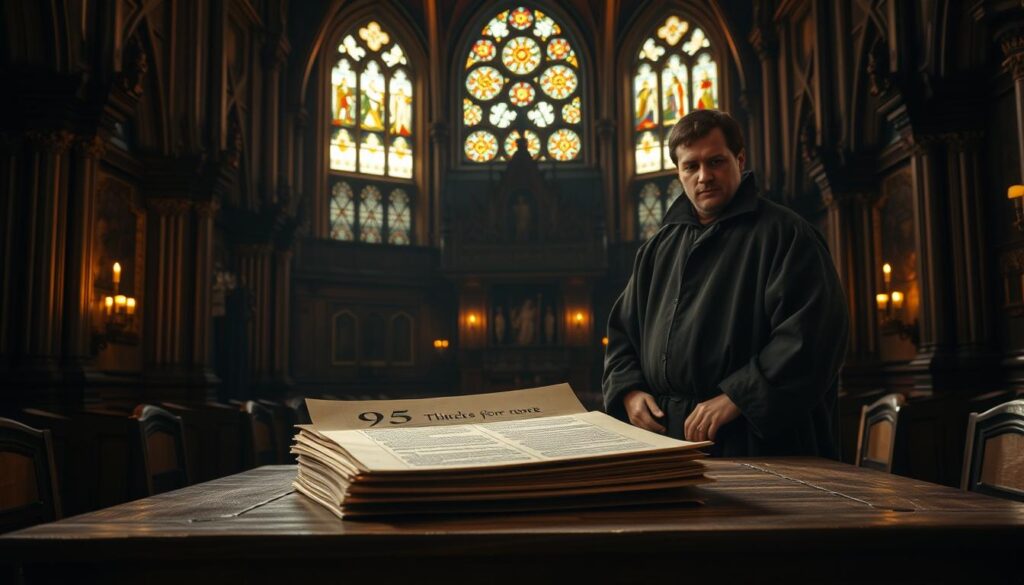
When Martin Luther nailed his arguments to a church door, history pivoted. This bold act on October 31, 1517, challenged the church’s power to sell spiritual favors. His 95 debate points, later called the “95 Theses”, questioned why forgiveness required payment rather than genuine belief.
From Monk to Movement Leader
As an Augustinian monk, Luther saw firsthand how indulgences exploited believers. His academic training helped craft clear arguments against corrupt practices. “Why does the pope’s wealth grow while ordinary people suffer?” he asked. This mix of theological insight and moral outrage made his message stick.
Luther’s core ideas transformed Christian thought. He argued salvation came through faith alone, not rituals or payments. Scripture, not church leaders, became the ultimate authority. These principles threatened existing doctrine and reshaped spiritual life.
Printing Press Revolution
Luther’s genius lay in using new technology. The printing press turned his writings into viral content. Pamphlets spread his theses across Europe faster than horse riders could carry them. Common people finally accessed religious debates in their language.
| Reformer | Publications (1518-1525) | Key Innovation |
|---|---|---|
| Martin Luther | 420+ | Mass-produced pamphlets |
| Other Top 17 Reformers | 398 combined | Local language translations |
By 1521, Luther faced Emperor Charles V at the Diet of Worms. His refusal to recant cemented his break with Rome. What began as academic debate became a continental revolution – proof that ideas paired with technology can change the world.
Diverse Movements: Lutheranism, Calvinism, and Beyond
The spiritual revolution of the 1500s blossomed into multiple branches, each offering fresh interpretations of faith. While Luther’s ideas spread rapidly, other thinkers shaped Christianity’s evolution through distinct approaches to doctrine and community life.
Calvin’s Geneva: The Rise of Reformed Doctrine
John Calvin transformed Geneva into a laboratory for religious reform. His Institutes of the Christian Religion became Protestantism’s first systematic guidebook. This French thinker argued God’s absolute power determined human destiny – a concept called predestination.
Geneva’s strict moral codes banned dancing and fancy clothes. Yet refugees flocked here, creating Europe’s first Protestant safe haven. Calvin’s ideas later fueled revolutions in Scotland and shaped America’s Puritan settlers.
Huldrych Zwingli and the Swiss Influence
Huldrych Zwingli launched Zürich’s spiritual makeover in 1519. Like Luther, he preached salvation through faith. But their views split over communion’s meaning. Zwingli saw it as symbolic, sparking debates that divided Protestant groups.
| Theologian | Key Work | Core Belief | Geographic Spread |
|---|---|---|---|
| John Calvin | Institutes of Christian Religion | Predestination | France, Scotland, Netherlands |
| Huldrych Zwingli | 67 Articles | Symbolic Communion | Swiss Cantons |
Zwingli’s blend of civic and religious leadership inspired later reformers. His tragic death in battle showed how deeply theology intertwined with politics during this era. These diverse approaches prove spiritual revolutions rarely follow single paths.
Exploring the protestant reformation time period: Key Events and Dates
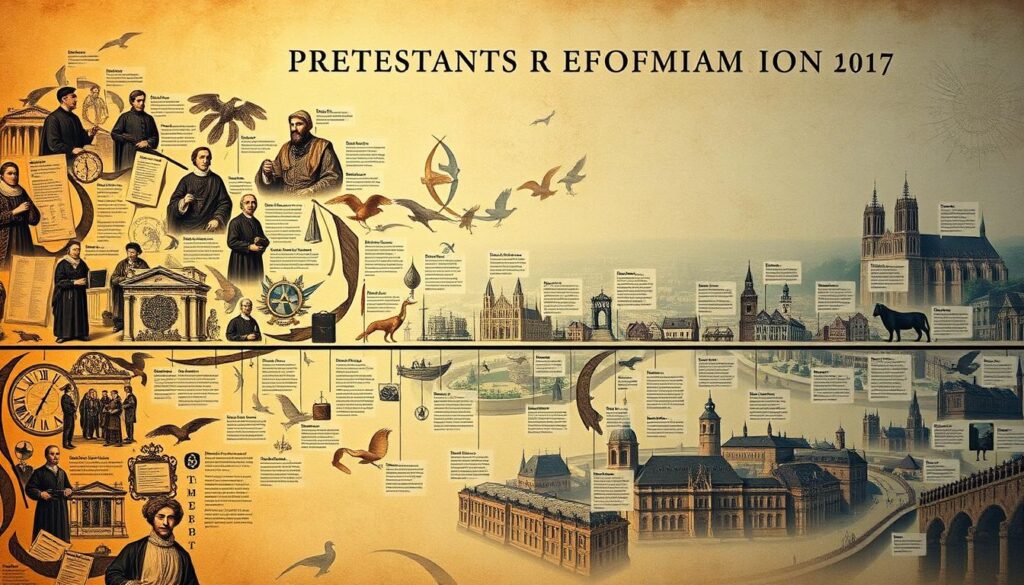
Europe’s religious map redrew itself through landmark moments between 1517 and 1648. These years saw spiritual revolutions, political showdowns, and cultural shifts that still influence modern beliefs.
Significant Milestones from 1517 to 1600
October 31, 1517, changed everything. Martin Luther’s public challenge to church tradition sparked debates reaching from German towns to the Vatican. Within four years, his refusal to recant at the Diet of Worms made reconciliation impossible.
| Year | Event | Impact |
|---|---|---|
| 1524 | Peasants’ Revolt | First major social uprising inspired by reform ideas |
| 1536 | Calvin’s Institutes Published | Created blueprint for Reformed Christianity |
| 1555 | Peace of Augsburg | Legalized Lutheran faith in German states |
The 1540s brought two crucial developments. Calvin transformed Geneva into a Protestant model city, while Catholic leaders launched the Council of Trent to counter reform movements. “Here I stand,” Luther’s famous declaration, became a rallying cry for those seeking religious freedom.
By 1648, the Treaty of Westphalia ended decades of conflict. This date marked both the close of an era and the beginning of new religious landscapes across Europe.
Reformation in England: The Middle Way Between Traditions
Personal desires and political maneuvering led to the birth of a national church. Unlike continental reforms driven by theology, England’s spiritual shift began with royal family matters. This unexpected origin story created a unique religious identity that still shapes worship today.
Henry VIII’s Break with Rome and the Birth of Anglicanism
King Henry VIII’s marriage troubles ignited England’s religious transformation. When the pope refused to annul his union with Catherine of Aragon, Henry declared himself head of the Church of England in 1534. This bold move transferred spiritual authority from Rome to the crown.
The king dissolved monasteries, redistributing their wealth and land. By 1536, every parish needed an English Bible – a radical change for worshippers accustomed to Latin texts. These actions mixed personal ambition with lasting religious reform.
The Book of Common Prayer and Religious Renewal
Queen Elizabeth I stabilized the Church of England with her famous “middle way.” Her 1559 settlement blended Catholic traditions with Protestant ideas. Central to this balance was the Book of Common Prayer, which standardized worship in English.
Thomas Cranmer’s masterpiece transformed daily practice. Its elegant phrases like “We have erred and strayed like lost sheep” gave believers familiar yet fresh ways to connect with their religion. This liturgical guidebook became the heartbeat of Anglican identity.
| Monarch | Reign | Religious Approach |
|---|---|---|
| Edward VI | 1547-1553 | Radical Protestant reforms |
| Mary I | 1553-1558 | Catholic restoration |
| Elizabeth I | 1558-1603 | Balanced compromise |
This unique way of practicing faith proved durable. By honoring tradition while embracing change, England created a spiritual model that influenced nations across oceans.
The Counter-Reformation: Catholic Response and Renewal
As new religious ideas swept Europe, the Roman Catholic Church launched its own wave of change. Leaders recognized the need to address criticisms while strengthening spiritual foundations. This renewal blended tradition with thoughtful updates to practices.
The Council of Trent and Doctrinal Reform
Between 1545 and 1563, church authorities held 25 meetings at Trent. These sessions clarified Catholic Church teachings on salvation and sacraments. They banned questionable practices like selling church positions while emphasizing clergy education.
The council established new rules for bishops and priests. Seminaries became required training centers, ensuring better-prepared leaders. Art and music gained fresh importance as tools for worship, inspiring magnificent Baroque creations.
This reform movement also produced dynamic new religious orders. Groups like the Jesuits combined intellectual rigor with missionary zeal. Their schools and global outreach helped the Roman Catholic tradition adapt to a changing world while preserving its core identity.
FAQ
What sparked the start of the Protestant Reformation?
Martin Luther’s 95 Theses, written in 1517, challenged the Catholic Church’s sale of indulgences. His critiques of doctrine and authority ignited debates that spread across Europe, thanks to the printing press.
How did John Calvin influence religious thought during this era?
Calvin’s Institutes of the Christian Religion outlined Reformed theology, emphasizing predestination and strict moral living. His ideas shaped communities like Geneva and inspired movements such as Puritanism.
Why did Henry VIII break from the Roman Catholic Church?
Henry sought to annul his marriage to Catherine of Aragon, which the Pope denied. This led to England’s split from Rome, forming the Church of England with the monarch as its head.
What role did the Council of Trent play in the Catholic Church?
The Council of Trent (1545–1563) addressed corruption, reaffirmed Catholic teachings, and launched the Counter-Reformation. It standardized liturgy and emphasized clergy education to counter Protestant critiques.
How did the Book of Common Prayer impact England’s religious practices?
Introduced under Edward VI, this book simplified worship in English instead of Latin. It unified Anglican services and reflected a blend of traditional rituals with Reformed theology.
What was unique about Huldrych Zwingli’s reforms in Switzerland?
Zwingli rejected Catholic practices like fasting and icon veneration, focusing on scripture alone. His debates with Luther over communion highlighted divides in early Protestant thought.
Why did the printing press matter during this period?
It allowed rapid spread of ideas through pamphlets, Bibles, and writings. Luther’s works, for example, reached thousands quickly, fueling debates and broadening support for reform.
How did the Catholic Church address Protestant challenges?
Beyond the Council of Trent, new orders like the Jesuits emerged. They focused on education, missionary work, and reviving spiritual fervor to reclaim influence across Europe.