Recent Posts

The Meaning Behind the Protestant Symbol


When you walk into a modern church, the emblems you see tell a story. For Protestant communities, these visual elements act as silent teachers of their core beliefs. Unlike ornate religious art, these designs focus on simplicity—a deliberate choice rooted in 16th-century reforms.

Many believers find these visual tools help ground their spiritual practice. A simple cross or open Bible artwork isn’t just decoration—it’s a reminder of direct access to God through Scripture. This approach began as a response to complex medieval traditions, emphasizing personal faith over ritual.

The Reformation didn’t just change theology—it reshaped how Christians express devotion. Leaders like Luther and Calvin promoted imagery that anyone could understand. Today’s churches continue this legacy, using meaningful designs to unite congregations across denominations.

Key Takeaways

  • Protestant visual elements prioritize clarity and scriptural focus
  • Historical reforms shaped today’s worship practices
  • Simple designs encourage personal spiritual connections
  • Modern churches balance tradition with contemporary needs
  • Visual tools serve as reminders of core theological ideas

Introduction to Protestant Symbols

Visual markers in worship spaces often carry deep spiritual significance. For Protestant communities, these elements act as silent guides to their foundational beliefs. Unlike ornate decorations, they prioritize clarity and purpose—a tradition rooted in historical reforms.

Overview of Key Faith Elements

Protestant churches use symbols to teach and unite. A simple wooden cross or open Bible invites reflection on core teachings. These designs avoid complexity, mirroring the movement’s focus on personal connection with scripture.

Three primary roles define these visual tools:

  • Teaching biblical narratives through accessible imagery
  • Creating sacred spaces for focused worship
  • Uniting diverse congregations under shared truths
Feature Catholic Tradition Protestant Use
Cross Design Often includes Christ’s body Typically empty, emphasizing resurrection
Artwork Complexity Detailed iconography Minimalist representations
Scripture Display Integrated into stained glass Prominent open Bible displays

Setting the Context for Modern Believers

Today’s congregations balance tradition with contemporary needs. A young worshiper might encounter the same empty cross their ancestors did—yet find fresh meaning in its simplicity. This continuity helps bridge generational gaps in faith communities.

Modern churches often adapt these visual elements for new contexts. Digital projections might pair ancient symbols with current worship music. Such innovations maintain core messages while speaking to evolving spiritual journeys.

The Historical Roots of Protestantism

The 16th century reshaped Christian visual identity through dramatic changes. Reformers stripped churches of ornate decorations, viewing them as distractions from true worship. This cleansing act, called iconoclasm, marked a clear break from past traditions.

Protestant Reformation symbols

Martin Luther and other leaders crafted new visual languages to reflect their theology. They prioritized open Bibles over statues, making scripture the centerpiece of worship spaces. The printing press spread these ideas rapidly, creating shared imagery across Europe.

Three key principles guided this transformation:

  • Rejection of imagery seen as idolatrous
  • Elevation of biblical texts as primary focus
  • Creation of simple designs for universal understanding

While Luther kept some traditional elements, reformers like John Calvin pushed for radical simplicity. Their beliefs about direct access to God shaped churches’ physical spaces. Empty walls and clear glass windows became testaments to renewed theological priorities.

These historical practices still influence modern congregations. The Bible’s central placement in sanctuaries traces directly to Reformation-era values. What began as protest became enduring visual testimony.

Understanding the protestantism symbol

Simple designs in worship spaces carry deep theological meaning. These visual tools guide believers without demanding attention, reflecting core Reformation values. Unlike decorative art, they act as signposts pointing to scriptural truths.

Definition and Visual Representation

Protestant symbols work like roadmaps rather than destinations. An empty cross or communion cup doesn’t hold sacred power itself—it directs focus to Christ’s resurrection or Last Supper promises. This approach stems from careful theological decisions about how humans interact with sacred imagery.

Three features mark these visual elements:

  • Clear connections to biblical narratives
  • Minimal artistic embellishment
  • Focus on communal understanding
Aspect Protestant Approach Other Traditions
Cross Design Empty, emphasizing victory Often shows suffering Christ
Art Complexity Purposeful simplicity Detailed iconography
Function Teaching tool Veneration object

Theological Significance in Worship

These visual elements act like handshakes in protestant worship—invitations to engage rather than spectate. When congregations see baptismal water or an open Bible, they’re reminded of their covenant relationship with God. This sparks active participation through prayer, singing, or scripture reading.

Modern churches carefully balance meaningful representation with spiritual focus. A Lutheran altar might display candles recalling Christ as light, while a Baptist chapel uses clear glass to symbolize transparency before God. Despite differences, all aim to enhance worship without distracting from its core purpose.

The Significance of the Empty Cross

What makes a cross without a figure carry such profound meaning? For Protestant communities, this intentional design choice reflects deep theological convictions. The absence of Christ’s body on the cross stems from interpretations of the Second Commandment, which cautions against creating graven images.

empty cross

Symbol of Resurrection and Hope

The bare cross serves as a visual celebration of victory over death. Unlike depictions focusing on suffering, this design points directly to Easter morning. Churches use it to remind worshippers that Jesus Christ conquered the grave, offering eternal hope.

Three key messages emerge from this emblem:

  • Completion of salvation through resurrection
  • Invitation to live in confident faith
  • Promise of new life for believers

Contrasts with the Crucifix in Catholicism

While Catholic traditions often use crucifixes showing Christ’s body, Protestant spaces emphasize the empty form. This difference highlights distinct theological priorities:

Feature Protestant Cross Catholic Crucifix
Visual Focus Empty structure Christ’s body
Theological Message Resurrection victory Sacrificial act
Commandment Alignment Second Commandment Incarnational theology

Modern churches continue using this symbol in creative ways. Some project digital crosses behind worship bands, while others craft minimalist wooden designs. All maintain the core message: Christ’s triumph changes everything.

Exploring the Role of the Empty Pulpit

At the heart of many Protestant churches stands an unadorned platform that speaks volumes through its simplicity. This central fixture isn’t just furniture—it’s a physical declaration of priorities. The empty pulpit acts as a silent herald, reserving its space for scripture alone.

Protestant pulpit design

Emphasis on Simplicity and Scripture

Protestant architecture uses placement and design to teach theology. Raised platforms and central positioning ensure all eyes focus on the word being proclaimed. Unlike ornate altars in other traditions, these pulpits showcase open Bibles rather than decorative carvings.

Three design choices reveal deeper meaning:

  • Elevated height symbolizes scriptural authority
  • Minimal decoration prevents distraction
  • Central location underscores preaching’s role

Modern churches maintain this focus while adapting to new contexts. Some replace wooden structures with clear acrylic lecterns—visible reminders that God’s truth should never be obscured. Others project scripture verses behind speakers, blending tradition with technology.

Historical roots explain this importance. Reformers removed visual clutter to spotlight biblical teaching. Today’s congregations continue valuing audible truth over visual spectacle. The pulpit’s emptiness becomes its message: only God’s word fills spiritual voids.

From Icons to the Word: Protestant Simplicity

Imagine walking into a 16th-century church after the Reformation—what would you see? Stripped walls, clear windows, and open Bibles replaced statues and paintings. This visual revolution reshaped worship spaces to reflect new theological priorities.

Rejecting Idolatry Through Scripture

Reformers like John Calvin argued God’s invisibility made physical representations dangerous. “The human mind is a perpetual forge of idols,” Calvin wrote, fearing art could distract from spiritual truth. Churches removed icons to protect against misplaced devotion.

Three core beliefs drove this change:

  • Scripture alone guides faith
  • Human-made images risk idolatry
  • Spiritual understanding needs no visual aids

Historical Shift in Worship Practices

The move from art to text transformed Christian communities. Preaching replaced visual storytelling as the primary teaching method. Congregations began prioritizing Bible literacy over memorizing saintly images.

Aspect Medieval Practice Reformed Approach
Focus Sensory experience Scriptural engagement
Art Role Teach through images Distraction from truth
Worship Center Altar with relics Pulpit with Bible

Modern churches still navigate this legacy. Some use projection screens to display verses during sermons. Others maintain plain walls to keep attention on spoken word. All share a common goal—keeping God’s message central.

The Symbolism of the Dove and the Holy Spirit

A white dove soaring through stained glass tells a story older than the Reformation itself. This enduring image connects modern worshippers to biblical events while reflecting Protestant values of clarity and purpose.

Artistic Expressions With Spiritual Depth

The dove’s association with the Holy Spirit originates in Jesus’ baptism accounts. Gospel writers describe the Spirit descending “like a dove” – a moment many Protestant churches highlight through art and architecture.

Three key aspects shape dove imagery:

  • Biblical roots in Matthew 3:16 and John 1:32
  • Visual connections to peace and renewal
  • Emphasis on God’s active presence
Denomination Dove Usage Worship Context
Lutheran Baptismal fonts Infant christenings
Baptist Communion tables Lord’s Supper services
Pentecostal Sanctuary banners Spiritual renewal events

Modern designs balance artistic beauty with theological accuracy. Stained glass doves often appear with rays of light, symbolizing divine guidance. Some congregations use abstract designs to avoid literal representation.

During Pentecost celebrations, many Protestant churches incorporate dove motifs into banners or projections. This practice reminds believers of the Spirit’s ongoing work while maintaining focus on scriptural truth over the symbol itself.

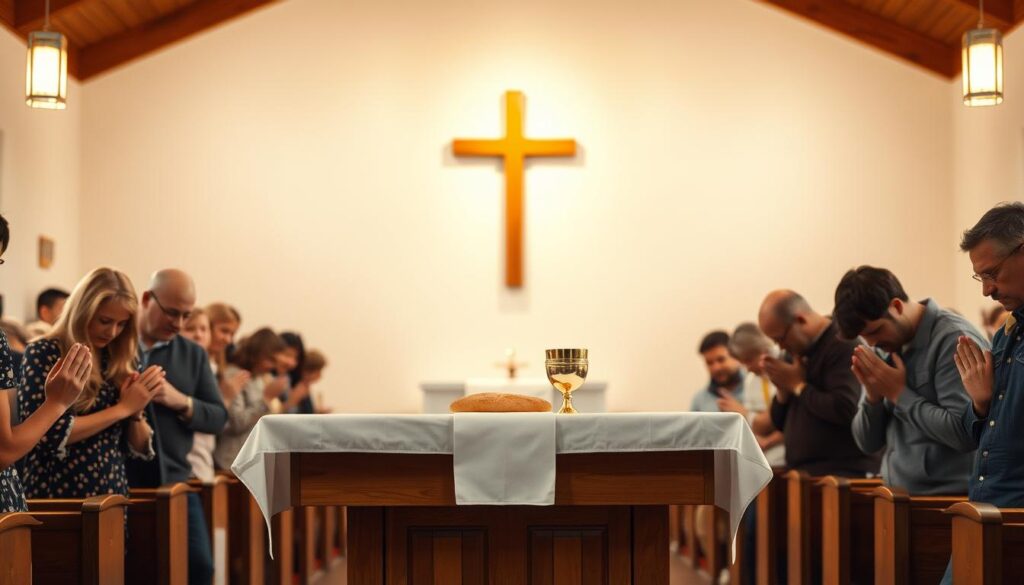
The Role of the Chalice and Bread in Protestant Communion

Gathered around a simple table, believers share two elements that bridge centuries of faith. The bread and chalice used in Protestant worship aren’t just ritual objects—they’re tangible connections to foundational Christian events. This practice transforms ordinary meals into sacred moments of reflection.

Commemorating Christ’s Sacrifice

In Protestant churches, communion bread represents Jesus’ broken body, while wine recalls his blood shed for humanity’s salvation. The chalice specifically mirrors the cup from Gethsemane, symbolizing acceptance of divine purpose. These sacraments focus on remembrance rather than mystical change.

Three key ideas shape this practice:

  • Historical continuity with Jesus’ final meal
  • Physical reminders of spiritual promises
  • Community participation in sacred storytelling

Modern communion tables reflect theological clarity through minimalist designs. Unadorned wood or plain glassware keeps attention on Christ’s sacrifice rather than decorative details. Some congregations use everyday plates to emphasize accessibility.

This approach contrasts with traditions believing in literal transformation. For Protestants, the presence of Christ emerges through shared faith, not altered elements. The meal becomes a living memorial—a way to taste grace rather than observe it.

FAQ

What does the empty cross represent in Reformation traditions?

The empty cross highlights Jesus’ resurrection and victory over death. Unlike crucifixes, which show Christ’s body, it emphasizes hope and eternal life through His sacrifice.

Why do many Reformation churches avoid ornate decorations?

Simplicity focuses attention on Scripture and avoids distractions. This practice reflects core beliefs about worship centered on God’s Word rather than physical imagery.

How is the Holy Spirit depicted in Reformation art?

The dove is a common image, symbolizing peace, purity, and divine presence. It connects to biblical accounts of Jesus’ baptism and the Spirit’s role in guiding believers.

What role does communion play in these traditions?

Bread and wine (or juice) commemorate Christ’s sacrifice and unity among believers. Unlike some traditions, they’re seen as symbolic reminders rather than literal transformations.

Why is the pulpit central in many Reformation churches?

It underscores the importance of preaching and Scripture. Elevating the Bible’s teachings reflects Martin Luther’s emphasis on accessible faith through God’s Word.

How did the Reformation change worship practices?

It shifted focus from rituals to Scripture, hymns, and congregational participation. This prioritized personal faith and understanding over elaborate ceremonies.

Do all Reformation traditions interpret symbols the same way?

Practices vary! Lutherans, Baptists, and Methodists, for example, may emphasize different elements based on their theological priorities and historical contexts.

Protestant Bible vs Catholic Bible: What’s the Difference?


Many Christians share the same core beliefs but read different versions of sacred texts. The most notable distinction lies in the number of books each tradition includes. While both groups recognize the 27 New Testament writings, their Old Testament collections differ significantly.

The additional texts in one tradition’s version include stories, prayers, and wisdom literature not found in the other. These writings have sparked theological discussions for centuries. Terms like “Deuterocanonical” and “Apocrypha” reflect how each group views these works—as either inspired or historically valuable.

This debate traces back to ancient manuscript traditions and intensified during the 16th-century Reformation. Understanding these differences helps explain how distinct practices and interpretations developed over time. The conversation remains relevant today, shaping worship styles, doctrinal teachings, and interfaith dialogues.

Key Takeaways

  • Both traditions share identical New Testament content
  • Old Testament variations account for the book count gap
  • Seven additional texts appear in one version’s canon
  • Historical debates shaped modern scriptural boundaries
  • Terminology reflects theological perspectives on disputed texts

Historical Overview of the Biblical Canon

Early Christian communities faced uncertainty about which writings held divine authority. Unlike modern readers, they inherited diverse Jewish texts without a predefined checklist. Leaders relied on tradition and spiritual resonance to identify sacred books for worship and teaching.

Fourth-century Greek codices like Vaticanus and Sinaiticus reveal surprising flexibility. These massive manuscripts blended texts later deemed Deuterocanonical with familiar Old Testament stories. No single canon existed yet—local church practices shaped collections.

Regional differences flourished for generations. A congregation in Alexandria might treasure Wisdom literature, while Antioch prioritized historical accounts. This diversity shows how spiritual communities organically shaped their history through lived faith.

By the late fourth century, consensus began emerging. Councils formalized boundaries, but earlier fluidity explains why some books remain contested today. The process wasn’t about exclusion—it reflected evolving understanding of divine inspiration.

Defining the Biblical Canons

Early believers wrestled with a pressing question: which ancient texts truly carried divine authority? This challenge shaped how communities preserved their spiritual heritage. Some leaders turned to Jewish traditions, while others relied on emerging church practices.

biblical canon formation

Christian Scripture in the Early Church

Paul’s declaration that Jews received “the oracles of God” (Romans 3:2) influenced many thinkers. Scholars like Melito of Sardis and Origen created canon lists in the second and third centuries. Their inventories excluded most disputed books, treating them as devotional aids rather than doctrinal foundations.

Fourth-century leaders Cyril of Jerusalem and Athanasius reinforced this approach. They categorized writings into two groups:

  • Core texts for teaching authority
  • Supplementary works for personal growth

Formation of the Hebrew Canon

Jewish leaders finalized their scripture collection around 100 CE. This decision impacted Christian debates, though not uniformly. Some church communities embraced these boundaries, while others valued additional writings used in worship.

The process wasn’t about rejection but discernment. As one scholar noted, “Sacred texts weren’t chosen—they proved their worth through generations of use.” This organic development explains why certain books remain cherished in some traditions yet absent in others.

Old Testament Composition: Identifying Key Differences

What makes one sacred text collection distinct from another? The answer lies in how different faith communities preserved their spiritual heritage. While both traditions share foundational writings, their Old Testament collections reveal striking variations in content and structure.

Canonical Books vs. Deuterocanonical/Apocryphal Books

One group follows the Hebrew canon containing 39 works, mirroring ancient Jewish scriptures. The other includes these plus seven additional texts revered for generations. These supplementary writings fall into three categories:

Category Books Included Key Features
Historical Narratives Tobit, Judith, 1-2 Maccabees Stories of faith during foreign rule
Wisdom Literature Wisdom of Solomon, Sirach Practical guidance for holy living
Prophetic Works Baruch, Daniel additions Visions and prayers from exile periods

Even shared books show organizational differences. For example, some editions combine minor prophets into single scrolls while others separate them. These structural choices reflect how communities prioritized accessibility over strict uniformity.

The debate extends beyond book counts. As one historian notes, “Sacred collections reveal what generations found indispensable for worship and moral instruction.” This perspective helps explain why certain texts became central to some groups while remaining optional for others.

The Catholic Bible: Inclusion of Additional Scriptures

The formation of sacred texts in one tradition reflects centuries of spiritual discernment and community practice. Central to this process was the Septuagint, a Greek translation completed around 250 BCE. Early believers relied on this version, which included seven extra books later affirmed by the catholic church.

Septuagint translation

Influence of the Septuagint and Early Council Decisions

This ancient Greek text became the primary scripture for Greek-speaking Jewish communities and early Christians. Many scholars note its widespread use: “The apostles quoted from it, and congregations across the Mediterranean cherished its wisdom.” Key manuscripts like Codex Sinaiticus (4th century) preserved these writings alongside familiar Old Testament stories.

Three pivotal gatherings solidified their status:

  • The Council of Hippo (393 CE) first approved the expanded list
  • Carthage (397 CE) reaffirmed these texts for worship
  • Trent (1546) formally closed debate during the Reformation era

Leaders viewed these books as essential for teaching, not optional supplements. They emphasized how God’s truth flows through both scripture and lived tradition. This dual approach shaped the catholic bible’s unique character, uniting ancient practices with formal declarations.

By valuing community consensus and historical continuity, the catholic church maintained writings that nourished generations. As one theologian observed, “These texts weren’t added—they endured because they resonated with sacred truth.”

The Protestant Bible: Exclusion During the Reformation

A single monk’s bold challenge reshaped Christianity’s literary foundation in the 16th century. Martin Luther, an Augustinian priest turned reformer, questioned long-standing practices like selling forgiveness through indulgences. His 95 Theses sparked a movement prioritizing direct engagement with sacred texts over institutional decrees.

Reformation impact on scripture

Martin Luther’s Critique and Reformation Impact

Luther’s deep study of ancient manuscripts led him to reject texts supporting doctrines like purgatory. He argued seven Old Testament books conflicted with his reading of divine grace. “Why should human additions obscure God’s clear message?” he famously questioned, advocating for a streamlined scripture collection.

Sola Scriptura and the Shift in Authority

The sola scriptura principle became the Reformation’s rallying cry. This belief shifted ultimate authority from church leaders to biblical texts themselves. Luther’s German translation made scriptures accessible, empowering individuals to interpret teachings through personal faith.

Aspect Pre-Reformation Post-Reformation
Scriptural Authority Church + Tradition Texts Alone
Canon Determination Ecclesiastical Councils Scholarly Analysis
Accessibility Latin Manuscripts Vernacular Translations

This transformation affected more than book counts—it redefined how communities relate to sacred writings. As Luther noted, “True belief flourishes when God’s word lives in every heart.” His legacy continues shaping modern approaches to religious texts and teaching.

Translational Variations and Textual Differences

Ancient scribes left hidden fingerprints in sacred writings through their translation choices. Even when traditions share the same books, variations emerge in wording, structure, and content length. These distinctions often trace back to decisions made centuries ago about which manuscripts to prioritize.

Differences in Versions of Daniel and Esther

The Old Testament’s most striking internal variations appear in Daniel and Esther. Some editions contain:

  • Three extra chapters in Daniel (13-14)
  • Six extended passages in Esther’s Greek version

These additions include dramatic episodes like Susanna’s courtroom vindication and Mordecai’s prophetic dream. Scholars believe they originated from early Greek translation efforts that blended oral traditions with written accounts.

Jerome faced this complexity when creating the Latin Vulgate. He noted: “Churches choose to read Daniel in the version of Theodotion. What sin have I committed in following the judgment of the churches?” His pragmatic approach respected community practices while acknowledging manuscript discrepancies.

Modern text comparisons reveal how translation teams navigate ancient sources. For example, Protestant editions typically omit Daniel’s “Song of the Three Holy Children,” while others preserve it as cherished liturgy. These choices remind us that sacred books often carry layers of historical and cultural meaning beyond their literal words.

The Role of Church Councils in Canon Formation

Gathering spiritual leaders shaped scripture’s boundaries through collaborative decisions. Two major assemblies played pivotal roles in defining sacred texts for millions of believers. Their work balanced ancient traditions with pressing theological questions of their eras.

Florence’s Ecumenical Vision

The 15th-century Council of Florence brought together Eastern Orthodox, Catholic, and Coptic leaders. In 1442, they agreed on a shared list of 73 books—the first ecumenical statement on scriptural canon. This effort aimed to heal divisions while honoring diverse traditions.

Trent’s Definitive Stance

Over a century later, the catholic church addressed rising challenges to traditional teachings. The Council of Trent (1546) reaffirmed Florence’s list but faced internal debates. Records show theologians hesitated to fully resolve ancient disputes between Augustine and Jerome’s viewpoints.

Council Year Key Action Impact
Florence 1442 Listed 73-book canon Created inter-church agreement
Trent 1546 Formalized canon Strengthened church authority

These decisions weren’t made lightly. As one historian notes, “Councils sought clarity for worshippers while respecting centuries of practice.” Their balanced approach continues influencing how communities engage with sacred texts today.

Impact on Doctrinal Beliefs and Practices

Theological debates often hinge on textual foundations. Disputed books became battlegrounds for shaping core teachings about salvation and the afterlife. One heated discussion centered on spiritual purification after death—a concept supported by specific ancient writings.

Scriptural Foundations of Afterlife Concepts

At the 1519 Leipzig debate, Martin Luther challenged traditional views. He acknowledged 2 Maccabees 12:43-45 mentions prayers for the dead but argued: “Since this text isn’t canonical, it can’t establish doctrine.” This stance removed scriptural support for purgatory in his tradition.

Other leaders disagreed strongly. John Calvin later criticized councils for using non-canonical works to validate teachings. “They invent new support by elevating disputed texts,” he wrote, referencing practices like saint veneration derived from Tobit and Maccabees.

Doctrine Textual Source Practical Impact
Purgatory 2 Maccabees 12 Prayers for departed souls
Sainthood Wisdom of Solomon Veneration practices
Spiritual Warfare Tobit 6-8 Exorcism rituals

These differences shaped how communities expressed faith. While some saw these texts as vital guides, others viewed them as historical footnotes. The debate wasn’t just academic—it changed how millions understood their relationship with God and eternity.

Historical Debates and Scriptural Authority

Centuries of spirited discussions shaped how communities define their sacred texts. These conversations weren’t just about book counts—they addressed deeper questions about truth and spiritual guidance. At the heart lay a critical issue: who gets to decide what counts as divine revelation?

Controversies in Canon Selection

Disagreements over specific writings often reflected broader tensions. Some leaders prioritized alignment with ancient Hebrew texts, while others valued widely used Greek translations. This split influenced how groups viewed teachings about prayer, morality, and the afterlife.

Key debates centered on three principles:

  • Connection to apostolic teachings
  • Consistency with core doctrines
  • Enduring community acceptance

These criteria created lasting divisions. As one historian observes, “Canon decisions weren’t dry academic exercises—they defined how generations encountered God’s voice.” Today, these choices still shape worship styles, study practices, and interfaith understanding.

Recognizing this history helps modern readers appreciate why certain texts resonate differently across traditions. It also highlights how faith communities preserve their identity through cherished scriptures.

FAQ

Why do Catholic Bibles have more Old Testament books?

The Roman Catholic tradition includes seven additional books and parts of Esther and Daniel, known as the Deuterocanon. These texts were affirmed by early councils like Trent and Florence, drawing from the Greek Septuagint used by early Christians.

Did Martin Luther remove books from scripture?

Luther questioned the Deuterocanon’s authority during the Reformation, aligning with Jewish Hebrew texts. While he didn’t delete them, Protestant Bibles later excluded these writings, prioritizing Sola Scriptura (scripture alone) as their guide.

How do translations affect differences in Bibles?

Variations arise from source texts—Protestant translations often use Hebrew manuscripts, while Catholic editions include Greek Septuagint passages. For example, Daniel’s Prayer of Azariah appears only in Catholic versions.

What role did church councils play in canon decisions?

Councils like Trent (1546) formalized the Catholic canon in response to Reformation debates. Earlier, the Council of Florence (1442) also affirmed Deuterocanonical texts, shaping Catholic doctrine on purgatory and intercessory prayer.

Are the “extra” Catholic books supported by scripture?

Passages like 2 Maccabees 12:45 reference praying for the dead, which Catholic teachings link to purgatory. Protestants reject these texts as non-authoritative, relying solely on the 66-book canon.

Why are Esther and Daniel different across Bibles?

Catholic Bibles include Greek additions to Esther and Daniel, such as Susanna’s story. Protestant editions omit these sections, following the shorter Hebrew versions accepted during the Reformation.

Do these differences impact core Christian beliefs?

Core teachings like Christ’s resurrection remain shared. However, doctrines like purgatory or intercession of saints stem from Deuterocanonical texts, creating distinct practices between denominations.

Exploring the Protestant Work Ethic: A Closer Look


What shapes our views on success, productivity, and personal responsibility? For centuries, certain cultural beliefs have influenced how societies approach daily labor and long-term goals. One influential framework emerged from 16th-century religious reforms, blending spiritual ideals with practical habits.

Sociologist Max Weber first analyzed this connection in his 1905 book, linking specific faith-based principles to economic growth. His research suggested that disciplined routines and careful resource management weren’t just personal choices – they reflected deeper spiritual commitments. This perspective helped fuel new approaches to business and innovation during industrialization.

Modern discussions about workplace culture often trace back to these historical roots. While economic systems have evolved, core ideas about dedication and responsibility remain surprisingly relevant. From startup founders to corporate leaders, many still embrace versions of these time-tested principles.

This exploration isn’t just about history books. Understanding these origins helps us make sense of current debates about ambition, work-life balance, and societal progress. As we’ll discover, what began as religious doctrine now influences everything from productivity apps to retirement planning.

Key Takeaways

  • Historical religious reforms created lasting impacts on economic thinking
  • Daily habits like discipline and thrift carry deeper cultural significance
  • Early sociological research connected spiritual values to capitalism’s growth
  • Modern work culture retains echoes of centuries-old principles
  • Understanding these roots helps analyze current workplace trends
  • Success perceptions often blend practical effort with symbolic meaning

Historical Context and Origins

How did spiritual beliefs reshape entire societies’ approach to labor? The 16th-century religious upheaval sparked radical shifts in how people valued daily tasks. Reformers reimagined ordinary jobs as divine callings, planting seeds for cultural transformations that crossed oceans.

Development Through the Reformation

Martin Luther’s teachings dismantled medieval hierarchies. He argued that every trade held spiritual worth, not just priestly roles. This idea spread rapidly across Europe during the 1500s.

John Calvin expanded these concepts with his doctrine of predestination. Followers sought signs of divine favor through disciplined living and economic thrift. These principles became cornerstones for communities seeking purpose in their labors.

Aspect Medieval Catholic View Reformation Protestant View Impact
Work Purpose Necessary burden Divine calling Increased work pride
Spiritual Status Monastic superiority Equal value in all work Class structure shifts
Economic Approach Wealth as temptation Thrift as virtue Capital accumulation

Influence of Early Puritan Settlers

Seventeenth-century migrants carried these ideals to American shores. Puritan colonies treated labor as both survival tactic and spiritual test. Captain John Smith’s Jamestown rule – “He that will not work, shall not eat” – became foundational.

These settlements fused religious devotion with practical effort. Their success stories helped cement lasting cultural attitudes about responsibility and resourcefulness in the New World.

Theological Foundations and the Doctrine of Vocation

How did ordinary tasks become sacred acts? Religious reformers redefined daily labor through revolutionary ideas about purpose and service. They taught that every role in society held divine meaning when performed with integrity.

doctrine of vocation

Martin Luther shattered medieval hierarchies by declaring all honest jobs equally valuable. “A cobbler serves God just as much as a priest,” he argued, “when he mends shoes with care.” This vision gave people multiple vocations – in families, trades, and communities – each reflecting God’s work through human hands.

Calvinism, Predestination, and Good Works

John Calvin’s teachings added depth to this concept. His doctrine of predestination emphasized that salvation comes through grace alone, not human effort. Yet believers still pursued excellence in their calling as gratitude for God’s gift.

This created a paradox: though good deeds couldn’t earn salvation, they became vital signs of faith. Thrift and diligence turned into spiritual practices. Craftsmen saw their benches as altars, serving neighbors through quality works.

The principle of sola gratia transformed daily life. Baking bread or building chairs became acts of worship when done with love. This mindset fueled both personal pride and community growth, weaving spiritual meaning into society’s fabric.

Weber’s Groundbreaking Perspective

A radical idea reshaped how we view economic systems when German sociologist Max Weber published his 1905 book. His analysis connected Reformation-era beliefs to modern financial practices, arguing that specific values fueled capitalism’s growth.

The Protestant Ethic and the Spirit of Capitalism

Weber noticed thriving economies in areas embracing Calvinist principles. His theory suggested that viewing success as divine approval motivated disciplined saving and business investments. This “spirit of capitalism” transformed modest earnings into engines for economic expansion.

The sociologist highlighted how moral restrictions on luxury spending channeled resources into productive ventures. Wealth became proof of virtue rather than mere privilege, creating self-reinforcing cycles of enterprise and thrift.

Criticism and Alternative Historical Views

Not all scholars embraced Weber’s conclusions. Historians like Fernand Braudel noted vibrant trade networks in 14th-century Catholic Venice and Florence. Hugh Trevor-Roper argued capitalist practices predated Reformation theology by centuries.

Despite these challenges, Weber’s work remains foundational. His exploration of belief systems shaping economies continues influencing discussions about motivation and market forces today.

The Protestant Work Ethic in American Culture

What invisible forces shaped America’s climb from colonial outposts to global leader? The answer lies in values so deeply rooted they became cultural bedrock. Early settlers brought more than tools – they carried a mindset that would define a nation’s character.

Foundations of Self-Made Success

Colonial leaders like John Winthrop demanded “a city upon a hill” – a model society built through collective effort. This vision required personal responsibility. By 1677, New England communities showed how shared values could drive development. Their respect for laws and tireless effort became survival strategies with lasting cultural impacts.

Political thinker Frank Chodorov noted candidates had to prove self-made status through grit and ability. Inherited wealth meant less than practical skills in this new merit-based system. This expectation still echoes in modern leadership ideals.

Unseen Currents in Modern Life

Today’s workplace habits reveal historical fingerprints. The U.S. celebrates entrepreneurs who “pull themselves up by bootstraps” – a phrase born from impossible tasks made possible. Many workers view overtime as badges of honor rather than burdens.

Yet these values carry complexities. The same drive that fuels innovation sometimes justifies unequal opportunities. Societal praise for relentless effort can overshadow needs for rest or collective support.

From Silicon Valley startups to factory floors, the legacy lives in subtle ways. People often describe career paths as “callings,” unknowingly echoing old spiritual frameworks. This cultural DNA remains powerful, even as debates grow about balancing ambition with well-being.

Contemporary Impact and Modern Interpretations

How do centuries-old values shape modern employment attitudes? Recent studies reveal surprising connections between cultural legacies and today’s workplace behaviors. Researchers are using global data to measure how deeply historical beliefs influence our relationship with labor.

modern work ethic studies

Studies on Work Ethic and Job Value Today

A landmark 2013 analysis of 150,000 individuals across 82 countries uncovered striking patterns. People in areas with specific religious heritage reported 40% stronger emotional distress after job loss compared to other regions. This suggests cultural views about employment extend far beyond practical income concerns.

Contrary to expectations, evidence from 44 European nations shows certain traditions correlate more strongly with workplace dedication than others. One study found religious background explains half the variation in work attitudes between countries – but not always as predicted.

Modern researchers propose fresh interpretations. A 2021 analysis argues values often tied to religious roots might actually reflect economic modernization phases. As societies industrialize, traits like punctuality and thrift become material necessities rather than spiritual choices.

These findings help explain why some workers view careers as core identity markers. They also highlight challenges in balancing productivity expectations with mental health needs in today’s fast-paced economies.

Comparisons, Criticism, and Broader Perspectives

Debates about cultural values and economic systems reveal surprising connections across time and traditions. Let’s examine how different philosophies approach wealth creation and societal progress.

critiques of work ethic theories

Contrasting with Prosperity Theology and Other Work Ethics

Modern prosperity theology flips traditional values on their head. Where older systems emphasized disciplined labor, some contemporary movements teach that divine blessings manifest through material wealth. South African scholar Tshilidzi Marwala suggests repurposing historical principles without religious baggage: “These values could drive development if separated from cultural imperialism.”

System Focus Wealth View Development Approach
Protestant Ethic Disciplined labor Byproduct of virtue Gradual accumulation
Prosperity Theology Miraculous gain Divine favor proof Immediate results
Buddhist Economics Mindful consumption Obstacle to peace Community balance
Confucian Work Ethic Social harmony Family stability tool Multigenerational planning

Socioeconomic Critiques and Historical Debates

Civil rights leaders challenged romanticized narratives.

“Capitalism grew through enslaved labor, not virtuous habits,”

Martin Luther King Jr. noted, exposing systemic contradictions. Historical evidence complicates popular theories – economist Joseph Schumpeter traced capitalism’s roots to 14th-century Italian city-states, long before Reformation ideas emerged.

Modern scholars question whether these values represent universal truths or cultural specifics. Some propose secular versions focusing on responsibility without religious ties. Others highlight successful economies in Japan and Singapore that developed unique frameworks blending tradition with innovation.

These discussions matter for today’s global challenges. Understanding different approaches helps societies craft inclusive systems that honor diverse heritage while addressing modern inequalities.

Conclusion

What cultural narratives continue to shape our understanding of success? Pastor John Starke highlights how the protestant work ethic created enduring myths linking productivity to spiritual worth. Many still assume disciplined labor serves as proof of virtue, despite modern shifts in religious adherence.

These historical beliefs helped forge identities across Europe and America. Communities measured progress through material gains and personal responsibility, often equating financial success with moral standing. Yet this framework rarely accounts for systemic barriers or the human need for rest.

Today’s discussions reveal surprising tensions. While some praise hard work as timeless wisdom, others question its emotional costs. The challenge lies in honoring diligence without making it life’s sole measure – balancing achievement with compassion in our ever-evolving world.

FAQ

How did the idea of linking faith and labor develop historically?

The connection between religious devotion and daily labor grew during the Reformation. Reformers like Martin Luther emphasized viewing everyday tasks as a form of spiritual service. Early Puritan communities in America later reinforced this by treating disciplined effort as both moral duty and a sign of divine favor.

What role did Max Weber play in popularizing this concept?

The German sociologist’s 1905 book, The Protestant Ethic and the Spirit of Capitalism, argued that certain religious beliefs fueled capitalism’s rise. He highlighted how practices like thrift and systematic labor became cultural norms, though his theories remain debated today.

How did this ethic shape early American society?

Settlers in colonial America saw hard work as a way to honor their faith and build a righteous community. This mindset influenced political ideals like self-reliance and contributed to the U.S.’s entrepreneurial culture, which still impacts business practices and attitudes toward success.

Is the ethic still relevant in today’s workforce?

Studies show many people still tie their job performance to personal integrity. However, modern discussions also stress balancing productivity with mental health, reflecting evolving views on what it means to live a meaningful, purposeful life.

What are common criticisms of Weber’s theory?

Critics argue capitalism existed before the Reformation or flourished in non-Protestant regions. Others note his focus on specific groups overlooks broader economic forces. Historians also debate whether cultural values alone can explain complex systemic changes.

How does this ethic differ from prosperity theology?

While both link faith and success, prosperity theology often frames wealth as a divine reward for belief. In contrast, the older tradition emphasized humble, consistent labor as a moral calling—not a guaranteed path to material gain.

Exploring the Protestant Non-Denominational Faith


Imagine a religious movement that’s grown from a tiny fraction to America’s largest Protestant group in just five decades. What started as a handful of independent congregations now represents over 13% of U.S. churchgoers, reshaping modern spiritual life. This is the story of faith communities choosing flexibility over tradition.

These autonomous churches thrive in nearly every corner of America, operating in 86% of U.S. counties. Unlike traditional denominations, they prioritize local decision-making and adaptive worship styles. Their rapid growth reflects a cultural shift toward personalized spiritual experiences that blend ancient truths with contemporary needs.

You’ll discover how these communities maintain core Christian beliefs while rejecting rigid structures. From their explosive growth since the 1970s to their unique approach to scripture interpretation, we’ll explore what makes them distinct. We’ll also examine why millions find this model more accessible than conventional religious institutions.

Key Takeaways

  • Independent congregations now form the largest Protestant group in America
  • Present in 86% of U.S. counties with continued expansion
  • Focus on biblical teachings without denominational rules
  • Adapt worship styles to local community needs
  • Grown from 3% to 13% of religious adults since 1972

Introduction to the Protestant Non-Denominational Journey

Modern spiritual seekers increasingly gravitate toward communities offering both ancient truths and fresh flexibility. At the heart of this shift are faith groups redefining how believers connect with scripture and each other.

What Makes These Communities Unique?

These self-governing congregations operate like spiritual startups – nimble, responsive, and deeply rooted in their neighborhoods. Local leaders shape worship experiences using modern music, casual atmospheres, and practical teachings. A 2022 Pew Research study found 74% of attendees value this tailored approach over rigid traditions.

Core beliefs remain steadfast across these groups:

  • Scripture as the ultimate authority
  • Personal relationships with Jesus
  • Community-focused outreach programs

Why Modern Society Embraces This Model

In our fast-paced world, people crave authenticity and direct spiritual connections. These churches meet that need through:

Feature Traditional Churches Modern Approach
Leadership Structure Hierarchical Local decision-making
Worship Style Formal liturgy Contemporary music
Community Impact Denomination-wide programs Neighborhood-specific initiatives

This adaptability explains why 1 in 7 American churchgoers now choose these communities. They preserve essential Christian practices while speaking the cultural language of today’s world.

Historical Roots and Evolution of Non-Denominational Churches

Centuries before modern worship spaces dotted American highways, radical reformers planted seeds for spiritual independence. What began as whispered dissent against rigid structures blossomed into a defining feature of American religious life.

historical church movements

The Impact of the Protestant Reformation

In 1517, a German monk’s bold act changed Christianity forever. Martin Luther’s famous critiques challenged centralized religious power, declaring “The true treasure of the Church is the Holy Gospel of the glory and grace of God.

This spark ignited three decades of reform that:

  • Established new Christian denominations
  • Emphasized personal Bible study
  • Inspired underground spiritual groups

While Luther never envisioned today’s independent churches, his stand against top-down control created space for future movements.

The Campbell-Stone Restoration Movement

Early 19th-century America saw pioneers reimagining Christian community. Thomas Campbell and Barton Stone led a grassroots shift with these principles:

Movement Key Figures Core Idea
Restoration Campbell & Stone No denominational labels
Reformation Martin Luther Scripture over tradition
Modern Practice Local leaders Community-driven worship

Their work birthed congregations that valued biblical authority more than human traditions. Over 200 years later, this approach continues shaping how millions experience faith.

Core Beliefs and Values in Non-Denominational Practice

At the heart of modern spiritual communities lies a shared commitment to foundational truths. These groups maintain essential Christian teachings while adapting expressions of faith to resonate with contemporary life. Their approach creates a unique blend of theological consistency and practical flexibility.

Scriptural Authority and the Role of Tradition

Independent congregations treat the Bible as their primary guide, but with a twist. Unlike some groups that strictly prioritize scripture over all traditions, these communities weave biblical principles into modern contexts. A 2023 Barna study found 68% of attendees appreciate this balanced approach to interpreting sacred texts.

Key distinctions emerge in how different groups handle spiritual guidance:

Approach Scripture Use Tradition’s Role
Traditional Supreme authority Supports existing structures
Modern Foundational framework Adapts meaningful elements

The Embrace of Trinitarian Faith and Evangelical Principles

Every Sunday, millions affirm the ancient confession: one God as Father, Son, and Spirit. This shared Trinitarian belief unites diverse congregations across theological spectrums. Salvation through Jesus Christ remains central, with most communities teaching that grace comes through personal faith rather than rituals.

You’ll typically encounter two main perspectives on salvation:

  • Calvinist-leaning: Emphasizes God’s sovereignty in redemption
  • Arminian-influenced: Focuses on human response to divine grace

These differences coexist within a common framework of evangelical values. The focus stays on living out faith through service and relationship-building, creating spaces where ancient creeds meet modern community needs.

Comparing Beliefs: protestant non denominational versus Traditional Denominations

Understanding how spiritual communities organize themselves reveals striking contrasts in belief and practice. These variations shape how millions experience faith weekly, from hymn selections to community outreach strategies.

church organizational differences

The Role of Scripture Versus Denominational Creeds

Traditional faith groups often blend biblical teachings with historical documents. The Nicene Creed and denominational confessions guide many congregations. Independent communities, however, treat scripture as their sole foundational text.

A 2023 Lifeway Research survey found 81% of autonomous congregations base decisions solely on biblical interpretation. This contrasts with groups that view tradition as equally important to scripture.

Aspect Traditional Approach Independent Model
Authority Scripture + historic creeds Bible alone
Decision-making Regional oversight Local leadership
Accountability Multi-level structures Congregation-based

Differences in Salvation, Leadership, and Congregational Autonomy

How communities understand salvation often reflects their structure. Denominational churches frequently follow specific theological systems developed over centuries. Independent groups tend to blend evangelical principles from various traditions.

Leadership models show clear contrasts:

  • Traditional: Seminary-trained clergy answer to regional boards
  • Independent: Local teams shape vision without external approval

This autonomy allows rapid adaptation to community needs but requires strong internal checks. As one pastor noted: “Our freedom demands greater personal responsibility in maintaining biblical fidelity.”

People increasingly value this self-directed approach – 63% of young adults prefer congregations that tailor programs to local challenges according to Barna Group data. The choice ultimately reflects whether individuals prioritize historical continuity or contextual flexibility.

Growth Trends and Cultural Impact of Non-Denominational Churches

America’s religious map has redrawn itself dramatically in recent decades. Communities embracing local autonomy now shape spiritual life from suburban megachurches to urban storefront chapels. Their rise reflects deeper societal shifts toward personalized faith experiences.

growth trends

Statistical Growth and Shifts in American Religious Identity

Since 1972, independent spiritual groups have grown like wildfire:

  • 1972: 3% of religious adults
  • 2020: 13% – surpassing Southern Baptist Convention numbers
  • 21 million adherents nationwide, second only to Catholic Church membership

This growth accelerated after 1996, with over 9,000 new communities launching in the last ten years alone. Traditional denominations watched their numbers shrink as these flexible groups expanded.

Regional Distribution and Changing Demographics

You’ll find thriving communities in 86% of U.S. counties. Hotspots include:

  • Florida: 26 counties with 20%+ membership rates
  • Rust Belt states: Addressing industrial decline through local outreach
  • Pacific Northwest: Attracting younger, spiritually curious populations

Areas experiencing rapid demographic changes show the strongest growth. These groups adapt quickly to community needs, whether supporting factory workers in Ohio or tech employees in Seattle.

The Influence of Modern Worship and Community Engagement

Contemporary music and practical teachings resonate in our fast-paced world. A 2023 survey revealed:

  • 68% of attendees prefer casual services over formal liturgies
  • 72% value neighborhood-focused programs addressing local issues

This approach creates spiritual hubs that feel both timeless and immediately relevant. As one Florida pastor noted: “We’re not just teaching scripture – we’re living it through our community.”

Contemporary Practices and Worship in Non-Denominational Congregations

Sunday mornings buzz with energy in communities redefining sacred spaces. From Hillsong’s global worship anthems to Lakewood Church’s arena-sized services, these groups blend ancient practices with modern expression. LED screens glow beside communion tables, creating spaces where timeless truths meet today’s culture.

Modern Worship Styles and Liturgical Adaptations

Guitars and liturgy coexist in surprising harmony. Many churches pair electric drum kits with sacraments like baptism. A 2023 study found 63% incorporate both contemporary music and traditional rituals. This flexibility allows folks to experience faith through art forms that resonate personally.

Community Building, Missions, and Local Impact

Local missions drive these congregations. Food pantries, job training, and youth programs often outgrow the worship space itself. Gateway Church in Texas runs 17 community centers, while Grace Church prioritizes tutoring for at-risk students. Their mantra? “Meet people where they are.”

This approach creates vibrant community hubs. Whether through podcast sermons or neighborhood cleanups, these churches prove ancient faith can thrive in modern society. Their secret? Staying rooted while reaching forward.

FAQ

What defines a Protestant non-denominational church?

These congregations focus on scripture as their primary authority, avoiding formal ties to established groups like the Southern Baptist Convention or Methodist Church. They prioritize a personal relationship with Jesus Christ over denominational creeds, fostering flexible worship styles and community-driven leadership.

How did the Protestant Reformation influence non-denominational beliefs?

The Reformation’s emphasis on individual faith and direct access to scripture laid the groundwork. Leaders like Martin Luther challenged rigid traditions, inspiring later movements such as the Campbell-Stone Restoration Movement, which sought to unify believers under biblical teachings rather than man-made doctrines.

Why do non-denominational churches avoid traditional creeds?

They believe creeds can divide believers or add layers between people and scripture. Instead, many highlight evangelical principles like salvation through grace and the Trinity, aiming to reflect early Christian practices described in the New Testament.

How do leadership structures differ from traditional denominations?

Unlike hierarchical groups like the Catholic Church, these congregations often operate autonomously. Decisions are typically made locally, with pastors and lay leaders collaborating. This flexibility allows them to adapt quickly to community needs and cultural shifts.

What explains the rapid growth of non-denominational congregations?

Cultural relevance plays a role. Many attract younger demographics by blending modern worship music with casual atmospheres. Additionally, their focus on local outreach—like food drives or youth programs—resonates in an era where institutional loyalty has declined.

Are there regional differences in their distribution?

Yes. While prominent in the Sun Belt and Western U.S., their growth spans urban and suburban areas nationwide. This reflects broader trends, such as declining membership in mainline groups like the United Methodist Church and rising interest in less formal spiritual expressions.

How do worship practices compare to liturgical traditions?

Services often feature contemporary music, multimedia elements, and interactive sermons instead of structured liturgies. However, some incorporate ancient practices like communion or prayer circles, blending innovation with timeless spiritual rhythms.

Do these churches engage in global missions?

Absolutely. Many partner with international organizations to support education, healthcare, or disaster relief. Locally, they might host neighborhood events or collaborate with secular charities, emphasizing practical faith in action over doctrinal debates.

The Protestant Faith: Discover Its Beliefs and History


Let’s explore a movement that reshaped Christianity forever. Born in 16th-century Europe, this spiritual revolution started as a call for change within the church. Over five centuries later, its teachings now guide nearly one billion people worldwide.

You’ll find this tradition emphasizes personal connection with scripture and salvation through grace. Unlike earlier practices, it encouraged believers to interpret sacred texts directly. This shift created new ways of worship that still influence modern Christian communities.

From humble beginnings in Germany, these ideas spread across continents. They shaped laws, inspired social reforms, and fueled educational advancements. Today, over 30% of Christians identify with denominations born from this movement.

Key Takeaways

  • Originated in 16th-century Europe as a reform movement
  • Focuses on scripture as the ultimate spiritual authority
  • Influences nearly a third of global Christians today
  • Shaped modern concepts of individual religious practice
  • Sparkled major social and cultural transformations

Ready to uncover how these beliefs took root? Let’s journey through their development and lasting impact on our world.

Introduction to the Protestant Journey

Imagine a spiritual revolution that began with handwritten challenges nailed to a church door. This 16th-century awakening didn’t just reshape religious institutions—it redefined how ordinary individuals connect with the divine. At its core lay three groundbreaking ideas: salvation through unearned grace, every believer’s right to spiritual leadership, and scripture as life’s ultimate roadmap.

This movement tore down barriers between clergy and congregations. Farmers could now read sacred texts in their native tongues. Housewives debated theology with scholars. “Why should truth be locked in ancient languages?” reformers asked, sparking mass Bible translations that changed how churches operated.

The heart of this transformation? A radical trust in personal conviction over institutional decrees. Leaders taught that divine grace flows freely—no elaborate rituals required. As one reformer declared:

“The Bible belongs to the people, not the powerful.”

Today, this journey continues through community food banks and online worship services. From German monasteries to Appalachian chapels, the emphasis remains clear: spiritual connection thrives when everyone participates. Over 40,000 denominations now carry this legacy, proving ideas born in medieval Europe still speak to modern hearts.

Historical Origins and the Medieval Church Context

The story of religious transformation begins long before the 16th century. By the 1400s, many Europeans questioned why their spiritual leaders lived like kings while preaching humility. The Roman Catholic Church faced growing criticism over lavish papal lifestyles and questionable financial practices.

medieval church reforms

Late Medieval Critiques and Seeds of Reform

Early voices like John Wycliffe and Jan Hus laid groundwork for change decades before Luther. Wycliffe’s English Bible translations challenged the church’s monopoly on scripture. “Why should Latin be God’s only language?” became a rallying cry among reformers.

Hus took this further in Bohemia, arguing that true authority came from biblical truth rather than church hierarchy. His famous declaration at the Council of Constance still echoes:

“I would not retreat a single inch unless convinced by Scripture.”

Jan Hus, 1415

The Role of Nationalism and Ecclesiastical Abuses

Kings grew tired of Roman Catholic leaders meddling in local affairs. When Pope Alexander VI used church funds to build palaces for his children, even loyal Catholics cringed. National rulers saw an opportunity to reclaim power while addressing public outrage.

Ordinary people bore the brunt of corrupt practices. Peasants paid for indulgences to fund St. Peter’s Basilica while their own churches crumbled. This mismatch between preaching and practice created perfect conditions for revolution.

The Birth of Protestantism in the 16th Century

History remembers 1517 as the year that shook European Christianity to its core. A single monk’s act of defiance sparked what we now call the Protestant Reformation, creating lasting changes in religious and political landscapes.

The Diet of Speyer and the 95 Theses

Martin Luther’s 95 Theses nailed to Wittenberg’s church door began as local debate fuel. By 1529, this criticism became rebellion. At the Diet of Speyer, six German princes and 14 cities protested Emperor Charles V’s power grab over regional churches.

Their bold declaration earned them the term “Protestants.” As one delegate argued:

“Majority votes can’t override conscience.”

Pivotal Moments in the Reformation

Three key events cemented the 16th century movement:

Event Year Key Figures Impact
95 Theses Posted 1517 Martin Luther Started public debate
Diet of Worms 1521 Charles V Declared Luther outlaw
Speyer Protest 1529 German Princes Coined movement’s name

Luther’s famous stand at Worms became legendary:

“Here I stand. I cannot do otherwise.”

Martin Luther, 1521

These clashes between conscience and authority birthed new ideas about personal belief and governance. What began as theological arguments grew into a cultural earthquake still felt today.

Key Figures Shaping the Movement

Visionary thinkers and bold leaders fueled Christianity’s great transformation. These pioneers blended deep scholarship with practical action, creating lasting change across nations.

Martin Luther, John Calvin, and Other Reformers

Martin Luther’s monastery experience shaped his revolutionary ideas. As a former monk turned professor, he translated complex theology into everyday language. His 95 Theses became the spark that lit Europe’s spiritual revolution.

John Calvin built systematic frameworks for reformed beliefs. Working from Geneva, he emphasized God’s ultimate authority in human affairs. His writings became textbooks for generations of believers.

Reformer Role Key Contribution Legacy
Martin Luther Theology Professor Scripture accessibility Lutheran churches
John Calvin Theologian Predestination doctrine Reformed tradition
Huldrych Zwingli Pastor Symbolic sacraments Swiss Reformation

Influences from European Leaders and Thinkers

Princes and printers helped spread new ideas. German rulers protected reformers, while publishers used Gutenberg’s press to distribute Bibles widely. As one pamphlet declared:

“Truth belongs to those who seek it – not just scholars.”

Humanist scholars like Erasmus paved the way by promoting ancient language studies. Their work made scripture analysis possible for grassroots movements. Together, these figures created a chain reaction that still shapes modern worship.

Diverse Doctrines and Core Beliefs

What holds together denominations as different as Baptists and Anglicans? A shared foundation built on radical ideas about divine acceptance. At its heart lies a truth that reshaped Christianity: God’s favor comes freely, not through rituals or human effort.

Five Solae doctrines

Justification by Grace Through Faith

The Five Solae form Christianity’s most influential framework. These Latin principles—grace alone, faith alone, Christ alone—declare salvation stems entirely from divine generosity. As reformers argued:

“We contribute nothing but our need; God provides everything through Christ.”

Martin Luther
Sola Meaning Impact
Sola Gratia Grace alone saves Ended merit-based rituals
Sola Fide Faith as conduit Empowered lay believers
Solus Christus Christ’s unique role Simplified worship practices

This theology flipped medieval traditions. Instead of earning favor through deeds, believers receive righteousness as a gift. Jesus’ sacrifice becomes the sole basis for spiritual standing—no intermediaries required.

Over 500 denominations now interpret these doctrines differently. Some emphasize predestination; others focus on free will. Yet all agree: eternal hope rests on divine kindness, not human achievement. This unity-through-diversity makes the tradition both adaptable and enduring.

Worship Practices and Sacramental Life

Picture a Sunday morning where everyone participates—not just clergy. This vision became reality through revolutionary worship reforms. Communities embraced two sacred acts seen as direct gifts from Christ, reshaping how people connect with the divine.

Protestant sacraments

Baptism and the Lord’s Supper

Most churches recognize baptism and communion as visible expressions of spiritual truth. Unlike medieval traditions, these acts serve as meaningful symbols rather than magical rituals. Baptism marks entry into Christian life—some sprinkle infants while others immerse adults.

Sacrament Form Meaning
Baptism Water ritual New spiritual identity
Lord’s Supper Bread & wine Christ’s sacrifice remembered

The Lord’s Supper unites churches through shared reflection. As one reformer taught:

“This meal isn’t magic—it’s memory made tangible.”

Congregations worldwide use this practice to strengthen community bonds.

The Priesthood of All Believers

This groundbreaking idea leveled spiritual hierarchies. Farmers could now lead prayers. Teachers might explain scripture. Every person gained direct access to divine grace without intermediaries.

Churches adopted democratic structures where members vote on leaders and ministries. This shift birthed Sunday schools, lay preachers, and volunteer-led outreach programs. Today, 83% of congregations report involving members in decision-making—a lasting legacy of these teachings.

Deep Dive into the Protestant Faith: Beliefs and Practices

Christian traditions bloom like wildflowers across a meadow—each unique, yet sharing common roots. Over 200 distinct church families exist today, shaped by how communities interpret sacred texts. This variety reflects a core principle: truth shines through many lenses.

Denomination Key Belief Worship Style Governance
Lutheran Grace through faith alone Liturgical hymns Regional synods
Baptist Adult baptism by immersion Congregational singing Local autonomy
Methodist Social holiness Contemporary mix Connectional system
Pentecostal Spiritual gifts active Spontaneous praise Charismatic leadership

Lutheran churches preserve ancient rituals while emphasizing Martin Luther’s teachings. Their pipe organs echo medieval cathedrals, yet sermons focus on accessible theology. Baptist congregations often gather in simple buildings, prioritizing personal conversion stories.

Methodists follow John Wesley’s vision of faith in action. As one 19th-century circuit rider noted:

“The world is our parish—not just the pews.”

This diversity brings both vitality and challenges. Neighboring churches might disagree on baptism methods yet unite in food drives. About 68% of American believers say denominational lines matter less today than shared community service.

Scriptural Authority and the Right of Private Interpretation

Imagine holding divine wisdom in your hands – not locked in monasteries, but printed in your native tongue. This revolutionary idea reshaped spiritual life by making sacred writings accessible to all. The shift from institutional control to personal engagement became Christianity’s game-changer.

The Bible as the Supreme Guide

Reformers declared scripture the ultimate authority, surpassing human traditions. “Why trust popes when we have God’s own word?” they argued. Every verse became a direct line to divine truth, with Martin Luther insisting:

“Scripture is its own interpreter.”

Translation, Printing, and Accessibility

Gutenberg’s press turbocharged this movement. Vernacular Bibles spread like wildfire – English, German, and French translations put God’s word in common homes. Suddenly, farmers could debate theology using first-hand knowledge of sacred writings.

This democratization of knowledge challenged old power structures. By 1600, over 200 million printed books circulated Europe. The authority to interpret scripture moved from clergy to congregations, creating lasting changes in how communities practice their beliefs today.

FAQ

How did the Protestant movement begin?

The movement emerged in the 16th century as reformers like Martin Luther challenged Roman Catholic doctrines. Key events, such as Luther’s 95 Theses and the Diet of Speyer, sparked widespread religious and social change across Europe.

What role did Martin Luther and John Calvin play?

Luther’s teachings on grace and scripture reshaped Christian thought, while Calvin’s systematic theology influenced Reformed traditions. Both emphasized salvation through faith alone, rejecting medieval Catholic practices they viewed as corrupt.

Why is scripture central to these beliefs?

Reformers prioritized the Bible as the supreme authority over church tradition. Advances in printing made translations accessible, empowering individuals to interpret texts personally—a radical shift from Roman Catholicism’s hierarchical structure.

How do worship practices differ from Catholicism?

Sacraments like baptism and the Lord’s Supper are simplified, focusing on communal faith rather than ritual. The “priesthood of all believers” idea also encourages lay participation, unlike Catholicism’s clergy-centric model.

What defines justification by grace through faith?

This doctrine teaches that salvation comes solely from God’s grace, received through faith in Jesus Christ—not human deeds. It became a cornerstone of Reformation theology, contrasting with Catholic teachings on merit and sacraments.

How did nationalism influence the Reformation?

European rulers often supported reformers to resist papal authority, merging religious reform with political independence. This alliance helped spread new ideas and establish state-aligned churches in regions like Germany and England.

Are all Protestant denominations the same?

No—groups like Lutherans, Calvinists, and Anglicans developed distinct doctrines. Differences in sacraments, church governance, and interpretations of scripture led to diverse traditions within the broader movement.

Exploring the Protestant 10 Commandments


Ancient guidelines for living still spark modern debates across America. Recent Supreme Court cases have questioned whether displaying religious texts in public spaces crosses constitutional lines. At the heart of these discussions lies a surprising truth: not all versions of these moral rules are the same.

Jewish, Catholic, and Protestant traditions interpret these principles differently. These variations affect everything from courtroom arguments to community values. Did you know some versions combine rules about desire, while others split them into separate teachings?

The King James Bible’s language shapes many Protestant communities’ understanding. Phrases like “Thou shalt not” carry weight beyond their words, connecting believers to centuries of tradition. Yet these distinctions create challenges when deciding which version belongs in shared spaces.

Legal experts and religious leaders continue wrestling with complex questions. Should historical importance outweigh concerns about favoring specific faiths? How do we honor tradition while respecting diverse beliefs? Our exploration will unpack these tensions and reveal why wording choices matter more than you might expect.

Key Takeaways

  • Different religious groups interpret moral guidelines with unique numbering and phrasing
  • Supreme Court cases examine whether public displays show religious favoritism
  • The King James Bible heavily influences Protestant wording traditions
  • Legal debates balance historical recognition against constitutional principles
  • Language differences impact both worship practices and civic discussions

Understanding the Significance of the Protestant 10 Commandments

Moral codes etched in stone millennia ago continue shaping American values and courtroom battles. Their influence stretches from colonial meetinghouses to today’s debates about faith in public life. How we interpret these rules determines their role in modern society.

Roots in Reformation Principles

Early reformers reshaped traditional teachings to reflect specific theological priorities. By separating bans on idolatry and false worship into distinct rules, they emphasized visual simplicity in worship spaces. This approach directly challenged practices common in other traditions, sparking centuries of discussion about proper devotion.

Rev. J. Phillip Miller-Evans observes: “These principles offer clarity, not complexity – a roadmap for honoring what matters most.” Churches adopted this structure to teach balanced living, with the first directives focusing on divine respect and later ones addressing community bonds.

Living Traditions in Today’s World

Contemporary faith communities use these teachings as relational tools rather than rigid demands. Weekly gatherings often explore how to keep holy meaningful traditions while navigating modern challenges. The instruction to honor father and mother, for instance, now sparks conversations about multicultural families and elder care ethics.

Legal scholars note an interesting pattern: Displays of these guidelines frequently use wording from Exodus rather than Deuteronomy. This choice quietly reinforces specific interpretations about human connections and sacred obligations. As one pastor remarked, “They’re not ancient laws – they’re invitations to build healthier relationships.”

Deep Dive into the “protestant 10 commandments”

Translations shape beliefs more than we realize, especially when ancient texts meet modern values. Scholars still debate whether Exodus 20 or Deuteronomy 5 offers the clearest presentation of moral laws. These discussions influence how communities teach sacred principles today.

scriptural translation differences

Scriptural Foundations and Numbering Variations

Early Christian thinkers left lasting marks on how we organize moral codes. The table below shows key differences in commandment numbering:

Protestant Tradition Catholic/Lutheran Tradition
1. No other gods 1. Combined worship rules
2. No graven images 2. Holy name reverence
3. Sabbath observance 3. Keep holy days

This split reflects deep theological priorities. Separating idol bans from divine loyalty rules became essential for teaching proper worship. As Dr. Lila Chen notes: “Numbering choices aren’t arbitrary—they signal what matters most to a faith community.”

The Role of the King James Version

Four hundred years of English-speaking worship owe much to one translation. Phrases like “thou shalt not kill” carry weight beyond their dictionary meanings. Compare this to Jewish texts using “murder”—a narrower term with different legal implications.

The King James Bible’s wording shaped American views on:

  • Family honor (“honor father and mother”)
  • Community trust (“bear false witness”)
  • Personal ethics (“shalt not commit adultery”)

These translation choices still affect court cases about public displays. They remind us that language builds bridges between ancient wisdom and contemporary life.

Comparing Protestant and Catholic Interpretations

Centuries-old debates about sacred texts resurface in modern courtrooms. At their core lies a simple question: Can governments display moral codes without favoring specific faiths? The answer often depends on which version they choose—and why.

The Influence of St. Augustine vs. Other Early Church Figures

Fifth-century thinker St. Augustine reshaped how many view divine laws. His numbering system merged rules about worship, creating a unified approach to honoring name lord and sacred spaces. This framework became standard in the Catholic Church, emphasizing spiritual unity over individual prohibitions.

Meanwhile, third-century scholar Origen advocated separating bans on idols from other worship rules. Protestant traditions adopted this structure, giving “graven image” prohibitions their own distinct status. As constitutional attorney Erwin Chemerinsky notes: “Choosing one version isn’t neutral—it’s picking theological sides.”

Cultural and Legal Perspectives on Commandment Displays

Organizations like the Fraternal Order of Eagles tried crafting neutral texts for public spaces. Their 1950s monument project brought Jewish, Catholic, and Protestant leaders together—yet still faced criticism. Why? Subtle phrasing differences matter deeply.

Consider the Texas monument case where “thou shalt kill” appeared instead of the Jewish “you shall not murder.” This King James wording implies broader ethical boundaries beyond criminal acts. Courts increasingly recognize that such choices shape cultural norms while testing constitutional limits.

Today’s displays continue sparking questions about fairness. Does highlighting bear false witness in one tradition alienate others? Can communities honor shared values without silencing diverse voices? These debates prove ancient words still carry modern weight.

Exploring Ethical and Contemporary Implications

In today’s diverse society, ethical foundations often spark lively discussions about shared values. As Rev. Robert Schneider observes, many moral guidelines focus on human relationships rather than divine mandates. These principles shape everything from courtroom oaths to neighborhood trust-building efforts.

The Commandments and Modern Moral Codes

Modern faith leaders increasingly frame traditional teachings as tools for community connection. Instead of emphasizing “thou shalt not” directives, many highlight positive actions like honest communication. The warning against bearing false witness, for example, becomes a call for transparency in media and personal interactions.

Impact on Public Policy and Community Values

American Baptist groups argue public displays risk reducing sacred texts to historical artifacts. Meanwhile, the Catholic Church uses these guidelines for self-reflection rather than strict rulekeeping. Courts now weigh whether highlighting rules like “commit adultery” serves universal ethics or specific religious views.

Balancing tradition with inclusivity remains key. As communities evolve, so does our understanding of how ancient wisdom informs modern fairness. The challenge lies in honoring roots while nurturing diverse ethical landscapes.

FAQ

How do Protestant teachings address "bearing false witness"?

The prohibition against lying or spreading dishonesty about others is central to fostering trust in communities. It emphasizes truthfulness in personal relationships and legal matters.

Why does the King James Bible shape interpretations of these guidelines?

The King James Version’s phrasing, like “thou shalt not take the name of the Lord thy God in vain,” heavily influenced English-speaking traditions, embedding these principles into cultural ethics.

How does the rule against "graven images" differ between faiths?

Some traditions strictly avoid visual representations of divinity, while others prioritize symbolic worship. This distinction often reflects theological priorities in interpreting divine reverence.

Are principles like "honor thy father and mother" still relevant today?

Yes—respect for family bonds and intergenerational responsibility remains foundational. Many see it as a timeless call to uphold dignity and care within households.

How do modern debates address displaying these rules in public spaces?

Discussions often balance religious heritage with inclusivity. Courts weigh historical significance against constitutional principles, reflecting evolving views on faith’s role in shared environments.