Recent Posts

The Enduring Influence of Catholicism Across Europe


Nearly 300 million people across the continent today identify with this ancient faith tradition. Though its global presence has expanded dramatically, the region remains a cornerstone of Catholic identity. Over a century ago, most followers worldwide lived here – now that number has shifted as other regions experience growth.

What makes this story unique? Unlike elsewhere, membership numbers have stayed steady here despite modern secular trends. From grand cathedrals to quiet village chapels, the physical and cultural imprints endure. Nearly 40% of residents maintain ties to these traditions, blending ancient practices with contemporary life.

The Church’s structure here reflects remarkable diversity. Thirty-nine distinct rites operate across 45 nations, each adding local flavor to shared beliefs. This network has shaped everything from education systems to holiday customs for generations.

Modern challenges test this legacy. Urbanization and changing social values create new dynamics for faith communities. Yet the persistence of pilgrimage routes and vibrant parish festivals shows how spiritual traditions adapt while maintaining core identity.

Key Takeaways

  • Nearly 300 million Europeans maintain Catholic affiliations today
  • Membership rates remain stable despite global demographic shifts
  • 39 distinct religious rites operate across 45 countries
  • Faith traditions influence education, arts, and community services
  • Modern secular trends coexist with centuries-old practices
  • Historic sites and rituals remain central to cultural identity

Historical Foundations and Legacy of the Catholic Church

The story of faith in this region begins with a fisherman’s final journey. According to tradition, Saint Peter’s martyrdom in Rome planted seeds for a global religion. His burial site became the foundation of Saint Peter’s Basilica – the heart of Vatican City.

From Persecution to Power

Early believers faced harsh trials. By the 4th century, the Catholic Church began shaping kingdoms. Medieval monasteries preserved knowledge while grand cathedrals redefined skylines. Consider these changes over time:

Country 1910 Catholic % 2010 Change
France 95% -38%
Italy 99% -19%
Poland 75% +15%

Enduring Symbols, Shifting Landscapes

The 44-hectare Vatican City punches above its weight. As one historian notes:

“This tiny state holds more spiritual sway than nations 10,000 times its size.”

Pilgrimage routes tell their own story. Santiago de Compostela’s trails have guided walkers for 12 centuries. Assisi’s peaceful hills still inspire visitors, proving ancient traditions adapt without losing their core.

Through plagues and revolutions, the Catholic Church kept reinventing its role. Its survival proves how deeply it’s woven into the part of human experience that seeks meaning beyond daily life.

Modern Impacts on Culture, Society, and Politics

Sacred traditions continue shaping daily life in surprising ways across the continent. From classroom debates to voting booths, faith principles influence modern institutions while sparking fresh conversations. This dynamic interplay between old and new creates fascinating tensions in how communities balance tradition with progress.
catholic cultural influence

Cultural Heritage and Identity

Cathedrals and festivals aren’t just relics – they’re living parts of local identity. In many regions, over 60% of historic landmarks have religious roots. Schools run by faith-based groups educate millions, blending academic rigor with moral teachings.

Artistic traditions also carry forward these values. Renaissance masterpieces still draw crowds, while modern artists reinterpret biblical themes. One curator notes: “Our galleries tell a 1,000-year story of hope and human struggle.”

Political Movements and Policy Influences

Voting patterns reveal faith’s role in shaping laws. Some nations see strong alliances between religious groups and parties promoting traditional values. Recent elections in Central Europe show how these ties impact policies on family rights and education funding.

Country Key Policy Area Voter Influence
Poland Abortion laws 82% Catholic voter turnout
Italy School vouchers 73% support faith-based education
Hungary Family subsidies 68% approve pro-family policies

Leaders within the Church actively address social issues. Cardinal Marx recently argued:

“True unity grows from shared compassion, not border walls.”

This vision clashes with nationalist movements, creating complex debates about collective identity.

Current Trends in catholicism europe and Community Dynamics

A surprising wave of young adults is breathing new life into ancient religious traditions. Recent data shows remarkable growth in participation, particularly among those under 25. This shift challenges assumptions about secularization while reshaping community structures.

Youth Revival and Changing Fervor

France’s Easter celebrations revealed striking patterns. Over 10,000 adults chose baptism this year – a 45% jump from previous records. Nearly half were aged 18-25, outpacing older age groups for the first time. “Young people crave authenticity,” notes Parisian catechist Marie Dubois. “They’re drawn to rituals that connect generations.”

UK figures tell a similar story. Catholics now form 31% of active churchgoers, up from 23% in 2018. Among under-35s, this group claims 41% participation – doubling Anglican numbers. Ash Wednesday services reported unprecedented crowds, with teens comprising a third of attendees.

Demographic Shifts and Regional Variations

Growth patterns vary widely across regions. Urban centers see vibrant multicultural parishes, while rural areas maintain traditional practices. The table below highlights key contrasts:

Country Youth Baptisms (2023) 5-Year Change
France 17,400 +58%
United Kingdom 9,200 +41%
Germany 4,800 +12%

Eastern regions show stronger retention of lifelong members, while Western nations attract more converts. Immigrant communities contribute significantly, blending cultural traditions with local customs. Student-led prayer groups and digital outreach programs help bridge these diverse experiences.

These changes suggest a turning point for religious institutions. As one London priest observes:

“Our challenge isn’t filling seats – it’s keeping up with the energy of these new believers.”

Challenges, Controversies, and Future Directions

Modern faith communities face complex crossroads between ancient traditions and evolving social values. Balancing spiritual heritage with contemporary expectations requires careful navigation. catholic-church-challenges
Secularism Versus Tradition in the Public Sphere

A growing majority of young adults across the European Union now identify as religiously unaffiliated. Recent surveys show 58% of 18-34 year-olds consider themselves “nones.” This shift creates pressing questions for the Catholic Church about engaging younger generations.

Recent scandals have intensified these challenges. High-profile abuse cases in France and Germany led to historic drops in church attendance. “Trust must be rebuilt through action, not words,” states German reform advocate Klaus Mertes. Many parishes now implement strict accountability measures and youth protection programs.

Managing Institutional Change and Global Influence

The Church maintains active dialogue with European Union institutions through COMECE, its official policy group. This relationship helps shape discussions on family policies and human rights. Vatican City’s unique status as a Eurozone member strengthens financial ties across the region.

Internal debates about modernization continue gaining momentum. Key issues include:

  • Expanding roles for women in leadership positions
  • Reevaluating celibacy requirements for clergy
  • Addressing LGBTQ+ inclusion in sacramental practices

These changes occur against a backdrop of shifting demographics. While Western nations see declining participation, immigrant communities bring new energy to urban parishes. The coming years will test how effectively the Church can honor its core values while adapting to a rapidly changing world.

Conclusion

With 286 million followers across 45 nations, the Catholic Church maintains deep roots in the continent’s identity. Its organizational web – from Vatican City’s global diplomacy to COMECE’s EU policy work – bridges ancient traditions with modern governance. Nearly 40% of the region’s population still participates in sacraments, festivals, and community services that shape local cultures.

Regional contrasts reveal fascinating adaptations. Western urban centers blend diverse immigrant traditions with historic practices, while Eastern areas preserve stronger ties to inherited customs. The Council of Bishops’ 39 member conferences reflect this mosaic of approaches to faith in daily life.

Future influence hinges on addressing dual pressures: nurturing youth engagement while maintaining theological clarity. As younger generations reinterpret rituals and digital tools reshape outreach, institutions must balance innovation with continuity. One truth remains – after twenty centuries, this religion still molds art, ethics, and social frameworks across countless communities.

What emerges is a living tradition neither frozen in time nor swept away by modernity. Its capacity to evolve while preserving core values will determine its role in Europe’s next chapter.

FAQ

How has the Catholic Church shaped Europe’s cultural identity?

From art and architecture to education and social values, the Church has deeply influenced Europe’s cultural fabric. Landmarks like Notre-Dame and traditions like Christmas celebrations reflect this enduring legacy, even as societies modernize.

What role does the Vatican play in European politics today?

While less dominant than in past centuries, the Vatican still impacts policies on issues like immigration, bioethics, and human rights. Its diplomatic presence and moral authority often spark debates in the European Union and individual nations.

Are younger generations in Europe still engaged with Catholic traditions?

Participation varies regionally. Countries like Poland and Ireland see stronger youth involvement, while Western Europe faces declining attendance. New movements, however, blend traditional practices with modern social activism to attract younger followers.

How do demographic changes affect Catholic communities in Europe?

Declining birth rates and migration patterns are reshaping membership. Immigrant populations from Africa and Asia often revitalize local parishes, creating dynamic multicultural congregations alongside aging native-born communities.

What challenges does the Church face in balancing tradition and modernity?

Debates over LGBTQ+ rights, gender equality, and clerical accountability test the institution. Reformists push for progressive changes, while traditionalists emphasize preserving doctrine, creating tensions within global and European leadership.

Which European countries have the strongest Catholic populations today?

Italy, Poland, and Spain remain strongholds, with over 70% identifying as Catholic. However, countries like Germany and France show significant secularization, with active members forming smaller, more devoted subgroups.
Catholicism’s Fascinating Timeline: From Past to Present


Imagine a story spanning two thousand years, beginning with a small group of followers in ancient Judea. What started as a grassroots movement weathered Roman persecution, doctrinal debates, and global expansion to become one of humanity’s most enduring institutions. This journey reveals how faith shaped empires, inspired art, and connected cultures across continents.

From its earliest days, communities gathered around shared beliefs passed down by apostles. Early followers faced immense challenges, including waves of persecution under Roman rule. Yet by the 4th century, this growing spiritual force became the empire’s official religion – a turning point that reshaped Europe’s political and cultural landscape.

The medieval period saw the Church emerge as a unifying force during fragmented times. Missionaries traveled uncharted lands while scholars preserved knowledge through turbulent eras. However, internal tensions led to pivotal moments like the 11th-century division between Eastern and Western traditions, followed centuries later by the Reformation’s seismic impact.

Modern transformations include landmark councils that redefined engagement with the contemporary world. Through every era, leaders balanced ancient traditions with evolving societal needs. Today, over 1.3 billion people identify with this global community, demonstrating its lasting relevance across shifting historical currents.

Key Takeaways

  • Origins trace back to 1st-century teachings with continuous growth across 20 centuries
  • Survived early persecution to become Rome’s state religion in 380 CE
  • Major divisions include the East-West split (1054) and Protestant Reformation (1517)
  • Councils like Trent and Vatican II addressed critical challenges through reforms
  • Maintains core traditions while adapting to modern global realities
  • Influenced art, education, and governance patterns worldwide

Apostolic Foundations and Early Beginnings

At the heart of the catholic church lies a transformative story that began in a humble Judean town. Historical records place Jesus’s birth around 4 BC in Bethlehem, during a time of Roman dominance. His teachings, rooted in compassion and spiritual renewal, sparked a movement that would reshape the ancient world.

Ministry of Jesus and the Origins

Around 28-29 AD, Jesus began his public work by gathering twelve devoted followers. These Apostles witnessed miracles and learned principles later recorded in the New Testament. Peter stood out as their leader, entrusted with guiding the growing community after Jesus’s crucifixion around 30-33 AD.

The Role of the Apostles in Early Christianity

Following Jesus’s resurrection, the Apostles faced a critical mission. At Pentecost, a powerful spiritual experience empowered them to spread their message globally. Peter’s first sermon drew thousands, proving ordinary people could build an extraordinary legacy.

The Great Commission – Jesus’s call to teach all nations – became their driving force. Through persecution and cultural barriers, this small group planted seeds for what’s now the world’s largest religious community. Their courage shows how personal conviction can ignite lasting change.

The Apostolic Age and Early Church Martyrdom

Fire tested faith in Christianity’s first century. Followers faced brutal opposition while planting spiritual roots across hostile lands. Their sacrifices became cornerstones for a movement that would outlive empires.

early church martyrdom

Foundations Forged Through Sacrifice

Stephen’s stoning in 34 AD marked a grim milestone. As the first recorded martyr, his death proved faith could withstand violence. This pattern continued as Roman authorities targeted believers.

Paul’s dramatic transformation reshaped the church. Once a persecutor, he became its most driven missionary. His journeys between 46-67 AD established communities from Antioch to Rome:

Leader Contribution Legacy
Peter Unified Jewish/Gentile believers First pope tradition
Paul Wrote 13 New Testament letters Spread faith beyond Judaism
Stephen Modeled martyr courage Inspired later saints

Nero’s brutal crackdown after Rome’s fire (64 AD) claimed both Peter and Paul. Their executions near the empire’s heart showed no person was safe. Yet their work thrived – Linus continued leading believers within three years of their deaths.

“I have fought the good fight, I have finished the race, I have kept the faith.”

2 Timothy 4:7 (Paul’s final letter)

These pioneers built the catholic church on conviction stronger than fear. Their stories remind us how ordinary people changed history through extraordinary commitment.

Formation of the New Testament Canon

How did early believers decide which writings belonged in their sacred texts? This critical process unfolded over 300 years as communities compared teachings with living apostolic traditions. Leaders sought to preserve Jesus’s message while filtering out later additions or distortions.

Emerging Scriptures and Early Writings

By 95 AD, Clement of Rome referenced eight texts we now find in the New Testament. Polycarp expanded this list to fifteen books within thirteen years. These leaders treated apostolic connections as essential – only writings linked to Jesus’s original followers gained traction.

The Muratorian Canon (170 AD) marked a turning point. This early list included 22 books but omitted five later additions like James and Hebrews. Church elders applied three tests:

Criterion Purpose Example
Apostolic Origin Verify direct links to Jesus’s circle Mark’s connection to Peter
Doctrinal Harmony Prevent contradictory teachings Rejecting Gnostic gospels
Widespread Use Confirm broad acceptance Paul’s letters read across regions

Irenaeus strengthened the canon by 185 AD, defending 21 books against rival groups. His work emphasized consistency with oral traditions passed down from the first believers. “Where the Church is,” he wrote, “there is the Spirit of God.”

Final approval came through fourth-century councils. Hippo (393 AD) and Carthage (397 AD) confirmed all 27 books after verifying their roots in apostolic teaching. This careful selection process created a unified foundation for Christian practice worldwide.

The Rise of Church Doctrine and the Council Era

How did ancient debates shape core Christian teachings? The answer lies in groundbreaking meetings where leaders defined essential beliefs. These gatherings established frameworks still guiding millions today.

ecumenical council

The First Ecumenical Councils and Creeds

Emperor Constantine summoned 300 bishops to Nicaea in 325 AD. Their task? Settle disputes about Jesus’s divinity. The resulting Nicene Creed became Christianity’s first universal statement, affirming Christ as “true God from true God.”

Later councils built on this foundation. Constantinople’s 381 AD meeting clarified the Holy Spirit’s role. Ephesus (431 AD) tackled how divine and human natures coexisted in Jesus. Each ecumenical council strengthened theological unity across regions.

Defining Doctrinal Boundaries

Chalcedon’s 451 AD gathering produced Christianity’s most precise Christological formula. Leaders declared Jesus “fully divine and fully human” – a paradox still central to church teachings. This definition rejected popular theories separating his dual nature.

These meetings did more than debate ideas. They created systems for resolving conflicts through collective wisdom. As one bishop noted: “Truth prevails when hearts seek understanding together.”

The catholic church emerged from this era with clearer identity markers. While later councils addressed new challenges, these early ecumenical councils set patterns for maintaining unity amid diversity.

The Impact of the Roman Empire on the Church

A single emperor’s decision reshaped religious history forever. When Constantine embraced Christianity, he didn’t just change his faith – he transformed the Roman Empire’s relationship with spiritual communities. This shift created ripple effects still felt in modern religious practice.

Constantine’s Conversion and the Edict of Milan

The Battle of Milvian Bridge in 312 AD became Christianity’s breakthrough moment. According to legend, Constantine saw a blazing cross with the words “In this sign, conquer” before his victory. This vision led him to adopt the Christian symbol as his military standard.

Within a year, the Roman Empire issued its landmark Edict of Milan. The decree stopped centuries of persecution, letting believers worship openly. Churches regained confiscated property, and leaders could finally focus on community growth instead of survival.

Constantine’s support went beyond laws. He donated the Lateran Palace to the church, creating Christianity’s first official headquarters. His funding helped build iconic basilicas that became centers for worship and charity work.

“In this sign, you shall conquer.”

Traditional account of Constantine’s vision

The emperor’s new capital Constantinople (modern Istanbul) became a Christian powerhouse. As the Roman Empire shifted eastward, this city nurtured theological developments for generations. Constantine’s actions blended political strategy with spiritual vision, setting patterns for church-state relations that endure today.

Medieval Growth and the Shaping of Catholic Authority

The medieval period transformed spiritual leadership into a cornerstone of European society. As political structures shifted, religious institutions became vital centers of stability. One visionary leader emerged to reshape both worship practices and social responsibility.

Pope Gregory reforms

Architect of Enduring Systems

Gregory I took the papal office in 590 AD amid crisis. His 14-year leadership established frameworks still used today. The church became a powerhouse of organization through three key strategies:

Reform Area Action Lasting Impact
Administration Centralized property management Funded hospitals & aid programs
Liturgy Standardized musical worship Gregorian chant endures 1,400 years
Language Mandated Latin (600 AD) Unified European scholarship
Doctrine Defined Purgatory (593 AD) Shaped afterlife concepts
Missions Sent monks to England (596 AD) Converted Anglo-Saxon kingdoms

Gregory believed true leadership served others. He sold church treasures to feed famine victims, declaring: “When we relieve the poor, we give them what is theirs, not ours.” His 595 AD decree banning enslavement of converts showed unprecedented social vision.

“The care of souls is the art of arts.”

Pope Gregory I

Through these reforms, the catholic church became Europe’s moral compass. Gregory’s work proved faith could inspire both beautiful worship and practical compassion. His legacy reminds us that lasting change requires both vision and attention to daily needs.

Key Moments in the catholicism history timeline

Throughout the centuries, pivotal gatherings and bold reforms have sculpted the Church’s path. These turning points reveal how spiritual leaders balanced ancient traditions with emerging challenges.

When Unity Sparked Transformation

The ecumenical council tradition began shaping doctrine in 325 AD. Centuries later, the Council of Trent (1545-63) answered Reformation challenges through education reforms and clarified sacraments. This gathering revitalized spiritual practices while preserving core teachings.

Major divisions also drove change. The 1054 East-West split created distinct traditions, yet recent dialogues show growing reconciliation. Meanwhile, Vatican II (1962-65) reimagined engagement with modern society – allowing Mass in local languages and interfaith cooperation.

From the Nicene Creed to social justice teachings, these milestones prove adaptability strengthens enduring values. Today’s global community continues this legacy – addressing new questions while honoring two millennia of shared wisdom.

FAQ

How did the apostles shape early Christian communities?

The apostles, like Peter and Paul, spread Jesus’ teachings across the Roman Empire. They established churches, ordained leaders, and defended the faith during persecution, laying the groundwork for the Church’s growth.

Why was Constantine’s conversion significant for the Church?

Constantine’s embrace of Christianity in 312 CE led to the Edict of Milan, which legalized the faith. This ended widespread persecution and allowed the Church to grow publicly, influencing doctrine and governance.

What role did the Council of Trent play in Catholic doctrine?

The Council of Trent (1545–1563) addressed Protestant reforms by clarifying teachings on salvation, sacraments, and scripture. It standardized practices and reinforced the Church’s authority during the Counter-Reformation.

How did Pope Gregory the Great impact medieval Catholicism?

Pope Gregory I (590–604) reformed liturgy, promoted monasticism, and strengthened papal authority. His missionary efforts, like sending Augustine to England, expanded the Church’s reach across Europe.

When was the New Testament canon officially recognized?

The canon was largely settled by the 4th century, affirmed by councils like Carthage (397 CE) and Rome (382 CE). It solidified the 27 books as inspired scripture, guiding worship and teaching.

What caused the East-West Schism of 1054?

Theological disputes, like the Filioque clause, and tensions over papal authority led to the split. The mutual excommunication of Rome and Constantinople divided Christianity into Catholic and Orthodox branches.

How did Vatican II modernize the Church?

The Second Vatican Council (1962–1965) introduced reforms like Mass in local languages, ecumenical dialogue, and a renewed focus on lay participation. It aimed to make the Church more accessible in a changing world.

Catholicism in Spanish: A Cultural and Spiritual Journey


Discover how language and faith intertwine across vibrant communities. This guide explores the cultural richness of religious expression in Spanish-speaking regions, offering more than just vocabulary lessons. You’ll learn how shared beliefs unite millions while adapting to local traditions.

Understanding terms like “catolicismo” opens doors to meaningful connections. This translation isn’t just a dictionary entry—it represents centuries of history, art, and community values. From Mexico’s festivals to Spain’s holy processions, every word carries stories waiting to be explored.

We’ll break down key phrases and customs that shape daily life for Spanish-speaking people of faith. Whether you’re studying the language or deepening your spiritual knowledge, this journey bridges cultures through shared reverence. You’ll gain tools to appreciate regional variations while recognizing universal truths.

Key Takeaways

  • Spanish religious terms reflect both faith and cultural identity
  • “Catolicismo” shares core meanings with its English counterpart
  • Language learning enhances understanding of spiritual practices
  • Regional traditions shape unique expressions of shared beliefs
  • Historical context enriches modern religious vocabulary

Cultural and Historical Roots of Catholicism in Spanish

The story of faith in Spanish-speaking regions is written in centuries-old stones and whispered in daily prayers. People across generations have shaped a spiritual landscape where religion dances with local customs, creating traditions that pulse with life.

From Doctrine to Daily Practice

When the Roman Catholic Church took root in Spain, it absorbed regional flavors while keeping core teachings. This blend birthed unique celebrations—like Mexico’s Day of the Dead—that honor saints and ancestors simultaneously. “Faith here isn’t just prayed—it’s lived through colors, flavors, and music,” notes cultural historian María López.

A Legacy That Crossed Oceans

Spain’s 16th-century explorers carried more than ships—they spread liturgical terms and rituals. Today, over 40% of global Catholic Church members live in Latin America. Modern surveys reveal shifts: while 68% of Spaniards identified as Catholic in 2021, only 19% attend weekly services.

This gap between identity and practice appears in translation too. The Spanish dictionary of faith includes words like “misa” (Mass) and “rezar” (pray), but their usage varies by region. From Philippine processions to Argentine folk hymns, shared beliefs wear local costumes.

These cultural contents form living lists of heritage—a testament to how communities remake traditions while honoring their roots. Whether through art or language, the dialogue between past and present continues to shape spiritual expressions worldwide.

Glossary of Key Catholic Terms and Definitions

Building religious vocabulary starts with core terms that unlock deeper understanding. Let’s explore essential phrases that bridge language gaps while respecting cultural context.

Catholic glossary terms

Defining “catolicismo” and Its Nuances

The term “catolicismo” serves as your linguistic anchor. This masculine noun (/kəˈθɒləˌsɪzəm/) represents more than church doctrines—it embodies centuries of tradition. Dictionaries list it as uncountable, reflecting its role as a collective identity marker rather than individual practice.

Start your personal word list with these related entries:

Term Type Pronunciation Cultural Note
Católico Adjective /kaˈtoliko/ Describes people or objects
Iglesia católica Noun phrase /iˈɣlesia kaˈtolika/ Refers to physical buildings and institution
Fe católica Noun phrase /fe kaˈtolika/ Emphasizes personal belief system

When you add word entries systematically, patterns emerge. Notice how “catolicismo” connects to rituals like “misa” (Mass) and “rezar” (to pray). These terms gain unique flavors across regions—Argentine hymns differ from Filipino processions, yet all reference the same root concepts.

Effective word lists add layers beyond translation. They reveal how communities weave faith into daily speech. For instance, “ser católico” (to be Catholic) often implies cultural belonging as much as religious practice. Track these nuances in your personal dictionary to grasp both language and lived experience.

Exploring catholicism in spanish as a Linguistic Journey

Language shapes how we experience faith through sound, rhythm, and cultural meaning. Mastering religious vocabulary requires more than memorization—it demands understanding how words live in natural written spoken contexts. This linguistic bridge connects communities across continents through shared spiritual expressions.

Bridging Faith and Language: English-Spanish Perspectives

Religious terms carry unique cultural weight. “Rezar” (to pray) might translate directly, but its usage varies from quiet meditation to festive community gatherings. English grammar thesaurus tools reveal surprising connections—like how “communion” and “comunión” share Latin roots but different ceremonial implications.

Consider these practical examples from english-spanish dictionary resources:

  • “Misa del Gallo” (Midnight Mass) blends specific timing with cultural symbolism
  • “Bendecir la mesa” (bless the table) shows faith integrated into daily routines

Pronunciation, Translation, and Usage in Daily Life

Getting sounds right matters spiritually. The “th” in “catolicismo” (/kəˈθɒləˌsɪzəm/) requires careful articulation in European Spanish. Latin American dialects often soften this sound, reflecting regional speech patterns.

Translations demand cultural sensitivity. A direct rendering of “Eucharist” as “Eucaristía” works technically, but local expressions like “Santo Sacramento” (Holy Sacrament) resonate more deeply. Language learners should practice explanations natural written in both formats:

“Good translations preserve meaning while honoring context—like choosing between ‘hermano en Cristo’ or ‘compañero de fe’ depending on relationship dynamics.”

Modern apps and english-spanish dictionary tools now include audio samples for perfecting spoken english-Spanish transitions. These resources help avoid common pitfalls, like confusing “santo” (saint) with “santa” (feminine form) in formal prayers.

Impact of the Roman Catholic Church: Beliefs and Practices

Global communities celebrate shared spiritual foundations through locally flavored traditions. The Roman Catholic Church maintains core beliefs while embracing cultural creativity, creating a dynamic balance between ancient rituals and modern life.

Roman Catholic beliefs and practices

Modern Practices versus Traditional Roots

Mexico’s Day of the Dead altars glow beside Argentina’s solemn Via Crucis processions—both express Roman Catholicism through distinct cultural lenses. A 2023 Pew Research study found 63% of Latin American people blend indigenous customs with standard church teachings.

This adaptability strengthens community bonds. “Our faith grows when it speaks the language of the streets,” explains Father Carlos Mendez from Guatemala. Seasonal pilgrimages and digital prayer groups now coexist, showing how religion evolves without losing its essence.

Insights from Global and Local Communities

The Church’s structure provides stability across 23 Spanish-speaking nations. Local parishes tailor explanations of doctrine using regional idioms, while Rome ensures unified contents in catechisms and liturgical guides.

Youth programs in Madrid differ from Bogotá’s outreach efforts, yet both reference the same core principles. This duality lets Roman Catholic traditions remain relevant—addressing climate concerns in Costa Rica while preserving centuries-old hymns in Puerto Rico.

Dictionary Insights: Enhancing Understanding of Catholic Terminology

Dictionaries serve as passports to deeper cross-cultural religious understanding. Modern tools blend precise translations with cultural insights, transforming simple word swaps into meaningful exchanges.

Utilizing Bilingual Resources for Clarity

Dictionary plus features revolutionize how we learn sacred terms. These platforms offer audio pronunciations and real-life usage examples—like hearing how Mexicans stress the second syllable in “sacramento” versus Argentinians’ softer articulation.

Resource Type Key Features Best For
Bilingual Religious Cultural notes, audio guides Daily practice
Academic Theological Etymology, doctrinal context Deep study
Mobile Translator Apps Instant phrase conversion Travel conversations

Master spanish noun patterns through grammar thesaurus tools. Notice how “iglesia” (church) always uses feminine articles, while “ritual” remains neutral across contexts. These details prevent awkward mistakes during spiritual discussions.

Professional translator services become crucial for formal documents. As language expert Luis Gutierrez advises:

“Accurate religious translations require understanding both doctrine and local speech patterns—machine tools often miss the soul of the message.”

Build your new words list systematically. Start with core terms from dictionaries english before exploring regional variations. Many apps now include sign log features to track your progress through interactive faith vocabulary challenges.

Conclusion

Exploring faith through language reveals bridges between hearts and histories. This journey connects you to diverse people who share core religious values while coloring traditions with local hues. Every word learned—from sacred terms to daily phrases—becomes a key to deeper cultural understanding.

Precise translation matters when discussing beliefs. A well-chosen term preserves respect across communities, whether you’re reading prayers or chatting with neighbors. Modern dictionary tools do more than define—they contextualize how grammar shapes spiritual expressions.

Structured lists and clear explanations help learners grasp layered meanings. These resources unpack the contents of faith traditions, showing why certain phrases resonate in specific regions. Your growing vocabulary becomes a passport to authentic exchanges.

As you continue learning, remember that words carry living histories. They invite dialogue with global people of faith, fostering mutual appreciation. This knowledge isn’t just about language—it’s about honoring shared humanity through religious connection.

Keep building your skills with curiosity and care. Each step forward strengthens your ability to engage meaningfully with worldwide religious communities. The journey never truly ends—it simply opens new doors to wonder.

FAQ

How has Catholicism shaped cultural identity in Spanish-speaking regions?

The Roman Catholic Church deeply influenced art, festivals, and social values in countries like Spain, Mexico, and Colombia. Traditions such as Día de los Muertos or Semana Santa blend indigenous roots with Catholic teachings, creating unique expressions of faith.

What is the significance of "catolicismo" in Spanish religious contexts?

“Catolicismo” refers to the doctrines, rituals, and community practices tied to the Roman Catholic Church. It emphasizes sacraments like baptism and communion, reflecting both spiritual devotion and cultural heritage across Hispanic communities.

How does language impact understanding Catholic beliefs in bilingual settings?

Bilingual resources, such as English-Spanish dictionaries, clarify terms like “Eucaristía” (Eucharist) or “Adviento” (Advent). Accurate translations bridge gaps in meaning, helping speakers grasp theological concepts while preserving cultural nuances.

Are there pronunciation challenges when discussing faith in Spanish?

Words like “sacramentos” (sacraments) or “confirmación” require attention to accents and regional dialects. Learning proper pronunciation fosters respectful communication and deeper engagement with Hispanic Catholic traditions.

How do modern practices differ from traditional Catholic customs in these communities?

While many still attend Mass and celebrate patron saints, younger generations often blend rituals with contemporary values. Social justice initiatives, like migrant advocacy, reflect evolving interpretations of Catholic teachings.

Why are bilingual dictionaries important for studying Catholic terminology?

They provide context for terms like “misa” (Mass) or “rosario,” ensuring clarity across languages. Tools like the Oxford English-Spanish Dictionary help avoid misunderstandings in theological discussions or academic research.

Discover the Captivating History of Catholicism


Let’s travel back 2,000 years to explore how a spiritual movement transformed into a global force. What began with a handful of devoted followers now unites over 1.3 billion people across continents, cultures, and generations. This story isn’t just about ancient rituals—it’s about human resilience, cultural evolution, and enduring belief.

The roots of this world-shaping institution trace back to Jerusalem’s Upper Room, where early believers gathered after Jesus’ crucifixion. Through persecution, political shifts, and societal changes, their message spread across empires. By the 4th century, it became the Roman Empire’s official religion—a turning point that shaped Europe’s development.

From medieval monasteries to modern social justice initiatives, the Church has constantly adapted while preserving core traditions. Remarkable figures like St. Augustine and St. Teresa of Ávila left indelible marks on theology and spirituality. Councils like Vatican II (1962-1965) show how ancient practices meet contemporary needs.

Today, this faith community influences everything from art to international diplomacy. Its hospitals, schools, and charities operate worldwide, proving how ancient teachings remain relevant. As we unpack this rich history, you’ll see how past decisions still echo in today’s religious practices and global conversations.

Key Takeaways

  • The Catholic Church began with small gatherings after Jesus’ death and now spans every continent
  • Critical moments like the Edict of Milan (313 CE) transformed Christianity’s role in society
  • Seven sacraments and liturgical traditions connect modern worship to early practices
  • Missionary work and religious orders helped spread beliefs across cultures
  • Historical challenges led to reforms that shaped today’s Church structure
  • Art, architecture, and music developed through Church patronage still define Western culture

Introduction to the Catholic Church’s Journey

What if I told you the world’s largest religious body operates like a well-orchestrated symphony? The Catholic Church coordinates 24 distinct traditions—from Roman rites to Ukrainian Greek practices—through nearly 3,500 dioceses. This spiritual network spans six continents, yet maintains unity through shared sacraments and papal leadership.

Through plagues, wars, and cultural revolutions, this institution preserved Western knowledge. Medieval monks copied ancient texts while Renaissance artists created masterpieces for Vatican patrons. “The Church became civilization’s memory bank,” observes historian Thomas Cahill.

Today’s Church balances ancient rituals with modern challenges. Its global reach shows in Philippine processions, Kenyan choirs, and Brazilian youth ministries. Yet Sunday Mass in Detroit shares the same Eucharistic prayer as worship in Damascus.

This journey through time reveals surprising adaptability. From imperial Rome to Silicon Valley, the Catholic Church reshapes its methods without compromising core beliefs. Its 1.3 billion members prove that faith traditions can thrive alongside smartphones and space exploration.

How does a 2,000-year-old organization stay relevant? Through decentralized leadership that empowers local communities while upholding universal teachings. This blend of flexibility and consistency makes the Church a unique bridge between past and present.

Early Beginnings and Apostolic Roots

How did twelve ordinary men become the cornerstone of a global faith community? The answer lies in Jesus Christ’s deliberate choices. He handpicked fishermen, tax collectors, and skeptics to form His core team—the apostles who would spread His teachings worldwide.

apostolic leadership structure

The Blueprint for Spiritual Leadership

The New Testament shows Jesus preparing His followers through parables and miracles. At the Last Supper, He gave clear instructions: “Go and make disciples of all nations” (Matthew 28:19). This charge became the apostles’ life mission after witnessing His resurrection.

Everything changed at Pentecost. When the Holy Spirit descended, the once-fearful apostles began preaching boldly. This event marks the church’s official launch—a moment when diverse crowds heard God’s message in their native tongues.

Peter’s Unshakable Legacy

Among the apostles, Peter stood out. Jesus renamed him “the rock”, declaring: “On this rock I will build my church” (Matthew 16:18). This endorsement shaped early Christian communities. Peter’s leadership set patterns for:

  • Resolving disputes among believers
  • Guiding missionary efforts
  • Maintaining teaching consistency

This apostolic authority flowed through generations. Early bishops saw themselves as successors to the apostles, preserving teachings while adapting to new cultures. Their governance model—tested through persecutions and schisms—still informs church structure today.

Exploring the catholicism origin: Foundations and Traditions

Three pillars uphold two millennia of spiritual continuity. Early believers faced a critical challenge: preserving Jesus’ teachings across generations and cultures. Enter St. Irenaeus of Lyon, whose three-part framework became Christianity’s safeguard against doctrinal drift.

  • New Testament writings
  • Bishops tracing authority to apostles
  • Unbroken teaching passed through communities

Imagine early Christians as detectives solving a faith puzzle. Heresies like Gnosticism offered competing truth claims. Church leaders countered by formalizing apostolic succession—the direct lineage from Peter to modern bishops.

The magisterium emerged as the Church’s living teaching voice. Unlike static documents, this authority adapts applications while protecting core doctrine. Think of it as software updates preserving a program’s original code.

Written Scripture and oral tradition worked like twin lenses focusing spiritual vision. While the Bible provided foundational texts, practices like infant baptism came through unwritten apostolic instruction. This dual approach kept teachings consistent from Roman catacombs to Gothic cathedrals.

Today’s Catholic Church still navigates Irenaeus’ balance—honoring ancient roots while engaging modern questions. From bioethics to social justice, that 1,900-year-old framework helps 1.3 billion believers interpret their faith in changing times.

Christianity’s Spread in the Roman Empire

How did ancient highways become pathways for spiritual revolution? The Roman Empire’s 250,000-mile road network did more than move legions—it carried ideas. This transportation web let early Christians share their message from Jerusalem to Spain within decades.

roman empire roads network

The Influence of the Pax Romana

Rome’s “Roman Peace” created unique conditions for growth. Safe travel under imperial protection allowed missionaries like Paul to journey 10,000 miles. By 100 AD, over 40 vibrant Christian communities dotted Mediterranean trade routes.

The empire’s common Greek language helped too. A fishmonger in Corinth could discuss Scripture with a sailor from Alexandria using shared vocabulary. “The roads didn’t just connect cities—they connected hearts,” notes archaeologist Maria Doulos.

Imperial Policies and Early Persecutions

Christianity’s monotheistic stance clashed with Rome’s religious tolerance. Unlike other faiths, believers refused to honor emperor statues or join pagan festivals. This created suspicion:

  • Farmers blamed Christians when crops failed
  • Senators accused them of undermining tradition
  • Emperors like Nero used them as scapegoats

Yet persecution backfired. Underground worship strengthened community bonds. Secret symbols like the fish (ichthys) became rallying points. What authorities meant to destroy only spread faster—proving truth travels best when challenged.

The Formation of Early Doctrines and Councils

Picture this: a heated debate in Jerusalem around 50 AD. Apostles and elders gather to resolve Christianity’s first major crisis—do Gentile converts need Jewish rituals? Their solution at the Council of Jerusalem set a revolutionary pattern: group decisions shape spiritual identity.

This first council answered a burning question. Non-Jewish believers could join the church without adopting circumcision or dietary laws. The ruling preserved unity while welcoming diverse cultures—a masterstroke of early Christian leadership.

By the 2nd century, bishops faced new challenges. Regional synods became spiritual think tanks. Leaders met to tackle local disputes, from leadership squabbles to doctrinal confusion. These meetings strengthened authority structures while respecting community differences.

Emperor Constantine changed the game in the 4th century. His ecumenical councils brought bishops worldwide to settle big questions. “Truth isn’t decided in isolation,” one participant noted. These gatherings established:

  • Binding interpretations of doctrine
  • Models for resolving theological conflicts
  • Balance between local autonomy and global unity

Early councils built a playbook still used today. When modern church leaders debate issues, they stand on decisions made in ancient meeting halls. Collective wisdom—tested through centuries—remains Christianity’s compass.

Cultural and Political Influences in Early Church History

What happens when a persecuted faith gains imperial backing? Constantine’s 312 AD conversion sparked a revolution. His vision at Milvian Bridge didn’t just change battle plans—it rewrote church-state relations forever.

The emperor worried fractured Christianity might anger God and destabilize his realm. His solution? Enforce unity through military might. The 313 Edict of Milan granted tolerance, but Constantine went further—banning rival sects and funding church projects.

By 380 AD, Christianity became the Roman Empire’s official religion. This shift brought unexpected consequences:

  • Christians gained legal protections within imperial borders
  • Neighboring kingdoms viewed believers as potential traitors
  • Persecution now flowed outward from Rome’s rivals

Imagine being a Christian merchant in Persia. Your faith now linked you to Rome’s power—a dangerous association. Some rulers expelled Christians, fearing fifth-column revolts.

This church-empire merger created lasting patterns. Bishops gained political roles while emperors shaped doctrine. The fourth-century blend of spiritual and earthly power still influences how religious institutions engage with governments today.

Establishing the Apostolic Succession and Papal Leadership

How does an ancient institution maintain its leadership across centuries? The answer lies in a carefully preserved chain stretching back to Saint Peter. Catholics believe Jesus’ chosen disciple became Rome’s first bishop, personally appointing his successor to ensure continuity. This unbroken line continues today with Pope Leo XIV, linking modern worshipers to foundational moments in faith history.

apostolic succession lineage

Early Christian communities in Rome initially operated with multiple bishops sharing leadership. By 150 AD, this shifted to a single Bishop of Rome overseeing local churches—a structure mirroring today’s diocesan system. “The change wasn’t about power,” explains church historian Dr. Elena Marquez. “It created clarity during persecution—one voice guiding scattered believers.”

The Role of Bishops and Apostolic Tradition

As the Church expanded, the Bishop of Rome gained recognition for preserving Peter’s teachings. Other bishops respected this spiritual legacy while managing their regions independently. This balance allowed unity without stifling local traditions—Syriac hymns coexisted with Latin liturgies under shared authority.

Three factors solidified papal leadership:

  • Clear succession records verifying spiritual lineage
  • Consistent teaching amid competing ideologies
  • Practical need for conflict resolution between churches

During the 3rd-century persecution under Emperor Decius, this structure proved vital. The Bishop of Rome coordinated secret worship networks while appointing temporary leaders for imprisoned clergy. Such crises deepened respect for apostolic succession as both a spiritual anchor and survival strategy.

Defining Moments: From the Council of Nicaea to Later Ecumenical Councils

Imagine a spiritual blueprint being drafted by 300 leaders in a single room. At the Council of Nicaea in 325 AD, bishops from Egypt to Spain debated Christ’s divinity. Their vote—“of one substance with the Father”—became the Nicene Creed’s core, settling disputes but sparking new divisions.

Arianism flourished outside Rome’s reach, creating rival churches across Germanic kingdoms. “The council aimed for unity, yet its clarity bred fresh fractures,” notes theologian Marcus Aurelius. This pattern repeated in 431 AD at Ephesus, where leaders affirmed Christ’s dual nature: fully human and divine.

The Council of Chalcedon (451 AD) deepened divides while strengthening Rome’s role. By elevating the pope’s authority, it strained ties with Constantinople’s bishops. Key outcomes included:

Council Year Key Decision Impact
Nicaea 325 Nicene Creed Arian schism
Ephesus 431 Christ’s dual nature Unified doctrine
Chalcedon 451 Papal primacy East-West tensions

These gatherings set a lasting template. Bishops resolved doctrine through debate, not decree—a method still used today. Yet each decision risked fracturing the very faith it sought to protect.

By the 5th century, councils had cemented core teachings. Their legacy? A church that values collective wisdom but wrestles with unity’s cost. As modern believers recite ancient creeds, they echo decisions made under Roman skies.

Medieval Developments and Monastic Movements

Hidden in quiet cloisters, medieval monks shaped Europe’s future while copying ancient texts. Their communities became innovation hubs blending prayer with practical work. Through daily rhythms of labor and study, they preserved knowledge that might have vanished forever.

The Impact of the Rule of St. Benedict

In 530 AD, Benedict of Nursia wrote a revolutionary guide for communal life. His Rule balanced prayer, work, and study—a blueprint still used after 15 centuries. Monasteries following this system became Europe’s most stable institutions during political chaos.

Monastic Contributions to Culture and Education

Imagine walking into a 9th-century scriptorium. Scribes here copied Aristotle’s works by candlelight while artists painted illuminated manuscripts. These spaces served as:

  • Early universities training scholars
  • Libraries safeguarding classical literature
  • Workshops advancing farming techniques

Monasteries boosted local economies through vineyards, mills, and medical care. Their schools taught reading to nobles and peasants alike—planting seeds for Europe’s intellectual development. This quiet influence shaped church and society long after the Middle Ages ended.

FAQ

What role did Saint Peter play in the early Church?

Saint Peter is recognized as the first pope and a key leader among Jesus’ apostles. His leadership helped unify early believers, and his teachings laid the groundwork for the Church’s structure. The Vatican honors his legacy as a symbol of spiritual authority.

How did the Pax Romana help spread Christianity?

The Pax Romana, a period of Roman stability, allowed safe travel and communication across the empire. Missionaries like Paul used Roman roads to share the Gospel, while trade networks connected diverse communities, creating pathways for faith to grow.

Why was the Council of Nicaea important?

The Council of Nicaea in 325 AD addressed debates about Jesus’ divinity. It produced the Nicene Creed, a statement of belief still recited today. This council also strengthened the Church’s unity and clarified doctrines during critical theological disputes.

How did monastic movements shape medieval Europe?

Monastic orders, like the Benedictines, preserved ancient texts, promoted education, and provided social services. Monasteries became centers for art, agriculture, and scholarship, influencing Europe’s cultural and intellectual revival during the Middle Ages.

What is apostolic succession?

Apostolic succession refers to the unbroken line of bishops tracing back to the apostles. This tradition ensures continuity in teaching and leadership. For example, Pope Francis’ authority is linked to this lineage, emphasizing the Church’s historical roots.

How did early persecutions affect Christians?

Persecutions under emperors like Nero tested believers’ resolve but also strengthened communal bonds. Martyrs became symbols of faith, inspiring others. When persecution ended, the Church emerged more organized and publicly recognized under Constantine.

What traditions define Roman Catholic worship?

Central practices include the seven sacraments, like Baptism and Eucharist, which mark spiritual milestones. Liturgical rituals, prayers to saints, and Marian devotion also reflect centuries of tradition, blending Scripture with cultural expressions of faith.

Understanding the Diverse Denominations of Catholicism


When most people think of the Catholic Church, they imagine Roman Catholic traditions. But did you know there are 24 distinct self-governing churches united under the Pope? These communities span six unique worship styles called liturgical rites, blending ancient customs with shared beliefs.

The largest group is the Latin Church, familiar to many in the West. The other 23 Eastern Catholic traditions – like Ukrainian or Chaldean – preserve vibrant cultural practices dating back centuries. Despite differences in language or ceremony, all recognize the Pope’s leadership while celebrating their heritage.

This rich variety developed through history. Early Christian communities adapted faith to local cultures, leading to diverse expressions of worship. Major events like the Great Schism and later reunions shaped today’s landscape of autonomous churches.

Many assume uniformity equals strength, but Catholicism’s global reach thrives on this balance. From incense-filled Armenian liturgies to Syriac chant traditions, each church offers a unique window into sacred practices. Let’s explore how these branches coexist while maintaining core teachings.

Key Takeaways

  • The Catholic Church includes 24 self-governing churches with distinct traditions
  • Only one church (Latin) follows Western liturgical practices
  • Eastern Catholic communities preserve ancient cultural worship styles
  • All churches share core beliefs and recognize the Pope’s authority
  • Historical events shaped today’s global network of Catholic traditions

Introduction to the Diverse World of Catholic Traditions

What if I told you one faith blooms in 24 unique expressions worldwide? The Catholic Church thrives through a mosaic of spiritual practices that honor local cultures while keeping core beliefs intact. From the incense-rich worship of Middle Eastern communities to the vibrant processions in Latin America, this variety reveals faith’s universal appeal.

Church leaders have celebrated this richness for over a century. Pope Leo XIII called Eastern traditions “extremely ancient, singular memorials” in 1894, recognizing their role in spreading Christian truth through martyrs and missionaries. His words still echo today: “There flowered… the glories of preaching the True Faith to the nations.”

“All in the Church must preserve unity in essentials,” the Second Vatican Council later affirmed, while encouraging “proper freedom in spiritual life and liturgy.”

Setting the Stage: An Ultimate Guide

This guide unlocks why cultural adaptations matter. You’ll see how Syrian chant traditions coexist with Roman sacraments – all under one global family. Such diversity helps the Church speak to people everywhere in ways that resonate deeply.

Why Diversity Matters in Catholicism

Understanding varied practices strengthens unity among members. It shows how faith transcends borders while embracing local heritage. This flexibility also fuels dialogue with other Christians, proving shared values can flourish in many forms.

Historical Foundations of Catholic Denominations

History shows how faith grows through cultural roots and pivotal moments. The Church at Rome began during apostolic times, with St. Paul’s letter to Roman believers marking early Christian outreach. This foundation shaped how local churches developed unique identities while staying connected to core teachings.

Catholic history apostolic era

The Role of the Apostolic Era

Early leaders like St. Clement of Rome called Peter the “rock” of the church. His leadership established Rome’s spiritual authority. By AD 100, three key figures documented this legacy:

  • St. Ignatius of Antioch described Rome’s guiding role
  • St. Irenaeus listed Peter as first bishop
  • Paul’s epistles bridged Jewish and Gentile traditions

These actions created a blueprint. Future communities linked their practices to apostolic origins, blending local customs with shared beliefs.

Milestones Through the Centuries

Four major events reshaped the church’s journey:

  1. 313 AD – Constantine legalized Christianity
  2. 1054 – The Great Schism split East and West
  3. 16th century – Reunions began with Eastern groups
  4. 1990 – Code of Canons updated Eastern rites

“The Church breathes with two lungs – East and West,” Pope John Paul II later observed.

Political shifts and theological debates often sparked change. Yet each era reinforced unity through diversity, proving faith adapts without losing its essence.

Overview of the Roman Catholic Church

At the heart of Catholic spiritual life lies seven sacred actions that shape daily faith. The Roman Catholic Church teaches these seven sacraments – from baptism to last rites – form stepping stones connecting believers to divine grace. Unlike some Christian traditions, Roman Catholics view these rituals as visible signs of God’s invisible work.

Core Doctrines and Sacraments

Central to Roman Catholic doctrine is the belief in transubstantiation. During Mass, worshippers affirm that bread and wine transform into Christ’s body and blood. “This change the holy Catholic Church fittingly calls transubstantiation,” declared the Fourth Lateran Council in 1215, shaping worship practices for centuries.

Three unique teachings further define Roman Catholicism:

  • Purgatory as a purification process before heaven
  • The treasury of merit allowing saints’ virtues to aid others
  • Mandatory priestly celibacy (with rare exceptions)

Liturgical Practices and Traditions

Sunday Mass follows a rhythm perfected over 800 years. The liturgical calendar marks seasons like Advent and Lent, while devotions like Eucharistic Adoration emphasize Christ’s physical presence. These traditions create continuity across 1.3 billion members worldwide.

Married priests remain uncommon in Roman Catholicism, unlike some Eastern churches. This discipline underscores the Latin Church’s distinctive approach to clerical life – a choice reflecting centuries of spiritual reflection rather than doctrinal necessity.

Exploring catholicism denominations

Words shape understanding – especially when exploring global faith communities. Many describe Catholic diversity using the term “denominations,” but this risks blurring crucial distinctions. Church leaders clarified this linguistic nuance in 1999: “We ought to speak, not of rites, but of Churches.”

Catholic Churches terminology

Defining the Term and Its Significance

Why does vocabulary matter? Unlike Protestant groups, Catholic Churches share identical core beliefs while maintaining self-governance. The Code of Canons defines them as “Churches sui iuris” – communities with their own hierarchy recognized by Rome. This framework preserves unity without uniformity.

“A group of Christian faithful united by a hierarchy… recognized as sui iuris.”

1990 Code of Canons

Three key points clarify this concept:

  • Autonomy applies to liturgy and discipline, not doctrine
  • Papal approval ensures alignment with universal teachings
  • The shift from “rites” to Churches honors their full ecclesial status

This precision prevents confusion with denominational splits. While Protestant branches often form over disagreements, Catholic Churches grow through cultural adaptation under shared leadership. Recognizing these differences helps appreciate how faith flourishes in varied forms.

Eastern Catholic Churches and Their Unique Traditions

Step into an Eastern Catholic liturgy, and you’ll experience faith through sight, sound, and scent. These 23 churches preserve worship styles older than the Roman Missal, blending ancient rituals with local customs. Their practices offer a living connection to Christianity’s earliest centuries.

Distinct Liturgical Rites and Practices

Five liturgical families shape Eastern traditions. The Byzantine rite uses honey-sweetened bread and golden icons, while Armenian services feature dramatic curtain movements symbolizing heaven’s veil. See how key rites compare:

Rite Name Example Churches Unique Features Geographic Roots
Alexandrian Coptic, Ethiopian 12-hour Easter vigils North Africa
Chaldean Syro-Malabar Communion by intinction Middle East
Byzantine Ukrainian Greek Leavened Eucharist bread Eastern Europe

Infants receive confirmation immediately after baptism in most Eastern churches – a practice dating to the 4th century. Chanted prayers and incense create multisensory worship, inviting full-body engagement with the sacred.

Cultural Influences and Heritage

From Lebanon’s cedar-carved Maronite altars to India’s palm-leaf Syro-Malabar manuscripts, local materials shape sacred spaces. Ethiopian Catholics maintain a 1,600-year-old calendar, celebrating Christmas on January 7.

“The variety of liturgical customs manifests the catholicity of the Church.”

1990 Code of Canons

These traditions aren’t museum pieces. Ukrainian Catholics in Minnesota still bake prosphora bread using ancestral recipes. Melkite communities in Texas blend Arabic hymns with English translations, proving heritage adapts while staying rooted.

Understanding Doctrinal Diversity Across Traditions

Imagine two chefs using identical ingredients to create distinct dishes. That’s how Eastern and Western Catholic traditions approach shared doctrine – same core truths, different theological flavors. The Second Vatican Council celebrated this creative harmony, noting methods for understanding divine mysteries vary while maintaining unity.

Comparing Doctrine and Theology

While all Catholic communities affirm Mary’s Assumption as doctrine, their theological expressions differ. Western teachings often use philosophical terms like “soul-body unity,” while Eastern perspectives might describe it as “participating in divine energies.” Consider these examples:

  • The Trinity: Latin theology emphasizes divine unity, Eastern thought focuses on three distinct persons
  • Original Sin: Western teachings highlight inherited guilt, Eastern traditions view it as ancestral wounding
  • Sacraments: Roman Catholics count seven, some Eastern churches avoid rigid numbering

“Different theological formulations complement rather than contradict,” explains Vatican II’s Unitatis Redintegratio.

The Role of Tradition in Belief Formation

Cultural contexts shape how communities preserve tradition. Greek Catholic theology developed through Byzantine poetry, while Roman teachings grew from medieval scholastic debates. Both methods:

  1. Root themselves in Scripture
  2. Answer local spiritual needs
  3. Undergo papal verification

This diversity enriches global theology. A Ukrainian Catholic’s prayer rope and a Mexican Catholic’s rosary both express devotion through culturally shaped tools. As traditions evolve, they offer new lenses to view eternal truths – like sunlight refracting through stained glass.

Comparing Liturgical Practices Between East and West

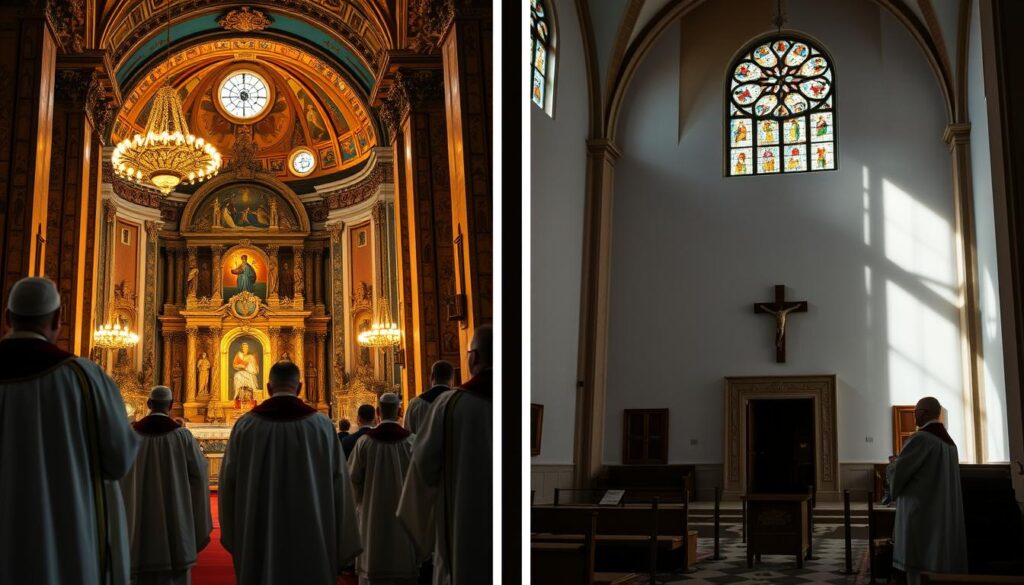
Sunlight streams through stained glass as worshippers kneel in silent prayer. Half a world away, golden icons glow under flickering candlelight while voices rise in ancient chant. These contrasting scenes reveal how Eastern and Western Catholic churches celebrate the same sacred mysteries through distinct cultural lenses.

Eastern vs Western liturgy

Variations in Eucharistic Celebrations

The most visible difference lies in the bread used for Communion. Eastern traditions bake leavened loaves symbolizing Christ’s risen body, while Western churches use unleavened wafers recalling the Last Supper’s Passover meal. Both practices trace back to early Christian communities – Jerusalem’s Jewish roots versus Greek-influenced Antioch.

Though structured similarly, worship experiences feel worlds apart. A Roman Mass typically lasts 45 minutes with spoken responses. Byzantine liturgy stretches two hours through continuous singing. “The variety of liturgical customs manifests the catholicity of the Church,” notes the Code of Canons, affirming both styles as valid expressions.

Three key contrasts shape these celebrations:

  • Eastern priests consecrate leavened bread with a liturgical spoon
  • Western altars face the congregation post-Vatican II
  • Byzantine churches screen the altar with an iconostasis

Incense swirls through Eastern services, engaging smell and touch. Western focus stays on visual symbols – stained glass, priestly gestures. Yet both traditions unite in their core purpose: making divine grace tangible through shared liturgy.

Influence of Leadership and Authority in the Church

Unity through shared leadership forms the backbone of Catholic communities worldwide. While practices vary, all 24 churches agree on one vital principle: collective guidance strengthens spiritual bonds across continents and cultures.

Guiding Lights: Papal and Episcopal Roles

Every Catholic church recognizes the Pope’s authority as successor to St. Peter. The 1990 Code of Canons confirms this role as “divinely appointed,” ensuring doctrinal unity. Bishops collaborate closely with Rome while addressing local needs – Roman Catholic dioceses report directly, while Eastern churches maintain self-governance through synods.

Two Models, One Mission

Western churches follow a centralized structure with the Vatican coordinating global efforts. Eastern communities operate through patriarchal councils, blending ancient traditions with modern challenges. For example, the Ukrainian Greek Catholic Church elects leaders while affirming papal primacy.

This dual approach allows flexibility without fragmentation. Whether in Roman Catholic parishes or Syro-Malabar dioceses, bishops serve as spiritual anchors – teaching timeless truths through culturally resonant methods. Such balance keeps the global church united yet responsive to 1.3 billion members’ needs.

FAQ

What’s the difference between the Roman Catholic Church and Eastern Catholic Churches?

The Roman Catholic Church follows the Latin liturgical tradition and recognizes the Pope’s authority. Eastern Catholic Churches, like the Ukrainian or Maronite Churches, maintain unique rites and cultural practices while remaining in full communion with Rome.

Why do some Catholic traditions have different liturgical practices?

Liturgical diversity stems from cultural, historical, and theological influences. For example, Eastern Churches often use leavened bread in the Eucharist, while the Roman Church uses unleavened bread, reflecting ancient traditions tied to their origins.

How does the Pope’s authority apply to Eastern Catholic Churches?

The Pope is recognized as the universal leader of all Catholics. However, Eastern Churches have their own hierarchies and governance structures, preserving autonomy in areas like liturgy and discipline while upholding shared doctrines.

Are sacraments the same across all Catholic traditions?

The seven sacraments are central to all Catholic communities. However, rituals like baptism or marriage may vary slightly in form, reflecting the theological emphases and cultural heritage of each tradition.

What role does tradition play in Catholic belief systems?

Tradition, alongside Scripture, shapes Catholic theology. Practices like Marian devotion or the veneration of saints developed over centuries, reflecting the lived faith of communities while staying rooted in core teachings.

How have cultural influences shaped Eastern Catholic practices?

Eastern Churches, such as the Syro-Malabar or Chaldean Catholic Churches, blend local languages, art, and customs into worship. This creates rich, diverse expressions of faith that remain united under Catholic doctrine.

Do all Catholic denominations accept the Nicene Creed?

Yes, the Nicene Creed is a foundational statement of belief for all Catholics. Differences in interpretation, like the Holy Spirit’s procession (Filioque), were historically debated but don’t undermine shared core truths.

How does governance differ between Eastern and Western Catholic Churches?

The Roman Church is centralized under the Pope and diocesan bishops. Eastern Churches, led by patriarchs or major archbishops, often govern through synods, emphasizing communal decision-making within their traditions.

Exploring the Relationship Between Catholicism and God


For centuries, religious traditions have shaped humanity’s understanding of the divine. Among these, one of the most enduring is the faith system rooted in ancient teachings that view the divine as both the origin and purpose of existence. This belief, deeply embedded in sacred texts and rituals, emphasizes a connection that spans creation itself.

The foundations of this tradition trace back to early teachings that describe the divine as the source of all life. Historical documents, like the Catechism, highlight how adherents see their creed as starting with the “First and the Last”—a reflection of timeless spiritual truths. Over generations, these ideas have evolved through theological debates, artistic expression, and communal practices.

Central to this journey is the interplay between scripture and lived experience. Followers engage with questions about existence through prayer, reflection, and service—a dynamic blend of intellectual inquiry and heartfelt devotion. Art, liturgy, and community gatherings further deepen this relationship, offering diverse pathways to connect with the sacred.

Today, interpretations of these teachings continue to adapt while honoring their roots. Whether through ancient hymns or modern social outreach, the core message remains: a call to recognize the sacred in everyday life. This guide will unpack how these beliefs took shape and what they mean for people today.

Key Takeaways

  • Examines how foundational beliefs define the connection between faith and the divine.
  • Explores the role of scripture and tradition in shaping spiritual understanding.
  • Highlights practices like prayer and community as expressions of devotion.
  • Connects historical teachings to modern interpretations of sacred principles.
  • Addresses common questions about theological concepts in accessible terms.

Introduction to the Relationship Between Catholicism and God

How does a 2,000-year-old tradition maintain its relevance in addressing life’s biggest questions? At its center lies a dynamic bond that shapes how believers see themselves and their place in the world. This connection influences everything from morning prayers to community outreach, creating a living bridge between ancient wisdom and modern life.

Over centuries, this belief system has grown through scripture study, philosophical debates, and personal encounters. It answers fundamental questions about purpose while inviting followers to explore mystery through both reason and reverence. The result? A religion that feels equally at home in grand cathedrals and humble soup kitchens.

People engage with these teachings in diverse ways. Some find clarity through structured liturgies, while others connect via quiet meditation. Service projects often become acts of devotion, blending practical help with spiritual growth. As one theologian noted, “The divine speaks through every act of love.”

What makes this faith unique is its balance of awe and approachability. Followers celebrate sacred mysteries that surpass human understanding while believing in a caring presence that walks with them daily. This dual perspective fuels everything from art to social justice efforts.

Cultural traditions add colorful layers to these core ideas. Mexican Day of the Dead altars, Filipino Simbang Gabi masses, and Polish Wigilia dinners all show how communities adapt practices while keeping doctrinal roots intact. These examples prove that unity doesn’t require uniformity.

Through evolving times, one truth remains: this relationship thrives when teachings meet real human needs. Whether grappling with personal struggles or global crises, believers return to a simple yet profound idea—love as the ultimate answer.

Historical Foundations and the Nicene Creed

What unites believers across continents and centuries? The answer lies in a 325 AD document forged through intense debate. This ancient text became the bedrock for understanding divine relationships in Western Christianity.

Nicene Creed historical document

Early Church Teachings and the Credo

The Nicene Creed emerged as Christianity’s first universal profession of faith. Church leaders gathered to counter claims denying Jesus’ divine nature. Their solution? A precise declaration: “True God from true God, begotten not made”.

This statement settled heated arguments about Christ’s role as both human and divine. By affirming he existed “before all ages”, the creed linked earthly stories to eternal truths. Every Sunday, millions still recite these words unchanged.

Evolution of Catholic Doctrinal Beliefs

Over time, teachings deepened without altering core ideas. The phrase “maker of heaven and earth” expanded to include invisible realities—angels, souls, and quantum physics mysteries. Scholars found new ways to explain how “all things were made” through Christ.

Modern thinkers still wrestle with phrases like “consubstantial with the Father”. Yet the creed’s structure remains vital. As one historian notes, “It’s like a theological compass—always pointing north even as cultures shift.”

From medieval universities to smartphone apps today, this ancient text keeps guiding seekers. Its balance of mystery and clarity shows how timeless truths adapt to every generation’s questions.

Evolution of Catholic Thought Over the Ages

How do ancient ideas stay fresh across generations? The answer lies in a dynamic dance between timeless truths and new questions. This religious tradition has refined its teachings through dialogue with philosophy, science, and shifting cultural landscapes.

Guiding Lights: Sacred Texts and Living Tradition

Sacred writings have always served as compasses for believers. Early monks pored over biblical texts, finding hidden meanings in familiar stories. Medieval scholars then built frameworks to connect scripture with Aristotle’s logic—a bold move that reshaped theological education.

https://www.youtube.com/watch?v=g-3CYNZNkVc

Take Thomas Aquinas’ work as an example. He blended faith with reason in a way that made complex ideas accessible. His Summa Theologica became a blueprint for balancing divine mystery with human understanding.

Historical Period Focus Key Contribution
Early Church Mystical prayer Desert Fathers’ wisdom
Middle Ages Systematic theology Scholastic method development
Modern Era Social teaching Ethical frameworks for justice

This evolution shows how tradition acts like a river—keeping its source pure while gaining new tributaries. Church councils addressed pressing issues while preserving core teachings about humanity’s place in the world.

Today’s thinkers continue this pattern. They explore how ancient texts speak to artificial intelligence or climate change. As one scholar notes, “Truth isn’t fragile—it grows brighter when tested by new light.”

Theological and Philosophical Perspectives on Divine Existence

How do thinkers balance logic and mystery when exploring ultimate truths? This question lies at the heart of theological debates. Scholars have long used rational inquiry alongside spiritual insights to map the contours of divine reality.

divine philosophy concepts

The tradition employs two complementary paths: philosophical analysis and lived faith. Take Thomas Aquinas as an example. His Five Ways argument uses observable patterns in nature—like movement and design—to point toward a first cause. Yet he also wrote, “To one who has faith, no explanation is necessary.”

This approach provides a way to address big questions without reducing mystery. Human reason offers one way to grasp truths about existence, but spiritual experience deepens understanding. As one modern theologian notes:

“We study divine footprints in creation while knowing the maker remains beyond full comprehension.”

Philosophical Method Focus Area Key Contribution
Scholasticism Logical proofs Bridging faith/science divides
Mystical Theology Contemplative practice Direct encounter emphasis
Contemporary Philosophy Existential questions Relevance to modern life

These perspectives acknowledge human limits while celebrating our capacity to recognize goodness and beauty as reflections of the sacred. Everyday experiences—like awe at a sunset—become touchpoints for deeper reflection.

Ultimately, the tradition invites exploration rather than final answers. It shows how intellectual rigor and humble wonder can coexist, offering a rich example of engaging life’s biggest mysteries.

Examining Theistic Proofs and Rational Inference

Can logic and faith walk hand in hand? For centuries, thinkers have crafted rational frameworks to explore divine truths. These efforts show how observation and deduction can illuminate spiritual realities without diminishing their mystery.

A Posteriori Arguments in Catholic Thought

St. Thomas Aquinas offered a way to connect daily experiences with eternal truths. His Five Ways use simple examples like falling leaves or crafted tools to show how the world points beyond itself. Take motion: since objects can’t move themselves infinitely, there must be an “unmoved mover.”

Another example examines causes. Every effect needs a prior cause—but tracing this chain backward leads to one uncaused source. This approach respects both human reason and the vastness of creation.

Deductive Reasoning and the Ontological Debate

Some philosophers start with concepts rather than observations. The ontological argument claims perfection implies existence—a way to deduce divine reality from pure logic. While intriguing, most theologians prefer grounding arguments in tangible evidence.

As one scholar notes, “The stars declare glory, but equations can’t contain it.” These proofs don’t erase mystery—they invite deeper questions about man‘s place in the cosmos. They remind us that every thing we see whispers of something unseen.

Ultimately, rational arguments serve as signposts, not destinations. They help curious minds recognize patterns in the world while leaving room for wonder at the heart of creation.

The Role of Sacred Scripture and Tradition in Shaping Faith

How do timeless writings and lived practices form a complete spiritual vision? The answer lies in two pillars working together: sacred texts and centuries of wisdom. These elements act like paired lenses—one focusing on divine revelation, the other on human application.

Ancient scriptures offer more than historical accounts. They’re seen as love letters from the divine, written through inspired authors yet requiring context. As one scholar notes, “You can’t read a 2,000-year-old letter without knowing the sender’s heart.” This is where tradition steps in, preserving interpretations passed down like family recipes.

The Church serves as a trusted guide, ensuring texts aren’t misunderstood. Imagine trying to solve a puzzle with missing pieces—tradition provides the edges. For example, early debates about Christ’s nature were settled by aligning scripture with apostolic teaching. This way of thinking prevents faith from becoming a solo project.

Here’s how these elements support each other:

  • Scripture anchors core truths about man‘s purpose
  • Tradition adapts these truths across cultures
  • Both foster a living religion that breathes with time

Modern challenges like AI ethics or climate justice show why this balance matters. Ancient words gain new life when paired with evolving practices. As a 4th-century bishop wrote, “The Spirit still speaks—if we’re humble enough to listen.” This dynamic support system keeps faith fresh yet rooted.

Spiritual Symbolism: Metaphors, Analogies, and Divine Images

How can finite words describe the infinite? Religious traditions answer this puzzle through creative language that paints vivid pictures of the sacred. These tools—metaphors, analogies, and symbols—act as stepping stones, helping man grasp truths too vast for literal terms.

biblical symbols and meanings

Understanding Biblical Symbols and Their Meanings

Take the metaphor “God is a rock” from Psalm 18. This comparison highlights strength and stability without suggesting divinity is geological. Similarly, calling divine love a “consuming fire” uses everyday experiences to hint at deeper realities.

Analogical language works differently. When we say “God is good,” we’re making a statement that shares meaning with human goodness but transcends it entirely. As one theologian explains: “Our words are signposts pointing beyond themselves.”

Figurative Tool Function Example
Metaphor Direct equivalence “Light of the world”
Analogy Partial similarity “Fatherly care”
Symbol Tangible representation Dove for peace

Symbols like bread or water take this way of thinking further. They connect physical objects to spiritual truths—nourishment becomes grace, thirst turns into longing for meaning. This approach avoids both rigid literalism and vague abstraction.

Guided by tradition, believers learn to interpret these images without losing their mystery. As a 5th-century monk wrote: “The map is not the territory, but it shows the path.” This balance lets sacred texts speak across ages while honoring their timeless source.

The Interplay Between Faith, Reason, and Revelation

Why do some see faith and science as rivals when they’re actually partners? This question sits at the heart of a rich tradition that views intellectual curiosity and spiritual devotion as allies. Like two wings lifting a bird, these forces work together to elevate humanity’s understanding of life’s deepest truths.

Revelation offers insights that pure logic can’t reach alone—think of concepts like divine goodness or sacrificial love. Yet reason gives man tools to explore and explain these mysteries. As St. Augustine noted, “Understanding is the reward of faith—seek not to understand that you may believe, but believe that you may understand.”

This balanced way of thinking shapes how believers approach modern challenges:

  • Scientific discoveries become invitations to marvel at creation’s complexity
  • Philosophical debates refine—rather than threaten—spiritual convictions
  • Personal doubts transform into stepping stones for deeper trust

The Church’s historical engagement with thinkers like Aristotle and Einstein shows this principle in action. Truth isn’t divided into sacred and secular—it’s a single tapestry woven from many threads. This approach provides an answer to those who see religion as anti-intellectual, proving that faith thrives when paired with honest inquiry.

Ultimately, this interplay reminds us that wonder and wisdom aren’t opposites. They’re companions on the journey to grasp life’s grandest realities.

Engaging with “catholicism god” in Practice

In modern life, ancient traditions meet fresh expressions through personal journeys and shared actions. Many find their path by blending time-honored rituals with creative approaches to devotion. From quiet meditation apps to neighborhood food drives, these practices show how timeless truths adapt to contemporary needs.

Bridging Ancient Wisdom and Daily Life

People today often experience the sacred through personal encounters rather than formal structures. A teacher might reflect on spiritual truths during her commute, while a nurse sees caregiving as a way to honor human dignity. These moments reveal how belief becomes tangible in ordinary settings.

Digital tools now offer new avenues for connection. Online prayer groups and virtual retreats help busy individuals nurture their inner life. Yet face-to-face gatherings remain vital, whether through volunteer projects or intergenerational faith-sharing circles. As one organizer notes, “Service reminds us we’re part of something bigger.”

This balance between innovation and tradition keeps spiritual practices relevant. By grounding modern belief in enduring principles, communities create meaningful bridges between sacred teachings and today’s challenges. The result? A living faith that walks with people through every season of life.

FAQ

How does the Nicene Creed shape Catholic beliefs about the divine?

The Nicene Creed, formalized in 325 CE, outlines core teachings like the Trinity and Jesus’ divinity. It unifies believers by summarizing essential doctrines, serving as a foundation for worship and doctrinal clarity.

What role do tradition and sacred texts play in understanding the divine?

Scripture and apostolic tradition work together to guide interpretations. Texts like Genesis and the Psalms reveal insights into creation, justice, and God’s nature, while tradition preserves teachings passed down through generations.

How do Catholic teachings balance faith with rational inquiry?

Thinkers like Thomas Aquinas emphasized that reason and revelation complement each other. Arguments from design, morality, and existence—rooted in observation and logic—support belief while honoring mystery.

Are biblical symbols like "light" or "shepherd" meant to be taken literally?

These metaphors convey deeper truths about care, guidance, and holiness. For example, referring to the divine as a “shepherd” highlights protection and leadership, inviting personal reflection rather than literal interpretation.

How do modern Catholics engage with the concept of the divine today?

Through prayer, sacraments, and community, many believers nurture a lived relationship with the divine. Social justice, ecological stewardship, and personal spirituality also reflect contemporary applications of ancient teachings.

Why does the Church emphasize both Scripture and Tradition?

Together, they provide a holistic framework for faith. Scripture offers inspired writings, while Tradition ensures continuity in practices like the Eucharist and teachings on mercy, adapting wisdom across ages.

What’s the significance of describing God as "Creator" in Catholic thought?

This title underscores belief in a purposeful universe shaped by love. It also invites responsibility—viewing creation as sacred fosters care for people, nature, and ethical living.