Recent Posts

Lutheran Rehab: Compassionate Care for Your Recovery


Every recovery journey deserves a foundation of compassion and expertise. At our rehabilitation center, we blend advanced medical care with genuine human connection, creating an environment where healing thrives. Whether you need short-term therapy or specialized long-term support, our programs focus on helping you regain independence and confidence.

Our team understands that true progress goes beyond physical healing. We prioritize emotional well-being and personal goals, ensuring every treatment plan reflects your unique needs. With occupational, physical, and speech therapies tailored to individual abilities, we help patients rebuild strength and reclaim their daily lives.

What sets us apart? A dedicated staff committed to excellence. High staffing levels mean you receive attentive, one-on-one support. Modern equipment and evidence-based methods ensure therapies deliver measurable results. Families appreciate our transparent communication and welcoming atmosphere, designed to ease stress during recovery.

Key Takeaways

  • Personalized treatment plans address physical and emotional needs
  • Experienced professionals provide 24/7 support for all care levels
  • Advanced therapies use the latest medical techniques and technology
  • Family-friendly environment encourages participation in the healing process
  • Focus on restoring independence through achievable daily milestones

Our Rehabilitation Programs and Services

Your path to renewed independence begins here. Our programs combine advanced therapies with personalized support, helping you regain strength and confidence after surgery, illness, or injury. From intensive recovery plans to daily living strategies, we focus on what matters most—your return to life at home.

Post-Surgical Recovery Care

Healing after surgeries requires precision and expertise. Our team specializes in orthopedic joint replacements, cardiac procedures, and neurological interventions. One-on-one therapy sessions target mobility restoration while managing pain through tailored strategies. “The staff didn’t just treat my injury—they helped me rebuild my life,” shares a recent patient.

Short-Term Rehabilitation & Functional Training

Need to bounce back quickly? Our intensive programs offer physical, occupational, and speech therapies seven days a week. Services include:

  • Ambulation training to improve walking safety
  • Adaptive equipment education for home transitions
  • Cognitive retraining for memory challenges

Skilled Nursing and Comprehensive Support

Complex medical needs deserve 24/7 attention. Our skilled nursing team provides:

Service Specialty Outcome Focus
Wound Care Diabetic Management Faster healing
Cardiac Education Stroke Recovery Risk reduction
IV Therapy Pulmonary Care Improved breathing

Every program includes discharge planning to ensure smooth transitions home. We measure success by your ability to reclaim favorite activities—whether gardening, playing with grandkids, or simply moving pain-free.

lutheran rehab: Comprehensive Recovery & Therapy

Recovery thrives when care meets expertise. Our programs combine advanced methods with personalized attention, helping individuals rebuild strength and confidence. From mobility challenges to speech improvements, every plan adapts to your unique needs.

A serene, sun-dappled therapy room with natural light streaming through large windows. Plush, earthy-toned furnishings create a warm, inviting atmosphere. In the foreground, a group of patients engage in gentle, guided exercises under the watchful eye of a compassionate Lutheran rehabilitation therapist. Soft, muted colors and a sense of tranquility convey the comprehensive, holistic approach to recovery. The overall scene exudes a feeling of comfort, care, and spiritual renewal.

Therapy Services: Physical, Occupational, and Speech

Three core services form the foundation of our approach. Physical therapy rebuilds strength through targeted exercises and balance training. Patients recovering from strokes or joint replacements often see improved mobility within weeks.

Occupational therapy focuses on daily tasks like dressing and cooking. Specialists teach adaptive strategies for home safety and community outings. One resident shared, “Learning new ways to button shirts gave me back my independence.”

Speech-language experts address swallowing issues and communication barriers. Using FEES technology, they pinpoint challenges while creating customized treatment plans. This helps those with Parkinson’s or brain injuries regain vital skills.

Adaptive Equipment & Cognitive Retraining

Modern tools meet innovative thinking here. We match residents with devices that simplify daily activities—like reachers or modified utensils. Training sessions ensure confident home use.

Cognitive programs sharpen memory and problem-solving abilities. Therapists use puzzles, memory drills, and real-life scenarios to rebuild mental agility. This benefits those recovering from strokes or traumatic injuries.

Therapy Type Focus Areas Common Conditions
Physical Mobility & Balance Stroke, Joint Replacements
Occupational Daily Living Skills ALS, Orthopedic Injuries
Speech Swallowing & Communication Parkinson’s, Brain Injury

Every plan includes home evaluations to ensure smooth transitions. We measure success by how easily you resume favorite activities—whether gardening or playing with grandkids.

Patient-Centered Experience and Family Support

Healing extends beyond medical treatment—it’s about creating a supportive environment where families and patients feel empowered. We design every detail to ease transitions and foster confidence during recovery.

Personalized Discharge Planning & Family Education

Our social services team partners with families from day one. They create customized discharge plans addressing home safety, equipment needs, and follow-up care. One caregiver noted, “The education sessions taught me how to assist safely—it lifted a huge weight off our shoulders.”

Before returning home, therapists conduct thorough evaluations of your living space. They identify risks like loose rugs or poor lighting while suggesting modifications. This proactive approach reduces falls and boosts independence.

  • Daily check-ins from our Resident Service Liaison ensure comfort
  • Nutrition-focused menus with chef-prepared meals
  • Private rooms with WiFi for seamless family connections

Pre-booked stays simplify post-surgery transitions. Tour our facility beforehand to meet staff and explore amenities like activity lounges. Families appreciate our transparent communication style, which builds trust during vulnerable moments.

From adaptive cooking tools to medication management training, we prepare everyone for success at home. Our goal? Turning recovery milestones into lasting victories.

Conclusion

Your recovery deserves a team as invested as you are. We collaborate closely with surgeons and physicians to craft personalized strategies that align with your post-treatment goals. Every therapist, nurse, and specialist here shares one mission: helping you rediscover life’s simple joys through renewed independence.

Families become partners in our welcoming environment. Transparent communication and inclusive planning ease worries while building confidence. Modern treatment spaces feature state-of-the-art equipment, blending innovation with compassionate support tailored to your pace.

Ready to start your next chapter? Connect with our admissions team to discuss services, tour our facilities, or reserve your stay. Call (555) 123-4567 today—we’ll coordinate every detail with your healthcare providers for a smooth transition.

At Lutheran Rehab, your victory isn’t just measured in milestones. It’s found in reclaimed hobbies, strengthened relationships, and the pride of regaining control. Let’s write that story together.

FAQ

What types of recovery programs do you offer?

Our programs include post-surgical care, short-term rehabilitation, and skilled nursing support. We focus on personalized plans to help patients regain strength, mobility, and independence after procedures like joint replacements or strokes.

How does short-term rehabilitation work?

Short-term rehab combines physical, occupational, and speech therapy tailored to your needs. Sessions focus on functional training, pain management, and daily living skills to prepare you for a safe return home or to the next level of care.

What makes your skilled nursing services unique?

Our skilled nursing team provides 24/7 medical care, wound management, and chronic condition support. We prioritize collaboration with therapists and families to ensure seamless progress tracking and adaptive equipment training when needed.

Do you provide therapy for stroke recovery?

Yes! Our therapists specialize in stroke rehabilitation, offering cognitive retraining, mobility exercises, and speech-language therapy. We use evidence-based techniques to improve communication, balance, and fine motor skills during recovery.

How are families involved in the care process?

Family education is central to our approach. We offer training sessions, discharge planning guides, and regular updates to help loved ones assist with home exercises, medication routines, and safety modifications after leaving our center.

What happens during discharge planning?

Our team creates a customized plan that may include home health referrals, follow-up appointments, or outpatient therapy. We assess your living environment and provide resources to minimize setbacks and promote long-term success.

Lutheran Bible Translators: Spreading the Word


Imagine hearing life-changing truths for the first time in the way you think, dream, and express love. For millions worldwide, this vision drives a dedicated ministry focused on making sacred texts accessible across cultures. Over 3,500 communities still wait to engage with spiritual teachings in their heart language—the dialect shaping their deepest connections.

This work goes far beyond converting words. Teams equip local leaders with tools to preserve cultural identity while ensuring accuracy. With 180 million people lacking full access to these resources, the urgency grows daily. Nearly 7,000 languages exist globally, yet one-third have no translated materials at all.

Collaboration sits at the core of this effort. Partnerships with communities and churches create sustainable projects that outlast initial efforts. Literacy programs and leadership training empower people to share knowledge within their own networks, sparking lasting change.

Key Takeaways

  • Over 3,500 language groups lack access to spiritual texts in their native dialects
  • Local leaders receive training to maintain cultural authenticity in translations
  • 180 million people currently have no complete texts in their heart language
  • Strategic partnerships help create self-sustaining community projects
  • Literacy initiatives complement translation work for broader impact

The Global Impact of Bible Translation Initiatives

When sacred texts speak your mother tongue, barriers crumble and connections form. Over 7,000 dialects shape how people share stories, pass down traditions, and build relationships. Yet 2,479 languages still wait for their first translated scripture passage.

Expanding Access for Every Language

Teams work with local speakers to capture cultural nuances. One village saw dramatic change after receiving materials in their heart language. “Five years ago, no one here followed these teachings,” shares a local leader. “Now, weekly gatherings unite hundreds.”

This progress requires more than linguistic skill. Experts combine ancient texts with modern tech tools while preserving oral traditions. Over 1,300 dialects now have complete New Testaments—a 40% increase since 2000.

Sparking Transformation Worldwide

Entire regions experience renewal when people grasp teachings in familiar words. Literacy rates rise as communities study translated materials. Social bonds strengthen through shared understanding.

Neighboring villages often adopt these resources, creating ripple effects. What begins with one language group can spread to five others within a decade. The true impact multiplies as local leaders train others.

lutheran bible translators in Action

Communities thrive when knowledge flows through familiar words and trusted voices. This principle guides efforts to equip native speakers with tools for meaningful communication. Teams prioritize sustainable methods that honor cultural identity while delivering accurate resources.

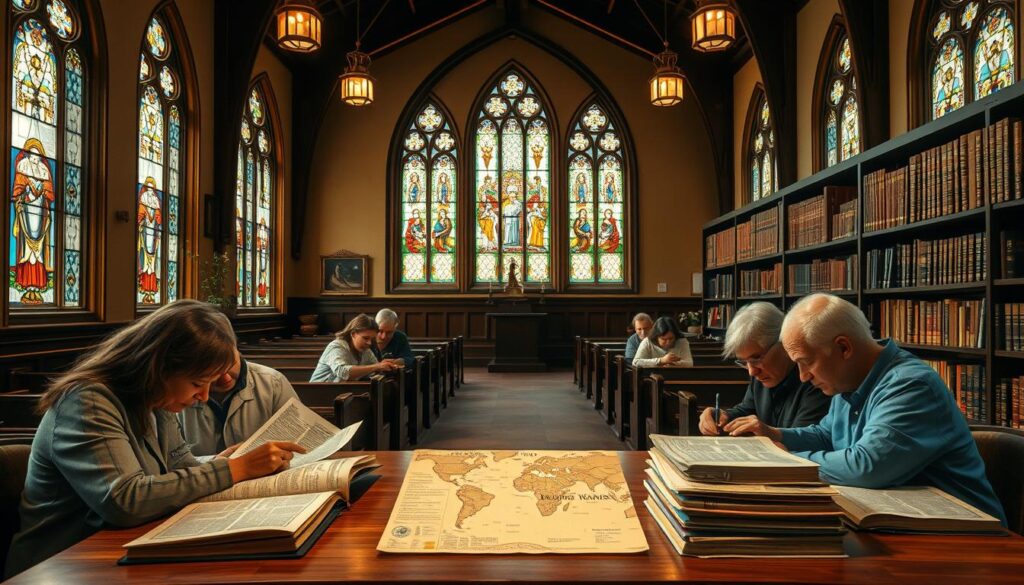
A serene Lutheran chapel, its stained-glass windows casting a warm glow. In the foreground, a group of translators meticulously poring over ancient texts, their faces illuminated by the soft light. In the middle ground, a map of the world and a stack of reference materials, symbolizing the global reach of their mission. The background features a bookshelf filled with foreign-language Bibles, a testament to the diverse communities they serve. The scene conveys a sense of dedication, collaboration, and the profound impact of their work in spreading the Word.

Empowering Local Leaders and Training Programs

Local experts receive specialized coaching in linguistics and technology. Programs blend classroom learning with hands-on practice, ensuring skills stay within communities. In Cameroon, Rev. Touka Daniel leads projects that train speakers to preserve their dialects through written and audio formats.

Training Component Tools Provided Outcome
Cultural Analysis Workshops Digital recording devices Preserved oral traditions
Translation Software Tutorials Computer-assisted tools Faster project completion
Community Engagement Strategies Literacy materials Increased local participation

Overcoming Technical and Cultural Challenges

Balancing modern technology with traditional communication styles requires creativity. Teams use voice-recognition software to capture rare dialects while consulting elders about phrasing. One group spent six months finding the perfect equivalent for “grace” in a mountain dialect.

Partnerships with organizations like SIL International help navigate complex language structures. These collaborations ensure translated materials feel natural to native speakers rather than foreign imports.

Cultural Relevance and Community Engagement

What happens when ancient wisdom meets modern culture? Teams work hand-in-hand with communities to craft resources that honor both tradition and truth. This delicate balance transforms how people experience sacred teachings.

Speaking to Hearts Through Culture

Adapting spiritual concepts requires more than dictionaries. Teams spend months studying local proverbs and family dynamics. One group replaced “shepherd” with “rice farmer” in agricultural communities for clearer understanding.

A translator from Papua New Guinea shares:

“When you hear God’s Word in your mother tongue, it bypasses your head and goes straight to your heart.”

When Words Spark Change

Entire villages experience renewal through culturally resonant materials. After receiving the Gospel of Mark in their dialect, one community saw church attendance triple. Elders now use translated texts to resolve conflicts and celebrate traditions.

  • A West African leader reported 40% literacy improvement after translation projects
  • Youth groups formed using audio recordings for oral cultures
  • Local artists create songs from translated scriptures

“I never knew these teachings could feel so familiar,” shared a grandmother in Guatemala. Her story echoes across 17 language groups now engaging with materials that reflect their daily lives.

Partnerships and Collaborative Ministry

True progress grows from shared purpose. Teams collaborate with communities through relationships built on trust and mutual goals. This approach ensures projects align with local needs while drawing on global expertise.

A diverse group of people from various backgrounds gathered in a sunlit, modern collaborative workspace. In the foreground, they are engaged in lively discussion, gesturing animatedly as they work together on a shared project displayed on a large interactive whiteboard. The middle ground features a mix of comfortable seating areas and standing stations, encouraging open communication and idea-sharing. The background showcases floor-to-ceiling windows, allowing natural light to flood the space and create a warm, inviting atmosphere. The overall scene conveys a sense of unity, inclusivity, and a shared dedication to a common goal, reflecting the spirit of "Partnerships and Collaborative Ministry".

Building Strength Through Alliances

Local churches provide cultural insights that shape translation methods. In Cameroon, leaders like Rev. Touka Daniel guide projects while preserving traditions. Partnerships with groups like SIL Cameroon offer practical support—from housing translators to hosting skill-building workshops.

Partner Type Support Provided Key Impact
Local Churches Cultural guidance & leadership Community-driven solutions
Translation Organizations Technical training & tools Faster project completion
Publishing Groups Quality review & distribution Multi-denominational access

These alliances create lasting networks. The Cameroon Bible Society checks translations for accuracy before sharing them widely. This ensures materials serve all faith groups fairly.

Global connections multiply local efforts. Membership in groups like CLAIM helps teams share resources across borders. Together, partners build systems that outlive individual projects—planting seeds for future growth.

Innovations and Future Strategies in Bible Translation

Breaking language barriers isn’t just about words—it’s about opening doors to transformation. Modern teams blend time-tested methods with digital breakthroughs to accelerate progress. Over 600 million people still need access to spiritual texts in their native dialects, driving creative solutions that bridge ancient wisdom and 21st-century tools.

A serene workspace where technology and faith intertwine. In the foreground, a laptop displays intricate Bible translation software, its screen illuminated by soft, warm lighting. Surrounding it, neatly organized reference materials, including ancient texts and language dictionaries, create an atmosphere of intellectual pursuit. In the middle ground, a pair of skilled hands delicately manipulate digital tools, seamlessly bridging the modern and the timeless. In the background, a tranquil window offers a glimpse of a verdant landscape, symbolizing the global reach and impact of this vital work. The scene conveys a sense of dedicated focus, innovation, and the reverent preservation of sacred knowledge.

Tech Meets Tradition

Artificial intelligence now helps identify rare grammar patterns in unwritten dialects. Voice-to-text software preserves oral traditions while creating written resources. Teams in Papua New Guinea used solar-powered audio players to share teachings with remote villages.

Approach Tools Used Impact
Cultural Adaptation AI Language Models 63% faster analysis
Oral Translation Voice Recording Apps 40+ dialects preserved
Community Training Tablet Learning Kits 89% retention rate

United for Progress

Global alliances multiply local efforts. A recent partnership with Wycliffe Bible Translators helped launch 12 new projects across Asia. “Our collaboration cuts project timelines by half,” shares a field coordinator in Myanmar.

Mobile networks now deliver translated texts to smartphones in war-torn regions. Literacy programs teach villagers to read while preserving their cultural identity. These dual efforts create self-sustaining communities that grow their own teachers.

Future plans focus on reaching sign language groups and developing augmented reality tools. As one translator notes:

“Our tools change, but our goal remains—clear understanding for every heart.”

Conclusion

Every voice deserves to hear life’s deepest truths in words that resonate. The work of Lutheran Bible translators bridges divides by making spiritual wisdom accessible across cultures. Their approach honors local traditions while creating resources that spark genuine connection.

Effective bible translation requires more than linguistic skill—it demands cultural respect. Partnerships with communities ensure materials feel familiar rather than foreign. This collaboration builds trust and empowers leaders to sustain progress long after initial projects conclude.

One tribal elder shared: “When we received these teachings in our dialect, God’s word became a friend speaking our language.” Stories like this highlight why preserving heart languages matters. It transforms abstract concepts into lived experiences.

Looking ahead, Lutheran Bible translators continue refining methods to reach underserved groups. Combining tech tools with grassroots efforts, they amplify the impact of bible translation work. As one team member notes: “The goal remains clear—help every person encounter truth in words that feel like home.”

FAQ

How do translation initiatives ensure cultural relevance?

Teams collaborate closely with native speakers to adapt texts into local dialects. This preserves idioms, traditions, and values, making Scripture resonate deeply within communities.

What role do local leaders play in these projects?

Communities actively shape translations through workshops and feedback. Leaders also help navigate cultural nuances, ensuring messages align with their people’s worldview.

Are literacy programs part of the mission?

Yes! Teaching reading skills empowers individuals to engage directly with translated texts. Literacy efforts often run alongside translation work to maximize impact.

How long does a typical translation project take?

Timelines vary based on language complexity and team size. Some projects span years, while others leverage partnerships to accelerate progress without sacrificing quality.

Can technology speed up the process?

Tools like AI-assisted software help draft initial texts, but human expertise remains vital. Teams balance innovation with careful review to maintain accuracy and clarity.

How can individuals support this work?

Donations, volunteering, and advocacy all make a difference. Many also join prayer networks to uplift teams facing logistical or spiritual challenges.

Why prioritize lesser-known languages?

Every group deserves access to Scripture in their heart language. Focusing on underserved regions fosters inclusivity and strengthens global faith communities.

Lutheran B Negative: Understanding This Blood Type


Imagine needing a blood transfusion but having a type so rare that doctors must search across continents to find a match. For individuals with one of the world’s most uncommon blood types, this scenario isn’t hypothetical—it’s a reality. Fewer than 0.2% of people globally share this unique profile, creating urgent challenges during medical emergencies.

This blood group’s rarity stems from its complex antigen structure. Unlike common types, it lacks specific markers that most people carry. These missing antigens mean even “universal” donor blood can trigger dangerous reactions. Patients often rely on specialized networks connecting hospitals worldwide to locate compatible donors.

Take Francisca Akata’s case, for example. Her search for life-saving transfusions stretched across multiple countries. Stories like hers highlight why medical teams prioritize advance planning for rare blood cases. Specialized labs now maintain global databases to streamline emergency responses.

Key Takeaways

  • Fewer than 2 in 1,000 people have this exceptionally rare blood profile
  • Missing common antigens creates high risk during transfusions
  • International donor networks are critical for emergency care
  • Medical teams use advanced testing to confirm compatibility
  • Early identification helps patients prepare for health crises

Introduction to Rare Blood Types and Lutheran B Negative

Your blood holds a unique biological fingerprint that could save lives—or create medical emergencies. Red blood cells carry up to 342 distinct antigens, acting like molecular ID badges. When someone lacks common markers found in 99% of people, their blood becomes exceptionally rare.

Overview of Rare Blood Groups

The human body recognizes 35 blood-group systems, each governed by specific genes. These systems determine which antigens appear on cell surfaces. High-prevalence antigens—present in nearly everyone—make mismatches dangerous when absent. For instance, lacking just one widespread marker classifies blood as rare, even if other antigens match.

Significance of Lutheran B Negative

Within these complex systems, the Lutheran group stands out for its medical impact. Patients missing the B antigen face heightened risks during transfusions or pregnancies. “A single mismatch can trigger life-threatening reactions,” explains a hematology specialist. This rarity demands global donor networks and tailored care plans long before emergencies arise.

Hospitals now prioritize early identification through advanced testing. International databases help locate compatible donors swiftly, turning logistical nightmares into manageable challenges. For those affected, awareness and preparation become as vital as the blood itself.

The Science Behind Blood Group Systems and Antigens

What makes one person’s blood compatible with another’s? The answer lies in microscopic markers called antigens. These protein molecules coat red blood cells like biological name tags, forming the basis of all blood group systems.

Understanding Blood Group Antigens

Antigens function as identification markers, helping the body distinguish its own cells from foreign ones. Over 35 blood group systems exist, each governed by specific genetic instructions. When someone lacks common antigens most people carry, their blood becomes harder to match.

Genetic inheritance plays a key role. Children receive antigen-determining genes from both parents, creating unique combinations. This explains why family members often share compatible blood traits—a crucial factor for rare types.

Importance in Transfusions

Mismatched antigens trigger immediate immune attacks. “The body sees unfamiliar antigens as threats,” notes a transfusion specialist. This reaction can destroy donor cells within hours, causing organ failure or death.

Modern labs use advanced tests to map over 300 antigens before transfusions. For rare blood types, this precision becomes lifesaving. Global donor networks now share antigen data, helping hospitals source compatible blood faster than ever.

Case Study: The Journey of a Rare Blood Type

Medical emergencies turn into global quests when patients have uncommon blood profiles. Francisca Akata’s story reveals how geographic boundaries dissolve during life-threatening situations. Her experience shows why international cooperation remains vital for rare medical cases.

The Diagnosis That Changed Everything

In 2013, a Nigerian grandmother traveled to the UAE for heart surgery. Pre-op tests revealed a shocking twist: her blood lacked two critical markers. Doctors identified a combination affecting fewer than 1 in 500,000 people worldwide.

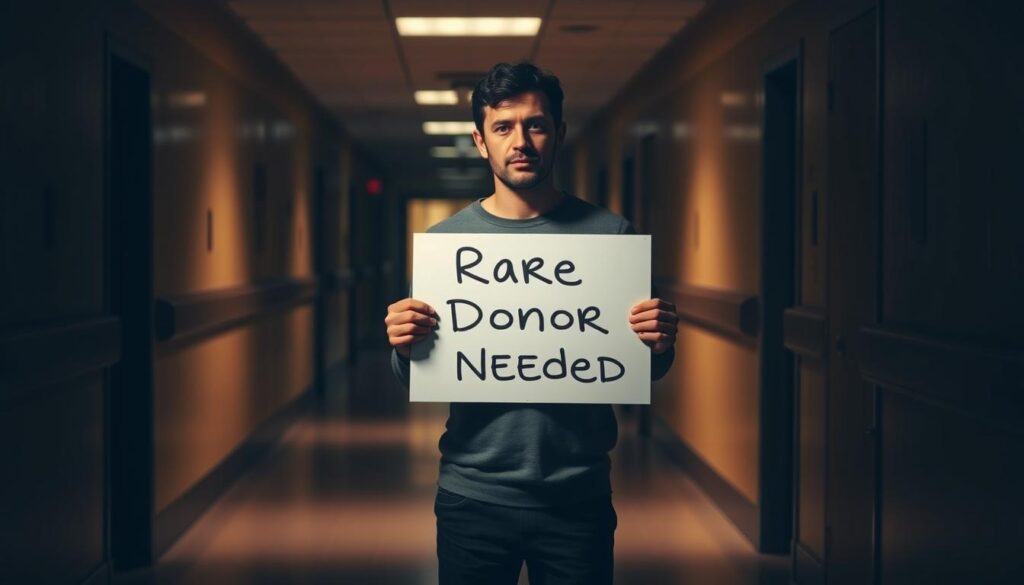
A lone individual stands in a dimly lit hospital corridor, their expression pensive as they hold a sign reading "Rare Blood Donor Needed." The scene is shot from a low angle, creating a sense of urgency and importance. Soft, warm lighting illuminates the subject, casting shadows that suggest the gravity of the situation. The background is blurred, drawing the viewer's focus to the central figure and their plea for help. The atmosphere is somber, yet hopeful, capturing the emotional journey of someone with a rare blood type seeking a lifeline.

Hospitals in three countries scrambled to find compatible donors. “Time wasn’t on our side,” recalled Walter Udoeyop, the hematologist leading the search. Regional blood banks came up empty, forcing teams to expand their hunt across continents.

Breaking Through Systemic Barriers

The search exposed gaps in global healthcare systems. Some nations restrict cross-border blood transfers, while others lack centralized donor databases. Key challenges included:

Challenge Impact Solution
Regional donor shortages Delayed surgery International networks
Policy restrictions Limited options Diplomatic coordination
Testing limitations Missed matches Advanced antigen mapping

After six weeks, the American Rare Donor Program located two potential donors in Philadelphia. This breakthrough highlights how technology and teamwork can overcome even the rarest medical obstacles. Patients with uncommon blood types now benefit from improved global tracking systems developed through cases like this.

lutheran b negative: Navigating the International Blood Donation Network

When seconds count, a hidden system springs into action. Behind every rare blood request lies a meticulously organized global effort connecting patients to potential lifesavers. This network operates like a high-stakes matching service, where precision meets urgency.

Donor Identification and Registration Processes

The International Blood Group Reference Laboratory in England coordinates this lifesaving web. Their database tracks over 550 active donors for one rare type, with 73% located near London. Advanced search systems scan registries across 45 countries to find matches faster than ever.

Registration isn’t just paperwork—it’s science. Each donor undergoes 12+ tests to confirm antigen profiles. These details get added to secure databases updated hourly. As one coordinator notes: “We treat donor information like gold—precious and constantly refined.”

Region Registered Donors Response Time
United Kingdom 400 12-24 hours
North America 90 36-48 hours
Asia-Pacific 40 72+ hours
Other Regions 20 Variable

Geography plays a surprising role. Certain regions have higher concentrations due to genetic patterns. This explains why 85% of matches for Francisca’s case came from one area. Modern systems now predict donor locations using migration data and population trends.

Innovations and Logistics in Rare Blood Management

Delivering life-saving blood across continents requires military precision and cutting-edge tech. Every step matters—from storage protocols to last-mile delivery in remote areas. Modern solutions combine science with logistics expertise to beat the clock.

A modern, hygienic blood storage and transportation facility. In the foreground, pristine blood bags are carefully arranged, each labeled with crucial details. In the middle ground, robotic arms efficiently sort and handle the precious cargo. The background reveals a sleek, temperature-controlled environment with state-of-the-art monitoring systems, ensuring the blood's integrity is maintained throughout the journey. Soft, diffused lighting bathes the scene, conveying a sense of precision and care. The overall atmosphere exudes a clinical yet reassuring ambiance, reflecting the critical importance of safely managing this rare, life-saving resource.

Modern Blood Storage and Transportation Methods

Keeping blood viable during transport demands strict temperature control. Red blood cells stay fresh for transfusions when maintained at 4°C. Even brief warmth exposure can ruin shipments. Francisca Akata’s six blood units traveled 4,000 miles using refrigerated trucks, climate-controlled planes, and a final helicopter dash.

Storage Type Temperature Lifespan Transport Needs
Fresh 4°C 4 weeks Continuous cooling
Frozen -65°C 48 hours post-thaw Specialized freezers

Frozen blood offers longer storage but becomes urgent once thawed. “You have two days to use it or lose it,” notes a transfusion specialist. This creates tough decisions for medical teams balancing shelf life against emergency needs.

Advanced tracking systems monitor shipments in real time. Alerts trigger if temperatures drift. Customs clearance gets fast-tracked through medical channels. These actions turn logistical nightmares into success stories.

Emerging tech focuses on stabilizing blood during long hauls. New cooling materials and drone delivery options show promise. Every innovation brings us closer to eliminating preventable tragedies.

Medical and Ethical Considerations in Rare Blood Transfusions

Every medical decision becomes high-stakes when dealing with scarce biological resources. Patients with uncommon blood profiles face unique challenges where safety protocols and ethical guidelines collide. Thomas, a donor with rare blood, carries an emergency ID card and avoids remote travel—a testament to the constant vigilance required.

A sterile medical setting, dimly lit with a soft, warm glow. In the foreground, a nurse's hands carefully preparing a rare blood transfusion bag, the deep crimson liquid reflecting the cautious intensity of the procedure. In the middle ground, a patient lies anxiously, their face etched with a mixture of hope and trepidation. The background is blurred, highlighting the focus on the delicate, high-stakes medical intervention. The scene conveys the gravity and sensitivity of this rare blood transfusion, the potential risks and the need for utmost care and precision.

When Life-Saving Treatments Carry Risks

Mismatched transfusions can spark catastrophic immune responses. Antibodies attack foreign blood cells within hours, causing kidney failure or shock. This risk forces hospitals to run 12+ compatibility tests before proceeding. Even then, specialists keep emergency medications ready during the procedure.

Ethical debates center on resource allocation. Should a rare blood unit go to a trauma patient now or be saved for a scheduled surgery next week? A PubMed review notes that 68% of hematologists face this dilemma annually. Global registries help, but shortages persist.

Patients often adjust their lifestyles due to these risks. Many avoid high-risk activities and keep medical alerts handy. Healthcare teams use MeSH terminology to standardize search protocols across databases, improving match accuracy. These actions aim to reduce errors in time-sensitive situations.

Balancing immediate needs with future demands remains tricky. “We’re stewards of a limited resource,” explains a transfusion director. Strict guidelines govern when to use these precious supplies, prioritizing emergencies over elective procedures. Ongoing research seeks alternatives, but for now, careful management saves lives.

Overcoming Global Challenges

Global healthcare faces a silent crisis when matching rare blood supplies with urgent needs. Hospitals now use real-time tracking systems to connect with donors worldwide. These tools cut search times by 60% compared to a decade ago, turning impossible hunts into coordinated missions.

Policy reforms are breaking down barriers. Over 30 countries recently streamlined cross-border blood transfers. New agreements let medical teams bypass red tape during emergencies. “Every saved minute means another life protected,” says a WHO coordinator.

Public awareness drives play a crucial role. Social media campaigns help identify potential donors in unexpected places. Blood banks train staff to spot rare antigen patterns during routine screenings. These efforts build stronger safety nets for future crises.

Progress thrives on collaboration. Scientists share antigen data openly, while airlines prioritize medical shipments. Together, we’re rewriting what’s possible—one rare blood match at a time.

FAQ

Why is Lutheran B Negative considered a rare blood type?

This blood type is uncommon due to low global prevalence. Only a small percentage of people inherit the specific combination of Lutheran and B antigens, making donors hard to find.

How do medical teams identify compatible donors for rare types?

Labs use advanced antigen-matching techniques and global registries like the International Blood Group Reference Laboratory to locate donors. Local networks and international partnerships also streamline searches.

What risks are linked to transfusions with mismatched rare blood?

Incompatible transfusions can trigger severe immune reactions, including hemolysis or organ damage. Strict crossmatching and antibody screening are critical to ensure patient safety.

Can someone with this blood type donate to other groups?

While universal donation isn’t possible, Lutheran B Negative blood can sometimes help recipients with compatible antigens. Always consult a specialist to confirm eligibility.

How does global collaboration improve access to rare blood?

Organizations like the WHO and rare donor programs share resources, track inventories, and expedite shipments worldwide. This teamwork saves lives during emergencies or complex cases.

What steps can individuals take to support rare blood initiatives?

Registering with donation centers, participating in awareness campaigns, and joining global databases like ISBT help expand access. Every donor registration increases the chances of saving lives.

Discover the Lutheran Faith: A Friendly Guide


Let’s explore a Christian tradition that’s shaped lives for over five centuries. Born from the Reformation era, this movement began with bold ideas about spiritual freedom and personal connection to scripture. Today, it unites millions through shared values and practices that balance tradition with modern life.

You’ll learn how this denomination grew from 16th-century reforms into a global community. With 80–90 million members worldwide, its influence spans continents while maintaining local roots. We’ll break down its history in simple terms, from early debates to current-day worship styles.

This guide avoids complex terms to focus on what matters most: understanding core principles and their real-world impact. You’ll see how congregations gather, celebrate, and support their neighborhoods. Whether you’re exploring beliefs or seeking community insights, we’ve got you covered.

Key Takeaways

  • Originated during the Protestant Reformation in 1517
  • Emphasizes grace, scripture, and personal faith
  • Maintains traditional worship with contemporary adaptations
  • Global presence with strong U.S. congregations
  • Focuses on community service and outreach

Introduction to Lutheranism

Ever wondered how a name meant as an insult became a badge of honor for millions? That’s exactly what happened with the term “Lutheran”. Born from heated 16th-century debates, this Christian tradition grew into a distinct movement emphasizing personal connection to spiritual truth.

Defining Lutheran Identity

At its core, this tradition teaches that divine grace comes through trust in Christ alone. Unlike other groups, followers focus less on rituals and more on scripture’s transformative power. The name itself has rebel roots – critics first used “Lutheran” to mock Martin Luther’s reforms before supporters claimed it proudly.

Johann Maier von Eck, a Catholic scholar, hurled the label during a 1519 debate. Luther reportedly hated it, preferring “evangelical” (meaning “gospel-centered”). His followers only adopted the term decades later to stand apart from Calvinists and Anabaptists.

Overview of Its Historical Roots

Everything changed after 1517 Germany. Corruption in religious institutions sparked urgent calls for change. Luther’s ideas spread like wildfire, thanks to newly invented printing presses. Ordinary people could suddenly read the Bible themselves – a revolutionary shift.

Modern congregations maintain this balance: ancient rituals meet practical service. Their worship spaces often blend traditional hymns with community food banks. This dual focus explains why the movement remains vibrant five centuries later.

Exploring the Reformation and Martin Luther’s Vision

What if one document could rewrite religious history? That’s exactly what happened when a German monk took a stand that reshaped Christianity forever. This pivotal moment created ripples we still feel today.

A dramatic, oil-painted portrait of Martin Luther, the visionary leader of the Protestant Reformation, standing tall and resolute against a backdrop of ornate Gothic architecture and stained-glass windows. Luther's intense gaze conveys his unwavering determination, his face illuminated by a warm, contemplative light that casts deep shadows, emphasizing the weight of his revolutionary ideas. The scene evokes a sense of historical significance, with a moody, introspective atmosphere that captures the pivotal moment of spiritual and intellectual awakening that shaped the course of Western Christianity.

The Impact of the Ninety-Five Theses

On October 31, 1517, Martin Luther nailed his famous arguments to a church door in Wittenberg. What began as an academic debate about indulgences became a spiritual revolution. Luther insisted grace came through trust in Christ, not payments to religious institutions.

The Catholic Church initially dismissed these ideas. But ordinary people embraced Luther’s message. His German Bible translation let farmers and shopkeepers read Scripture themselves – a radical change in the 16th-century religious landscape.

How the Reformation Shaped Modern Christianity

Luther’s “priesthood of all believers” concept broke down barriers between clergy and laypeople. This shift made personal spirituality accessible to everyone. Churches began prioritizing Scripture over tradition, a principle called Sola Scriptura.

Today’s diverse Christian denominations owe much to this movement. From hymn singing in worship services to Bible study groups, Luther’s reforms created patterns millions follow. His courage to challenge authority paved the way for religious freedom across continents.

The Evangelical Lutheran Church in America Explained

Did you know America’s largest Lutheran denomination started as a trio? The Evangelical Lutheran Church in America (ELCA) formed in 1988 when three groups merged. Today, it balances tradition with modern social engagement while serving 3.3 million members.

Differences Between Synods and National Bodies

Lutheran churches organize through synods – regional networks handling pastor training and community programs. Think of them as teamwork hubs. The ELCA and Lutheran Church-Missouri Synod (LCMS) show how this system allows flexibility within shared roots.

Aspect ELCA Missouri Synod
Bible Interpretation Contextual approach Literal inerrancy
Social Issues Progressive stances Traditional views
Communion Partners 7 denominations Lutheran only
Clergy Rules Ordains LGBTQ+ pastors Traditional requirements

An LCMS leader once stated: “Scripture’s truth remains unchanged by cultural shifts.” This contrasts with the ELCA’s emphasis on re-examining teachings through modern lenses.

Both groups share core practices like weekly communion. Yet their synod structures create distinct identities. The ELCA’s national body coordinates global aid projects, while LCMS focuses on doctrinal consistency across congregations.

Local churches choose their synod affiliation based on community needs and theological priorities. This system lets a Chicago parish address urban poverty differently than a rural Kansas congregation – while both remain part of the same national family.

Understanding the Lutheran Faith: Core Beliefs

Two revolutionary ideas transformed how millions connect with spirituality. These principles answer life’s biggest questions through radical simplicity rather than complex rituals.

a Lutheran Bible resting on a wooden table, with a simple cross made of dark wood standing behind it, illuminated by soft, warm lighting from the side, creating a reverent and introspective atmosphere, capturing the essence of the core beliefs of the Lutheran faith, the Bible and cross symbolizing the central tenets of scripture and faith, the arrangement elegant and minimalist, the focus drawn to the sacred objects against a muted, neutral background.

Justification by Faith Alone

At the heart of this belief system lies a game-changing truth: salvation comes as a gift, not a reward. Lutherans believe God’s grace flows freely to those who trust in Christ’s sacrifice. This eliminates spiritual scorekeeping – no need to earn approval through actions or rituals.

Martin Luther famously compared this to a sick person accepting medicine. Just as swallowing a pill brings healing, accepting divine grace through faith brings spiritual renewal. This doctrine rejects the idea that donations, pilgrimages, or strict rule-following affect one’s standing with God.

Sola Scriptura and Its Role in Worship

The Bible isn’t just studied here – it’s the ultimate authority shaping every practice. “Scripture alone” means congregations constantly return to biblical texts for guidance. You’ll notice this during services through:

  • Responsive readings where congregations speak verses aloud
  • Sermons dissecting Bible passages line by line
  • Hymn lyrics directly quoting Psalms and Gospels

This focus creates a unique worship rhythm. Ancient texts feel fresh when applied to modern struggles like anxiety or relationships. As one pastor explained: “We’re not interpreting the Bible through today’s lens – we’re interpreting today through the Bible’s lens.”

Together, these beliefs form a spiritual safety net. They assure believers that grace isn’t earned but freely given, while Scripture provides timeless answers to ever-changing human needs.

The Book of Concord: Doctrinal Foundations

Imagine a book that settled centuries of debate while preserving ancient wisdom. The Book of Concord does exactly that – a 1580 compilation unifying scattered congregations under shared principles. This collection remains the ultimate reference for understanding core teachings, blending early Christian creeds with Reformation-era insights.

A grand, ornate book rests upon a wooden lectern, its weathered leather cover embossed with intricate designs. Sunlight filters through stained glass windows, casting a warm, reverent glow. Surrounding the book, ancient tomes and scrolls are neatly arranged, conveying the profound theological heritage. The scene evokes a sense of scholarly contemplation, where the foundations of Lutheran doctrine are carefully preserved and studied. A serene, contemplative atmosphere pervades the space, inviting the viewer to delve into the depths of this pivotal work.

Key Creeds and Catechisms

Three ancient statements anchor the Book of Concord’s doctrine. The Apostles’ Creed connects modern practices to Christianity’s earliest days, while the Nicene and Athanasian Creeds clarify complex concepts like the Trinity. Together, they form a bridge between historical Christianity and Reformation ideas.

Martin Luther’s teaching tools shine here. His Small Catechism breaks down beliefs into simple Q&A formats – perfect for family discussions. The Large Catechism expands these ideas for church leaders, tackling nuanced theological questions. One pastor describes them as “flashlight and microscope: one guides beginners, the other examines details.”

Modern churches still rely on these resources:

  • Confirmation classes use Luther’s catechisms to teach youth
  • Sunday school materials quote the Apostles’ Creed
  • Pastors reference the Book of Concord during doctrinal reviews

This system balances stability with adaptability. While cultural changes challenge many traditions, these documents provide a steady foundation. They prove that deep roots allow branches to grow freely – a lesson in timeless relevance.

The Augsburg Confession: Defining Lutheran Doctrine

How do you define a movement that’s reshaping religious thought? In 1530, reformers faced this challenge when ordered to explain their beliefs to Emperor Charles V. The result became Christianity’s first Protestant confession – a document still shaping worship practices today.

Birth of a Blueprint

Philip Melanchthon, a scholar called “the quiet reformer,” crafted the Augsburg Confession to show continuity with historic Christianity. Presented June 25, 1530, it outlined 28 articles addressing salvation, sacraments, and church-state relations. Unlike earlier protests, this text systematically explained core teachings using Scripture and early church writings.

Aspect Augsburg Confession Apology of Augsburg Confession
Purpose State core beliefs Defend against criticisms
Author Philip Melanchthon Philip Melanchthon
Date 1530 1531
Focus Doctrinal clarity Theological arguments
Key Argument “We are justified by faith” Grace isn’t earned through works

The Apology of the Augsburg Confession emerged when Catholic leaders rejected the original document. Melanchthon expanded his defense, creating what one historian calls “a masterclass in theological debate.” Together, these texts became pillars of Protestant identity.

Modern congregations still use this 493-year-old confession. It explains why baptism and communion remain central – viewed as tangible expressions of divine grace. While culture changes, these doctrinal anchors keep communities rooted in their heritage.

Sacraments in Lutheran Tradition

Two sacred practices form the heartbeat of spiritual life for millions. These sacraments – baptism and communion – act as visible promises, connecting believers to divine love through simple elements.

Baptism as a Means of Grace

Water becomes a spiritual doorway in this practice. Followers view baptism as God’s initiative, not human effort. Infants and adults alike receive this gift, marking entry into Christian community. “It’s not about the water alone,” one pastor explains, “but the life-changing promise it carries.”

The ritual washes away sins through Christ’s sacrifice. Parents bringing babies for baptism celebrate this unconditional grace. Adults undergoing the rite often describe renewed purpose and belonging.

The Lord’s Supper and Real Presence

Communion tables become meeting places between heaven and earth. Unlike symbolic interpretations, believers experience Christ’s real presence in bread and wine. This meal offers forgiveness of sins and strength for daily challenges.

Weekly holy communion keeps congregations grounded. As members share the Lord’s Supper, they reconnect to core truths. “We taste mercy,” says a lifelong member. “It’s faith made tangible.”

Together, these two sacraments shape worship rhythms. They transform ordinary moments into encounters with sacred love, sustaining communities across generations.

FAQ

What makes Lutheranism different from other Christian denominations?

The tradition emphasizes “justification by grace through faith,” teaching that salvation comes from God’s grace alone, not human deeds. It also prioritizes Scripture as the ultimate authority, unlike groups that blend tradition with biblical teachings.

How did Martin Luther’s Ninety-Five Theses change Christianity?

Luther’s critique of church practices in 1517 sparked the Protestant Reformation. His ideas, like challenging indulgences and emphasizing personal faith, reshaped worship and theology across Europe, influencing many modern Christian movements.

What is the Evangelical Lutheran Church in America (ELCA)?

The ELCA is one of the largest U.S. Lutheran bodies, known for its inclusive approach. It collaborates with other denominations and focuses on social justice, differing from synods like the LCMS, which holds stricter doctrinal views.

Why is the Book of Concord important?

This 1580 collection, including the Augsburg Confession and Luther’s catechisms, unites global congregations around core teachings. It clarifies beliefs on sacraments, sin, and grace, ensuring doctrinal consistency across generations.

Do Lutherans believe Christ is physically present in Communion?

Yes, they affirm “real presence”—Christ’s body and blood are “in, with, and under” the bread and wine. This differs from symbolic views in some Protestant traditions, reflecting Luther’s emphasis on God’s tangible grace.

How does baptism function in Lutheran theology?

Seen as a sacrament, baptism is God’s act of claiming individuals as His own. It’s not just a ritual but a means through which faith is awakened and sins are forgiven, rooted in Scripture’s promises.

What role do creeds play in worship services?

The Apostles’, Nicene, and Athanasian Creeds are recited to affirm shared beliefs. They connect modern congregations to historic Christian teachings, reinforcing unity and theological clarity during liturgy.

Top Lutheran Theologians You Should Know


What makes certain thinkers stand the test of time? For over 500 years, a group of brilliant minds has shaped how millions understand faith, grace, and humanity’s relationship with the divine. Their ideas sparked revolutions in religious practice and still guide modern spiritual discussions.

At the heart of this tradition lies a radical idea: salvation comes through grace alone, not human effort. This principle, first articulated by a 16th-century German reformer, became the cornerstone of a theological movement that spread across continents. Early writings like The Book of Concord laid the groundwork for interpreting scripture and Christian living.

The movement’s founders drew inspiration from ancient thinkers like Saint Augustine while addressing their era’s pressing questions. Their teachings traveled far beyond Europe, adapting to new cultures from Asia to the Americas without losing their core message. Today, these ideas continue to evolve while staying rooted in their original vision of divine mercy and human dignity.

Key Takeaways

  • Core teachings emphasize grace as the foundation of faith
  • Historical roots trace back to 16th-century religious reforms
  • Ideas spread globally while maintaining essential principles
  • Writings address scripture interpretation and daily Christian practice
  • Modern applications include social justice and community building
  • Key figures blended ancient philosophy with contemporary insights

Introduction to Lutheran Theology and Its Enduring Influence

How did a single monk’s quest for truth reshape Christianity forever? At the dawn of the Protestant Reformation, revolutionary ideas about divine love and human purpose began transforming religious thought. These concepts didn’t just challenge existing power structures – they redefined how people understood their connection to the sacred.

Understanding the Historical Context

Sixteenth-century Europe buzzed with spiritual anxiety. Many believers felt trapped in a cycle of trying to earn God’s approval. A German scholar’s intense study of scripture led to a life-changing realization: righteousness comes as a gift, not a reward.

This insight grew from personal struggle. The reformer’s own search for peace sparked fresh interpretations of biblical texts. His teachings emphasized direct access to divine mercy through scripture, bypassing complex religious systems.

The Role of Grace, Faith, and Justification

At the heart of this theological shift stood three pillars: grace, faith, and justification. Unlike earlier views that saw grace as a spiritual substance, this tradition presented it as God’s unwavering love. “We are saved by faith alone,” became the rallying cry.

True belief meant more than intellectual agreement. It required complete trust in God’s promises – like leaning your full weight on a strong rope. This trust reshaped personal identity and community practices.

The law-gospel distinction became crucial for understanding scripture. While religious rules revealed human shortcomings, the good news celebrated God’s saving action. This balance continues guiding worship and social outreach in modern congregations.

Exploring the Roots: Martin Luther, Melanchthon, and the Book of Concord

Three revolutionary thinkers built a bridge between ancient truth and modern belief. Their collaborative efforts created a spiritual framework that still supports millions today.

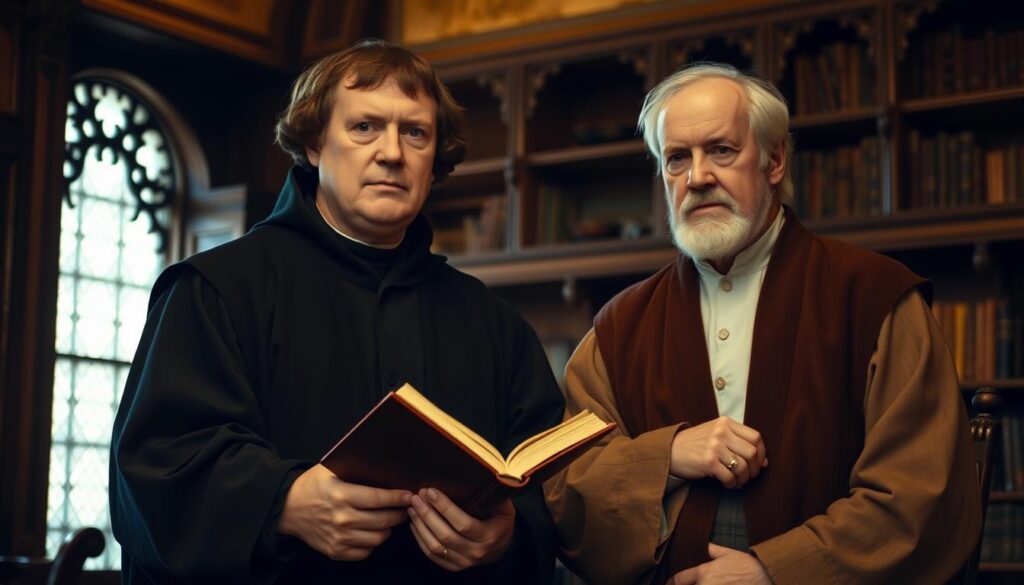
Detailed historical portrait of Martin Luther and Philip Melanchthon, two prominent 16th century Lutheran theologians. Set in a warm, well-lit interior, the subjects are captured in a thoughtful pose, gazing intently. Luther, in a dark robe, holds a book, symbolizing his scholarly and reformist work. Melanchthon, in a lighter colored attire, is positioned close by, reflecting their collaborative efforts in shaping Lutheran theology. The background features ornate wooden furniture and shelves, evoking the scholarly atmosphere of the era. The overall composition and lighting convey a sense of reverence and intellectual gravitas befitting the significance of these two figures in the Protestant Reformation.

The Foundations Laid by Martin Luther

A tormented monk’s midnight discovery changed religious history. While studying Romans, Luther realized salvation wasn’t earned – it was freely given. This insight became the heartbeat of his teaching.

He redefined sin as distrust in God’s promises. Original sin wasn’t just about Adam’s mistake. It described humanity’s daily struggle to trust divine goodness.

Luther’s spiritual battles shaped his theology. He abandoned the idea of earning God’s favor through rituals. Instead, he taught that faith alone connects people to Christ’s redeeming work.

Melanchthon’s Contributions and Early Controversies

While Luther sparked the fire, Melanchthon built the fireplace. His logical mind turned passionate ideas into clear doctrines. The Augsburg Confession became his masterpiece.

He faced criticism for seeking middle ground during conflicts. Some thought his compromises weakened core teachings. Yet his law-gospel framework proved essential for balanced preaching.

The Book of Concord settled these debates in 1580. This collection of confessions gave churches shared standards. It remains the definitive guide for applying scripture to modern life.

Impact and Legacy of Lutheran Theologians in Shaping Faith

How do ideas from centuries ago continue to shape modern spirituality? The fingerprints of these thinkers appear in everything from Sunday sermons to soup kitchens. Their revolutionary concepts redefined how communities worship and serve.

Two Pillars: Divine Approval and Scriptural Balance

At the heart of this legacy lies a radical idea: God declares people righteous through Christ’s work alone. This “passive righteousness” becomes the believer’s core identity. As one reformer noted: “Faith clings to this gift like ivy to an oak tree.”

Law Gospel Impact
Reveals human limits Announces divine mercy Creates humility and hope
Guides moral choices Frees from condemnation Balances truth and grace
Exposes brokenness Restores relationship Fuels compassionate action

From Pulpit to Playground: Faith in Action

Churches transformed when sacraments became encounters with grace rather than rituals. Baptism shifted from symbolic act to identity-shaping promise. Parents bringing babies for blessing now hear: “This water marks God’s ‘yes’ to your child.”

Daily life gained spiritual significance. Teachers and carpenters began seeing their work as holy service. Families embraced mealtime prayers as acts of trust. This theology turned ordinary moments into sacred opportunities.

The rhythm of repentance became central to spiritual growth. Believers learned to say: “I’m both sinner and saint – broken yet beloved.” This honest approach continues helping people navigate modern challenges with grace.

Modern Perspectives: Feminist and Contemporary Reformations in Lutheran Thought

What happens when 500-year-old ideas meet modern equality movements? Today’s thinkers are reshaping spiritual traditions to address systemic injustices while staying true to core principles. Their work bridges historic teachings with urgent calls for fairness in religious communities.

A vibrant and thought-provoking depiction of feminist theology and social justice, captured through a dynamic interplay of colors, symbols, and abstract forms. In the foreground, a central figure symbolizing the spirit of feminist reform stands tall, surrounded by a kaleidoscope of gestural brushstrokes and symbolic elements that evoke the themes of empowerment, inclusivity, and the pursuit of equality. The middle ground features a collage-like composition of sacred texts, historical figures, and social justice movements, all converging to create a tapestry of the modern reformation in Lutheran thought. In the background, a luminous, ethereal glow illuminates the scene, conveying a sense of hope, enlightenment, and the transformative power of this progressive theological perspective. Rendered with a bold, expressive style and a masterful use of light and color, this image captures the essence of the "Modern Perspectives: Feminist and Contemporary Reformations in Lutheran Thought."

Integrating Feminist, Womanist, and Mujerista Theologies

Mary Streufert’s Transformative Lutheran Theologies argues: “Women’s full humanity isn’t negotiable.” This bold approach builds on the belief that divine grace embraces everyone equally. By naming patriarchy as harmful, these frameworks empower communities to rethink power dynamics.

Traditional View Reformed Perspective Impact
Male-centered leadership Shared ministry roles Diverse voices in decision-making
Fixed gender roles Gift-based service Broader community engagement
Silence on inequality Active justice work Stronger congregational trust

Addressing Social Justice and Equality Within the Church

Baptismal identity becomes a rallying cry for change. When people see themselves as equally redeemed, they challenge unfair systems. One pastor notes: “Our faith frees us to fix what’s broken, not just pray about it.”

Modern applications include:

  • Training programs for inclusive leadership
  • Reimagining worship language
  • Partnering with local justice initiatives

This shift honors cultural diversity while maintaining spiritual unity. By grounding action in grace, communities find new ways to live out their beliefs daily.

Conclusion

Great ideas outlive their creators. For five centuries, a spiritual framework built on grace over guilt has shaped how communities live out their beliefs. This tradition’s heartbeat – God’s unearned love – still pulses through modern churches and social movements alike.

From Martin Luther’s scripture studies to today’s justice advocates, the core remains unchanged. Faith becomes active through service, not just Sunday rituals. The gospel’s transformative power fuels soup kitchens and boardrooms, proving ancient wisdom can address modern struggles.

Three principles guide this enduring legacy:

1. Human worth rooted in divine approval, not achievement
2. Scripture as living truth, not historical artifact
3. Ministry that meets people where they are

As society evolves, these ideas adapt without losing their essence. Churches now blend 16th-century confessions with 21st-century inclusivity efforts. The result? A faith that honors tradition while embracing progress – where baptismal water and protest signs both declare sacred identity.

True impact lies beyond doctrine books. It’s seen in parents teaching grace-filled values, nurses offering compassionate care, and communities bridging divides. When theology becomes lived experience, it changes everything.

FAQ

What are the core themes of Lutheran theology?

Central themes include grace as God’s unconditional gift, faith as trust in divine promises, and justification—being made right with God—through Christ alone. These ideas shape worship, ethics, and community life.

How did Martin Luther and Philip Melanchthon shape early thought?

Luther’s bold critiques of church practices sparked reforms, while Melanchthon systematized teachings in documents like the Augsburg Confession. Together, they framed the Law-Gospel distinction still vital today.

Why is the Law-Gospel distinction important?

It clarifies how Scripture reveals human limitations (Law) and God’s saving action (Gospel). This balance fosters humility and hope, guiding preaching, counseling, and personal spiritual growth.

How has feminist theology influenced modern perspectives?

Scholars like Mary Streufert and Gwen Sayler reexamine tradition through gender equality, amplifying marginalized voices. This enriches discussions on leadership, language, and social justice in congregations.

What role does baptism play in community life?

Seen as God’s promise of belonging, baptism unites individuals across differences. It inspires service, mutual care, and advocacy—reflecting grace in action within and beyond church walls.

How do modern thinkers address current social issues?

Leaders like Barbara Rossing connect biblical hope with environmental care, while others champion racial equity. Their work shows faith’s power to drive meaningful change in today’s world.

Explore Lutheran West Football: Highlights and News


Welcome to your go-to source for staying updated on one of Ohio’s most spirited high school football programs. Here, you’ll find everything from game highlights to behind-the-scenes stories celebrating the grit and camaraderie of student-athletes. Whether you’re cheering from the stands or following along from home, we’re here to keep you connected every step of the way.

This fall, the team has shown resilience under Head Coach John Parrella, navigating a challenging schedule in the Chagrin Valley Conference. With a 2-8 regular-season record, they’ve secured the No. 16 seed in the OHSAA Division III playoffs—a testament to their perseverance. Their next challenge? A historic matchup against Central Catholic on November 1st at Gallagher Stadium.

Our coverage dives into what makes this program special. From player achievements to strategic insights, we highlight the heart of Ohio high school athletics. Join us as we follow their journey, sharing stories that inspire both longtime supporters and newcomers alike.

Key Takeaways

  • Lutheran West Football enters the playoffs as Region 10’s No. 16 seed.
  • Head Coach John Parrella leads the team through a competitive fall season.
  • Upcoming playoff game marks their first-ever meeting with Central Catholic.
  • Comprehensive updates include game recaps, player spotlights, and strategy breakdowns.
  • Stay informed on all developments in the Chagrin Valley Conference and beyond.

Latest Updates on lutheran west football

Get ready to cheer: the team gears up for a historic playoff showdown this Friday! On November 1st at 7 p.m., they’ll face Central Catholic at Gallagher Stadium in the OHSAA Division III first round. This marks their debut matchup against the top-seeded squad, promising an unforgettable night under the lights.

Upcoming Games and Scheduling Information

The postseason clash kicks off at 7 p.m., with live radio coverage starting at 6:30 p.m. on The Ticket 100.7 FM. Fans can expect intense competition as the underdog squad challenges Central Catholic’s 9-1 record. This game could redefine the program’s trajectory in the Chagrin Valley Conference.

Ticketing and Game Day Details

Secure your seats early – tickets are exclusively available online through OHSAA.org/tickets. Student passes cost $5, while adult admission is $11. Remember: no tickets will be sold at the gate, and all attendees must purchase in advance.

Arrive early to Gallagher Stadium for optimal parking near the main entrance. Concessions will be open, and spirit wear vendors will set up shop by the east bleachers. Need directions? Check the stadium’s website for real-time traffic updates and parking maps.

  • First-ever meeting with Central Catholic creates playoff history
  • Radio broadcast begins 30 minutes before kickoff
  • Digital tickets only – print or save to your mobile device

Game Highlights and Performance Analysis

Breaking down the pivotal plays and standout efforts reveals how this squad built momentum despite a tough schedule. Their final regular-season clash against Thomas W. Harvey showcased flashes of brilliance that could prove vital in the postseason.

A high-intensity football game analysis scene. In the foreground, a large touchscreen display showcases detailed game statistics and player performance metrics, illuminated by warm lighting. The middle ground features coaches and analysts intently studying the data, their expressions focused and determined. In the background, a busy control room with multiple monitors, video feeds, and technical equipment, conveying the technical complexity of modern sports analysis. The overall atmosphere is one of analytical precision, strategic decision-making, and the relentless pursuit of game-winning insights.

Key Moments and Score Summaries

The season finale saw a spirited fourth-quarter rally, cutting a 20-point deficit to just 13. Though the 34-21 result didn’t flip the script, it demonstrated the grit that earned them a playoff berth. This never-quit attitude will be essential against Central Catholic’s dominant defense.

Their first-round opponents boast a 9-1 record anchored by explosive playmakers. Junior running back Anthony Sylvester averages 5.2 yards per carry, while senior quarterback Isaiah Fox completes passes at a 66% clip. These weapons helped secure a nail-biting 14-13 win over Mona Shores last week.

Standout Player Performances

While the squad’s record doesn’t sparkle, individual leaders emerged through the fall campaign:

  • A sophomore receiver notched three 100-yard games
  • The defensive line forced 12 turnovers in conference play
  • Special teams blocked four kicks during critical moments

Central Catholic’s offensive firepower presents a steep challenge. But with strategic adjustments and capitalizing on red-zone opportunities, this matchup could deliver playoff surprises. The teams’ contrasting styles – grinding resilience versus high-octane execution – make for compelling state tournament drama.

Team History, Coaching Insights, and Community Impact

Beyond the Friday night lights lies a story of transformation. This program’s identity blends athletic growth with community pride, shaped by leaders who prioritize character as much as competition. Let’s explore how strategy and legacy fuel their journey.

Coaching Strategies and Leadership

Head Coach John Parrella’s approach centers on adaptability. By rotating defensive schemes and emphasizing clock management, he maximizes his roster’s strengths. “We focus on progress, not perfection,” he shared after a pivotal conference game. This mindset builds resilience in players facing top-tier opponents like Central Catholic.

The Team’s Athletic and Historical Journey

Since joining the Chagrin Valley Conference, the squad has become a rallying point for local pride. Alumni often return to mentor players, creating a bridge between eras. Their annual youth skills camp draws 100+ participants, proving athletics can unite generations.

As playoff preparations intensify, community support shines through. Fundraisers for new equipment sell out within hours, while local businesses sponsor travel costs. This fall’s state tournament run isn’t just about scores – it’s a celebration of Ohio high school spirit at its finest.

FAQ

How can I purchase tickets for upcoming games?

Tickets are available online through the school’s athletic website or at the gate on game days. Discounts are often offered for students, seniors, and families purchasing group bundles.

Where can I find the team’s current schedule?

The full schedule, including dates, opponents, and locations, is posted on the official school athletics page. Updates are also shared on social media platforms like Twitter and Instagram.

What makes this program stand out in Ohio high school sports?

The program combines competitive play with a focus on leadership and community values. Its legacy includes multiple playoff appearances and a commitment to developing well-rounded student-athletes.

Are there opportunities to support the team beyond attending games?

Yes! Volunteers are always welcome for events, fundraisers, and booster campaigns. Donations to the athletic department also help fund equipment, travel, and facility upgrades.

How does the coaching staff prepare players for postseason challenges?

Coaches emphasize film study, strength conditioning, and situational drills. Their strategies adapt to opponents’ strengths while fostering teamwork and mental resilience.

Can alumni or community members access historical game records?

Archives dating back to the team’s early years are maintained by the school. Reach out to the athletic office for access to past scores, rosters, and milestone moments.