Recent Posts

Astrology in Hinduism: A Deeper Understanding


Welcome to the world of Jyotisha, an ancient spiritual science that has shaped decisions and cultural traditions for millennia. Often called Vedic astrology, this practice goes beyond predicting the future—it reveals how cosmic patterns influence personal growth and daily life.

Unlike Western traditions focused on sun signs, this system prioritizes the moon’s position. Its calculations consider 27 lunar mansions and planetary movements to create detailed birth charts. These charts guide major life events, from naming ceremonies to wedding dates.

At its core lies the principle of bandhu—the sacred link between universal forces and human existence. This connection helps practitioners align their actions with cosmic rhythms for harmony and purpose.

Key Takeaways

  • Jyotisha is a complex spiritual framework, not just fortune-telling
  • Moon positions matter more than sun signs in this tradition
  • Birth charts influence names and important life events
  • 27 lunar mansions shape interpretations
  • The bandhu principle connects cosmic and human realms

Introduction to Astrology in Hinduism

Many wonder how a 5,000-year-old celestial practice remains vital in our tech-driven world. The answer lies in Jyotisha—a living tradition blending cosmic wisdom with practical life guidance. Often called hindu astrology, this system helps people align their actions with universal rhythms.

Overview of Jyotisha and Its Relevance Today

Derived from the Sanskrit term for “science of light,” Jyotisha analyzes planetary movements to map personal destiny. Families consult experts for key moments like baby naming or wedding dates. Indian astrology, also known as vedic astrology, uses 27 lunar constellations called nakṣatras.

Modern practitioners combine ancient methods with digital tools. Software calculates birth charts in seconds, but interpretations still follow sacred texts. This balance preserves tradition while meeting contemporary needs.

Aspect Traditional Practice Modern Adaptation
Chart Calculation Handwritten ephemeris AI-powered software
Life Guidance Marriage compatibility Career path analysis
Cultural Role Festival scheduling Global online consultations

Over 70% of Indian families still use these principles for major decisions. Beyond predictions, it helps people understand their life purpose. From choosing homes to resolving conflicts, Jyotisha shapes lives across generations.

Historical Roots and Cultural Significance

Imagine a time when celestial movements dictated the timing of sacred fires and harvest festivals. This is where vedic astrology began—not as stargazing for personal fate, but as a tool to align rituals with cosmic cycles.
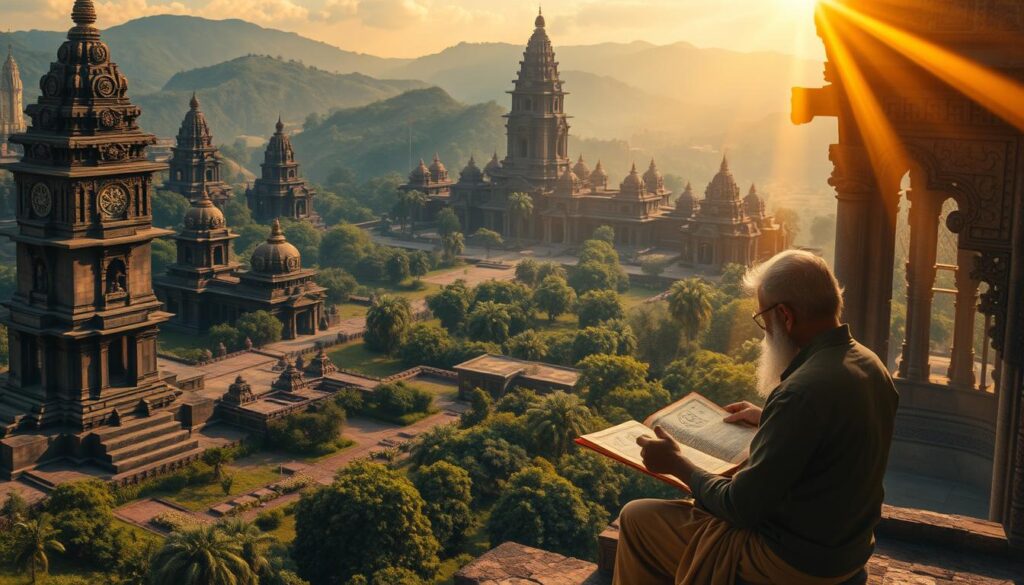
A sprawling ancient temple complex, its intricate architecture a testament to the deep-rooted traditions of Vedic astrology. Towering stone structures, adorned with celestial motifs and zodiac symbols, cast long shadows across a lush, verdant landscape. In the foreground, a learned scholar pores over ancient manuscripts, tracing the mystical connections between the heavens and the earth. Beams of warm, golden light filter through ornate windows, illuminating the scene with a sense of timeless wisdom and spiritual contemplation. The atmosphere is one of reverence and discovery, inviting the viewer to unravel the historical tapestry of this profound astrological tradition.

Vedic Origins and Ancient Texts

Early practitioners focused on creating calendars for ceremonies, not predicting futures. The Vedāṅga texts, dating back over 3,000 years, reveal how priests tracked lunar phases to schedule sacrifices. Surprisingly, these ancient writings never mentioned planets—they used the term “graha” (meaning cosmic influencers) to describe eclipse-causing forces.

Traditional Concept Modern Meaning
Graha (demon) Planetary body
Nakṣatra cycles Lunar mansions
Yajña timing Festival dates

Greek Influences and Evolution in India

Everything changed in the 2nd century CE. Greek star charts arrived through texts like the Yavanajātaka, blending mathematical precision with Vedic wisdom. This fusion created:

  • The seven-day week system
  • Planetary order based on Hellenistic models
  • Detailed birth chart calculations

Medieval scholars compiled these innovations into foundational texts like the Bṛhat Parāśara Horāśāstra. These works still guide practitioners today, proving that cross-cultural exchanges shaped this spiritual science over countless years.

Understanding the Cosmos: Planets, Signs, and Nakṣatras

Celestial patterns shape our existence in ways we’re only beginning to understand. These cosmic blueprints combine planetary movements, star groups, and mathematical precision to map personal journeys.

Planets and Their Energetic Impact on Human Life

Seven cosmic players rule different aspects of daily experience. Their position at birth creates unique energy patterns that color your decisions and relationships.

Planet Energy Type Life Influence
Mars Dynamic Career drive, physical vitality
Venus Harmonizing Relationships, artistic talents
Saturn Restructuring Life lessons, personal growth
Moon Emotional Inner world, instincts

The Role of Zodiac Signs and Lunar Mansions

The zodiac forms a 360-degree map divided into 12 rāśi (signs). Each 30-degree section highlights specific life themes—like Aries’ bold initiatives or Cancer’s nurturing instincts.

Beyond these signs lie 27 precise Nakṣatras. These 13°20′ sky segments use fixed stars to reveal hidden talents and challenges. Your birth moon’s placement here unlocks detailed insights about life purpose and compatibility.

Together, these systems create a multi-layered cosmic fingerprint. They show how universal rhythms shape individual paths through precise mathematical relationships.

Astrology in Hinduism: Foundations and Key Concepts

The stars tell stories older than civilizations, mapping karmic debts and soul lessons through cosmic patterns. At its core lies bandhu—the sacred link between individual choices and universal forces. This connection transforms celestial movements into a spiritual mirror reflecting personal growth.
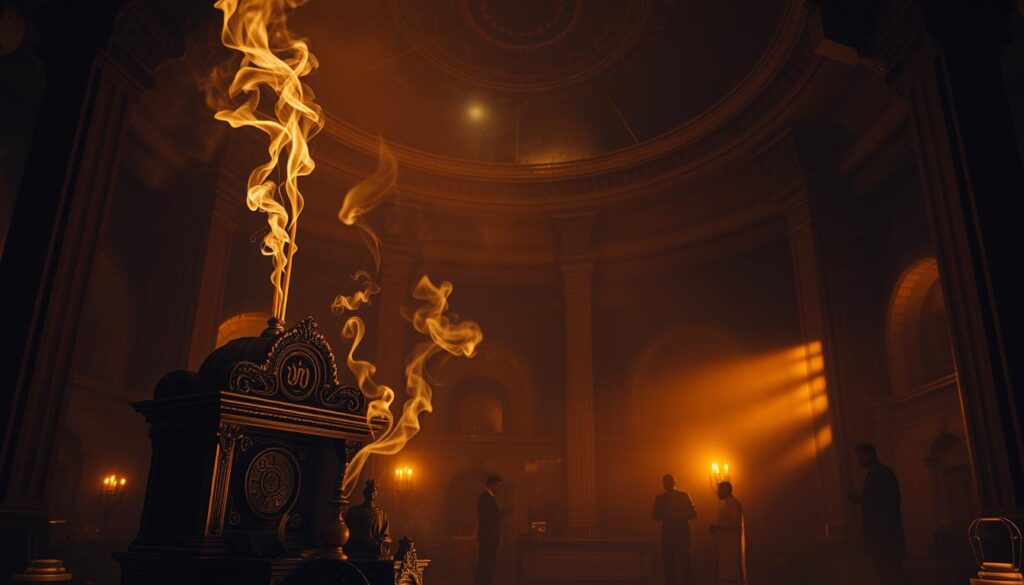
A serene, dimly lit temple interior bathed in warm, golden light. In the foreground, an ornate altar adorned with intricate carvings and symbols of Vedic astrology - planets, stars, and mystical diagrams. Hovering above the altar, wisps of incense create an ethereal, meditative atmosphere. In the middle ground, the silhouettes of priests performing rituals, their hands tracing the celestial patterns. The background reveals a domed ceiling with painted constellations, echoing the themes of the cosmic knowledge and spiritual enlightenment at the heart of Vedic astrology. The overall composition evokes a sense of timeless wisdom, connection to the divine, and the profound principles of karma guiding the human experience.

The Principles of Vedic Astrology and Karma

Your birth chart acts as a cosmic report card, showing where past actions meet present opportunities. The nine Navagraha (planetary deities) serve as divine accountants, delivering lessons tailored to your soul’s journey under the Supreme Being’s guidance.

Three key ideas shape this system:

  • Karmic feedback: Planetary positions highlight patterns needing resolution
  • Soul evolution: Challenges become growth opportunities
  • Cosmic teamwork: Deities collaborate to balance your spiritual ledger

Unlike systems promoting fixed fate, this approach celebrates free will. As one scholar notes: “Planets suggest, humans decide—your choices rewrite celestial scripts daily.” Your chart reveals tendencies, not prison sentences, empowering you to shape outcomes through conscious action.

This wisdom turns stargazing into self-mastery. By understanding your karmic blueprint, you gain tools to align daily choices with your soul’s highest path.

Comparing Hindu and Western Astrology

The night sky tells different stories through two distinct lenses. While both systems explore cosmic influences, their approaches reveal contrasting philosophies about human destiny.

The Sidereal Versus Tropical Zodiac

Hindu astrology, also known as Vedic practice, anchors its zodiac to fixed star positions. This sidereal system stays aligned with constellations. Meanwhile, western astrology uses movable seasonal markers called tropical signs.

A 22-degree gap has grown since 285 CE. This shift means your sun sign likely differs between systems. Your Leo might be Cancer in Vedic charts—a perspective shift reshaping personality interpretations.

Lunar Priorities in Eastern Traditions

Where Western systems spotlight sun positions, Jyotisha prioritizes the moon’s location. Your lunar sign reveals emotional patterns and instinctive reactions. This focus stems from observing how lunar cycles affect consciousness more directly than solar movements.

Both approaches offer value—one rooted in seasonal symbolism, the other in stellar mathematics. Whether you resonate more with planetary degrees or emotional tides depends on which cosmic language speaks to your journey.

FAQ

How does Jyotisha remain relevant in modern life?

Jyotisha, or Vedic astrology, focuses on understanding karmic patterns and life cycles. Many use it for guidance on relationships, career choices, and timing major events like marriage. Its emphasis on lunar cycles and planetary transitions helps people align with natural rhythms.

What’s the difference between sidereal and tropical zodiac systems?

The sidereal system used in Jyotisha adjusts for Earth’s axial precession, aligning constellations with their current positions. Western astrology’s tropical system fixes signs to seasonal markers. This creates a ~23-degree shift, changing how signs correlate to birth dates.

Why are moon signs prioritized in Hindu traditions?

The moon symbolizes mind and emotions in Jyotisha. Its position at birth reveals emotional tendencies and subconscious patterns. This contrasts with Western practices, which often emphasize sun signs for personality traits.

How do nakshatras shape predictions in Vedic practices?

The 27 lunar mansions (nakshatras) refine interpretations by linking planetary movements to specific star clusters. Each governs unique qualities, helping astrologers assess compatibility, auspicious timings, and spiritual growth opportunities.

Did Greek culture influence early Indian astrological systems?

Yes! Hellenistic concepts entered India during the Indo-Greek era (2nd century BCE). Techniques like planetary dignity and aspects merged with Vedic frameworks, creating hybrid methods seen in texts like the Yavanajataka.

Can planetary positions truly impact personal karma?

Jyotisha views planets as mirrors of karmic energy, not direct causes. Their placements at birth reflect past actions, offering insights into challenges and strengths. Remedies like mantras or rituals aim to harmonize these energies for balanced growth.
Understanding the Hindu Faith: Key Insights and Practices


Let’s explore one of humanity’s oldest and most vibrant spiritual paths. Unlike many belief systems, this tradition thrives as a dynamic network of practices rather than a rigid set of rules. Its beauty lies in how it intertwines philosophy, art, and daily life across countless communities.

The term “Hindu” first appeared through outsiders’ perspectives. Ancient Chinese and Persian travelers used it to describe people living near the Indus River. Over time, this label grew into a shared identity for diverse regional customs.

Today, over a billion people worldwide connect with these traditions. That’s nearly 15% of humanity! What unites them isn’t a single holy book or leader, but a shared cultural heritage that values personal spiritual exploration.

From colorful festivals to quiet meditation, practices vary widely. Some focus on loving devotion to deities, while others prioritize philosophical inquiry. This flexibility lets the tradition evolve while keeping ancient wisdom alive.

Key Takeaways

  • Represents a family of interconnected customs rather than a single organized faith
  • Originated as a geographical term before becoming a cultural identifier
  • Engages over 1 billion followers globally through adaptable practices
  • Blends spiritual beliefs with artistic expression and community values
  • Encourages both devotional worship and philosophical questioning

Overview of the Hindu Faith & Its Global Impact

Across continents and cultures, a vibrant spiritual tradition shapes lives from Mumbai to Manchester. With over 1.2 billion followers worldwide, it stands as the third-largest belief system globally. Nearly 80% of India’s population and 90% of Nepal’s citizens maintain these practices, keeping ancient customs alive in modern society.

The United Kingdom showcases this tradition’s adaptability. Over 840,000 people there identify with these customs—1.5% of the population. Many British followers trace roots to Gujarat or Punjab, often through families who first settled in East Africa or Caribbean nations.

Diaspora communities thrive through cultural preservation and innovation. Temples double as community hubs, while festivals like Diwali light up cities from London to Los Angeles. These groups often excel in education and business, blending traditional values with contemporary success.

Global influence extends beyond temples and rituals. Yoga studios, meditation apps, and plant-based diets now shape wellness trends worldwide. This living tradition continues evolving, proving ancient wisdom can find fresh relevance in every corner of the world.

Historical Roots: From the Indus Valley to the Vedic Period

Journey back 4,500 years to uncover the origin of spiritual practices still thriving today. Along the Indus River’s fertile banks, one of humanity’s first urban cultures built cities with stunning precision.

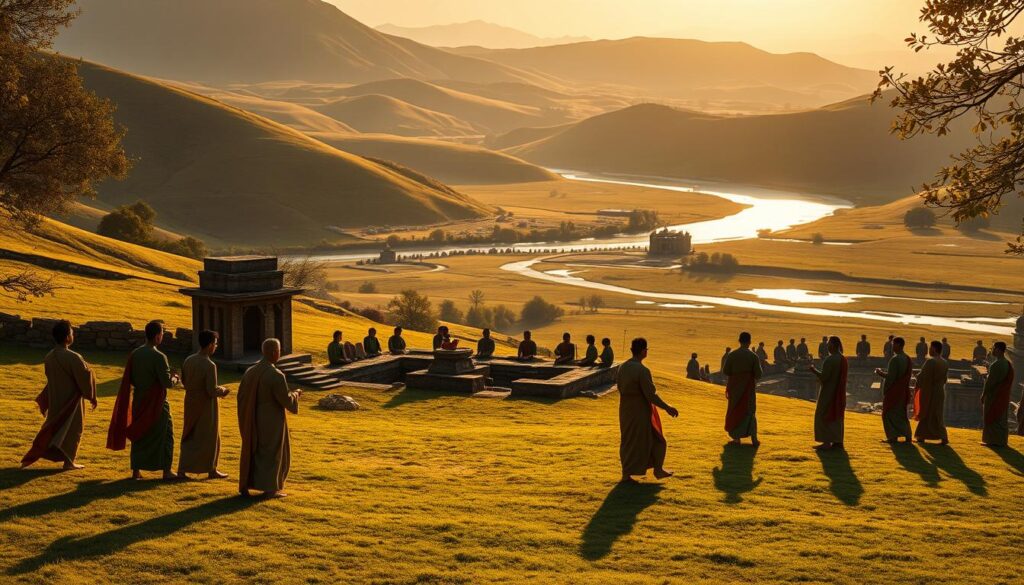
Prompt A serene scene of ancient Indus Valley rituals unfolding within a verdant landscape. In the foreground, a group of robed figures engage in a ceremonial dance, their movements graceful and measured. The middle ground reveals stone structures and altars, casting long shadows under the warm, golden light of a setting sun. In the distance, rolling hills and a tranquil river create a picturesque backdrop, evoking a sense of timelessness and connection to the natural world. The overall atmosphere is one of reverence, spirituality, and the enduring traditions of this ancient civilization.

Indus Valley Civilisation and Early Rituals

Mohenjo-Daro’s streets tell silent stories through baked-brick houses and advanced drainage systems. The star attraction? A 39-foot-long bathing pool – the Great Bath – hinting at early rituals tied to water purification.

Clay seals show horned figures surrounded by animals. Some archaeologists think these might represent early divine forms. Small female figurines suggest mother goddess worship – practices echoing through traditions millennia later.

Transition to Vedic Religion and Cultural Continuity

Around 1500 BCE, new spiritual expressions emerged. Fire became central to sacred ceremonies. People gathered around blazing altars, offering grains and chanting verses now preserved in the Rigveda.

This time introduced key concepts like cosmic order (rta) and sacred sound. The Vedic world had three realms – earth, atmosphere, and sky – each home to different deities receiving smoke-borne offerings.

These developments didn’t erase earlier practices. Instead, they wove ancient water rituals into new fire ceremonies, creating spiritual threads still visible in modern worship.

Understanding the hinduism religion: Core Beliefs and Practices

At the heart of this ancient tradition lies a dynamic trio of concepts shaping daily choices and cosmic perspectives. These principles guide ethical living while answering life’s biggest questions about purpose and existence.

The Principles of Dharma, Karma, and Reincarnation

Dharma acts as life’s compass—it’s about doing what’s right for your stage of life and social role. Think of it as maintaining universal balance through everyday actions rather than rigid beliefs.

The law of karma reminds us every choice matters. Good deeds create positive ripples, while harmful actions bring challenges. This isn’t punishment—it’s nature’s way of teaching through experience.

Reincarnation offers a grand view of existence. Souls evolve through countless lifetimes, wearing different bodies like changing clothes. Each life presents new lessons until ultimate freedom is achieved.

Diverse Spiritual Paths and Devotional Approaches

Four main roads lead seekers toward truth. Some pour love into deity worship through song and prayer. Others seek wisdom through study or find purpose in selfless service.

Meditation fans discover peace in silent reflection. The philosophy celebrates this diversity—no single path fits all. Your neighbor might chant hymns while you volunteer at shelters, yet both fulfill dharma.

These ideas form a living framework that’s lasted millennia. They adapt to modern life while keeping ancient wisdom alive, proving timeless truths can thrive in changing times.

Deities and Divine Manifestations in Hinduism

Divine figures shape daily life for millions through stories, rituals, and personal devotion. These sacred beings represent nature’s forces, moral ideals, and cosmic principles—bridging the infinite and everyday.

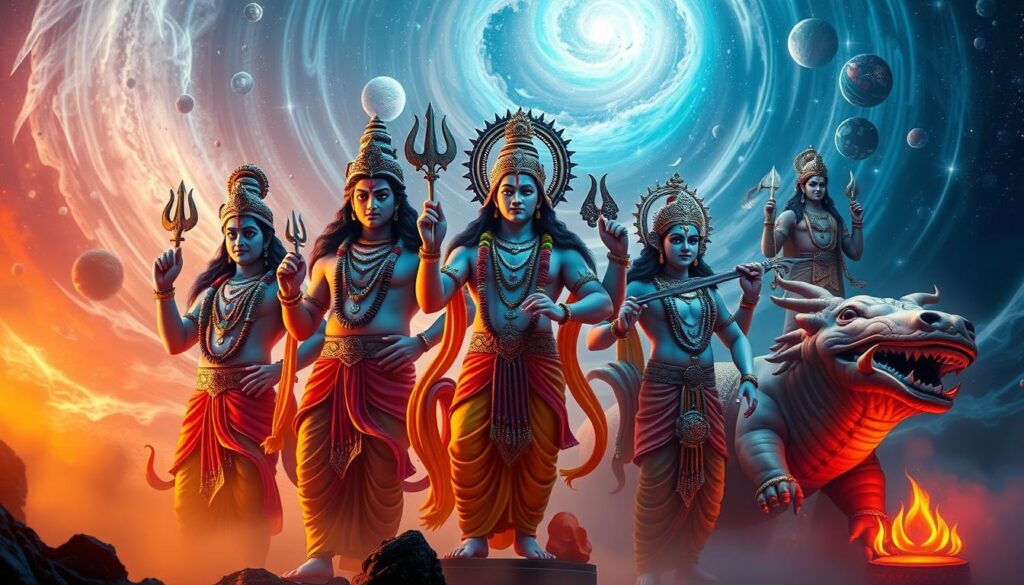
A breathtaking scene of Hindu deities and avatars, captured in a vibrant, ethereal light. In the foreground, the powerful forms of Lord Shiva, Vishnu, and Brahma stand tall, their intricate features and ornate adornments meticulously rendered. In the middle ground, the avatars of Vishnu - Krishna, Rama, and Narasimha - are depicted in dynamic poses, radiating divine energy. The background is a swirling, cosmic landscape, with celestial bodies and mystic symbols filling the frame, creating a sense of otherworldly grandeur. The lighting is a soft, ambient glow, casting a serene and reverent atmosphere, inviting the viewer to bask in the majesty of these divine manifestations.

Sacred Figures Guiding Life’s Journey

Three cosmic forces form a powerful trio. Brahma sparks creation, Vishnu sustains harmony, and Shiva clears space for renewal. Together, they mirror life’s endless cycles—birth, growth, and transformation.

Goddesses command equal reverence. Devi appears as Lakshmi blessing homes with prosperity, Saraswati inspiring students, or Durga battling injustice. “The divine feminine isn’t gentle—it’s unstoppable,” explains a temple priestess from Kerala.

When the Divine Walks Among Us

Believers celebrate divine incarnations called avatars. These earthly forms appear during crises to restore balance. Krishna’s playful wisdom and Rama’s righteous leadership remain timeless guides for ethical living.

Regional customs highlight different deities. Coastal villages might honor ocean gods, while mountain communities celebrate earth goddesses. This diversity lets people connect with forms that reflect their lives and values.

From kitchen shrines to grand temples, these sacred figures make spirituality tangible. They remind followers that wisdom and grace live in every moment—if we know how to look.

Sacred Texts and Philosophical Foundations

Ancient wisdom flows through timeless writings that shape spiritual practices across generations. At the core stand the Vedas—sacred texts preserved through meticulous oral traditions for over 3,000 years. The Rig Veda, oldest among them, contains hymns still recited today with near-perfect accuracy.

These works are called shruti, meaning “heard” knowledge believed to originate from cosmic vibrations. Unlike human-authored guides, they form an unbroken thread connecting modern seekers to ancient sages. Later writings like the Upanishads explore profound ideas about consciousness and universal truth through poetic dialogues.

The Mahabharata and Ramayana epics bring philosophy to life through gripping stories. Families worldwide share tales of prince Rama’s exile or warrior Arjuna’s dilemmas. Within the Mahabharata lies the Bhagavad Gita—a 700-verse masterpiece offering practical advice for balancing duty and spiritual growth.

Text Time Period Key Contribution
Rig Veda 1200-900 BCE Oldest hymns & rituals
Upanishads 800 BCE-200 CE Philosophical explorations
Bhagavad Gita 500-200 BCE Ethical living guide
Ramayana 500-100 BCE Moral storytelling

Modern adaptations keep these works relevant. The Bhagavad Gita inspires business seminars, while Ramayana plays attract stadium crowds. This living tradition proves ancient texts can speak to every era—if we listen closely enough.

Diverse Traditions and Denominations in Hinduism

Four main spiritual paths reveal how ancient practices adapt to modern lives. Each offers unique ways to connect with the sacred while sharing common roots in timeless wisdom.

Paths of Devotion and Practice

Vaishnavism leads in numbers with 640 million followers globally. Devotees focus on Vishnu and beloved forms like Krishna. Daily rituals often include chanting mantras and studying sacred texts under guidance.

Shiva-centered traditions thrive through meditation and symbolic worship. Followers honor the cycle of creation and destruction through fire ceremonies and yoga practices. Many find meaning in balancing worldly life with spiritual growth.

Shaktism stands out by celebrating divine feminine energy. Temples feature powerful goddess forms that inspire courage and creativity. This path particularly resonates with those seeking to honor nature’s life-giving forces.

The Smartism approach values philosophical exploration. Followers may honor multiple deities while emphasizing personal ethics and scriptural study. This tradition often appeals to those who appreciate structured rituals with deep symbolic meanings.

These living traditions show how shared values blossom into distinct practices. From chanting communities to eco-conscious temples, they prove spiritual journeys can take countless forms while heading toward common truths.

FAQ

What are the origins of Hindu practices?

Early rituals trace back to the Indus Valley Civilisation, with fire ceremonies and reverence for nature. Over time, these blended with Vedic traditions, forming a spiritual framework centered on cosmic order and devotion.

How do concepts like karma shape daily life?

Actions (karma) influence future outcomes, encouraging ethical choices. Dharma guides moral duties, while reincarnation reflects the soul’s journey toward liberation (moksha). These ideas inspire personal growth and social harmony.

Which deities are most widely worshipped?

Vishnu (preserver), Shiva (transformer), and Devi (divine feminine) are central. Avatars like Krishna and Rama also play key roles, embodying virtues and intervening in human struggles.

What texts form the foundation of Hindu philosophy?

The Vedas outline rituals, while the Upanishads explore metaphysics. The Bhagavad Gita discusses duty and devotion, and epics like the Mahabharata and Ramayana share moral stories.

How do traditions like Shaivism differ?

Shaivism focuses on Shiva as supreme, while Vaishnavism emphasizes Vishnu. Shaktism honors Devi’s energy, and Smartism integrates multiple deities. Each path offers unique rituals and teachings.

Why are temples and puja significant?

Temples serve as spiritual hubs, hosting rituals that connect devotees to the divine. Puja (worship) involves offerings, prayers, and hymns, fostering personal bonds with deities.

How does caste influence social structures?

Historically linked to occupation, the caste system shaped roles in society. Modern interpretations emphasize equality, though debates about its impact continue in communities today.

Are vegetarianism and non-violence required?

Many avoid meat to honor ahimsa (non-harm), but practices vary. Some traditions permit select foods, reflecting regional customs and personal interpretations of sacred teachings.

The God of Hinduism: Understanding the Hindu Deity


Exploring the spiritual landscape of one of the world’s oldest religions reveals a vibrant mosaic of beliefs. Unlike many faiths, this tradition embraces diverse perspectives—from worshiping multiple divine forms to focusing on a universal essence. This flexibility makes it unique among global spiritual systems.

At its core, the tradition celebrates countless divine expressions. Terms like Deva (divine masculine) and Devi (divine feminine) represent these sacred energies. Over thousands of years, these concepts evolved from early Vedic rituals to the rich symbolism seen today across South Asia and beyond.

Practitioners might focus on a single beloved figure or honor many. Some even approach spirituality without traditional worship. This adaptability reflects the philosophy’s depth—it’s less about rigid rules and more about personal connection.

Key Takeaways

  • Hindu spirituality supports diverse approaches, including monotheistic, polytheistic, and non-theistic perspectives
  • Divine concepts have transformed significantly since ancient Vedic times
  • Key terms like Ishvara (supreme being) and Bhagavati (divine mother) help navigate the tradition
  • Regional practices across India and Southeast Asia showcase cultural adaptability
  • Modern interpretations balance ancient roots with contemporary understandings

Introduction to Hindu Deities and Their Complexities

The vibrant world of Hindu spirituality centers around divine figures called Deva (masculine) and Devi (feminine). These terms translate to “heavenly” or “divine excellence,” reflecting their sacred roles. Unlike simple characters, they embody complex energies that shape cosmic balance and human understanding.

Defining Deva and Devi

Rooted in ancient Sanskrit, Deva and Devi represent more than just gods and goddesses. They symbolize universal principles—light, wisdom, creation, and transformation. Each carries rich stories that explain natural phenomena and spiritual truths.

Sacred texts list 108 names for major deities, a number tied to cosmic cycles. These aren’t random labels. Chanting Lakshmi’s names for prosperity or Shiva’s titles for renewal creates specific spiritual connections. Devotees often use these names like keys to unlock deeper meanings.

What makes this system unique? It honors both masculine and feminine energies equally. While Deva might represent protective strength, Devi channels creative power. Together, they show how opposites weave through existence—a dance of balance central to Hindu thought.

Vedic Beginnings of Hindu Deities

The roots of Hindu divine concepts stretch back to ancient rituals and sacred chants. During the early Vedic period (1500–500 BCE), spiritual practices focused on cosmic forces personified as powerful beings. These foundational ideas evolved into the rich symbolism we recognize today.

Insights from Vedic Texts

The Rigveda, one of the oldest known Vedic texts, introduces deities like Indra and Agni. Indra, celebrated as a warrior king, governed storms and courage. Agni, the fire deity, acted as a divine messenger linking humans and celestial realms.

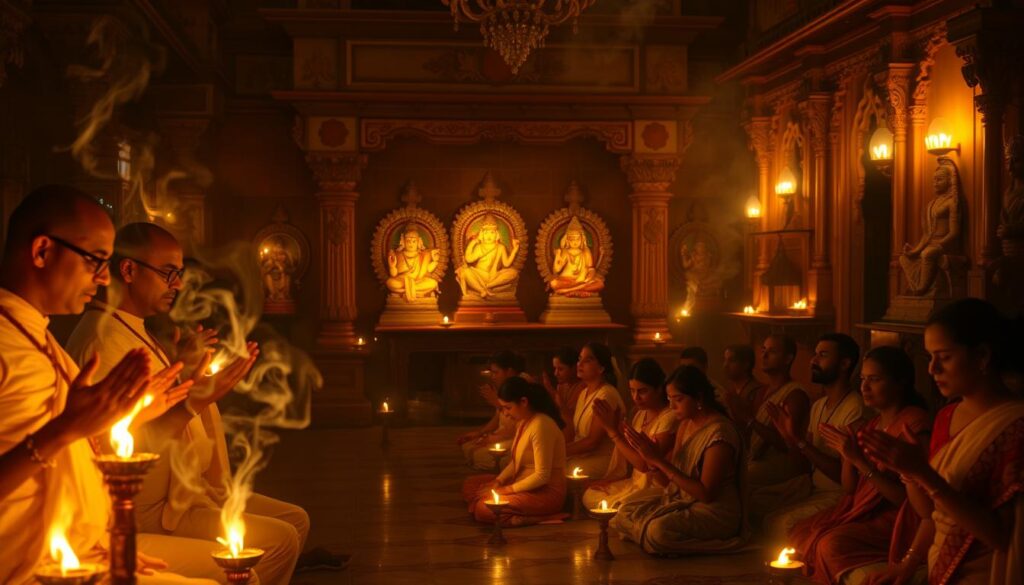
A serene temple interior, dimly lit by flickering oil lamps. In the foreground, a group of priests perform ancient Vedic rituals, their hands gracefully moving through intricate mudras. Wisps of fragrant incense drift through the air, creating an ethereal atmosphere. In the middle ground, devotees kneel reverently, their faces filled with devotion as they chant Vedic mantras. The background is adorned with ornate carvings and sculptures of Hindu deities, each radiating a divine aura. The scene is bathed in a warm, golden glow, conveying a sense of timelessness and spiritual transcendence.

Early deities often represented natural elements. Soma, associated with a sacred plant and ritual drink, symbolized spiritual awakening. These figures weren’t just symbols—they guided daily life through stories and hymns.

Deity Role Symbolism
Indra Storm & War Leadership
Agni Fire Transformation
Soma Sacred Ritual Enlightenment

The Role of Early Rituals

Sacrifice formed the heart of Vedic worship. Elaborate yajna ceremonies used fire to honor divine forces. Priests chanted hymns while offering grains and herbs, believing these acts sustained cosmic order.

By 500 BCE, a clear distinction emerged between benevolent Devas and opposing Asuras. This shift reflected evolving spiritual priorities—from appeasing forces to seeking personal connection.

Evolution from Vedic to Medieval Representations

The stories carved in ancient temples reveal a fascinating journey of sacred figures. Between 500 BCE and 1200 CE, spiritual traditions transformed through epic tales and regional practices. Texts like the Puranas reimagined early divine concepts, giving them vibrant personalities and family ties.

Consider Rudra’s evolution—a storm deity in Vedic hymns became Shiva, the cosmic dancer. Early sculptures from the 2nd century show him as Shiva-Rudra, blending old and new traits. By the 13th century, artists depicted him with flowing locks and a crescent moon, symbols millions recognize today.

This period also enriched visual storytelling. Deities gained distinct colors, weapons, and animal companions. Vishnu’s blue skin signaled infinite wisdom, while Durga’s lion mount symbolized courage. These details helped worshippers connect with different aspects of the divine.

Sacred texts played a key role. The Ramayana and Mahabharata wove moral lessons into divine adventures. Regional variations flourished too—a temple in Tamil Nadu might celebrate Shiva differently than one in Gujarat. Yet all shared a core belief: spiritual truths adapt without losing their essence.

The Concept of Brahman and Absolute Reality

Imagine a cosmic glue holding everything together—seen and unseen. This is Brahman, the bedrock of Hindu philosophy. Unlike typical ideas about divinity, it’s not a deity you pray to but the ultimate fabric of existence itself.

A serene and ethereal landscape depicting the Brahman concept. In the foreground, a tranquil lake reflects the sky above, its surface a mirror of shimmering calm. In the distance, majestic mountains rise, their peaks capped with snow and bathed in a warm, golden light. Wisps of mist drift between the peaks, evoking a sense of the infinite and the unknowable. The atmosphere is one of profound stillness and contemplation, inviting the viewer to ponder the nature of ultimate reality. The lighting is soft and diffused, creating a sense of timelessness and unity. The overall composition conveys the Brahman - the absolute, eternal, and all-encompassing essence of the universe.

Brahman in Vedantic Thought

Vedanta teachings describe this one supreme reality as both everywhere and beyond everything. Think of ocean waves: individual yet part of the whole. Scholar Ishwar Chandra Sharma put it best:

“Absolute Reality transcends dualities—existence and non-existence, light and darkness.”

Three main views shape how people understand Brahman:

School Perspective Key Idea
Advaita Impersonal No separation between self and Brahman
Dvaita Personal Divine essence exists apart from creation
Vishishtadvaita Transpersonal Unity with distinctions

This explains why Hindu traditions honor many deities. Each represents different facets of the same universal essence. Whether through rituals or meditation, the goal remains—connecting with what’s called Brahman in its boundless form.

Unifying Themes in the Hindu Pantheon

Picture a symphony where every instrument plays a unique melody yet forms one harmonious piece. This mirrors how Hindu traditions view their deities—distinct expressions of a shared cosmic rhythm. Ancient temples showcase this unity through stunning sculptures that blend divine forms into single figures.

Take Harihara, a half-Vishnu, half-Shiva figure carved in stone. Or Ardhanārīshvara, merging masculine and feminine energies into one being. These manifestations aren’t contradictions—they’re visual reminders that all sacred forms flow from the same source.

Three major traditions highlight this interconnectedness. Vaishnavism celebrates Vishnu’s nurturing power, while Shaivism honors Shiva’s transformative energy. Shaktism reveres the divine feminine through goddesses like Durga. Despite different focuses, they share rituals, festivals, and core philosophies.

Why does this matter? It explains why a devotee might light lamps for Lakshmi and chant Shiva’s name without conflict. Each deity represents specific aspects of existence, like colors in a prism revealing sunlight’s full spectrum.

Scholar Meera Nanda observes:

“The pantheon acts as a spiritual toolkit—different tools for different needs, all serving the same purpose of connection.”

This approach keeps the tradition vibrant. New aspects emerge while honoring ancient roots, proving that unity thrives in diversity. Whether through temple rituals or home altars, the message remains: many paths, one supreme truth.

Exploring the Trimurti: Creator, Preserver, and Destroyer

Picture three cosmic architects shaping existence itself. This is the Trimurti—three sacred forms working together to sustain universal rhythms. Brahma sparks creation, Vishnu maintains balance, and Shiva clears space for renewal. Together, they form a divine blueprint for life’s endless cycles.

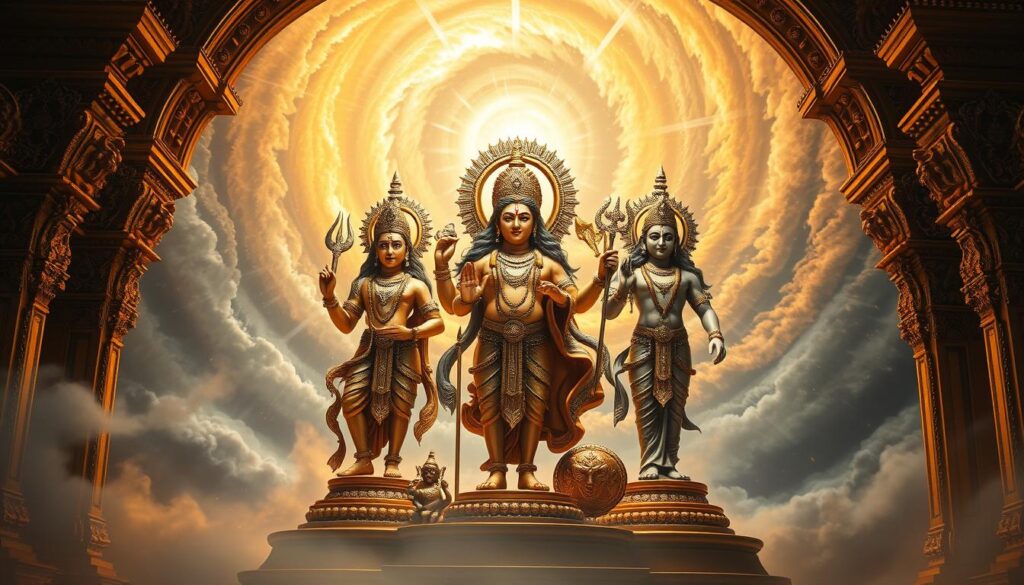
A majestic and ornate depiction of the Trimurti, the divine triad of Hinduism. In the center, three divine figures stand with purpose and grandeur, representing the Creator Brahma, the Preserver Vishnu, and the Destroyer Shiva. Each deity adorned with intricate details, holding their symbolic attributes. Radiating golden light illuminates the scene, casting an aura of divinity and cosmic power. The background is a swirling vortex of cosmic energy, hinting at the cyclical nature of creation, preservation, and destruction. Framed by ornate architectural elements, the Trimurti stands as a testament to the holistic and balanced nature of the Hindu pantheon.

Brahma: The Creator

Brahma emerges from a golden lotus rooted in Vishnu’s navel, symbolizing creation’s birth from preservation. His four faces represent the four Vedas, ancient texts holding cosmic wisdom. Despite his role as the creator god, fewer than ten temples honor him today.

Why the lack of worship? Legends suggest Brahma’s focus shifted after completing creation. Unlike Vishnu and Shiva, he rarely intervenes in worldly matters. His imagery—holding scriptures and water pots—reminds us that beginnings require both knowledge and nourishment.

Shiva: The Destroyer

Shiva’s title often misleads newcomers. His third eye doesn’t just erase—it transforms. The crescent moon on his head symbolizes time’s cycles, while his trident cuts through illusion. Followers celebrate him during Maha Shivaratri, chanting hymns that echo his dual nature.

Modern science mirrors Shiva’s role. Just as forests need fires to regenerate, universes require dissolution to rebirth. This makes the “destroyer” essential to cosmic sustainability—a truth etched in temple carvings across India.

Deity Role Symbols Temples
Brahma Creator Lotus, Vedas <10
Vishnu Preserver Conch, Discus Thousands
Shiva Transformer Trident, Moon Thousands

Scholar Anika Patel explains:

“The Trimurti shows how opposites collaborate—like seasons ensuring Earth’s survival.”

This framework helps devotees see unity behind apparent contrasts, much like recognizing day and night as parts of one rotating planet.

Major Deities: Vishnu, Shiva, and Shakti

Three powerful forces shape modern Hindu practice—Vishnu’s compassion, Shiva’s transformative energy, and Shakti’s creative spark. These deities anchor distinct spiritual paths while sharing core principles of balance and connection.

Vishnu shines as the preserver, celebrated through beloved avatars like Krishna and Rama. Followers of Vaishnavism cherish his role in restoring harmony. Ancient texts describe him descending whenever chaos threatens cosmic order—a divine safety net for righteousness.

Shiva captivates as both destroyer and renewer. His meditative poses and fiery third eye symbolize inner transformation. Shaivites see his dance as the universe’s heartbeat—destroying illusions to make space for growth.

The goddess Shakti fuels existence through forms like Durga and Kali. Worshipped in Shaktism, she embodies raw creative power. Durga’s victory over the buffalo demon isn’t just myth—it’s a metaphor for overcoming life’s struggles.

Deity Role Symbol Tradition
Vishnu Preserver Conch shell Vaishnavism
Shiva Transformer Trident Shaivism
Shakti Creator Lotus Shaktism

These paths aren’t competing truths but different lenses to view the divine. As scholar Dr. Anika Patel notes:

“Whether through Vishnu’s grace or Shakti’s strength, all routes lead to the same eternal truth.”

Modern temples reflect this diversity. You might find Krishna’s playful smile beside Durga’s fierce stance—proof that Hindu deities offer multiple doorways to spiritual awakening.

god of hinduism: Monotheistic Perspectives in Hindu Traditions

Imagine a spiritual framework where devotion takes countless forms yet shares common threads. A 2021 Pew Research study reveals this balance—29% of Indian Hindus see one god as supreme, while 61% honor multiple divine expressions. This duality defines the tradition’s unique flexibility.

Groups like the Arya Samaj emphasize one supreme reality, rejecting idol worship. Vedanta philosophy describes Brahman as the singular essence behind all existence. Even Krishna-centered practices blend devotion to a personal deity with recognition of universal oneness.

What makes these perspectives coexist? The answer lies in respecting personal spiritual paths. As scholar Ravi Mishra notes: “The divine isn’t confined to theological boxes—it’s experienced through individual lenses.”

Modern temples reflect this harmony. You might find a Krishna statue beside abstract symbols of formless divinity. Whether through chanting or silent meditation, the goal remains connection with the sacred essence that unites all traditions.

This approach keeps ancient wisdom relevant. It allows space for both focused devotion and philosophical exploration—proof that unity thrives within diversity.

FAQ

Is Hinduism polytheistic or monotheistic?

Hindu traditions embrace both perspectives. While many deities exist, they’re often seen as manifestations of one supreme reality called Brahman. This unity-in-diversity concept allows for diverse worship practices while recognizing a singular divine essence.

What are the oldest texts referencing Hindu deities?

The Rigveda, composed around 1500–1200 BCE, is among the earliest sources. It highlights deities like Agni (fire), Indra (storms), and Varuna (cosmic order), reflecting early Vedic rituals and spiritual ideas.

How do Brahma, Vishnu, and Shiva differ in roles?

These three form the Trimurti: Brahma creates, Vishnu preserves, and Shiva transforms the universe. While Brahma is less widely worshipped today, Vishnu and Shiva remain central, often linked to devotional movements like Vaishnavism and Shaivism.

What is Brahman’s relationship to individual deities?

In Vedantic philosophy, Brahman is the unchanging, infinite reality underlying all existence. Deities like Vishnu or Shakti represent its dynamic aspects, helping devotees connect with the divine through relatable forms.

Why is Shakti significant in Hindu worship?

Shakti embodies the divine feminine energy, seen as the active force behind creation. She’s worshipped as Durga, Kali, or Parvati and is central to Shaktism, emphasizing power, fertility, and the inseparable bond with Shiva.

Can Hinduism be considered monotheistic?

Certain traditions, like Vaishnavism or Shaivism, focus on a single supreme deity (Vishnu or Shiva) while acknowledging other forms. This “one with many names” approach reflects Hinduism’s adaptability across regional and philosophical contexts.

What role do avatars play in Hindu belief?

Avatars, like Vishnu’s incarnations Krishna or Rama, represent divine interventions to restore cosmic balance. These stories, found in texts like the Bhagavad Gita, illustrate ethical ideals and the deity’s accessibility to devotees.

How do modern Hindus engage with deities?

Practices vary widely—from temple rituals and home offerings to meditation and yoga. Many choose a personal deity (ishta devata) for focused devotion, blending ancient traditions with contemporary spiritual needs.

Nearby Hinduism Churches: Find One Today


Looking to connect with vibrant spiritual centers? Many local worship spaces blend ancient traditions with modern community engagement. These hubs offer serene environments for reflection, cultural celebrations, and meaningful connections.

Today’s spiritual centers cater to diverse needs. You’ll find traditional rituals alongside family-friendly programs and educational workshops. Seasonal festivals and weekly services create opportunities for both personal growth and collective joy.

Newcomers often appreciate the welcoming atmosphere at these gathering places. Many locations provide visitor guides and multilingual resources to help you navigate customs and schedules. From meditation sessions to youth activities, there’s something for every age and interest.

Key Takeaways

  • Local spiritual centers host cultural events and religious services
  • Modern facilities often include educational programs and social initiatives
  • Visitor-friendly resources help newcomers participate comfortably
  • Diverse activities cater to all age groups and interests
  • Regular community gatherings foster meaningful connections

This guide will help you explore nearby options, understand service schedules, and discover special events. Let’s find the perfect space for your spiritual journey!

Explore Local Hindu Temples and Worship Spaces

Georgia’s spiritual landscape shines with sacred spaces that honor ancient traditions while serving modern communities. These vibrant centers host daily rituals, cultural festivals, and educational programs tailored for all ages.

Temple Locations and Contact Details

Atlanta’s metro area features nine major spiritual hubs. The Hindu Temple of Atlanta in Riverdale (5851 GA Hwy 85) welcomes visitors at 770-907-7102. Those near Cumming can reach the Satyanarayana Temple at 470-210-4492.

Northside residents connect with the Hanuman Temple in Alpharetta (770-475-7701), while the BAPS Swaminarayan Temple in Lilburn showcases stunning architecture. Direct phone access helps plan visits: Ganesha Temple (470-297-8118) and Shiv Mandir (770-680-2356) offer personalized guidance.

Diverse Venues and Regional Offerings

Each space reflects unique regional influences. The Hare Krishna Temple near Ponce de Leon Avenue blends devotional music with vegetarian meals. Sugar Hill’s Shiva Durga Temple focuses on family-oriented services.

From South Indian-style complexes to contemporary worship halls, these venues celebrate varied traditions. The Shirdi Sai Temple in Suwanee (678-455-7200) and Cumming’s Shiva Durga Temple (910-853-1800) demonstrate how local communities preserve cultural roots through specialized events.

hinduism church near me: Your Guide to Community Connection

Building spiritual connections starts with finding welcoming spaces that fit your lifestyle. Atlanta’s Sri Maha Lakshmi Temple at 1637 Peachtree Parkway offers flexible access to cultural traditions and new friendships. Their schedule adapts to modern routines while honoring timeless practices.

Connecting with Local Devotees

This vibrant hub helps newcomers form bonds through shared rituals. Experienced members guide visitors during ceremonies like the monthly Sri Satyanarayana Pooja. These gatherings create natural opportunities to discuss spiritual paths and regional customs.

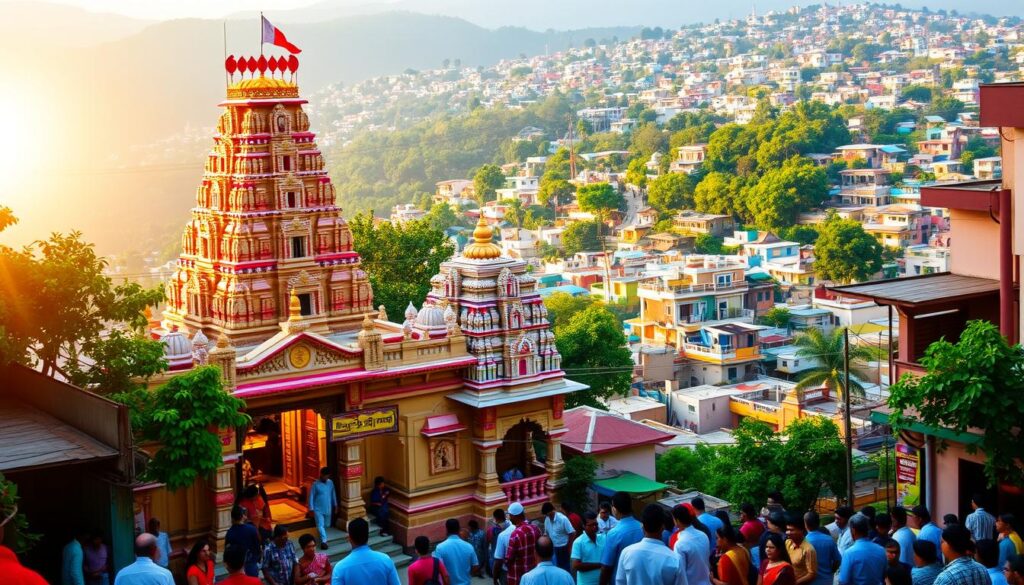
A vibrant Hindu temple nestled in a bustling community, its intricate architecture and vibrant colors radiating warmth and devotion. In the foreground, worshippers gather in a serene courtyard, their faces aglow with the soft, golden light filtering through the temple's ornate entryway. The middle ground showcases the temple's towering spires, adorned with intricate carvings and statues, casting long shadows that intertwine with the lush, verdant foliage surrounding the structure. In the background, a bustling cityscape of homes and businesses hums with the energy of a thriving neighborhood, a testament to the temple's role as a hub of spiritual and communal connection.

Worship Schedules and Service Highlights

The temple’s practical hours cater to diverse needs:

Day Morning Hours Evening Hours
Weekdays 9:00 AM – 1:00 PM 5:00 PM – 9:00 PM
Weekends 9:00 AM – 9:00 PM
Festivals 9:00 AM – 9:00 PM

Full moon ceremonies occur monthly at 7:00 PM (weekdays) or 4:00 PM (weekends). Evening aartis and weekend cultural workshops let working professionals participate easily. Regular attendees often say these shared experiences deepen both faith and friendships.

Temple Services and Events: From Sri Satyanarayana to Special Puja

Discover transformative ceremonies that blend ancient wisdom with modern spiritual needs. These carefully curated events help devotees navigate life’s challenges while celebrating cultural heritage.

Sri Satyanarayana Vratham and Prosperity Rituals

The sacred Sri Satyanarayana Vratham draws seekers nationwide. This revered ceremony supports financial growth, academic success, and family well-being. Many participants report renewed hope after addressing career hurdles or health concerns through these rituals.

Weekly opportunities include Saturday Shani Thailabishekam services from 10 AM to 8 PM. Devotees often combine oil offerings with prayers for stability during challenging times.

Monthly Abishekam and Special Festival Events

Structured monthly services create consistent spiritual engagement. The first Saturday features Sri Venkateshwara Abishekam at 10:30 AM, ideal for blessing new ventures. Second Friday’s Sri Maha Lakshmi ceremony at 7 PM specifically targets wealth manifestation.

Deity Schedule Focus
Ganesha Third Sunday, 11 AM New Beginnings
Hanuman Fourth Sunday, 11 AM Strength
Shiva Any Monday, 7 PM Transformation

Flexible Lord Shiva services accommodate busy schedules, while Sunday Hanuman blessings build resilience. These timed ceremonies help devotees align spiritual practices with personal goals effortlessly.

Comprehensive Amenities and Devotional Support

Modern spiritual centers blend practical convenience with sacred traditions. Visitors enjoy streamlined access to resources that enhance worship experiences while supporting community growth.

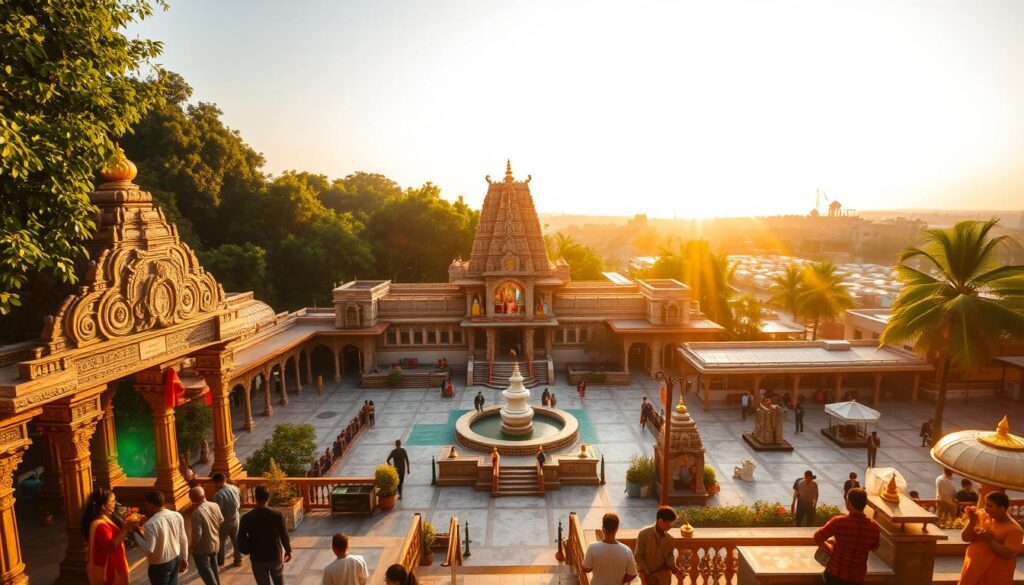
A serene Hindu temple nestled amidst lush greenery, bathed in warm, golden sunlight. The ornate architecture features intricate carvings and towering spires. In the foreground, devotees offer flowers and incense at the entrance, while in the middle ground, a tranquil courtyard showcases a central water feature and elaborately decorated shrines. The background reveals a panoramic view of the temple's sprawling complex, complete with meditation halls, community centers, and guest accommodations for pilgrims.

Donations and Facility Access

The Sri Maha Lakshmi Temple simplifies charitable giving through secure digital platforms. All donations qualify for federal tax deductions (ID 47-1886181), with instant receipts for credit card contributions. Need to book a puja remotely? Their website handles ceremonial reservations and general support in three clicks.

Service Availability Benefit
Canteen Meals Weekends & Festivals 10 AM – 9 PM
Custom Catering 72-hour notice Event Planning
Proxy Rituals Daily Remote Participation

Parking and Accessibility Features

Front parking lots accommodate 200 vehicles, with overflow spaces behind the complex. A shaded pathway connects rear parking to the North Entrance – ideal for elderly visitors or stroller access. Regular attendees love the hassle-free arrival process:

“I never worry about finding space, even during Navratri!”

Wealth Ceremonies and Cultural Impact

Engage with prosperity-focused rituals beneath the nation’s tallest Maha Lakshmi statue (32 feet). Monthly Sri Satyanarayana ceremonies merge material goals with spiritual growth, while volunteer programs let families contribute to food drives and cultural workshops.

Weekday lunch services feed 300+ community members, creating shared moments that transcend generations. Whether you’re seeking personal blessings or group activities, these amenities make spiritual engagement effortless and rewarding.

Conclusion

Your path to spiritual growth finds its home in Atlanta’s welcoming sacred spaces. These vibrant communities blend authentic traditions with modern support systems, offering both peace and connection under one roof.

Explore the metro area’s diverse temple network for celebrations that light up the calendar year-round. From weekly meditation sessions to grand festivals, every gathering strengthens personal devotion while building lasting friendships.

Practical resources make participation effortless. Digital donation systems, flexible event bookings, and accessible facilities remove barriers for busy families. First-time visitors often discover unexpected joys through weekend workshops or shared meals.

Whether seeking quiet reflection or cultural immersion, local temples deliver meaningful experiences. Their doors stay open to all – longtime practitioners and curious newcomers alike. Why wait? Check schedules online, join a weekend service, and let your journey begin today.

FAQ

How can I find a nearby Hindu temple for worship?

Search online directories like Google Maps or Hindu temple networks such as BAPS Shri Swaminarayan Mandir or ISKCON. Many temples list addresses, contact details, and service schedules on their official websites.

What is the Sri Satyanarayana Vratham ritual?

Sri Satyanarayana Vratham is a devotional ceremony honoring Lord Vishnu. It’s performed to seek blessings for wealth, prosperity, and family harmony. Temples like Sri Venkateswara Temple often host these rituals monthly.

Can I book catering services for temple events?

Yes! Many temples offer vegetarian catering for weddings, anniversaries, or pujas. Contact your local temple’s administration office to discuss menu options and event requirements.

Are donations tax-deductible at Hindu temples?

Most registered temples in the U.S., such as the Hindu Temple Society of North America, provide tax receipts for donations. Check the temple’s nonprofit status or ask staff for details.

Do temples host special events for prosperity rituals?

A> Absolutely. Events like Lakshmi Puja for wealth or Sudarshana Homam for protection are common. Follow your temple’s newsletter or social media for updates on festivals like Diwali or Navratri.

Is parking available at larger Hindu temples?

Major temples like the Malibu Hindu Temple or Shiva-Vishnu Temple in Livermore offer ample parking. Some provide shuttle services during crowded festivals—arrive early for convenience.

How can I participate in monthly Abhishekam services?

Abhishekam, a sacred bathing ritual for deities, is often open to devotees. Sign up in advance through the temple’s website or visit the priest’s office to schedule participation.

What community activities do temples organize?

Many host yoga classes, language lessons, or volunteer groups. For example, the Bharatiya Temple in Troy offers youth programs and cultural workshops to foster community bonds.

Hinduism’s Caste System: Origins and Impacts


India’s social fabric has long been shaped by a complex structure that organizes communities through inherited roles. While often simplified as a four-tier hierarchy, this framework actually includes thousands of subgroups with distinct customs. Its roots remain debated, with theories ranging from ancient rituals to colonial-era interpretations.

Scholars emphasize that the actual practice of this structure differs from early religious texts. Families within these groups traditionally shared occupations, marriage rules, and dietary practices. Over time, these distinctions became deeply tied to identity and social status.

What makes this system unique is its regional diversity. Local traditions and historical events created variations across communities. This complexity challenges common stereotypes, requiring a nuanced understanding of how it shaped daily life and cultural values.

Key Takeaways

  • Contains over 3,000 subgroups, far more intricate than commonly described
  • Origins debated among scholars, with no single agreed-upon theory
  • Defined by hereditary roles, marriage rules, and occupational ties
  • Varies significantly by region and community traditions
  • Continues to influence modern social dynamics globally

Historical Origins and Evolution of the Caste System

Scholars trace complex social structures to early Vedic hymns and rituals. These ancient ideas organized communities through shared duties rather than rigid labels. Over centuries, this framework transformed into a mosaic of localized identities.

Vedic Foundations and the Varna Concept

The Rig Veda first described four broad social categories called varnas. Brahmins (teachers), Kshatriyas (protectors), Vaishyas (producers), and Shudras (supporters) each had distinct roles. Originally, these groups focused on skills, not ancestry—a farmer’s child could become a warrior if talented.

By 500 BCE, texts like the Manusmriti tied varnas to birth. Priests gained prominence through ritual authority, while others faced restrictions. Yet regional customs often overruled these rules, creating countless exceptions.

From Jatis to a Complex Social Structure

Thousands of jatis emerged as communities specialized in trades like weaving or pottery. These subgroups developed unique marriage rules and dietary habits. A blacksmith’s family, for example, might only wed within their occupational network.

Three factors deepened social divisions:

  • Strict purity codes governing touch and food sharing
  • Endogamy practices preserving family lineages
  • Land ownership patterns favoring certain groups

Those labeled “untouchables” faced harshest limits, barred from temples and wells. Their struggles highlight the gap between religious ideals and lived realities.

Colonial Influence and European Misinterpretations

What we call the caste system today reflects colonial-era myths more than ancient realities. British administrators arrived with preconceived ideas about racial hierarchies, determined to fit India’s social diversity into neat boxes.

A dimly lit colonial study, with rich mahogany furniture and a large globe on a heavy oak desk. Shelves of leather-bound books line the walls, casting long shadows. In the foreground, an elderly European scholar sits hunched over, poring over parchments and scrolls, his brow furrowed in deep contemplation. The lighting is warm and candlelit, creating a somber, introspective atmosphere. The scholar's expression conveys a sense of intellectual grappling with complex theories and ideas about the caste system of the colonies. Muted tones of brown, gold, and amber predominate, evoking a bygone era of colonial conquest and misinterpretation.

British Census and the Ethnographic Mapping of Castes

Starting in 1871, officials tried cataloging thousands of communities into four rigid categories. They ignored local identities tied to professions or regions. One frustrated officer noted: “Our classifications bear little relation to how natives describe themselves.”

The 1901 census recorded over 2,300 distinct groups – a number growing with each survey. Colonial rulers leaned on obscure texts like the Manusmriti, which few Indians had read. This created an artificial system unrecognizable to most communities.

Racial Theories and Their Lasting Impact

European scholars spread dangerous myths about “Aryan invaders” establishing a color-based hierarchy. These ideas later fueled Nazi propaganda about racial purity. By 1935, British laws labeled 50 million people as “Criminal Tribes” based on flawed theories.

Three colonial legacies still shape perceptions:

  • Freezing fluid social networks into fixed categories
  • Linking skin tone to social status through pseudoscience
  • Treating ancient texts as rulebooks rather than philosophical works

Modern terms like “Scheduled Castes” originate from this era. Though meant to address inequality, they reinforce colonial influence on how we discuss social structures today.

Religious Beliefs, Dharma, and Social Order

Dharma, karma, and samsara aren’t just abstract ideas—they shape how communities organize roles and responsibilities. These principles form a cosmic blueprint, linking individual actions to societal harmony. As one ancient text states: “A person’s duties arise from their place in the web of existence.”

Karma, Ritual Purity, and the Role of Dharma

Traditional teachings suggest birth circumstances reflect past actions. A farmer’s child, for example, might inherit duties tied to land stewardship. This system enforces strict rules about food sharing and physical contact to maintain ritual purity.

Priests often cite temporary impurities—like mourning periods—to explain lasting social divisions. However, many scholars argue this comparison overlooks systemic inequality. “Comparing menstruation to inherited status ignores centuries of oppression,” notes sociologist Anika Patel.

Renunciation, Initiation, and Social Mobility

Renunciation offers a radical escape route. By symbolically “dying” to their identity, initiates join spiritual communities that ideally disregard birth status. Their rituals mimic funerals, burning possessions to mark rebirth.

In practice, some ascetic groups still observe dietary rules tied to regional customs. A 2018 study found 63% of renunciants in Gujarat avoided foods linked to their former life. This gap between ideals and reality shows how deeply social patterns endure.

Modern Perspectives on hinduism caste and Contemporary Society

Post-independence India sought to dismantle inherited social barriers through bold legal reforms. The 1950 constitution banned untouchability and introduced reservation policies to uplift marginalized groups. Yet recent data reveals persistent gaps between law and lived experiences.

A bustling city street in modern India, people of various castes and backgrounds hurrying about their daily lives. In the foreground, a young Dalit woman faces discrimination and prejudice from a group of higher-caste individuals, their expressions cold and judgmental. In the middle ground, a mix of affluent and impoverished residents, the divide between them stark. In the background, towering skyscrapers and ancient temples coexist, a juxtaposition of old and new, tradition and progress. The scene is bathed in a warm, golden light, hinting at the gradual erosion of caste barriers, yet the stubborn persistence of deeply rooted prejudices. Dramatic, cinematic, and thought-provoking.

Legal Protections vs. Daily Struggles

Affirmative action programs opened doors in education and government jobs. Over 27% of parliamentary seats now belong to Scheduled Castes and Tribes. But a 2022 study found Dalit students face 3x higher dropout rates than upper-group peers.

Three key challenges remain:

  • Underreporting of violence due to police bias
  • Digital discrimination through coded language
  • Economic boycotts against inter-caste marriages

Dalit women bear dual burdens—facing 23% wage gaps and higher assault risks. “Legal equality hasn’t erased centuries of stigma,” explains activist Meera Kulkarni.

Global Networks and Shifting Identities

South Asian diaspora communities show surprising patterns. A 2021 survey found:

Aspect India Diaspora
Workplace Bias Overt exclusion Subtle networking favors
Marriage Choices 70% endogamy rate 45% on matrimonial sites
Youth Attitudes 52% support reforms 68% reject hierarchy

While Silicon Valley tech workers rarely discuss lineage openly, community events often mirror regional hierarchies. Second-generation immigrants increasingly challenge these norms through inter-group alliances and social media activism.

Caste, Hindutva, and the Struggle for Reform

Centuries before hashtag activism, spiritual rebels challenged social hierarchies through poetry and radical equality. Their voices still echo in modern efforts to balance tradition with justice.

Revisiting Anti-Caste Movements and Scholarly Critiques

Bhakti poets like Kabir mocked rigid divisions with verses like: “If God lives in temples, who lives outside?” These mystics inspired communities like the Sikhs and Virashaivas to reject birth-based status. Their teachings created parallel spaces where farmers and kings shared meals.

Dr. B.R. Ambedkar’s 1956 conversion to Buddhism sparked mass departures from oppressive structures. Over 500,000 people joined him in a single day, seeking dignity beyond inherited labels. “You cannot build equality on rotten foundations,” he declared, advocating complete systemic overhaul.

Movement Approach Modern Influence
Bhakti Saints Poetic ridicule of rituals Inspires Dalit literature
Sikhism Langar (community meals) Model for social kitchens
Ambedkarites Mass conversions Shapes reservation policies

Recent Hindutva politics often sidesteps these reform roots. While promoting yoga globally, some groups minimize ongoing discrimination. Progressive organizations counter by redefining dharma as collective responsibility. “True spirituality dismantles walls, not builds them,” argues scholar Anjali Rao.

Young activists now blend digital campaigns with temple entry protests. Their work shows that challenging old systems requires both courage and fresh strategies. As caste debates enter global boardrooms and universities, the fight for equality keeps evolving.

Conclusion

Understanding social hierarchies requires peeling back layers of history and human interaction. This framework emerged from a blend of ancient principles and colonial-era classifications, creating divisions that still impact millions. Rather than a fixed structure, it’s a living system shaped by regional customs and power dynamics.

Modern efforts to address inequality show both progress and persistent gaps. Legal protections exist, yet many face daily barriers in education and employment. Women and marginalized groups often bear the heaviest burdens, facing layered discrimination in workplaces and communities.

Hope lies in grassroots movements redefining traditions through shared values. Younger generations increasingly challenge outdated practices while honoring cultural roots. As global conversations grow, the focus shifts from rigid labels to universal rights and dignity for all.

True change demands recognizing this complexity—honoring thousands of unique identities while building bridges across divides. The path forward balances respect for heritage with unwavering commitment to equality.

FAQ

How did ancient texts shape social hierarchy?

Early Vedic literature introduced the concept of varna, a framework that categorized roles based on duties. Over time, this evolved into jati, localized groups tied to occupations, creating a layered social structure.

What role did British policies play in reinforcing divisions?

Colonial administrators used censuses to categorize communities, often oversimplifying identities. This rigid classification, paired with racial theories, deepened societal divides and influenced modern perceptions of identity.

How do religious principles intersect with social roles?

Concepts like dharma emphasized fulfilling one’s duties, while karma linked actions to future outcomes. Ritual purity and initiation practices further defined roles, though movements like Bhakti challenged exclusivity.

Are legal measures addressing inequality effective today?

Affirmative action and anti-discrimination laws aim to uplift marginalized groups. However, biases persist in education and employment, sparking debates about fairness and representation in a rapidly changing society.

Does migration erase traditional divisions?

While global diasporas adapt to new cultures, some communities retain ties to ancestral identities. Intergenerational dialogues and activism continue to reshape these dynamics in multicultural settings.

What challenges do reform movements face?

Advocates push for equitable practices, but resistance from orthodox groups and political ideologies like Hindutva complicate progress. Grassroots efforts and scholarly critiques remain vital in driving systemic change.

Discover the Beauty of Hinduism Temples in America


Step into vibrant centers where ancient traditions meet modern American life. These sacred spaces, called Mandir, Devasthanam, or Kovil, serve as cultural anchors for millions. Their ornate designs and spiritual energy create welcoming environments for both devotees and curious explorers.

The Swaminarayan Akshardham in New Jersey stands as a marvel of craftsmanship. Opened in 2014, its 10,000 carved figures and 136 golden-spired domes showcase architectural brilliance. Located between New York and Philadelphia, this landmark draws visitors seeking peace and artistic inspiration.

Daily rituals here blend ancient practices with contemporary community needs. From dawn prayers to colorful festivals like Diwali, these spaces pulse with life. They host language classes, yoga sessions, and cultural workshops alongside traditional ceremonies.

Key Takeaways

  • Sacred sites preserve cultural heritage through art and rituals
  • Modern architectural wonders combine tradition with innovation
  • Community events welcome people of all backgrounds
  • Festivals create year-round opportunities for cultural exchange
  • Spiritual centers serve as educational hubs for younger generations

Introduction to Hinduism Temples in America

America’s spiritual landscape transformed as diverse communities planted roots across the nation. Early Hindu immigrants carried sacred traditions in their hearts, determined to recreate spiritual homes far from ancestral lands. These spaces became vital for preserving rituals, languages, and cultural identity.

Cultural Diversity and Religious Heritage

From San Francisco’s colorful Ganesh festivals to Texas meditation halls, these centers celebrate regional traditions. Many blend architectural styles – South Indian gopurams stand beside modern eco-friendly designs. This fusion reflects both innovation and respect for ancient practices.

The Journey of Migration and Establishment

Pioneering communities faced unique challenges. Early 20th-century workers often converted homes into prayer rooms. By the 1970s, groups pooled funds to build proper structures. The Venkateswara Temple in Pittsburgh became North America’s first traditional stone-carved temple in 1976.

Country First Major Temple Notable Feature
United States Pittsburgh Venkateswara (1976) Dravidian architecture
Canada Toronto Vishnu (1984) Largest in North America
Australia Sydney Murugan (1979) First in Southern Hemisphere
UK London Neasden (1995) Hand-carved limestone

Modern hindu temples serve multiple roles. They host language classes, youth programs, and interfaith dialogues. Sunday services often mix Sanskrit chants with English explanations, helping younger generations connect with heritage.

The Rich History and Spiritual Evolution

Centuries before skyscrapers dotted skylines, sacred stone structures reshaped spiritual landscapes. Early Hindu temple construction gained momentum around the 5th century CE in North India and spread southward. These spaces replaced temporary Vedic ritual sites with permanent homes for divine connection.

A majestic Hindu temple standing tall, its ornate spires reaching towards the heavens. The intricate carvings and vibrant colors of the façade captivate the eye, transporting the viewer to a realm of ancient spiritual traditions. The temple is set against a backdrop of a serene, lush landscape, with lush greenery and a clear azure sky. Warm, diffused lighting casts a golden glow, imbuing the scene with a sense of timelessness and reverence. The temple's grandeur and timeless elegance embody the rich history and enduring spiritual essence of Hinduism, inviting contemplation and a deeper connection with the divine.

A monumental shift occurred as devotional practices replaced fire sacrifices. The rise of bhakti movements between the 8th-10th centuries CE transformed worship. People began seeking personal relationships with deities through songs, prayers, and temple rituals.

This evolution crossed oceans when immigrants brought traditions to American soil. Modern communities blend ancient designs with local materials. Carved stone pillars now stand beside energy-efficient lighting, showing how sacred spaces adapt without losing their essence.

Key developments shaped today’s spiritual hubs:

  • Transition from open-air rituals to iconic shrine architecture
  • Integration of Puranic stories into temple art and ceremonies
  • Creation of community-focused spaces for cultural preservation

Early builders couldn’t have imagined their work inspiring global centers. Yet the core purpose remains unchanged – creating bridges between earthly life and eternal truths. These sacred structures continue evolving, just like the communities they serve.

Architectural Brilliance of Hindu Temple Design

Sacred geometry transforms stone into spiritual maps where every angle whispers cosmic secrets. Architects follow ancient texts called Shilpa Shastras, using precise ratios to create spaces that mirror universal patterns. These designs turn buildings into 3D yantras – geometric tools for meditation.

Symbolism and Geometric Principles

Floor plans often begin with a perfect square, representing earthly stability. Circles within these squares symbolize infinite cosmic cycles. This mandala-based layout guides visitors from outer courtyards to the inner sanctuary, mirroring the soul’s journey toward enlightenment.

Towering spires called shikharas stretch skyward like stone mountains. These aren’t just decorations – they map constellations and solstice alignments. “The temple becomes a bridge between human and divine realms,” explains architect Priya Desai, “through calculated proportions in every carving.”

Regional Variations and Traditional Styles

North and South India developed distinct styles over centuries. Northern designs feature curved shikhara towers resembling Himalayan peaks. Southern builders created pyramidal vimanas topped with carved stone disks. Both styles reached American shores, adapting to local materials and climate.

Region Style Key Feature Modern Adaptation
North India Nagara Curved shikhara tower Fiberglass accents in Texas temples
South India Dravida Pyramidal vimana Earthquake-resistant designs in California
America Fusion Energy-efficient gopurams Solar-powered sanctums in Chicago

Modern architects face exciting challenges. They blend traditional stone carving with steel reinforcements and eco-friendly materials. The result? Spaces that honor ancient wisdom while meeting 21st-century needs – proving sacred design can evolve without losing its soul.

Understanding Sacred Spaces and Cosmic Layouts

Sacred spaces act as bridges between earthly existence and cosmic truths. Every corner follows precise geometric patterns that mirror universal order. These designs help visitors experience spiritual concepts through physical surroundings.

A towering Hindu temple rises from a lush, verdant landscape, its intricate spires and ornate facades bathed in warm, golden light. The building's symmetrical, mandala-like layout reflects the sacred geometry at the heart of Hindu cosmology, with each architectural element evoking the interconnectedness of the physical and spiritual realms. In the foreground, a tranquil reflection pool mirrors the temple's ornate silhouette, creating a sense of harmony and balance. The middle ground features elaborately carved stone figures and mythological motifs, while the background is filled with wispy clouds and a deep azure sky, conveying a sense of timelessness and the divine. This image captures the profound spiritual significance and breathtaking beauty of a sacred Hindu temple, inviting the viewer to contemplate the mysteries of the cosmos.

Cosmological Significance and Divine Geometry

Ancient builders used mandala blueprints to map the universe in stone. Concentric squares represent different planes of existence – outer layers for daily life, inner zones for enlightenment. The central garbhagriha (sanctuary) forms the axis connecting earth to celestial realms.

Four key elements shape these layouts:

Temple Element Cosmic Principle Human Connection
Outer Walls Material World Dharma (Duty)
Pillared Halls Social Order Artha (Purpose)
Inner Sanctum Divine Essence Moksha (Liberation)
Spire Cosmic Axis Karma (Action)

Modern adaptations preserve this sacred space philosophy. Architects adjust proportions for smaller lots while keeping cosmic ratios intact. “We use local materials but maintain the divine geometry,” shares designer Ravi Patel.

Light patterns during solstices highlight alignment with stars. These features turn worship into multisensory journeys. Visitors often describe feeling part of something larger while walking through these thoughtfully planned spaces.

The Role of Tradition in Daily Devotional Practices

Morning bells echo through corridors fragrant with jasmine as priests begin sacred cycles that have pulsed through generations. These living traditions transform spiritual centers into dynamic hubs where timeless customs meet contemporary life. Every gesture and chant carries centuries of meaning, creating bridges between ancient wisdom and modern seekers.

Rhythms of Reverence and Connection

Dawn marks the first act of devotion – awakening deities with tender care. Priests bathe marble figures in milk and honey, draping them in vibrant silks as devotional songs fill the air. “We don’t just maintain statues,” explains priest Arun Sharma. “We honor living embodiments of divine energy through daily rituals.”

The heart of temple worship revolves around darshan – that powerful moment when eyes meet across sacred space. Devotees offer flowers and fruits while whispering personal prayers. In return, they receive blessed sweets, completing a symbolic exchange of love and grace.

Weekly gatherings burst with communal energy:

  • Children practice traditional dance steps in sunlit courtyards
  • Volunteers prepare community meals using ancestral recipes
  • Elders share folk stories beneath ancient bodhi tree replicas

Festivals transform these spaces into cultural kaleidoscopes. Drummers lead processions as families create intricate flower arrangements honoring divine forms. Through these shared experiences, traditions breathe and grow, nurturing both personal faith and collective identity.

Inspiration from Ancient Vedic Texts and Manuals

Ancient blueprints whisper secrets through stone, guiding modern builders with timeless wisdom. The Vastu-Sastra manuals reveal precise formulas for creating sacred spaces that balance cosmic energies. These 1,500-year-old texts outline everything from land surveys to decorative details, ensuring harmony between nature and human-made structures.

A grand Vedic temple rises majestically, its intricate carved stone façade glowing in the warm afternoon light. Towering spires and domes, adorned with intricate symbolic motifs, reach skyward, their silhouettes casting dramatic shadows across the surrounding landscape. In the foreground, skilled artisans work diligently, meticulously chiseling and shaping the ornate architectural elements, their tools echoing the rhythmic patterns of the temple's design. The scene evokes a sense of timeless tradition, where ancient wisdom and masterful craftsmanship converge to create a sacred space that inspires reverence and wonder.

Ancient Rule Modern Application Purpose
East-facing entrances Solar alignment studies Maximize morning light
5:4 proportion ratios 3D modeling software Maintain sacred geometry
Local material use Eco-friendly composites Reduce carbon footprint
Water placement Rainwater systems Enhance energy flow

The 10th-century Silpa Prakasa text still shapes temple construction today. Its instructions for carving deities help artists maintain traditional forms while using modern tools. Architects blend these rules with seismic safety standards in earthquake-prone areas.

Recent projects showcase this fusion. A Texas Indian temple uses geothermal cooling beneath hand-carved pillars. California designers combine steel frames with sandstone façades from Rajasthan. These innovations prove ancient wisdom adapts beautifully to new challenges.

The Intersection of Art, Music, and Spiritual Expression in Temples

Stone walls hum with timeless stories where artistry and devotion become one. These spiritual centers burst with creative energy, blending visual marvels with soul-stirring performances. Every corner offers a doorway to cultural treasures passed down through generations.

Rhythms That Connect Earth and Sky

The music of sacred spaces ranges from whispered mantras to joyful bhajan singalongs. Skilled artists play the veena’s haunting melodies or the mridangam’s heartbeat rhythms during evening ceremonies. Dance forms like Bharatanatyam turn courtyards into stages, where footwork patterns mirror cosmic cycles.

American indian temples keep these traditions vibrant. Sunday workshops teach children classical ragas while concert series introduce new audiences to Carnatic vocals. The clang of ceremonial bells often mixes with jazz-inspired flute improvisations in creative cultural fusions.

Stories Carved in Stone and Spirit

Look closely at any pillar or doorway. Intricate carvings show Krishna lifting mountains or Durga battling darkness. These image-filled narratives serve as visual textbooks, teaching values through epic tales. Modern artists add contemporary touches while preserving ancient techniques.

Festivals transform spaces into living art galleries. Floral designs carpet floors while oil lamps cast dancing shadows on deity statues. Through art and music, these sacred spaces become bridges – connecting past to present, earth to divine, and heart to community.

FAQ

What makes Hindu temple architecture unique in America?

Hindu temples in America blend traditional Indian styles like Dravidian (gopuram towers) and Nagara (curved shikharas) with local materials. Designs follow Vedic principles of sacred geometry, aligning spaces to cosmic energy. For example, the BAPS Shri Swaminarayan Mandir in New Jersey features hand-carved marble from India.

How do Hindu temples serve the community beyond worship?

They act as cultural hubs, hosting festivals like Diwali, language classes, and yoga sessions. The Sri Venkateswara Temple in Pennsylvania, one of the oldest, also runs charity drives and interfaith dialogues to foster unity.

Are non-Hindus allowed to visit these sacred spaces?

Yes! Most temples welcome visitors of all faiths. Guests can observe rituals, admire art like stone carvings of deities, or attend events. Modest attire and removing shoes before entering sanctums are common courtesies.

What role do ancient texts play in temple construction?

The Agamas and Shilpa Shastras guide everything from site selection to sculpture poses. For instance, the Dakshineswar Kali Temple’s layout mirrors descriptions in the Devi Mahatmya, ensuring alignment with divine symbolism.

How do American temples differ from those in India?

While core rituals remain unchanged, U.S. temples often adapt to smaller spaces. The Malibu Hindu Temple in California mixes South Indian architecture with modern facilities for youth programs, reflecting diaspora needs.

Why are dance and music integral to temple activities?

Classical arts like Bharatanatyam or Carnatic music are offerings to deities, rooted in Natya Shastra traditions. Events at places like the Shiva-Vishnu Temple in Maryland use these arts to share Hindu epics like the Ramayana.

What’s the significance of temple towers like vimanas?

Vimanas symbolize Mount Meru, the cosmic axis in Hindu cosmology. Their intricate carvings, seen in temples like Angkor Wat, represent the connection between earthly and divine realms.