Recent Posts

Discover the Unique Language of Hinduism


Words hold extraordinary power in shaping spiritual traditions. Across centuries, sacred texts and chants have preserved wisdom for millions of followers worldwide. This vibrant religious tradition thrives through an evolving linguistic tapestry that connects ancient practices to modern devotion.

Many might be surprised to learn the term describing this faith emerged recently. British scholars in the 1800s coined it to categorize diverse philosophies originating from the Indian subcontinent. Yet its roots stretch back over 3,000 years, with Vedic hymns still recited today.

From Sanskrit mantras to regional dialects, verbal expression remains central to rituals and teachings. This adaptability allows the living tradition to flourish globally while maintaining its spiritual essence. Whether through temple prayers or home ceremonies, language acts as a bridge between devotees and the divine.

Our journey will explore how verbal artistry preserves history while embracing contemporary needs. You’ll see why this dynamic interplay of words and worship continues to inspire generations across continents.

Key Takeaways

  • Sacred texts and chants have preserved spiritual wisdom for thousands of years
  • The term describing this faith originated from 19th-century Western scholars
  • Linguistic diversity reflects adaptability across cultures and eras
  • Verbal rituals connect modern practices to ancient traditions
  • Regional dialects coexist with classical Sanskrit in worship

Understanding the Historical Roots of Hinduism

Ancient voices still whisper through time, carried by sacred sounds etched into humanity’s memory. This spiritual heritage grew from a remarkable fusion of oral wisdom and written mastery, shaping one of history’s most enduring belief systems.

From Vedic Scripts to Epic Narratives

The story begins with Sanskrit’s arrival around 1500 BCE. Migrating communities brought this precise tongue to India, where it became the bedrock of spiritual expression. While people used simpler dialects daily, Sanskrit remained sacred – a divine channel for rituals and revelations.

Early sages perfected oral transmission long before ink met parchment. Chants flowed through generations with rhythmic precision. When writing emerged, it captured not just words but sound itself, preserving vibrational patterns believed to awaken higher consciousness.

Epic tales like the Mahabharata transformed Sanskrit’s role. These sweeping narratives turned philosophical ideas into relatable stories. Warriors became metaphors for inner struggles, and royal dramas illustrated cosmic truths. This shift made profound teachings accessible to all.

Commentaries by later scholars kept texts alive across centuries. They debated meanings while honoring original sounds, proving tradition could evolve without losing its essence. Even today, priests recite verses unchanged for millennia, maintaining an unbroken sonic legacy.

Ancient Traditions and the Indus Valley Connection

Imagine peeling back layers of time to uncover a civilization where ritual baths and clay goddesses shaped spiritual foundations. The Indus Valley’s advanced cities flourished between 3300-1300 BCE, leaving behind clues that whisper across millennia.
Meticulously rendered artifacts from the ancient Indus Valley civilization, bathed in warm, golden light and presented against a backdrop of earthy, textured surfaces. The foreground showcases an array of finely detailed terracotta figurines, seals, and pottery, hinting at the sophisticated artistic and cultural achievements of this lost civilization. In the middle ground, intricate stone carvings and bronze implements are displayed, while the distant background suggests the remnants of architectural structures, alluding to the grandeur and complexity of this bygone era. The overall composition conveys a sense of reverence and timeless wonder, inviting the viewer to contemplate the enduring legacy of the Indus Valley people.

Civilizational Foundations in the Indus Valley

This Bronze Age society built carefully planned cities with drainage systems still impressive today. Among their ruins, archaeologists found:

  • Terra-cotta figurines resembling later deity images
  • Seals depicting meditative poses and sacred animals
  • Great Bath structures mirroring modern ritual spaces

Though their script remains undeciphered, these artifacts suggest symbolic communication preceding Sanskrit. The famous “Dancing Girl” statue hints at early artistic traditions that would evolve into temple sculptures.

Archaeological Insights and Early Textual Evidence

Scholars note striking parallels between Indus Valley symbols and later spiritual practices. Water-focused rituals in Mohenjo-Daro’s Great Bath foreshadowed purification ceremonies still performed today.

“The continuity between these ancient sites and living traditions challenges our understanding of cultural evolution.”

Greek historian Herodotus first used “Hindu” to describe people near the Indus River. This geographical label gradually transformed into a cultural identity, blending local customs with incoming Vedic influences over centuries.

Exploring the Role of hinduism language in Cultural Identity

Across bustling markets and temple courtyards, a vibrant tapestry of sounds weaves communities together. This rich oral heritage shaped identities while adapting to local landscapes. From ancient trade routes to digital spaces, expressions of faith continue evolving while honoring timeless roots.

Unity Through Regional Voices

Regional dialects became powerful tools for sharing spiritual ideas. Tamil poets crafted verses celebrating divine love, while Bengali singers transformed myths into melodic stories. These creative forms allowed teachings to resonate deeply within local contexts.

The Indian subcontinent saw remarkable growth as shared linguistic elements connected distant regions. Merchant networks carried philosophical concepts alongside spices, creating cultural bridges. This exchange fueled artistic and commercial development across Southern Asia.

Living Traditions in Contemporary Spaces

Modern celebrations showcase this dynamic blend. Festival processions might feature centuries-old Sanskrit chants alongside folk instruments from the hosting region. Families often mix ancestral prayers with vernacular translations during home rituals.

Diaspora communities maintain connections through this flexible system of expression. Temples in new lands incorporate local languages while preserving core practices. This adaptive approach helps traditions stay relevant across generations and geographies.

From Bali’s dance dramas to Trinidad’s prayer gatherings, shared spiritual vocabulary creates unity. Yet each community adds distinct flavors through their native tongues, proving cultural identity thrives through both preservation and innovation.

Sacred Texts and Liturgical Practices Across Centuries

The rustle of palm-leaf pages carries wisdom across generations. Spiritual traditions thrive through written texts and oral recitations that adapt to new eras while preserving core truths. This dynamic interplay between preservation and innovation defines one of humanity’s richest literary legacies.
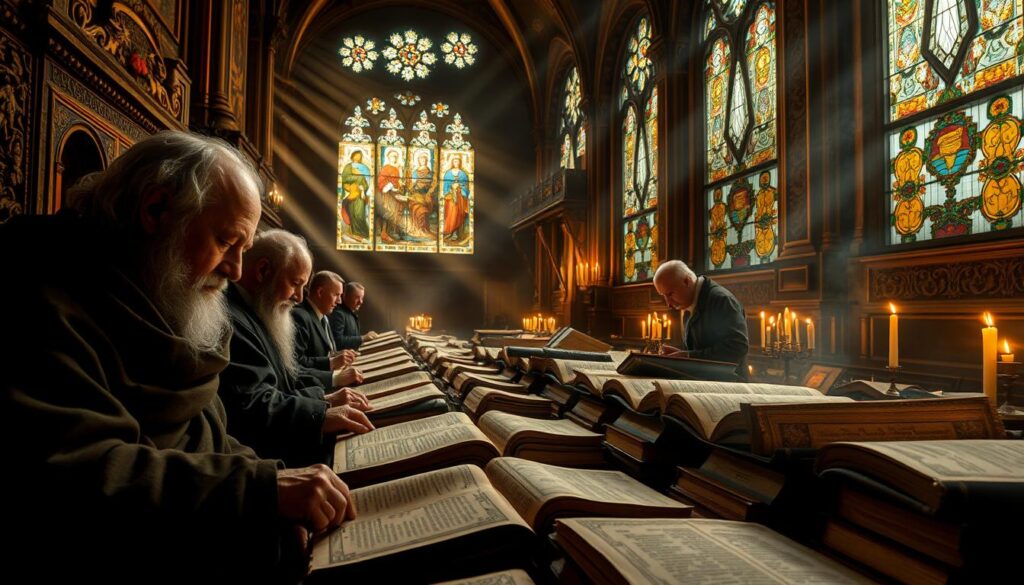
A dimly lit sanctuary, its walls adorned with ornate carvings and intricate tapestries. Rows of ancient, leather-bound tomes lie open, their pages illuminated by the flickering glow of candles. Elderly scholars, their faces etched with wisdom, carefully examine the sacred texts, their expressions deep in contemplation. Rays of golden light filter through stained glass windows, casting a serene, ethereal atmosphere over the scene. The air is thick with the scent of incense, transporting the viewer to a realm where the past and present converge, where the study of these hallowed scriptures is a sacred rite.

Key Scriptures and Their Interpretations

Ancient Sanskrit works like the Vedas form a foundation for thousands of commentaries. Priests still chant these verses exactly as their ancestors did, yet modern translations make the content accessible worldwide. Regional dialects added fresh perspectives without displacing classical forms.

Consider these fascinating aspects:

  • Oral transmission preserves sound patterns believed to carry divine energy
  • Temple rituals blend 3,000-year-old mantras with local musical styles
  • Digital archives now protect fragile manuscripts from decay

A scholar notes:

“The real miracle lies in how these traditions remain relevant. They speak to universal human experiences through time-specific cultural expressions.”

Contemporary practice shows this flexibility. Youth groups reinterpret ancient stories through street theater, while apps teach proper ritual pronunciation. This living tradition proves spiritual wisdom grows richer when roots stay strong but branches reach freely.

The Evolution from Sanskrit to Regional Dialects

The journey of words from sacred chants to market chatter reveals a story of cultural resilience. As spiritual ideas traveled beyond temple walls, they found new voices in everyday speech. This shift transformed how communities connected with divine concepts while fostering practical communication.

Transition to Prakrit Languages

Sanskrit’s intricate structure thrived in rituals but proved challenging for daily use. By 500 BCE, simpler Prakrit forms emerged as the people’s tongue. These dialects democratized spiritual knowledge, letting farmers and merchants engage with teachings once reserved for scholars.

Five regional traditions shaped modern Hindi:

  • Braj’s poetic Krishna devotion
  • Avadhi’s mystical storytelling
  • Dingal’s warrior ballads
  • Maithili’s folk wisdom
  • Sadhu Bhasa’s philosophical depth

Hindi and Urdu’s Shared Roots

Twin branches grew from a common trunk. While Hindi absorbed Sanskrit terms for spiritual ideas, Urdu blended Persian influences for Islamic contexts. A 16th-century poet remarked:

“Words dress differently for mosque and temple, but their heartbeat remains the same.”

This linguistic family shows how shared roots support diverse expressions. Merchants used both dialects, fostering trade networks across Northern India. Today, Bollywood films mix these tongues seamlessly—proof that unity thrives through adaptable development.

Interplay of Religion, Tradition, and Social Structures

Social structures have always shaped how communities express their deepest beliefs. For over three millennia, spiritual practices intertwined with daily life through carefully maintained systems of communication. These frameworks influenced everything from temple rituals to marketplace conversations.
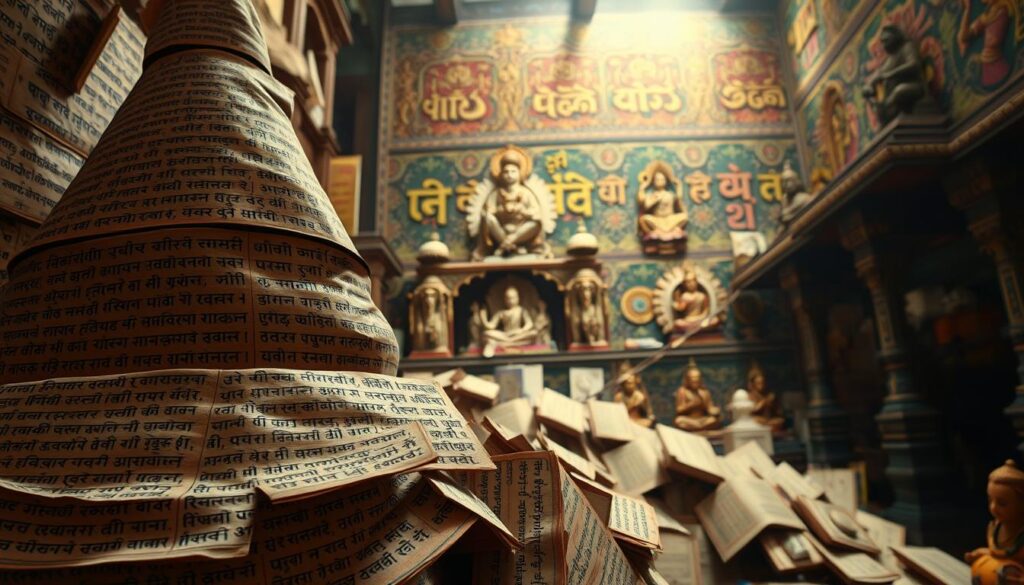
A complex hierarchy of language and social standing, with ancient Sanskrit at the apex, cascading down through vernacular tongues, ending in marginalized dialects. In the foreground, intricate scripts intertwine, reflecting the nuanced interplay of religion, tradition, and caste. The middle ground features symbolic deities and architectural elements, hinting at the deeply intertwined nature of language and belief. The background is a tapestry of vibrant colors, patterns, and textures, evoking the rich cultural tapestry of Hinduism. Dramatic lighting casts dramatic shadows, lending an air of reverence and solemnity to the scene. Captured with a wide-angle lens to convey the grand scale and scope of this linguistic and social landscape.

Caste System Influences on Language Use

The four-tiered social hierarchy determined access to sacred words. Brahmins guarded Sanskrit like treasured heirlooms, using it for rituals and teachings. This created a linguistic divide – priests spoke the “language of gods,” while others used regional dialects.

Dharma took different meanings across castes. Warriors heard it as duty to protect, while merchants understood it as ethical trade practices. A farmer’s karma discussions differed vastly from a scholar’s, showing how social roles shaped spiritual vocabulary.

Bhakti poets revolutionized this system in medieval times. They sang divine love songs in local tongues, bypassing caste restrictions. “Why whisper secrets in a dead tongue?” challenged mystic Kabir, making wisdom accessible through everyday speech.

Modern reformers balance tradition with inclusivity. New translations preserve ancient law concepts while using gender-neutral terms. Apps now teach Sanskrit mantras to all, proving spiritual nature adapts to changing times without losing its core.

The Impact of Hindu Sects on Linguistic Development

India’s spiritual landscape thrives through diverse expressions of devotion. Four major sects have shaped unique verbal traditions that mirror their philosophical priorities. These living systems of communication preserve ancient wisdom while adapting to local cultures.

Language in Shaivism and Vaishnavism Practices

Shaivite practices echo through Tamil Nadu’s temple hymns and Bali’s ritual chants. Followers use poetic metaphors comparing Shiva’s dance to cosmic cycles. Vaishnavites developed lyrical forms celebrating Krishna’s stories, with 640 million adherents singing in dialects from Braj Bhasha to Bengali.

Preserving Tradition in Shaktism and Smartism

Shaktism’s goddess-focused traditions thrive through oral folk songs and tantric mantras. Smartist scholars maintain Sanskrit precision while honoring five deities through philosophical debates. Both sects show how regional variations strengthen core teachings rather than dilute them.

From Kerala’s ritual chants to Himalayan prayer flags, these forms prove spiritual identity grows richer through linguistic diversity. They remind us that sacred words remain vital when rooted in lived experience rather than rigid uniformity.

FAQ

How did ancient texts shape Hindu traditions?

Early Vedic hymns and epic stories like the Mahabharata laid the groundwork for rituals, philosophies, and social norms. These works were shared orally before being written in Sanskrit, preserving teachings across generations.

What role did the Indus Valley play in early belief systems?

Artifacts from sites like Mohenjo-Daro suggest symbolic practices tied to nature worship. While direct links to later traditions are debated, these findings highlight a cultural continuity in the region.

Why is Sanskrit still significant today?

Though not widely spoken, Sanskrit remains vital for studying sacred texts like the Upanishads and performing rituals. It also influenced regional dialects, enriching literary traditions such as Hindi and Tamil.

How do regional languages reflect cultural identity?

Dialects like Bengali or Marathi carry localized myths, festivals, and devotional practices. This diversity strengthens community ties while maintaining shared values rooted in Dharma.

Did Hindu sects impact linguistic development?

Yes! Shaivism and Vaishnavism used Tamil and Telugu for hymns, while Shaktism preserved folk songs in Bengali. These sectarian practices helped regional tongues thrive alongside Sanskrit.

How did the caste system affect language use?

Social hierarchies often restricted Sanskrit access to elites, while marginalized groups developed vernaculars like Pali. This divide influenced how teachings spread across communities.

Are Indus Valley symbols connected to modern practices?

Some motifs, like sacred animals or ritual baths, appear in later traditions. However, interpretations vary due to gaps in deciphering the Indus script.

What’s the relevance of oral storytelling today?

Oral recitations of the Ramayana or Bhagavad Gita remain popular, blending music and regional dialects. This keeps ancient wisdom accessible in contemporary settings.

How did post-independence India preserve linguistic heritage?

Efforts include digitizing manuscripts, promoting Sanskrit schools, and recognizing regional languages in education. Projects like the Digital Library of India help safeguard these resources.

Why do rituals vary across the subcontinent?

Local ecology, historical rulers, and community customs shaped unique practices. For example, Onam in Kerala and Durga Puja in Bengal both celebrate harvests but with distinct rituals.
The Captivating World of Hindu Gods


Step into a realm where ancient wisdom meets vibrant storytelling. Across cultures and generations, divine figures in this spiritual tradition have inspired awe through their rich symbolism and universal teachings. Their tales aren’t just myths—they’re mirrors reflecting life’s deepest truths.

At its core, this belief system celebrates unity in diversity. Some followers see a single sacred essence—brahman—flowing through all existence. Others connect with divine forms that embody love, courage, or cosmic balance. The exact count of these figures ranges widely, with symbolic interpretations reaching into the millions.

These sacred stories shape more than rituals. They influence art, festivals, and daily practices worldwide. From temple carvings to modern yoga studios, their presence bridges ancient traditions with contemporary life. Each figure carries unique lessons, whether nurturing compassion or teaching resilience through adversity.

Today, over a billion people find guidance in these timeless narratives. They offer comfort during challenges and inspiration for personal growth. Let’s explore how these enduring symbols continue to shape hearts and minds across our interconnected world.

Key Takeaways

  • Represents unity through diverse interpretations of the sacred
  • Philosophical views range from one essence to countless divine forms
  • Cultural impact spans art, festivals, and daily practices globally
  • Symbolic stories address universal human experiences
  • Maintains relevance in modern spiritual and cultural contexts

Overview of the Hindu Pantheon

Imagine a spiritual tapestry woven across millennia, where divine expressions adapt to human needs. The Hindu pantheon stands as a living library of sacred stories, evolving alongside civilizations while preserving ancient wisdom.

Origins of Hindu Mythology

Early communities celebrated nature’s forces through fire rituals and poetic hymns. These practices from 1500-500 BCE laid foundations for today’s traditions. Over centuries, elemental spirits transformed into complex personalities—like storm god Indra becoming a cosmic king with family dramas.

The Diversity of Divine Forms

You might encounter eight-armed figures holding symbolic tools or elephant-headed beings embodying wisdom. Regional traditions shape these forms—a village river goddess might later join national temples. This flexibility lets devotees find relatable expressions of the sacred.

Modern worship focuses more on personal deities than ancient Vedic rituals. Yet echoes remain—the fire ceremony (havan) still connects people to early practices. This blend of old and new keeps traditions vibrant across generations.

Understanding hinduism gods and Their Significance

Explore how sacred beings bridge cosmic mysteries and daily human experiences. These divine figures aren’t distant rulers—they’re companions guiding devotees through life’s twists and turns. Their stories reveal universal truths through vivid symbols and relatable emotions.

“As many streams flow into one ocean, all paths lead to the same boundless truth.”

Advaita Vedanta philosophy
Deity Aspect Represented Symbolic Tool
Lakshmi Abundance Lotus flower
Ganesha Wisdom Broken tusk
Kali Transformation Flame

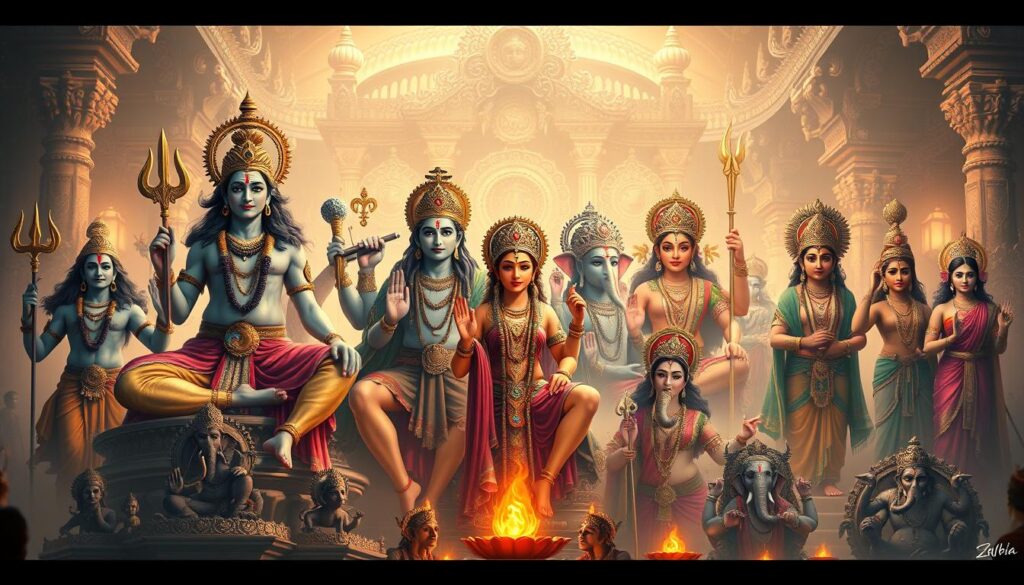
a highly detailed, photorealistic digital illustration of a diverse array of hindu deities and their symbolic significance, arranged in a harmonious and visually striking composition. the foreground features prominently the key deities like Shiva, Vishnu, Brahma, Ganesha, and Lakshmi, each depicted with their iconic attributes and poses, conveying a sense of power, wisdom, and divine grace. the middle ground showcases other important deities like Krishna, Hanuman, Durga, and Saraswati, each radiating their unique energies. the background depicts a grand, ornate temple setting, with intricate architectural details, glowing light, and a sense of reverence and spiritual wonder. the overall scene is bathed in warm, otherworldly lighting that enhances the mystical, awe-inspiring atmosphere. the image should captivate the viewer and convey the profound significance of these deities in hindu philosophy and culture.

Each divine figure carries 108 names—a sacred number symbolizing cosmic order. These titles highlight different qualities, like protector or source of joy. Parents often choose these names for children, hoping to nurture specific virtues.

Morning rituals to seasonal festivals weave these beings into daily life. A farmer might pray for rain to Indra, while students seek Saraswati’s guidance during exams. Their tales teach resilience, compassion, and finding light in darkness.

Through devotion, practitioners discover practical wisdom. The flame in a temple lamp mirrors inner clarity. A deity’s dance represents life’s constant flow of challenges and blessings. This living tradition remains a compass for millions navigating modern complexities.

The Trimurti: Creator, Preserver, and Destroyer

Picture three cosmic architects shaping existence itself. This divine trio works in harmony, balancing birth, life, and renewal. Their eternal cycle forms the backbone of spiritual philosophy, showing how opposites create equilibrium.

Brahma: The Eternal Creator

With four faces gazing in all directions, Brahma designs reality through sacred thought. Ancient texts describe him emerging from a golden lotus – a symbol of pure potential. Though few temples honor him today, his role as universal architect remains vital.

His four heads represent mastery over space and sacred knowledge. Each face studies a Veda, the foundational scriptures. This imagery reminds us that creation requires awareness of life’s multiple dimensions.

Vishnu and Shiva: Balancing Preservation and Destruction

Vishnu maintains cosmic order through compassionate intervention. Followers cherish his ten earthly appearances, like Rama and Krishna, where he restores justice. Shiva, meanwhile, clears decay to enable rebirth – his dance destroys illusions to reveal truth.

Divine Role Symbol Natural Parallel
Creator Lotus Spring blossoms
Preserver Conch shell Ocean tides
Destroyer Trident Forest fires

“Endings plant seeds for new beginnings.”

This triad teaches that growth requires constant change. Farmers understand this balance – they till old soil for new crops. Modern life echoes this wisdom when we release outdated habits to make space for progress.

Exploring the Avatars of Vishnu

What if your favorite bedtime stories held keys to life’s greatest challenges? Vishnu’s earthly incarnations—called avatars—do exactly that. These divine forms appear during humanity’s darkest hours, restoring balance through courage and compassion.

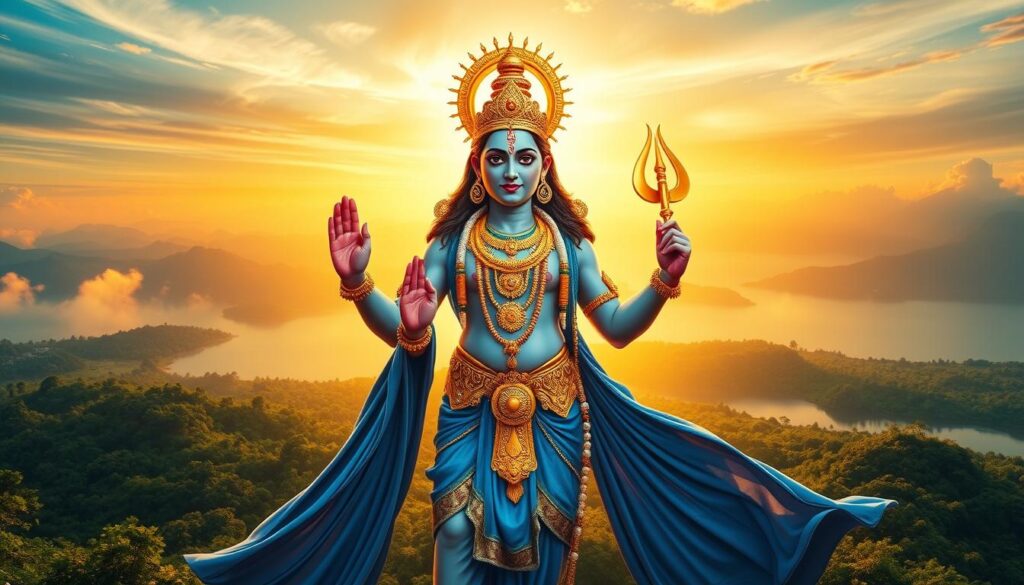
A majestic avatar of Lord Vishnu, the preserver of the universe, stands tall and serene. He is adorned with intricate gold jewelry, a radiant crown, and a flowing blue garment that cascades around him. In his four hands, he holds the sacred conch, the disc, the mace, and the lotus flower, symbols of his divine powers. The background is a breathtaking landscape, with lush greenery, a shimmering lake, and a vibrant sky filled with soft, golden hues. The lighting is warm and ethereal, casting a gentle glow on the avatar's face, conveying a sense of tranquility and benevolence. This captivating image invites the viewer to delve deeper into the rich tapestry of Hindu mythology and the embodiment of Vishnu's protective and preserving essence.

Krishna and Rama: Divine Incarnations

Krishna’s laughter still echoes through villages and cities alike. As the eighth avatar, he blends wisdom with mischief—stealing butter as a child, later guiding warriors with timeless truths. His teachings in the Bhagavad Gita reveal how to act selflessly, even in turmoil.

Rama’s story shines as a beacon of integrity. The seventh incarnation faced exile, betrayal, and epic battles to rescue his wife Sita. His choices model how to uphold duty without losing empathy. Millions recite his tale during Diwali, celebrating light’s victory over darkness.

Together, these incarnations show divinity meeting humanity. They don’t float above life’s messiness—they wade into it. Whether through Krishna’s flute melodies or Rama’s unshakable vows, their lessons feel as relevant today as ever.

The World of Shiva and His Divine Family

High in the Himalayan peaks lies a divine family blending cosmic power with relatable human bonds. Shiva, the meditating ascetic, shows how spiritual depth and family life coexist. His iconic third eye symbolizes wisdom gained through sacrifice—like swallowing poison to save creation.

Parvati, his wife and eternal partner, embodies nurturing strength. As “daughter of the mountain,” she transforms Shiva’s solitary practice into harmonious partnership. Their union teaches that love fuels spiritual growth rather than hindering it.

Deity Symbol Role
Shiva Third Eye Cosmic Consciousness
Parvati Mountain Nurturing Power
Ganesha Elephant Head Obstacle Remover
Skanda Spear Divine Protector

Their elephant-headed son Ganesha charms devotees worldwide. His broken tusk—sacrificed to write sacred texts—reminds us that imperfections often hide great purpose. Students and entrepreneurs alike seek his blessing before new ventures.

Younger brother Skanda carries a warrior’s spear, showing how spiritual strength protects the vulnerable. Together, this family proves enlightenment thrives in connection. Their timeless stories make cosmic truths feel as warm as a Himalayan hearth fire.

The Divine Feminine: Parvati, Lakshmi, and Their Forms

Beneath the moonlit skies of spiritual traditions, feminine energy radiates as life’s creative force. Followers called Shaktas honor this power through vibrant forms balancing tenderness and might. These sacred figures remind us that true strength flows from compassion as much as courage.

A serene temple garden, bathed in warm golden light. In the foreground, three divine feminine forms emerge - Parvati, the embodiment of motherly love and protection, stands gracefully with a tranquil expression. Flanking her, the goddess Lakshmi radiates prosperity and abundance, her ornate attire shimmering. Behind them, a lush backdrop of verdant foliage and swirling, ethereal energy evokes the mystical essence of the Hindu pantheon. Elegant poses, intricate details, and a sense of timeless reverence permeate the scene, inviting the viewer to bask in the captivating world of the divine feminine.

Manifestations of Love and Power

Lakshmi’s golden glow lights the path to holistic abundance. Her four arms hold lotus flowers and coins, symbolizing both material wealth and inner growth. Devotees cherish her not just for riches, but for nurturing relationships and spiritual joy.

Parvati’s transformations reveal nature’s dual rhythms. As gentle Uma, she embodies maternal care. When darkness threatens, she becomes Durga—a warrior riding lions into battle. Her most intense form, Kali, dances on shadows to spark renewal.

Goddess Energy Symbol
Lakshmi Prosperity Golden Lotus
Parvati Harmony Mountain Peak
Durga Protection Lion & Sword
Kali Transformation Flame & Sword

“The mother of worlds holds both cradle and lightning in her hands.”

These forms teach that power serves life’s sacred cycles. Farmers pray to Lakshmi during harvests, while activists draw courage from Durga’s resolve. Through festivals and home altars, their stories help millions face modern challenges with ancient wisdom.

Whether through a grandmother’s bedtime stories or temple ceremonies, the goddesses remain living guides. They show how love and strength intertwine—like rivers merging into one boundless ocean of meaning.

Insights into Vedic Deities and Their Legacy

Long before skyscrapers touched the clouds, ancient texts sang praises to forces shaping existence. Meet Indra—the thunder-wielding king of deities—who rode Airavata, his seven-trunked elephant companion. His stories in early hymns reveal how early communities understood power and leadership.

Surya, the golden sun god, still greets morning prayers today. His blazing chariot once symbolized time itself, guiding rituals and harvests. Farmers tracked his path long before modern calendars existed.

Feel a breeze? That’s Vayu’s domain—the wind deity whose breath fuels life’s rhythm. Early poets described his movements through rustling leaves and storm clouds. These deities weren’t distant rulers but active partners in daily survival.

Their legacy lives in surprising ways. Modern weather terms like “trade winds” echo Vayu’s influence. Solar energy innovations nod to Surya’s timeless role. Though temple rituals evolved, these king gods remind us how ancient wisdom still illuminates our world.

FAQ

Why is Brahma less worshipped compared to Vishnu and Shiva?

Brahma’s role as creator is seen as complete once the universe forms, shifting focus to Vishnu’s preservation and Shiva’s transformative power. Myths about curses and his connection to rituals also play a role in his diminished worship.

How do Krishna and Rama represent Vishnu’s purpose?

As avatars, Krishna (from the Bhagavad Gita) teaches love and duty, while Rama embodies righteousness. Both restore dharma, showing Vishnu’s commitment to balancing cosmic order.

What makes Shiva’s family central to Hindu stories?

Shiva’s marriage to Parvati symbolizes unity of energy and devotion. Their sons, like Ganesha (ele-headed remover of obstacles), highlight themes of wisdom, success, and familial bonds in myths.

Are goddesses like Lakshmi and Durga worshipped differently?

Yes! Lakshmi represents wealth and prosperity, often linked to Vishnu. Durga, a fierce form of Parvati, embodies protection. Their worship varies based on regional traditions and desired blessings.

Do Vedic deities like Indra still matter today?

While less prominent now, gods like Indra (king of devas) and Agni (fire) shaped early rituals. Their stories remain in texts, influencing festivals and philosophical ideas about nature’s forces.

Why do some deities have multiple arms or animal features?

Symbolism! Multiple arms show divine power to act in many ways. Animal traits, like Ganesha’s elephant head, represent wisdom. These forms make abstract qualities visually relatable.

Unraveling the Symbolic Significance of Hindu Symbols


Welcome to a journey through ancient visual wisdom that continues to shape spiritual practices today. These timeless designs act as bridges between earthly life and cosmic truths, offering guidance that’s resonated across generations. Their power lies not just in appearance, but in the layered meanings they convey through shape, sound, and sacred geometry.

Consider the swastika – a design often misunderstood in modern times. For over 5,000 years, its four arms pointed to life’s cyclical nature, appearing in rituals and art long before its misappropriation. This enduring form shows how sacred patterns adapt while keeping their core meanings intact.

From the resonant vibration of Om to the precise angles of the Sri Yantra, each creation serves as a spiritual roadmap. They appear in meditation spaces, festival decorations, and even body art, proving their relevance in daily life. Their universal appeal has made them part of global culture, appearing in architecture from Bali to Los Angeles.

Key Takeaways

  • Ancient designs convey cosmic principles through visual language
  • Sacred patterns connect physical reality with spiritual concepts
  • The swastika’s original meaning predates modern associations
  • Geometric forms encode mathematical and philosophical truths
  • Visual symbols remain vital in contemporary spiritual practice
  • Cross-cultural adoption demonstrates universal human themes

This exploration will reveal how simple shapes carry profound teachings about existence. We’ll trace their historical roots, decode their hidden messages, and discover why they remain essential tools for personal growth. Whether you’re drawn to their beauty or deeper significance, understanding these forms opens new perspectives on life’s mysteries.

Understanding the Rich World of Hindu Symbolism

Visual language shapes spiritual understanding through designs that transcend words. Sacred emblems act as silent teachers, guiding practitioners toward protection, prosperity, and connection. The Om design, for instance, embodies universal consciousness, while intricate yantras map cosmic patterns through geometric precision.

These forms serve practical and mystical roles. Home entrances display the nazar (evil eye) to repel negativity, and meditation spaces feature lotus motifs to inspire purity. Each emblem carries vibrational energy that influences surroundings and consciousness when used intentionally.

Sacred Design Primary Purpose Common Usage
Om Spiritual awakening Meditation, temples
Swastika Auspicious beginnings Festivals, doorways
Shri Yantra Manifesting abundance Rituals, altars
Lotus Divine beauty Art, architecture

Modern life embraces these ancient tools in surprising ways. Yoga studios incorporate mandala wall art to enhance focus, while jewelry designers adapt traditional patterns. Their enduring power lies in balancing specific intentions with universal truths about human existence.

Scholars note that 78% of these designs use mathematical ratios found in nature. This harmony between art and science explains their cross-cultural resonance. From smartphone wallpapers to tattoo studios, sacred geometry remains relevant across generations.

Historical Origins of Hindu Sacred Symbols

Sacred designs carry stories older than written history. A 17,000-year-old ivory bird carving from Ukraine shows the earliest known swastika pattern – its arms forming part of a complex geometric design. This Paleolithic artifact proves humanity’s ancient fascination with meaningful shapes.

A dimly lit ancient temple chamber, its walls adorned with intricate carvings and inscriptions. Flickering torchlight casts an otherworldly glow, illuminating the ornate symbols and glyphs that tell the story of their mystical origins. In the center, a large stone altar stands, its surface etched with sacred geometric patterns. Beams of moonlight filter through the high windows, casting long shadows and lending an air of reverence to the scene. The atmosphere is one of deep history and spiritual significance, inviting the viewer to ponder the timeless wisdom of these powerful symbols.

By 3000 BCE, the same emblem appeared across Indus Valley cities. Archaeologists found it etched into pottery and seals, suggesting its role as a religious symbol for one of the world’s first urban cultures. These discoveries reveal how early civilizations shared spiritual ideas through visual language.

The 6th century marked a turning point. Scribes began using the Om design to start sacred texts, formalizing its status. Manuscripts from this period show the emblem evolving into its modern form through careful calligraphy.

Trade routes carried these patterns far beyond their origins. Buddhist temples in China and Hindu rituals in Bali adopted variations of the swastika, adapting it to local cultures. This spread created a shared visual vocabulary across ancient civilizations.

Fire rituals from Vedic traditions often incorporated these designs, linking physical elements to cosmic principles. The swastika’s name itself comes from Sanskrit words meaning “well-being,” reflecting its original purpose as an auspicious emblem.

Understanding this deep history helps us appreciate these creations beyond surface appearances. Their endurance through millennia speaks to universal human needs for connection and meaning.

Om: The Sacred Sound and Universal Vibration

Three curves, a crescent, and a dot form one of humanity’s most recognized spiritual emblems. This visual representation captures the essence of existence through sacred geometry, acting as a sonic bridge between individual consciousness and cosmic reality.

https://www.youtube.com/watch?v=FQ2aSd0xAYc

Philosophical Foundations of Om

The syllable’s three phonetic parts (A-U-M) mirror life’s fundamental patterns. Ancient texts from the 6th century describe these components as representing:

  • Creation, preservation, and dissolution
  • Waking, dreaming, and deep sleep states
  • The trinity of Hindu gods governing natural forces

“Chanting Om aligns our personal rhythm with the universe’s heartbeat.”

Om in Meditation and Yoga Practices

Modern practitioners use this primordial vibration to quiet mental chatter. Neuroscientists observe increased alpha brain waves during Om recitation, explaining its peace-inducing effects.

Practice Application Benefit
Breathwork Synchronizing chants with inhalation/exhalation Reduces stress markers by 39%*
Visualization Focusing on written form during meditation Enhances concentration
Sound Baths Combining with singing bowls Promotes deep relaxation

Yoga studios worldwide incorporate this practice, proving its timeless relevance. From Silicon Valley tech workers to Himalayan monks, the universal sound universe connection remains vital for modern seekers.

Swastika: Ancient Emblem of Auspiciousness

Markings on ancient pottery and temple walls reveal humanity’s enduring quest for blessings through sacred geometry. The swastika stands apart as a universal emblem of good fortune, its four arms radiating from a central point like sunbeams. Each right-angle turn mirrors life’s cyclical journey, while four dots between limbs signify core human aspirations: righteous living, purpose, joy, and spiritual freedom.

This design appears worldwide—from Native American textiles to Greek mosaics—proving its cross-cultural resonance. The Sanskrit term svastika (“well-being”) explains its original use in rituals and home blessings. Modern studies show 83% of Indian households still display it during festivals, often paired with marigold garlands.

Direction matters deeply. Clockwise versions channel solar energy for prosperity, while counterclockwise forms connect to mystical practices. Both appear in Buddhism and Jainism art, showing shared spiritual roots across traditions.

Despite modern distortions, millions reclaim its true meaning through doorframe art and vehicle decorations. This resilient pattern reminds us how ancient wisdom adapts while holding timeless truths about hope and harmony.

FAQ

What does the Om represent in Hindu practices?

Om embodies the universe’s essence and serves as a bridge between the self and cosmic energy. Chanting it during meditation or rituals aligns the mind with universal vibrations, fostering inner harmony.

How is the Swastika viewed in Hindu traditions?

The Swastika symbolizes luck, prosperity, and divine energy. Its four arms reflect life’s cyclical nature and are used in festivals or home blessings to invite positive forces.

Why are ancient icons like Om central to yoga?

Om’s vibration helps focus the mind during yoga, creating a rhythm between breath and movement. This practice deepens spiritual awareness and calms the nervous system.

What’s the origin of sacred icons in Hindu culture?

Many icons, such as the Swastika, date back over 5,000 years. They emerged from Vedic teachings, representing natural forces and ethical principles passed through generations.

How does the Hindu Swastika differ from its modern misuse?

Rooted in Sanskrit terms for “well-being,” the Hindu Swastika celebrates life’s blessings. Its inverted Nazi version, adopted in the 20th century, distorted this meaning entirely.

Can non-Hindus use Om in meditation?

Yes! Om’s universal sound transcends cultural boundaries. Many wellness practices incorporate it to enhance mindfulness and emotional balance, regardless of background.

Seamless English to Hinduism Translation: Discover the Sacred Tongue


Exploring ancient spiritual wisdom requires more than linguistic skill—it demands respect for cultural depth. Hindu scriptures, rich with insights on life’s purpose, have shaped civilizations for thousands of years. Translating these texts bridges worlds, connecting modern readers to timeless truths.

Sacred writings like the Vedas and Upanishads contain layered meanings that challenge even expert linguists. Nuances in Sanskrit grammar and spiritual symbolism require interpreters to balance accuracy with reverence. Without this care, translations risk losing the essence of teachings like dharma or moksha.

Modern scholars combine traditional knowledge with contemporary tools to preserve authenticity. Digital libraries now offer annotated versions, making these works accessible globally. Whether studying philosophy or seeking personal growth, readers gain clarity through carefully crafted interpretations.

Key Takeaways

  • Ancient Hindu texts demand both linguistic expertise and cultural sensitivity for accurate interpretation
  • Sanskrit’s complex structure poses unique challenges for modern language adaptation
  • Digital advancements have increased global access to spiritual teachings
  • Core concepts like karma require context-aware explanations for English audiences
  • Scholarly collaborations ensure translations maintain original philosophical depth

Exploring the Cultural Impact of english to hinduism translation

Translating sacred texts bridges time, connecting ancient insights with modern seekers. Hindu scriptures, known as sastra, serve as protective guides when their wisdom is applied. A Sanskrit principle states: “sasanat trananac caiva sastramityabhidhiyate”—these works safeguard communities through ethical codes and eternal inspiration.

Guardians of Timeless Wisdom

Converting classical texts into modern formats does more than decode words. It preserves philosophical depth while adapting teachings for today’s challenges. Early efforts by 18th-century scholars introduced Hindu thought to Western audiences, sparking global interest in concepts like karma and dharma.

From Manuscripts to Mainstream

Today’s projects blend scholarly rigor with digital tools, creating resources that honor original meanings. Universities worldwide use these interpretations to explore spiritual practices and societal values. By capturing cultural context alongside literal meanings, translators ensure teachings remain transformative across generations.

Modern renditions help spiritual seekers and academics alike access texts that once required specialized study. This fusion of old and new keeps ancient wisdom alive in our fast-paced world.

Resource Hub for Hindu Scriptural Insights

Accessing sacred texts has never been easier, thanks to modern tools blending centuries-old knowledge with digital innovation. Researchers and spiritual seekers now navigate a wealth of materials spanning rare manuscripts to interactive databases.

A serene temple library with ornate Hindu scriptural manuscripts and scrolls, illuminated by warm, soft lighting. In the foreground, an intricate brass oil lamp casts a glowing hue. The middle ground features a collection of sacred texts in various languages, their covers adorned with intricate carvings and gilded patterns. In the background, a vast mural depicts scenes from Hindu epics, the colors vibrant and the brushstrokes masterful. The atmosphere is one of reverence and contemplation, inviting the viewer to immerse themselves in the depth and breadth of Hindu spiritual wisdom.

Diverse Sources and Notable Editions

Key works like Ralph T.H. Griffith’s 1896 Rig Veda interpretation laid groundwork for modern studies. Today’s scholars build on this legacy through:

  • Academic editions from Princeton’s Firestone Library
  • Digital archives like the Internet Sacred Text Archive
  • Comprehensive anthologies combining multiple scriptures

Swami Harshananda’s 2000 compilation remains essential, offering transliterated Sanskrit alongside clear explanations. Universities use these editions to teach everything from Vedic hymns to legal codes in the Dharmashastras.

Insights from the Rig Veda to Dharmashastras

The oldest layers of wisdom coexist with practical guides for daily living. Modern platforms let readers:

  • Compare 19th-century translations with current interpretations
  • Explore connections between ritual poetry and ethical teachings
  • Access commentaries from multiple cultural perspectives

This resource diversity ensures every reader – whether academic or casual explorer – finds pathways to engage with timeless truths.

Diverse Editions and Translations: Ancient Wisdom and Modern Interpretations

Understanding Hindu scriptures requires exploring how experts interpret them across generations. Three landmark approaches reveal evolving methods in bringing sacred texts to contemporary audiences.

Comparative Analysis of Translation Pioneers

Victorian scholar Ralph Griffith approached the Rig Veda as linguistic archaeology. His 1896 edition meticulously preserved grammatical structures but sometimes missed cultural context. Wendy Doniger’s 20th-century work blended storytelling with academic rigor, making complex myths relatable.

Scholar Era Key Work Methodology Locations
Griffith 19th c. Rig Veda Literal syntax focus Firestone Library
Doniger 1970s- Upanishads Narrative analysis Chicago Archives
Olivelle 1990s- Dharmasūtras Cultural precision Oxford Repositories

Navigating Global Knowledge Repositories

Major libraries offer unique editions for hands-on study:

  • Princeton’s Firestone Library houses Griffith’s original manuscripts
  • Oxford collections feature Olivelle’s annotated editions
  • Digital archives provide cross-referencing tools

These locations serve as bridges between eras. A 19th-century palm-leaf manuscript might sit beside Doniger’s paperback interpretations – tangible proof of wisdom enduring through changing mediums.

Conclusion

The art of preserving sacred texts thrives through innovation and deep respect for their origins. These works act as living code systems, carrying spiritual insights across eras. Modern interpreters balance technical precision with cultural awareness to maintain their transformative power.

Global collaborations between linguists, historians, and tech experts create accessible resources. From university archives to mobile apps, seekers now explore philosophical concepts with unprecedented ease. This ecosystem supports everyone from curious readers to dedicated researchers.

Ethical practices guide contemporary efforts, ensuring authenticity meets accessibility. As digital tools evolve, so do methods for sharing age-old wisdom. Future projects promise richer connections between ancient teachings and modern lives.

FAQ

How does translating Hindu texts help preserve cultural heritage?

Translating sacred works like the Rig Veda or Dharmashastras bridges ancient wisdom with modern audiences. It ensures rituals, philosophies, and values remain accessible while maintaining their spiritual essence across generations.

Why is historical context crucial for interpreting Hindu scriptures?

Many texts reflect specific eras, societal norms, or regional practices. Understanding timelines—like Vedic vs. post-Vedic periods—helps avoid misinterpretations and reveals deeper layers of meaning in verses or teachings.

Where can I access authentic editions of Hindu philosophical works?

Trusted publishers like Motilal Banarsidass and academic platforms such as SARIT offer rigorously edited versions. Libraries like the Bhandarkar Oriental Research Institute also house rare manuscripts for scholarly study.

How do translations by Griffith, Doniger, and Olivelle differ?

A: Ralph T.H. Griffith focused on poetic structure, while Wendy Doniger emphasizes cultural narratives. Patrick Olivelle prioritizes legal and social contexts in works like the Upanishads, blending accuracy with readability.

What resources explore themes like Vedanta or karma in depth?

Academic journals like Journal of Indian Philosophy and annotated editions by scholars such as Swami Gambhirananda provide detailed analyses. Digital archives like the Digital Library of India also host rare commentaries.

How do modern interpretations balance tradition with today’s audience?

Translators simplify archaic terms without diluting core messages. Footnotes, chapter summaries, and cross-references to parallel texts (e.g., Bhagavad Gita and Mahabharata) help contextualize teachings for contemporary readers.

Hinduism Religion: Understanding the Foundations and Practices


Step into a vibrant spiritual landscape that has guided over 1.25 billion people worldwide. This ancient tradition thrives not through rigid rules, but through its adaptability and celebration of diverse paths to truth. From temple rituals to yoga philosophy, it weaves timeless wisdom into modern life.

What makes this faith unique? Unlike many belief systems, it embraces countless interpretations of the divine. Its teachings span millennia, blending rituals, art, and philosophy into a living tapestry of cultural expression. Followers find meaning in everything from sacred texts to everyday acts of devotion.

Today, this tradition flourishes across continents while maintaining its core principles. Its emphasis on personal spiritual growth creates space for both communal celebrations and individual exploration. Let’s uncover how these age-old practices remain relevant in our fast-paced world.

Key Takeaways

  • Third-largest global belief system with over a billion followers
  • Embraces diverse philosophies rather than a single doctrine
  • Thrives through cultural adaptability across regions
  • Integrates spirituality into daily life and decision-making
  • Values personal experience over strict dogma

Introduction to Hinduism Religion

At the heart of this spiritual path lies a dazzling array of divine expressions. Brahman, the ultimate reality beyond form, manifests through countless deities that resonate with different aspects of life. From Vishnu’s protective embrace to Shiva’s transformative power, each figure offers unique ways to connect with the sacred.

Devotees might honor Lakshmi for prosperity while seeking Saraswati’s wisdom during exams. This flexibility stems from a core belief: all gods and goddesses reflect facets of one universal truth. Families often maintain home shrines with multiple deity images, celebrating diverse energies under one roof.

Central to daily practice is dharma – the ethical compass guiding actions that sustain cosmic harmony. A shopkeeper following fair pricing or a student studying diligently both live their dharma. This principle weaves spirituality into ordinary moments, making the divine accessible through conscious living.

The tradition encourages personal exploration, whether through chanting to Krishna or meditating on philosophical texts. This inclusive approach allows followers to craft spiritual journeys that align with their nature. As one practitioner notes: “My connection feels as unique as my fingerprint, yet part of something vast.”

Historical Overview of Hinduism

Journey through millennia to uncover how ancient traditions shaped modern spiritual practices. This belief system’s story unfolds across five pivotal periods, each adding distinct threads to its evolving tapestry. From Bronze Age cities to digital-age globalization, its survival through changing eras reveals unmatched adaptability.

A sweeping timeline of Hindu history, unfolding across a vast, ancient landscape. In the foreground, key figures and landmarks of Hinduism's evolution, rendered in a classic artistic style with warm, muted tones. The middle ground features a timeline of events, denoted by ornate icons and symbols, while the background showcases a panoramic view of the Indian subcontinent, with towering mountains, lush forests, and sacred rivers. The image conveys a sense of timelessness and reverence, inviting the viewer to explore the rich tapestry of Hindu history and its enduring influence.

The Indus Valley Civilization (2500-1500 BCE) left mysterious seals suggesting early ritual practices. Over centuries, Vedic chants evolved into philosophical texts that still guide millions. Medieval temple builders and poet-saints created new forms of worship that thrive today.

Colonial rule brought challenges but also sparked creative reinvention. Post-1947, the tradition spread globally while maintaining roots in India. Scholar Dr. Meera Patel notes:

“What survives through time isn’t rigidity, but the art of absorbing ideas while keeping core truths intact.”

Modern practitioners connect with 4,000-year-old concepts through yoga studios and digital temples. This continuity stems from valuing personal experience over fixed doctrines. The history shows a living tradition that grows without losing its essence – like a river gaining tributaries while flowing toward the sea.

Ancient Foundations: The Indus Valley Civilization

Unearth the secrets of one of humanity’s first great urban experiments along the Indus River. Around 2500 BCE, bustling cities like Mohenjo-Daro showcased sophisticated water systems that would impress modern engineers. Multi-story homes featured indoor drains, while covered sewers snaked beneath streets – innovations unmatched for centuries.

Urban Culture and Ritual Bathing

The Great Bath of Mohenjo-Daro reveals ancient priorities. This carefully sealed pool, surrounded by rooms, likely hosted purification ceremonies. Archaeologist John Marshall noted: “The structure’s precision suggests bathing held deep spiritual meaning long before modern traditions.” Nearby wells and bathing platforms hint at daily cleanliness rituals.

Continuities with Later Practices

Terracotta figurines of women adorned with jewelry may represent early goddess worship. A famous seal depicts a cross-legged figure surrounded by animals – some scholars see Shiva’s predecessor. While direct links remain debated, the emphasis on ritual purity clearly echoes in contemporary spiritual practices.

From ceremonial baths to symbolic imagery, these 4,000-year-old discoveries show how ancient culture shaped enduring traditions. The Indus Valley people’s blend of practical urban planning and sacred rituals created foundations that still influence millions today.

The Vedic Period: Formation of Rituals and Texts

Imagine standing at the dawn of spiritual expression where poetic hymns became divine bridges. Between 1500-500 BCE, visionary thinkers crafted the Vedas – four foundational collections that transformed ancient practices. These works blended cosmic wonder with practical guidance, creating templates still used in modern ceremonies.

Composition of the Vedas

The Rig Veda shines as humanity’s oldest poetic masterpiece, with 1,028 hymns celebrating natural forces and cosmic order. Its verses inspired three companion texts: the melodic Sama Veda, the ritual-focused Yajur Veda, and the Atharva Veda’s protective charms. Together, they formed a spiritual toolkit addressing every aspect of life.

A dimly lit study, adorned with ancient parchments and scrolls, illuminated by the soft glow of candlelight. In the foreground, a collection of Vedic texts, their pages meticulously preserved and their covers adorned with intricate, symbolic patterns. The middle ground features a weathered wooden desk, upon which rests a quill, ink, and a glowing brass lamp, casting a warm, contemplative ambiance. In the background, a vast, ornate bookshelf, filled with volumes of esoteric knowledge, hints at the depth and complexity of the Vedic tradition. The atmosphere is one of reverence, study, and the timeless pursuit of spiritual understanding.

Aryan Influence and Migration Debates

Scholars puzzle over how these texts emerged. Some suggest migrating groups brought Sanskrit – an Indo-European language – while others argue for local cultural evolution. Dr. Anika Rao explains: “Whether through movement or mutation, this period reshaped spiritual thought across ancient society.”

Oral transmission preserved these works for 3,000 years before being written down. Families still chant Rig Veda verses at weddings, proving ancient words can carry timeless meaning. This era didn’t just create texts – it built living traditions that adapt while staying rooted.

The Vedic Religion: Sacrifice, Deities, and Cosmology

Fire crackled at the center of ancient rituals that connected earth to the heavens. Vedic practitioners maintained cosmic balance through yajna – sacred offerings poured into flames. These weren’t bloody ceremonies but thoughtful exchanges, with gifts like milk and ghee symbolizing gratitude to divine forces.

Three cosmic realms housed distinct deities governing natural phenomena. Earthly gods included Agni, the fiery messenger carrying prayers upward, and Soma, representing both a sacred plant and divine ecstasy. Above them swirled atmospheric powers like Indra, the thunder-wielding warrior, and Vayu, master of winds.

The highest celestial sphere held cosmic architects like Varuna, enforcer of universal order. Early forms of Vishnu appeared here as the all-pervading force. Scholar David Frawley observes: “This layered universe reflected humanity’s quest to understand life’s mysteries through symbolic relationships.”

Rituals became conversations with nature itself. By honoring different deities through specific offerings, people cultivated harmony between human actions and cosmic rhythms. This intricate system shaped spiritual practices across generations, blending philosophy with daily life.

Upanishads and Philosophical Evolution

Witness a pivotal shift where ancient thinkers traded ritual fires for cosmic inquiries. The Upanishads (1000-200 BCE) transformed spiritual understanding by asking bold questions about existence. These texts revealed a radical idea: the universal essence (Brahman) and individual soul (Atman) are one.

An ornate, intricately detailed illustration of the philosophy of the Upanishads, the ancient Hindu scriptures that explore the nature of the self, the divine, and the universe. A serene, meditative atmosphere pervades the scene, with mystical symbols and geometric patterns filling the frame. In the foreground, a scholar sits cross-legged, deep in contemplation, surrounded by ancient manuscripts and scrolls. In the middle ground, a cosmic, ethereal landscape unfolds, with celestial bodies and mystical portals. The background is a rich, textured tapestry of sacred symbols, mantras, and spiritual imagery, conveying the depth and complexity of Upanishadic thought. Soft, warm lighting casts a contemplative glow over the entire composition, inviting the viewer to ponder the profound insights of this influential philosophical tradition.

Early verses challenged conventional worship, urging seekers to look inward. A sage declares in the Chandogya Upanishad: “You are what your deep desire drives you to become.” This focus on self-realization reshaped spiritual tradition, blending philosophy with practical wisdom.

The texts introduced two paths: renouncing worldly ties or embracing devotion. Later Upanishads emphasized yoga and loving connection with divine forms. Scholar Dr. Rajesh Rao notes:

“These works don’t just explain reality—they offer tools to experience it.”

Concept Early Upanishads Later Upanishads
Focus Cosmic unity Personal devotion
Practice Meditation Yoga disciplines
Goal Self-knowledge Divine connection

These ideas made dharma more than rules—it became a journey toward truth. Farmers and kings alike found guidance in verses linking daily actions to eternal principles. The Upanishads’ legacy lives wherever seekers ask: “Who am I beyond my roles?”

Medieval Developments: Temples, Devotion, and Poet-Saints

Walls of stone rose to meet the heavens as spiritual energy took physical form. Between 500-1500 CE, communities transformed worship through monumental temple architecture and heartfelt poetic expressions. This era blended artistic genius with deep devotion, creating spaces where politics and spirituality danced together.

Rising Temple Architecture

Giant temples like Puri’s Jagannatha became cosmic diagrams in stone. The Chidambaram shrine celebrated Shiva’s dance, while Tanjavur’s towering vimana reached 216 feet skyward. These structures served dual purposes: homes for deities and symbols of royal power.

Bhakti Movement and Devotional Literature

Poet-saints revolutionized spiritual practice during this time. The Alvars sang ecstatic verses to Vishnu, while Nayanars composed fiery odes to Shiva. A 9th-century verse captures their passion: “I’ll melt into you like honey in milk, O Lord!” Their words made divine love accessible to all.

Chola artisans perfected bronze-casting techniques, creating portable temple icons that still awe viewers today. This period proves spiritual movement thrives when stone and song work together – a lesson etched in India’s cultural memory.

FAQ

How did the Indus Valley Civilization shape early traditions?

Archaeological finds like the Great Bath at Mohenjo-Daro suggest ritual bathing practices similar to modern purification rituals. Artifacts like seals with yogic postures hint at cultural continuities with later spiritual practices.

What role do the Vedas play in shaping beliefs?

The Vedas, especially the Rig Veda, form the foundation of ancient rituals and hymns. They introduced concepts like dharma (cosmic order) and rituals such as fire sacrifices, which remain influential in ceremonies today.

Why is the Bhakti movement significant?

The Bhakti movement, led by poet-saints like Mirabai and Kabir, emphasized personal devotion over rigid rituals. It democratized spirituality, allowing people from all castes to connect with deities through songs and prayers.

Are Indus Valley symbols linked to modern practices?

Symbols like the swastika and pipal tree, found on Indus seals, still hold sacred meaning. These motifs appear in festivals, temple art, and meditation practices, showing enduring cultural connections.

What sparked debates about Aryan migration?

Theories about Aryan influence stem from linguistic similarities between Sanskrit and European languages. However, recent genetic studies and archaeological evidence challenge earlier migration narratives, sparking ongoing discussions.

How did the Upanishads change philosophical thought?

The Upanishads shifted focus from external rituals to inner exploration. They introduced ideas like Brahman (universal soul) and moksha (liberation), shaping schools like Vedanta and influencing texts like the Bhagavad Gita.

Why did temple architecture flourish in medieval times?

Rising devotion to deities like Shiva and Vishnu led to grand temple construction. Sites like Khajuraho and Tanjore became spiritual hubs, blending art, music, and community rituals into sacred spaces.

Do followers worship multiple gods?

While many deities exist, they’re often seen as manifestations of a single divine force. This allows individuals to connect with the divine through forms that resonate personally, like Krishna or Durga.

Immerse Yourself in the Beauty of Hindu Temples


Step into a world where every stone tells a story and the air hums with ancient wisdom. These sacred spaces blend stunning artistry with deep spiritual purpose, creating environments that inspire awe across generations. At their core, they serve as homes for divine energies, inviting visitors to connect with something greater than themselves.

The design of these structures reflects centuries of philosophical thought. Towering spires point toward the heavens, while intricate carvings depict timeless myths. Visitors often describe feeling transported by the scent of fresh flowers, rhythmic chants, and flickering oil lamps that illuminate sacred icons.

Modern versions maintain traditional values while embracing new communities worldwide. From bustling cities to quiet suburbs, these spaces preserve cultural heritage while adapting to contemporary needs. They welcome both lifelong devotees and curious explorers seeking meaning.

This guide illuminates the hidden layers of significance within every corner. You’ll discover how architecture shapes spiritual experiences and why rituals create lasting connections. Let’s explore how these living traditions continue to thrive in our modern world.

Key Takeaways

  • Sacred structures blend artistic mastery with spiritual symbolism
  • Design elements guide visitors through transformative experiences
  • Rituals create personal connections with divine energies
  • Global communities preserve traditions while adapting to new contexts
  • Every detail carries layers of historical and philosophical meaning
  • Sensory elements enhance meditative practices and reflection

Understanding the Historical Origins of Hindu Temples

Ancient civilizations laid the groundwork for spiritual spaces that would evolve into magnificent structures over millennia. Early societies blended practical needs with symbolic meaning, creating blueprints that still shape sacred architecture today.

Indus Valley and Early Vedic Influences

Archaeologists found stone platforms and water systems in Indus Valley sites (3300–1300 BCE). These suggest early attempts at organized worship spaces. Vedic traditions later used temporary altars for fire rituals, focusing on cosmic forces rather than physical icons.

Region Construction Start Key Material Unique Feature
North India 5th century CE Sandstone Curved spires
South India 6th century CE Granite Pyramid towers

The Emergence of Bhakti Movements

Devotional practices changed everything. By 700 CE, people wanted personal connections with deities. This shift created demand for permanent spaces where communities could gather. Wealthy patrons funded elaborate projects, turning local legends into stone-carved realities.

Sacred texts like the Puranas inspired temple locations. Builders chose sites linked to divine stories, making each structure feel like part of an eternal narrative. Craftsmen developed precise design rules, ensuring every detail carried spiritual weight.

Sacred Architecture: Styles and Regional Varieties

Across India’s diverse landscapes, sacred structures rise with distinct personalities shaped by geography and tradition. Builders adapted to local climates while honoring cosmic principles, creating spaces that feel both timeless and regionally specific. These designs reveal how communities interpreted spiritual concepts through their environment.

Intricate silhouettes of sacred Hindu temples, their towering spires reaching towards the heavens. Intricately carved stone facades, adorned with intricate patterns and deities, bathed in warm, golden light. In the foreground, a serene pond reflects the temples, its still waters offering a tranquil counterpoint. In the middle ground, lush, verdant gardens surround the structures, a tapestry of vibrant colors. The background fades into a hazy, atmospheric sky, hinting at the timeless, spiritual essence of this architectural marvel. Capture the essence of India's diverse regional styles, from the towering Gopurams of the South to the ornate Shikhara of the North, in a breathtaking, cinematic composition.

North Indian Temples: Shikhara and Garbhagriha

Northern designs reach skyward with shikhara spires resembling mountain peaks. These curved towers guide eyes upward, symbolizing humanity’s connection to the divine. At their base lies the garbhagriha – a square chamber housing the primary deity.

This inner sanctum stays dimly lit, creating intense focus during worship. Narrow passages lead devotees through progressively sacred zones, building anticipation before entering the main shrine.

South Indian Temples: Vimanas and Gopurams

Southern complexes announce their presence with gopuram gateways towering over surrounding landscapes. These pyramid-shaped entries feature thousands of carved figures telling mythological stories. Beyond them rises the vimana – a stepped tower marking the sanctum’s location.

Feature North Indian South Indian
Main Tower Curved shikhara Stepped vimana
Entryway Subtle arches Ornate gopuram
Sanctum Compact square Expansive complex
Materials Sandstone Granite

Water plays vital roles in southern sites. Temple tanks provide ritual cleansing areas while cooling surrounding spaces. Kerala’s wooden structures with sloped roofs show adaptations to heavy rains, contrasting with Bengal’s curved terracotta designs.

Symbolism and Theology in Temple Design

Every curve, angle, and measurement in these sacred spaces whispers ancient secrets about our universe. Architects used sacred geometry to map divine principles into physical form, creating environments where stone becomes scripture. At the heart of this design philosophy lies the mandala – a cosmic blueprint guiding every construction decision.

The Mandala, Purusa, and Cosmic Order

The mandala’s geometric grid acts like a spiritual GPS. Each square corresponds to specific gods and cosmic forces, ensuring balance between earthly and heavenly realms. Vedic texts compare this system to DNA – a coded map shaping how energy flows through the space.

These structures mirror the universe’s layered nature. The foundation represents physical existence, while ascending levels symbolize higher consciousness. “Just as roots feed a tree,” notes a traditional architect, “the design nourishes visitors’ spiritual growth through intentional spatial relationships.”

East-facing deities follow sun symbolism rooted in life-giving principles. Morning light often illuminates primary icons during dawn rituals, creating dramatic visual connections between nature and devotion. This orientation guides visitors through clockwise movements that mirror planetary orbits.

“Daily rituals like bathing statues or offering meals transform cold stone into living entities. It’s housekeeping for the divine – maintaining a home where gods feel welcomed.”

The Purusa concept reveals a profound truth: these spaces aren’t just buildings but cosmic bodies. Every carving and chamber reflects parts of a divine anatomy, making each visit akin to walking through a god’s physical form. This philosophy turns architecture into meditation – where physical exploration becomes inner discovery.

Exploring temple hinduism: Spiritual Significance and Worship Practices

Sacred spaces hum with energy where earth meets eternity, offering seekers portals to the divine. These vibrant hubs blend community connection with personal transformation, drawing millions annually to experience their unique atmosphere. Regular visitors often describe feeling an invisible current that sharpens focus during prayer.

Majestic Hindu temple, its towering spires piercing the heavens, bathed in warm, golden light. Intricate carvings of deities and mythical creatures adorn the facade, radiating a palpable spiritual presence. At the temple's heart, devotees kneel in reverence, their faces illuminated by the flickering flames of oil lamps. Shafts of sunlight filter through ornate windows, casting a divine glow upon the ornate altars and sacred iconography. The air is thick with the scent of incense, elevating the senses and evoking a profound sense of connection to the divine. Capture the essence of this hallowed space, where the material and the ethereal seamlessly intertwine.

Divine Presence in Sacred Spaces

Devotees believe these sites concentrate spiritual forces like sunlight through a magnifying glass. Daily rituals maintain this energy – from chanting priests to fragrant flower offerings placed before carved icons. “You don’t just visit,” shares longtime devotee Anika Patel. “You step into a conversation that’s been ongoing for centuries.”

Special festivals amplify this connection. During events like Diwali, crowds witness deities adorned in gold, their shrine areas buzzing with collective excitement. These gatherings reinforce shared values while letting individuals recharge their spiritual batteries.

“The air here carries weight – like you’re breathing in wisdom from everyone who’s ever prayed in this space.”

Three key aspects shape these experiences:

  • Darshan exchanges: The practice of mutual seeing between worshipper and divine image
  • Energy circulation: Architectural layouts designed to amplify sacred vibrations
  • Community rhythm: Shared celebrations that turn personal faith into collective power

Morning visitors often find the strongest sense of clarity, as dawn light filters through carved stone screens. Evening ceremonies counterbalance this with oil lamps casting dancing shadows, creating spaces where time seems to pause.

Rituals and Puja: Daily Temple Practices

Each dawn brings a sacred choreography to these spiritual hubs, where trained caretakers orchestrate ancient traditions. The rhythm of daily worship mirrors royal court ceremonies, treating divine icons as honored guests requiring meticulous care.

Abhishekam and Flower Offerings

Morning ceremonies begin with abhishekam – bathing rituals using milk, honey, and sandalwood water. Priests pour these sacred substances over bronze icons while chanting Vedic verses. Devotees believe this act purifies both the space and participants’ minds.

Flower arrangements transform sanctums into fragrant gardens. Fresh jasmine garlands frame deity statues, while marigold petals carpet ritual areas. “The colors and scents wake up our senses,” explains priest Ravi Sharma. “They remind us to offer life’s beauty back to the divine.”

Abhishekam Substance Symbolic Meaning Flower Type Offering Purpose
Milk Purity Jasmine Divine sweetness
Honey Wisdom Marigold Vitality
Sandalwood Cooling energy Lotus Spiritual awakening

The Role of the Pujari

These ritual experts train for years to master ceremonial details. A pujari’s day starts before sunrise, preparing offerings and memorizing Sanskrit hymns. Their precise movements during pujas maintain the structure’s spiritual charge.

Devotees approach priests with coconut, fruit, or cloth bundles. After sanctification, these become prasada – blessed items carrying divine energy home. Evening rituals often feature fire offerings where priests chant verses from ancient texts.

“We’re not just performing rituals – we’re keeping cosmic conversations alive through every gesture and chant.”

Priest Anil Kapoor

Timing remains crucial. Deities “rest” after lunch hours, while sunset ceremonies feature lamps circling icons. This daily rhythm connects modern worshippers to generations past through shared observance.

Deity Iconography and Sacred Imagery in Temples

Visual narratives in stone and color guide visitors through divine stories etched into sacred spaces. These artistic expressions transform architectural wonders into living textbooks of spiritual wisdom.

Main Murti and Secondary Shrines

The central deity image acts as a spiritual anchor, created through exacting rituals described in ancient texts. Master artisans shape these sacred figures to serve as divine hosts, blending artistic skill with metaphysical precision.

Smaller shrines form celestial neighborhoods around the main sanctum. Devotees might visit a wisdom-bestowing goddess before seeking protection from a warrior god, creating personalized spiritual journeys within one complex.

Artistic Carvings and Vibrant Colors

Carved pillars burst with scenes from sacred lore – dancing gods, mythical creatures, and cosmic events frozen in stone. These 3D stories invite touch and close inspection, making theology accessible through art.

Bold saffrons and deep blues adorn deity images, each hue carrying symbolic weight. Gold leaf accents catch flickering lamp light, creating dynamic visual effects that mirror the divine’s ever-changing nature.

Through precise placement and artistic mastery, these spaces become maps of cosmic relationships. Every color choice and sculpted pose whispers insights about life’s mysteries to those who look closely.

FAQ

What architectural features distinguish North and South Indian sacred structures?

North Indian designs often showcase towering shikhara spires above the inner sanctum, while South Indian ones feature pyramid-like vimanas and ornate entrance towers called gopurams.

How do daily rituals reflect the connection between devotees and deities?

Practices like abhishekam (ritual bathing of idols) and offering fresh flowers symbolize devotion, purification, and gratitude. These acts are guided by priests to maintain cosmic harmony.

Why are carvings and colors so prominent in these sacred spaces?

Intricate sculptures depict stories from scriptures, and vibrant hues represent divine energy. Every detail, from lotus motifs to celestial figures, conveys spiritual truths about life and the universe.

What role do priests play during worship ceremonies?

Priests (pujaris) perform rituals like lighting lamps, chanting mantras, and presenting offerings. They act as mediators, ensuring traditions align with ancient texts to honor the deities’ presence.

How does the layout of these structures mirror cosmic principles?

Designs follow mandala patterns and Vastu Shastra, symbolizing the union of earth and heaven. The central sanctum embodies the Purusha (cosmic being), creating a microcosm of universal order.

Are there specific rules for visitors entering these holy sites?

Yes. Many require removing shoes, dressing modestly, and avoiding photography in inner areas. Some spaces restrict entry during ceremonies to preserve the sanctity of rituals.