Recent Posts

Understanding the Rise of Neo Protestantism


In 1517, Martin Luther sparked a religious revolution by posting his Ninety-Five Theses. This bold critique of Catholic practices birthed Protestantism, reshaping Christianity forever. Centuries later, a fresh wave of theological innovation emerged, challenging traditional beliefs.

The 19th century brought rapid social changes that demanded new approaches to faith. Thinkers began reexamining Scripture through modern lenses, blending spiritual traditions with evolving worldviews. This shift created space for groundbreaking interpretations of divine truth.

Ernst Troeltsch noted early reformers like Luther shared more with their Catholic contemporaries than modern believers. This observation highlights how cultural environments shape religious thought. As societies transformed, so did people’s relationship with spiritual concepts.

Today’s theological landscape still feels the ripple effects of these changes. From debates about biblical authority to fresh perspectives on salvation, this movement’s legacy remains vital. Our exploration will unpack its lasting impact on Christian practice and belief.

Key Takeaways

  • Originated in 19th-century cultural and intellectual shifts
  • Reinterpreted traditional Christian doctrines for modern contexts
  • Emphasized personal faith experiences over rigid structures
  • Influenced liberal theology and contemporary religious debates
  • Balanced historical traditions with evolving societal values
  • Spark ongoing discussions about biblical interpretation

Introduction to the Rise of Neo Protestantism

The 19th century reshaped Christianity like never before. Industrial revolutions and scientific breakthroughs made old answers feel inadequate. Religious thinkers split into two camps: those holding fast to tradition and others forging new paths.

Defining the Scope of the Ultimate Guide

This guide walks through three key transformations. First, how faith met Darwin’s evolution theories. Second, why biblical stories faced historical scrutiny. Third, what made personal spiritual experiences matter more than church rules.

You’ll see how thinkers balanced ancient texts with fresh ideas. Some kept core beliefs while updating practices. Others rewrote entire doctrines to match modern thought.

Context and Purpose

Four forces drove these changes:

Challenge Religious Response Impact
Scientific discoveries Reinterpreted creation stories New Bible reading methods
Secular governments Separated church power Focus on personal belief
Romantic philosophy Emphasized feeling over rules Experiential worship styles
Historical research Questioned scripture origins Revised theology foundations

These shifts created a movement that still affects how millions practice religion today. By understanding this history, we better grasp current debates about spirituality’s role in modern life.

Historical Roots and the Reformation Legacy

A single document reshaped Christianity’s trajectory in 1517. Martin Luther’s Ninety-Five Theses didn’t just critique church practices – they redefined humanity’s connection to the divine. This watershed moment birthed principles that still guide millions today.

Reformation legacy: A grand cathedral stands as a testament to the past, its towering spires and intricate Gothic architecture casting long shadows across a serene landscape. Sunlight filters through stained glass windows, illuminating the intricate details of the facade. In the foreground, a group of people gather, deep in contemplation, representing the enduring influence of the Reformation on religious thought and practice. The scene evokes a sense of history, spirituality, and the ongoing legacy of a pivotal era in European history.

Breaking Chains of Tradition

Luther’s bold stance against indulgences struck at a core belief: that human effort could influence salvation. “Why does the pope not empty purgatory for love’s sake?” he challenged, sparking debates about divine grace versus works.

Three revolutionary ideas emerged:

  • Salvation through faith alone
  • Scripture as ultimate authority
  • Every believer as their own priest

Scripture Sparks a Revolution

The Reformation turned Bibles into battleaxes. For the first time, ordinary people could interpret God’s word themselves. This shift from Latin texts to vernacular translations democratized spiritual truth.

Printing presses spread new doctrines faster than ever. By 1550, over half of German literature focused on religious reform. This movement didn’t just change churches – it reshaped how societies viewed personal responsibility and divine connection.

Neo Protestantism: Understanding the Term

The late 1800s introduced a theological term that would spark heated debates: “neo-Protestantism.” This label described thinkers who reimagined Christian faith for modern minds. Unlike earlier reformers, they saw tradition as a starting point rather than fixed truth.

At its core, this movement sought to bridge ancient beliefs with 19th-century thought. Scholars began asking bold questions: Could Darwin’s theories coexist with Genesis? Did historical research change how we read scripture? Their answers reshaped religious theology.

Three key features defined their approach:

  • Personal spiritual experiences over rigid doctrines
  • Critical analysis of biblical texts
  • Adaptation to scientific discoveries

The term itself caused controversy. Traditionalists argued it abandoned core principles, while progressives saw it as necessary evolution. One pastor famously remarked: “We’re not destroying the faith – we’re building it stronger foundations.”

This understanding of religion emphasized the changing nature of truth. Followers believed divine revelation could unfold through new insights. Their legacy? A Christianity that continually dialogues with culture while keeping faith at its heart.

Proto-Protestantism and Early Reforms

Centuries before Luther’s famous protest, brave voices challenged religious power structures. These early reformers planted seeds that would later blossom into full-scale reformation movements. Their stories reveal how faith always finds ways to renew itself.

The Hussites and Early Dissenters

Jan Hus lit a fire in 15th-century Bohemia with radical ideas. This university rector argued that church authority should come from scripture, not papal decrees. His followers, called Hussites, demanded communion for all believers – not just clergy.

The Waldensians showed even earlier reform instincts. Starting in the 12th century, these mountain-dwelling people lived by Christ’s word rather than church traditions. They translated the Bible into common languages, making God’s message accessible.

Group Time Period Key Beliefs
Hussites 1400s Scripture over popes, lay participation
Waldensians 1100s-1600s Simple living, Bible translation
Lollards 1300s Critique of wealth, vernacular preaching

These movements faced fierce opposition. Hus was burned at the stake in 1415, his ashes thrown into a river. Yet his work inspired later reformers. As one follower wrote: “Truth does not drown – it floats to new shores.”

Early dissenters proved that faith could thrive outside official structures. Their emphasis on personal connection to God became a blueprint for future religious changes. Through persecution and underground networks, they kept reform hopes alive.

Key Figures in Protestant History

Religious transformation often begins with courageous voices. Two thinkers reshaped Christianity’s landscape through bold ideas that still echo today. Their teachings became cornerstones for understanding faith and divine connection.
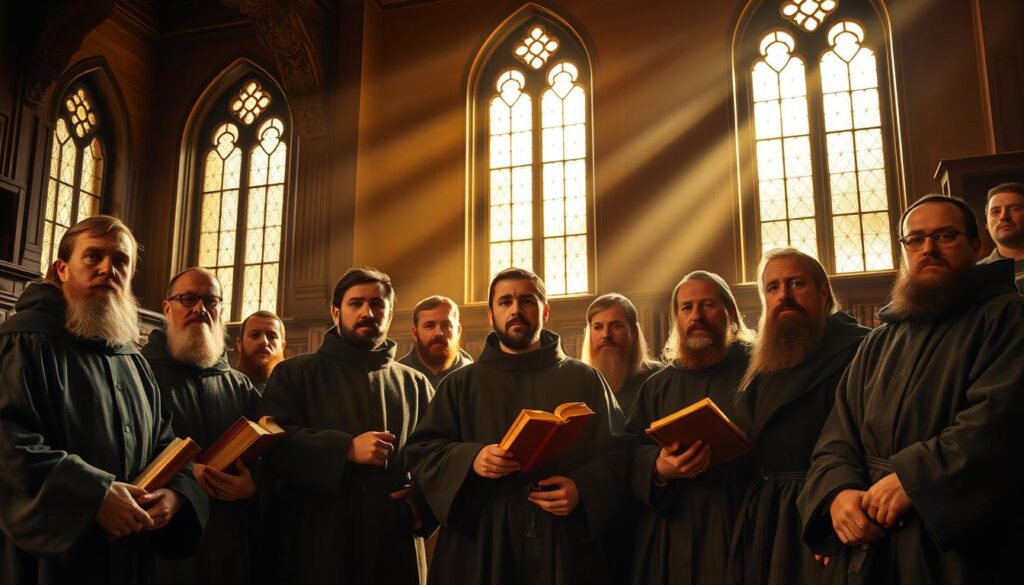
a group of protestant reformers in the 16th century, standing tall and resolute, with determination etched on their faces. They are dressed in the austere, somber attire of the time, positioned in a dimly lit, wood-paneled study, surrounded by heavy tomes and scrolls. Beams of warm, golden light filter in through tall, leaded windows, casting a dramatic, chiaroscuro effect. The reformers' gazes are fixed, as if deep in theological discourse, the weight of their mission palpable in the air. The scene evokes a sense of intellectual rigor, moral conviction, and the pivotal historical moment that would reshape the religious landscape of Europe.

Martin Luther’s Revolutionary Vision

A German monk’s inkpot changed everything in 1517. Luther’s radical claim – that grace alone saves – challenged centuries of tradition. His translation of scripture into German let ordinary people access God’s truth directly.

Three principles defined his theology:

  • Scripture as ultimate authority
  • Salvation through faith, not deeds
  • Every believer’s right to interpret God’s word

John Calvin’s Systematic Approach

While Luther sparked the fire, Calvin built the furnace. His Institutes of the Christian Religion organized Protestant thought into clear doctrine. The concept of predestination became his hallmark – the belief that God’s plan shapes human destiny.

Calvin’s Geneva became a laboratory for religious ideas. His emphasis on education created lasting impacts:

  • Schools for biblical literacy
  • Systematic view of scripture
  • Church-state cooperation models

Other reformers like Zwingli and Knox expanded these ideas across Europe. Their work proved that belief could adapt to cultural changes while keeping Jesus Christ central. Together, they laid groundwork for ongoing religious dialogue – a legacy that still shapes modern spirituality.

Theological Concepts and Core Doctrines

Five Latin phrases transformed how believers understood their relationship with God. The Five Solae became bedrock principles of Reformation theology, offering clear alternatives to medieval Catholic teachings. These concepts still shape debates about salvation and spiritual authority today.

Sola Scriptura, Sola Fide, and Solus Christus

Sola Scriptura placed the Bible above church tradition. Reformers argued scripture alone held divine truth, challenging papal decrees. This principle empowered ordinary people to interpret God’s word personally.

Sola Fide redefined salvation as a gift received through faith, not earned by good deeds. As Luther wrote: “Faith is the yes of the heart.” This shift made personal trust in Jesus Christ central to Christian faith.

Solus Christus declared no human mediator needed between believers and God. “There’s one God and one mediator,” stated Paul’s letter to Timothy. Reformers used this to dismantle priestly hierarchies.

Principle Core Idea Modern Influence
Sola Scriptura Bible as ultimate guide Encourages personal Bible study
Sola Fide Faith-based salvation Inspires grace-centered worship
Solus Christus Direct Christ connection Supports diverse prayer practices
Sola Gratia Unearned divine favor Shapes humility teachings
Soli Deo Gloria God-focused purpose Informs service-oriented faith

Later thinkers would expand these ideas in unexpected ways. Some blended grace with human experience, while others saw God’s glory in everyday actions. Yet all grappled with the reformers’ original vision – a belief system rooted in scripture, faith, and Christ alone.

The Role of the Bible in Shaping Faith

Sacred texts have always shaped how communities understand divinity. For centuries, the Bible stood as humanity’s ultimate guide to truth, its pages seen as direct messages from God. But the 19th century brought seismic shifts that reshaped this belief.

Biblical Authority and Interpretation

Earlier generations viewed scripture through unwavering devotion. Most people saw biblical stories as literal fact, their meaning fixed for all time. This changed when scholars began treating the text as both divine inspiration and historical artifact.

Three key developments altered biblical understanding:

  • Archaeological discoveries challenged traditional timelines
  • Scientific theories reshaped creation narratives
  • Literary analysis revealed cultural influences

These changes didn’t weaken faith for many believers – they deepened it. As one theologian noted: “True religion grows when we engage both heart and mind.” Modern readers now balance spiritual authority with critical knowledge, creating dynamic conversations about God’s living word.

FAQ

How does modern Protestant thought connect to the Reformation?

Modern movements build on ideas from the 16th-century Reformation, like sola scriptura and grace through faith. Figures like Martin Luther and John Calvin laid the groundwork for today’s emphasis on scripture and personal faith.

What role does the Bible play in shaping these beliefs?

The Bible is seen as the ultimate authority, guiding teachings and practices. Sola Scriptura—meaning “Scripture alone”—emphasizes its centrality, rejecting traditions that conflict with biblical truth.

Who were key influencers in early Protestant history?

A: Martin Luther sparked the Reformation by challenging church practices in 1517. John Calvin later shaped Reformed Theology, focusing on God’s sovereignty and predestination. Earlier reformers like Jan Hus also paved the way.

How do doctrines like Sola Fide impact daily faith?

A: Sola Fide (“faith alone”) teaches that salvation comes through belief in Christ, not deeds. This idea fosters a personal relationship with God and influences how believers approach worship and ethics.

What distinguishes modern movements from earlier reforms?

Earlier reforms focused on correcting church practices. Today’s discussions often address cultural shifts, science, and social justice while upholding core doctrines like grace and biblical authority.

Why is Karl Barth significant in recent theological discussions?

A: Karl Barth reshaped 20th-century theology by stressing God’s revelation through Jesus Christ. His work countered liberal theology, reviving interest in scripture and divine grace.

How did groups like the Hussites influence later changes?

The Hussites, led by Jan Hus, challenged church authority a century before Luther. Their calls for reform and emphasis on scripture inspired later movements, showing dissent’s role in shaping faith.

The Growth of Protestantism in Brazil: A Fascinating Story


Imagine a nation where nearly everyone shared the same faith for generations. Now picture that same place experiencing one of history’s fastest religious shifts. This isn’t fiction—it’s Brazil’s reality over the past 40 years.

While Catholicism dominated the country for centuries, dynamic new faith communities have reshaped spiritual life. Vibrant worship styles and community-focused ministries resonate with modern Brazilians seeking personal connections to faith. The Assemblies of God and Universal Church of the Kingdom of God stand out as pioneers driving this change.

Demographics play a crucial role. As the nation’s population more than doubled since 1980, urban centers became hubs for religious experimentation. These growing cities created ideal conditions for alternative beliefs to take root and flourish.

This transformation matters beyond church walls. It influences politics, culture, and even global religious trends. Understanding how a traditionally Catholic society embraced new spiritual paths offers insights into modern identity formation and social change.

Key Takeaways

  • Brazil has experienced one of the world’s fastest religious shifts in recent decades
  • Pentecostal groups lead this spiritual transformation through adaptive practices
  • Urban population growth created fertile ground for new belief systems
  • Religious changes impact multiple aspects of Brazilian society
  • This shift reflects global patterns of modernization and faith evolution

Historical Overview of Protestantism in Brazil

Brazil’s journey toward religious diversity began with 19th-century missionaries carrying Bibles instead of swords. These pioneers built more than churches – they created schools that taught literacy alongside scripture and hospitals offering both prayer and penicillin. Their holistic approach laid groundwork that would bear fruit decades later.

Foundations Through Service

For nearly 80 years, these efforts yielded modest results. Missionaries established printing presses and radio stations, yet conversion rates remained low. A Lutheran pastor in 1896 noted: “We plant seeds knowing our grandchildren will harvest.” This patience proved vital as communities gradually embraced new ideas through education and healthcare access.

Immigration Sparks Change

Southern regions saw different growth patterns. German immigrants arriving between 1824-1969 brought their Lutheran traditions, creating self-sustaining communities. While these groups initially focused on preserving culture, their churches became bridges for broader spiritual exploration over time.

The early 1900s brought a pivotal shift. Two Swedish preachers arrived in Belém in 1910, founding what’s now the country’s largest Protestant denomination. Their energetic services and emphasis on personal spiritual experiences contrasted sharply with formal rituals, appealing to urban populations during rapid modernization.

Understanding the Rise of Pentecostal and Neo-Pentecostal Movements

When spiritual lightning struck in the late 20th century, it ignited a faith revolution unlike anything seen before. At its core stood two dynamic forces: Pentecostal enthusiasm and neo-Pentecostal innovation. These groups didn’t just fill pews – they rewrote the rules of religious engagement.

Key Denominations and Their Origins

The Assemblies of God laid early groundwork with spirited worship styles. But the real game-changer emerged in 1977 when Edir Macedo founded the Universal Church of the Kingdom of God. This neo-Pentecostal powerhouse blended fiery sermons with bold promises: “God doesn’t want his children poor,” Macedo declared, championing prosperity theology.

By 2000, census data showed 11.7% of the population identified as Pentecostal. The Universal Church alone claims 4.8 million members, backed by media muscle like Record TV – Brazil’s second-largest network. Such growth transformed storefront churches into national influencers.

Cultural and Social Impact

These movements became lifelines for working-class communities. Beyond Sunday services, they offered job networks, addiction support, and financial advice. Members found more than faith – they gained practical tools for daily survival.

The cultural ripple effects reshaped society. From pop music to political campaigns, Pentecostal values now permeate public life. As one worshiper noted: “Our church doesn’t just save souls – it builds neighborhoods.” This grassroots empowerment continues to redefine what spiritual community means in modern times.

The Role of Economic Transformation and Male Earnings

Faith communities are rewriting economic rules in unexpected ways. Research spanning three decades reveals a powerful connection between spiritual participation and financial stability for vulnerable populations.

A peaceful gathering of a diverse faith community, set against a backdrop of a thriving urban landscape. In the foreground, a group of people from various backgrounds engage in discussion, their expressions reflecting a sense of shared purpose and economic collaboration. The middle ground features a bustling commercial district, with small businesses and storefronts showcasing the vibrant economic activity of the community. In the background, modern high-rise buildings and infrastructure symbolize the integration of spiritual and economic progress. Warm, diffused lighting creates a welcoming atmosphere, emphasizing the harmonious relationship between faith and economic transformation.

Religious Impact on Earnings and Productivity

Studies show men with limited formal education earn 18% more in areas with strong faith-based networks. This boost proves strongest among non-white groups, where traditional job markets often exclude workers. How does this happen?

Factor Impact on Earnings Most Affected Group
Substance Abuse Reduction +22% productivity Men aged 25-40
Church Job Networks 34% find work through members Less educated workers
Employer Perception 41% prefer evangelical hires Service industry roles

Job Networks and Community Benefits

Congregations function as unofficial employment agencies. A construction worker shares: “My pastor connected me with three contractors last year.” These networks prove vital in areas lacking formal job centers.

The economic ripple effects extend beyond individual paychecks. Families gain stability, while employers benefit from reliable workers. This unique ecosystem helps explain why certain groups thrive despite systemic challenges.

Data-Driven Insights into Religious Change

Numbers never lie – and Brazil’s census records reveal a spiritual revolution in hard statistics. Over five decades, the data shows a clear pattern: gradual shifts became seismic change as millions redefined their beliefs.

The 2010 census marked a historic flip. For the first time, Catholic numbers dropped – from 125 million to 123 million – while the total population grew by 20 million. Meanwhile, Protestant ranks swelled from 26 million to 42 million in just ten years.

Year Catholic (%) Protestant (%) Total Population
2000 74 15 169M
2010 65 22 190M

What explains this shift? Demographers found something surprising. Birth rates and immigration numbers couldn’t account for the growth. As one researcher noted: “This isn’t about babies being born into faith – it’s adults actively choosing new paths.”

Urban areas drove the trend hardest. Cities with over 500,000 residents saw Protestant growth rates triple rural zones during the 2000s. Education levels also played a role – 63% of converts had completed high school, compared to 41% of lifelong Catholics.

These data points paint more than graphs. They reveal millions of personal journeys – people seeking communities that speak to modern life’s challenges. As the years progress, this spiritual reshuffling continues rewriting the nation’s cultural map.

Religious Switching: From Catholicism to Protestantism

What makes millions walk away from centuries-old traditions? A 2006 Pew survey reveals 45% of Pentecostals once belonged to the Catholic Church. This mass migration of believers reshapes spiritual landscapes through personal choice rather than birthright.

A dimly lit interior, a Catholic church facade fading into the background. In the foreground, a figure stands at a crossroads, pondering their path. To one side, a grand cathedral with intricate stained glass windows; to the other, a modern Protestant church, its sleek architecture contrasting the ornate gothic. Rays of warm light filter through, casting a pensive glow. The figure's face is partly obscured, reflecting the weight of their spiritual decision. The scene evokes a sense of transition, a personal journey of religious exploration and discovery.

Conversion Patterns and Motivations

Converts often seek faith that feels alive. Maria, a former Catholic from São Paulo, explains: “I craved worship where my voice mattered.” Her story reflects many who join vibrant groups offering:

  • Emotional connection through music and prayer
  • Practical support for financial or family struggles
  • Clear paths to personal transformation

Generational Shifts in Religious Identity

Age plays a surprising role. While 73% of those over 70 keep Catholic ties, only 63% under 30 do. Younger people increasingly choose:

Generation Catholic (%) Protestant (%)
70+ years 73 17
15-29 years 63 22

A researcher notes: “This isn’t rebellion – it’s seeking faith that speaks to modern life.” As older groups shrink, these changes suggest lasting cultural transformation.

Social and Demographic Trends Amid Urbanization

Cities became spiritual laboratories as Brazil’s urban explosion reshaped lives. Between 1970-2010, the urban population surged from 56% to 84% – faster than China’s growth and triple Germany’s rate. This shift created new social landscapes where traditional structures crumbled and fresh opportunities emerged.

Impact of Urban Migration

Migrants arriving in São Paulo and Rio faced a stark reality. Anthropologist Gilberto Velho observed: “They traded village roots for concrete jungles, losing family networks that once guided life choices.” Catholic parishes struggled to keep pace in sprawling favelas, while adaptable congregations filled the void.

Consider these contrasts in major areas:

City Urban Population 2010 Catholic Percentage
Rio de Janeiro 97% urban 46%
National Average 84% urban 65%

Newcomers found more than faith in storefront churches. These spaces offered job leads, addiction support, and instant community. As one migrant noted: “The church became my extended family when mine was 2,000 miles away.”

This urban transformation unfolded over mere decades, not centuries. The speed left traditional institutions scrambling while agile groups capitalized on changing needs. Today’s city dwellers navigate a spiritual marketplace unimaginable to their rural grandparents.

Health, Temperance, and Behavioral Change

Faith communities are reshaping daily habits with life-changing results. Through practical teachings and peer support, members achieve measurable improvements in well-being that ripple through families and neighborhoods.

Influence on Substance Abuse and Public Health

Young adults show remarkable transformation rates. Studies reveal 68% reduce alcohol use within six months of joining congregations, with cachaça consumption dropping most sharply. This shift proves vital in areas where binge drinking traditionally marked social gatherings.

Health outcomes tell a compelling story. Infant survival rates climb 10% in families adopting faith-based practices. Men particularly benefit – 42% report better job performance after cutting substance use. “The church gave me tools to rebuild,” shares a former construction worker now three years sober.

These changes create community-level impacts. Households with stable routines spend more time nurturing children and less money on vices. While critics debate methods, the results speak clearly: altered behaviors lead to longer lives and stronger social bonds.

FAQ

How did Protestant churches gain momentum in Brazil?

Growth accelerated in the 20th century, driven by Pentecostal and neo-Pentecostal movements like the Assemblies of God and Universal Church of the Kingdom of God. Urbanization, media outreach, and community-focused programs also played key roles.

What cultural shifts accompanied the rise of Pentecostal groups?

These groups emphasized personal transformation, temperance, and family values. Their services blended lively worship with practical life advice, resonating with urban populations seeking stability amid rapid social changes.

How does religious affiliation affect economic opportunities?

Studies suggest Protestant men often earn more than Catholic peers, partly due to job networks within congregations. Abstinence from alcohol and focus on productivity further enhance workplace reputation in certain industries.

Why do younger generations switch religions more often?

Urbanization exposed youth to diverse beliefs, while Protestant groups offered dynamic communities. Many also distanced themselves from traditional Catholic practices, seeking faiths that aligned with modern lifestyles.

What role did the Universal Church of the Kingdom of God play?

Founded in Rio de Janeiro in 1977, it revolutionized outreach using TV and radio. Its prosperity theology and emphasis on miracles attracted millions, making it one of Brazil’s most influential neo-Pentecostal denominations.

How has Protestant growth impacted public health trends?

Congregations often discourage smoking and drinking. Regions with higher Protestant populations report lower substance abuse rates, contributing to broader health improvements in urban areas.

Are men more likely to join Protestant churches than women?

While membership skews slightly female, men benefit visibly from social networks and behavioral expectations. Churches often promote male leadership roles, appealing to those seeking structure and community respect.

Discover the Protestant Union: A Comprehensive Guide


Welcome to your gateway into early 17th-century European history! This guide explores a pivotal alliance formed during a time of intense religious and political tension. On May 14, 1608, Frederick IV of the Palatinate united a group of German territories under a shared mission: to protect their lands, rights, and beliefs.

The coalition brought together Calvinist and Lutheran rulers, two groups often divided by theology. Despite these differences, they prioritized collective security against rising Catholic influence. Their cooperation marked a rare moment of unity in an era defined by division.

Lasting just 13 years, the alliance dissolved in 1621—but its impact lingered. Internal disagreements and external pressures weakened its structure, foreshadowing the devastating Thirty Years’ War. Through this guide, you’ll uncover how princes, territories, and faith shaped one of history’s most fragile yet influential partnerships.

Key Takeaways

  • Founded in 1608 to defend religious and territorial rights in the Holy Roman Empire
  • United Calvinist and Lutheran regions under a defensive pact
  • Countered Catholic political expansion during the Counter-Reformation
  • Dissolved in 1621 due to internal conflicts and external pressures
  • Key members included powerful princes from influential German territories

Understanding the Historical Context and Significance

Imagine a map of Europe where every color represents a different faith. This was reality after the Protestant Reformation splintered religious unity. Central Europe became a chessboard of competing beliefs, with rulers using religion to cement power and control territories.

A Divided Empire

The 1555 Peace of Augsburg tried to calm tensions by letting princes choose their realm’s faith. “Cuius regio, eius religio” became the rule—but only for Catholics and Lutherans. Calvinists, growing in influence, got no protections. This oversight planted seeds for future conflict.

By 1608, Catholic leaders demanded lands taken since 1552 be returned. For Protestant rulers, this threatened their rights and economic stability. The Holy Roman Emperor faced pressure from both sides, struggling to maintain authority.

Ripples Across Europe

The response came swiftly. When Protestant territories united defensively, Catholic powers formed their own league in 1609. Duke Maximilian of Bavaria led this coalition, creating two armed blocs. Religious identity now dictated alliances across the empire.

This polarization reached beyond German borders. Catholic nations backed the Catholic League, while Protestant states watched nervously. The stage was set for a clash that would reshape European politics for generations.

History and Formation of the protestant union

Tensions reached a boiling point in 1607 when Catholic forces seized Donauwörth. Duke Maximilian of Bavaria and Emperor Rudolf II forced the town to restore Catholic practices. This bold move sent shockwaves through German territories.

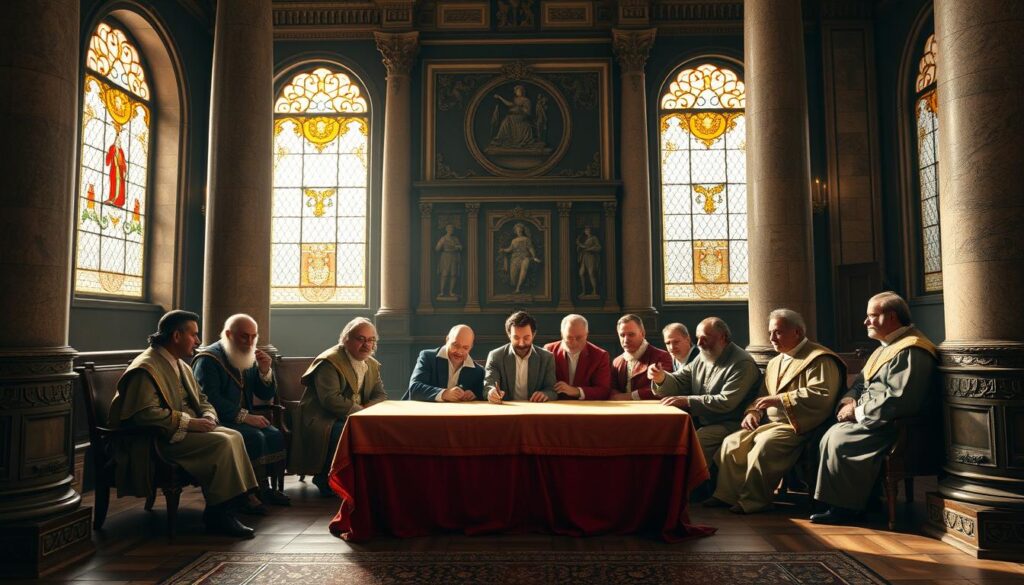
Stately chamber, ornate furnishings, stained glass windows casting warm light. In the center, a table draped in rich fabric, surrounded by solemn-faced men in formal attire, signing a parchment document - the Protestant Union treaty. Tension palpable in the air, as this pivotal moment in history unfolds. Imposing stone columns frame the scene, conveying a sense of gravity and significance. Soft chiaroscuro lighting highlights the faces and hands of the signatories, creating an atmosphere of solemnity and purpose. A momentous occasion captured in intricate detail, a visual testament to the birth of the Protestant Union.

Breaking Point at the Imperial Diet

By 1608, Catholic leaders demanded church lands be returned. Protestant rulers saw this as a threat to their rights. When their objections were ignored at the Imperial Diet, princes walked out in protest.

Six leaders gathered secretly at Auhausen Monastery that May. Led by Frederick IV, Elector Palatine, they signed a groundbreaking defensive pact. This coalition became known as the Protestantische Union.

Rules for Survival

The alliance established strict guidelines to maintain unity:

Commitment Purpose
Exclusive loyalty Prevent divided alliances
Secret correspondence Share intelligence securely
Joint decision-making Present unified demands
Religious tolerance Ban attacks through books/sermons
Military support Immediate aid during attacks

Frederick IV’s leadership proved crucial. The Elector Palatine convinced rival factions to prioritize security over theological debates. Their treaty created Europe’s first mutual defense pact among diverse states.

Membership, Dynamics, and Internal Challenges

Picture a coalition stretching from bustling trade hubs to sprawling principalities. Over 25 territories joined the alliance, creating a patchwork of power across German lands. Wealthy cities like Nuremberg stood beside princes controlling vast farmlands and forests.

Major Players and Missing Pieces

The Palatinate led with military resources and political influence. Württemberg brought strategic lands, while Hesse-Kassel offered troops. Free cities like Strasbourg added economic muscle through trade networks.

But glaring gaps weakened the alliance. The Elector of Saxony, a Lutheran heavyweight, refused to join. His absence left a leadership vacuum and reduced trust among members. Smaller states wondered: “Why risk our safety if powerful neighbors won’t commit?”

When Allies Became Rivals

Lutheran and Calvinist rulers agreed on opposing Catholic policies but clashed on everything else. Disputes erupted over:

  • Funding military defenses
  • Responding to imperial decrees
  • Sharing intelligence with foreign powers

City leaders prioritized protecting trade routes over territorial disputes. Meanwhile, princes argued about troop deployments. These divisions often stalled urgent decisions, giving opponents time to exploit weaknesses.

Despite clever leadership structures, the alliance struggled to act as one. When crisis struck Bohemia in 1618, members couldn’t agree on support levels. This hesitation ultimately doomed their collective defense efforts.

Conclusion

The alliance’s collapse in 1621 marked a turning point in European history. When Frederick V accepted Bohemia’s crown in 1619, members faced a critical choice. Their Treaty of Ulm decision to abandon mutual defense shattered trust and left their leader vulnerable to Emperor Ferdinand II’s wrath.

By May 1621, the coalition dissolved under imperial pressure. This failure didn’t just end an alliance—it ignited the Thirty Years’ War. Religious tensions exploded into full-scale conflict, reshaping borders and power structures across the continent.

Though short-lived, the partnership left lasting lessons. Later groups like the Heilbronn League learned from its mistakes, blending military strategy with foreign support from Sweden and France. The original alliance showed how shared beliefs could unite states, but also how fear could fracture them.

Today, this story reminds us that cooperation requires more than common goals. It demands compromise, resources, and courage to defend principles—even when risks loom large. The echoes of these 17th-century struggles still resonate in modern diplomacy and collective security efforts.

FAQ

What was the main goal of the alliance formed in 1608?

The group aimed to protect the rights of reformers within the Holy Roman Empire. It sought to counter growing Catholic influence and defend territories against pressures from figures like Emperor Ferdinand II.

Why did tensions rise between Lutheran and Calvinist members?

Disagreements over doctrine and leadership roles caused friction. Lutheran leaders, like the Elector of Saxony, often distrusted Calvinist approaches, weakening unified action against external threats.

How did the Treaty of Ulm affect the alliance’s stability?

Signed in 1620, the treaty revealed divisions. Some members refused to support Frederick V’s claim to Bohemia, leading to fragmentation and eventual dissolution after the Battle of White Mountain.

Which external powers later supported the dissolved group’s cause?

Nations like Sweden and France intervened in later phases of the Thirty Years’ War. Their involvement shifted the conflict’s dynamics, aiding former members against Habsburg forces.

What role did Duke Maximilian of Bavaria play?

As a Catholic League leader, he opposed the alliance militarily. His victory at White Mountain in 1620 crushed Frederick V’s forces, accelerating the group’s decline.

Did the Peace of Augsburg influence the alliance’s creation?

Yes. The 1555 peace allowed rulers to choose their realm’s religion but excluded Calvinists. This exclusion fueled demands for broader protections, contributing to the 1608 coalition.

Protestant vs Catholic Work Ethic: What’s the Difference?


For over a century, scholars have debated how religious values shape attitudes toward labor and success. At the heart of this discussion lies a fascinating question: do different faith traditions foster distinct approaches to productivity and economic life?

German sociologist Max Weber sparked this conversation in 1905 with his groundbreaking theory linking certain religious beliefs to the rise of modern capitalism. His research suggested that specific values emphasizing discipline and frugality became cultural cornerstones in some societies.

But new discoveries are reshaping old assumptions. Historians like Thomas Barnebeck Andersen reveal that organized efforts to promote diligence and restraint existed long before the Reformation. Centuries-old monastic communities, for instance, developed structured systems blending spiritual devotion with practical labor.

This exploration isn’t just about historical curiosity. Understanding these roots helps explain why different cultures prioritize various aspects of professional life – from teamwork styles to leadership philosophies. As global workplaces become more interconnected, recognizing these nuances matters more than ever.

Key Takeaways

  • Historical theories about productivity values continue to influence modern workplace culture
  • New research challenges long-held assumptions about religious influences on economics
  • Early monastic traditions developed systematic approaches to labor management
  • Cultural values shape career choices and leadership styles worldwide
  • Globalization increases the need to understand diverse professional philosophies
  • Historical patterns still affect modern business practices and economic systems

Historical Roots of Work Ethics in Religion

Long before modern theories emerged, spiritual communities laid the groundwork for how societies view productivity. Ancient traditions blended practical labor with divine purpose, creating frameworks that shaped entire civilizations.

The Monastic Blueprint for Productivity

The Cistercian Order, founded in 1098, revolutionized labor management centuries before industrialization. These communities transformed rugged landscapes into thriving agricultural hubs using water-powered mills and organized land systems called granges.

Their approach spread beyond monastery walls through lay members who lived semi-monastic lives. This cultural exchange created lasting patterns – regions near these monasteries showed stronger economic growth even 500 years after their closure.

Sacred Texts as Labor Guides

Early Christian teachings framed daily tasks as acts of devotion rather than punishment. Passages like “Whatever you do, work heartily” (Colossians 3:23) encouraged believers to see ordinary jobs as spiritually meaningful.

This perspective differed from older views of labor as mere survival. Instead, it promoted the idea that skillful craftsmanship and careful resource management honored divine creation. Such principles helped shape both religious and secular approaches to career success across generations.

Evolution of Protestant Work Beliefs

The 16th century reshaped how societies perceived daily labor through theological innovation. Religious reformers introduced ideas that turned ordinary jobs into spiritual missions, creating ripple effects still felt today.

Max Weber’s Theories and the Reformation Impact

Martin Luther’s translation of Beruf blended earthly jobs with divine purpose. This concept suggested that bakers, farmers, and craftspeople served God through skilled labor – not just clergy.

A dimly lit 17th century study, shelves of leather-bound books lining the walls. At the center, a Protestant scholar sits hunched over a large wooden desk, quill in hand, meticulously recording his thoughts on the nature of labor and divine purpose. Soft candlelight casts a warm glow, highlighting the pensive expression on his face. The room is thick with an atmosphere of scholarly introspection, a visual representation of the origins of the Protestant work ethic. High contrast lighting emphasizes the gravity of the scene, while muted tones evoke a sense of historical weight. The composition draws the viewer's eye to the focal point of the scholar, capturing the intellectual foundations of this influential belief system.

Max Weber expanded this idea in his book The Protestant Ethic and the Spirit of Capitalism. He argued that Calvinist teachings about predestination created existential anxiety. Believers sought signs of divine election through disciplined productivity and financial success.

“Labour must be performed as if it were an absolute end in itself,” Weber wrote. This mindset required societies to abandon medieval views of labor as drudgery. Instead, people began seeing relentless effort as both moral duty and path to spiritual assurance.

Cultivating the Calling as a Modern Principle

Early Protestant communities treated time management like sacred practice. Wasting hours became sinful, while efficient work signaled devotion. These values gradually shaped modern economics through thrift and reinvestment.

Today, the idea of vocational purpose influences career coaching and leadership training. Many professionals still seek meaning beyond paychecks, framing ambition as personal calling. This cultural legacy shows how centuries-old beliefs continue molding our relationship with productivity.

protestant work ethic vs catholic: A Comparative Review

Modern workplaces still feel the ripple effects of centuries-old religious debates about labor’s spiritual meaning. These contrasting views shaped everything from daily routines to national economic policies.

Distinct Philosophical Foundations

Catholic teachings traditionally framed labor through Genesis’ concept of “toil” – a necessary burden requiring endurance. This perspective emphasized collective spiritual responsibility guided by church leadership.

Reformation thinkers introduced a radical shift. They reimagined ordinary jobs as divine stewardship, where excellence in craft became worship. Salvation through grace alone transformed labor from obligation to grateful response.

Aspect Traditional Catholic View Reformation Perspective
Purpose of Labor Penance for original sin Expression of faith
Role of Community Church-mediated salvation Individual divine calling
Economic Impact Regional thrift patterns Entrepreneurial growth
Modern Manifestation Collective work rituals Personal career missions

Cultural Transmission and Long-Term Societal Impacts

Historical patterns show remarkable staying power. European surveys reveal stronger work discipline in areas near former monastic centers – even among non-religious residents. This cultural imprint persists centuries after monasteries closed.

Economic development maps reveal lasting differences. Regions shaped by individual vocational models often developed distinct approaches to innovation and wealth creation compared to areas with stronger communal traditions.

Economic and Social Implications of Work Ethics

The fingerprints of historical labor philosophies remain visible in modern economic landscapes. Centuries-old values continue shaping how societies create wealth and measure progress.

A detailed economic growth chart depicting a vibrant upward trajectory, with clean lines and a crisp, professional appearance. The chart is rendered in a minimalist style, with a neutral color palette of blues, grays, and whites, creating a sense of balance and sophistication. The background is a seamless gradient, providing a clean, uncluttered canvas for the data visualization. The chart elements, such as the x and y axes, gridlines, and data points, are rendered with precision and clarity, conveying a sense of authority and credibility. The overall composition evokes a mood of progress, prosperity, and the power of hard work.

Capitalism, Thrift, and Wealth Accumulation

The 19th century brought a dramatic shift in financial priorities. Industrialist Andrew Carnegie declared wealth itself as “the true measure of civilized life”, sparking a global race for capital accumulation.

This philosophy transformed economic systems. Where earlier models valued frugality, modern markets now prioritize:

  • Investment in scalable enterprises
  • Aggressive expansion strategies
  • Personal wealth as status marker
Era Economic Focus Social Impact Modern Legacy
Pre-1800s Community sustenance Stable populations Regional trade networks
Post-Industrial Capital growth Urban migration Global corporations

Population Growth and the Persistence of Cultural Values

Regions with strong historical work traditions show remarkable staying power. OECD data reveals that areas near former Cistercian monasteries still outperform neighbors in:

  • Educational attainment rates
  • Business startup frequency
  • Technological adoption speed

These patterns form self-reinforcing cycles. Communities valuing disciplined labor attract skilled workers, creating hubs for economic development. Over generations, these advantages compound into measurable differences in national success metrics.

Modern Interpretations and Relevance of Traditional Work Ethics

Today’s professionals face a fascinating dilemma: how to balance historical values with evolving ideas about life’s purpose. The search for meaningful careers now drives decisions as much as financial security once did.

Meaningful Work and the Modern Calling

Yale researcher Amy Wrzesniewski discovered three ways people view their jobs:

  • A paycheck-driven job
  • A status-focused career
  • A purpose-oriented calling

Her study revealed those embracing work as a calling reported 32% higher life satisfaction. This mirrors historical spiritual concepts, but with a modern twist: fulfillment now often replaces divine duty as the primary motivator.

Technological Advancements and the Hustle Ethic

Digital tools have reshaped productivity expectations. Silicon Valley’s “always-on” culture exemplifies this shift, blending round-the-clock availability with mission-driven ambition.

“We’ve created systems where busyness masquerades as purpose,” notes workplace analyst Tara Robertson.

Aspect Traditional Model Modern Approach
Focus Duty & Discipline Self-Expression
Key Driver Economic Need Personal Growth
Time Investment Fixed Hours Continuous Engagement
Outcome Financial Security Existential Fulfillment

Surveys show 68% of workers under 40 would sacrifice earnings for roles aligning with their values. This trend challenges older success metrics, creating new tensions between productivity and well-being in our always-connected world.

Conclusion

The way societies value productivity remains deeply rooted in centuries-old debates about life’s purpose. Both religious traditions shaped modern attitudes toward success, though cultural values adapt faster than institutions. While Max Weber’s “ethic spirit capitalism” theory made history, new studies show similar principles existed in medieval communities.

Today’s economic patterns still reflect these foundations. Regions with strong vocational heritage often prioritize innovation differently than areas valuing collective responsibility. This explains why leadership styles vary across countries, even in our interconnected global economy.

Modern professionals blend old principles with new priorities. The search for meaningful careers now balances personal growth with communal well-being. As automation reshapes the modern workplace, these age-old questions gain fresh urgency: What makes labor valuable? How do we measure progress?

Whether analyzing European social models or tech hubs’ hustle culture, historical influences linger. Understanding these roots helps navigate evolving business practices and career choices in a world where work increasingly defines identity and purpose.

FAQ

How does Max Weber’s theory connect to today’s workplace culture?

Max Weber linked the Protestant Work Ethic to capitalism’s rise, emphasizing hard work as a moral duty. Modern hustle culture echoes this idea, though many now prioritize balance alongside ambition.

What separates Catholic and Protestant views on labor’s purpose?

Catholic teachings traditionally tied labor to community service and spiritual growth, while Protestant reformers framed it as a personal calling to glorify God. This shaped distinct approaches to wealth and duty.

Did early monastic groups influence modern work attitudes?

Yes! Groups like the Cistercians blended prayer with disciplined labor, creating templates for productivity. Their focus on routine and craftsmanship still resonates in professional standards today.

Can religious work values boost economic growth?

Studies suggest societies valuing thrift and delayed gratification, like those influenced by the Protestant Ethic, often experience faster development. However, globalization has blended these cultural patterns over time.

Why do some cultures retain strong work ethics despite secularization?

Values like perseverance often outlive their religious origins, becoming ingrained in education and family systems. For example, Germany’s emphasis on apprenticeships reflects this legacy.

How has technology reshaped traditional ideas about productivity?

Digital tools blurred lines between work and life, challenging old notions of “hard labor.” Yet, the rise of gig economies and side hustles shows how hustle culture adapts Weber’s theories for the 21st century.

Protestant Knights: Uncovering Their Remarkable Story


Let’s travel back to the 11th century, where a small group of Italian Christians laid the foundation for one of history’s most enduring organizations. In 1050, they received land in Jerusalem from the Caliph of Egypt, building a hospital, church, and convent that welcomed pilgrims of all faiths. This humble beginning would spark a legacy of service spanning nearly a thousand years.

By 1099, Crusader rule transformed Jerusalem—and the caregivers managing the hospital. Their work caught the attention of Pope Paschal II, who formally recognized them as a religious order in 1113. With papal protection, they adopted the eight-pointed white cross, symbolizing the Beatitudes, and became known as the Order of St. John.

Over centuries, this group evolved into both a military force and a humanitarian network. While their early focus was medical care, they later took on defensive roles during the Crusades. The Protestant Reformation eventually led to new branches, each preserving core values while adapting to modern needs.

Today, descendants of this ancient tradition operate hospitals, disaster relief programs, and community services worldwide. Their story isn’t just about the past—it’s a living testament to how faith-driven organizations can shape global compassion.

Key Takeaways

  • Origins trace back to an 11th-century Jerusalem hospital serving all religions
  • Gained papal recognition in 1113 as the Order of St. John
  • Distinctive eight-pointed cross represents spiritual principles
  • Evolved from medical caregivers to protective forces during medieval conflicts
  • Modern branches continue humanitarian work across six continents

Historical Origins and Transformation

In the bustling streets of 12th-century Jerusalem, caregivers at the hospital of St. John began reshaping history. Their iconic eight-pointed cross—a symbol of hope—soon became recognized across continents. This humble medical center would spark an evolution spanning 900 years.

Foundations in Jerusalem and Early Crusader Era

By 1150, the order st. John had mastered dual roles: healing pilgrims and guarding trade routes. Their network of priories stretched from the Holy Land to England, creating Europe’s first international aid system. Eight regional “tongues” streamlined operations while preserving local customs.

From Holy Land Hospitals to Military Protection

When Muslim forces reclaimed john jerusalem in 1187, the organization adapted brilliantly. They built war galleys with onboard surgeons—medieval floating hospitals. After establishing headquarters in Malta (1530), their orders st. john became legendary for resisting Ottoman sieges while maintaining emergency clinics.

The grand priory system proved crucial during these changes. Though forced from Rhodes and Cyprus, their Maltese fortress became a beacon of resilience. This strategic relocation preserved their mission through turbulent centuries.

The Rise of Protestant Knights: Faith, Service, and Legacy

Religious upheaval in the 1500s tested Europe’s oldest charitable network. As the 16th century unfolded, the Order St. John faced its greatest challenge—navigating the Protestant Reformation while maintaining its 400-year mission of care.

A grand castle of weathered stone stands tall against a backdrop of rolling hills, its towers and ramparts casting long shadows in the golden light of a setting sun. In the foreground, a squadron of Protestant knights, their armor gleaming, ride forth on proud steeds, banners snapping in the crisp autumn breeze. The scene exudes a sense of power, faith, and legacy - a testament to the remarkable story of these noble warriors who shaped the course of history. Soft beams of light filter through clouds, lending an air of reverence to the moment. The composition captures the essence of the Brandenburg region, where these knights rose to prominence, their deeds echoing through the ages.

Division During the Reformation and Emergence as Protestant Knights

The Bailiwick Brandenburg made history in 1530 by refusing to abandon Lutheran teachings. This German branch became independent, creating Europe’s first Protestant chapter of the ancient order. “Our hospitals need not bow to Rome,” declared their leaders, establishing clinics that blended medical care with reformed theology.

Across the English Channel, King Henry VIII dismantled Catholic institutions—including the Order St. John‘s British operations. His 1540 seizure of their properties forced members underground, though their ideals survived to resurface centuries later.

Transition from Religious to Charitable Mission

Despite expulsion by the Sovereign Order Malta in 1581, the Protestant branches thrived. The Bailiwick Brandenburg expanded orphanages while training surgeons. Their eight-pointed cross now symbolized unity in service, not division.

By century’s end, both Catholic and Protestant wings operated parallel hospital systems. This unexpected outcome proved humanitarian work could transcend doctrinal differences—a lesson still relevant today.

Diverse Orders and Global Activities

What began as medieval caregivers now spans six continents through four distinct branches. These groups maintain their historic mission while adapting to 21st-century needs through specialized programs and cross-border partnerships.

The Bailiwick of Brandenburg and Its Evolution

Germany’s Bailiwick Brandenburg leads modern efforts with 11 acute-care hospitals and 46 senior living facilities. Their 8,000 staff members and 30,000 volunteers form Europe’s largest faith-based care network. “We’re not just preserving history—we’re rewriting what compassionate service means,” notes a director at Johanniter Unfallhilfe ambulance service.

Modern-Day Commanderies in Europe and Beyond

From Stockholm to Cape Town, the order st. john adapts to local needs. Sweden’s branch runs elder care centers while advocating for refugees. The British venerable order maintains outposts in five Commonwealth nations, including disaster response teams in Australia.

Collaborative Humanitarian and Medical Services

Since 1961, the Alliance of the four orders st. John coordinates international projects. They share resources with the Catholic sovereign order Malta during crises. This partnership recently delivered medical supplies to conflict zones and supported political prisoners through legal aid programs.

Together, these groups assist over 2 million people annually. Their blend of ancient traditions and modern methods proves that 900-year-old ideals can still heal divided communities.

Conclusion

Nine centuries after Jerusalem’s first hospital opened its doors, the legacy of compassion continues through global partnerships. Since 1961, the Alliance of the Orders of Saint John unites five branches from Europe to Africa, coordinating disaster relief and medical programs. Their Bern headquarters fosters collaboration with the Sovereign Order Malta, proving ancient rivals can work together for modern good.

Look at France’s innovative approach: the Commandery operates family housing units in three Parisian hospitals. These 126 beds help parents stay near sick children—a direct link to medieval care traditions. Meanwhile, Germany’s Bailiwick Brandenburg deploys 38,000 professionals across clinics and senior centers.

What began as a single order st. john now thrives through adaptation. From training Syrian refugee nurses to funding cancer research, these groups show how timeless values meet today’s challenges. Their story reminds us that helping others remains humanity’s most enduring mission—one that started with bandages in Jerusalem and now spans continents.

FAQ

What is the connection between the Sovereign Order of Malta and Protestant orders?

The Sovereign Order of Malta traces its roots to medieval Catholic hospitaller traditions. During the Reformation, Protestant branches like the Bailiwick of Brandenburg emerged, maintaining similar ideals of service while adapting to new religious contexts. Both groups share historical ties but operate independently today.

How did the Bailiwick of Brandenburg evolve over time?

Founded in the 16th century, the Bailiwick of Brandenburg became a Protestant branch under Prussian protection. After surviving political changes, it reorganized into the Noble Order of Prussia and later the Order of St. John in Sweden. Today, it focuses on charitable projects and interfaith collaboration.

What role did King Henry VIII play in the history of these orders?

King Henry VIII dissolved Catholic institutions in England during the 16th century, including properties tied to the Knights Hospitaller. This led to the decline of Catholic orders in England but paved the way for Protestant-inspired groups to emerge across Northern Europe.

What charitable work do modern Protestant orders engage in?

Modern groups like the Bailiwick of Brandenburg prioritize medical care, disaster relief, and refugee support. They run hospitals, fund ambulance services, and partner with organizations like the Sovereign Order of Malta to address global humanitarian crises.

Where are the Protestant orders active today?

Commanderies exist in Germany, Sweden, Finland, France, Canada, and the United States. These branches operate care homes, youth programs, and first-aid training centers, reflecting their commitment to community service across generations.

How do these orders collaborate with other St. John organizations?

Groups like the Venerable Order of St. John and the Sovereign Order of Malta often work together on initiatives such as refugee resettlement and medical aid. Their shared heritage fosters partnerships in tackling modern challenges while respecting distinct traditions.

Protestantism’s Influence in China: Tracing Its Evolution


How does a foreign religious tradition take root in a society with ancient cultural traditions? This question lies at the heart of understanding how churches built on Western teachings became part of China’s modern spiritual landscape. Over decades, these communities have balanced their global roots with local practices, creating a unique blend of belief systems.

Since 1949, religious groups faced new challenges and opportunities under shifting political landscapes. Many adapted their practices to align with cultural expectations while preserving core principles. This delicate dance between tradition and transformation reveals much about how faith evolves in diverse settings.

Today, millions participate in worship services that reflect both historical teachings and contemporary Chinese values. The growth of these communities highlights their ability to thrive despite complex regulations. From humble beginnings to vibrant gatherings, their journey showcases resilience and innovation.

Key Takeaways

  • Protestant communities creatively merged global beliefs with Chinese cultural traditions
  • Government policies significantly shaped religious practices after 1949
  • Local congregations developed unique worship styles over time
  • Modern gatherings balance spiritual needs with societal expectations
  • Cultural adaptation helped foreign teachings gain lasting relevance

Historical Context: The Legacy of Protestantism in China

The story of faith crossing borders often reveals unexpected twists in its journey. Long before Protestant teachings arrived, other Christian groups tried to establish roots in the region. Nestorian monks from Persia brought their beliefs in the 600s, followed by Catholic Franciscans in the 1200s and Jesuits in the 1500s. Each effort dissolved over time, struggling against political tensions and cultural resistance.

Foreign missionaries faced a recurring challenge: mainland communities viewed outside influences with suspicion. Local traditions and governance systems often clashed with imported religious practices. One scholar noted, “Lasting presence required more than translated scriptures—it demanded cultural fluency.”

This pattern changed when Protestant workers arrived centuries later. Unlike earlier attempts, they focused on training chinese christians to lead communities rather than relying solely on foreign clergy. This shift helped create sustainable networks that survived political upheavals.

The growth of these communities over recent years highlights their adaptive strategies. By learning from past failures, new generations blended spiritual teachings with regional customs. This approach turned historical obstacles into stepping stones for lasting impact.

Early Missionary Work and Cultural Intersection

Planting seeds of faith in foreign soil often required more than translated Bibles. Robert Morrison’s 1807 arrival sparked a new chapter, becoming the first Protestant missionary to establish lasting roots. His work unfolded during Europe’s aggressive colonial expansions, creating both opportunities and distrust.

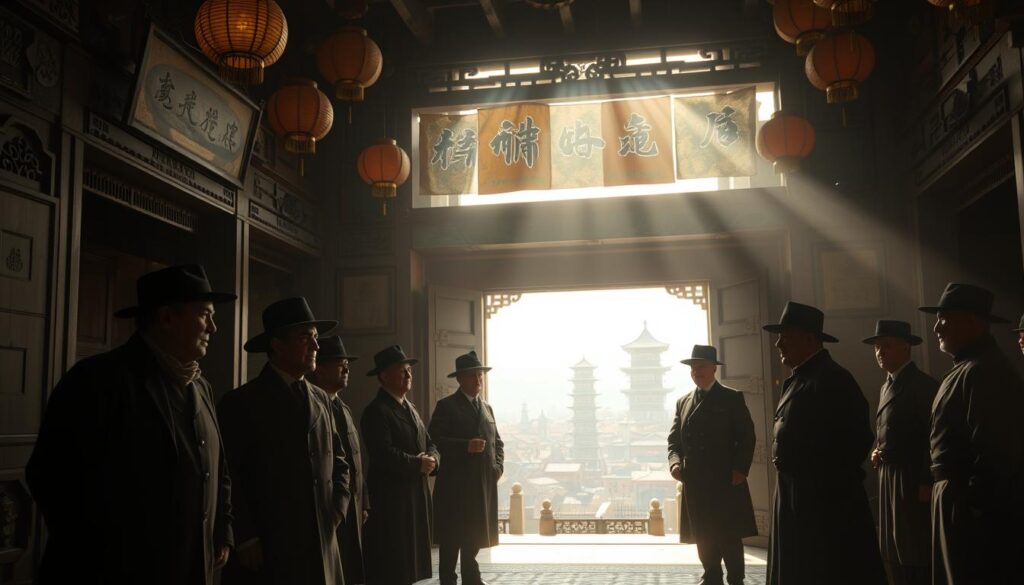
A dimly lit 19th century Chinese temple, ornate with intricate carvings and hanging lanterns. In the foreground, a group of Protestant missionaries stand solemnly, dressed in traditional western attire of the era - frock coats, high collars, and pith helmets. Their expressions are pensive, as they gaze upon the unfamiliar cultural landscape. Sunlight filters through the temple's doorway, casting a warm glow and creating dramatic shadows. The background is hazy, with the distant silhouettes of pagodas and rooftops, suggesting the bustling city beyond. An air of cultural intersection and discovery permeates the scene, capturing the essence of early Protestant missionary work in China.

Robert Morrison’s Pioneering Mission

Morrison spent years mastering local dialects while secretly printing religious texts. “A man who dies rich in Mandarin,” he once wrote, “dies poor in soul.” His translation of the Bible laid groundwork for future missionaries, though fewer than 10 converts joined him initially.

Emergence of Indigenous Churches

By 1920, over 500,000 believers attended self-governed congregations. Local leaders blended ancestral customs with Christian rituals—hymns echoed traditional folk melodies, and sermons used regional proverbs. This cultural fusion helped churches thrive without foreign oversight.

The rise of nationalist sentiments accelerated this shift. Communities rejected colonial-era associations, reshaping worship into something distinctly theirs. This groundwork proved vital when political changes later expelled foreign missionaries entirely.

Protestant Growth Before 1950

Unity became the watchword as religious communities built their own institutional frameworks. In 1922, Shanghai hosted a landmark gathering where over 1,000 delegates formed the National Christian Council. This body championed the “Three Self” principles – financial independence, local leadership, and grassroots outreach.

Cheng Jingyi, the council’s first general secretary, declared: “Our faith must grow Chinese roots to bear lasting fruit.” His vision transformed how churches operated, replacing foreign funding with local donations. Rural and urban congregations developed distinct flavors while sharing core beliefs.

City churches often focused on education and social services. Countryside communities blended agricultural rhythms with worship cycles. This flexibility helped religious groups thrive in diverse areas while maintaining unity through the Christian Council structure.

By 1949, over 700,000 believers attended self-supported congregations. Local leaders trained in theology and management replaced foreign missionaries. This strategic shift prepared communities for coming political storms while fueling steady growth across regions.

Communist Takeover and Religious Transformation

When political tides shift, religious communities often face their greatest test of adaptability. The 1949 establishment of the Chinese Communist Party brought sweeping changes to spiritual life. Foreign ties became liabilities overnight as the new government launched campaigns to erase external influences.

Impact on Foreign Missionaries and Institutional Shifts

Within months, 130 missionary schools and hospitals closed. Funds froze like winter rivers. By 1951, every foreign worker had left—ending a 150-year chapter. A local pastor later recalled: “We stood at a crossroads, wondering if our faith would survive the storm.”

The state introduced strict oversight measures. Worship activities required approval, and sermons faced ideological scrutiny. This control aimed to align religious practices with socialist values while maintaining patriotic unity.

Aspect Pre-1949 Post-1949
Leadership Foreign missionaries Local committees
Funding International sources Domestic donations
Institutions 130+ organizations State-regulated groups
State Oversight Limited Mandatory approvals

Nearly 700,000 believers navigated this new reality. Some merged worship with community service projects to demonstrate socialist values. Others met quietly in homes, preserving traditions beneath the radar of communist party officials.

This period set patterns for decades. The government‘s approach balanced suppression of foreign links with limited tolerance for local practices. As one scholar noted: “They sought not to eliminate faith, but to redefine its role in society.”

The Three-Self Movement and Patriotic Reforms

Navigating political change requires more than adaptation—it demands reinvention. This truth shaped the 1950s transformation of religious communities into nationally aligned institutions. At the heart of this shift stood the Three-Self Patriotic Movement, a framework blending spiritual independence with socialist ideals.

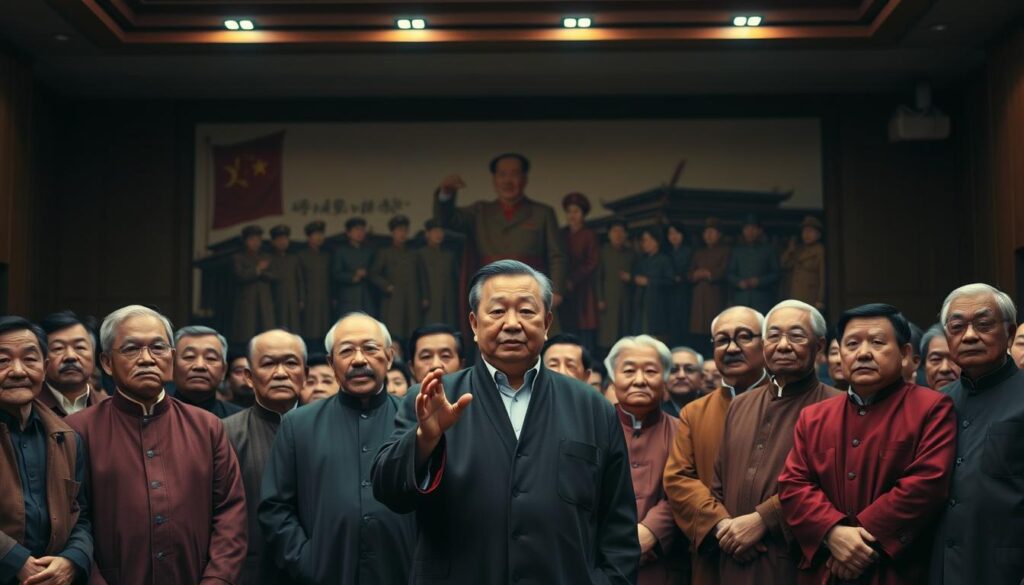
A solemn gathering of Chinese Protestant church leaders, standing united in a dimly lit auditorium, their faces etched with determination. In the foreground, a central figure gestures emphatically, surrounded by a circle of elders in traditional robes. Behind them, the backdrop depicts a faded mural of Chinese nationalist iconography, hinting at the political tensions underlying the "Three-Self Patriotic Movement." The scene is illuminated by warm, muted lighting, capturing the gravity and significance of this pivotal moment in China's religious and political history.

Formation of the Church of Christ in China (CCC)

Premier Zhou Enlai’s push for ideological alignment sparked a historic response. In 1950, forty leaders signed “The Christian Manifesto,” declaring: “We must thoroughly recognize imperialist influences within religious affairs and reject them.” The document gained 400,000 signatures within months—a stunning show of unity.

The newly formed Christian Council rebranded their efforts in 1954 as the Three-Self Patriotic Movement (TSPM). Chairman Wu Yaozong emphasized: “Our faith serves both God and the people’s needs.” This pivot distanced communities from Western ties while securing state approval.

The “Three Self” Principles in Action

Self-governance, self-support, and self-propagation became survival tools. Local leaders replaced foreign missionaries, while donations replaced overseas funding. The state administration religious oversight system emerged, creating official channels for worship activities.

Key changes included:

  • Mandatory approval for sermons and events
  • Integration of socialist values into teachings
  • Collaboration with the Christian Council on community projects

This patriotic movement transformed congregations into partners of the state rather than adversaries. By aligning religious affairs with national interests, communities preserved their identity while navigating strict political realities.

Cultural Revolution and Its Impact on Protestant Practices

Dark clouds gathered over spiritual life as political turmoil reshaped society. The decade-long cultural revolution (1966-1976) erased visible signs of organized faith. Public religious activities vanished overnight, with authorities labeling them “poisons of capitalism.”

Every registered church shut its doors. Bibles burned in public squares while red guards ransacked homes. One survivor recalled: “They made us kneel on broken scripture pages—our faith became a crime.” Believers faced beatings, forced labor, and public shaming to “cleanse bourgeois influences.”

Underground networks kept hope alive. Families whispered prayers behind locked doors, sharing handwritten verses. Secret worship gatherings rotated between attics and rural barns. These hidden church meetings preserved traditions when official structures collapsed.

Paradoxically, persecution deepened spiritual bonds. As one elder noted: “The fire that tried to destroy us tempered our resolve.” This resilience laid foundations for future revivals, proving even radical ideology couldn’t extinguish centuries-old beliefs.

Reform Era: Rebirth of Protestant Churches

A new chapter unfolded as economic reforms reshaped spiritual landscapes. Deng Xiaoping’s leadership brought unexpected opportunities for communities of faith. The 1982 Constitution marked a turning point, declaring citizens’ right to religious belief under Article 36.

State Policies and the Revival Process

Officials shifted from viewing churches as threats to potential partners in social stability. One pastor recalled: “We received permits to gather again—like sunlight after decades of winter.” This state-approved revival required careful alignment with national development goals.

Key policies allowed gradual reopening starting in Shanghai. By 1982, over 1,100 worship spaces operated nationwide. Leaders negotiated terms ensuring sermons promoted patriotic values alongside spiritual teachings.

Reopening of Church Buildings and Theological Seminaries

Nanjing Theological Seminary’s 1981 restart became crucial for training clergy. Over 200 students enrolled within three years, learning to balance tradition with modern state expectations. Restored buildings symbolized renewed trust between communities and authorities.

This era proved religious activities could coexist with socialist principles when properly managed. As one official noted: “Well-regulated faith strengthens social harmony.” The careful revival set patterns still shaping church operations today.

Social and Political Harmonization in Religious Affairs

Modern societies often grapple with balancing spiritual values and material progress—a challenge shaping current approaches to religious affairs. The government recognizes faith communities’ potential to strengthen social bonds while supporting national development goals. Recent studies by the Chinese Academy of Social Sciences highlight how blending ethical teachings with traditional values could counterbalance excessive consumerism.

Officials promote frameworks where religious affairs align with public welfare initiatives. One researcher noted: “Shared moral foundations create bridges between belief systems and civic responsibility.” This strategy helps maintain stability as communities navigate rapid economic changes.

The state encourages faith groups to participate in poverty relief and disaster response programs. Such policies foster cooperation while ensuring activities remain within approved boundaries. Local leaders increasingly frame spiritual practices as complementary to—rather than conflicting with—patriotic values.

By integrating time-honored principles with modern governance, authorities aim to cultivate harmony in government-community relations. This delicate equilibrium allows spiritual traditions to contribute meaningfully to society’s broader aspirations under the state‘s guiding framework.

FAQ

How did early missionaries like Robert Morrison shape religious activities in the country?

Robert Morrison, the first Protestant missionary to mainland China, translated the Bible and founded schools. His work laid the groundwork for cultural exchange and inspired later indigenous church movements.

What role did the Three-Self Patriotic Movement play in organizing worship communities?

Established in the 1950s, the movement promoted self-governance, self-support, and self-propagation. It aimed to align faith groups with state policies while reducing foreign influence in religious affairs.

How did the Cultural Revolution affect believers and their practices?

During this period, many churches closed, and public worship was banned. Followers often practiced privately, preserving their faith despite strict government control over religious activities.

What changes occurred after the reform era began in the late 1970s?

Authorities permitted the reopening of theological seminaries and registered churches. Policies shifted to allow limited growth, though unregistered groups still faced scrutiny from the State Administration for Religious Affairs.

How do registered and unregistered congregations differ today?

Registered groups operate under the Chinese Christian Council and state oversight, while unregistered “house churches” function independently. The latter often face challenges balancing growth with compliance.

What strategies do leaders use to harmonize faith with political expectations?

Many emphasize social service, charity, and patriotism. This approach helps align their work with the Chinese Communist Party’s goals while addressing community needs.

Are foreign missionaries still active in the region?

Since the 1950s, foreign missionaries have largely been excluded. Religious affairs are managed domestically, with a focus on maintaining cultural and political alignment.