Recent Posts

Discover the Variety of Protestant Denominations


Christianity’s landscape transformed dramatically in 16th-century Europe. A movement began challenging traditional doctrines, sparking reforms that reshaped faith practices forever. The term “Protestant” emerged in 1529 when reformers stood firm against religious restrictions at the Diet of Speyer. This pivotal moment birthed a new branch of Christianity, distinct from Roman Catholicism and Eastern Orthodoxy.

Today, hundreds of denominations exist worldwide, each with unique traditions. From Lutheranism’s focus on grace to Pentecostalism’s vibrant worship styles, these groups share core principles like scripture’s authority and salvation through faith. Yet their interpretations of rituals, leadership, and community roles vary widely.

Modern churches reflect this diversity. Some prioritize structured liturgy, while others embrace spontaneous prayer. Despite differences, all aim to connect believers with their beliefs and foster spiritual growth. This guide explores how these traditions evolved and why they remain vital to millions today.

Key Takeaways

  • Protestantism began as a 16th-century reform movement in Europe
  • Core principles include scripture authority and salvation through faith
  • Denominations vary in worship styles and organizational structures
  • Major traditions include Lutheranism, Anglicanism, and Pentecostalism
  • Modern churches adapt historical teachings to contemporary needs
  • Global influence spans religious, cultural, and social dimensions

Introduction to Protestant Denominations

Exploring Christian traditions reveals a rich mosaic of beliefs and practices shaped by centuries of interpretation. While these faith communities share core principles like scripture’s authority and salvation through grace, their approaches to worship and leadership vary widely. This guide helps you navigate that diversity with clarity.

Purpose and Scope of the Article

We’ll unpack how different denominations developed from shared Reformation roots. You’ll discover:

  • Why Baptists emphasize adult baptism
  • How Methodist churches structure community outreach
  • What makes Presbyterian governance unique

The focus extends beyond historical branches to modern movements. Non-denominational churches, for example, prioritize biblical teachings over traditional labels. Over 35% of U.S. congregations now identify this way.

Understanding the Listicle Format

Complex ideas become approachable through bite-sized sections. Each entry highlights:

  1. Key doctrinal distinctions
  2. Notable worship practices
  3. Cultural influences

This structure lets you compare traditions like Lutheranism’s liturgical depth with Pentecostalism’s spontaneous worship. Whether you’re new to faith studies or deepening your knowledge, the format delivers insights without overwhelm.

Historical Foundations of Protestantism

Religious transformation in the 1500s didn’t emerge from a vacuum. Centuries of simmering tensions within the Roman Catholic Church created fertile ground for change. By Luther’s time, many believers questioned practices that seemed more about power than spiritual growth.
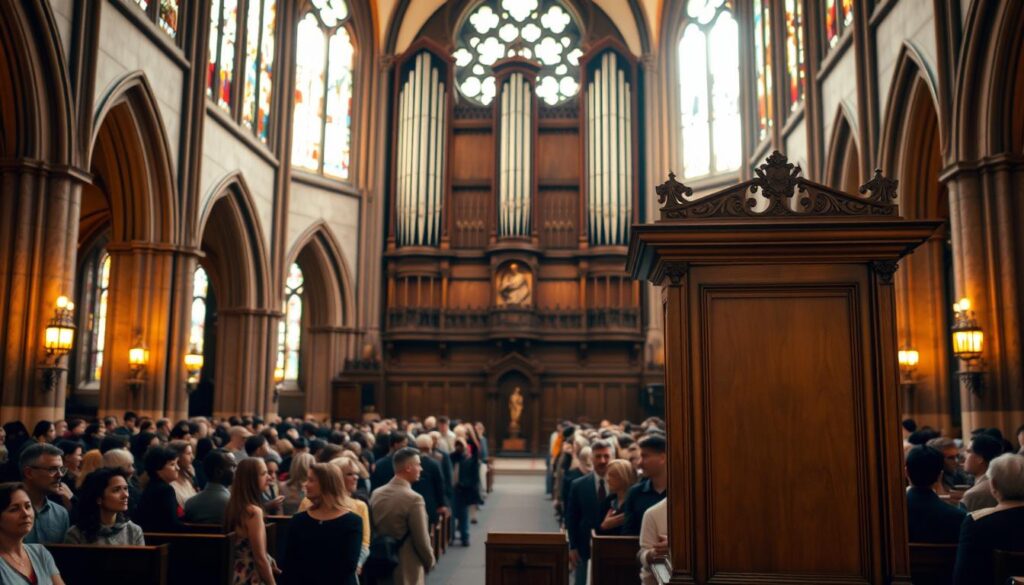
A grand cathedral interior, illuminated by the warm glow of stained-glass windows. In the foreground, a prominent pulpit stands as a symbol of the Protestant Reformation, with intricate carvings and a simple, unadorned design. In the middle ground, a congregation of worshippers, their faces filled with reverence and contemplation. In the background, a towering organ pipes reach towards the vaulted ceiling, a testament to the musical tradition of Protestantism. The overall scene evokes a sense of historical significance, a pivotal moment in the religious and cultural landscape.

Origins of the Protestant Reformation

The 16th-century movement began as pushback against systemic issues. Church leaders sold forgiveness certificates called indulgences, while funding lavish projects in Rome. Ordinary people grew frustrated as local clergy seemed disconnected from their needs.

Earlier critics like Jan Hus had demanded reforms a century before Luther. Their ideas spread through handwritten texts, planting seeds for larger changes. When the printing press arrived, it supercharged this process.

The Social and Political Context

Kings and citizens alike resented Rome’s control over local affairs. German princes saw religious independence as a way to strengthen their rule. Meanwhile, merchants and tradespeople wanted faith that matched their practical, self-made lives.

Three key factors accelerated the Protestant Reformation:

  • Growing literacy rates let people read scripture themselves
  • National rulers sought to reduce foreign influence
  • New middle classes valued personal faith over hierarchy

This mix of ideas reshaped Europe’s religious map within decades. What began as church debates became revolutions in how communities worshipped and governed themselves.

The Protestant Reformation and Its Key Figures

Three visionaries reshaped Christianity’s course through bold actions and revolutionary ideas. Their distinct approaches to faith created lasting frameworks that still guide millions today. Let’s explore how these leaders challenged norms and built enduring spiritual legacies.

Martin Luther and the Break from Rome

A monk’s hammer strikes echoed across Europe in 1517. When Martin Luther nailed his 95 Theses to Wittenberg’s church door, he questioned the Roman Catholic practice of selling forgiveness. His radical claim? Salvation comes through faith alone, not payments or rituals.

Luther’s German Bible translation empowered ordinary people to read Scripture themselves. This broke the clergy’s monopoly on biblical interpretation. His stand at the Diet of Worms became legendary: “Here I stand; I can do no other.”

John Calvin’s Influence on Reformed Theology

While Luther sparked change, John Calvin systematized it. His Institutes of the Christian Religion outlined God’s complete control over human destiny. Calvin’s Geneva became a laboratory for Reformed teachings, emphasizing predestination and moral discipline.

The reformer’s ideas crossed oceans. Puritan settlers carried Calvinist principles to America, shaping early colonial values. His focus on God’s sovereignty still defines Presbyterian and Reformed churches worldwide.

John Wesley and the Rise of Methodism

Centuries later, John Wesley brought fiery passion to English fields. His open-air sermons reached coal miners and factory workers ignored by traditional churches. Wesley’s “heart strangely warmed” experience fueled a movement emphasizing personal holiness and social action.

Methodism’s circuit riders and class meetings created spiritual networks across continents. Wesley traveled distances equal to circling Earth ten times, proving faith could thrive beyond church walls.

Reformer Key Contribution Lasting Impact Notable Work
Martin Luther Scripture accessibility Lutheran churches 95 Theses
John Calvin Predestination doctrine Reformed traditions Institutes
John Wesley Methodist movement Social holiness 40,000 sermons

Distinctive Doctrines and Worship Practices

Walk into any two churches sharing the same core beliefs, and you might think they’re from different worlds. This vibrant diversity stems from how communities express shared teachings through unique worship practices.

Core Beliefs and Teachings

All these traditions agree salvation comes through faith alone, not works. They uphold scripture as ultimate authority and reject hierarchical priesthoods. But interpretations vary widely:

  • Lutherans emphasize Christ’s presence in communion
  • Baptists focus on adult baptism by immersion
  • Methodists stress social justice alongside personal holiness

Differences in Sacramental Understanding

The Lord’s Supper sparks particularly diverse views. Lutherans teach Christ is present “in, with, and under” the bread and wine. Baptists see communion as symbolic, while Anglicans blend traditional and modern approaches.

Tradition Baptism Practice Communion View
Lutheran Infant sprinkling Real presence
Baptist Adult immersion Memorial symbol
Anglican Infant pouring Spiritual presence

Music styles further showcase diversity. Some churches use pipe organs and hymnals, while others feature electric guitars and projection screens. These practices all aim to deepen faith, proving unity exists within variety.

Exploring Protestant Groups in America

Modern believers in the U.S. encounter a mosaic of spiritual communities shaped by cultural adaptation. Historic traditions brought by European settlers blend with fresh approaches developed in the 20th century. This creates vibrant spaces where ancient teachings meet contemporary life.

A diverse congregation of Protestant churches, each with its unique architectural style, stands proudly against a backdrop of a vibrant American cityscape. The foreground features a traditional white steepled church, a modern glass-and-steel structure, and a historic stone edifice, all nestled in a harmonious urban landscape. The middle ground showcases a range of denominational diversity, from a towering Gothic cathedral to a sleek, contemporary megachurch. Warm natural light filters through the scene, casting a sense of unity and community. The overall composition reflects the rich tapestry of Protestant groups, each contributing to the spiritual fabric of America.

The Diversity of Denominational Practices

Walk through America’s spiritual landscape, and you’ll find:

  • Lutheran congregations preserving Scandinavian hymns
  • African Methodist Episcopal churches blending gospel music with social activism
  • Korean Presbyterian assemblies offering bilingual services

These churches maintain theological roots while adapting to local cultures. Hispanic evangelical movements often integrate family-centered worship, while Asian American communities emphasize educational programs.

Non-Denominational Churches and Modern Trends

Over 35% of U.S. congregations now avoid specific denomination labels. The Vineyard churches, for example, combine rock-style worship with practical teachings on daily living. Their focus? Creating accessible faith experiences through:

  1. Casual dress codes
  2. Interactive sermon discussions
  3. Community service projects

From 20,000-seat mega-churches to living-room gatherings, these spaces prove spiritual connection thrives in varied settings. They attract people seeking authenticity beyond traditional structures.

Anabaptist Traditions and Their Descendants

Some spiritual paths choose peace over power. In 1525, a movement began in Zurich that valued personal faith above institutional rules. These reformers insisted baptism should follow conscious belief – a radical idea that sparked intense opposition.

Mennonites, Hutterites, and Amish Communities

Menno Simons gave his name to the largest Anabaptist group. Today’s Mennonites follow the 1632 Dordrecht Confession, emphasizing nonviolence and community support. Many run disaster relief programs while maintaining simple lifestyles.

The Amish trace their history to Jakob Amman’s 1693 reforms. Their horse-drawn buggies and hand-sewn clothes reflect a deliberate choice. “We shape our life around faith, not convenience,” explains an Ohio bishop. About 350,000 Amish now live across 31 U.S. states.

Hutterites stand out through shared ownership. Meals, work, and worship happen communally in colonies averaging 80 people. Though numbering just 50,000, they’ve preserved 16th-century German dialects and farming methods.

These communities share core values:

  • Adult baptism after personal commitment
  • Separation from mainstream society
  • Practical service over doctrinal debates

Their churches often meet in homes or barns, keeping the focus on lived faith rather than ornate buildings. For Anabaptist children, learning practical skills matters as much as scripture study.

Anglican Heritage and the Book of Common Prayer

A unique blend of ancient rituals and modern flexibility defines the Anglican tradition. Rooted in the Church of England, this global family values both scripture and tradition. Its 70 million members share the Book of Common Prayer – a 16th-century worship guide still shaping services today.

Foundations of Faith and Governance

Henry VIII’s 1534 Act of Supremacy shifted religious authority from Rome to the English crown. This move birthed a church balancing Catholic rituals with Reformed theology. While keeping bishops and liturgy, the Anglican Church emphasized scripture’s role in daily life.

Global Adaptations and Innovations

Today’s Anglican communities reflect local cultures while honoring heritage. African dioceses often blend traditional dance with prayer book recitations. Many Church of England branches now ordain women as clergy, sparking both celebration and debate. Even the common prayer tradition evolves, with some churches adding modern language versions.

FAQ

What sparked the Protestant Reformation in the 16th century?

The Reformation began as a response to corruption in the Roman Catholic Church, including the sale of indulgences. Martin Luther’s 95 Theses in 1517 challenged these practices, emphasizing salvation through faith alone and Scripture’s authority over church tradition.

How did John Calvin shape Reformed theology?

Calvin’s teachings on predestination and God’s sovereignty became central to Reformed theology. His work Institutes of the Christian Religion influenced denominations like Presbyterians and Congregationalists, stressing a structured, Bible-centered church life.

What distinguishes Methodist churches from other traditions?

Founded by John Wesley, Methodism emphasizes personal holiness, social justice, and practical faith. Its focus on small-group accountability and evangelism set it apart from Lutheran or Anglican practices.

Why do Anabaptist communities like the Amish reject modern technology?

Groups such as the Amish prioritize simplicity and separation from worldly influences, rooted in their interpretation of Scripture. This includes limiting technology to preserve community bonds and traditional lifestyles.

How does the Book of Common Prayer define Anglican worship?

The Book of Common Prayer, established under the Church of England, standardizes liturgy and sacraments for Anglicans worldwide. It blends Scripture readings, prayers, and rituals, reflecting a balance between Catholic tradition and Reformed theology.

What role do non-denominational churches play in modern Christianity?

These churches often avoid formal labels, focusing on adaptable worship styles and community outreach. They appeal to those seeking less structured traditions while retaining core teachings like salvation through Christ.

Why do Pentecostal churches emphasize speaking in tongues?

Pentecostals view speaking in tongues as evidence of the Holy Spirit’s presence, based on Acts 2:4. This practice underscores their belief in direct spiritual experiences and empowerment for ministry.

How do Baptist churches approach baptism?

Baptists practice believer’s baptism by immersion, viewing it as a public declaration of faith rather than a sacrament. This contrasts with traditions like Lutheranism, which baptize infants as a covenant sign.

Laugh Out Loud with These Funny Protestant Jokes


Humor has always been a cornerstone of connection, and faith communities are no exception. For generations, lighthearted stories and witty observations about church life have brought people together, creating moments of shared laughter that transcend differences. Whether it’s a playful nod to Sunday morning routines or a clever twist on theological debates, these jokes celebrate the quirks of religious traditions while fostering unity.

What makes these stories special? They reflect the everyday experiences of congregations—think coffee-hour mishaps or choir practice adventures. Through gentle humor, they highlight the community bonds that form when we laugh at life’s relatable moments. Even in the busy modern world, taking time to share a smile remains a cherished part of spiritual life.

Key Takeaways

  • Humor strengthens connections within faith-based groups through shared experiences.
  • Lighthearted stories often mirror real-life church activities and traditions.
  • Jokes about denominational quirks celebrate uniqueness without undermining beliefs.
  • Laughter helps balance serious theological discussions with relatable moments.
  • These timeless anecdotes work well for gatherings, sermons, or casual conversations.

From pulpit blunders to Sunday school antics, this collection showcases the side of faith that doesn’t take itself too seriously. It’s a reminder that joy and reverence can coexist—and sometimes, a well-timed joke is the best way to honor both.

A Brief Dive into Protestant Humor

Laughter echoes through sanctuaries just as powerfully as hymns. For centuries, faith groups have woven humor into their culture, using wit to turn ordinary moments into unifying threads. This tradition isn’t just about fun—it’s a bridge connecting generations and sparking joy in shared spaces.

Understanding the Roots of Protestant Humor

Where did this playful spirit begin? Early reformers used storytelling to simplify complex ideas. Over the years, these tales evolved into gentle jabs at human quirks—like debates over coffee flavors at potlucks. One pastor quips, “We’ll agree on salvation faster than choosing light roast or dark!”

Each denomination developed its own flavor. Baptists might chuckle about immersion mishaps, while Methodists swap stories about marathon committee meetings. Yet all share a purpose: making faith feel like home.

The Role of Laughter in Church Community

Why does humor matter so much? It transforms awkward moments into inside jokes that bond folks. Imagine a children’s pageant where a sheep costume goes rogue—suddenly, everyone’s laughing together, not just watching.

Shared laughter also softens tough conversations. As one deacon notes, “A smile helps us discuss tithing without squirming.” It’s how church life stays relatable, whether you’re new or have attended for decades.

Exploring the History and Context

In every era, communities have found solace in humor, turning trials into tales of resilience. This tradition stretches back centuries, where laughter helped people navigate wars, plagues, and social shifts. Even today, these stories remind us that joy persists amid life’s storms.

A dimly lit library interior, bookshelves lining the walls, casting soft shadows. In the foreground, an ornate wooden desk with a quill, inkwell, and aged parchment. A single beam of light illuminates the desk, revealing handwritten notes and sketches depicting humorous religious scenes from throughout history. In the middle ground, two figures in scholarly robes engaged in lively discussion, their expressions reflecting the playful nature of the subject matter. The background is filled with a hazy, dreamlike quality, suggesting the passage of time and the rich tapestry of faith-based humor that has evolved over the centuries.

From Classic Anecdotes to Modern Takes

Early humor often centered on daily things—like a pastor’s hat blowing off during baptism. These tales gave voice to shared struggles, making faith feel approachable. One 18th-century diary recounts a deacon’s horse eating the Sunday sermon—a story still retold with grins.

Over the years, themes evolved to mirror the changing world. Colonial-era jokes tackled strict piety, while modern quips explore tech mishaps during virtual services. Yet both eras share a goal: highlighting the human side of spiritual life.

Classic Themes Modern Adaptations Common Thread
Sermon blunders Zoom call fails Relatable mishaps
Potluck disasters Social media debates Community dynamics
Hymnbook mix-ups Streaming service glitches Shared laughter

This culture of humor also bridged divides. During the 19th-century revival movements, rival groups used wit to soften theological clashes. A Methodist might jest, “We’ll sing three hymns before the Baptists finish one!”

Today’s stories still balance reverence with reality. They prove that faith thrives not just in grand moments, but in the side-splitting ones too.

Protestant Jokes: Classic Gags and One-Liners

Ever wonder why Sunday morning services sometimes feel like improv comedy? Behind every solemn sermon lies a treasure trove of laugh-out-loud moments that keep congregations coming back.

Memorable Pulpit Stories

Take the minister whose dog devoured his sermon notes. He delivered a 10-minute message instead of his usual 30. A visitor later asked, “Where can I get that puppy for our pastor?” These tales reveal the human side of spiritual leadership.

Another favorite features a church secretary’s typo. The pastor planned to discuss “Are Ministers Cracking Up?” The bulletin? It read: “Our Minister Is Cracking Up.” Congregants still chuckle about that one.

Jokes Inspired by Renowned Preachers

Even legends like Billy Graham star in humorous folklore. One story imagines Graham, Oral Roberts, and Robert Schuller briefly in hell. While waiting for heaven’s renovations, Graham converts souls, Roberts heals demons, and Schuller fundraises for AC.

These quips balance respect with relatability. As one parishioner noted, “Seeing our leaders’ funny side makes their wisdom more approachable.” Whether it’s a pastor battling a balky microphone or Billy Graham negotiating thermostat settings, laughter bridges the sacred and everyday.

Ecumenical Encounters That Spark Laughter

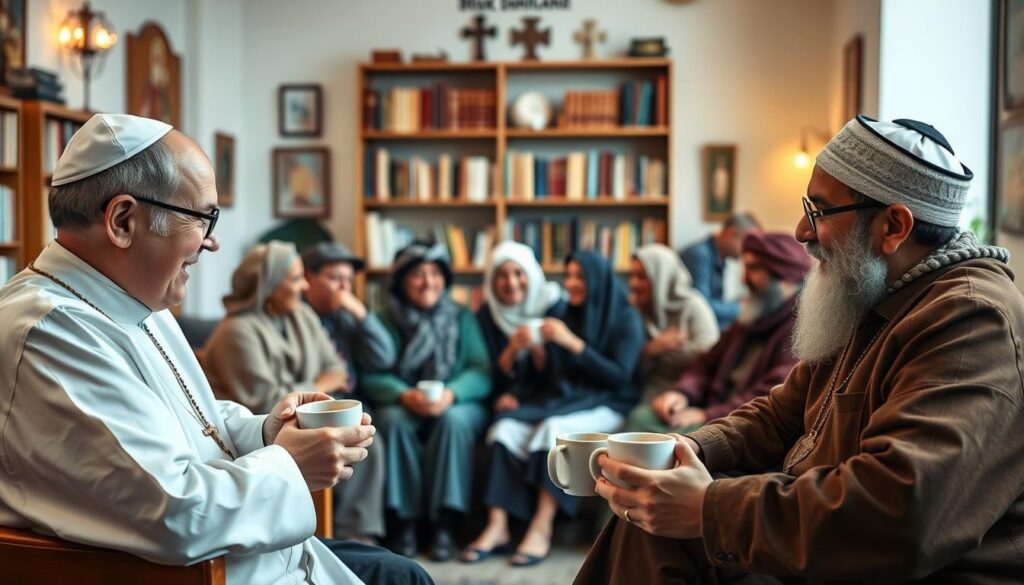
Imagine a priest, rabbi, and minister boarding the same flight to a theology conference. Before takeoff, they’re already swapping stories about congregational quirks. These lighthearted meetings between faith leaders reveal how humor bridges divides while celebrating differences.

A warm, inviting interfaith gathering where members of different religious traditions share a lighthearted moment. In the foreground, a Catholic priest, a Jewish rabbi, and a Muslim imam exchange cheerful banter over cups of coffee, their expressions radiating good-natured humor. In the middle ground, a diverse group of believers from various faiths sit together, engaged in animated conversation, their laughter and camaraderie filling the air. The background depicts a cozy, well-lit setting, with bookshelves and religious artifacts creating a sense of intellectual and spiritual harmony. Soft, diffused lighting casts a welcoming glow, enhancing the mood of ecumenical fellowship and interfaith understanding.

Interfaith Humor and Shared Stories

One classic line features religious leaders debating who best understands heaven. A rabbi jokes, “We’ve been waiting longer—we get priority seating!” The priest counters, “But we’ve got a direct father-son connection.” Meanwhile, the minister chuckles, “Y’all keep arguing—we’ll handle the coffee hour.”

These tales often highlight theology through playful misunderstandings. Take the father who invited his rabbi friend to a confession booth. The rabbi asked, “Why’s there a screen? Are we playing holy charades?” Their exchange became a beloved story about learning through laughter.

Shared humor also tackles heavier topics. At an interfaith panel, leaders discussed hell’s existence. One quipped, “If it’s real, I hope they serve better snacks than our last committee meeting.” Laughter softened the debate, reminding everyone that choice words can unite rather than divide.

Whether poking fun at liturgical differences or translation blunders, these stories prove that theology thrives when we laugh together. After all, what better way to honor divine connection than through shared joy?

Ministers, Sermons, and Misadventures

Leading a congregation often means embracing the unexpected. Ministers and pastors regularly navigate a delicate balance between delivering profound messages and handling moments that veer into comedy. These stories, passed down through generations, remind us that spiritual leadership thrives on adaptability—and a good sense of humor.

Pulpit Pranks and Hilarious Sermon Flubs

Take the minister who asked his organist for “inspirational music” during a pledge drive. When he requested donations, she launched into the National Anthem. The entire congregation stood at attention, unsure whether to salute or reach for their wallets. “That’s one way to test their commitment,” he later joked.

Then there’s the inventive pastor who wired random pews to mild electric charges. His plan? Use buttons to activate shocks during the collection, correlating voltage to donation amounts. The experiment ended when ten deacons jumped up simultaneously—a lesson in creative fundraising gone awry.

Unexpected Encounters With Church Life

Committees aren’t immune to chaos either. One building team approved contradictory plans: construct a new sanctuary using materials from the old one… while still holding services there. Members joked about worshipping amid lumber piles and echoing hammers.

Even the church door becomes a stage for comedy. A visitor once told her pastor, “Your sermon was like the peace of God—it passed all understanding!” Meanwhile, an announcement mix-up had congregants bringing casseroles to a finance meeting. Who knew spreadsheets paired so well with green bean bake?

These tales, born from Sunday morning mishaps and committee debates, turn ordinary church life into shared legends. They prove that laughter often arrives unannounced—and stays long after the final amen.

Side-Splitting Church and Community Tales

Some of life’s funniest moments unfold where people gather with shared purpose. Whether during Sunday services or neighborhood cookouts, these stories capture the side of faith that turns blunders into bonding opportunities.

Stories from the Pew and Beyond

Take the eager clergyman who spotted a young farmer struggling with hay. “Need a hand?” he asked. The farmer declined, insisting his father wouldn’t approve. Turns out, Dad was buried under the haystack—literally. “He always said he’d work till his last breath,” the farmer explained.

Then there’s the revival attendee who heard testimonies about “defeating the devil.” Exiting the church, he found a man weeping on the steps. “They blamed everything on me!” the stranger wailed. Turns out, he was just a local named Luc—short for Lucius.

Classic Church Tales Modern Twists Common Thread
Haystack mix-ups Misheard Zoom confessions Unexpected humor
Revival meeting antics Emoji prayer request fails Community connections
“Fish” fry fundraisers Viral TikTok hymn parodies Shared laughter across days

These stories thrive because they mirror real folks navigating faith’s side roads. From confused visitors to creative fundraisers, each tale becomes part of a congregation’s DNA—proof that joy grows best in church soil.

Tickling Theology: Jokes with a Deeper Message

Exploring theology doesn’t always require solemnity—sometimes a chuckle opens the deepest insights. These stories use wit to unpack complex ideas about sin, life, and divine relationships, making spiritual truths feel approachable.

Reflecting on Faith Through Humor

Three ministers once confessed their flaws during a retreat. One admitted gambling with raffle tickets, another to distracted thoughts during prayers, and the third to spilling choir secrets. Their laughter afterward revealed a truth: acknowledging sin often starts with self-aware humor.

This mirrors how communities discuss theology. A rabbi once joked at a conference, “Life begins when teenagers move out and the dog stops chewing shoes.” It’s a playful way to address profound questions without tension.

The Lighter Side of Divine Debates

Even heated topics like predestination or justice get humorous spins. Imagine debating free will using a GPS analogy: “God recalculates your route no matter how many wrong turns you take.”

Serious Topic Humorous Twist Shared Insight
Original sin “Adam blamed Eve… and we’ve been passing the buck ever since!” Human nature
Divine timing “God’s watch has two hands: ‘Wait’ and ‘Wow.’” Trust in uncertainty
Father-child bonds “Praying is like texting your father—read receipts are on, but replies vary.” Relational faith

Humor as a Spiritual Relief

Laughter helps believers navigate tough questions. One member joked during a storm, “If Noah built the ark today, they’d call it extremist architecture.” It’s a side door to discussing fear and faith.

These stories remind us that joy isn’t opposed to reverence—it’s the way we stay grounded. After all, even the father of a prodigal son probably chuckled when the kid asked for his inheritance early.

Contemporary Comedy: Jokes from Today’s Perspective

Faith and laughter have always shared a pew, but today’s humor comes with Wi-Fi passwords and emoji prayer requests. Modern congregations blend tradition with tech, creating jokes that resonate with smartphone-toting believers and coffee-hour regulars alike.

Modern Takes on Traditional Beliefs

Ever seen a baptismal pool made from a repurposed washtub? Or heard elk calls replace church bells? These quirky scenarios define “redneck church” humor—a playful side of adapting traditions to rural life. One finance committee famously rejected chandeliers because “nobody here plays the harp!”

Current humor also tackles digital life. Prayer requests now mirror social media posts: “Like this status if you’ve done intercession today!” Others joke about church newsletters becoming way too relatable—like comparing Sunday announcements to spam folder updates.

Digital Era of Protestant Humor

Tech mishaps fuel today’s stories. Imagine a livestream where the pastor’s dog photobombs communion. Or PowerPoint slides advancing mid-prayer. “We wanted to ‘amen’ the tech team,” one member quipped after a service glitch.

Traditional Humor Modern Spin Shared Theme
Sermon notes eaten by dogs Cloud storage fails Classic excuses, new twists
Hymnbook typos Autocorrect blunders Language laughs
Potluck casserole wars #ChurchCookoff TikTok trends Community bonding

Social media amplifies this voice, turning local jokes into global memes. A viral post comparing altar calls to Zoom waiting rooms got 50K shares. Another showed a pastor’s “Out of Office” reply during vacation: “Jesus took breaks—so do I.”

Conclusion

Behind every hymn and prayer lies a hidden layer of humor that binds congregations together. These lighthearted moments—whether a minister’s mic mishap or a pastor’s coffee-fueled sermon—reflect the real life of faith communities. As Billy Graham once noted, “Joy is the sacred echo of a heart aligned with purpose.”

Laughter does more than entertain. It turns committee meetings into shared adventures and Sunday mornings into memory-making things. Over the years, this tradition has reminded people that even in serious places, there’s room for grins.

In the end, humor isn’t about undermining beliefs. It’s about celebrating the choice to find connection through every chuckle. After all, a church that laughs together stays rooted in what truly matters—community, grace, and the occasional potluck surprise.

FAQ

Why is humor important in church communities?

Laughter builds connections and eases tensions, helping people engage with faith in relatable ways. Many churches use lighthearted stories or anecdotes to illustrate biblical truths without diminishing their depth. It’s a tool to foster unity and remind congregants that joy is part of spiritual life.

How do historical traditions shape faith-based jokes?

Classic anecdotes often reflect cultural values or theological debates from specific eras. For example, Reformation-era humor might highlight contrasts between denominations, while modern gags tackle current issues like technology or social dynamics. These stories evolve but keep core messages about grace, humility, and human imperfection.

Can humor bridge gaps between different faiths?

Absolutely! Shared stories about misunderstandings or universal struggles—like parenting or patience—create common ground. Interfaith humor emphasizes our shared humanity rather than differences, fostering mutual respect. Laughter becomes a bridge, not a barrier, in diverse communities.

Do famous preachers influence church-related comedy?

Yes! Figures like Billy Graham inspired jokes about sermon quirks or pastoral mishaps. Their distinct styles or memorable quotes often become punchlines that celebrate their impact while poking fun at human quirks. It’s a loving nod to their legacy within the community.

How does modern culture impact faith-based humor?

Digital platforms let comedians riff on topics like livestreamed services or “Zoom church” blunders. Memes and viral videos add fresh twists to timeless themes, making theology accessible to younger generations. The core of the message stays rooted in tradition, even as delivery methods evolve.

Is there a line between respectful humor and offense?

Balance is key. Jokes that mock beliefs or target individuals cross lines, but light-hearted takes on human flaws or relatable church mishaps usually land well. The best humor invites self-reflection without undermining sacred values, keeping the tone inclusive and kind.

Can laughter deepen theological understanding?

Definitely! Parables and witty analogies simplify complex ideas, like comparing grace to a “free gift” or sin to tangled fishing lines. Humor makes abstract concepts tangible, encouraging people to reflect on their faith journey with curiosity rather than fear.

Exploring the Beginnings of Protestantism


Welcome to a journey through one of history’s most transformative moments. In the 16th century, a wave of religious change reshaped Europe—and eventually the world. This movement didn’t just alter churches; it redefined how people viewed faith, authority, and personal freedom.

Everything changed on October 31, 1517. A German monk named Martin Luther nailed his 95 Theses to a church door in Wittenberg. His bold critiques of church practices ignited debates that spread like wildfire. What began as a call for reform soon became a full-blown revolution in Christianity.

This wasn’t just about theology. Political tensions, social unrest, and new ideas all played roles. Rulers saw opportunities to break from Rome. Ordinary people craved spiritual clarity. Printing presses helped spread revolutionary thoughts faster than ever before.

By exploring this era, you’ll uncover how a single act of defiance sparked global change. From Germany to England, and later across oceans, these ideas shaped nations and cultures. Their echoes still influence modern beliefs about individual rights and religious diversity.

Key Takeaways

  • The Reformation began in 1517 with Martin Luther’s public critique of church practices
  • Political and social factors accelerated the spread of Protestant ideas
  • Printing technology played a crucial role in sharing reformist views
  • The movement led to lasting changes in Christian traditions worldwide
  • Modern concepts of religious freedom trace roots to this period

Historical Context of the Late Medieval Church

The stage was set for religious upheaval long before Luther’s hammer struck wood. By the 15th century, the Roman Catholic Church held unmatched power—both spiritual and political. But cracks were forming in its foundation.

Medieval Church Practices and Abuses

Imagine walking into a church where leaders lived like kings. Popes hosted lavish feasts while poor families starved. One shocking example? Pope Alexander VI reportedly held parties with naked dancers in the Vatican.

The clergy sold forgiveness like market goods through indulgences. “As soon as gold in the basin rings, the soul to heaven springs,” joked critics. Ordinary people grew angry watching leaders ignore Christ’s teachings about humility.

Rise of Nationalism and Early Reform Efforts

Kings and queens saw their chance. Why should foreign popes control local church lands? England’s monarchs began appointing bishops themselves. This clash between national authority and Rome reshaped Europe’s power map.

Brave thinkers lit small fires of change. John Wycliffe translated the Bible into English in the 14th century, declaring scripture belonged to everyone. Though silenced, these voices kept reform alive until Luther’s time.

This article shows how decades of frustration made Europe ready for transformation. From corrupt leaders to patriotic rulers, the old order couldn’t last. The next section of our article reveals how one monk’s protest became a revolution.

The 1517 Spark: Martin Luther’s 95 Theses

A single document changed Christianity forever in 1517. Martin Luther, an unknown monk, pinned his grievances to a Wittenberg church door. This act of courage questioned practices many saw as unfair. His words traveled faster than anyone imagined.

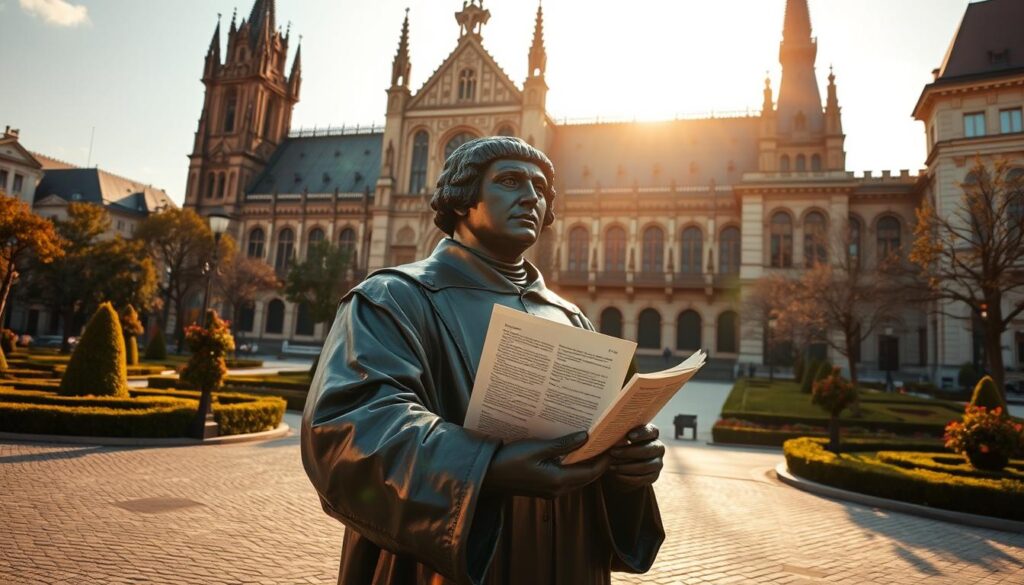
An imposing bronze statue of Martin Luther stands in a public square, his 95 Theses clutched firmly in his outstretched hand. The scene is bathed in warm, golden light, casting dramatic shadows that highlight the determination on Luther's face. In the background, a grand cathedral looms, its ornate architecture a testament to the power of the Catholic Church he sought to challenge. The cobblestone pavement and manicured gardens evoke a sense of historical significance, as if this moment marks the beginning of a profound religious and social revolution. The composition is balanced, with Luther's figure commanding the foreground, while the cathedral and its surrounding environment provide a rich, contextual backdrop. The overall atmosphere conveys the gravity and importance of this pivotal moment in the history of Protestantism.

The Challenge to Indulgences

Luther’s main target? The Catholic Church’s sale of indulgences. These certificates promised reduced punishment for sins—for a price. Wealthy believers could buy their way to heaven, while others struggled. “Why does the pope’s wealth grow while Christ’s people suffer?” Luther asked.

His 95 arguments shredded this system. True forgiveness, he argued, comes through faith—not coins. This idea shook the church’s power structure. Ordinary people began questioning every religious rule they’d followed.

The Debate Over Catholic Doctrine

The article of faith became battleground. Luther claimed scripture alone—not church leaders—should guide believers. This challenged centuries of doctrine. Who gets to interpret God’s word? The debate spread like wildfire.

Printing presses made copies of the Theses in weeks. Soon, farmers and kings alike discussed reform. What began as academic criticism became a revolution. By 1520, Europe’s religious map started shifting.

This time period shows how ideas can outgrow their origins. Luther never planned to split the church. Yet his call for change ignited movements that reshaped nations. The next article section reveals how these sparks became flames.

How protestantism started: Understanding the Reformation Movement

The Reformation Movement reshaped Christianity by tackling core beliefs rather than surface issues. Unlike earlier reformers who focused on corruption, Luther dug into theology. His ideas struck at the heart of medieval religious practice.

The Role of Scriptural Authority

Luther’s sola scriptura principle changed everything. He declared the Bible—not church leaders—as God’s true voice. Farmers could now read scripture themselves, sparking a spiritual revolution.

Another breakthrough came with sola fide—salvation through faith alone. This idea transformed people’s relationship with God. No more endless rituals or payments. Personal belief became the key to grace.

Catholic Teaching Protestant View Impact
Church interprets scripture Bible guides believers directly Empowered individuals
Good works earn salvation Faith alone saves Simplified spiritual life
Pope as supreme authority Christ as only head Weakened Rome’s power

Printing presses spread these ideas faster than ever. By 1521, Luther’s reform efforts led to his excommunication. What began as internal criticism became a new branch of the christian religion.

This article shows how deep movements grow from bold ideas. Luther’s focus on scripture and faith created lasting change—proving that words can indeed remake the world.

Key Figures Who Shaped the Reformation

Behind every great movement stand visionary leaders who turn ideas into action. The Reformation’s success relied on courageous thinkers from varied backgrounds. Each brought unique skills to challenge religious norms and inspire lasting change.

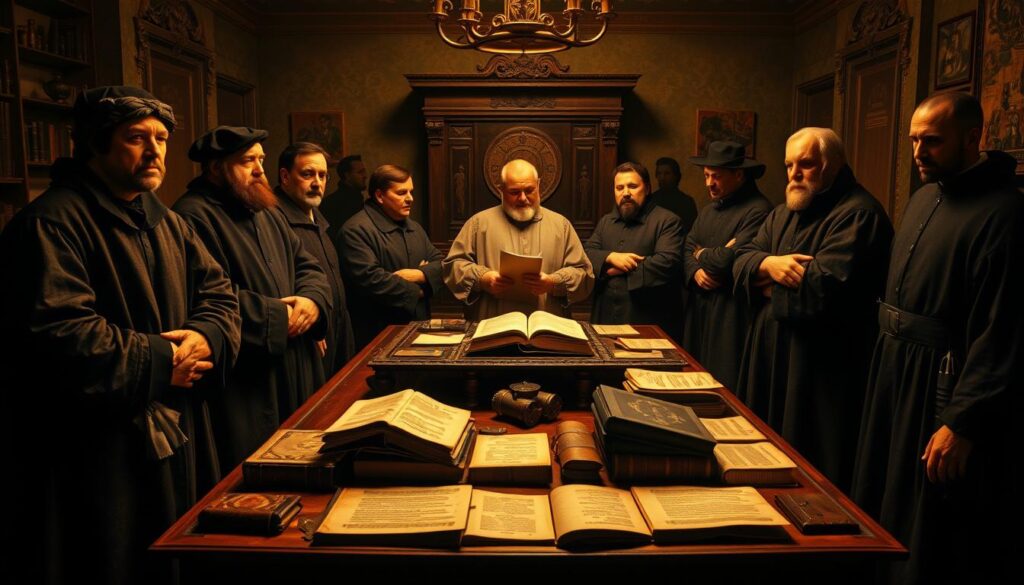
A group portrait of prominent Reformation leaders in a dimly lit, Renaissance-era study. In the foreground, the figures of Martin Luther, John Calvin, and Ulrich Zwingli stand resolute, their expressions reflecting the gravity and importance of their ideas. Behind them, a large, ornate desk serves as the centerpiece, scattered with theological texts and manuscripts. The middle ground features Philip Melanchthon and Thomas Cranmer, engaged in deep discussion, while in the background, the shadowy silhouettes of other influential reformers can be seen, creating a sense of a pivotal moment in history. Warm, golden lighting casts a reverent glow, emphasizing the weight of their contributions to the birth of Protestantism.

Martin Luther and John Calvin

Martin Luther’s personal struggles fueled his reforms. Once tormented by guilt, this German monk found freedom in scripture. His translation of the Bible empowered ordinary people to connect directly with God’s word.

John Calvin brought legal precision to theology. Forced to flee France, he crafted the Institutes of the Christian Religion—a masterwork organizing Protestant beliefs. His teachings on predestination shaped churches from Geneva to New England.

Influential Voices Beyond Germany

Swiss priest Huldrych Zwingli took reform further. He banned music in churches and viewed communion as symbolic—clashing with Luther’s views. His ideas laid groundwork for later Reformed traditions.

Czech scholar Jan Hus paid the ultimate price a century earlier. Burned for criticizing corrupt clergy, his dying words—“You cook a goose now, but a swan will come”—predicted Luther’s rise. Hus’s martyrdom proved reform couldn’t be silenced.

These figures shared grit but differed in approach. From Luther’s emotional breakthroughs to Calvin’s systematic rigor, their combined efforts reshaped Christian life worldwide. Their stories remind us how conviction can alter history’s course.

The Role of Doctrine and Theological Debate

At the heart of religious transformation lay ideas that rewrote centuries of tradition. Protestant reformers didn’t just challenge church practices—they rebuilt Christianity’s foundation stone by stone. Their doctrine reshaped how believers understood divine grace, personal faith, and ultimate salvation.

Sola Scriptura and Sola Fide Explained

Sola scriptura became the Reformation’s battle cry. This principle declared the Bible as God’s ultimate authority—not church leaders. Farmers could now read scripture in their language, discovering truths once locked in Latin texts.

The companion concept sola fide sparked spiritual liberation. Luther taught that faith alone—not rituals or payments—secured salvation. Imagine the relief for believers told they didn’t need to earn God’s love through endless good deeds.

Catholic Teaching Protestant View Key Difference
Church interprets God’s word Scripture guides directly Power shift to individuals
Works earn grace Grace comes through faith Simplified path to salvation
Seven sacraments required Two sacraments recognized Fewer mandatory rituals

John Calvin took these ideas further with his theology of predestination. While controversial, it emphasized God’s sovereignty in granting grace. These debates weren’t just academic—they created new church traditions that still shape worship today.

Through fierce doctrine battles, reformers gave believers tools for spiritual independence. Personal prayer replaced fear-driven rituals. Scripture study became a path to divine connection—a radical shift that echoes in modern Christian practice.

Spread of the Reformation Across Europe

Flames of religious revolution leaped across borders faster than anyone expected. By the 1530s, the protestant reformation transformed from local debate to continental upheaval. Every region added its own flavor—like cooks tweaking a shared recipe to local tastes.

The Expansion in Germany and Switzerland

Northern Europe became Luther’s stronghold. By 1550, over half of Germany’s churches followed his teachings. Kings in Denmark and Sweden declared Lutheranism their state religion, blending faith with national pride.

Switzerland brewed its own reform cocktail. Zwingli turned Zürich into a Bible-driven society—banning music during services. Calvin later transformed Geneva into a model Protestant city. His strict moral code earned it the nickname “Protestant Rome.”

Evolution of Lutheran and Reformed Traditions

Two distinct branches emerged from the reform movement:

  • Lutherans: Kept some Catholic rituals like altar candles
  • Reformed churches: Stripped services bare to focus on preaching

Printing presses turned laypeople into theologians. Farmers debated predestination while kneading bread. This grassroots energy created new denominations faster than authorities could track them.

Eastern Europe’s mix of weak kings and tolerant nobles allowed radical groups to thrive. From Poland to Hungary, unique Protestant blends took root—proving the 16th century wasn’t just about Luther, but countless voices reshaping faith.

Reformation in England: Politics, Power, and Puritanism

England’s religious revolution began at the royal bedroom door. When Pope Clement VII refused Henry VIII’s marriage annulment in 1534, the king rewrote the rules. His break with Rome created the Church of England—a hybrid of Catholic rituals and Protestant ideas that pleased neither Rome nor reformers.

Henry VIII and the Formation of the Church of England

The Tudor monarch’s quest for a male heir reshaped a nation. Henry kept Latin masses and bishops’ robes but declared himself the church’s supreme head. This political masterstroke let him seize monastery lands while avoiding full Protestant alignment.

Religious whiplash followed for decades:

  • Queen Mary (1553-1558) burned Protestants to restore Catholicism
  • Elizabeth I crafted a middle path with her 1559 Settlement
  • Church attendance became law—absentees faced fines

The Divergence between Separatists and Nonseparatists

Puritans demanded deeper reforms, splitting into two camps:

Separatists Nonseparatists
Left the Church of England Stayed to reform from within
Founded Plymouth Colony (1620) Shaped Parliament’s religious policies
Rejected all Catholic traces Accepted some traditional elements

Both groups influenced America’s founding. Their debates about church-state relations echo in modern laws about religious freedom. England’s messy marriage of politics and faith created denominations that still shape worship today.

Diverse Ideologies: Lutheranism, Calvinism, and Radical Reform

Europe’s religious landscape fractured into competing visions after 1529. That year, German princes and city leaders made history at the Diet of Speyer by formally protesting Roman Catholic authority—coining the term “Protestant.” This defiance birthed three distinct paths forward.

Understanding Calvin’s Institutes and Predestination

John Calvin sharpened Protestant thought with his 1536 masterwork, Institutes of the Christian Religion. Unlike Luther’s focus on faith, Calvin taught God predestined souls for salvation. This idea sparked debate but united followers through its logical rigor.

Radical reformers took ideas further, rejecting infant baptism and state ties. Meanwhile, Lutherans preserved some Roman Catholicism traditions like liturgical music. By the late 16th century, these factions shaped Europe’s spiritual map.

Today’s ecumenical movement traces roots to these divisions. While the Diet of Speyer divided believers, it also planted seeds for future dialogue. From fiery debates emerged a faith mosaic still vibrant in modern worship.

FAQ

What role did indulgences play in sparking the Reformation?

The sale of indulgences—certificates claiming to reduce punishment for sins—angered Martin Luther. He saw them as corrupt and unbiblical, leading him to post his 95 Theses in 1517. This act challenged the Catholic Church’s authority and ignited widespread debate.

How did Henry VIII contribute to religious change in England?

Henry VIII broke from the Roman Catholic Church after the Pope refused to annul his marriage. He established the Church of England in 1534, blending Catholic traditions with new reforms. Political power, rather than theology, drove this shift initially.

What does Sola Scriptura mean for Protestant beliefs?

A: Sola Scriptura (“Scripture alone”) emphasizes the Bible as the ultimate authority over church traditions. Reformers like Luther and Calvin argued that teachings not rooted in scripture—like papal supremacy—lacked legitimacy, reshaping Christian thought.

Why is the Diet of Speyer significant in Reformation history?

At the 1529 Diet of Speyer, German princes protested restrictions on Lutheran teachings, coining the term “Protestant.” This event marked a turning point, as rulers openly defied Catholic authorities to protect reformed ideas.

How did John Calvin’s teachings differ from Martin Luther’s?

Calvin emphasized predestination—the belief God preordains salvation—and structured church governance around elders. Luther focused more on faith’s role in salvation and retained some liturgical practices. Both, however, rejected papal authority.

What early reformers influenced Luther and Calvin?

Figures like Jan Hus (burned at the stake in 1415) and Huldrych Zwingli critiqued church corruption decades before Luther. Their calls for scriptural focus and clergy accountability laid groundwork for the 16th-century Reformation.

How did the Reformation impact everyday people in Europe?

It encouraged literacy (to read the Bible), challenged social hierarchies, and offered alternatives to Catholic rituals. However, conflicts like the Thirty Years’ War also caused upheaval, blending religious fervor with political strife.

Why did the Church of England face internal divisions later?

Puritans sought to “purify” the church of remaining Catholic practices, while Separatists wanted full independence. These tensions led to groups like the Pilgrims leaving England, shaping religious diversity in America.

What was Calvin’s Institutes of the Christian Religion?

Published in 1536, Calvin’s Institutes systematized Reformed theology, covering doctrines like grace, predestination, and church structure. It became a foundational text for Presbyterian and Reformed churches worldwide.

How did nationalism help spread Protestant ideas?

Rulers in Germany, Scandinavia, and England used reformist movements to assert independence from Rome. By controlling regional churches, they strengthened political power while addressing local discontent with Catholic practices.

Protestantism in Russia: Exploring the Faith’s History


Discover a story of spiritual resilience often overshadowed by Russia’s dominant religious landscape. While the Orthodox Church holds cultural prominence, smaller faith groups have carved unique paths through centuries of change. Among them, Protestant believers stand out as some of the nation’s most devoted practitioners.

These vibrant communities trace their roots to multiple waves of spiritual renewal. Most modern adherents belong to groups like Baptists, Pentecostals, and Adventists – denominations that blended Western theology with local traditions. Their ability to adapt while preserving core beliefs created a distinctive spiritual identity.

Despite facing historical challenges, these groups thrived through creativity and commitment. Early 2010s estimates suggest over 1.5 million members actively shaping their neighborhoods through outreach and service. Their journey reveals much about religious freedom and cultural coexistence in complex societies.

Key Takeaways

  • Russia hosts diverse Protestant groups with 1.5 million active members
  • Major denominations include Baptists, Pentecostals, and Seventh-day Adventists
  • Communities balance Western theology with Russian cultural influences
  • High levels of religious engagement despite minority status
  • Historical adaptability key to survival through political changes

Historical Overview of Protestantism in Russia

Foreign merchants and artisans brought unexpected religious diversity to Russia’s urban centers long before modern denominations formed. Western European traders established the first non-Orthodox Christian congregations near the Kremlin walls during Ivan the Terrible’s reign.

From Foreign Chapels to Local Congregations

German-speaking Lutherans built Moscow’s first Protestant churches in the 1500s. These communities served diplomats and craftsmen from Scandinavia and Central Europe. By 1700, Dutch Reformed services echoed through St. Petersburg’s merchant districts.

Catherine the Great’s 1763 manifesto dramatically changed the religious landscape. Thousands of German families settled the Volga region, bringing:

  • Mennonite farming collectives
  • Lutheran parish schools
  • Reformed church governance models

Unexpected Growth Before 1917

Indigenous Baptist groups emerged separately across the empire between 1860-1880. Ukrainian peasants, Caucasian intellectuals, and St. Petersburg workers developed distinct worship styles while sharing core Baptist principles.

Denomination Origin Period Key Settlers Regions
Lutheran 16th Century German Merchants Moscow
Reformed 17th Century Dutch Traders St. Petersburg
Baptist 19th Century Local Converts Ukraine/Caucasus

By 1897, census records showed over 3 million people identifying with non-Orthodox Christian groups. This spiritual diversity laid foundations for today’s multi-denominational landscape.

Key Waves and Shifts in Russian Protestant Trends

The story of spiritual movements often mirrors a nation’s heartbeat, revealing patterns of resistance and renewal. Nowhere does this ring truer than in the development of Pentecostal communities, whose growth charts a course through repression and remarkable rebounds.

Three Waves of Pentecostalism

Pentecostalism arrived through three distinct phases. The first wave crashed ashore in the 1900s with fiery sermons about spiritual gifts. By the 1960s, a second wave brought charismatic practices into mainstream churches. The 1970s’ third wave blended evangelism with pop culture, creating what one historian called “rock music with a redemption message”.

These movements crystallized into three main branches by the 1990s:

Branch Approach Membership
Traditional Strict adherence to early teachings 35%
Moderate Modernized worship styles 45%
New Media-driven outreach 20%

Impact of the Soviet Era and Revival

The 1920s offered brief breathing space for religious organizations, but Stalin’s purges soon shattered church structures. Remarkably, baptized members grew from 250,000 to 540,000 between 1946-1958 despite persecution. Wartime hardships oddly strengthened communal bonds, with many finding hope amid chaos.

Post-Soviet freedom brought both opportunities and tensions. While some groups embraced Western partnerships, others developed distinctly local flavors. This adaptive spirit helped communities navigate changing relationships with Russian Orthodox neighbors and state authorities alike.

Community Impact and Expansion of protestantism in russia

From the Arctic Circle to the Black Sea coast, faith communities developed unique ways to connect with local populations. Their growth patterns reveal surprising geographic logic – areas with limited traditional religious ties often welcomed new spiritual approaches most readily.

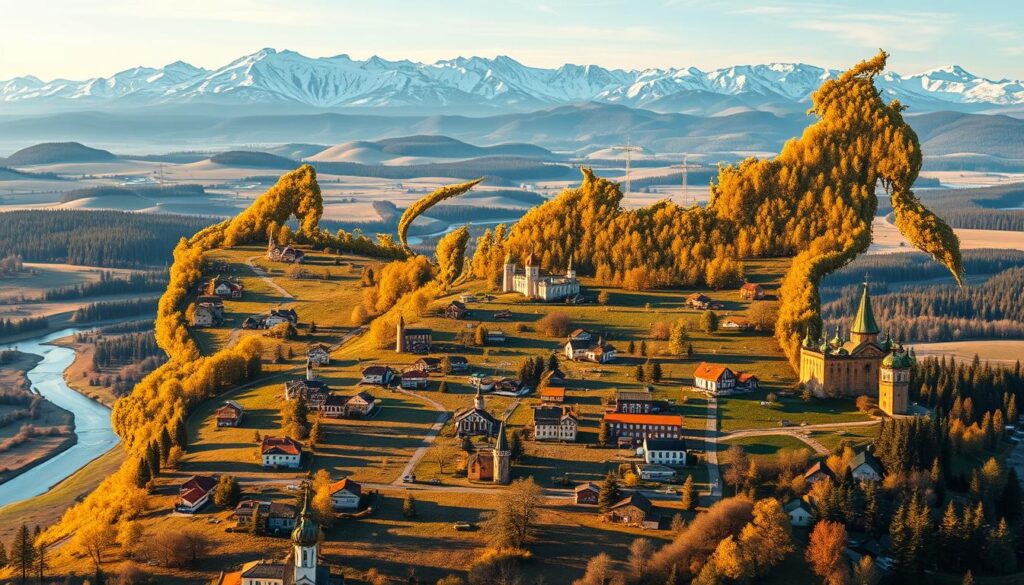
A detailed map of Russia showcasing the regional distribution of Protestant communities, bathed in warm, golden light. In the foreground, clusters of houses and churches representing the diverse Protestant denominations, each with its unique architectural style. The middle ground features rolling hills, forests, and winding rivers, conveying the vast, expansive landscape of the Russian countryside. In the background, snow-capped mountains rise majestically, creating a sense of grandeur and timelessness. The overall scene evokes a harmonious blend of the spiritual and the natural, reflecting the growth and influence of Protestantism within the regional tapestry of Russia.

Regional Distribution and the Role of Missionaries

Siberian towns and Far Eastern ports became unexpected strongholds. Korean missionaries found receptive audiences here, blending Bible studies with practical aid programs. Their success stemmed from addressing two critical needs:

  • Spiritual guidance in regions with scarce churches
  • Community support during economic transitions

Formation of Diverse Denominations

Three main groups dominate Russia’s spiritual landscape today. Baptist congregations thrive in industrial cities, while Adventist communities flourish near border regions. Pentecostal groups show remarkable adaptability, splitting into traditional and modern branches.

Denomination Members Primary Regions Key Demographics
Baptist 500,000 Urals, Volga 48% blue-collar workers
Pentecostal 300,000 Siberia, Cities 30% professionals
Adventist 90,000 Far East 19% students

Protestant churches show fascinating gender dynamics, with 70% of members being women. This imbalance shapes outreach strategies across denominations, from family-focused programs to youth mentorship initiatives. Their ability to adapt while maintaining core beliefs helps these groups thrive across 11 time zones.

Cultural Adaptations and Interfaith Relations

Navigating religious coexistence in a land of deep traditions presents unique challenges and opportunities. Minority faith groups often walk a tightrope between preserving their identity and respecting established norms. This delicate dance shapes interactions across Russia’s spiritual spectrum.

Interactions with Russian Orthodox and Other Faiths

Many groups blend elements from the Orthodox Church into their practices. Some incorporate traditional icons or use Slavic musical styles during worship. “We’re building an Evangelical Russia that honors our roots,” explains a Moscow pastor.

Three main strategies help bridge cultural gaps:

Approach Methods Outcomes
Cultural Integration Adopting local holidays 25% acceptance boost
Social Outreach Food banks, rehab programs 40+ joint projects
Theological Dialogue Interfaith councils 15 regional partnerships

The Moscow Patriarchate remains cautious about these efforts. A 2018 survey revealed 62% of Orthodox leaders view non-traditional groups as cultural threats. Yet shared community projects in Siberia show promising cooperation models.

“True faith heals divisions – we focus on serving neighbors, not debates about doctrine.”

Youth initiatives particularly succeed in building bridges. Summer camps and music festivals create spaces where majority and minority traditions interact organically. These efforts help reshape perceptions while maintaining distinct identities.

Government Policies and Legal Challenges for Protestants

Modern faith communities face evolving legal landscapes that test their resilience. New regulations since 2007 have reshaped how groups operate, blending security concerns with religious freedom debates. The changes reveal much about balancing state interests with minority rights.

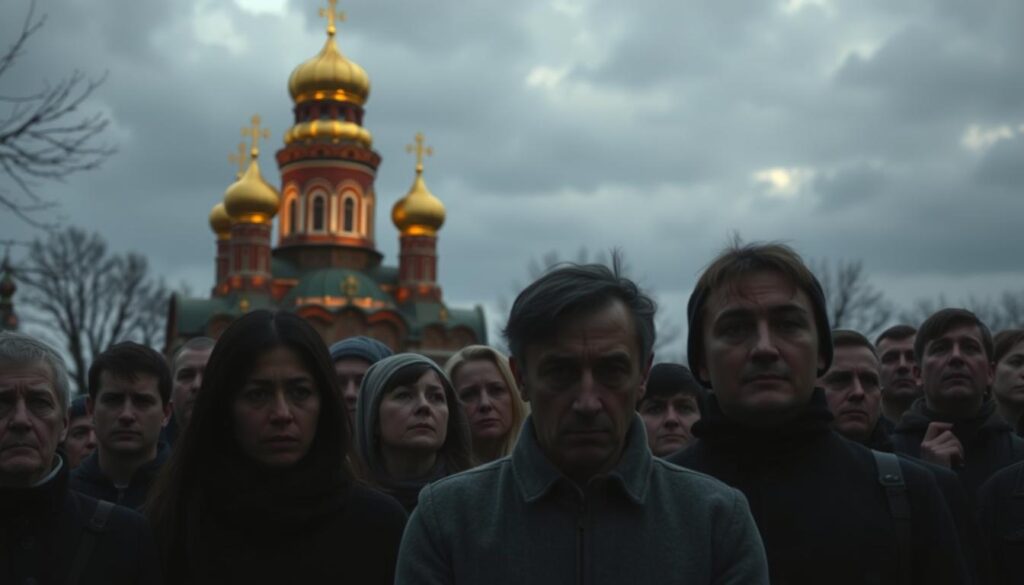
A dimly lit Orthodox church, its golden onion domes casting a warm glow against a cloudy Russian sky. In the foreground, a group of Protestant worshippers gathers nervously, their faces etched with uncertainty as they navigate the legal challenges to their religious freedom. The scene conveys a sense of tension and unease, with the imposing presence of the church looming over the congregants, symbolizing the complex relationship between the state and minority faiths. The image is rendered in a realistic style, with muted tones and subtle details that evoke the somber mood of the subject matter.

Legislative Restrictions and the Yarovaya Law

The 2007 NGO law forced churches to register as organizations with strict oversight. Leaders now track attendance and report foreign donations – rules many found intrusive. “We became accountants instead of pastors,” shared one Moscow minister anonymously.

2016 brought tighter controls through anti-terrorism measures. The Yarovaya package banned sharing faith in homes or online without state permits. Violators risk fines up to $15,000 – crippling for smaller congregations.

Responses from Local and International Institutions

Human rights groups worldwide condemned the laws. The U.S. Commission called them “a hammer against peaceful worship.” Yet some communities adapted creatively:

  • Bible studies became “cultural exchanges”
  • Outreach shifted to private social media groups
  • Churches partnered with registered charities
Law Key Requirements Impact Compliance Challenges
2007 NGO Law Registration, financial reports 30% membership drop Small church paperwork
2016 Yarovaya No home worship 58% activity reduction Digital monitoring

Current tensions with neighboring countries add complexity. Some officials link foreign-linked churches to geopolitical issues, creating new hurdles for cross-border collaborations. Despite this, many groups maintain hope through quiet service and legal advocacy.

Missionary Work and Religious Education

In remote corners of the country, creative evangelism meets cultural curiosity. Missionaries have become cultural translators, blending ancient traditions with modern outreach methods. Their work often starts with practical aid – medical clinics or language classes – before introducing spiritual teachings.

Influence of Missionary Expeditions

Korean missionaries transformed Siberia’s spiritual map through churches that respect local customs. In Buryatia and Altai, 9 out of 10 members belong to indigenous groups. “We learned to sing folk melodies before teaching hymns,” shares a Seoul-born pastor.

The 2007 bicycle expedition by Baptist religious groups showed both determination and resistance. Pedaling 1,200 miles, teams faced:

  • Police questioning in 6 regions
  • Confiscated literature in Volgograd
  • Unofficial bans on public gatherings

Local authorities often view foreign-linked groups cautiously. A regional official admitted anonymously: “We track any activity that might upset community balance.” Despite this, creative approaches thrive – one church near Lake Baikal runs a popular reindeer husbandry workshop alongside Bible studies.

“Our bicycles carried Bibles and building supplies – faith and service rolled together.”

Recent government policies push missionaries toward subtle methods. Many now train local people as lay leaders, creating self-sustaining communities. This shift helps ensure spiritual continuity even when foreign forces face entry restrictions.

Social and Economic Contributions of Protestant Communities

Beyond Sunday services, faith-based groups quietly reshape neighborhoods through practical compassion. Their work addresses urgent social needs while building bridges across cultural divides.

Healing Through Shared Purpose

Addiction recovery programs stand out as life-changing initiatives. Over 70% of communities run rehabilitation centers blending spiritual guidance with job training. The Iskhod movement, born from these efforts, now supports 90 churches nationwide.

Creative approaches help navigate strict law requirements. Many churches partner with secular NGOs to deliver:

  • Vocational workshops in high-unemployment regions
  • Multilingual support for migrant workers
  • After-school programs serving 15,000+ youth annually

These initiatives foster unexpected partnerships. A Siberian church recently collaborated with Russian Orthodox volunteers on a food bank network. Such cooperation shows how shared service can transcend doctrinal differences.

Through quiet dedication, these groups prove faith’s power to heal bodies and communities alike. Their model offers hope for building inclusive societies – one transformed life at a time.

FAQ

How did Protestantism first arrive in the country?

Early Protestant movements entered through trade and migration in the 16th century. German Lutherans and Dutch Reformed communities settled in regions like St. Petersburg, influencing local religious practices.

What role did the Soviet era play in shaping these communities?

Soviet policies suppressed all faiths, forcing many groups underground. Despite persecution, networks like Baptists and Pentecostals preserved traditions through secret gatherings, leading to a post-Soviet revival.

How do local denominations interact with the Russian Orthodox Church?

Relations are often strained due to the Orthodox Church’s close ties to the state. Groups like the Good News Church face scrutiny, though some interfaith dialogues occur at grassroots levels.

What legal challenges do these groups face today?

Laws like the 2016 Yarovaya Law restrict missionary activities and require permits for preaching. Smaller congregations, especially in regions like Siberia, struggle to comply with strict regulations.

How have missionary efforts influenced growth?

Missionaries from the U.S. and Europe supported Bible translations and training in the 1990s. Today, local leaders focus on social programs, such as addiction recovery, to build community trust.

What social initiatives are led by these communities?

Many run food banks, shelters, and rehabilitation centers. The Pentecostal Church, for example, partners with NGOs to aid vulnerable populations, blending faith with practical support.

Are there regions where these faiths thrive more than others?

Urban centers like Moscow and rural areas in the Far East show higher activity. Ethnic minority regions, such as Tatarstan, also host diverse congregations due to cultural openness.

How has the Ukraine conflict impacted religious freedom?

Tensions have led to increased state oversight, with some churches accused of “foreign influence.” International bodies like the WCC criticize these measures as suppressing minority voices.

Exploring the Rise of Protestantism in Spain


Imagine living in 16th-century Europe, where questioning religious authority could cost your life. This was reality for brave reformers who dared challenge Spain’s Catholic stronghold. While neighboring countries embraced new ideas, the Spanish Empire fiercely guarded its religious unity through the Inquisition and royal decrees.

Yet whispers of change persisted. Secret networks smuggled banned books across borders, spreading Reformed teachings to curious minds. Small groups gathered in shadows, risking execution to discuss faith outside official doctrine. These hidden believers created Europe’s most unlikely religious movement – one that threatened the crown’s absolute power.

Why did this struggle matter? It wasn’t just about theology. The clash shaped Spain’s identity during its Golden Age, influencing politics, culture, and global exploration. Through personal stories and daring escapes, we’ll uncover how ordinary people defied impossible odds to share forbidden beliefs.

Key Takeaways

  • Reformed ideas entered Spain despite strict Catholic control
  • The Inquisition played a key role in suppressing new religious movements
  • Underground networks distributed banned literature across regions
  • Secret meetings occurred in major cities like Seville and Valladolid
  • Most reformers faced imprisonment or execution by the 1560s
  • This period influenced Spain’s cultural development for centuries
  • Modern scholars still debate the movement’s true impact

Understanding the Historical Context

The story of Spain’s faith begins not with conflict but with ancient traditions and gradual changes. For nearly a thousand years after Christianity’s arrival, local believers shaped spiritual practices that reflected Iberian culture rather than foreign mandates.

The Religious Landscape Before the Reformation

Early Christian communities thrived independently after the apostles’ era. Unlike other regions, these groups developed unique worship styles and leadership structures. This changed when Roman Catholic leaders began consolidating power across Europe.

By 1100 CE, papal authority had fully replaced local church governance. This shift created tension between grassroots believers and centralized religious power. Many people quietly preserved older traditions despite official changes.

The Role of the Spanish Inquisition

The Catholic Church strengthened its grip through fear-based systems. Established in 1200, the Inquisition targeted anyone challenging approved doctrines. King Ferdinand’s 1492 decree made heresy accusations a state matter, blending religious and political control.

Year Event Consequence
1st Century Christianity arrives Localized practices develop
1100 Papal authority accepted Centralized control begins
1492 Church-State merger Religious uniformity enforced

This historical framework explains why later reformers faced such harsh opposition. The church and crown had spent centuries building an inseparable partnership. Ordinary people who questioned this system risked losing everything – their homes, freedom, and lives.

The Roots of Protestantism in Spain

Books became silent revolutionaries in Spain’s religious landscape. While authorities monitored ports and roads, daring thinkers found ways to circulate forbidden ideas. This underground effort laid the foundation for lasting change.

A dimly lit library interior, the shelves adorned with aged leather-bound volumes on Protestant theology. Sunlight filters through stained glass windows, casting a warm glow on the intricate woodcarvings and ornate furniture. In the foreground, a collection of 16th-century Spanish Reformation books, their covers emblazoned with intricate designs and faded gold lettering, sit atop a worn wooden table. The scene evokes a sense of scholarly contemplation and the quiet triumph of the Reformist movement taking root in the Iberian Peninsula.

Initial Seeds of Reformation Thought

Johannes Froben’s 1519 shipment of Martin Luther‘s Latin writings marked a turning point. Though only scholars could read them initially, their arrival proved dangerous ideas could penetrate Spain’s defenses. One merchant noted: “Words travel faster than royal decrees when hearts are hungry.”

The real shift came in 1520. A Spanish translation of Luther’s Galatians commentary reached common readers, spreading concepts like faith-based salvation. Merchants smuggled these texts through trade routes, creating secret groups of believers.

Year Event Impact
1519 First Latin tracts arrive Educated elites exposed
1520 Galatians translation Broader audience reached
1521+ More works translated Protestant Reformation ideas spread

These efforts sparked a quiet movement challenging church authority. Ordinary people debated scripture in homes, not cathedrals. Though crushed by the 1560s, this chapter shows how ideas outlast empires when they answer deep human needs.

The Spanish Auto de Fe: A Dramatic Display

Church bells shattered the dawn silence in Valladolid as crowds packed the square. Families wore colorful garments, blending celebration with terror. At sunrise, a line of shackled figures emerged from prison gates – their final walk beginning where torture chambers ended.

The Symbolism of Processions and Punishment

The church turned fear into theater. Each step of the parade mirrored Catholic triumph: prisoners in shameful sanbenito robes, clergy carrying sacred relics, officials displaying royal banners. “These spectacles weren’t just about punishment,” notes historian María Gómez, “but reaffirming absolute authority.”

Public executions followed elaborate rituals. Flames consumed not just bodies, but unapproved ideas. The message echoed clear: dissent meant becoming ash before your neighbors.

The Impact on Public Perception

Whole communities became unwilling participants. The church offered a forty-day indulgence to attendees, mixing spiritual rewards with morbid curiosity. Parents brought children, merchants closed shops – all bearing witness to horror disguised as holiness.

This psychological warfare worked. After seeing neighbors executed, many ordinary people avoided controversial topics. The auto de fe created generations who equated safety with silence, shaping cultural attitudes for centuries.

Key Figures in the Spanish Reformation

Two men from different walks of life shaped early challenges to religious authority. Their stories reveal how ordinary people carried revolutionary ideas through dangerous times.

From Merchant Clerk to Martyr

Francisco San Roman’s life changed during a routine business trip. While collecting payments in Germany, he attended churches teaching Reformed truths. The merchant clerk returned home transformed, sharing teachings about salvation through faith alone.

Authorities arrested San Roman multiple times. He spent years in dark cells before his execution, yet never stopped speaking about Jesus Christ. His final words reportedly inspired other believers: “Truth shines brightest in chains.”

The Scholar Who Wrote in Exile

Juan Valdes took a different path. As a courtier to Emperor Charles V, he wrote books explaining Protestant Reformation ideas. His works on spiritual rebirth and God’s grace reached readers through secret networks.

Facing persecution, Valdes fled in 1535 but kept sending banned writings home. One letter stated: “Words outrun soldiers when they carry divine light.” His writings later influenced Martin Luther‘s followers across Europe.

Figure Role Contribution Legacy
San Roman Merchant clerk First Spanish martyr Inspired underground groups
Valdes Court scholar Authored key texts Shaped Reformation theology

These pioneers proved ideas could cross borders and social classes. Their courage kept spiritual debates alive during Europe’s most repressive era.

Influential Reformers and Their Legacies

Paper became more dangerous than swords in the hands of determined reformers. While authorities burned forbidden texts, courageous thinkers found clever ways to spread revolutionary ideas. Their efforts changed countless lives and reshaped spiritual conversations across generations.

A cathedral-like interior, sunlight filtering through ornate stained glass windows, casting a warm, reverent glow. In the foreground, a group of Spanish reformers deep in scholarly discussion, their faces etched with determination. Bookshelves and parchments line the walls, hinting at the intellectual legacy they are shaping. In the background, a mural depicting scenes of religious upheaval and social change, a visual representation of the profound impact these figures have had on the nation's spiritual and political landscape. The scene exudes a sense of historical significance, capturing the pivotal moment when these reformers stood at the vanguard of a religious revolution that would echo through the centuries.

Johannes Froben and Book Smuggling

The Swiss printer became an accidental hero of religious change. His 1519 shipment of Latin books opened new doors for curious minds. Men like university professor Juan de Valdés secretly distributed these works, creating underground study groups.

“Ideas travel best wrapped in commerce,” Froben reportedly told associates. His books reached Spain through wool merchants and diplomats’ luggage. This quiet revolution proved truth could outmaneuver soldiers when carried by determined people.

Rodrigo Valero’s Journey of Conviction

Valero’s story shows how divine grace could transform privileged lives. The nobleman traded horse races for handwritten scripture copies after a spiritual awakening. He taught himself Latin using classical texts, then devoured the Bible’s message about salvation.

Former friends gasped when Valero began preaching in market squares. His passionate speeches about Christ’s free gift drew crowds of common people. The reformer’s final sermon ended with soldiers dragging him away, but his beliefs lived on through listeners.

Reformer Method Impact
Froben Book distribution Spread Reformation ideas
Valero Street preaching Connected with ordinary people

Protestantism in Spain: Balancing Faith and Authority

While northern Europe saw princes shield reformers, Spanish believers stood alone against twin giants of throne and altar. Their faith became a tightrope walk between personal conviction and survival under watchful eyes.

Without political allies, reformers faced relentless pressure from both church leaders and royal officials. A 1559 decree made possessing banned books punishable by death, forcing believers to develop ingenious hiding methods. One smuggler reportedly sewed pages into wine skins, whispering: “Truth travels best disguised as ordinary.”

The psychological toll proved immense. Families ate communion bread secretly at midnight, while maintaining Catholic appearances by day. Historian Luis Fernández notes: “Every church bell became a reminder of their double life.”

  • Underground networks used merchant routes and coded letters
  • Exiled believers established print shops abroad
  • Home gatherings rotated locations to avoid detection

This struggle revealed a harsh truth – religious change needs more than bold ideas. Without political protection, even the deepest faith struggles against authority. Yet the reformers’ persistence shows how hope endures where there’s way to share it.

The Role of Translation in Spreading Reformation Ideas

Words became weapons of change when placed in common tongues. For centuries, Latin kept sacred texts locked away from most people. Breaking this barrier through translation ignited a quiet revolution across the Spanish-speaking world.

Impact of Translating Religious Texts

Francisco Enzinas risked everything to give his countrymen the New Testament in their own language. His 1540 Castilian translation let farmers and merchants read scripture directly. Authorities arrested him instantly, fearing empowered people more than armed rebels.

Enzinas’ jailbreak became legend. Finding his cell mysteriously unlocked, he fled to Wittenberg. His work inspired others like Cassiodoro de Reina, who spent 12 years crafting the first complete Spanish Bible while exiled.

Case Study: Casiodoro de Reina’s Spanish Bible

Printed secretly in Amsterdam (1602), Reina’s translation outsmarted censors for decades. Smugglers hid copies in wine barrels and grain sacks. This language milestone let ordinary believers bypass church-controlled Latin texts.

Reina’s team included Cypriano de Valera, who later revised the work. Their Bible became a cornerstone for Reformed thought, influencing even John Calvin‘s networks. Together, these translators proved ideas could cross borders when wrapped in familiar words.

FAQ

How did the Spanish Inquisition impact the spread of Reformation ideas?

The Spanish Inquisition actively suppressed dissenting beliefs, creating fear through trials, censorship, and public punishments like the Auto de Fe. This made open support for reformers like Martin Luther or John Calvin extremely risky, slowing the growth of new religious movements.

Who were some key figures in Spain’s early Protestant movements?

A: Francisco San Román, a merchant, became the first known Spanish martyr for Reformation beliefs in 1541. Juan de Valdés wrote influential works blending humanist ideas with critiques of Catholic practices, inspiring underground reformist circles.

Why were translated religious texts significant during this period?

Translating the Bible into Spanish, like Casiodoro de Reina’s 1569 version, allowed ordinary people to engage with scripture directly. This challenged the Catholic Church’s authority over interpretation and fueled demands for spiritual renewal.

What role did book smuggling play in spreading Protestant ideas?

Printers like Johannes Froben secretly distributed Reformation writings into Spain. These banned books introduced concepts like justification by faith and critiques of Catholic traditions, reaching intellectuals and clergy despite censorship.

How did public events like the Auto de Fe influence religious attitudes?

The Auto de Fe combined religious ritual with punishment, often targeting those accused of heresy. These spectacles reinforced Catholic dominance but also sparked quiet resistance among some who questioned the Church’s methods.

Did any Spanish reformers collaborate with broader European movements?

Yes. Figures like Rodrigo Valero fled Spain and joined Reformed communities abroad. Their writings and networks helped connect Spanish dissenters with broader Reformation currents in England, France, and Switzerland.

How did Spanish Protestants reconcile their faith with state authority?

Many practiced their beliefs secretly, emphasizing personal devotion over public defiance. They often framed their views as a return to “true” Christianity, avoiding direct challenges to royal power while prioritizing individual conscience.

Discover the Top Protestant Holidays


Faith communities across the world mark their calendars with meaningful events that blend ancient roots and modern practices. These special days unite believers through shared reflection and joyful gatherings, creating a tapestry of spiritual connection that spans continents.

Unlike other Christian traditions, these observances often focus on core principles like grace and scripture. Historical milestones like Reformation Day sit alongside biblical events such as Easter, showing how faith evolves while honoring its foundations.

Many celebrations emphasize community participation over ritual. Some churches host simple services, while others organize festivals with music and shared meals. This flexibility lets diverse congregations find their own voice in honoring sacred moments.

Understanding these dates reveals how faith shapes daily life. From quiet prayer to lively celebrations, each event offers fresh ways to connect with spiritual heritage. Let’s explore the most impactful occasions that continue to inspire millions today.

Key Takeaways

  • Protestant observances blend biblical roots with Reformation-era history
  • Core principles like grace and scripture guide holiday meanings
  • Celebrations range from simple services to community-wide events
  • Major dates include Easter, Pentecost, and Reformation Day
  • Traditions emphasize personal faith over elaborate rituals
  • Modern practices adapt ancient customs to local cultures

Diving into the World of Protestant Celebrations

What makes these events stand out? Unlike other faith-based observances, Protestant gatherings prioritize personal connection and scriptural focus. This approach took shape during the Reformation, when leaders challenged rigid practices to create worship that resonated with everyday people.

Defining Core Observances

The 16th-century shift reshaped how believers mark sacred moments. Reformers stripped away complex rituals, keeping biblical events at the heart. Easter’s date follows the Gregorian calendar, while Good Friday services often occur at noon—mirroring the crucifixion timeline.

Different denominations developed unique styles. Some use traditional hymns; others embrace modern music. What unites them? A shared emphasis on Scripture over ceremony. This flexibility lets local churches design celebrations that fit their community’s needs.

From Past to Present Practices

Early reformers simplified existing traditions without losing their meaning. Christmas became less about saints and more about Christ’s birth. Epiphany shifted focus from Jesus’ baptism to the Magi’s journey—a detail still reflected in many Protestant churches today.

Modern celebrations blend old and new. Many congregations mix ancient prayers with interactive discussions. Tableside meals replace formal liturgies during Holy Week. This evolution helps centuries-old teachings stay relevant in a fast-paced world.

Aspect Catholic Tradition Protestant Practice
Epiphany Focus Jesus’ baptism Visit of the Magi
Easter Dating Gregorian calendar Gregorian calendar
Good Friday Services Afternoon observance Midday gatherings
Community Role Priest-led rituals Member participation

Reformation Day: A Pivotal Moment in Protestant History

The clang of a hammer against a church door echoed through history on October 31, 1517. This simple act—posting academic arguments—ignited a spiritual revolution that changed how millions worship. At its heart lay a monk’s frustration with practices he believed distorted faith’s true purpose.

Origins and the Ninety-Five Theses

Martin Luther, an Augustinian friar, challenged the sale of forgiveness certificates called indulgences. His famous protest targeted Johann Tetzel’s aggressive fundraising tactic for rebuilding St. Peter’s Basilica. “When coins clink in the chest,” Tetzel claimed, “souls escape purgatory’s flames.”

Luther’s 95 arguments questioned this practice and broader church authority. Though intended for scholarly debate, his ideas spread like wildfire through newly invented printing presses. Within months, Europe buzzed with calls for change no ruler could silence.

Evolution of Celebrations Over Centuries

Early commemorations focused on Luther’s 1517 act as a turning point. By the 17th century, German communities held special services on October 31. Today, many churches host “Reformation Sunday” near this date, featuring hymns like A Mighty Fortress and dramatic readings of Luther’s writings.

Modern observances blend education with celebration. Some congregations recreate the door-nailing moment using replica theses. Others organize trivia nights about Reformation-era figures. These lively approaches help new generations grasp why a 500-year-old event still matters.

Distinctive “protestantism holidays” and Their Traditions

From vibrant music to shared meals, faith communities express their beliefs through diverse practices. These gatherings reflect each group’s interpretation of sacred moments while maintaining core spiritual values. Denominations craft unique approaches that honor both Scripture and local culture.

A grand cathedral interior with stained glass windows, bathed in warm, golden light. In the foreground, a congregation of worshippers kneeling in pews, their faces serene and reverent. In the middle ground, an ornate pulpit and altar, adorned with intricate carvings and religious symbols. The background showcases towering columns, arched ceilings, and a sense of timeless, solemn grandeur. The atmosphere is one of deep devotion, tranquility, and a profound connection to the Protestant faith.

Celebratory Rituals Across Faith Groups

Lutheran services often feature classical hymns and structured liturgies during special events. Many host Advent wreath ceremonies with weekly candle lightings. Baptist congregations might swap organs for praise bands at Easter, encouraging spontaneous prayer moments.

Pentecostal gatherings frequently include healing services during holy days. Some incorporate dance or art installations to illustrate biblical stories. These variations show how traditions adapt while keeping faith central.

Denomination Worship Style Key Traditions Community Activities
Lutheran Liturgical Advent calendars Christmas markets
Baptist Contemporary Sunrise services Food drives
Pentecostal Charismatic Prayer vigils Street evangelism
Anglican Traditional Choral evensong Charity auctions

Many churches blend ancient and modern elements. A Presbyterian congregation might pair Reformation Day lectures with smartphone scripture quizzes. Others organize living nativities using local volunteers and animals.

The spiritual calendar varies by group. Some follow liturgical colors and seasonal rituals closely. Others focus on major events like Resurrection Sunday, letting members shape additional observances. This flexibility helps people connect meaningfully across generations.

Key Observances: Easter to Ascension

Spring brings a sacred sequence of events that shape Protestant spiritual life. These interconnected days form a journey from sacrifice to renewal, each marking pivotal moments in Christian belief.

Good Friday and Easter Sunday

Good Friday stands as Christianity’s most solemn day. Many churches hold midday services mirroring the hours Jesus hung on the cross. Hymns like Were You There accompany Scripture readings about Christ’s death.

Joy erupts three days later on Easter Sunday. Sunrise services celebrate the resurrection, often featuring baptisms in lakes or rivers. Churches bloom with lilies—white petals symbolizing new life through Christ’s victory over death.

Ascension and Pentecost

Forty days after Easter comes Ascension Day. This event marks Jesus’ return to heaven, observed through services emphasizing spiritual presence over physical form. Some congregations release balloons or doves as visual reminders.

The journey concludes with Pentecost, also known as Whitsunday. Falling seven weeks post-Easter, it commemorates the Holy Spirit empowering the disciples. Many churches use red decorations symbolizing spiritual fire, while sermons focus on community outreach.

  • Timeline of key spring observances
  • Good Friday: Midday remembrance services
  • Easter: Sunrise celebrations and baptisms
  • Ascension: 39 days later, symbolic rituals
  • Pentecost: 7th Sunday after Easter, emphasis on spiritual gifts

Exploring Other Notable Protestant Festivities

Throughout the year, Protestant communities honor key figures who shaped their faith through birthday observances and educational events. These commemorations blend history lessons with spiritual reflection, keeping reformers’ legacies alive for new generations.

A solemn commemoration of Protestant reformers takes place in a grand cathedral. In the foreground, intricate stained glass windows cast warm, filtered light upon the crowd. In the middle ground, robed figures stand at the altar, delivering a sermon to the pews of worshippers. The backdrop features an ornate pipe organ and towering stone columns, instilling a sense of reverence and historical significance. The atmosphere is one of reverence and reflection, with a muted color palette and soft, diffuse lighting evoking the solemnity of the occasion.

Martin Luther Day and John Wesley Day

Churches mark Martin Luther’s birthday every November 10th with services exploring his revolutionary ideas. Many feature dramatic readings of his “95 Theses” or discussions about sola scriptura—the belief in Scripture’s supreme authority. These gatherings remind believers how one monk’s courage changed Christian history.

June 28th brings celebrations for John Wesley, Methodism’s founder. Congregations often host outdoor services mirroring his open-air preaching style. “The world is my parish,” he famously declared—a principle reflected in modern food drives and prison ministries organized on his birthday.

Ulrich Zwingli and John Calvin Commemorations

January 1st honors Swiss reformer Ulrich Zwingli, whose bold changes to worship services still influence churches today. Some communities recreate his 1523 “Zurich Disputation,” where he debated Catholic leaders using only biblical arguments.

John Calvin’s July 10th birthday celebration often features lectures about his systematic theology. Many Reformed churches display his famous seal—a heart held in God’s hand—during services. These events showcase how 16th-century ideas about divine sovereignty remain relevant after 500 years.

From interactive exhibits to community service projects, these observances make theological history tangible. They help believers connect personal faith to the larger story of God’s work through ordinary people’s lives and works.

Impact of the Reformation on Modern Protestant Worship

The echoes of 16th-century reforms still shape Sunday mornings in churches worldwide. When Martin Luther challenged indulgences, he sparked changes that transformed how believers connect with faith. These shifts created worship experiences focused on personal understanding rather than ritual performance.

Liturgical Shifts and Contemporary Practices

Early reformers simplified the Catholic Church‘s elaborate ceremonies. They replaced Latin chants with songs people could sing in their own languages. This beginning of vernacular worship paved the way for today’s diverse musical styles—from pipe organs to electric guitars.

Modern services prioritize active participation. Many churches encourage congregants to discuss sermons or lead prayers. This approach reflects Luther’s belief that all believers form a “priesthood” serving God directly.

Cultural and National Influences

Different regions adapted Reformation ideas to local customs. German Lutherans kept structured liturgies, while Scottish Presbyterians developed sermon-focused services. In America, megachurches blend Bible teaching with concert-like productions.

These variations show how worship evolves across time and place. A Korean Presbyterian service might include traditional drumming, while a Brazilian Baptist gathering features samba rhythms. Yet all maintain core principles from the Reformation era.

Through these adaptations, Protestant worship stays relevant while honoring its roots. The course set by reformers continues guiding how millions experience faith today.

Interfaith Observances: Bridging Protestant and Catholic Traditions

Once divided communities now share sacred days with renewed understanding. The Catholic Church and Protestant groups have transformed historical tensions into collaborative worship, particularly around Reformation commemorations.

Ecumenical Celebrations and Joint Commemorations

A groundbreaking shift occurred in 1999 when Catholic and Lutheran leaders signed the Joint Declaration on Justification. This agreement reframed the 16th-century debate about grace, allowing both traditions to celebrate shared beliefs while acknowledging past conflicts.

Pope Francis’ 2017 visit to Sweden showcased this progress. At Lund Cathedral’s Reformation observance, leaders emphasized reconciliation over division. The event blended thanksgiving for spiritual renewal with repentance for violent history.

Many congregations now mark Easter and Christmas using coordinated dates. Joint food drives and prayer services have become common. Some parishes even host alternating Bible studies, proving that ancient divides can find healing in modern practice.

This ecumenical course continues evolving. As communities focus on Christ’s message rather than doctrinal differences, they create space for unity without losing their distinct voices.

FAQ

What makes Reformation Day significant in Protestant history?

Reformation Day, observed on October 31, marks Martin Luther’s posting of the Ninety-Five Theses in 1517. This act challenged Catholic Church practices like indulgences and sparked the Protestant Reformation. Churches often hold services, lectures, or festivals to honor this turning point.

How do Protestant Easter traditions differ from Catholic ones?

While both groups celebrate Christ’s resurrection, Protestant churches often emphasize scripture and congregational participation over rituals. For example, Good Friday might focus on reflective sermons, while Easter Sunday highlights joyful worship music and communal gatherings.

Are Ascension and Pentecost widely observed in Protestant denominations?

Yes! Ascension (40 days after Easter) and Pentecost (50 days after) remain key events. Many churches host special services, though practices vary. Pentecostal denominations, for instance, might emphasize spiritual renewal, while Lutherans focus on the Holy Spirit’s role in the early church.

Do Protestants honor figures like John Calvin or Ulrich Zwingli with specific days?

Some denominations do! Reformed churches may commemorate John Calvin’s teachings on July 10, while Swiss Protestants might honor Ulrich Zwingli around October 11. These events often include historical reflections or discussions on their theological impacts.

How has the Reformation influenced modern Protestant worship?

The Reformation shifted focus to scripture, faith, and grace—principles still central today. Many churches use vernacular languages in services, prioritize congregational singing, and avoid hierarchical structures seen in pre-Reformation traditions.

Are there joint celebrations between Protestant and Catholic communities today?

Absolutely! Ecumenical events like World Day of Prayer or shared Christmas services foster unity. Both groups might collaborate on charity projects or interfaith dialogues, though theological differences still shape separate observances for holidays like All Saints’ Day.

Why don’t all Protestant denominations celebrate the same holidays?

Denominations like Baptists, Methodists, or Lutherans have unique histories and theological emphases. For example, Anglican churches may retain more liturgical traditions, while others prioritize simplicity. Local culture and national history also play a role in shaping celebrations.